Comedians may not be able to perform these days, with clubs closed due to COVID-19, but they can talk about the standup life, which they do remotely for the Netflix Is a Joke social media platform in the 20-minute video “Hey, Remember Comedy?”
Adam Sandler, Jerry Seinfeld, Amy Schumer, Iliza Schlesinger, Sarah Silverman, Tiffany Haddish, Nick Kroll are among the standups who tell jokes and answer host and producer Neal Brennan’s questions about subjects including their first jobs, comics they opened for and followed, and jokes that killed and bombed.
Lots of fun facts are shared in the special, which is a fundraiser: Netflix partnered with Comedy Gives Back Standup Comedian Fund to support comics in the Black, Indigenous and people of color community who have suffered from economic and mental hardship during the pandemic.
Other stars taking part include Chris Rock, David Letterman, Ellen DeGeneres, George Lopez, Sebastian Maniscalco, Steve Martin, Tom Papa, Wanda Sykes and Whitney Cummings. Watch the video here:
Sandler will also be seen in Netflix’s comedy “Hubie Halloween,” a comic caper set on the holiday in Salem, Mass. that premieres Oct. 7. Kevin James, Maya Rudolph, Ray Liotta and Julie Bowen co-star.
Haddish just signed on to the Lionsgate action comedy “The Unbearable Weight of Massive Talent,” opposite Nicolas Cage, playing a fictionalized version of himself. Haddish plays a rogue government agent who forces Cage to go undercover to take down a crime syndicate.
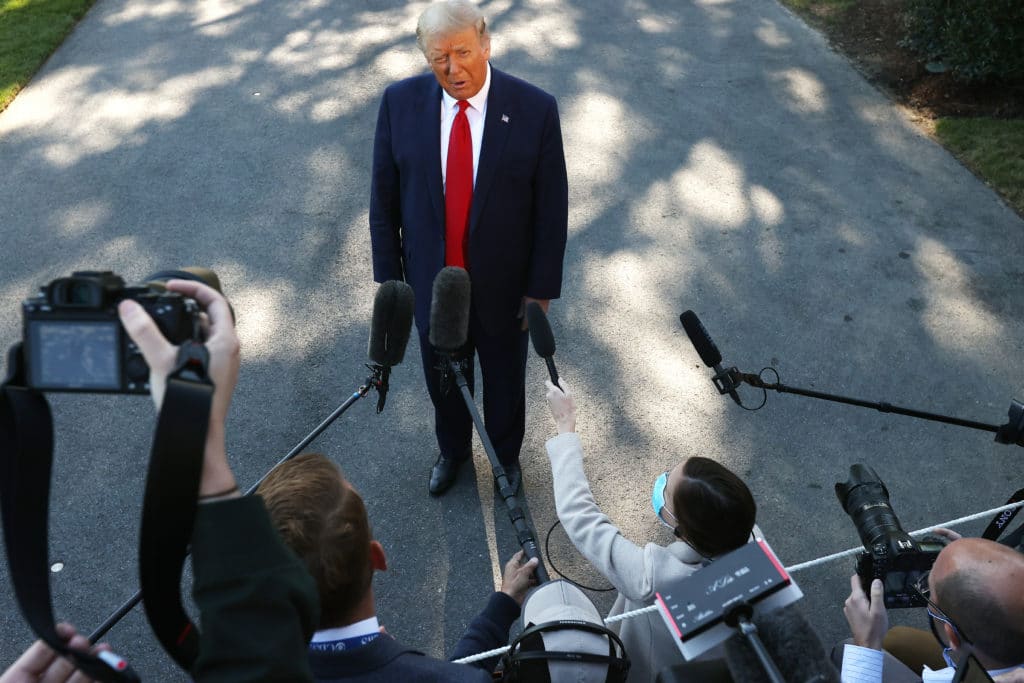
(JTA) — For the past decade, Jews have made up a third of justices on the U.S. Supreme Court. And while that streak appears likely to end when President Donald Trump nominates someone to replace Ruth Bader Ginsburg, who died Friday, there are Jews on the shortlist.
Of the 44 conservative jurists he has named over time as possible court choices, two are Jewish and another cites his Jewish father’s upbringing as shaping his outlook.
All three are men, making them unlikely to be Trump’s choice when the president unveils his pick, which he said would happen by the weekend. Trump has said he is likely to name a woman, and none of the frontrunners cited in media reports is Jewish.
Still, justice shortlists often act as a pool for future Supreme Court picks, so it’s worth knowing who made Trump’s cut. They are:
Steven Engel, 46, is the assistant attorney general for the Office of Legal Counsel, the branch of the Department of Justice that advises the president on legal matters. He is a member of Washington Hebrew Congregation, a Reform synagogue known for its government official-heavy membership. His mother taught academically gifted students at Yeshiva Har Torah in Queens, New York. He was a leading member of the Trump transition team, focusing on the Department of Justice.
He clerked for Alex Kozinski, a Jewish judge who was known as an outspoken conservative on the liberal 9th Circuit Court of Appeals until 2017, when he was driven out amid claims of sexual harassment. Kozinski took part in Engel’s 2004 wedding to another clerk, Susan Kearns. A clerkship for Kozinski was a fast track to a Supreme Court clerkship, and Engel went on to clerk for Justice Anthony Kennedy.
The late Sen. John McCain, an Arizona Republican, opposed Engel’s 2017 nomination for his current job because Engel, as a deputy assistant attorney general, had signed off on a 2007 memo allowing torture during interrogation.
Christopher Landau, 56, is the ambassador to Mexico. He is a graduate of Harvard Law School and clerked for two conservative Supreme Court justices, Clarence Thomas and Antonin Scalia. In an online July 4 celebration, he told the story of his Jewish father’s flight from Vienna. His father later became an ambassador to several Latin American nations.
David Stras, who is on the 8th Circuit U.S. Court of Appeals, which is based in both St. Louis and St. Paul, is active in the Minneapolis Jewish community. His paternal grandparents are Holocaust survivors and their experiences helped drive him to the bench.”My grandfather talked to me about the importance of laws in a society,” he was quoted as saying by the Kansas City Jewish Chronicle in 2018 after Trump released his first list of possible nominees. “That broke down in Germany. The law protects civil liberties, preserves the structure of government, and maintains order.” (Stras, 47, also cited “Perry Mason” reruns as making an impression.)
Whoever is ultimately confirmed for the role will join six other justices, including the two remaining Jews on the court, Elena Kagan and Stephen Breyer. Both were nominated by Democratic presidents.
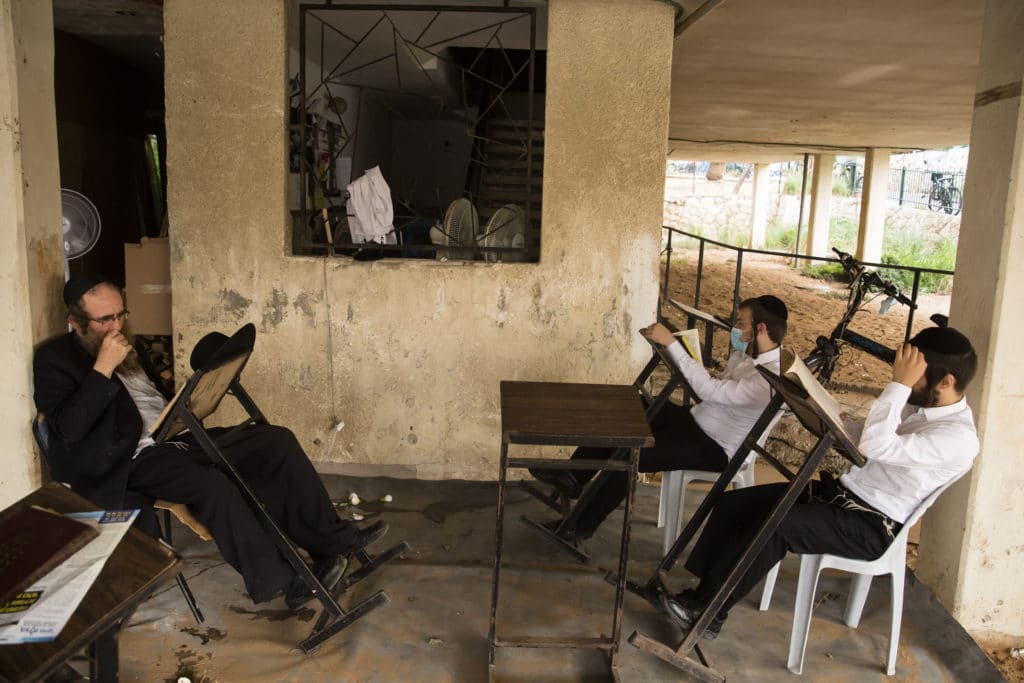
(JTA) — Traffic jams and violations citations are the hallmarks so far of Israel’s second lockdown to slow the spread of the coronavirus.
Israelis heading to work on Monday morning battled heavy traffic jams caused by dozens of police checkpoints set up on highways throughout the country.
The lockdown went to effect on Friday afternoon, hours before the start of the two-day Rosh Hashanah holiday. Under the lockdown regulations, Israelis whose places of employment are open can travel to work. All other Israelis are required to stay within 1,000 meters — about two-thirds of a mile — of their homes at all times.
Police cited nearly 7,000 lockdown violations over Rosh Hashanah, Haaretz reported, most for violating the rule to remain near home. A restaurant in Tel Aviv was fined for being open and filled with 50 patrons.
Some 40 Israelis died during Rosh Hashanah.
On Monday, Shaare Zedek Medical Center in Jerusalem and Assuta Medical Center in Ashdod announced that they could not accept more patients with the coronavirus since their wards for such patients are at capacity. At the same time, Health Ministry Director General Chezy Levy ordered all hospitals to suspend elective surgeries due to the surge in cases of the deadly virus.
In an interview Sunday, Israel’s so-called coronavirus czar, Dr. Ronni Gamzu, told Channel 12 news that the number of coronavirus cases in Israel is reaching “emergency” levels and called on hospitals to open more coronavirus wards. He did not support tightening further restrictions meant to slow the progress of the virus.
The government’s coronavirus cabinet was set to meet on Tuesday to discuss a further tightening, though such regulations likely would not go into effect until after Yom Kippur, which begins on the evening of Sept. 27.
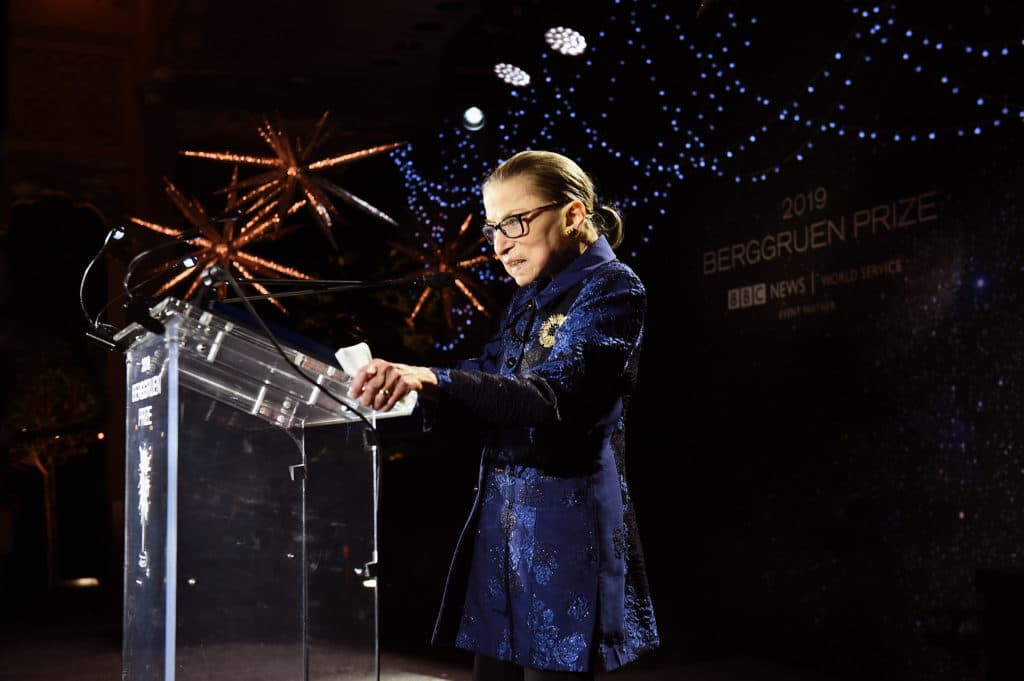
Various Jewish groups paid homage to the late Supreme Court Justice Ruth Bader Ginsburg, who died on Sept. 18 at the age of 87 from metastatic pancreatic cancer.
Following the news of her death at her Washington, D.C., home, Chief Justice John Roberts said in a statement, “Our nation has lost a justice of historic stature. We at the Supreme Court have lost a cherished colleague. Today we mourn but with confidence that future generations will remember Ruth Bader Ginsburg as we knew her, a tireless and resolute champion of justice.”
The justice became a pop icon and earned the nickname the Notorious RBG.
“As the sun sets on Rosh Hashanah, we mourn Justice Ruth Bader Ginsburg, the first female Jewish SCOTUS Justice,” Anti-Defamation League CEO Jonathan Greenblatt tweeted. “We honor her memory & her words: ‘Fight for the things that you care about, but do it in a way that will lead others to join you.’ We promise, #RBG.”
American Jewish Committee (AJC) CEO David Harris hailed Ginsburg in a tweet as “a giant of American jurisprudence, she championed women’s rights & gender equality. She exemplified courage & conviction throughout her life. We’ll never forget her speeches to @AJCGlobal.”
His tweet also featured a 1996 New York Times adaptation of a speech Ginsburg gave to the AJC in 1995 in which she said, “I am a judge born, raised and proud of being a Jew. The demand for justice runs through the entirety of the Jewish tradition. I hope in my years on the bench of the Supreme Court of the United States, I will have the strength and courage to remain constant in the service of that demand.”
The Simon Wiesenthal Center tweeted, “We join all Americans in mourning the passing of Supreme Court Justice Ruth Bader Ginsburg #RBG who brought dignity, grace, and brilliance to our Nation’s highest court for 27 years. May her memory always be a source of blessing.”
The tweet also featured a cartoon of Ginsburg greeting the late Justice Antonin Scalia, who died in 2016. The two had a close friendship while serving on the high court together.
“She fought fiercely and unflinchingly to advance and defend the rights of women and minorities.” — Ronald Lauder
J Street tweeted, “If this year has taught us anything, it’s how to mourn as we fight and fight as we mourn. RBG’s memory shall be a blessing and her example an inspiration as we give our all to defend our democracy.”
Jewish Democratic Council of America Executive Director Halie Soifer tweeted that she was “devastated” over Ginsburg’s death. “#RBG embodied the Jewish value of tikkun olam & fulfilled the commandment to pursue justice, which hung in her chambers in Hebrew. May her memory be a blessing & may we honor her dying wish.”
Ginsburg said in a statement to her granddaughter days before her death: “My most fervent wish is that I will not be replaced until a new president is installed.”
The Democratic Majority for Israel (DMFI) similarly tweeted, “We will be forever grateful for her moral leadership and her fierce advocacy for women’s equality and for justice. This is a profound loss for our country. May her memory be a blessing.”
World Jewish Congress President Ronald Lauder called Ginsburg “a trailblazer on behalf of gender equality.” His statement went on to say, “She paved the way for women in the law and on the courts. She fought fiercely and unflinchingly to advance and defend the rights of women and minorities, and, in the tradition of Justices Louis D. Brandeis and Benjamin Cardozo, embodied the principle of equal justice for all under the law, as well as the Jewish value of ‘tzedek, tzedek, tirdof’ — ‘justice, justice shall you pursue.’ Her life is a legacy and a testament, and her memory will be a blessing and a lesson forever more.”
StandWithUs wrote a Sept. 17 letter to the New York State Department of Health’s Office of Professional Medical Conduct (OPMC) to investigate and discipline Dr. Walid Khass regarding his alleged anti-Semitic tweets.
The Forward initially had reported that New York-Presbyterian Brooklyn Methodist Hospital had attempted to remove Khass from its residency program in 2019 after the hospital found tweets from Khass from 2012-17 stating that he hoped that “only Israelis get ebola” and “Go beat up a Zionist.” Some of Khass’ other tweets expressed “anti-gay and racist material,” according to The Forward.
Khass challenged the hospital’s move in court, and the New York State Supreme Court sided with him. The hospital is appealing the decision.
In its letter, StandWithUs argued that Khass’ “alleged statements made contemporaneously during Dr. Khass’ medical studies demonstrate an obsessive and continual spewing of hatred, bias and discrimination against Jews, Israelis and Zionists, spanning years.”
The pro-Israel education organization stated that it is “alarmed by the court’s determination to disregard the health and safety of New York’s Jews, particularly when New York boasts the largest Jewish community in the world outside of Israel. We question the court’s wisdom when Dr. Khass would be in a position to make life and death healthcare decisions during his residency for a population he publicly detests.”
StandWithUs argued that the OPMC should investigate Khass to see if his tweets violated the American Medical Association Principles of Medical Ethics and state law.
“Dr. Khass’ repeated discriminatory statements against Jews and Israelis would appear to establish incompetence to practice medicine as it relates to all patients,” the letter stated. “His biases indicate an unfitness to practice medicine consistent with the standards set forth in New York law and are therefore sufficient for this Board immediately to investigate his actions and determine whether a larger penalty is warranted, including his complete suspension from any dealings with patients.”
The OPMC didn’t respond to the Journal’s request for comment.
According to The Forward, the Khass case partially involves contractual matters because Khass has argued that the hospital has “a binding commitment to offer or to accept an appointment if a match results and to start training in good faith.” Khass’ tweets first were discovered in 2017 while he was in medical school at St. George’s University of Medicine in Grenada in the West Indies. He was let off with a warning, The Forward reported.
Khass’ attorney didn’t respond to The Forward’s request for comment.
There’s plenty to love about Ruth Bader Ginsburg, the trailblazing liberal justice who passed away on Sept. 18 at the age of 87.
Many of her fans love her because she was a champion of their cherished causes, from abortion to immigration to health care to women’s rights to gender equality, among others.
In the Jewish world, there is obvious pride in having a Jewish woman on the highest court in the land.
Even in popular culture, Ginsburg captured the nation’s imagination. Her nickname, “Notorious RBG,” is a play on the name of therap star, The Notorious B.I.G. She earned it by tirelessly defending human rights, through her grueling workouts and her tenacity in surviving several bouts of cancer.
“Throughout Justice Ginsburg’s entire career, there was sort of like nothing that could ever take her down,” Julie Cohen, the director of the Oscar-nominated documentary “RBG,” told Yahoo News. “If she got rejected, if she got discriminated against, if she got kind of dismissively pushed aside, her response to that was always just to push right past that.”
Perseverance and resilience, then, are things we can learn from Ginsburg in this horribly challenging pandemic year.
But there is something else, something perhaps even more critical in these divisive times that we can learn from her.
It’s well known that Ginsburg had a close friendship with a colleague who was her ideological opposite, the late Supreme Court Justice Antonin Scalia.
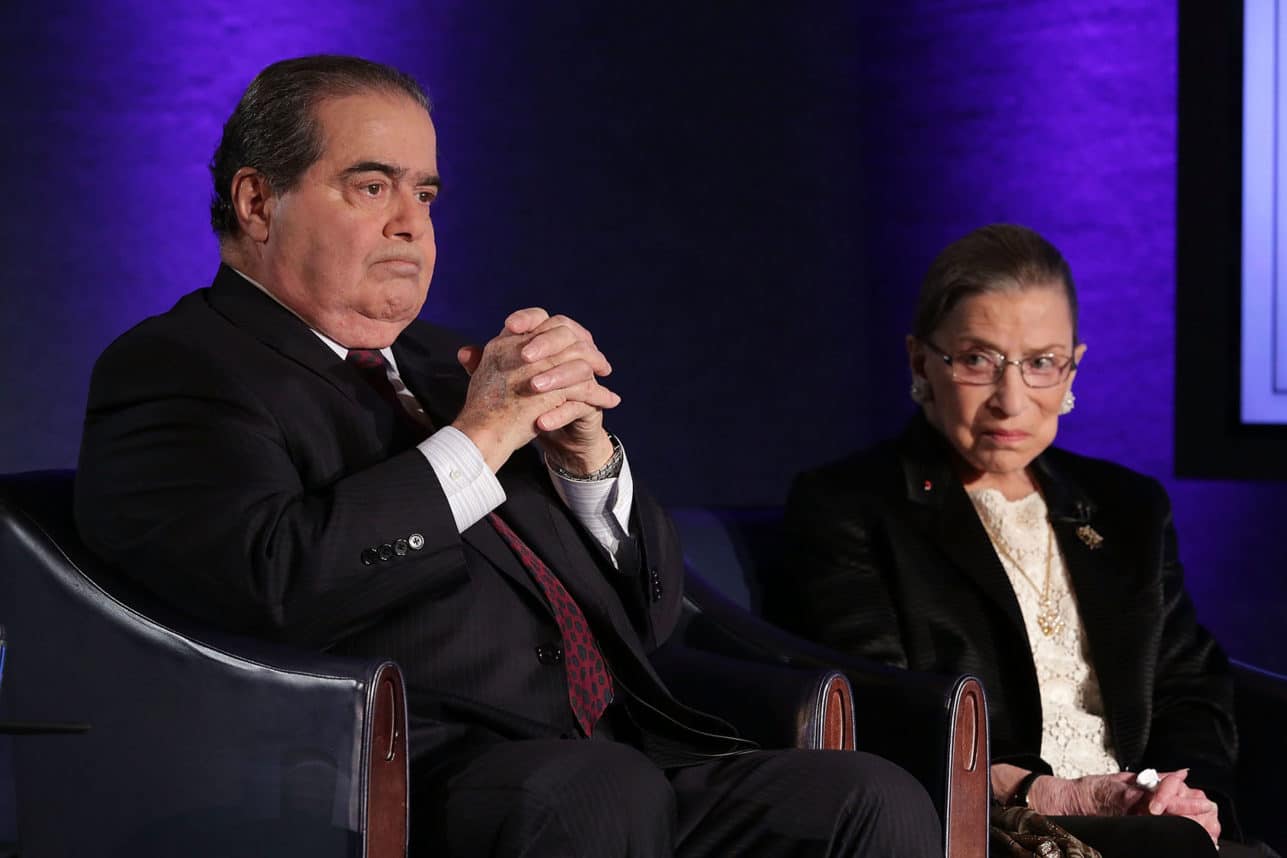
Supreme Court Justices Antonin Scalia (L) and Ruth Bader Ginsburg (R) wait for the beginning of the taping of “The Kalb Report” April 17, 2014 at the National Press Club in Washington, DC. (Photo by Alex Wong/Getty Images)
Ginsburg and Scalia were colleagues for years on the DC Circuit Court of Appeals before Scalia was appointed to the high court in 1982 by President Ronald Reagan. “I have missed Ruth very much since leaving the court of appeals,” Scalia, who died in 2016 at the age of 79, told an audience years after he was appointed.
Considering how strongly Ginsburg felt about her liberal views, how could she be so friendly with someone who so sharply disagreed with her? And how could Scalia himself reciprocate such an extreme level of tolerance?
One possibility is that they didn’t see their ideological differences as something to “tolerate”—like a bitter medicine or a nasty flu. Rather, they separated their ideology from their humanity. Easier said than done, right?
In our era of vicious political division, it’s almost impossible to conceive of ideological rivals becoming such close friends. We’ve become so attached to our political worldviews it’s hard to even fathom a deep friendship with someone on the “other side.”
Maybe that’s why in the eulogies of Ginsburg, we don’t hear much about her friendship with her ideological opposite— it’s too hard to relate to. It’s easier to focus on Ginsburg’s legacy, her remarkable character and her many legal accomplishments. After all, compared to the crucial issues of the day, a friendship doesn’t seem like much of an accomplishment.
We all value friendships, but we usually stick to like-minded friends. It feels more enjoyable, less stressful. Ginsburg and Scalia transcended that thinking. They found a way to stay true to their ideologies while honoring the timeless value of friendship.
We all value friendships, but we usually stick to like-minded friends. It feels more enjoyable, less stressful. Ginsburg and Scalia transcended that thinking.
Their relationship was so special it spawned an opera, “Scalia/Ginsburg”, inspired by their court rulings. After Scalia died, Ginsburg said:
“Toward the end of the opera “Scalia/Ginsburg”, tenor Scalia and soprano Ginsburg sing a duet: ‘We are different, we are one,’ different in our interpretation of written texts, one in our reverence for the Constitution and the institution we serve. From our years together at the D.C. Circuit, we were best buddies.”
In that statement is a pearl of wisdom. Ginsburg and Scalia differed in their interpretation of written texts, but they shared a reverence for the Constitution and the institution they served.
In other words, their friendship was not simply an expression of their humanity. It rested on a fundamental pillar they shared.
Their friendship was not simply an expression of their humanity. It rested on a fundamental pillar they shared.
Can we find pillars today which we share with our ideological foes? If anything, we’re going in the opposite direction. We’ve become geniuses at finding the things which divide us. Those pillars that we thought we shared are crumbling beneath us.
As we honor the extraordinary legacy of Ruth Bader Ginsburg, as we recall her trailblazing accomplishments, as we sit shivah for a Jewish and American hero, let us not forget the part of her legacy that speaks directly to our divisive times.
Of all the things to love about RBG, “We are different, we are one” may be the one we need most.
Around 6,000 people registered to be on a call Sept. 17 with Democratic presidential nominee Joe Biden and his wife, Jill, to speak directly to the Jewish community.
The call also featured Rabbi Lauren Berkun, vice president, rabbinic initiatives at the Shalom Hartman Institute in Miami; Rabbi David Ellenson, director of the Schusterman Center for Israel Studies at Brandeis University; and former United States ambassador to Israel Dan Shapiro. The Bidens were introduced by Karen Adler, a longtime aide to Joe Biden, while Aaron Keyak, the campaign’s director of Jewish engagement, gave the pithiest endorsement: “We need a mensch in the White House. One thing I can tell you: Joe Biden is a mensch.”
Biden joked that like many rabbis, he had to learn to “sermonize on Zoom.” His seven-minute speech reminded the audience that this year the High Holy Days are taking place “in a time of profound pain and loss,” but they “teach us that we can find purpose in pain.”
The Days of Awe, he said, “give us a chance to restart and speak up, to ask ourselves the most important questions, such as what kind of person are you going to be, what kind of people, what kind of country do we wish to be?”
Describing himself the son of “righteous Christians,” Biden said he was raised to believe that “silence is complicity,” and that both the Jewish and Christian faiths “instruct us that we can’t ignore what’s going on around us: a deadly pandemic, an economic crisis, a moral reckoning on race, a declining faith in a bright American future.”
The common thread between them, he said, is “a president that makes things worse, who appeals to the dark side of us, who in fact talks about division. A person who does not focus on unity.” He also noted that a priority of a Biden administration would be “to bring people together around the values that unite us. We can begin to repair this nation.”
“Remember your power and make this year one of hope and progress. It’s got to be better than last year.” — Joe Biden
Biden also pledged to “restore America’s mandate to be a nation of immigrants.” In the faces of new arrivals, he said, “we see the grandparents streaming into Ellis Island,” including both his and his wife’s. Together, he said, America can “stamp out bigotry and anti-Semitism.”
He also spoke about President Donald Trump’s response to the 2017 protests in Charlottesville, Va., and the images of “people carrying torches, their veins bulging … chanting the same anti-Semitic bile that was heard in the streets of Germany in the ’30s.” Biden said this was one of the reasons he decided to run for president. “When the president was asked about the young woman that was killed, what did he say? He said ,‘There are very fine people on both sides.’ That’s not who we are.”
Biden also promised that the U.S. would remain “a steadfast ally of Israel” and exhorted the community to “remember your power and make this year one of hope and progress. It’s got to be better than last year,” he said, and wished everyone a “Shanah tovah — have a happy, healthy and sweet new year.”
Jill Biden echoed her husband’s thoughts, praising the Jewish community. “In every generation you have shown us what it’s like to live up to our highest ideals and deepest principles,” she said, adding, “This season is not just about reflecting on the past, but imagining what’s possible in the year ahead. It’s a moment to repent, pray and allow us the glimmer of hope …. Redemption is always possible; renewal is within.”
Named for the Iranian capital in which it is set, “Tehran” is an edge-of-the-seat espionage thriller about an Israeli mission to disable a nuclear reactor — a task that’s left in the inexperienced hands of a young Mossad agent and master hacker on her first undercover assignment. Things don’t go according to plan as errors are made and relationships both romantic and familial complicate the operation and raise the stakes.
From co-creator Moshe Zonder, who wrote the first season of “Fauda,” it stars Niv Sultan in the central role and “Homeland’s” Shaun Toub and Navid Negahban —both born in Iran — in supporting roles. The eight-part Apple TV+ series will premiere three episodes on Sept. 25 and one installment per week thereafter.
“Our show is entertaining and full of action but we knew that it would be better if we [could] integrate the personal side of the characters, to make one thing lead to another … [and raise] the stakes to be as high as possible by integrating those two layers,” Zonder told the Journal. “The show is actually about identity, connection, devotion to your family and your roots and checking out what the price is for trying to break away from them.”
While it was co-creator Maor Kohn’s original idea five years ago, “Everything about Iran has fascinated me, the ayatollah regime and the young people who are demonstrating against the regime in the streets, risking their lives,” Zonder said. He endeavored to humanize characters like Toub’s security chief Faraz Kamali, who has to deal with a personal crisis as well as a national one.
“Our biggest challenge was to write the Iranian characters; to get under their skin and understand the way they feel, think and act,” Zonder said. “I was an investigative journalist before I became a screenwriter and it was always a challenge for me to cross the border physically and mentally, to learn about my enemy, the one I’ve been told that wants to kill me. When we were doing the research before writing, we looked at YouTube for example, and if you put it on mute, they looked Israeli. We are more the same than different. There are a lot of similarities between us.”
During their research, he and co-writer Omri Shenhar met and interviewed Mossad case officers who work counterintelligence on Iran’s nuclear program. For obvious reasons, they couldn’t go to Tehran at that stage or to shoot the series. Co-creator Dana Eden suggested Athens, Greece, as a stand-in, and director Daniel Syrkin and his team worked their magic.
As for their main character, Iranian-born Israeli Tamar Rabinyan, “We wanted our protagonist to be a woman. It was a political decision to put a young woman, this amazing hacker, in this tough macho world,” Zonder said.
It’s Sultan’s first international role, and learning to speak Farsi and training in the martial art krav maga were not her only hurdles. “It’s such a challenging role because Tamar combines so many layers within her,” the actress said. “Her journey is so interesting. She’s not the regular Mossad agent, saving the day. She’s brave, powerful and strong, but she’s also afraid and insecure and she makes mistakes.”
Of Moroccan Jewish heritage, Sultan grew up in Jerusalem, where she visits most weekends. “In the middle” between religious and secular, she has a strong connection to Judaism, her family and her city. “Faith is a very important thing for me,” she said.
Although she always dreamed of becoming an actress, the Tel Aviv entertainment world seemed out of reach. But after her military service, she moved there to study and landed TV series roles starting in 2013. She’s in rehearsals for a new series now. “ ‘Tehran’ is such an important story and I hope to keep on working in these kinds of things,” Sultan said. “I’m hoping to keep on doing things that interest me and challenge me and make me feel alive. I’m hoping for good things to come.”
Zonder’s Polish-born father escaped to Israel in 1935 and his mother, also Polish, moved to Canada after the war after losing her entire family in the Holocaust. “She came to Israel for a vacation in 1956 and met my father. They fell in love and she stayed here,” he said. He’s married with two sons, one who recently completed his military service and the other, who has just started it.
Zonder was studying to be a movie and TV director at the University of Tel Aviv when he “realized I was writing the scripts for half of my class,” he said. “I really love to direct actors but my heart is in the writing. I wrote five feature films and then started to write TV series.” He’s developing a new show now and has ideas for a second season of “Tehran,” but can’t share any details yet about either.
“Tehran” already has aired in Israel, and “the reaction was amazing,” Zonder said. “Many people saw it and loved it. While it was airing in Israel, there were mysterious bombings in Iran. Israel didn’t take responsibility, but everyone was thinking that the Mossad was connected to it.”
(JTA) — For Mandy Patinkin, blowing the shofar on TV was his way to help Ruth Bader Ginsburg’s dying wish be heard.
Ginsburg had told her family shortly before she passed away on Friday that it was “fervent wish” that she not be replaced until there is a new president.
Patinkin was appearing Sunday, the second day of Rosh Hashanah, on the MSNBC show “The Week with Joshua Johnson” with his his wife, actress Kathryn Grody, to discuss their get-out-the-vote efforts in the Nov. 3 elections when Grody noted Ginsburg’s wish.
“And I want her wish to be heard, so I will blow the shofar for her,” Patinkin said.
He then blew a long and clear “tekiyah” in honor of the Supreme Court justice.
“So now her wish will be heard,” actor said, “and let it be heard throughout the land.”
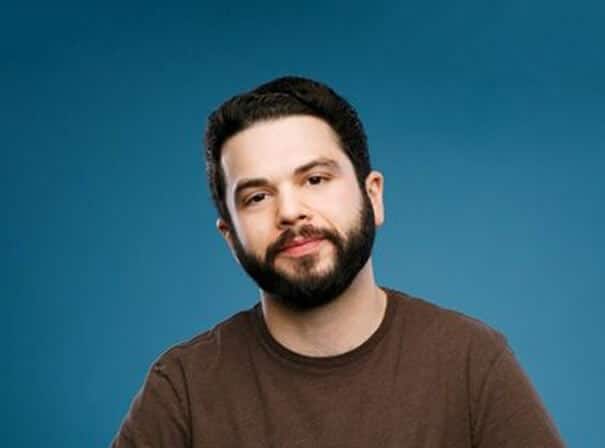
I first learned about Samm Levine when he was a cast member of “Freaks & Geeks,” the short-lived NBC series which helped launch the careers of many key performers and producers. Around 20 years later, Levine has amassed a list of film and television credits that most actors could only dream of. This includes work in Quentin Tarantino’s “Inglourious Basterds,” Broken Lizard’s “Club Dread,” the television and film versions of “Wet Hot American Summer,” Comedy Central favorite “Drunk History” and long-time ABC staple “Modern Family.”
The latest release for Samm Levine is the film “Immortal.” Released to digital and on-demand outlets earlier this month, the Different Duck Films title was written, directed and produced by Rob Margolies, and features a star-studded cast headlined by Tony Todd (“Candyman”), Dylan Baker (“Hunters”), Robin Bartlett (“Shutter Island”), Vanessa Lengies (“Waiting”) and Agnes Bruckner (“The Woods”). A chilling horror/thriller anthology film told in 4 chapters, “Immortal” also includes Award-winning actor Mario Van Peebles (“Posse,” “New Jack City”), Lindsay Mushett (“Blue Bloods”) and Jason Stuart (“The Infiltrators”).
On Sept. 7 I had the pleasure of interviewing Samm Levine via Zoom, as embedded below. Among the topics we discussed were:
He wound up working on “Immortal.”
When and how “Immortal” was filmed.
Recent projects he has worked on besides “Immortal.”
How he started producing and not just acting in films.
Whether his bar mitzvah had a theme
Performing stand-up comedy at bar mitzvahes
My 2019 interview with Counting Crows’ Adam Duritz for the Jewish Journal
Where Neal Schweiber from “Freaks & Geeks” probably would have wound up after high school
Whether co-hosting “Kevin Pollak’s Chat Show” left him wanting to host his own talk show in the future