fbpx

September 12, 2020

Viral Apathy in Israel

Israeli Prime Minister Benjamin Netanyahu held a joint press conference on Monday evening with Defense Minister Benny Gantz, Health Minister Yuli Edelstein and National Coronavirus Project coordinator Ronni Gamzu.

The purpose of the event, after which only Netanyahu responded to reporters’ questions, was pretty clear: to display a unified front in what has begun to seem like a circus of contradictory COVID-19 rules and a losing battle against the spread of the virus.

The discrepancy between the Jewish state’s stellar record during the first wave and its current failing grade—listed earlier this week by John Hopkins University as having the world’s highest rate of new infections per day per million people—is only part of the reason that Netanyahu, Gantz, Edelstein and Gamzu each took to the podium to make a statement.

The greater impetus was the recent confusion surrounding the government’s latest conflicting announcements on how it intends to tackle the worrisome infection rates and rising death toll. On Thursday, the coronavirus cabinet decided to impose a general seven-day lockdown on some 30 of the country’s “red” towns and cities—those with the highest morbidity rates—in accordance with Gamzu’s color-coding “traffic light” model, which was to go into effect on Sunday.

The cabinet determined that the week-long lockdown on the yet-to-be-finalized areas would be extended if necessary. By Sunday night, however, two things happened.

The first was that the number of “red” cities was increased to 40. The second was that the haredi (ultra-Orthodox) parties, realizing that their population was going to be hard-hit by the lockdown, railed against Netanyahu.

Then, after hours of the infighting that has come to be typical of coronavirus cabinet meetings, the Prime Minister’s Office and Health Ministry announced an adjusted policy. Rather than a full lockdown, the “red” zones would be subjected to a nightly curfew, to be in force from 7 p.m. until 5 a.m. the following morning. In addition, gatherings in these areas would be strictly limited, and all schools, other than special-education institutions, would be closed.

The government said the plan would go into effect on Monday evening—without specifying which towns would be targeted.

Then came Monday, and with it, another round of meetings. These resulted in a declaration that the night curfews would begin only on Tuesday night. Again, no list of cities was released, but Israelis in areas designated as “red” on the Home Front Command’s National Emergency Portal began to get agitated. Among these were Arab villagers and hoteliers in Tiberias, all justifiably panicked about being forced to shut down their businesses for a second time since March.

Even after Monday night’s press conference, just as many questions remained unanswered as before—particularly as medical professionals continued to argue that the measures about to be taken were “too little, too late.”

Nor did it help matters when Yisrael Beiteinu Party leader Avigdor Lieberman told the public to rely on “common sense” in safeguarding its health, rather than listen to the government, which he accused of putting political considerations (i.e., staying in power by keeping the coalition intact) ahead of scientific ones.

Chaos doesn’t begin to describe the atmosphere, which pundits keep insisting is due to a “lack of public faith” in the government’s handling of the coronavirus crisis. But the truth, like the Israeli psyche, is more complicated than that.

Taking issue with the powers-that-be is nothing new in Israel. In fact, it is so commonplace that’s it’s barely worth mentioning, certainly in this context. No, it’s not an absence of belief in Netanyahu or Gamzu that’s causing Israelis to reject, forget or shrug at the health regulations. The culprit, rather, is a waning fear of the virus itself.

Ironically, when the death toll was negligible, there was a sense of anxiety in the air that COVID-19 was lurking on every surface, hovering in the air, waiting to pounce. After months of mask-wearing and temperature-taking, most Israelis have developed herd immunity to the panic.

Gone is the refrain: “We’re all in this together.” In its place is a new mantra: “Why are only some sectors allowed the privilege of congregating in close quarters?”

The haredim, for example, see the tens of thousands of anti-Netanyahu protesters swarming the streets surrounding the Prime Minister’s Residence in Jerusalem every Saturday night and ask—rightly—why a wedding in Bnei Brak with 500 guests is considered a more dangerous coronavirus Petri dish. Ditto for Israel’s Arabs, who have been warned that their banquet-hall celebrations are microbe-infested.

The reason they are given is that there is no epidemiological evidence suggesting a link between the spread of COVID-19 and the demonstrations. This is laughable, of course, since it turns out that the protesters have been switching their cellphones to “airplane mode,” making it impossible to trace their chain of infection.

Meanwhile, the protesters and other citizens attack the Breslov Chassidim for demanding the right to make their annual pilgrimage to Ukraine to visit the grave of Rabbi Nachman of Uman.

Yes, every pot is calling each kettle black, and the whole populace is bemoaning the unfairness of it all. The possibility of contracting the disease doesn’t enter the discussion.

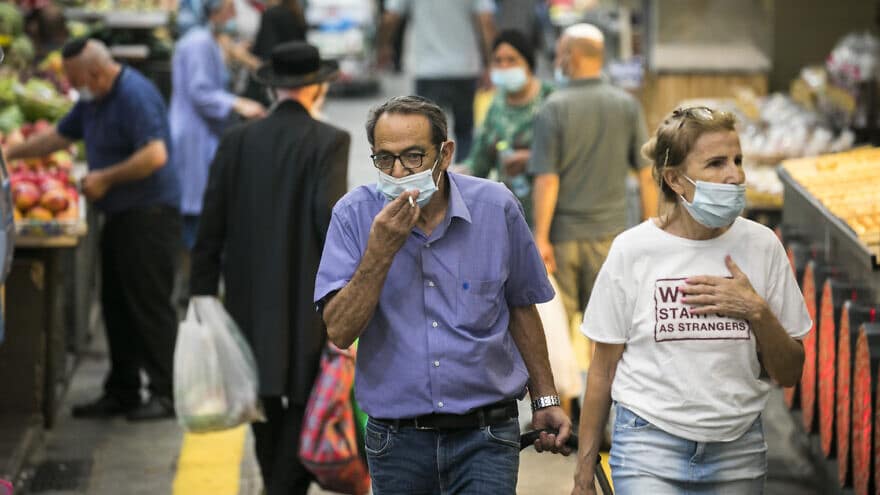
The sad fact is that unless hospitals start collapsing from the burden of critically ill and dying patients, public apathy will grow. And without a nationwide lockdown that includes the banning of all mass events equally—even the “democratic” anti-Netanyahu demonstrations—Israelis will have a difficult time not yawning behind the masks that most have been wearing to avoid a NIS 500 ($148) fine.

Netanyahu, Gantz, Edelstein and Gamzu are well-aware of this societal situation; it may be the only thing on which they are in complete agreement. Their press conference, then, could have been simply a precursor to the blow that they’ll be dealing with all colors of the “traffic light” next week in preparation for the upcoming Jewish High Holidays.


Ruthie Blum is an Israel-based journalist and author of “To Hell in a Handbasket: Carter, Obama, and the ‘Arab Spring.’ ” 

Viral Apathy in Israel Read More »
An Insider’s Look at ‘Corona Hotels’ Operated by IDF Home Front Command

As the Israeli cabinet weighs increasingly stringent steps to deal with the growing numbers of confirmed coronavirus cases, the Israel Defense Forces’ Home Front Command is playing an increasingly essential part in the state’s fight against the pandemic.

The Home Front Command is the military’s main interface with the civilian population, and it is tasked with helping the civilian domain prepare and respond to a range of emergencies. Currently, its headquarters south of Tel Aviv is hosting the IDF’s Coronavirus Command center, which recently began taking over the national epidemiological tracking efforts. The center has also relocated more than 50,000 people to “corona hotels” since being established in August.

The Home Front Command is operating 21 such hotels—17 for confirmed patients, and four for those who require isolation and who cannot isolate at home.

Most of those with the virus at the hotels have little to no symptoms, with the occasional fever, and do not require hospitalization, explained Col. Michael Gilinski, the Jerusalem Home Front District Commander Chief of Staff in reserve duty.

His own district runs nine coronavirus hotels that cater to a range of populations. “We attempt to provide them with all of their needs and give them the optimal conditions for recovery,” said the officer.

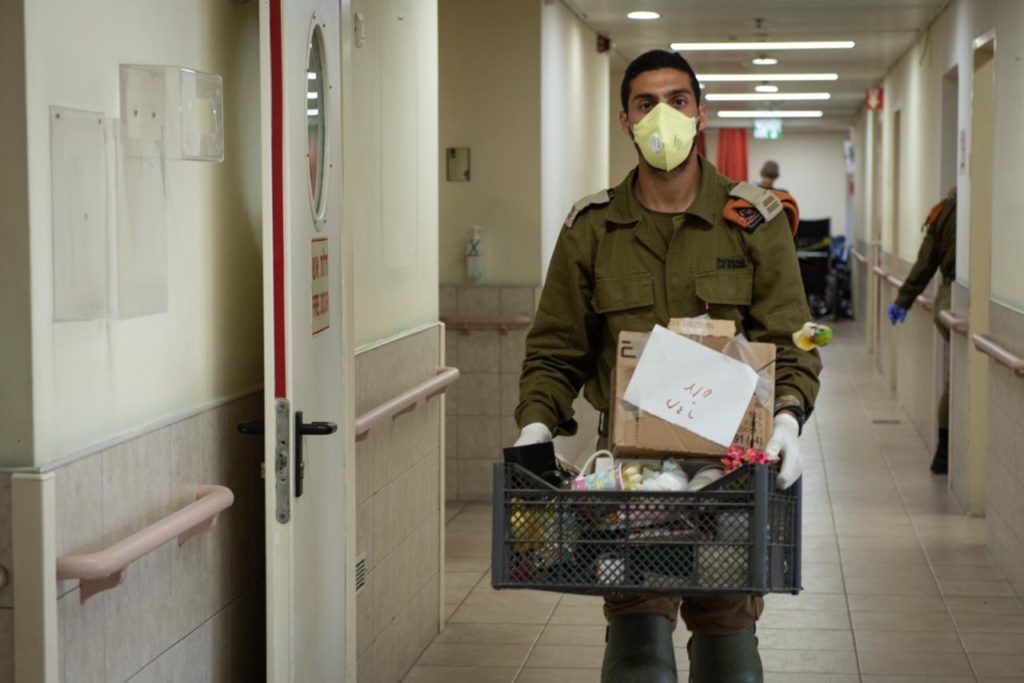
That includes making their stays comfortable, providing food—kosher food for the religious—and any other needs that need to be accommodated while they’re there.

“The goal is to remove them from the community to disrupt the infection chain,” said Gilinski. “We’re now getting ready for the High Holidays and Sukkot, which is no easy task. Every hotel is seeking to create its own suitable response and to figure out what requirements it needs to cater for.”

‘There is a meticulous observance of the guidelines’

Caring for large numbers of people is intensive, and the Health Ministry provides the Home Front Command with guidance throughout, he said, setting the conditions for who is authorized to enter and leave the hotels.

Using the Home Front Command’s command and control system, the military tracks every “guest” who enters the isolation centers, placing them on a “track” that begins with their arrival and ends when they have neutralized the virus.

Those needing isolation arrive either by bus or ambulance, arranged for by the military, and are allowed to leave the hotel after receiving approval from their health maintenance organization and their doctor.

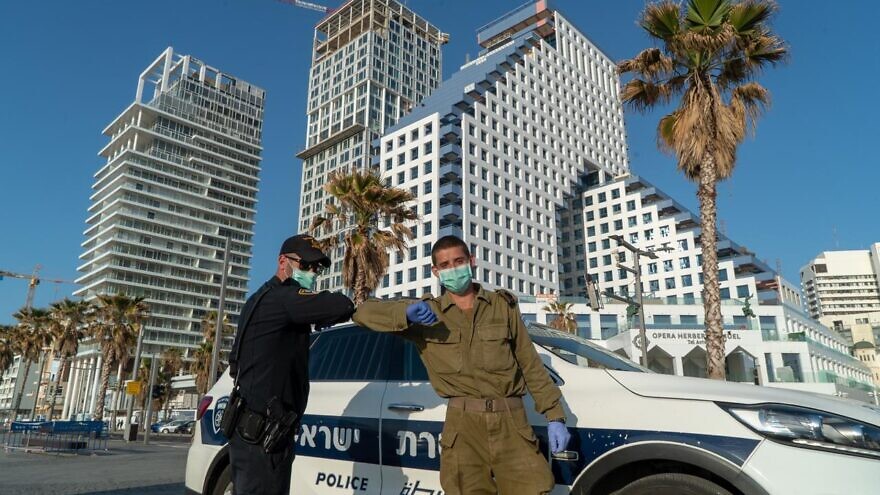
A IDF soldier and Israel Police do an elbow bump in front of one of the IDF Homefront Command”s coronavirus hotels in Tel Aviv. Credit: IDF Spokesperson’s Unit.

The Home Front Command is cooperating closely with hotel staff—Arabs and Jews alike—to coordinate operations. The hotels have been divided into yellow and green zones, said Gilinski. “Yellow zones are where those confirmed to be infected go. The hotel personnel are also divided into yellow and green zones.”

In line with this system, which is designed to strictly control movements and prevent infections, those staff authorized to enter the yellow zones can clean rooms, distribute food and conduct maintenance tasks, while the green zone staff carries out management and lobby-related tasks.

Every hotel has its own Home Front command center with a computer network that manages operations. On-site soldiers are similarly divided into yellow and green zone teams.

“Throughout the past five months of activating the hotels, we do not know of any soldiers or personnel who became infected at the hotels. There is a meticulous observance of the guidelines. We have had personnel infected while outside,” said Gilinski.

Military instructors refresh the guidelines continuously for the hotel staff, and cameras are used to supervise personnel to ensure that safety guidelines are being met. “Where we see that a loosening of procedures has occurred, we respond by having extra guideline refreshers,” stated the officer.

The Home Front Command’s Jerusalem district stretches from Ma’ale Adumim to Palmachim Beach, and from Gedera to Petach Tikvah, covering almost a third of Israeli civilians.

During more normal times, it prepares for emergency situations like missile attacks and earthquakes.

The current hotel operations are building valuable operational experience, he added, to both soldiers and commanders.

The command has been running the hotels since mid-March and has since developed an entire activation doctrine for them.

It has also given the command opportunities to build new bridges with populations that have not been exposed to it in the past, including the ultra-Orthodox populations, Arab Israelis, new immigrants and foreign workers from China and India, said Gilinski.

“These connections will reverberate in the future,” he added. “The connection to the haredi population has been very interesting to watch. This population, which never previously had direct contact with IDF soldiers and the Home Front Command, is now seeing an organization that has come to serve and assist them. Soldiers have been getting quite a few ‘thank you’ letters, chocolates and gifts.”

An Insider’s Look at ‘Corona Hotels’ Operated by IDF Home Front Command Read More »

The Joys of a Mizrahi Rosh Hashanah Seder

This article originally appeared on Alma.

(JTA) — I don’t need to remind you of all the reasons that 2020 has been an incredibly rough year. We could all use a fresh start, so it’s a good thing that Rosh Hashanah, the Jewish New Year, is just around the corner, offering a chance for renewal and a new beginning.

As an Iranian Jewish American, I get the pleasure of celebrating three New Years: the Gregorian calendar (New Year’s Eve/Day), the Persian New Year (Nowruz) and the Jewish calendar (Rosh Hashanah). I connect with each of these holidays in my own way, but there is something special about the spiritual essence of Rosh Hashanah.

As a child, the High Holidays for me were a time of repentance, going to synagogue and gathering with family. As I have gotten older, I have found meaning in these three elements for myself. I enjoy the reflective element of going inward and taking note of where I hit the mark and where I can do better next year. I’ve learned not only to love but to crave the beautiful melodies of Aveinu Malkenu and other prayers unique to this time. And would it be a holiday if I didn’t gather with family? My parents, siblings, aunts, uncles and cousins gather around a long table filled with delicious food, good energy and, of course, have a Rosh Hashanah Seder.

If you’re only familiar with the Passover Seder, allow me to explain: Like many Jewish families, we gather to celebrate Rosh Hashanah eating apples dipped in honey and pomegranates, but as Iranian Jews, before we dig into our delicious meal of Persian stews, crispy rice and other mouthwatering foods, we sit down for a formal Seder. The Seder consists of nine symbolic signs (“simanim” in Hebrew) represented by  foods that reflect what we want from God in the year to come.

This practice, mentioned in the Babylonian Talmud, dates back thousands of years and was practiced by my ancestors in the region of Iran/Persia. Many believe that at one point, the Rosh Hashanah Seder was practiced by Jews of all cultural backgrounds, but today it remains a beloved tradition among many Mizrahi families (Jews from the Middle East and North Africa). Each sign is accompanied by a blessing that begins with “Yehi ratzon” (“May it be your will”), and each food has been carefully chosen based on its taste, texture or name in Hebrew. I wait all year to eat my mother’s delectable bean stew, the beans representing abundance.

Of course, this year is going to look different. We won’t have a Seder with 25-plus loved ones. We won’t get to practice the mitzvah of “hachnasat orchim” — inviting guests who do not have a place to celebrate. And we won’t be going to synagogue to pray in community, recite the special melodies and hear the sound of the shofar.

The beautiful thing about our tradition during this time of year is that while it’s clearly a time for inner reflection, we often do so in community. In today’s world, “community” has transitioned to our devices and screens. For some, joining a livestreamed service with your local community (or one far away that you’ve never been able to join before) might offer an exciting opportunity this Rosh Hashanah. For others, it’s just not the same.

But one thing is for sure: We don’t need a Zoom meeting or FaceTime to connect with ourselves or with our spirituality. As I prep for the High Holidays this year, I still look to our Jewish tradition to guide me to holiness and connection while recognizing that it will look different.

Around this time, it is customary to hear the sound of the shofar, the call of the ram’s horn that symbolizes a spiritual wake-up call. While we may not be able to hear the shofar in person this year, the takeaway from why we hear the sound of the shofar still applies — we haven’t missed our chance to have our yearly awakening.

Perhaps this pandemic is the biggest wake-up call for all of us. A reminder to be kinder to others. That our lives are fragile but also that we are resilient. And a reminder that we have less control over our lives than we think. We can still look to our ancient traditions and reimagine them in these unusual times. Personally, I hope to find meaning in the symbolic foods of the Rosh Hashanah Seder. Even if I’m not eating them surrounded by friends and family, I’ll be using them to guide the blessings I want to manifest in 5781.

For those not familiar, here are the symbolic foods from the Rosh Hashanah seder, what they represent and how I’ll be thinking about them this year:

Beans: Abundance. In what area would I like to experience abundance in the year to come?

Leeks. To cut off enemies. What personal traits or self-sabotaging habits are no longer serving me? (Fun fact: Persian Jews do not eat the leeks, but instead rip the leek in half.)

Beets. To depart. What is something in my control that I want to leave behind in the New Year that is holding me back?

Dates. To end our enemies or simplicity/innocence. In what area/toward whom can I practice more compassion? Or, if I consider someone my enemy, how can I understand that person more and have more compassion?

Squash/pumpkin/gourd. To proclaim or to announce. What do I want to be known for this year? What’s my intention for the year?

Pomegranate. Mitzvot. What acts of kindness do I want to practice in the year to come?

Apples dipped in honey. To have a sweet New Year. What sweetness and blessings do I want?

Meat from animal head (cow tongue) or head of lettuce. Leadership. Where do I want to lead this year? What leadership skills do I want to improve and what actions can I take to enhance those skills?

Fish/Lungs/Popcorn. Lightness. What practices can I implement to give me peace of mind, to have more playfulness in the year to come, and to connect to my inner light?

As Rosh Hashanah approaches, we wish each other a “shana tova umetuka,” a sweet New Year. It has been a difficult year for many of us, but perhaps there has also been light and sweetness among the struggles. If I have learned anything from this pandemic, it is to find the sweetness in difficult times, to find the blessings in everyday moments and to appreciate the finer things in life: a warm hug, a beautiful sunset and, of course, the sweetness in our tradition.


DONNA MAHER is a Jewish community professional based in LA with an MBA from Tel Aviv University. She is a first-generation Iranian American and is passionate about dance, meditation and unifying our diverse Jewish community.

The Joys of a Mizrahi Rosh Hashanah Seder Read More »

A Florida Congressional Race Between Two Jews Symbolizes the Culture War

WASHINGTON (JTA) — Just two years ago, right-wing provocateur Laura Loomer was making headlines for being banned from social media and rideshare services for her anti-Muslim and anti-migrant rhetoric.

Now Loomer, who is Jewish, is facing off against Lois Frankel, the Jewish incumbent in Florida’s 21st District, which includes Palm Beach and not so incidentally President Donald Trump’s Mar-a-Lago estate. Trump has endorsed Loomer and his campaign is helping her out.

I wrote about the race and spoke to Frankel, who can barely say Loomer’s name aloud — she is not happy about facing someone associated with the far right.

“That’s the issue with her, with her rhetoric, and her extremism, her bigotry, her linkage with Trump, she uses it to raise money,” the eight-year congresswoman said.

Loomer, for her part, made no bones to me that this is a very Jewish fight.

“We’re putting the Jews on trial here in District 21,” she said. “They have a choice between a Republican Jew who is going to advocate for their survival in their best interests, or they can stand with self-hating Jew Lois Frankel, who is doing the bidding for the jihadists in the Democrat Party who are just literally walking Jews to the gas chamber.”

Read my full article here.

IN OTHER NEWS

Engel’s going out fighting

Rep. Eliot Engel, the New York Democrat who chaired the House Foreign Affairs Committee, lost his primary to progressive Jamaal Bowman, but unusually for an outgoing congressman he’s going down swinging: Engel has launched contempt proceedings against Secretary of State Mike Pompeo for not complying with subpoenas related to alleged wrongdoing connected to the firing of the agency’s inspector general.

Engel’s high profile notwithstanding, the scramble to replace him on the committee in the next Congress is fully underway. The Democratic Majority for Israel, a pro-Israel advocacy group, is seeking to interview the three declared candidates: Brad Sherman of California, Joaquin Castro of Texas and Gregory Meeks of New York.

Sherman was the first to agree to a grilling this week. He is perhaps one of the closest Democrats to the mainstream pro-Israel community represented by the Democratic Majority for Israel, which is why many were surprised last month when the candidates all said they opposed Israel spending U.S. aid money on West Bank annexation. Sherman explained to the group that he meant Israel was not in any case able to spend defense assistance on annexation.

Sherman also took shots at his rivals, noting that each had boycotted Israeli Prime Minister Benjamin Netanyahu’s 2015 speech to Congress when he slammed President Obama’s Iran policies, and each had voted against condemning the U.N. Security Council Resolution denouncing Israel’s settlement policies that Obama had allowed through in the last weeks of his administration. Sherman attended the Netanyahu speech and voted to condemn the Security Council.

Intriguingly, though, Sherman hinted that should he be defeated, the Democratic Majority for Israel should back one of the other two candidates. He said Meeks and Castro were of the moderate stripe, not leftists of the type that the group’s affiliated political action committee has opposed in primaries.

“My job is to convince you not that I’m an acceptable person to serve as chair, but rather that I am so much better than my opponents, that the most important thing your organization could do is to work to make me chair of the Foreign Affairs Committee,” he told the group, adding later about the others, “I want to point out if they were being challenged by Justice Democrats in their own district I’d be rooting for them.”

QME yet to be QED

Despite the recent normalization deal, Israel opposes the sale of F-35 stealth jets to the United Arab Emirates. Jared Kushner, the senior White House adviser who brokered the deal, defended the possible sale, but he seemed hesitant to say outright that Israel’s qualitative military edge, or QME, would be preserved in such a sale.

“We’re going to, obviously, work with the QME. And we’ll do what we can do to make sure that we accommodate that circumstance,” Kusher, Trump’s son-in-law, said Wednesday.

Democrats already are seizing on the issue. Rep. Debbie Wasserman Schultz of Florida, a key swing state with a substantial Jewish vote, railed against the proposed sale in an op-ed, and Rep. Brad Schneider, D-Ill., led 10 Democrats in writing to Trump on Thursday, saying they would take steps to scuttle any such sale. Along with Wasserman Schultz and Schneider, other   Jewish Democrats who signed are Elaine Luria of Virginia, Josh Gottheimer of New Jersey, Max Rose of New York and Dean Phillips of Minnesota.

Sore at Soros? Read this

My colleague Ben Sales breaks down the Jews who attack George Soros, despite the anti-Semitic baggage that goes along with that. He also adds a Soros explainer.

Kushner also talked with Woodward

Among other comments, Kushner made an eyebrow-raising statement according to Bob Woodward in his new book, The New York Times reported Wednesday. After calling advisers who had left the White House “overconfident idiots,” Kushner told Trump, “This is really when you’ll appreciate having the neurotic Jews around.”

WORTH A LOOK

Homeland Security staffer-turned-whistleblower Brian Murphy rocked Washington this week by saying he was pressured by higher-ups to downplay intelligence on Russian extremists and domestic far-right terrorists. Murphy’s superiors, he alleges, were trying to hew to Trump’s preferred narratives, including that leftists posed a more grievous threat. There’s been a lot of reporting this week on the Russia component. The Daily Beast’s Kelly Weill delves into the downplaying of the white supremacist threat.

TWEET SO SWEET

Haaretz’s Noa Landau picks out the superlatives used by the Mossad in a recruitment tweet for Israel’s intelligence agency.

STAY IN TOUCH

<!–The Tell is a weekly roundup of the latest Jewish political news from Ron Kampeas, the Jewish Telegraphic Agency’s Washington Bureau Chief. Sign up here to receive The Tell in your inbox on Thursday evenings.–>

Share your thoughts on The Tell, or suggest a topic for us at thetell@jta.org.

A Florida Congressional Race Between Two Jews Symbolizes the Culture War Read More »