fbpx

August 30, 2020

Why Sports and Politics Don’t Mix

As long as it doesn’t incite violence, speech in America is generously protected, regardless of ideology. Whether you are a Black Lives Matter or a Blue Lives Matter supporter, you have the same freedom to express yourself. Maybe because I was born in a Third World country, I never take that kind of freedom for granted. It’s a major reason why I love this country.

But there’s a big difference between the freedom to express myself on a street corner and on a job. Let’s say I work in a restaurant. Do I have the right to hand out propaganda leaflets to customers or express my political views to anyone who walks in? My constitutional right to free speech is in the public sphere. In the private world, it’s up to the owner.

Business owners usually see it as bad for business to have employees engage in political activism while on the job — so they tend to disallow it. 

But there are exceptions, which we are seeing lately with professional sports. In the case of the National Basketball Association (NBA), team owners and league leaders are supporting the right of players to express their support for Black Lives Matter while on the job, either through slogans on jerseys, kneeling during the national anthem or even, as happened recently, boycotting games.

Frankly, as much as I empathize with the cause, I think this mixing of sports and partisan messaging may backfire.

I feel somewhat lonely in this position because virtually all sportswriters and announcers have supported the move. In the wake of widely publicized police violence against Blacks, including the recent shooting of Jacob Blake, this is not surprising. The Black Lives Matter movement has dominated our nation’s consciousness and touched just about everyone.

It would seem natural, then, for the public to go along and support any expression of outrage at racial injustice, whether on a basketball court or on a street corner. But while this may be true for athletes and journalists, I’m not sure it’s the same for the fans.

Professional sports offer something indispensable: a refuge from the harshness of the world. For a few hours, I can watch my beloved Lakers engage in sports combat knowing that the stakes are deliciously low. I’m not worried about anyone dying. I get deep joy when my team wins, but I don’t grieve when we lose.

Professional sports offer something indispensable: A refuge from the harshness of the world.

When I attend Lakers games, I marvel at the multicultural kaleidoscope of the fan base. No matter who you are, no matter what your political beliefs, no matter your race or ethnicity or gender or age or class or celebrity status, we all share one purpose — we want our team to win. Where do you find such cohesion and common cause these days?

Is it worth jeopardizing that civic spirit of cohesion with the divisive force of politics?

I understand if you might believe that Black Lives Matter is worthy of an exception, but there’s a complication: There are surely sports fans who also support Blue Lives Matter and may be more concerned right now about street violence than police violence. Whether or not you share that sentiment, is it wise to alienate them? When people say politics is divisive, it’s not an opinion — it’s a fact.

When people say politics is divisive, it’s not an opinion— it’s a fact.

So, I worry.

I worry that fans, regardless of their political affiliations, will grow tired of the partisan activism on the court and in broadcast booths. I worry that the sanctuary of competitive sports will be tainted by the divisiveness of politics, with no end in sight (because causes rarely end). I worry because both sports and causes deserve better.

Players have multiple platforms outside of basketball courts and playing fields to promote their causes. Slogans knitted on jerseys or painted on basketball courts are optics that interfere with the game. Real progress happens when we move beyond slogans and optics, which the NBA is trying to do with its “social justice coalition.” But the optics and activism around the actual games are still very much with us, all behind the same cause.

If this trend continues, I wonder how many fans will simply get tired of the social messaging and exercise their right to just stop watching.

As for me, well, I’m still hoping my Lakers will crush those bloody Celtics in the Finals.

Why Sports and Politics Don’t Mix Read More »
Germany’s Lessons for BDS

Three incidents in three different countries during the last week graphically illustrated the ease with which anti-Zionism can serve as a vehicle for anti-Semitism.

In the Austrian city of Graz, the president of the Jewish community, Elie Rosen, was assaulted by a Syrian Islamist outside the synagogue. Fortunately, he escaped unscathed. The attack occurred after Rosen warned in the media of an atmosphere of “left-wing and anti-Israel anti-Semitism” in Graz—a comment he made after the words “Free Palestine” were found on the synagogue’s outer wall. The culprit was the same man who returned to the synagogue a few days later to attack Rosen.

In Kenosha, Wis., the same “Free Palestine” slogan was painted on the driveway of the Beth Hillel Temple during a Black Lives Matter protest sparked by the police shooting of Jacob Blake, another black man. Had the synagogue been sprayed with the letters “BLM,” as was the case with the Christ the King Church nearby, then this would have been interpreted as an act of protest, not anti-Semitism. But instead, an institution that serves the local Jewish community specifically was chosen as the target for a message urging the destruction of the Jewish state.

And in Strasbourg, France, a young Jewish graffiti artist working on a project for the local city council was accosted by two men who objected to the appearance of the word “Israel,” among a host of other cities and countries, on his T-shirt. After haranguing and jostling the Jewish man, one of them grabbed one of the paint cans, wrote the words “Forbidden to Jews” on the ground. All this took place, incidentally, on rue Leon Blum — a street named after the French Socialist who became his country’s first Jewish prime minister.

Incidents such as these give lie to the claim that anti-Zionism and anti-Semitism can be separated, with the former understood as political solidarity with the oppressed Palestinians and the latter understood as hatred towards Jews. In all three cases outlined above, it was the Jewish nature of Israel that provided the rationale for attacking Jews with Austrian, French and American citizenship. That identification marks the singular contribution of today’s anti-Zionists to the ongoing adaptation of classical anti-Semitism.

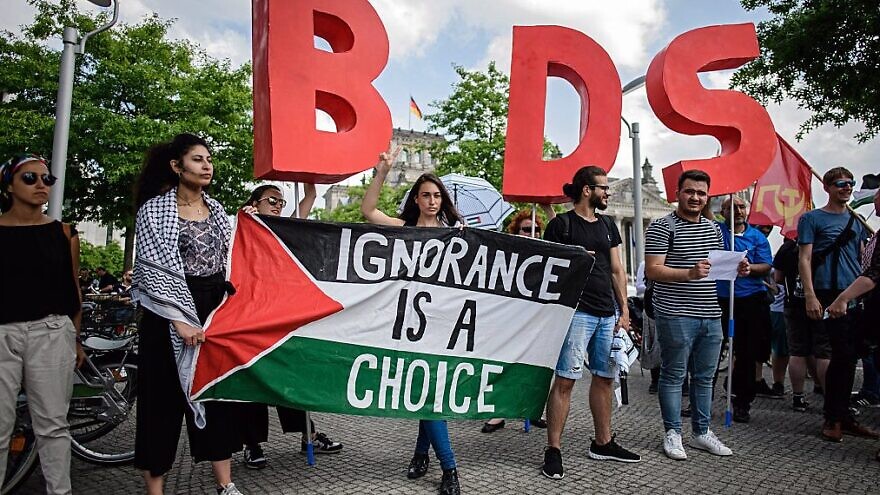
Which brings me to what is still the main aim of anti-Zionist activists — subjecting Israel to a regime of boycotts, divestment and sanctions (BDS) as a prelude to its dissolution as a sovereign entity. Over the two decades that the Jewish community has been countering this campaign, the suggestion that Jews deliberately conflate “criticism of Israel” with “anti-Semitism” has frequently been offered up by BDS advocates and their defenders.

This back and forth has occurred in most Western countries where the BDS movement has gained a foothold. One of the more interesting varieties of this debate has emerged in Germany, where the contention that goods of Jewish origin are deserving of a boycott.

In a new monograph for the Foundation for the Defense of Democracies (FDD), Benjamin Weinthal — a journalist who has been based in Berlin for many years (and, full disclosure, a personal friend and colleague) — examines the period from 2012, when the first proposals for labeling produce from Israeli communities in the West Bank emerged, to 2019, when the Bundestag, Germany’s parliament, passed a milestone resolution deeming the “arguments and methods” of the BDS movement as anti-Semitic.

Weinthal wrote,  “The Bundestag resolution had few tangible effects, since it was not legally binding,” he writes. “Yet it challenged the BDS campaign’s portrayal of itself as an advocate for human rights and an opponent of prejudice. While the resolution made points similar to those offered by the campaign’s other critics, it endowed such arguments with the moral weight of Germany’s efforts to grapple with its own history of anti-Semitism.”

On the surface of that history is the slogan Kauft nicht bei Juden! (“Don’t buy from Jews!”), brandished by Nazis in the 1930s as they blockaded Jewish-owned stores that were eventually consumed in flames during the pogrom of November 1938. As Weinthal’s paper makes clear, discussion of Israel in Germany has historically been filtered through the experience of the Holocaust, which perhaps makes Germans relatively more sensitive to the rising anti-Semitism around them now. He quotes German Chancellor Angela Merkel’s observation in 2019: “There is to this day not a single synagogue, not a single daycare center for Jewish children, not a single school for Jewish children that does not need to be guarded by German policemen” — noting that within this context, “opposition to BDS began to mount.”

Weinthal does not claim that the battle against BDS in Germany has been won, and he offers some policy proposals. But he does make the critical argument that “the BDS campaign has gained little traction on the German left compared to other Western European countries. Indeed, Germany is a rare case in which the left is also home to pro-Israel voices that arose after the collapse of the Berlin Wall.”

Since the BDS movement elsewhere in Europe and in the United States regards the left as its primary constituency, Germany’s experience is worth further exploration. As Weinthal says, its “blunting of the BDS campaign, particularly amidst an alarming rise in global anti-Semitism, is a sign that the country has learned some difficult lessons from its past.” Those are lessons that need to be imparted to the rest of the world.


Ben Cohen is a New York City-based journalist and author who writes a weekly column on Jewish and international affairs for JNS.

Germany’s Lessons for BDS Read More »

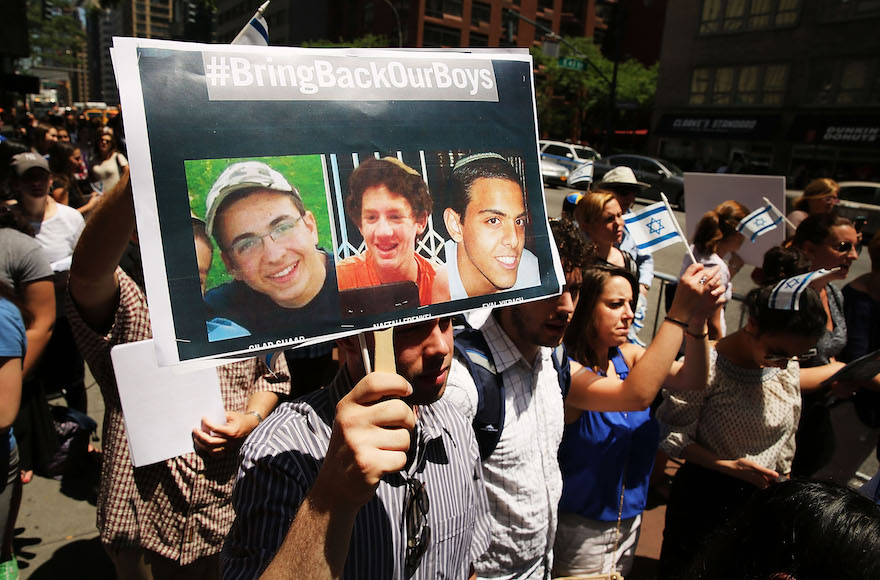
Families of 3 Israeli Teens Kidnapped and Murdered in 2014 File $150M Suit Against Hamas and Palestinian Authority

(JTA) — The families of three teenage Israeli boys kidnapped and murdered by Hamas terrorists six years ago have filed a lawsuit against Hamas.

The lawsuit filed in Jerusalem by the Shurat HaDin-Israel Law Center on behalf of the families of Naftali Fraenkel, Gilad Shear and Eyal Yifrach asks for about $150 million from the Palestinian Authority.

The families released a statement saying that a goal of the suit is to stop the Palestinian Authority from transferring money to Hamas, the militant group that runs Gaza and whose military wing claimed responsibility for the abduction and murders, Israeli media reported.

“Of course, this lawsuit does not cure our pain, reduce our grief, or minimize our longing for our children. If the prosecution has the power to deter, even slightly, these evil forces, it will be our reward,” the statement said.

If successful, the lawsuit would result in Palestinian Authority funds being confiscated for the first time as a consequence for a terror attack that was carried out by Hamas, according to Shurat HaDin, an organization that files lawsuits on behalf of Israeli terror victims. The lawsuit says that the Palestinian Authority transfers between $50 million and $100 million per month to Hamas.

The search for the teens, who were abducted June 12, 2014, while hitchhiking in the West Bank, gripped Israel for the 18 days it took for their bodies to be found in a shallow grave in a field near Hebron. A recording of an emergency call made by one of the teens to police and the interior of the car used to abduct them indicated that they were killed shortly after being taken.

Families of 3 Israeli Teens Kidnapped and Murdered in 2014 File $150M Suit Against Hamas and Palestinian Authority Read More »

US State Department Envoy Works to Secure Compensation for Nazi-Era Wrongs

Cherrie Daniels was tapped last year as the U.S. State Department’s Special Envoy for Holocaust Issues.

Founded in 1999, the Office of the Special Envoy for Holocaust Issues “develops and implements U.S. policy to return Holocaust-era assets to their rightful owners, secure compensation for Nazi-era wrongs, and ensure that the Holocaust is remembered and commemorated appropriately,” according to the State Department website.

Prior to her current role, Daniels served in the U.S. embassy in Belgrade and at the U.S. embassy in Oslo. She also served in the Office of the Vice President as a special adviser for Europe and Russia, and as a Pearson Foreign Affairs Fellow under former Sen. Joseph Lieberman (I-Conn.).

Last month, Daniels’s office, which is in the State Department’s Bureau of European and Eurasian Affairs, released a report about the status of countries over their handling of issuing restitution to Holocaust survivors and their relatives.

Released in accordance with the 2017 Justice for Uncompensated Survivors Today (JUST) Act that was signed into law by U.S. President Donald Trump in May 2018, the report states that “a handful of the countries that endorsed the Terezin Declaration have yet to pass laws that facilitate the restitution of immovable property,” and that “in countries that have adopted such legislation, too many claimants face discrimination based on citizenship and residency or are otherwise unable to benefit due to overly complicated administrative barriers.”

The Terezin Declaration was created in 2009 after a meeting of 47 countries, including the United States, in June that year in the Czechoslovakian town where 33,000 Jews perished at the Theresienstadt ghetto and concentration camp. The member countries signed a declaration stressing the importance of restitution for Holocaust survivors and their heirs.

The report blamed “bureaucratic inertia” for the delay in resolving restitution claims. It calls out Bosnia and Herzegovina, Belarus and Ukraine for not passing laws to enable the restitution of private property; and Poland for not passing laws dealing with restitution of private property confiscated during the Holocaust, making it “the only European Union member state with significant Holocaust-era property issues not to have done so.”

Also in Poland, “approximately half of the 5,500 Jewish communal property claims filed under a 1997 restitution law remain unresolved, and approximately half of the adjudicated claims were rejected.”

Daniels is married with two children.

JNS talked with Daniels by phone on Aug. 18. The interview has been edited for brevity and clarity.

Q: Since the release of the JUST Act Report, what has the response been from countries under the Terezin Declaration? Positive or negative?

A: So far, a lot of the reactions are a lot of the governments that endorsed the Terezin Declaration are likely still translating, digesting and absorbing what’s in the report.

Q: Which governments have you heard back from and what have they said?

A: I wouldn’t want to characterize our diplomatic conversations, but I would say some countries issued public statements, like Poland. Some countries, like Israel, have welcomed the report directly to me and my team.

Q: Poland is the only E.U.-member state that has not adopted a national comprehensive private property restitution law. You’ve said that as a sovereign country, this is an issue for Poland to resolve. However, shouldn’t the United States push for Poland to pass such a measure in that your office seeks to lead on the issue of Holocaust-era restitution?

A: There are other E.U. states that don’t have property restitution issues like Ireland. U.S. leadership has been crucial in the decades after the war. I’d point you to U.S. leadership since the 1990s on everything such as the Swiss Bank Settlement. Continued U.S. leadership is crucial, and both the president and secretary of state have made that clear in the social media surrounding the release of the JUST Act report.

Each country that endorsed the Terezin Declaration is a sovereign country and it was a nonbinding declaration where each country really freely undertook commitments to do the right thing and they listed the principles by which they would do the right thing on private property, on the communal or religious property, on heirless property, on moveable property, all the principles are in there and we’re looking for conversations with those governments to see how we can help them.

We hope that in the report, in comparing themselves in all the different chapters, they will find best practices. How a country can do this in a reasonable way that fits within their budget and does justice.

Q: What leverage can America use in pushing for changes from countries like Poland to have laws dealing with Holocaust-era restitution?

A: In the case of Poland, we recognize a victim of Nazi brutality, and then Soviet occupation and Communist domination, etc. You have that intervening period after World War II where they were not able to deal with these issues until they were given their independence.

When it comes to leverage, it’s in Poland’s interests to settle the issue once and for all because, as a practical matter, resolving restitution or compensation for all these property claims would facilitate their own economic development.

Q: Is there an estimated amount of how much public and private restitution is still owed overall worldwide?

A: I’m not aware if there is an overall number. The fact is that some countries don’t have comprehensive private property legislation dealing specifically with the Holocaust issue. In those countries, there’s no record-keeping by religion of who has seen their property back and who hasn’t.

Q: Will there ever be a time when all Holocaust-era restitution cases will be resolved? Or do you see this as an infinite issue?

A: Certainly, the secretary of state has been on record in the foreword to the JUST Act report on the issue that the need for action is urgent with Holocaust survivors aging, and having domestic health and welfare needs, so that’s the nature of the focus that I have. Whether every country will do everything is one question. Another is what can they do now, and that’s where I have my focus.

Q: Do you see the issue of providing restitution to Holocaust survivors and their relatives as a matter to fix the past or as part of the ongoing fight against anti-Semitism?

A: We see finding a delayed measure of justice for Holocaust survivors and their heirs as a moral obligation that countries enter freely into in endorsing the Terezin Declaration. On the issue of anti-Semitism, our report doesn’t cover that because the United States reports on that through the International Religious Freedom Report and through the Human Rights Report, but in the JUST Act report we do address how restitution for Holocaust survivors and their heirs is connected to combating anti-Semitism.

Q: In comparison to the previous roles you’ve held inside government, has your current role been your greatest challenge? Besides the job requirements, how does it compare to your previous jobs?

A: It’s been very satisfying and rewarding work. The small team that I’ve assembled are very proud of what they were able to do. We feel very compelled to answer the questions in the nature of our report, but also the diplomatic conversations with countries named and not named in the report every day. I’ve had a lot of challenges and have done a lot of interesting jobs, and I have to say I was proud of being in Serbia when that country adopted groundbreaking heirless property legislation in February 2016. Challenges are the nature of the game of the Foreign Service, and I relish all of them and feel that this is very rewarding work.

US State Department Envoy Works to Secure Compensation for Nazi-Era Wrongs Read More »