A 28-year-old man was arrested Aug. 6 for allegedly vandalizing a Jewish community center, and breaking and entering a synagogue in Worcester, Massachusetts.
The man, reportedly identified as Kyle Wood, is alleged to have broken into Temple Emanuel Sinai on Aug. 5, breaking a window and damaging part of the building. He also is accused of kicking a Star of David at the Worcester JCC and throwing a yard sign on Aug. 6, while yelling at parents and children who were being dropped off for camp.
Wood subsequently was arrested after allegedly attempting to break into Temple Emanuel again. He is being charged with vandalism and breaking and entering in the daytime.
Anti-Defamation League New England tweeted, “Horrified by #antisemitic fueled vandalism & tirade targeting #Jewish campers & synagogue. Quick action by parents/staff @WorcesterJCC prevented escalation to violence. [Thank you] @WorcesterPD for immed resp [immediately responding]. Reminder that security training/awareness is critical.”
Horrified by #antisemitic fueled vandalism & tirade targeting #Jewish campers & synagogue. Quick action by parents/staff @WorcesterJCC prevented escalation to violence. TY @WorcesterPD for immed resp. Reminder that security training/awareness is critical https://t.co/M90qpN9O4x
On Aug. 9, The New York Times published an article I wrote about Israel and the U.S. presidential race. The bottom line was this mixed message:
As far as Israelis are concerned, Joe Biden has two disadvantages. He is not Donald Trump and he is a Democrat. He is not the candidate they support and he comes from the party many of them distrust. Biden could provide an opportunity for Israel to reemerge as a truly bipartisan cause in America. Biden is a self-proclaimed Zionist and a longtime supporter of Israel who is familiar with both the issues and the main players, and who instinctively understands the country’s security concerns.
My Times articles usually draw a large volume of comments and I often use the Jewish Journal to respond, so here are some of my responses to comments on my latest opinion piece:
Jake Donnelly asked: “Is the ‘for a Democrat’ bar really that low?”
I end my article stating that Biden is as good as Israel can hope for when it comes to a Democratic candidate. Donnelly is right. The “bar” I use for Biden is lower than one I’d want in an ideal world. But we do not live in an ideal world. We have reality to contend with. This reality means that from an Israeli perspective, Biden is as good as it gets, if Israel can pass the uneasy test of having to handle a Democrat.
Abraham Reznick wrote: “The best president for Israel is the best president for America. Full stop.”
In an ideal situation, that would be true. In reality, one’s idea of the “best president for America” depends on one’s ideological tendencies. The same is true for “best for Israel.” So, we end up having debates about both. In my experience, when someone says what is best for America is also best for Israel, this usually means that he or she intends to vote for the candidate whom Israelis aren’t going to see as the best for them. Of course, no American is under any obligation to vote for what’s best for Israel. On the other hand, no Israeli is under obligation to pretend that unfriendly American politicians are in fact good for Israel (just because some Americans believe they are best for America).
Evgeny Cherpak wrote: “The problem with Biden is … his VP choice.”
He has a point. In fact, many readers joined him in saying the vice president could change my outlook on the matter, and they were especially concerned about the prospect of Biden choosing Susan Rice. (@udekel tweeted: “The problem isn’t going to be President Biden as much as it is going to be Acting President Rice.”)
I agree. A problematic vice presidential pick could somewhat change my outlook. So why did I not mention it in the article? Because the choice hadn’t been made when I wrote it, and because the article looked at Biden as a challenge and an opportunity. Also, it’s impossible to cover all angles in one article. And yet, the point is well taken: Considering Biden’s age, the vice presidential pick matters. Rice has a history of confrontation with Israel.
Jim Recht tweeted: “As an American Jew, I find this opinion piece obscene. Its implicit assumption is that we will debate U.S. policy toward Israel overlooking … Israel’s crimes against humanity. Enough!”
That’s why I think Biden is much better than the alternatives. It is important to remember that in politics, we choose between existing alternatives, not creating our own imaginary world.
Daniel Ehrenreich wrote: “As a conservative voting for Biden, your gushpanka means a lot.”
Gushpanka means a seal of approval. I have no authority to give any candidate a seal of approval. So, let me make it clear: On Israeli matters per se, Trump is the better choice. But the choice is not between a friend and an enemy. It is a choice between two friends. Biden is a friend.
The choice of Kamala Harris
I am calm again. Of all the realistic potential Democratic presidential candidates, Biden was Israel’s choice. Of all the realistic potential Democratic vice presidential candidates, Sen. Kamala Harris of California was Israel’s choice.
Biden picked her. Good for him. Good for her. And until proven otherwise, good for Israel, because, like Biden, she is neither an ideologue nor a dreamer. She understands that under certain circumstances there is a need to use force and therefore would be open to the option that Israel occasionally must use force.
Rep. Rashida Tlaib (D-Mich.) once tweeted that Harris’ meeting with Israeli Prime Minister Benjamin Netanyahu meant that Harris is no longer “part of the resistance to racism against all people.”
That’s another reason for Israelis to be pleased. Not because Tlaib would be unhappy but because Harris was never a part of a group or a movement that targeted Israel as a symbol of misbehavior. She is not a member of “the squad” or any other radical group pretending to be a serious political entity. Surely, she will not always agree with Israel. But to disagree with her would feel like disagreeing with an ally — not a foe.
Shmuel Rosner is senior political editor. For more analysis of Israeli and international politics, visit Rosner’s Domain at jewishjournal.com/rosnersdomain.
More than 120 Jewish and pro-Israel organizations signed an open letter Aug. 7 calling on Facebook to adopt the International Holocaust Remembrance Alliance (IHRA) definition of “anti-Semitism.”
The letter, posted on the Stop Anti-Semitism.org website, noted that Peter Stern, Facebook’s Director of Content Policy Engagement, admitted that Facebook doesn’t have a policy addressing anti-Semitism and that the social media giant doesn’t use the IHRA definition of anti-Semitism because it states that certain criticisms of Israel are anti-Semitic.
“We the undersigned coalition of 128 organizations, urge Facebook to implement a hate speech policy on anti-Semitism that includes the full IHRA working definition at its core,” the letter stated. “Nearly 40 countries have already endorsed or adopted the IHRA working definition in some official capacity, either through their membership in the IHRA or independently. In the United States, in addition to the adoption by the State Department, the recent Executive Order on Combating anti-Semitism instructs the Department of Education to consider the IHRA definition when evaluating Title VI Civil Rights Act complaints of discrimination.”
The letter argued that modern anti-Semitism involves delegitimizing Israel’s right to exist, and subjecting Israel to double standards.
“Jews overwhelmingly report that online anti-Semitism is the most acute form of Jew-hatred they experience,” the letter stated. “The full IHRA working definition of anti-Semitism provides Facebook an effective, neutral, and nuanced tool to protect Jewish users from hate speech and imagery that incites hate and oftentimes leads to violence. While the impact of online hate speech, misinformation, and disinformation on our society continues to be researched and explored, we cannot afford to lose any more time in fighting this bigotry and preventing violence.”
Some of the organizations that signed the letter include the Simon Wiesenthal Center, StandWithUs, and the Israeli-American Council.
Facebook did not respond to the Journal’s request for comment.
The Anti-Defamation League (ADL) has been engaged in a campaign called Stop Hate for Profit, in which the Jewish organization has urged companies to stop advertising with Facebook until the social media company better addresses hate speech on its platform. Facebook has claimed it already handles hate speech adequately, pointing to a June 2020 European Union study showing that Facebook was looked into 96% of hate speech notifications within 24 hours.
(JTA) — During the pandemic, Jews have attended virtual services, read scripture or prayed less often than other Americans, and they have given charity and volunteered at higher rates.
Eighty percent of American Jews don’t want special exemptions for houses of worship to reopen — essentially the same percentage as Americans as a whole (79%) and American Christians (74%).
Those figures come from a new survey by the Pew Research Center, published Friday. It found that 17% of American Jews had attended virtual prayer services in the last month, as opposed to 33% of all Americans and 49% of Christians.
Before the pandemic, 61% of American Jews attended services in person with at least some regularity, as opposed to 57% of all Americans and 78% of American Christians.
Many American congregations, including many synagogues, have transitioned to virtual services. But Orthodox Jews, who attend services at the highest rates regularly, cannot hold services on Shabbat online because of prohibitions on the use of technology.
The survey found that 57% of Jews have donated to or volunteered with a charity during the pandemic, as opposed to 38% of all Americans. Over a third of Jews have helped friends and neighbors with errands and childcare, essentially the same rate as Americans overall.
In addition, 36% of American Jews have prayed at least weekly during the pandemic and 20% have read scripture, as opposed to 55% of Americans overall who have prayed weekly and 29% who have read scripture weekly. Like Americans as a whole, large majorities of Jews have gotten through the pandemic by watching movies and TV, going outdoors or talking to friends and family on the phone or via video.
The study was conducted July 13 to 19, and surveyed 10,211 U.S. adults, including 250 Jews. The overall margin of error was 1.5%, while the margin of error for Jews was 8.8%.
Two months after I started to date my future husband, I asked him, “Am I more Israeli, Australian or American?”
His answer surprised me. “You’re more Iraqi.”
My parents were born in Iraq but they met and married in Israel, where my older brother, Rafi, and I were born. My mother’s family moved to Australia in 1967, and my family followed, landing there on my second birthday in 1968.
By the age of 5, I was putting in solid hours as my grandmother’s sous chef in her kitchen in Rose Bay, a suburb of Sydney. While I spoke Hebrew with my father and English with my mother, I spoke a Judeo-Iraqi-Arabic dialect with my Nana Aziza, and I was the official interpreter on our shopping expeditions to Bondi Junction.
When I was 7, my family and I visited Israel for the wedding of my father’s youngest brother. We were in the kitchen at my uncle’s apartment in Petah Tikva and, unbeknownst to me, I was naming the fruits and vegetables in Arabic, prompting hysterical laughter from the Baghdadi-born wives of two of my uncles. I quickly learned that ba’ban jan was cha’tzil (eggplant) and ka’ra was d’la’at (pumpkin or squash) and prat’kal was tapuz (orange).
Every Friday morning, my grandmother would peel, slice and brine the purple ba’ban jan and put it in the sun to drain and then fry it. She would peel the bright orange ka’ra and fry it to golden brown perfection. She would make her t’bit, the Iraqi chicken and rice version of cholent and place the eggs on top, ready to roast overnight in the oven. She would boil potatoes in their skins and carefully wash tons of Italian parsley and romaine lettuce. She would grate juzur (carrots) and add sweet, juicy segments of prat’kal and snowy flakes of coconut.
Friday night dinners were bright and fancy affairs, with lots of spirited singing and many honored guests, with the finest English bone china table settings and the most exquisite foods. Shabbat day was relaxed.
When the weather was warm, my grandparents, parents, aunts and uncles would dine al fresco. The table was laden with fare for the perfect Iraqi breakfast. Velvety brown bethi mel Shabbath, eggs that have cooked overnight, also known in Ladino as huevos haminados (cholent eggs). Fried eggplant and butternut squash and boiled potatoes, perfectly sliced with a heavy sprinkle of black pepper. Z’lata (salad) of bright red tomatoes and green parsley was perfectly flecked with purple onion. The array of homemade condiments included pungent amba, with its tangy notes of vinegar, turmeric, chile and fenugreek; spicy green s’chug; and turshi, vegetables pickled in a curry, turmeric brine. Not to mention hummus, tehina, fij’il (radishes) and bas’l akhdar (green scallions).
Legend has it that in the early 1960s, an Iraqi man named Sabich had a little stand near the bus depot in Ramat Gan, Israel, and that the bus drivers ending their shift asked him to sell ready-made food. He came up with the idea of combining all of the ingredients of this Iraqi breakfast in laffa, the delightfully pillowy sheets of Iraqi flatbread. Along with falafel, Sabich is one of the most popular street foods in Israel.
Our family still eats this meal every Shabbat and even if my mother is hosting, I make the eggplant and butternut squash. I think of my grandmother and how much patience she had to stand and fry everything. I pray that she forgives me for being lazy — I roast my veggies in the oven. I make my own turshi, but luckily amba is readily available at the kosher market. My lovely Aunt Tina taught me a great hack for baking the Shabbat eggs by wrapping the cardboard container with a double layer of foil. Fresh bread is key and there is none better than the soft, flavorful pita from Bibi’s Bakery Cafe on West Pico Boulevard.
Good thing my husband knew what he was getting into when he married an Iraqi woman.
SABICH
Eggs: 1 dozen eggs in cardboard container
Preheat oven to 350 F.
Double wrap container of eggs in foil.
Bake 1 hour, then reduce heat to 225 and bake at least 4 hours or overnight.
Butternut squash: 1 medium butternut squash, peeled, seeded and sliced in half moons
4 tablespoons olive oil
1/2 teaspoon salt
1/2 teaspoon sugar
Preheat oven to 400 F.
Place squash slices on baking sheet. Coat with oil and dust with salt and sugar.
Bake 15- 20 minutes until golden.
Eggplant: 4 eggplants, washed and dried
Kosher salt 8 tablespoons avocado oil or almond oil
Granulated garlic powder
Slice eggplant in 1/4-inch thick rounds.
Place tiny pinch of salt on each piece of eggplant.
Drain in colander at least 1 hour.
Preheat oven to 400.
Grease baking sheet with oil, then place eggplant slices in one layer, making sure not to overlap.
Sprinkle with garlic powder, then drizzle with a little more oil.
Bake 15-20 minutes till golden brown.
ISRAELI SALAD 1 pint (10 ounces) heirloom cherry tomatoes, halved
2 Roma tomatoes, diced 3 Persian cucumbers, diced
1 red pepper, seeded and diced
1 purple onion, finely chopped
1 bunch Italian parsley, finely chopped 2 lemons, juiced
4 tablespoons olive oil
Kosher salt and pepper to taste
Combine first six ingredients in serving bowl.
Dress with lemon, olive oil, salt and pepper 10-15 minutes before serving.
Serves 12.
Sharon Gomperts and Rachel Sheff will answer cooking questions on Instagram at SephardicSpiceGirls or on Facebook at Sephardic Spice SEC Food. They have collaborated on Sephardic Educational Center projects and community cooking classes.
Home Shalom promotes healthy relationships and facilitates the creation of judgement free, safe spaces in the Jewish community. Home Shalom is a program of The Advot Project.
Please contact us if you are interested in a workshop and presentation about healthy relationships, self-worth or communication tools.
“The tablets and the broken tablets were placed in the ark together.” Talmud Berahot 8b
There is a famous Midrash that describes the discussion between God and the mountains of the world which resulted in God choosing Mount Sinai as the place for the revelation of the Torah.
When God decided to give Moses the Ten Commandments, every mountain said, “Choose me!”
Mount Tabor said, “I am the highest mountain. When God sent the flood, Noah’s ark rested on me while waiting for the rains to end.” Mount Carmel said, “Choose me! When the Israelites crossed the Red Sea while fleeing from Egyptian slavery, I rose up in the middle of the sea so they could cross in safety.”Mount Zion said, “Choose me! I will be the sight of the holy Temple in Jerusalem, so God should certainly choose me.”
The mountains quarreled. Only little Mount Sinai was quiet. “Why should God choose me?” Mount Sinai thought. “I am the smallest of the mountains and don’t have any great deeds yet to boast about.” The mountains continued to argue until God said, “Stop. I have made my decision. I will choose Mount Sinai to remind everyone that even the smallest or weakest among us makes great contributions because large or small, strong or weak, everyone is unique, special, one-of-a-kind and worthy.” It was for a similar reason that the Talmud taught that the tablets that were whole and those that were broken were placed in the ark together and carried reverently by the Children of Israel throughout their 40 years of wandering then brought into the Promised Land of Israel at the end of their journey.
We learn from ancient Jewish wisdom that each and every one of us is a precious, unique, one-of-a-kind creation of God and as such has fundamental spiritual self-worth whether we are strong or weak, black or white, rich or poor, Jewish, Christian or Muslim, physically or emotionally able or challenged in one way or another. Whether we grow up with the privileges of race or affluence, intact families and the best of care, or the opposite, Judaism teaches us to remember our self-worth and that every day is a precious divine gift to be cherished and lived to its fullest.
Rabbi Steven Carr Reuben, Home Shalom; Naomi Ackerman, The Advot Project
Renowed British musician Elton John announced in an Aug. 4 Instagram post that he and husband David Furnish signed the #NoSilenceInMusic letter condemning systemic racism and anti-Semitism.
John wrote, “There is no room for any kind of prejudice in music, or in society as a whole. We must be united to eradicate all forms of racism and hatred against people because of who they are, or what they believe in. Music is a place for spreading joy.”
The letter, published on Aug. 1, denounced all forms of bigotry.
“Whether it be systemic racism and racial inequality highlighted by continued police brutality in America or anti-Jewish racism promulgated through online attacks, the result is the same: suspicion, hatred and division,” the letter stated. “We are at our worst when we attack one another.”
It added, “Minorities from all backgrounds and faiths have struggled and suffered. From slavery to the Holocaust, we have painful collective memories. All forms of racism have the same roots — ignorance, lack of education and scapegoating.”
The letter concluded that silence on the matter is unacceptable. “Music brings joy and hope and connects us all,” it stated. “Through music, education and empathy, we can find unity. We stand together, to educate and wipe out racism now and for our future generations.”
The letter has received approximately 700 signatures from people in the music industry, including former One Direction member Niall Horan and members of British pop rock band The 1975.
Anti-Defamation League CEO Jonathan Greenblatt tweeted on Aug. 9, “Inspiring to see Sir Elton John and the near 700 others from the music industry back the #NoSilenceInMusic letter. An uplifting and needed example of using your platform and voice for good.”
Inspiring to see Sir Elton John and the near 700 others from the music industry back the #NoSilenceInMusic letter. An uplifting and needed example of using your platform and voice for good.https://t.co/5U20fG7HzC
The letter was published following a series of tweets from British rapper Wiley in July, including “Jewish people you make me sick.” Wiley since has been banned from Facebook, Instagram, Twitter and YouTube, and the British Cabinet Office is reportedly reviewing Wiley’s Most Excellent Order of the British Empire (MBE) award.
(JTA) — Alex Morse, the 31-year-old gay, Jewish progressive Democrat running to unseat a longtime congressman in Massachusetts is facing allegations that he had inappropriate relationships with students at local colleges. Morse is the mayor of the town of Holyoke.
The College Democrats of Massachusetts announced that the group would sever ties with Morse in a letter last week that charged that Morse used “his position of power for romantic or sexual gain” in relationships with college students, including at the University of Massachusetts-Amherst, where he taught a course on urban government.
In a statement to the newspaper, Morse said he had exercised “poor judgment” in having relationships with college students. “I want to be clear that every relationship I’ve had has been consensual,” he said. “However, I also recognize that I have to be cognizant of my position of power.”
The allegations come just weeks before Morse goes head to head in the Massachusetts primary with Richard Neal, a Democrat elected to Congress the year Morse was born. Morse told the Jewish Telegraphic Agency last month that he hoped to bring a different perspective to conversations about Israel within the progressive wing of the Democratic party.
“I think one can be critical of Israel and their actions without being anti-Semitic,” said Morse, who has been endorsed by the Justice Democrats political action committee and IfNotNow, a Jewish group opposing Israel’s occupation of the West Bank. “And as a young openly gay progressive Jew, I think I have a unique voice to lend in this conversation.”
Political insiders said he faced long odds competing with a longtime incumbent. But other progressive Democrats endorsed by the Justice Democrats political action committee have scored notable upsets in recent primaries, including last week in Missouri where Cori Bush won a primary against William Lacy Clay, a congressman who has been in office for 19 years.
The most recent post on Morse’s Twitter feed is a retweet midday Friday from someone who recapped last week’s primary outcomes and wrote, “@AlexBMorse is next.” Shortly after that, the allegations broke in the student newspaper.
On Saturday, the paper reported that the university is investigating allegations that Morse had relationships with students while he taught at the school, in violation of its code of conduct for faculty. And one member of Holyoke’s City Council has called on him to resign as mayor.
When I was in college, I fell in love with midrash. It wasn’t something I had grown up with, and one might say I came in through a back door, a secret pathway of sorts. I had never even heard the word “midrash,” but I discovered feminist midrashic poetry one day while sitting on the floor in a bookstore. “You have to enter the tents/texts,” wrote poet Alicia Ostriker, “invade the sanctuary, uncover the father’s nakedness. We have to do it, believe it or not, because we love him. It won’t kill him. He won’t kill us.” It was a strange-sounding word: midrash. But the idea of entering into the text in this way, uncovering what was hidden in the spaces and silences, sent a feeling of immense joy through my body and brain.
It wasn’t just a biblical thing, as I’d soon discover. Technically, it is; classical midrash, created by the rabbis of antiquity, is a collection of anecdotal responses to absences or ambiguities in the biblical text. It’s comprised of stories that explain these gaps and extend the biblical text in a meaningful way. Midrash is meant both to clarify uncertainties and raise further questions and possibilities. But for me, it was much more than that.
Midrash reminds us of the importance of the spaces between. It’s like writing in the margins of a compelling novel, responding to gaps and ellipses and sometimes creating more, to be responded to at another time. As a graduate student, I became further obsessed with this idea, and immersed myself in classical midrash as well as midrashic thinking in the context of contemporary literature. It became my world, the only lens through which I saw everything around me. I even wrote a dissertation, and later a book, on the topic.
I’ve always struggled to pinpoint exactly why the idea of midrash became a lifelong obsession for me rather than simply an area of academic research or interest. But over the past few months, the reasons crystallized not just into something I could understand, but also into something that tells me a lot about myself. Midrashic thinking has always felt familiar and comforting to me. The question is: Why?
It really is about the margins. It’s about the luxury of being both inside and outside of a text, a movement or an idea. It’s about having the peculiar vantage point of being simultaneously inside and outside of a world. It’s the space in which I’ve always been most comfortable, and so it’s no surprise the world of midrash felt familiar to me. I’m one of those people who struggle to fit fully into any one group or ideology. I rarely gravitate to the center of anything; instead, I hover within the margins, along the border between one idea or group and another.
It’s not that I can’t make a decision or choose a side; rather, I refuse to set up camp in a place where I can no longer see or listen to the other side. I prefer the borderlands, those spaces that allow me the wider perspective. I want to see both sides at once, and I want to think and speak from that position.
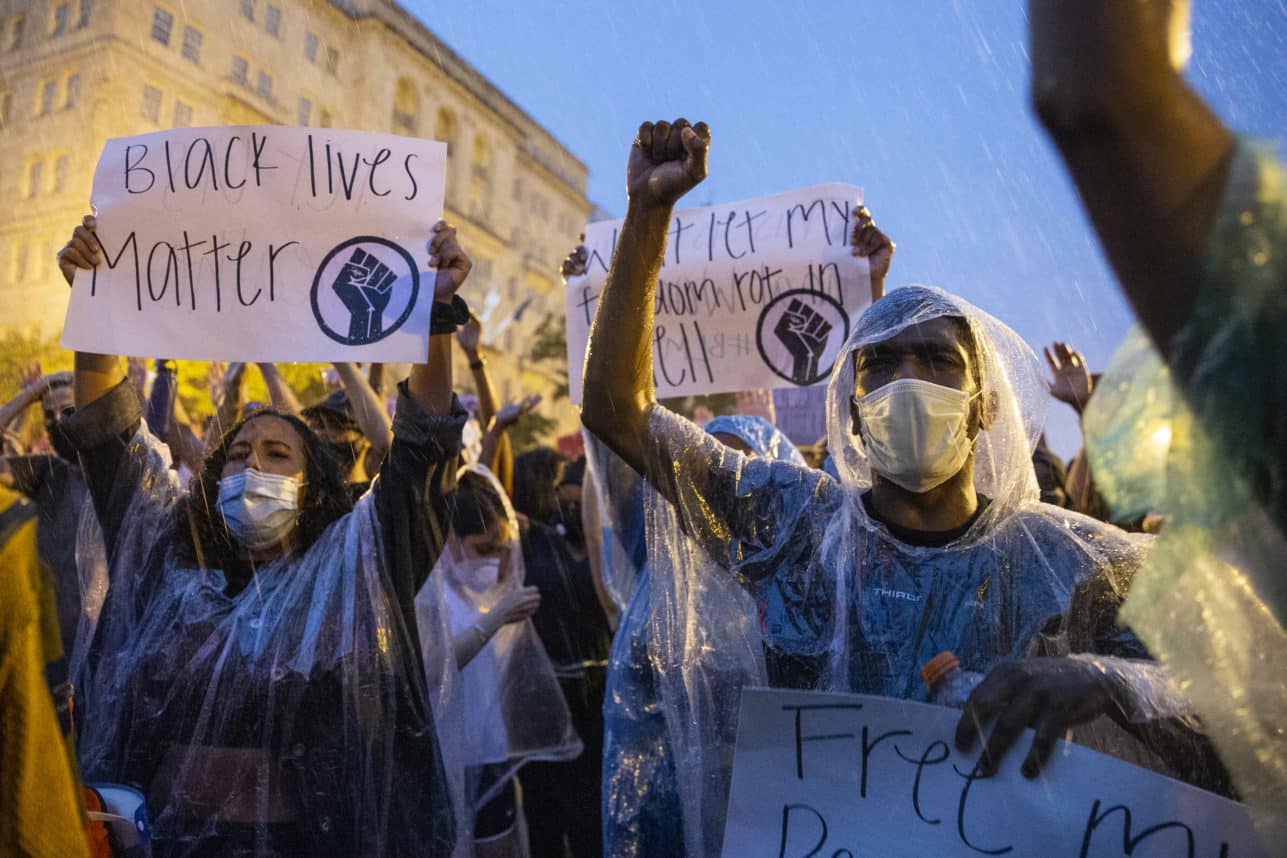
WASHINGTON, DC – JUNE 04: People gather in the rain outside of the White House for a peaceful protest against police brutality on June 4, 2020 in Washington, DC. Protests in cities throughout the country have been largely peaceful following the death of George Floyd, a black man, who died while in police custody in Minneapolis on May 25. (Photo by Sarah Silbiger/Getty Images)
The social and political landscape of the past few months is not conducive to this way of being in the world. It demands we choose a side and not back down from that perspective, no matter what. It requires us to be relentless in our doubling down, to avoid backing away from the script set for us by our political affiliation or religious ideology. Even worse, it asks us to shun nuance and distance ourselves from complexity, but it is an acceptance and understanding of nuance and complexity that has the potential to bring us back to the center and make it difficult to perpetuate extreme viewpoints.
Many of us have felt that pull over the past few months, whether we realize it or not — that pull farther left or farther right, that urge to hold tightly to our ideologies and not let go, no matter what. The endless social media bullying and virtue signaling have played an immense role in this. I’m neither a Democrat nor a Republican, and although I tend to lean left in most cases, I reserve the right to see both sides and to alter my perspective and my position when it seems that “the other side” might be making a strong or valid point.
But this isn’t seen as good behavior by either the right or the left. “You’re either with us or you’re against us” seems to be the mindset that drives both sides. Tragically, the pandemic has become more politicized than anything in recent history. Post an article from a credible source, written by a medical expert, that suggests the coronavirus may not signal the imminent death of the majority of humans and the hounds will come from the left, banners waving and teeth gnashing. Likewise, post an opinion piece about why mask-wearing should be mandated and the right will come running with accusations of the poster being anti-American and of hastening the day when we will all be required to wear burqas indefinitely.
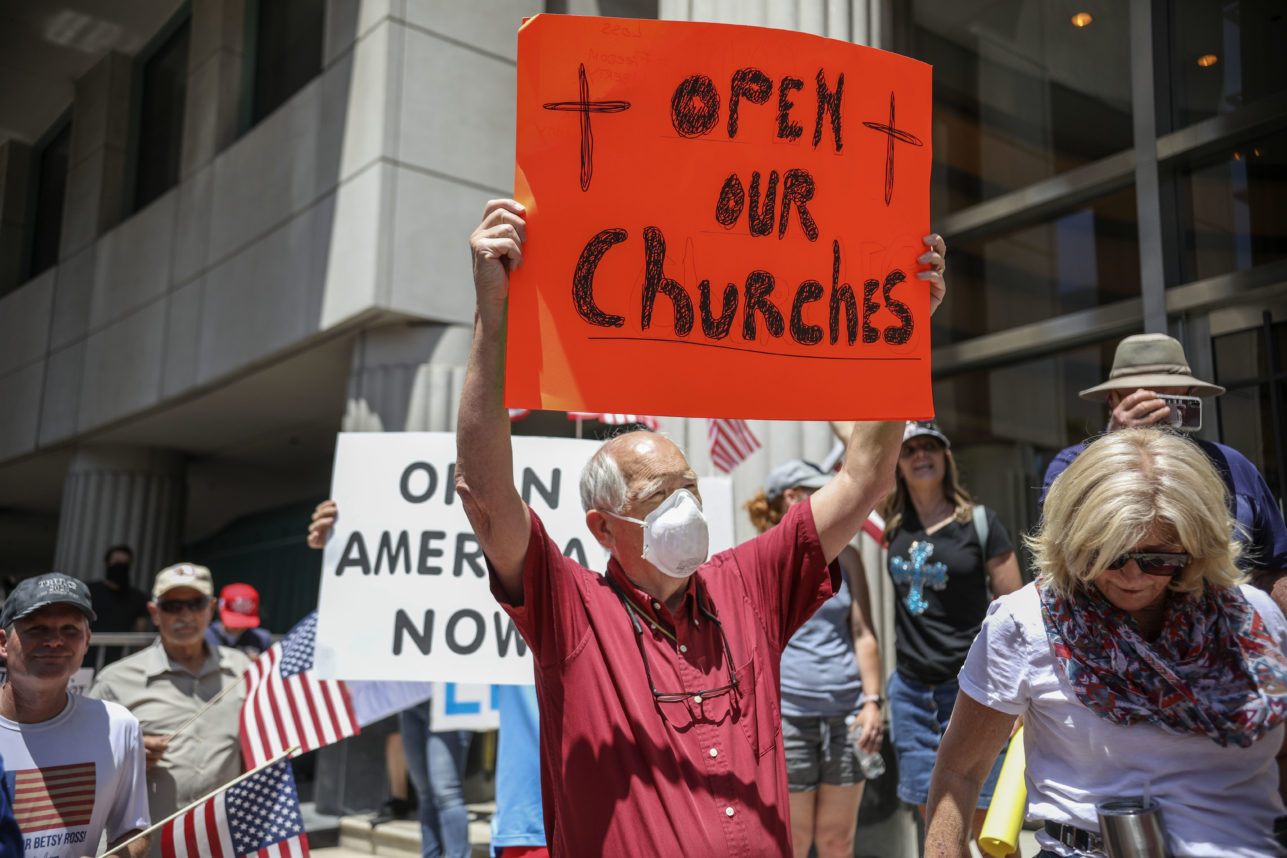
Demonstrators holding signs demanding their church to reopen, protest during a rally to re-open California and against Stay-At-Home directives on May 1, 2020 in San Diego, California. (Photo by Sandy Huffaker / AFP) (Photo by SANDY HUFFAKER/AFP via Getty Images)
Isn’t there something in between?
In no way am I suggesting the answer to our social and political turmoil is the clichéd impulse to meet in the middle or find common ground. While it may be feasible in some cases, compromise can be extremely problematic in many others. It functions under the guise of making both parties happy, giving each side a little of what they want, but in many cases, compromise results only in two dissatisfied parties, both of whom feel they sacrificed something important. The initial effect may be to disarm both parties, but the long-term consequence can be bitterness and resentment, bubbling slowly under the surface but sure to burst forth at a later date. Compromise often is little more than a makeshift bandage.
In a social and political climate that only seems to be made worse by the movement of each side to its most extreme place, it might seem strange to reject compromise as a viable solution. To be sure, there is a time and place for compromise. But this may not be the time.
Rather, it might be time to start listening to the other side. It might be time to start acknowledging that no one party or ideology has all the answers or does right 100% of the time with regard to every issue. It might be time to say, every once in a while, that maybe, just maybe the other side has a point with regard to certain issues. There is wisdom and humility in an ability to acknowledge one’s own shortcomings, blind spots and flaws. There is bravery and integrity in being able to step outside one’s self or one’s political affiliation every once in a while. This is not compromise; this is balance.
But we’ve lost our sense of balance, and after balance is lost, footing is sure to follow. Have we already lost our footing? Are we already tumbling down into the abyss?
It’s a lonely and often sad place to be, but I’ve grown grateful these past few months for my impulse to avoid extremes and to value the vantage point of seeing both sides. There is a lot to be learned from the margins, and from the spaces and silences between words and sentences. Endless media declarations of breaking news often are the antithesis of this idea. They seek to fill the silence with moral certainty, enabling and emboldening the clutching of extreme ideas on both sides. Rather than looking to what is there, they often spin words and events just enough to impose their own ideas and agendas onto the situation they claim to describe honestly. We reject the fullest version of the truth in exchange for clips and soundbites that affirm a viewpoint to which we already pay allegiance. We learn very little from this method. We build ourselves up higher and higher with the continued assurances and affirmations that we, and only we, are right — that we, and only we, know what is truly going on in this country.
Our arrogance is astounding. And it is dangerous. I can’t help but think of the biblical King Nimrod, his Babel tower tumbling down in the wake of ego, arrogance and certainty pushed to its extreme.
Are we next? Will the tall tower of American exceptionalism fall? It’s already crumbling, decaying around the edges and through the root. But it doesn’t have to be this way. It’s true that a single solution won’t repair the damage, but we have to start somewhere. Perhaps we start by listening, and by backing down from our positions of moral certainty and our hatred of differing viewpoints. Perhaps we do a little bit of midrash.
The loudest voices are not always the most authentic voices. I wonder what would happen if we moved to the margins and the borderlands, if we started to pay more attention to the words and deeds of those who don’t most readily appear in our social media newsfeeds because we have curated them carefully to reflect our own biases. I wonder what would happen if we didn’t immediately ridicule and silence the voices of those who see the world from a different vantage point. And I wonder what would happen if we put a moratorium on moral certainty?
Things can be better. But it’s going to take a lot of work and a lot of listening.
Monica Osborne is a scholar of Jewish literature and culture. She is the author of “The Midrashic Impulse and the Contemporary Literary Response to Trauma.”
At 5 p.m. on Aug. 9, approximately 45 Israeli Americans gathered outside the Israeli consulate building on Wilshire Boulevard in Westwood, calling on Israeli Prime Minister Benjamin Netanyahu to resign. They held Israeli flags and carried signs that read: “Enough with the corruption,” “Israel deserves a better leader,” “Bibi, we won’t let you take the country down.”
Drivers honked their horns, and although there were a few signs in English, most were in Hebrew and were intended to send a message to the tens of thousands of demonstrators in Israel: We support you.
“Our goal is to call out the corruption in the Israeli government and say that a prime minister who is suspected of corruption should go home,” said Tamar Forman, who arrived with her husband and four children. “We also wanted to support the protesters in Israel and show them our solidarity.”
Forman said that many of her friends and family in Israel participated in the large-scale demonstrations in Jerusalem just outside of Netanyahu’s house— one of which drew 15,000 people — calling on the prime minister to resign.
“We asked activists in Israel what they need from us,” Forman said. “We thought maybe we could try and raise money, but they said that all they want is for us to let people in the States know what’s going on in Israel.”
Netanyahu was indicted in January on corruption charges in three separate cases: bribery, fraud and breach of trust. A Jerusalem court ruled in July that his trial, which has been delayed because of the pandemic, will resume in January. He faces more than a decade in prison if convicted on all three counts. Some fear that Netanyahu will try to influence events in order to evade conviction.
Photo by Ayala Or-El
Netanyahu is sharing power in the recently formed coalition with Blue and White’s Benny Gantz. The political rivals agreed to rotate the premiership, with Netanyahu serving first, with Gantz as deputy, then Gantz stepping up after 18 months. If the coalition can’t pass a budget, new elections might be called, preventing Gantz from ever taking office. And if Netanyahu emerges with a coalition, he might make a power play for immunity.
Aimee Ginsburg Bikel, widow of the late performer Theodore Bikel, was one the protest’s organizers. Bikel lived in Israel for many years before returning to Los Angeles with her two sons.
“I was in the Israeli army and went to university in Israel,” she said. “I was very involved politically but eventually left because I was burnt out with the situation. I have not been involved with Israeli politics since then not because I don’t care but because I was overwhelmed and [had feelings] of despair.”
However, things changed when she heard about the anti-Netanyahu demonstrations in Washington, D.C., and Florida. Through a new Facebook group called UnXeptable, she was able to join a group of Israelis in the United States calling for Netanyahu’s resignation. To date, the movement has organized six demonstrations in New York, Miami, Los Angeles and San Francisco.
“We want to send a message to our brothers and sisters in Israel that we support them and that we are all united.” — Hadar Harush
Encino resident Riki Shilo told the Journal she attended the demonstration after hearing about it from friends. “The large majority of Israelis living in L.A. are Benjamin Netanyahu supporters,” she said, “so I’m not surprised not too many [came] to protest, but I had to come. It’s unheard of that a prime minister who is suspected of receiving bribes would not be forced to resign. If Netanyahu claims that he is innocent, let him first go to trial and prove it.”
“No one is calling Netanyahu guilty before he goes to trial,” Bikel said, “but a true democracy cannot be run with a leader being indicted for such a serious crime. Our main goal is to express our own feelings of disgust and anger and demand that justice be done.”
Hadar Harush attended the demonstration with her husband and her 4-year-old and 2-year-old children. She held signs in Hebrew that said: “No Left and no Right, only straight” and: “We haven’t lost our faith.”
“There are those in the community who support Benjamin Netanyahu but also they can’t stand the lack of justice,” she said. “We want to send a message to our brothers and sisters in Israel that we support them and that we are all united. My siblings and my husband’s siblings in Israel as well as our friends are demonstrating in Israel every weekend. I want to return to Israel one day and I want my children to be able to live in a true democracy, but that’s not what we have right now.”