

July 21, 2020

Sharren Haskel: On the Israeli Lobby to Promote Relations With Christian Communities Worldwide
Knesset member Sharren Haskel and Shmuel Rosner chat about the unique importance of the Lobby to Promote Relations With Christian Communities Worldwide, which is headed by Sharren.
Sharren Haskel is an Israeli member of the Knesset for Likud. She is the youngest member of Likud and the second youngest member of the 20th Knesset. She speaks English, Hebrew and French.
Follow Shmuel Rosner on Twitter.
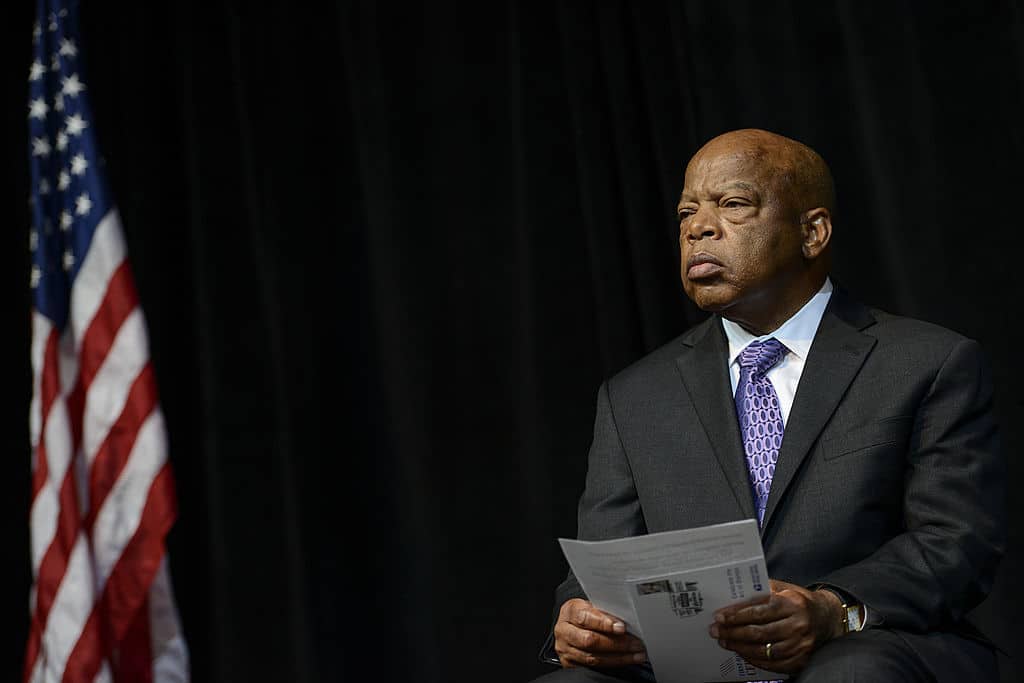
Local Jewish Community Responds to the Death of Rep. John Lewis
When civil rights leader and U.S. Rep. John Lewis (D-Ga.) died in Atlanta on July 17 at the age of 80, we reached out to some prominent members of the Los Angeles Jewish community to share their reflections.
A Kindred Spirit on the Journey for Justice
John Lewis’ brand of moral leadership is what our country needs most right now. As a young man, he “prayed with his feet” in his pursuit of civil rights. As a legislator, he was a prophetic voice nagging at our conscience and the better angels of our nature. For the Jewish community, it feels as if we lost one of our own great leaders. It’s because we did. It felt as if he was a divinely inspired, kindred spirit on the same journey for justice. May his memory be a blessing.
Sam Yebri, president, 30 Years After; board member, Jewish Community Foundation
Speaking Truth to Power, Guided by Conscience
“You are not obligated to complete the work, but neither are you free to desist from it.”(Pirkei Avot 21). To me, this teaching embodies the life lesson of John Lewis, a consistent, persistent, insistent, relentless and fearless fighter who never lost sight of his goal: the pursuit of justice and equality. John Lewis is a leader like the great prophets of the Bible. He had a special relationship with the Jewish community. Speaking at an American Jewish Committee event at the 2012 Democratic National Convention, Lewis lamented the growing schism between the Black and the Jewish communities, saying, “If we know each other and understand each other, there would not be a schism.” In Lewis’ memory and to honor his legacy, the Jewish community would do well to heed Lewis’ advice and deepen our understanding of and engagement with the Black community. John Lewis’ memory is a blessing and his life shines as a beacon for those pursuing justice and equality.
Janice Kamenir-Reznik, co-founder, Jewish World Watch; chair, Jews United for Democracy & Justice
He Put His Life on the Line for Freedom
I shed tears after Shabbos when I saw that John Lewis had passed. (We also lost civil rights organizer Rev. C.T. Vivian; two giants in one day.) I have been talking to my sons about John Lewis for as long as they have been old enough to see that fire in my eyes. I reminded them that this is a man who blazed trails for Black people and for all of us. As Jews who care deeply about our Black brothers and sisters, we stand on the shoulders of men like Lewis who teach us what real courage looks like. This is the kind of man I hope my sons will aspire to be like. Fearless, passionate, unrelenting and unforgettable.
Mayim Bialik, actress and neuroscientist
Giving Us Strength to Do the Real Work of Democracy
We lost Rep. John Lewis and Rev. C.T. Vivian, both icons of the civil rights movement, on the same day, at a moment in history when we need their ringing voices now, perhaps more than ever. Their legacies confer upon us a responsibility in this particular moment as we head toward the November elections. We need to commit ourselves to ensuring the enfranchisement of all citizens, not only with the right to vote but with the practical ability to vote. Their lives offer us an ongoing reminder that the hard work of coalition building for change can come from a place of joy and faith.
Andrea Hodos, associate director, NewGround: a Muslim-Jewish Partnership for Change
Our Moral Compass
Congressman John Lewis exemplified what it meant to be the change you wish to see, having risked so much to overcome injustice. As a 23-year-old AVODAH-nik, I sat on the floor of his Congressional office, where he told us of running from side to side during windstorms in his childhood home to keep it from blowing away. He was our moral compass, a restive soul who never stopped running and fighting for the soul of our democracy. His death must compel us to work harder for the values he shed blood and tears to realize. His legacy is a blessing.
Serena Oberstein, executive adviser with Star Insights; former president of the Los Angeles Ethics Commission
We Must Continue His Fight
John Lewis used every ounce of strength, every day of his life and all the gifts God gave him to fight for a more fair, just and loving America. I was honored to have met him when my daughters and I went to Atlanta to poll monitor for the 2018 midterms. The girls loved watching him dance hopefully and wholeheartedly, as we sang and prayed the night before Election Day at Ebenezer Baptist Church. Building a just and equitable democracy was not an empty aspiration for him. It meant health care, a living wage and voting rights for every American. It meant defeating white supremacy, the original sin of our country. It meant speaking truth to power and getting into good trouble. To honor John Lewis’ memory, we must pick up the baton and carry on, continuing the fight to realize that beautiful vision for America.
Rabbi Sharon Brous, IKAR
A Singular Source of Soul
John Lewis cried the first time I saw him speak, on a videoconference link, recalling his days as a student activist. He cried again during an interview for my book, named after Lewis’ now-famous rallying cry. And there he was again in the new documentary “John Lewis: Good Trouble,” hanging his head and weeping over his family’s history. Honoring his memory is not enough. His example should inspire all people of conscience to put their bodies in the fight for justice, starting with the fight to restore the Voting Rights Act.
Christopher Noxon, author, “Good Trouble: Lessons From the Civil Rights Playbook”
Fought for Equality for All
Judaism teaches that it is not enough to just talk the talk, we also have to walk the walk. John Lewis, a giant among humans, showed us how that was done. He supported marriage equality long before it was cool. He supported LGBTQ+ equality because he saw little difference between the civil rights movement and the fight for equality for all. May we follow his lead, be inspired by his example, and use our voices and feet to finish the work he started. Rest in Power, our teacher and ally.
Rabbi Jillian R. Cameron, Beth Chayim Chadashim
It’s Up to Us
In my office, I have a small, framed copy of the famous picture of John Lewis after his arrest in 1961 for using a “whites-only” bathroom. I look at the picture almost daily and it always makes me feel just a bit stronger and more resolute, a bit more resistant to despair. It’s up to us to live in the light of our hero’s memory. It’s up to us to make “good trouble,” to vote like our nation’s soul depends on it, to live with sacred courage. I’m glad I’ll have his picture nearby to remind me.
Rabbi Adam Greenwald, vice president for Jewish Engagement, American Jewish University; director, Maas Center for Jewish Journeys and Miller Intro to Judaism Program
Continuing to Guide Our Path
Congressman John Lewis was a leader without equal. We saw this not only in his steadfast support for ending hunger in America, but also his unwavering commitment to leading others to join him. At MAZON’s annual National Hunger Seder, in a room full of passionate leaders each offering powerful remarks, when John Lewis spoke, the room became hushed and focused. He lifted us up with his oratory, clarity and wisdom. All with a twinkle in his eye and a delicious sense of humor. We miss him. We mourn his death and we grieve for our country, which has lost a leading light. His memory will truly be a blessing, continuing to guide our path toward justice for all those facing hunger, poverty and inequity.
Abby J. Leibman, president and CEO, MAZON: A Jewish Response to Hunger
‘Don’t Get Lost in a Sea of Despair’
After the horror of the 2016 election, I immediately said, “I want to talk to Holocaust survivors and John Lewis.” Why? I wanted to know how those who lived through the darkest of nights survived to see a new dawn. John Lewis endured the worst of what America was and responded with the best of what America could be. In 2018 he tweeted, “Don’t get lost in a sea of despair. Be hopeful. Be optimistic. Our struggle is not the struggle of a day, a week, a month or a year. It is the struggle of a lifetime.” John Lewis’ struggle is our struggle. For our lifetime.
Eric Greene, writer, civil rights activist and racial equity consultant
Deep Appreciation
When I visited the National Museum of African American History and Culture on the Mall in Washington D.C. I cried for three hours straight. As I walked the main exhibit and journeyed through our American history of how we brought, abused, mistreated and attempted to grant equal rights to Black people in our country, my heart broke with deep pain and appreciation toward Congressman Lewis who envisioned and fought to create this museum for every American and generations to come. He had vision, clarity and gumption.
Rabbi Michelle Missaghieh, Temple Israel of Hollywood
His Legacy as a Beacon
As I reflect on the loss of civil rights activist Rep. John Lewis, I am humbled by his courage, sacrifice and lifelong fight against systemic racism. His spirit reminds us that we cannot sit in comfort while others suffer and that progress can only be made by taking risks and challenging all forms of injustice. Lewis’ legacy serves as a beacon guiding the tough work ahead here at the Federation and elsewhere in the civic engagement space — a reminder to strive tirelessly to live up to the humanitarian ideals and values he championed. It is my hope that his memory will continue to inspire righteousness and loving acts of kindness on our journey toward a more just society.
Mary Kohav, vice president of Community Engagement Programs, The Jewish Federation of Greater Los Angeles
The Fight Isn’t Over
Half my family are Jews from Birmingham, Alabama going back a few generations. There was a lot about life in the south that my family didn’t discuss, but I always felt a connection to and passion for the civil rights movement. Seeing leaders like John Lewis in public positions of leadership and power convinced me that those dark times were over, that our country had moved through it and into a better future. I’ve realized as an adult how hard it must have been for Lewis and his colleagues to fight — mostly alone — for decades, even until today. There is something poetic about the death of these icons in the very same year that new leaders are rising up and reminding us that the fight isn’t over. Only this time, Black leaders are less alone. It feels like we finally understand that those who are targets of injustice can’t be solely responsible for addressing its root problems.
Margalit Rosenthal, director, West Coast Region, Foundation for Jewish Camp
Stay With the Hard Question
John Lewis recalled that when he was very young he asked his parents to explain the discrimination in his small town of Troy, Ala. His parents, protecting him, tried to smooth over the discomfort, the pain. This did not satisfy young John, and he stuck with the question, refusing to normalize the Jim Crow system. This question brought him to Martin Luther King Jr. and James Lawson and a lifetime of nonviolence as a philosophy, a political practice and a way of life. He demonstrated the revolutionary capability of strategic nonviolence to overthrow Jim Crow, to desegregate bus lines and lunch counters, to win the right to vote and to win a seat in Congress. Stay with the hard question. Agitate. Stand up to racism and white supremacy aggressively and nonviolently. Make beautiful trouble. John Robert Lewis led a life worth living and emulating.
Rabbi Dr. Aryeh Cohen, professor of rabbinic literature at AJU and rabbi in residence at Bend the Arc: Jewish Action
He Allowed Us to See a Better Version of Ourselves
Many men and women played pivotal roles in leading the civil rights movement. Then there was an esteemed class of movement makers who continued to march even after the crowds died down and the hype simmered. For decades, this cadre of folks kept building toward their vision of true liberty, justice and freedom for all. Yet, we only know the names of a handful of these fearless leaders. John Lewis is one them and we grew to love him. We loved him, not just because of what he did, but because of how he did it. We loved him because he was never afraid to reveal his earnest commitment to achieving a better and equal America. We loved John Lewis, because he allowed us to see a better version of ourselves. We loved John Lewis because we knew without a doubt that he loved us.
Gamal J. Palmer, senior vp of leadership development, Jewish Federation of Greater Los Angeles
‘I Will Not Fear’
I first met John Lewis at dinner. We were seated together at a fundraiser in Washington D.C. and when I told him I was born in Alabama, he gave me a huge hug and said, “Another Southern Boy! We have to stick together!” I was all of 27, fresh-faced and newly married, and enamored by this individual with so much history and power relating to me like an old friend. The rest of the evening was spent with him regaling me with tales of the South, of being an activist, standing up for justice and what was right even if it meant getting knocked down a few times. On that night, I learned from him the same lesson I learned from our rabbis: Fear is only in the mind. It is the prophecy of the worst possible future. Hope and faith on the other hand, is the prophecy of a better tomorrow. It is hope that gives courage to march either across a river on a bridge or through the sea on dry land. It is hope and faith that change the world for the better. It’s the only thing that ever has. To him, I commend the final verse of every prayer service, the Adon Olam. It’s the verse I take with me and tuck away in my tallit bag that gives me hope as I leave the sanctuary and step into the street to stand up for what is right and just. It reminds me of Rep. Lewis. “Into God’s hand I place my spirit/For when I sleep and I wake/And with my spirit and my body/ The LORD is with me and I will not fear.” May his memory be a blessing.
Rabbi Noah Zvi Farkas, Valley Beth Shalom
Local Jewish Community Responds to the Death of Rep. John Lewis Read More »

British Jews Board of Deputies Compares China’s Treatment of Uighur Muslims to Nazi Germany
Board of Deputies of British Jews President Marie van der Zyl wrote a letter to Chinese Ambassador to Britain Liu Xiaoming, stating that his government’s treatment of Uighur Muslims is analogous to Nazi Germany.
The July 20 letter noted that the similarities include “people being forcibly loaded on to trains; beards of religious men being trimmed; women being sterilized; and the grim specter of concentration camps.”
“China risks squandering its achievements and sabotaging its own legacy if it fails to learn the lessons of history,” van der Zyl added. “The World will neither forgive nor forget a genocide against the Uyghur people.”
The letter concluded with a call for the Chinese government to release Uighur Muslims from the concentration camps and allow the camps to be investigated.
“The world is watching,” van der Zyl wrote. “The hand of history is poised. For its future, China has a choice between great glory and eternal shame. Let it choose the former.”
The letter comes after leaked drone footage from 2019 that recently resurfaced on social media showed Uighur Muslims and other minority groups handcuffed and blindfolded, being led to trains in Xinjiang, which is located in northern China. When the BBC pressed Xiaoming about the video, he said he didn’t know where the news outlet got the video.
“Sometimes you have a transfer of prisoners, in any country,” Xiaoming said. “Uighur people enjoy peaceful, harmonious coexistence with other ethnic groups of people.”
The United States announced sanctions against various Chinese government officials on July 9 because of their treatment of the Uighur Muslims.
“The United States will not stand idly by as the [Chinese Community Party] carries out human rights abuses targeted [at] Uighurs, ethnic Kazakhs, and members of other minority groups in Xinjiang, to include forced labor, arbitrary mass detention, and forced population control, and attempts to erase their culture and Muslim faith,” Secretary of State Mike Pompeo said in a statement at the time.
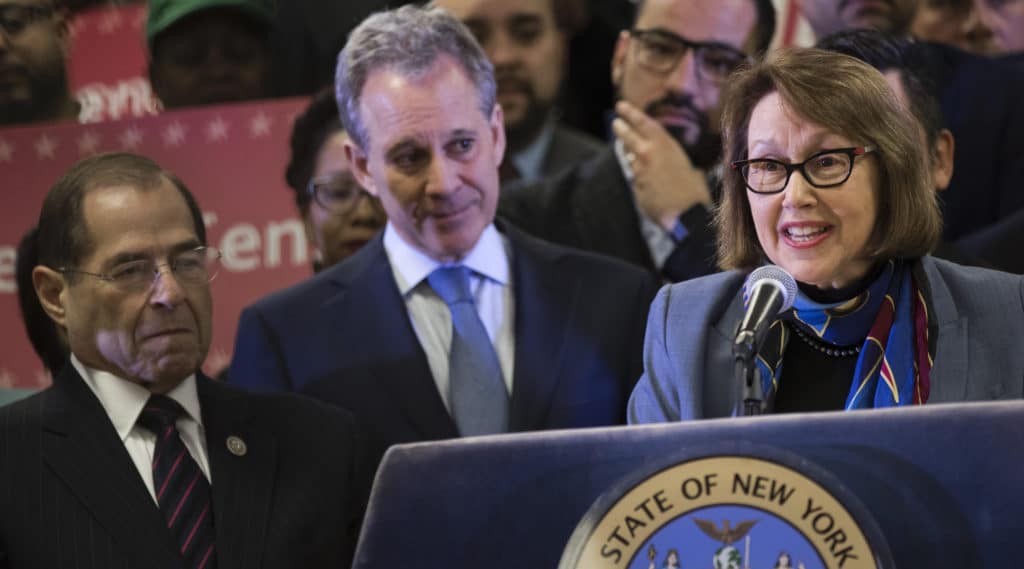
Meet Ellen Rosenblum, Oregon’s Attorney General Who Is Taking on Trump’s Federal Forces in Portland
(JTA) — From the mayor to the governor to House Speaker Nancy Pelosi, many in positions of power want to stop the Trump administration’s crackdown on protesters in Portland, Oregon.
The person in the best position to make it happen now is the state’s Jewish attorney general, Ellen Rosenblum.
On Friday, Rosenblum sued the Department of Homeland Security, Customs and Border Protection and other federal agencies, accusing them of civil rights violations. She’s also seeking a restraining order that would halt the detaining of demonstrators.
President Donald Trump has said that the officers from those agencies are there to curb unrest and protect federal property in the city after more than 50 days of protests for racial justice. He has suggested doing the same in other large cities, like Chicago and New York, over the objections of local officials.
Rosenblum says the intervention is an affront to democratic values. If her legal action succeeds, it could provide a playbook for other attorneys general who want to block the move in their jurisdictions.
“The federal administration has chosen Portland to use their scare tactics to stop our residents from protesting police brutality and from supporting the Black Lives Matter movement,” she said in a statement about the lawsuit. “Every American should be repulsed when they see this happening. If this can happen here in Portland, it can happen anywhere.”
The suit is the latest step in Rosenblum’s fight against unfair treatment and on behalf of constituents she feels are marginalized. Rosenblum is a former board member of Portland’s largest and oldest synagogue, Congregation Beth Israel, a former singer in its choir and the founder of its book club.
Fellow congregants, and others in the local Jewish community, say her response to the federal forces doesn’t surprise them.
“She believes in justice, and she’s not one to shrink from doing what needs to be done, and she does it with a smile and a very lovely demeanor,” said Ellen Bick, a friend of Rosenblum and a past president of the synagogue Sisterhood. “Every time I’ve seen her she’s just been a lovely person, even when someone asks some tough questions. She answers, and she looks to make it a win-win.”
The synagogue’s rabbi, Michael Cahana, is similarly outraged by the federal intervention in his city.
“The actions that these federal forces are using are a complete affront,” he said. “These are the kinds of tactics that are used in dictatorships, and this is something that absolutely does not belong on our streets or on the streets of any city in the United States.”
On Friday, 10 Oregon rabbis who are members of T’ruah, a liberal rabbinic human rights group, sent a letter to the acting Homeland Security secretary, Chad Wolf, calling for a withdrawal of the federal forces. They cited Jewish text in opposing “governments and ruling powers taking advantage of those whom they are charged with serving and leading.”
“We’re all afraid, and yet we are also outraged,” said Rabbi Ariel Stone, who signed the letter and convened a group called Portland Interfaith Clergy Resistance, which has been attending the downtown protests. “You have to go ahead and stand up for what’s right anyway. Nobody wants to spend their evenings this way.”
She added, “We’re downtown because there is terrible injustice going on.”
Rosenblum, 69, the first Jewish attorney general in Oregon and the first woman to have the job, makes a point of advocating for more opportunity for women and minorities. The native of Berkeley, California, is a graduate of the University of Oregon’s law school, and served as a judge for two decades before winning the 2012 election for her current post. She is running for a third term this year.
In interviews and speeches, Rosenblum talks about being part of the first Oregon Law class with more than just a handful of women, and of her fight against sexism — including an instance when, as a judge, she was mistaken for a secretary by a male lawyer.
Rosenblum’s office did not respond to requests for an interview.
“It was as if female college seniors had suddenly taken note that there were virtually no women lawyers, and that perhaps we could do something about that,” she said in a 2014 speech to the Oregon Area Jewish Committee, as reported by Oregon Jewish Life. “There was this pervasive – and wonderful – sense that the law was the best agent for social change.”
Part of the change she’s tried to make as attorney general has been in fighting the Trump administration. Rosenblum was among the attorneys general who successfully brought suit against Trump’s travel ban, and has also fought for the DACA program for undocumented immigrants who came to the United States as children.
“Let’s face it: The rule of law is under siege,” she said in a commencement address last year to her alma mater’s law school. “Or, if you think that’s an exaggeration — I don’t — at a minimum, the basic underpinnings of our democracy are being challenged as never before — at least, in my lifetime.”
Rosenblum also has encouraged the reporting of hate crimes and pressed law enforcement bodies to do better in investigating and prosecuting them. In May 2018, she established a state task force on hate crimes. In one session for victims to describe their experiences, a neo-Nazi confronted Rosenblum claiming to be a victim of hate. In response, according to the local Mail Tribune, she “gave little reaction beyond pursed lips and furrowed brows.”
In the 2014 speech to the Jewish group, she said the biblical mandate to pursue justice “is part of our DNA and what we learn if we are at all learned in Judaism.”
Her synagogue, which has also counted Oregon Sen. Ron Wyden and Rep. Suzanne Bonamici as members, has a history of encouraging public service. Another longtime congregant and local elected official, Multnomah County Commissioner Sharon Meieran, was teargassed during protests on Saturday night, according to an account she posted on Twitter.
Rosenblum also makes a point of being at Beth Israel’s annual Friday night service in honor of Martin Luther King Jr. Day. The synagogue has brought in prominent civil rights activists as speakers and the attorney general has sung with a visiting gospel choir.
“I think that she is really pleased that we’re a congregation that’s very vocal about social action and about putting our Jewish values out into the community,” Cahana said. “Singing those gospel songs in a Jewish service and connecting them to our prayers as well, and to be a part of hearing these great heroes of the civil rights movement, I think that has been something that’s been very meaningful to her.”

Poll: Two-Thirds of U.S. Voters Say They Are Pro-Israel
A poll released on July 20 found that approximately 67% of U.S. voters say they support Israel.
The poll, conducted by The Mellman Group on behalf of Democratic Majority for Israel (DMFI), found that 73% said they view Israel as a staunch ally of the United States and 62% said support for Israel is necessary for U.S. national security interests. Among Democrats, those numbers were 72% and 59%, respectively.
The poll also found that 66% of voters think U.S. aid to Israel either should stay at current levels or increase; 70% say they support the Democratic Party’s 2016 platform on Israel, which expressed opposition to the boycott, divestment and sanctions (BDS) movement and reaffirms Israel’s right to defend itself. Those numbers among Democrats were 63% and 71%, respectively. Only 18% of overall voters and 29% of Democrats said the Democratic 2020 platform should be more pro-Palestinian.
Additionally, the poll found that support of Israel is crucial to winning background states, as a generic pro-Israel Democrat beats a generic pro-Israel Republican 51% to 38% among voters in battleground states. A generic Democrat that isn’t pro-Israel loses to a generic Republican by a margin of a 44% to 40% among battleground voters.
Voters overall have a favorable view of Israel − 62% favorable to 17% unfavorable − as do Democrat voters − 57% favorable to 25% unfavorable.
“Most voters – including Democrats and those in crucial battleground states – view Israel positively, oppose cutting U.S. security assistance to Israel, prefer pro-Israel candidates, and believe the Democratic platform should remain pro-Israel,” the survey concludes. “The Democratic Party should make every effort – starting with the platform – to communicate its pro-Israel positions to voters in the coming months.”
The poll was taken July 8-13 and 1,000 voters were surveyed nationwide.
The publication of the survey comes after Jewish Telegraphic Agency (JTA) reported on July 16 that the 2020 Democratic Party platform will remain the same on Israel as the 2016 party platform; some progressive groups had advocated for the platform to condemn the Israeli occupation of the West Bank.
Poll: Two-Thirds of U.S. Voters Say They Are Pro-Israel Read More »
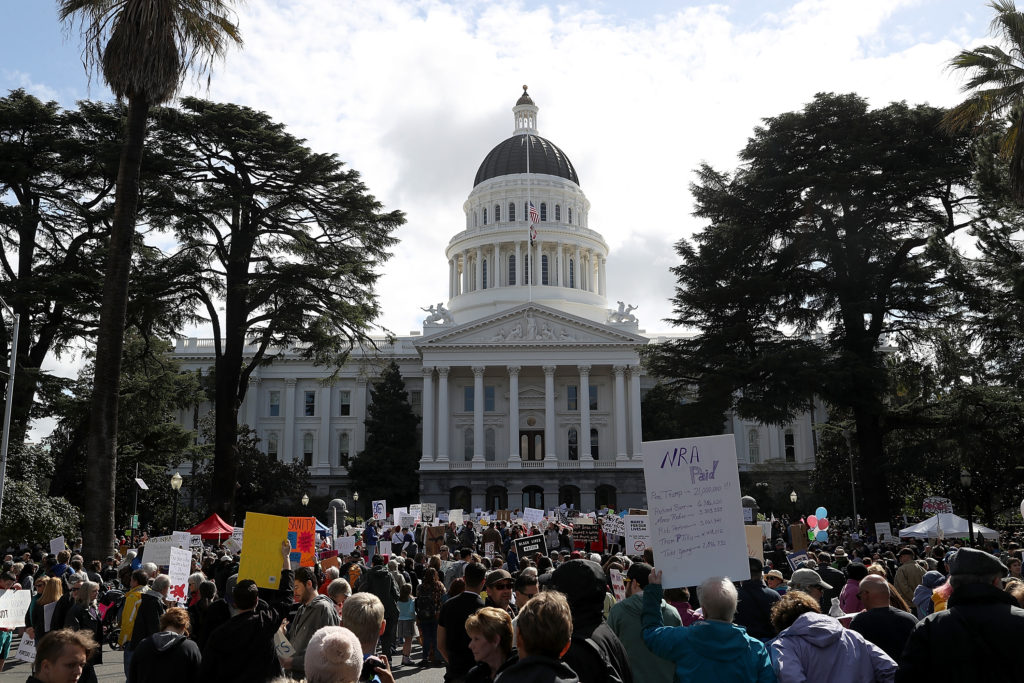
AMCHA Initiative Petitions CA Board of Education to Stop School Boards From Adopting ‘Controversial’ Ethnic Studies Curriculum
AMCHA Initiative sent a letter to the California State Board of Education (SBE) urging SBE president Dr. Linda Darling-Hammond to dissuade local school boards from adopting the current Ethnic Studies Model Curriculum (ESMC) until the state approves a revised version of the curriculum.
The letter, which contains signatures from 2,503 California residents, warns of “an unscrupulous campaign to mislead district school boards into approving and making plans to implement the divisive and highly flawed first draft of the AB 2016-mandated high school ethnic studies model curriculum.”
“The original draft promotes highly controversial political ideologies that can’t help but exacerbate ethnic divisions and foment bigotry in our schools,” the letter added. “This is not the ethnic studies curriculum that we want for our children, our school districts or our state.”
Various Jewish groups have criticized the initial ESMC draft in 2019 of glorifying the boycott, divestment and sanctions (BDS) movement and not listing anti-Semitism as a form of bigotry. The SBE shelved the current draft in response to criticism; California Gov. Gavin Newsom later said that ESMC draft will never come to fruition.
Fifteen school boards in the state have approved the 2019 ESMC draft, including Oakland Unified School Board and San Francisco Unified School Board. According to Jewish News Syndicate (JNS), Oakland School Board President Jody London said during a May 27 meeting that the resolution to adopt the ESMC draft was “unclear about what is it we are supporting.”
JNS also noted that Assemblymember Jose Medina (D), is pushing for the legislature to pass A.B. 331, which mandates that ethnic studies be a graduation requirement for state high schools, before the end of August. In 2019, Medina had delayed his bill for a year in response to the criticisms over the current ESMC draft.
A spokesperson from the SBE told the Journal in an email that the Instructional Quality Commission (IQC) will produce a revised version at an August 13 meeting and the SBE will take up the IQC’s proposal in March 2021.
“The public will have ample opportunities to provide public comment before the model curriculum is considered by the State Board of Education in March 2021,” the spokesperson wrote.

Let There Be Light With Your Own Suncatchers
June gloom has ended and the sunlight is sparkling once again. Now is the perfect time to create a few suncatchers for your home. Suncatchers are small, colorful and translucent ornaments that reflect, or “catch,” the light. They hang either in a window or on a patio, spreading the light inside like little pieces of stained glass.
I’ve made these suncatchers out of clear plastic sheets, which are remnants from some packaging I had around the house. I recommend upcycling your old plastic packaging rather than buying new materials. Clear plastic report covers also work.
While there are many ways you can add color to the plastic sheets, e.g., gluing on tissue paper or painting them, here’s a really fun and easy technique that creates wild patterns similar to tie dye. And with this tutorial, you’ll create two suncatchers at the same time.
What you’ll need:
2 clear plastic sheets
Acrylic paint, assorted colors
Scissors
Hole punch

1. Cut out two pieces of clear plastic so they are about the same size. A six-inch square is a good size to start with.

2. On one of the pieces of plastic, squeeze drops of acrylic paint in various colors. You don’t need that much paint, or need to cover up the entire sheet.

3. Place the second piece of plastic over the first one and press down. The paint will spread between the two layers and create a colorful pattern.

4. Lift off the second piece of plastic to separate the two layers. The act of lifting the plastic creates interesting striations in the paint.

5. After the paint has dried, cut the plastic sheets into any shape you wish your suncatcher to be.

6. On one end of the suncatcher, punch a hole for hanging. Thread a string through the hole, and hang it where it will catch direct sunlight.
Let There Be Light With Your Own Suncatchers Read More »

Israel Accused of Airstrike on Damascus That Killed 5 Iran-Backed Fighters
JERUSALEM (JTA) — An airstrike on Damascus that is being blamed on Israel killed five Iranian-backed fighters, a watchdog group reported.
The attack on Monday night destroyed a missile depot and hit military positions, weapons and ammunition warehouses in the Syrian capital, according to the Syrian Observatory for Human Rights, which is based in the United Kingdom.
It is not known if the dead fighters were Iranians or members of Iranian-backed groups from other countries.
Four other foreign fighters and seven members of Syria’s Air Force also were injured in the attack, two seriously, according to the report.
The state-controlled Syrian Arab News Agency, or SANA, reported that Syrian air defenses were able to shoot down the majority of the missiles fired during the “Israeli aggression.” It quoted an unnamed military source as saying that “the aggression led to the injury of seven soldiers and caused material damages.”
Israel neither confirmed nor denied the airstrikes, though it is believed to have carried out dozens of airstrikes on Syria. Syria has accused Israel of at least eight airstrikes on its territory in the past two months, the last on June 28, according to Haaretz.
Israel Accused of Airstrike on Damascus That Killed 5 Iran-Backed Fighters Read More »

Zach Banner Endorses Challah Back Girls Who Bake to Raise Funds for Social Justice Groups
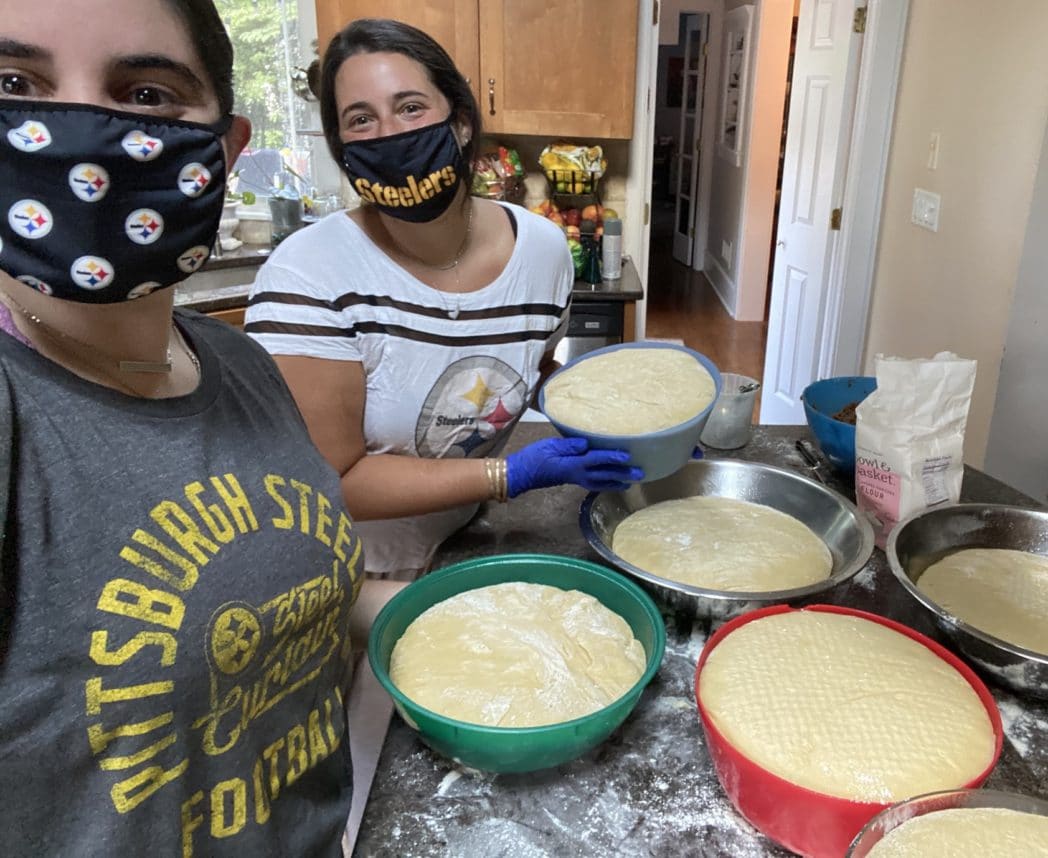
The New Jersey-based Loffman sisters — Sara, 27, Marni, 24, Hannah, 22, and Eliana, 16 — are baking and selling challah to shine a light on racism, poverty, anti-Semitism and other injustices.
Meet the Challah Back Girls. Since early June they have been baking and delivering challahs every week and sending a portion of the proceeds to different social justice groups. To date, they have received more than 200 orders, baked more than 500 challahs, gone through at least 70 bags of flour and shipped the bread to more than 130 cities in 27 states. They also have received attention from a major NFL player.
“Challah Back Girls grew when we realized there were more cooks in the kitchen — literally,” the sisters wrote in an email to the Journal. “After weeks, we started to wonder how we could contribute to both epidemics plaguing our country: COVID-19 and anti-Black racism. It was important to us that the community send our money and support to organizations and communities who were leading the charge.”
The challahs are baked in their family kitchen, and while the business has not received an official hechsher, according to the Challah Back Girls’ website, the kitchen is strictly kosher, they use only pareve equipment and ingredients (which are nut free), and they bake while wearing masks and gloves.

Hannah started to bake consistently after Binghamton University canceled classes because of COVID-19. She and her sisters volunteered to donate challah to local potluck Shabbats. They also donated challahs to first responders and frontline workers who were working around the clock. In order to get the challah deliveries out on time, it was a case of all hands on deck (washed, of course).
Sara started “brainstorming marketing and outreach techniques” to get the word out. Marni’s “commitment to equity and improving quality of life for those around her” motivated the sisters to find causes outside the Jewish community. Eliana used her “Gen-Z perspective” to organize in innovative ways.
They created the @ChallahBackGirls Facebook page, which now has more than 10,000 followers and you can watch their baking updates on Instagram @WeLoffToTravel. They also created an easy-to-use order form on their website, where you can choose two challahs for $16. The choices are plain, Everything But the Bagel (A Trader Joe’s staple), coffee crumb or chocolate chip. Payments can be made through Venmo or CashApp. The challahs are delivered locally in Bergen County, N.J., and contact-free every Friday afternoon. If you want challahs delivered to Los Angeles (or anywhere else in the country), orders must be submitted by 9 a.m. EDT that Wednesday.
https://www.instagram.com/p/CCB-s8sj5cd/?utm_source=ig_web_copy_link
Among the organizations the Challah Back Girls have raised funds for are the Okra Project, which helps Black trans chefs cook healthy home-cooked meals; the Loveland Foundation, which provides essential therapy funds to Black women and girls; and Everyone Home DC, which provides housing solutions and support services to homeless families or those that run the risk of becoming homeless. Marni works full time for Everyone Home DC.
“We wanted to find a way to combine spreading the challah love each week while supporting the work being done right now to address discrimination, poverty [and] racism,” the sisters said.
But they aren’t just all about the challah. They also are die-hard Pittsburgh Steeler supporters and have season tickets. And yes, they do shlep seven hours each way to attend every home game. So, when they heard Steelers offensive tackle Zach Banner condemn anti-Semitism on July 8, they knew exactly where to donate next. Since July 13, their proceeds have gone to Banner’s B3 Foundation.
“Zach Banner works to address critical social issues starting with youth empowerment, and has advocated for adding the Black Lives Matter decal to the Steelers’ helmet,” the sisters said. “He does this all while being one of the few non-Jews who spoke out against this recent wave of anti-Semitic rhetoric …. We are so excited though about the power of our movements when they see the intersection of all forms of prejudice and speak out against white supremacy whether it’s directed at Jewish people, Black people, Muslim people, Latinx people [or] trans/LGBTQ+ people.”
When the sisters told the B3 Foundation they would be sending a donation — and challah — to Banner’s foundation, the football player weighed in.
“These incredible women have used their passion and love to raise money for a lot of organizations, especially the ones who are supporting the Black Lives Matter movement,” Banner said in a Twitter video to his 44,000 plus followers on July 15. “This is gonna be my first time eating challah bread and I’m so excited. God Bless. Thank you, ladies!”
Banner also tasted challah for the first time this week. Watch his reaction here:
Sarah Bergstrom, vice president of B3 Foundation and an old friend of Banner’s, told the Journal she was thrilled the Challah Back Girls had chosen to support B3.
“In the middle of a pandemic with so much going on in the world, for them to spend hours and hours literally up till midnight baking, it’s been such a joy to watch and that they would donate some of their proceeds to us is an honor,” she said.
The Challah Back Girls said none of this would be possible without their parents, Clark and Caryn, who taught them the importance of challah baking, inclusion, hospitality and a well-working website. They hope customers enjoy breaking bread and go on to support their own communities.
“Though we are all very different, we share a love of people and cultivating deep empathy,” the sisters said. “This project is one way to learn more about the amazing work organizations across the country are doing to deepen our capacity to humanize and support each other …. Our name, Challah Back Girls, is as true to the bone (or dough) as it sounds: girls who give back through challah.”
You can learn more about the Challah Back Girls and order challah via their website.