fbpx

May 1, 2020

Letters: Israel’s Unity Government, The Reopening Dilemma

Israel’s Unity Government
Shmuel Rosner describes the current governmental arrangement between Benjamin Netanyahu and Benny Gantz as a camel-opotamus (“The Camel-opotamus: A Primer,” April 24). I agree that it was a necessary measure to gain stability during a turbulent time by creating a hybrid government. However, I also believe that either side may end up deviating from the agreement if it is in the best interests of his party or himself. In my opinion, this pact is not meant to last. It’s true that this agreement dilutes the authority of each party when in effect, but it is essential during these times.
Jacob Sostchen, Los Angeles

Although not everyone agrees with this assessment, we at Fuente Latina take the view that the unity government is good news.

If all goes well, the coalition government between Prime Minister Benjamin Netanyahu and rival Benny Gantz could have greater internal consensus than its predecessors.

For the past five years, Israel has been ruled by a right-wing coalition rife with disagreements and disputes; the new development means that it now could be run by a shared center-right government, in which each of the two men would take turns in the post of prime minister for alternating terms of 18 months.

However, the announcement of the new unity government has not been welcomed by many voters of Gantz’s Blue and White Party, the broad center coalition that was almost tied with Likud in three bitter consecutive electoral calls and that broke up when leader Gantz decided to agree with Netanyahu.

The former military chief announced on March 26 that he was joining Netanyahu because, he said, the combination of the coronavirus crisis and the various threats to Israeli democracy required atypical decisions and actions.

The news landed like a bomb. His allies accused him of stealing votes from his electorate and warned him that Netanyahu could crush him politically, but Gantz insisted that he was convinced of what he was doing because he was putting Israel ahead of his own interests.

Throughout the past year, Gantz has labeled Netanyahu as dangerous for Israel and promised he would never be a part of a government led by a prime minister who is under indictment for corruption charges.

Netanyahu, on the other hand, has called Gantz weak, slow and lacking in skill to lead the country.

With this new agreement, the former enemies — now allies — are going to have to make political decisions together. If that doesn’t paralyze the country, it can only be good.
Leah Soibel, Founder & CEO Fuenta Latina, via email

Column Brought Back Memories
Months ago, a piece on friendship by Mark Schiff ran in the Journal. It prompted me to share an indelible memory (“The Perfect Circle,” Feb. 7).

It happened many years ago at the Brandeis Institute. I was approached by a man. We spent time chitchatting and touched on many things that Shabbat afternoon. Then, there was another Saturday at Brandeis when the same thing happened — we sat on a bench chatting. This was heaven for me, who has speech difficulties and other handicaps.

Quickly, the man became my friend and I started to call him Pop (my dad had died years before). Pop and his wife no longer attended the institute. I got his phone number and this marked the beginning of many phone calls between Pop and me. Our friendship spanned several years until he died.

One of the many that gifts Pop gave me was allowing me to express whatever was on my mind. After our pleasantries of “How are you?” he would ask, “How are you really?” and I was off to the races. Pop’s concern was palpable. I once held a high-ranking position, for a person like me. I told Pop that I wanted to quit the job. His advice was to stick with it. I’m so thankful for that advice. It was absolutely the best.

Here’s to friendships like mine with Pop. May others be so lucky.
Susan Cohn, via email

Jewish Ethical Questions
Thank you, Rabbi Jason Weiner, for delineating the cost-benefit analysis a person must make before risking one’s life for the sake of our community as well as humanity, especially since human life is so powerfully valued in Judaism (“Jewish Ethical Questions Around Developing a Coronavirus Vaccine,” April 24).

Tangentially, in these extraordinary times, we have both the opportunity to risk our lives in the battle against an invisible foe, in the tradition of Sarah Aaronsohn, who, after witnessing the horrors of the Armenian genocide and Turkish oppression of Palestinian Jews, spied for the British, was captured, tortured and killed herself; and/or to perform simple acts of kindness, a Kiddush HaShem, that now take on elevated importance.

For instance, my husband, Eli, a psychiatrist, risks COVID-19 exposure in order to help patients at the Kaiser facility in Chinatown who are suffering from stress and mental illness. I shelter in place, and every afternoon, I do movements to world music on our balcony. From the street, a Muslim woman in a hijab with two little girls wave at me. The little girls watch my movements, then join in. Soon, the mother moves, too. Spontaneously, we form a unity. Maybe it will carry over into ordinary times.

So many choices and opportunities.
Mina Friedler, Venicec

The Reopening Dilemma
In his analysis of how political leaders will “reopen” the country, kudos to David Suissa when he writes, “They can announce all the gradual ‘openings’ they want, but none of it will matter, because it’s not up to them. It’s up to us. It’s up to the people who will actually go out and do the mingling and consuming.” (“No One Can Just ‘Reopen’ Our Nation,” April 24).

And when will that occur? It’ll happen when we decide it’s safe for us and our loved ones to resume living the lives that we enjoyed before the COVID-19 outbreak.

And Suissa rightly and repeatedly points to our lack of preparedness as directly related to the “six weeks” it took to get the government to respond to what was universal knowledge of the forthcoming epidemic.

The only problem I have with the description of events is his assignment of blame upon “… our fearless leaders — whether they be the president, governors, mayors, health authorities or civic and community leaders.” As if the nation’s tardy response was the shared result of a weak group of leaders.

Later in this otherwise excellent description of events, blame was further blurred by describing the culprits in our nation’s tardy response to the deadly virus as “political leaders” and “bureaucracies.”

Let’s face it. There was only one person responsible for our country’s tragic six-week late response to the epidemic: President Donald Trump.

Suissa comments that “Six weeks too late” is the phrase that will forever haunt him when he looks back at the devastation of COVID-19. I share Suissa’s sentiment with the addition that I will forever be haunted by the weak, uninformed and harmful lack of leadership provided by Trump at the outset and continuing historical threat to the health and welfare of all of our country’s citizens.
Stu Bernstein, Santa Monica

Outdoor Minyans
I have seen several reports indicating that outdoor transmission of COVID-19 is rare. If that’s true, and perhaps the studies are too preliminary to be certain, wouldn’t that imply that it would be OK to have minyanim outdoors? It would probably have to be without Torah reading, as that would entail close contact.

But it’s perfectly easy to have a minyan in an outdoor space, and most shuls in Los Angeles at least have a parking lot.

For those of us saying Kaddish, it would be a blessing.
Richard Samuelson, Pasadena

Letters: Israel’s Unity Government, The Reopening Dilemma Read More »
Orthodox Jews Are Being Scapegoated for COVID-19, ADL Reports

The Anti-Defamation League (ADL) published a report on April 29 highlighting efforts on social media to scapegoat Charedi and Orthodox Jewish communities for the COVID-19 pandemic.

The report explains there are Facebook comments accusing all Charedi and Orthodox Jews of disregarding social distancing measures and spreading the virus. There are also posts calling for Charedi and Orthodox communities to be isolated from everybody else.

A Facebook comment cited in the report states, “They [Charedi and Orthodox Jews] don’t really give a damn about anyone but themselves, and it is time to forcibly contain these people.”

Other posts advocate for Charedi and Orthodox Jews to be denied medical treatment; the report cites a Facebook comment that reads, “Why are we wasting tests and medical supplies on a community that refuses to follow the rules??” Some posts called for “law enforcement officials to use water hoses and tear gas to stop Haredi and Orthodox community members from gathering,” according to the report, as well as compare Charedi and Orthodox rabbis to Adolf Hitler.

The report states that such posts can be found in “mainstream community Facebook groups that purport to discuss public policy issues, but instead quickly morph into forums that enable Jew hatred, both veiled and overt.” Politicians also participate in these forums and don’t condemn these anti-Semitic comments, thus enabling the anti-Semitism to continue, according to the report.

The report acknowledges that although some members of the Charedi and Orthodox communities have flaunted social distancing measures, most have been following these measures.

“These aberrations are not unique to the Haredi or Orthodox communities,” the report states. “Nevertheless, and as too often is the case, the bad acts of a few have been widely attributed to an entire community — leading many to conclude that the Orthodox community as a whole is collectively failing to adhere to public health directives and is therefore responsible for recklessly or even intentionally attempting to spread COVID-19 — an untrue and alarming allegation reminiscent of age-old anti-Semitic tropes blaming Jews for spreading filth and plague.”

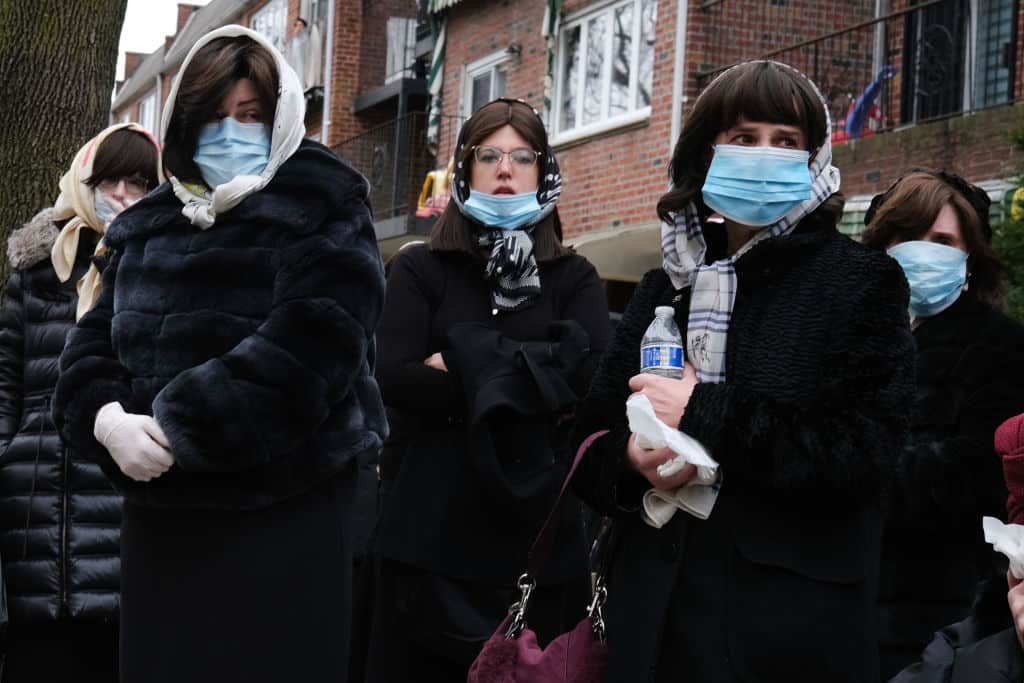
The report comes after New York City Mayor Bill de Blasio tweeted in response to a large funeral gathering for a rabbi that died of COVID-19 complications, “My message to the Jewish community, and all communities, is this simple: the time for warnings has passed. I have instructed the NYPD to proceed immediately to summons or even arrest those who gather in large groups.” Videos of the funeral procession showed thousands of people not following social distancing guidelines.

Several Jewish groups and leaders have condemned de Blasio’s remarks, arguing that he unfairly singled out the Jewish community. However, two Chasidic synagogues issued letters on April 30 defending de Blasio from accusations of anti-Semitism.

“The close relationship between Mr. De Blasio and our community go back close to two decades, during which time we have come to know, respect and appreciate his understanding and sensitivity to the unique needs of our community,” Yetev Lev D’Satmar President Mayer Rispler wrote. “We consider him a dear friend and pray for his success.”

Orthodox Jews Are Being Scapegoated for COVID-19, ADL Reports Read More »

Chabad Delivers Shabbat Meals During Lockdown

As the coronavirus shelter-in-place order continues, Chabad congregations are delivering Shabbat meals around Los Angeles to hundreds of people who are unable to cook for themselves.

“This is not only for people who don’t have money,” Rabbi Levi Raichik of Chabad of Hancock Park, told the Journal.

Chabad of Hancock Park, also known as Congregation Levi Yitzchok, together with Bais Bezalel in Pico-Robertson and Chabad of Malibu’s Rabbi Levi Cunin, is running the program.

The initiative began as an effort to provide Passover meals to people in need, especially to the elderly and single. With the support of donors and volunteers, they delivered ready-made meals to people all over the city.

They decided to continue the program after Passover, in an effort to bring the light of Shabbat into people’s homes. “It brings a taste of Moshiach and a taste of Shabbat into people’s houses,” Bais Bezalel’s Rabbi Moshe Levin said. “It makes a difference in that person’s day in a real way.”

The volunteers have been cooking the meals out of Yeshiva Ohr Elchonon Chabad’s kitchen in the Fairfax district, and supporters have donated money to buy the food necessary to prepare the meals. Others have given their time to deliver the meals.

Photo by Ryan Torok

“A lot of people in the city of L.A. came through to make this initiative work,” Raichik said. “They opened themselves, their pockets, to make it happen. This was a community effort.”

His wife, Miriam, said the program give people the opportunity to fulfill the mitzvah of welcoming visitors. “You get to feed a guest,” she said. “You get the mitzvah.”

Raichik added that if someone calls minutes before sundown, requesting a meal, Chabad will get it to them, even if it means leaving their car behind and walking home so as not to drive on Shabbat. That’s exactly what happened right before Passover, Raichik said.

“The holiday started at 7:03 on Wednesday. The last person got their meal at 6:53. That’s what it is about,” he said. “Chabadniks will do that. They will walk home so that someone should get their meal. It’s ingrained in them. The other person comes first.”

Chabad Delivers Shabbat Meals During Lockdown Read More »

Hasidic Leaders Defend New York Mayor From Anti-Semitism Allegations

Two Hasidic synagogues defended New York Mayor Bill de Blasio from charges of anti-Semitism and called on members of their communities to adhere to government social distancing requirements.

The letters – issued on Thursday by two rival factions of the Satmar Hasidic community in the Williamsburg neighborhood of Brooklyn – offered praise for the mayor. De Blasio, who has long enjoyed a close relationship with the Hasidic community, was widely criticized this week for singling out “the Jewish community” after a large Hasidic funeral drew a crowd of thousands into the street. Both letters denounced de Blasio’s critics, in particular those who accused the mayor of anti-Semitism, while calling on their communities to work with law enforcement to avoid behavior that endangers lives.

“Our positions remain consistent,” Mayer Rispler, a leader of the Aronim faction, wrote. “We do not condone any behavior that puts people at risk and pledge to keep working alongside the brave men and women of the NYPD in addressing and eliminating any such occurrences.”

“At the same time, we want to disavow the attacks and derogatory language against our mayor, from people from outside the community and from reckless people among us,” Shaul Perlstein, a leader of the Zaloynim faction, wrote in a letter that was shared widely on Twitter. “We call upon the entire community not to be drawn into their views and not be influenced by those big-mouths on hotlines and the internet who are trying to kindle a fire of hate, it shall never happen.”

Members of the Satmar Hasidic Jewish community in Brooklyn, photo by REUTERS/Stephanie Keith

The letters come at the end of a week in which the mayor has come under withering criticism from the Jewish community over his tweet. Dozens of Jewish leaders signed a letter this week asking for a meeting, saying the mayor engaged in “scapegoating” the Jewish community, playing into anti-Semitic tropes.

But the letters from the Satmar synagogues served as a public reminder that the community’s leadership remained in lockstep with the mayor.

“The close relationship between Mr. De Blasio and our community go back close to two decades, during which time we have come to know, respect and appreciate his understanding and sensitivity to the unique needs of our community,” Rispler wrote. “We consider him a dear friend and pray for his success.”

Hasidic Leaders Defend New York Mayor From Anti-Semitism Allegations Read More »

Newsom Says Shelter-in-Place Restrictions Could Be Eased in ‘Days’

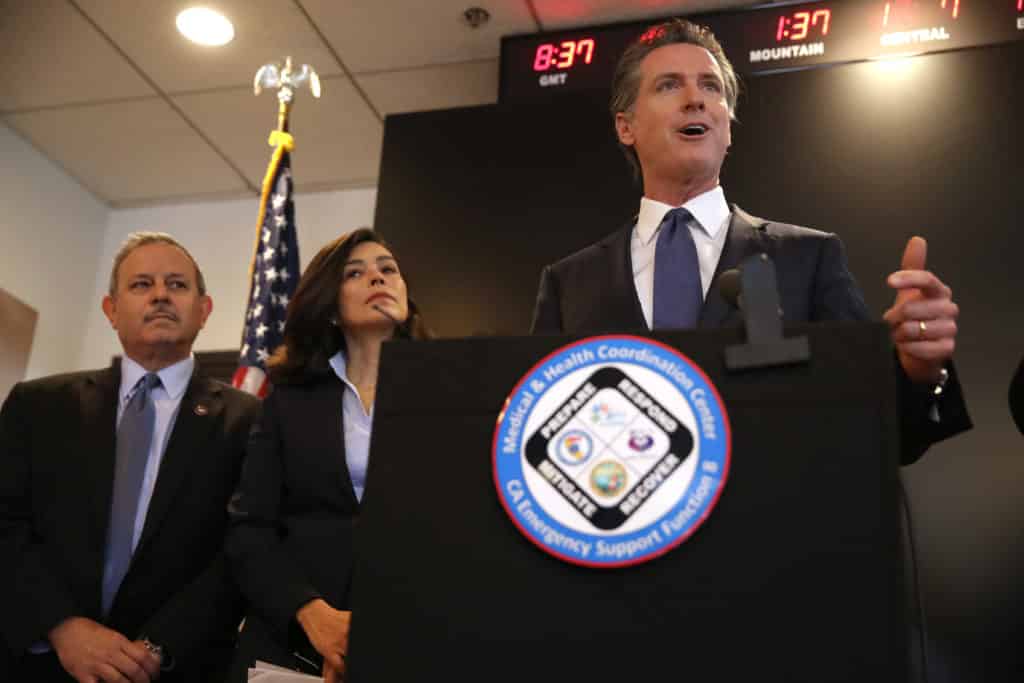
California Gov. Gavin Newsom, a Democrat, said in a May 1 press briefing that California’s shelter-in-place order could start to be eased in a matter of “days, not weeks.”

Newsom said he would make an announcement about it sometime next week.

“We said ‘weeks, not months’ about four or five days ago,” he said. “I want to say ‘many days, not weeks.’ As long as we continue to be prudent and thoughtful in certain modifications, I think we’ll be making some announcements.”

The changes to the shelter-in-place order will be “significant,” Newsom said, as retail, hospitals and restaurants will likely be allowed to re-open, under the condition that they can implement social distancing measures.

Additionally, Newsom said that he could start lifting his closure of Orange County beaches on May 4 or 5, provided that people don’t crowd the beaches over the weekend.

“The only thing that is assured to advance the spread of the virus is thousands of people congregating together,” he said.

Newsom expressed optimism over the latest data showing that there was a 2% decline in hospitalizations over the past 24 hours and intensive care unit (ICU) cases were flat. However, the number of cases and deaths are almost as 50,000 and 2,000, respectively.

He urged those protesting the shelter-in-place to order to wear masks and observe social distancing, warning that not doing so could set the state back on the progress it’s made against COVID-19.

“We can screw all that up, we can set all that back, by making bad decisions,” Newsom said.

Los Angeles County officials announced in a May 1 press briefing that there were 62 new COVID-19 deaths in the county and 1,065 new cases, bringing the county totals to 1,172 deaths and 24,215 cases.

Newsom Says Shelter-in-Place Restrictions Could Be Eased in ‘Days’ Read More »

Israeli Humanitarian Group Joins Efforts to Combat Coronavirus-Related Hunger in California

IsraAID is expanding its reach from international disaster relief to helping in the United States as the COVID-19 outbreak has seen requests at food banks skyrocket.

“What happened now is an unprecedented disaster in the United States,” said Seth Davis, executive director of the nongovernmental group IsraAID U.S. “We felt it was important to activate our local members. There was a huge gap because food pantries were seeing a decrease in volunteers, and yet there was huge increase in need for food.”

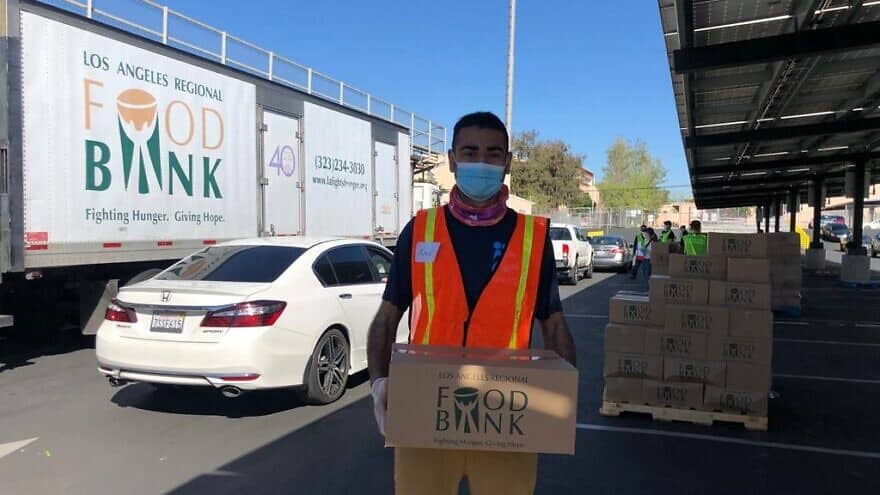
Working with several other partners, including the Merage Institute and Shalom Corps, IsraAID reached out to local community members and asked for volunteers to help pack and distribute boxes of food on behalf of the Los Angeles Regional Food Bank. The boxes are distributed at Los Angeles public schools with parents coming to pick up prepared school lunches for their children. Each box contains enough food to feed a family of four for one week.

Some IsraAID volunteers help in the warehouse sorting food while others are on the front lines of the distribution—putting boxes directly into the cars of families when they arrive to get the food.

According to Davis, in just the first week, “we facilitated 30 volunteers and assisted with the distribution of 21,000 boxes, which feeds approximately 58,000 people. It’s expanding very fast.”

Because many children rely on the Los Angeles Unified School District for both breakfast and lunch, IsraAID asked the Modern Orthodox Pico-Robertson section for assistance.

Flora Glouberman, chair of the Chesed Committee at Young Israel of Century City, has been organizing support initiatives for area residents. When she previously asked for volunteers to shop for the elderly or immune-compromised, she had more helpers sign up than people who needed help.

When she heard about the new food-distribution efforts from her rabbi, Rabbi Elazar Mushkin, she immediately shared it.

“I thought it was a real kiddush Hashem [“sanctification of God’s name”]; there’s a real need to help everybody,” she said. “Whenever there is a crisis, it’s beautiful to see how many are willing to go out and help.”

Los Angeles isn’t the only place where IsraAID is stepping up their efforts. They are also helping with food-distribution programs in San Jose and the San Francisco Bay region, and in San Diego.

The organization is also looking to assist with the emotional impact of the COVID-19 outbreak, particularly in hard-hit areas of New York.

“There will be a high level of trauma that will need to be dealt with, and there has not enough talk about mental-health [issues] that people will endure,” said Davis. “It will take years to bounce back, so we are now assessing which partners to work with so we can do this over the next year.”

Israeli Humanitarian Group Joins Efforts to Combat Coronavirus-Related Hunger in California Read More »

david suissa podcast curious times

Pandemic Times Episode 31: How do we show up when we’re not allowed to?

New David Suissa Podcast Every Morning at 11am.

A reflection on the freedom to “show up” and how 12 essential heroes are showing up and making a difference.

How do we manage our lives during the Coronavirus crisis? How do we keep our sanity? How do we use this quarantine to bring out the best in ourselves? Tune in every day and share your stories with podcast@jewishjournal.com.

Pandemic Times Episode 31: How do we show up when we’re not allowed to? Read More »

Cruz Says U.S. Cooperation With Israel on COVID-19 Necessary to ‘Decouple’ From China

Sen. Ted Cruz (R-Tex.) joined Jewish Institute for National Security of America (JINSA) on April 29 to discuss why it was important for the United States to cooperate with Israel on COVID-19 resources.

On April 16, Cruz and Sen. Chris Coons (D-Del.) pushed for $12 million to be appropriated toward such cooperation with Israel. Cruz said on the call that the partnership with Israel is necessary to wean the U.S. off its dependence on China for personal protective equipment (PPE) and pharmaceuticals.

“We saw just how problematic that supply chain is in the midst of this pandemic,” he said, citing a state-controlled newspaper in China stating the Chinese government would cut off medication from the U.S. if the Trump administration took action against China over the pandemic.

“That would not merely be economic warfare, that would be real warfare,” Cruz added.

The Texas senator also pointed out that the majority of the world’s PPE is manufactured in China; China has been hoarding PPE since the pandemic started, resulting in shortages.

Cruz said he has been warning for years that China is the United States’ chief geopolitical rival, accusing China of stealing U.S. military technology to avoid research and development costs.

“Never before in the history of the world has a nation-state … employed an intellectual property theft as a strategy integral to their national defense,” he argued.

The Texan also pointed to the Chinese government putting millions of Uighur Muslims into concentration camps as reason to decouple from China, as well as China’s Belt and Road Initiative (BRI) of offering cheap and easy credit for governments worldwide to invest in infrastructure. Cruz argued that BRI has caused governments to take on debt they are unable to pay back to China, giving the Chinese government economic leverage over those countries.

“That threat is enormous,” Cruz said.

Cruz blamed China for causing COVID-19 to become a global pandemic, arguing China silenced individuals in Wuhan who were raising alarm bells about the spread of the coronavirus in December and January.

“There’s a real possibility that this could have been contained as a regional outbreak rather than as a worldwide pandemic,” he said. “But the Chinese government, they were more concerned about saving face than saving lives.”

For the U.S. to start decoupling from China, the U.S. needs to increase its cooperation with Israel in fighting COVID-19, Cruz argued. “Israel is a world leader when it comes to pharmaceuticals and medicine,” Cruz said, pointing to the fact that half of civilian research in Israel is devoted to life sciences.

“They [Israel] have roughly 1,000 medical devices, and that’s second only to the United States,” the Texas senator added.

Under Cruz and Coons’ initiative, the U.S. would provide $12 million toward cooperation with Israel over the span of 2021 to 2023; Israel would match that $12 million.

“I think standing with Israel is critical, not only for Israel but for [the] U.S.’ national defense,” Cruz said.

Cruz Says U.S. Cooperation With Israel on COVID-19 Necessary to ‘Decouple’ From China Read More »

Surviving COVID-19: Special Interview with Eli Beer of United Hatzalah

Together with Rabbi Yonah Premier Episode


Surviving COVID19 with Special Guest Eli Beer • VIDEO


In the first episode of Together with Rabbi Yonah we speak with the incredible and inspiring Eli Beer about his experience surviving COVID19. Eli is the President of United Hatzalah in Israel, the volunteer paramedic organization.

In this video you will hear his incredible saga of how a person dedicated to saving lives was himself saved miraculously by doctors in Miami.

This moving and powerful story of survival and his message are potent medicine during this difficult time. Eli heard the doctors in the ICU unit deciding his fate. Then he prayed to God for healing.

Eli also shares a heartwarming story about a Hatzalah volunteer helping a Holocaust survivor and much more.

Simply put, Eli’s amazing recovery is teaches us that when God hasn’t decided on bringing someone back home, that our actions, prayers and good deeds can and do make a difference.

On Sunday, United Hatzalah is raising critical funds for first responder supplies. You can watch this special streaming event with Jay Leno starting on Sunday, May 3, at 11 a.m PT, 1PM ET. Check out SavingLivesSunday.com

Watch on Facebook and YouTube

Surviving COVID-19: Special Interview with Eli Beer of United Hatzalah Read More »

Virtual Coronavirus Benefit to Raise Funds for United Hatzalah of Israel

Mentalist Lior Suchard (“Brain Games”), Rona Lee Shimon (“Fauda”), Broadway star Adam Kantor (“Rent”), singer Dudu Aharon and NBA star Amar’e Stoudemire and other stars will appear in a virtual event on May 1 to support the United Hatzalah of Israel’s’ Coronavirus Emergency Response Fund. Hosted by Jay Leno, Saving Lives Sunday: A Streaming Event Honoring First Responders and Welcoming Home Eli Beer will stream free of charge here and United Hatzalah’s YouTube page at 10 a.m. PST.

“’Saving Lives Sunday’ is a way to bring people together during a time of enforced distance, stress, and uncertainty,” said United Hatzalah of Israel’s Vice President of Operations

Saving Lives Sunday is a way to bring people together during a time of enforced distance, stress, and uncertainty,” United Hatzalah of Israel’s Vice President of Operations Dov Maisel said in a statement. “Our volunteers have been putting themselves and their families at risk every day by responding to all types of medical emergencies as well as undertaking an incredible amount of humanitarian assistance calls since the virus swept across the globe. While we cannot come together in person to say thank you and show our support, we can still come together and show our gratitude through this virtual medium.”

https://www.youtube.com/watch?v=IwzwmtlCoqM

Produced by Adam Kantor (who starred on Broadway in the Tony Award-winning musical “The Band’s Visit,” “Saving Lives Sunday” will also feature volunteers from United Hatzalah who are on the front lines of the corona campaign will be telling their stories.

During the event, there will also be a special tribute to Eli Beer, the Founder and President of United Hatzalah of Israel, who contracted the Covid-19 Coronavirus six weeks ago while in Miami on a fundraising trip to help the organization. Eli was in serious condition in the hospital and was placed on a ventilator in an induced coma for almost 30 days.

“Eli was helped by many people including Dr. Miriam Adelson, who gave him her personal jet to fly him back to Israel after his recovery from the disease just last week,” Maisel added. “He has dedicated his life to saving others and has helped so many people across the globe. Now, more than ever, he deserves our honor and support in his mission.”

Virtual Coronavirus Benefit to Raise Funds for United Hatzalah of Israel Read More »