Halie Soifer, head of Jewish Democratic Council of America, on Jewish values, the corona crisis and the upcoming presidential elections.
How do we manage our lives during the Coronavirus crisis? How do we keep our sanity? How do we use this quarantine to bring out the best in ourselves? Tune in every day and share your stories with podcast@jewishjournal.com.
COVID-19 patients in four Israeli hospitals will take part in a clinical trial testing a cancer drug’s effectiveness in treating the coronavirus.
The Jerusalem Post reported the drug is called selinexor, which goes under the name XPOVIO in the United States. Selinexor typically has been used to treat myeloma, when cancer forms in plasma cells.
According to Karyopharm Therapeutics, the company that developed the drug, selinexor’s potential in fighting COVID-19 is that it can stop the virus from duplicating and causing an overactive immune system response. Dayana Michel, Karyopham Israel’s senior medical director, told the Post they have tested the drug on animals.
“What we have seen is that in two different experiments, the production of the virus was inhibited by 90 percent at a low dosage,” she said.
The trial will consist of 230 patients in Israel, Europe and the U.S.; the patients selected are in serious condition but not at the point where they need to be intubated. The trial is expected to last three months.
Israel has seen initial success with some of its own COVID-19 treatments; the drug Opaganib was given to two patients, and both saw major improvements in their conditions. Additionally, the use of placental expanded cells has been used on seven Israeli COVID-19 patients; four of them saw improvement in their conditions.
As of this writing, there are 14,882 confirmed cases in Israel and 193 deaths from the coronavirus. The Israeli government has started allowing stores to re-open, including beauty salons and hairdressers.
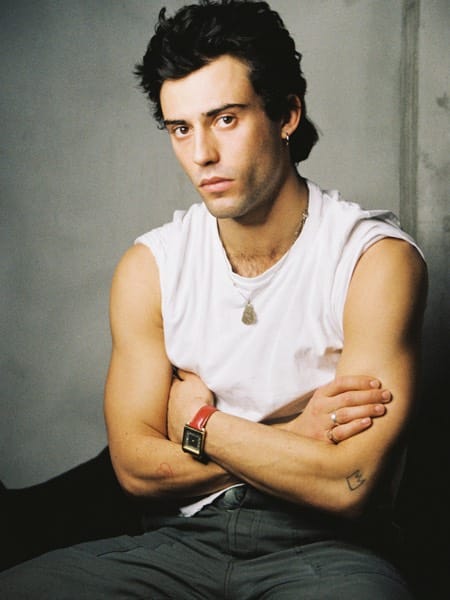
“I can’t believe you’re interviewing Aaron Altaras,” a Tel Aviv friend of mine said. “He’s so hot.”
Normally, I’d dismiss this as one of her usual “movie star” crushes (Henry Cavill being No. 1), except two other Israeli friends couldn’t believe it, either. You’d think Atlaras were Brad Pitt (from back in the day), the way they were gushing over the co-star of the Netflix sensation “Unorthodox.” For them, he has special allure: Altaras is Jewish. (Spoiler: But not necessarily more available. The 24-year-old has a girlfriend.)
Meeting him was a walk in the park, literally. No cafes were open, so we opted for the popular Gleisdreieck park in the hip neighborhood of Kreuzberg during the sunny denouement of Berlin’s coronavirus lockdown. His vintage jacket from a thrift shop went well with his heartthrob-y smolder and swagger.
We had been in touch in September 2017, when his proud father, composer Wolfgang Böhmer, suggested I interview Altaras about the film “The Invisibles,” in which Altaras plays a “U-boat,” the term for Jews hiding underground during Nazi Berlin. At the time, Böhmer (who was raised Catholic) was promoting his Holocaust-themed production, the musical “Stella: The Blonde Poison of Kurfurstendamm” about the infamous Jewess, Stella Goldschlag, who under duress collaborated with the Nazis to “catch” the U-boats. Atlaras’ mother, writer-director-actress Adriana Altaras, also deals with Holocaust themes as a second-generation Holocaust survivor.
Now, in the streets of Berlin, should Altaras be “chased,” it would be for his good looks and onscreen charisma — not that he’s concerned anyone would approach him for a selfie. Berlin doesn’t have American celebrity-paparazzi culture. And there’s social distancing.
At my request, he gave me a peek at his never-ending Instagram message feed. “You’re so beautiful” and “You were great in ‘Unorthodox,’ ” read the more PG-rated fan mail from men and women. He’s already the subject of a spontaneous, international fan club among the gay community, in the wake of his role as a gay soccer player in the German film “Mario.”
“ ‘Unorthodox’ was a whole different level because the reach of Netflix is obviously mind-blowing, but then within that, a couple of things came together,” Altaras said as we walked along the park’s pathways. “The first thing was, obviously, that it was during the peak or the beginning of corona[virus] lockdowns, which is obviously a tragic thing. But the upside of it was that it probably helped our series to get a lot more attention because people are at home and they need to be entertained or moved. We were very, very surprised at how well the series did.”
Aaron Altaras
“Unorthodox” became one of the top 10 most-watched series on Netflix in Germany and other countries. Altaras plays Robert, the happy-go-lucky (and non-Jewish) romantic interest of the heroine, Esty (played by Israeli actress Shira Haas). Esty’s journey to Berlin out of the Satmar ultra-Orthodox sect in Williamsburg, N.Y., was inspired by Deborah Feldman’s memoir.
While Atlaras knew little about the Williamsburg sect before filming, he is well versed in Judaism.
Apparently, it’s a small Jewish film world. The director-writer of “The Invisibles,” Claus Räfle, happened to be walking ahead of us.
The lockdown gave Räfle the opportunity to watch “Unorthodox” and the Israeli drama series about ultra-Orthodox Jerusalem life, “Shtisel.” He wonders why public German television stations wouldn’t collaborate on such productions because they could combat Jewish stereotypes and anti-Semitism by humanizing these mysterious Jews.
“It showed us how they live their daily life, especially the series ‘Shtisel,’ ” said Räfle, who is not Jewish. “They run around with curly ‘things’ and they look different and we think, ‘What a world!’ But no one knows anything about it. But when you are in touch with it, you start to like it.”
“Unorthodox,” on the other hand, received some criticism for portraying characters in the Satmar community with clichéd, even subtly anti-Semitic strokes, despite the writers being Jewish. Alan Posener, a prominent columnist for Die Welt, a national German daily newspaper, remarked on the difference between “Unorthodox” and “Shtisel”: “Must it be that the uncle with whom Esty lives is a tenant shark who makes life difficult for a financially strapped piano teacher? That her cousin, who is sent to Berlin to bring her back, carries a pistol with him and associates with a Jewish brothel and casino operator?” Posener described the series as a “feel good” movie for Berlin hipsters who pride themselves on being (superficially) liberated and enlightened.
Altaras thinks the series’ focus — and inspiration — is the coming-of-age theme. “It’s about a woman’s journey, who says, ‘I don’t want to live like this, and I’m going somewhere else,’ ” he said, adding he admires the guts of fictional Esty, Feldman and Haas. It’s also why Robert and Esty’s romantic relationship in the film is undefined: She gets to decide.
While Atlaras knew little about the Williamsburg sect before filming, he is well versed in Judaism. He attended Berlin’s community Jewish elementary and high school, and studied liberal arts in Amsterdam before realizing acting was his calling. He’s concerned about rising right-wing anti-Semitism and xenophobia in Germany (which he thinks possibly can bond Muslims and Jews), although he doesn’t feel it on a day-to-day basis, perhaps because people might not know he was Jewish (unless they Googled him).
Blame it on his multi-ethnic looks and theatrical versatility, Altaras is not pigeonholed into Jewish roles — to his delight. He was bummed the shooting of his next series in which he plays a Turkish German boxer was interrupted by the coronavirus — as was his Passover trip to Israel. He would have loved to hang with the cast of “Unorthodox,” and maybe some new fans.
Could “Unorthodox” be a springboard into Hollywood? Atlaras has his sights set on Hollywood’s indie scene. Netflix has changed the Hollywood game. “Everything’s shot in the original language. If something’s set in Mexico, the actors will be Mexican and they’ll be speaking Spanish. And it’s the same with our series. It’s a hard sell; we’re going to do a series that will be 50% in Yiddish. Try to sell that to a big production company? … Netflix just pulls that off.”
Going through his Instagram feed, he rattles off invitations from Cape Town, Buenos Aires — and, of course, Tel Aviv. But they — and Hollywood — will have to wait.
“I can’t go anywhere right now,” he said.
Orit Arfa is a journalist and author based in Berlin. Her second novel is “Underskin.”
(JTA) — The Jewish Democratic Council of America has endorsed Joe Biden for president.
The group released its endorsement on Friday along with a statement from the former vice president.
“You share the Jewish community’s commitment to the principle of tikkun olam, healing the world, in addition to our commitment to combatting the rise of anti-Semitism and supporting a strong U.S.-Israel relationship,” the council said in a letter to the presumptive Democratic nominee.
“They are an important new voice for the progressive values that unite us here at home and for a secure, peaceful future for the Jewish and democratic State of Israel,” he said.
Earlier this month, Biden earned an endorsement from J Street, the liberal pro-Israel lobby, and his former 2020 primary opponent Sen. Bernie Sanders.
The Jewish Chronicle of London, the world’s longest-running Jewish publication, has been saved from liquidation and transferred to new owners.
A consortium from the Jewish community and beyond has reached an agreement with the paper’s former owners, the Kessler Foundation, to take over The Chronicle “with the ultimate goal of establishing a charitable trust to ensure its long term stability,” editor-in-chief Stephen Pollard wrote in a statement Thursday.
Pollard’s statement is the latest twist in a story that began earlier this month when the Kessler foundation revealed their plans to dissolve the Chronicle due to the economic crisis prompted by the coronavirus.
Leo Noe, the owner of the Jewish News, a competing publication that was supposed to merge with the Chronicle before the crisis hit, also announced that he planned to liquidate his paper.
Both papers were rescued by the consortium led by Robbie Gibb, the BBC’s former head of political programming and a former adviser to former prime minister Theresa May.
Other members include BBC journalist John Ware; broadcaster Jonathan Sacerdoti; Rabbi Jonathan Hughes; John Woodcook, a spokesman for former prime minister Gordon Brown; and former Charity Commission chairman William Shawcross, the Press Gazette reported Tuesday.
The new owners have promised not to interfere with the Chronicle’s editorial independence.
“For the first time in many years we have backers who are committed to investing in journalism and to making the JC and thejc.com even better and more essential reads,” Pollard wrote.
My father used to travel around the world when he was growing his business. I once asked, “How do you get along in countries where you don’t speak the language?”
He responded, “Pointing and smiling can do wonders.”
I thought of his wisdom the other day while sitting by the window with my twins. A woman looked up at us from the street below and raised two fingers (as if to ask, “Twins?”)
I smiled with a thumbs up.
She then pointed to herself and raised two fingers in the air.
She smiled broadly and walked on.
Was she saying, “I, too, am a twin”? Or, “I, too, have twins”?
Unclear. But what is clear is that I made this awesome connection with a stranger. And those connections are so very important in these crazy times.
So go out there!
Smile.
Point.
Communicate.
And create a moment in time that will connect our physically distant world.