fbpx

April 4, 2020

Meet The Orthodox Jewish Mom Who Became LA’s Go-To Jewish Artist

Los Angeles artist Aliza Marton was raised in an artistic family. But after she got married, she focused on raising her own family and teaching Mommy and Me classes.

It wasn’t until Marton’s fourth child was 18 months old that she decided to go to Pearl Art Supply and buy a sketchbook. Nine years later, Marton, who lives in Pico-Robertson, is creating original and commissioned artwork with Jewish themes and teaching art classes in the community.

Some of her pieces have biblical verses hidden in them. One piece, “Man With His Staff,” depicts an older religious man standing with a staff outside his shtetl and in front of the gates of Auschwitz. Painted in the grass in Hebrew is Psalm 23:4: “Though I walk in the valley overshadowed by death, I will fear no evil for you are with me.”

The Journal spoke with Marton about her journey and where she finds her inspiration.

Jewish Journal: When did you start creating art?

Aliza Marton: As early as I can remember, I have been drawing, doodling and sketching. That said, I did not begin truly “creating art” until I was 39. It was then that I picked up my first brush to put oil on canvas. But if you look at my eighth-grade yearbook, where it said what I wanted to be when I grew up, I wrote “artist.”

Both of my parents were really artistic. My dad’s sister used to be the set director for pretty much every Broadway show and he had another sister who was an artist. One more sister would teach art. My mother was a sculptor and my mother’s mother painted.

JJ: Where were you trained?

AM: While I am primarily self-taught, I have to express my deep gratitude [to local teacher] Gila Balsam, who allowed me to paint with oil for the first time in her studio. She is a wonderful artist and had been giving lessons to my daughters. I had wanted to paint since I was a young child but never had the opportunity. As a mother, I always wanted to give my children what I didn’t have. Once I began, Gila gave me the confidence and encouragement to venture out on my own as an artist and as a teacher.

JJ: Which artists inspire you? 

AM: Although my painting style is quite different, I am most inspired by the great masters. I find myself mesmerized by Rembrandt’s realism and masterful use of light. I also love the color palette of Renoir.

JJ: Did you grow up Orthodox? 

AM: I am the daughter of ba’al teshuvah parents. I was raised in a Modern Orthodox home where there was a deep appreciation for Judaism and for Israel. I would say that I have become more frum as an adult and I am grateful for the wonderful community my family is a part of.

JJ: What’s your artistic process?

AM: I find inspiration everywhere. There is never a shortage of [things] to paint. The number of ideas I have for new pieces is always so much greater than my ability to accomplish, due to a lack of time. Stories from the Torah, natural beauty, people of strong character with striking features and my dreams are regular sources of inspiration. I will typically sketch what I have imagined and then quickly move to the canvas.

JJ: Do you only work in oils?

AM: Almost all of my artwork is oil on canvas. I love working with oil. I love everything about it. The feel, the look, the fact that it doesn’t dry too quickly. Very recently, I have been experimenting with poured acrylics on wood panel.

JJ: Why do you make Jewish art?

AM: This is what speaks to my soul. I can’t say that I specifically think about creating Jewish art. It is simply what comes out of my creative process. Even when I am painting the natural world, there is always an underlying spiritual element that drives me.

JJ: What figures or ideas in Judaism inspire you the most?

AM: Jewish unity, perseverance and inner strength are themes that I often incorporate into my artwork. I find [the prophets] and Tehillim (Book of Psalms) to be endless sources of inspiration for me.

JJ: Where can people find and purchase your artwork?

AM: My original artwork and high-quality giclées are available via my website (alizafineart.com). I can be reached via email and phone to discuss commission works. I am also excited to share that, based on some recent conversations, I have made arrangements to be able to produce large-format artwork for commercial installations.

JJ: What is your dream?

AM: I would love to have a few studios in Israel, maybe in Safed and Jerusalem. It’d be a dream to be in Israel. All my siblings and my parents live there, and I love it. I definitely have a very strong spiritual side. It fits with the land. It fits with Israel.

JJ: Why is Jewish fine art important?

AM: The Jewish commitment to art dates back to the earliest of times. The renowned artists (Betzalel and his students) that contributed to the building of the Mishkan did not just make beautiful things; they did so with a deep commitment to serving HaShem. Creating beautiful artwork infused with spirituality has the power to enhance a person’s connection to HaShem and to the people in their lives.

Meet The Orthodox Jewish Mom Who Became LA’s Go-To Jewish Artist Read More »

Israel Cordons Off Heavily Infected Orthodox Suburb

Israeli security forces cordoned off the city of Bnei Brak, near Tel Aviv, and are enforcing a total lockdown there.

At least a third of the city’s heavily Haredi Orthodox population has the coronavirus, according to government estimates. On Thursday, the Israeli government decided for the first time since the coronavirus crisis began to declare an Israeli city a “restricted area” and ordered Border Police and army troops to join police in making sure no one leaves or enters Bnei Brak without permission.

Israel went into lockdown last week, wherein residents are not permitted to congregate and are confined to their homes or a 300-foot radius of their homes. Over the past week, multiple infractions have been recorded in Bnei Brak, including by Haredi Jews who prayed together.

Bnei Brak Deputy Mayor Gedaluahu Ben Shimon criticized the way in which his city, which has a population of nearly 200,000, has been cordoned off. Ben Shimon told Israel Hayom that simply preventing people from moving around in his central Israeli city will not prevent a humanitarian disaster.

“This is a half-measure that increases the risk of infection and could lead to loss of life,” he said, arguing that the army should not only seal off Bnei Brak but also provide its residents with food and medication. “For older people, this is a death trap.”

On Thursday, the number of people who died of the virus in Israel was 36, with another 108 in critical condition.

Israel Cordons Off Heavily Infected Orthodox Suburb Read More »

Palestinian Incitement Continues Unabated, Despite Israeli Assistance Regarding COVID-19

In just the last month alone, Israel transferred millions of shekels to the Palestinian Authority and has facilitated the entry of thousands of Palestinian workers into Israel so they can work. It has expedited the transfer of equipment to the Gaza Strip to help fight the COVID-19 pandemic there. Israeli Finance Minister Moshe Kahlon and his Palestinian counterpart, Shukri Bishara, met to discuss the economic impact of the coronavirus on Israel and the Palestinians, and Israel’s President Reuven Rivlin spoke on the phone with P.A. head Mahmoud Abbas, during which they agreed to cooperate on combating the pandemic.

So it was a slap in Israel’s face when Palestinian Prime Minister Mohammed Shtayyeh not only falsely accused Israeli soldiers of trying to infect Palestinian civilians with COVID-19, but also tweeted that “the real weakness in our battle against #Covid19 is the Israeli occupation and all its policies that attempt to thwart our efforts to protect our people. We don’t accept Israeli guardianship over our measures. What is required is for Israel to leave us alone.”

Michael Milstein, head of the Palestinian Studies Forum at the Moshe Dayan Center at Tel Aviv University, denied Shtayyeh’s false claims and told JNS that “every Palestinian office and organization operates in full coordination with Israel.”

So why is Shtayyeh inciting against the Jewish state at a time when he should be working towards bringing the two sides closer together?

According to Milstein, he is thinking about the day after Abbas. “While Shtayyeh is a member of the Fatah Central Committee, he aspires to more and is currently trying to crystallize his image,” he said. “Also, it is possible that he is trying to channel criticism inside the West Bank toward Israel.”

No matter the reason, Milstein believes that Israel should have responded in a much tougher manner because such words can very quickly lead to violence.

He thinks Israel needs to dispel rumors spread by Shtayyeh and others, and needs to spend more energy on disseminating the facts.

“The campaign to create awareness is very important,” he said.

“The situation in Gaza is the tip of the iceberg. Things there could really explode.”

A former adviser on Palestinian affairs in Israel’s Unit for Coordination of Government Activities in the Territories (COGAT), Milstein suggested that Israel reach out to the Palestinians as much as possible to deliver its message in clear Arabic and create channels of discourse with the Palestinian public to clarify that first, what they hear from people like Shtayyeh is fake news; and second, to explain the truth and show how broad the assistance is from Israel to the Palestinian arena.

And that assistance is indeed broad.

In an emailed statement to JNS, COGAT said it has been “working in conjunction with the P.A. and the international community to assist in the struggle against the spread of the coronavirus in Judea and Samaria, and the Gaza Strip.”

As part of its efforts, COGAT “coordinated the entry of thousands of test kits for detection of the coronavirus, as well as thousands of protection kits for the use of medical teams and various disinfection materials.”

COGAT also coordinated training sessions by Israeli doctors for their Palestinian counterparts. “This aid paralleled the coordination of the crossing of dozens of trucks that delivered medical equipment, medicine and disinfection materials that various international organizations had donated,” it said.

‘Tight linkage between economy and security’

From the start of the outbreak of the virus, the merchandise crossings from Israel to the Palestinian territories, both in Gaza and Judea and Samaria have not been closed.

COGAT also emphasized that hundreds of Palestinian patients enter daily from the Gaza Strip, and Judea and Samaria, to receive life-saving medical treatment.

Milstein noted that there is full coordination with the P.A. in every aspect on security, economic and civil levels. “Israel knows that economic stability in the West Bank is the basic condition for strategic and security stability in that area, and Israel’s transition government is aware of the tight linkage between the economy and security in the West Bank,” he said.

COGAT acknowledged this as well. After the coronavirus outbreak in Bethlehem and an increase in the scope of Palestinians in quarantine, Israel decided, in coordination with the P.A., to impose a citywide closure. Later, the P.A. decided to impose its own closure throughout Judea and Samaria.

“Nevertheless,” COGAT said,” in an unprecedented and exceptional step, Israel approved, in coordination with the P.A., a two-month stay in Israel for tens of thousands of Palestinian workers in order that they not lose their places of employment and instead be able to continue supporting their families, despite the closure that was imposed on the territories.”

COGAT has also made available to the Palestinian public, through its Facebook page “Al-Munassiq” (the coordinator), the Israeli Ministry of Health guidelines on prevention and ways to deal with contagion and outbreak. The information, published in Arabic, is available to the entire Palestinian public in Judea and Samaria, as well as in the Gaza Strip.

Even the United Nations, almost always a critic of Israel and its policies, had good words for this cooperation.

Nickolay Mladenov, the U.N. Special Coordinator for the Middle East Peace Process, has praised the coordination between the Israeli and Palestinian authorities in dealing with the COVID-19 pandemic.

‘Hamas doing almost nothing for the people of Gaza’

Unfortunately, Hamas has not expressed any gratitude. In fact, it has done only the opposite.

Last week, Hamas fired a rocket into Sderot in southern Israel, the first since the coronavirus outbreak began. Milstein assessed that this attack was a “signal” from the terrorist organization that it is in trouble. “Hamas wanted to promote a very limited, very contained signal towards Israel with one rocket,” he explained. “This is proof that when Hamas wants quiet in Gaza, it is quiet.

“However, if Hamas comes under massive pressure, if there is no broad assistance or if border crossings are not kept open, Israel may see more of these ‘signals,’ ” he said.

According to Milstein, “Hamas is doing almost nothing for the people of Gaza,” he said.

“All the money needed today to confront the coronavirus is going towards rockets,” he added. “Israel needs to explain to the people of Gaza that it can offer significant assistance, but right now, Hamas insists on promoting only its own terror interests.”

“We must show the world how much we help Gaza in every aspect.”

While Hamas says that Gaza is fine, no one there believes it, especially since there are at least 12 people who are, in fact, known to be infected. Gazans realize that the situation is probably much more serious, and there are likely many more people who are sick. If the virus spreads, Hamas has no means to confront this challenge.

Milstein believes that if there will be any popular or social unrest against Hamas, it will be channeled very quickly by Hamas or other terror organizations towards Israel, possibly leading to a new round of clashes or even a broader conflict.

“The situation in Gaza is the tip of the iceberg,” he said. “Things there could really explode.”

To counter that, he said, “we must show the world how much we help Gaza in every aspect.”

However, according to a report in Reuters, Israel on Wednesday linked any continued assistance it might offer for the Gaza Strip’s efforts against coronavirus to progress in its attempt to recover two Israeli soldiers killed during the 2014 war there and whose remains are being held hostage by Hamas.

“The moment there is talk of the humanitarian world in Gaza, Israel also has humanitarian needs, which are mainly the recovery of the fallen,” Defense Minister Naftali Bennett told reporters. “And I think that we need to enter a broad dialogue about Gaza’s and our humanitarian needs. It would not be right to disconnect these things … and certainly, our hearts would be open to many things.”

According to COGAT, the State of Israel will continue to assist in the struggle against the spread of the coronavirus in the Palestinian territories by “offering aid, coordinating and conducting dialogue and optimal cooperation in conjunction with the Palestinian health system and the international community.”

Palestinian Incitement Continues Unabated, Despite Israeli Assistance Regarding COVID-19 Read More »

Israeli Missile-Production Line Starts Churning Out Much-Needed Ventilators

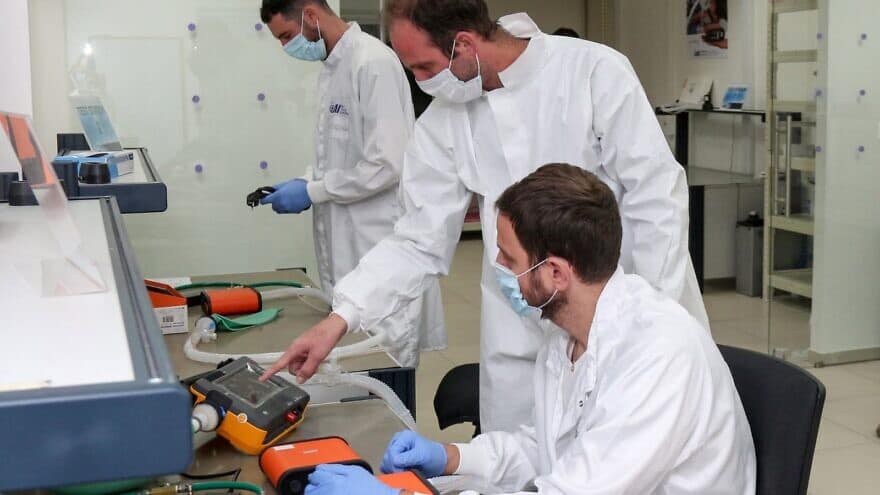
In ordinary times, Israel Aerospace Industry’s Systems Missiles Space group churns out advanced missiles, including interceptors used by the Arrow 2 and Arrow 3 defense systems. During these extraordinary times, the group has added a new production line—one that produces hospital ventilators.

As Israel, like many countries, grapples with a shortage of ventilators in the face of a potential tidal wave of vulnerable coronavirus patients, IAI teamed up with Ra’anana-based Inovytec, which specializes in the production of emergency medical systems, to get the new production line going quickly.

The new cooperation program, which is being conducted together with the Defense Ministry’s Directorate of Production and Procurement, and the Ministry of Health, will soon see hundreds of ventilators being produced, giving Israel a domestic pass production capability.

The new line was set up in a matter of days, and has already produced and tested dozens of machines.

“The issue of ventilators is a significant bottleneck,” an IAI source told JNS. “We have been in contact with the health and defense establishments to see how we can call up our capabilities to assist.”

IAI is working with government-owned companies and start-ups on multiple task forces aimed at finding new solutions to the pandemic. After being put in touch with Inovytec via the Defense Ministry, the cooperation quickly resulted in the production line of the company’s Ventway Sparrow ventilators.

“This is a proven machine in use in Israeli hospitals and abroad,” the source said. But Inovytec’s small size meant it could not rapidly shift to mass production. As a result, IAI entered the picture with its factory, engineers, technicians, and infrastructure, who normally work on building missiles and satellites. Both types of production require great precision and technical checks, the source explained.

The Defense Ministry described the Ventway Sparrow as “a state-of-the-art, turbine-powered, lightweight, easy-to-use ventilator that enables effective invasive and non-invasive mechanical ventilation for both adults and children. The ventilator has been tested for compliance with the most stringent medical standards, and is currently used in hospitals and emergency medical centers in Israel and around the world.”

IAI is also able to procure the materials needed for production and has the logistical prowess to get hundreds of ventilation systems rolling off the production line by next week. “The infrastructure, equipment, electronics and precision that are needed to make missiles fit the production of ventilators,” said the source.

‘Accelerate production rates even further’

Avi Dadon, head of the DOPP, stated, “Once we were assigned the task of acquiring and producing a maximum number of ventilators in a short period of time, we saw the immediate mobilization of the local industry. A high-tech medical company, working with the excellent defense industry and the Ministry of Defense, has been able to deliver an advanced production line that already issues dozens of advanced respirators within just a few days. We are at the beginning of the road, and in the coming weeks, we will accelerate production rates even further.”

The Defense Ministry noted on Tuesday that “all the parties involved are facing challenges in the international chain of supply and dealing with record demand and difficulty in purchasing components. As a result, all of the relevant bodies in the State of Israel have joined forces in order to achieve what is needed for the production of these crucial ventilators.”

The new production line is one of several efforts under way by the Defense Ministry’s Directorate of Production and Procurement.

The DOPP is also overseeing the purchase of medical equipment and protective gear, including ventilators and masks, abroad. Under the DOPP’s plan, drawn up together with the Health Ministry, this will include 2,500 ventilation machines—1,000 assembled in Israel and another 1,500 bought abroad and flown in. Those target numbers appear to have grown substantially in recent days, in line with potential worst-case scenarios.

In an extraordinary report aired by the Israeli investigative program, Uvda on Channel 22 this week, a Mossad official in charge of a joint operations room at Tel Hashomer Hospital, involving health and defense officials, shed light on the overseas operation aimed at getting hold of the machines.

The program also featured comments by Mossad director Yossi Cohen, who stated, “My central objective is procurement and readiness for the most severe scenarios.”

A man identified only as H, the head of Mossad’s Technological Branch discussed how his organization joined forces with the Health Ministry and brought its operational expertise to the unprecedented overseas purchasing operation. The Mossad has been instructed to bring to Israel more than 130 million items in the next two months that are needed to fight the coronavirus, including protective gear, test kids, medicines, and most of all, ventilators—the subject of fierce international competition around the world.

“The world is selling them in between the cracks. We must find those cracks,” said H. “We activate our special ties to win in this competition.”

He spoke of thousands of leads that the intelligence agency is pursuing. The operation should result in a million-and-a-half N95 masks—vital for medical teams—700,000 surgical masks and a large number of ventilators.

‘We cannot remain dependent on procurement from other countries’

At the same time, officials in Israel are stressing the need to develop rapid self-sufficiency in this field.

“The State of Israel must develop independent capabilities in everything related to dealing with the COVID-19 virus pandemic,” Defense Minister Naftali Bennett stated on Tuesday. “We cannot remain dependent on procurement from other countries. We must develop independent, advanced capabilities.”

Brig. Gen. (res.) Dr. Dani Gold, director of the Directorate for Defense Research and Development in the Defense Ministry, said, “Turning a missile-production line into a ventilator assembly plant is a very complex task, made possible by the collaboration between the Ministry of Defense and the defense industry. We are continuing in the race around the clock to translate the extraordinary tech capabilities of the defense establishment to the fight against corona.”

Udi Kantor, Inovytec CEO, added that “the collaboration with IAI and with the Ministry of Defense is amazing at this time, and it allows us to multiply our production capabilities and supply ventilators in the shortest possible time frame. We are operating in a challenging time, and in a global ‘war’ to acquire the necessary components and fulfill our mission.”

Also this week, the Defense Ministry announced a new agreement with the Sion Medical company in Israel, whose factory is in Sderot, for the purchase of 35 million masks and hundreds of thousands of Uniforms for medical staff. Some 11 million surgical asks will be available by April. The company will also produce 5.5 million N95 masks, and hundreds of thousands of overalls and protective gear.

“A unique machine was brought to Israel with the assistance of the Defense Ministry, in order to enable Sion to open the production line for advanced masks. The machine is the only one of its kind in Israel,” the Ministry said in a statement.

Israeli Missile-Production Line Starts Churning Out Much-Needed Ventilators Read More »

Forgot How Good ‘The Prince of Egypt’ Is? Well, Now It’s On Hulu.

Social distancing and staying inside is hard. Thankfully, accessing good things to watch during this time is not. This is the first installation of a weekly column on Jewish movies and TV shows that you should stream in quarantine.

The Prince of Egypt

Streams on: Hulu

Available to rent on: Amazon, YouTube, iTunes and more

Family-friendly? Yes – though potentially frightening at times for very young children

(JTA) — My reconnection with “The Prince of Egypt” this week, after what I’m going to estimate as approximately 15 years, was not under ideal circumstances.

I was curled up alone in my childhood bed at my parents’ house in suburban New Jersey, where I have decamped to escape the giant death magnet that is New York City during the coronavirus pandemic.

I was (virtually) with my non-Jewish girlfriend, who had never seen the classic animated DreamWorks version of the Exodus story, and who wants to join my family’s upcoming Passover seder via video conference from her home in Brooklyn. It seemed like a nice pre-Passover “date” idea to watch it “together” through our computer screens.

So we downloaded an app called Kast, which promised to allow us to watch the same screen at the same time (you may have heard of the more popular version of this idea, a Google Chrome extension called Netflix Party, but that only works for Netflix. “The Prince of Egypt” is on Hulu).

Despite looking sleek and fancy, Kast didn’t work — we spent almost an hour trying different ways to make it work, scouring our app and computer settings, rummaging for different headphones, googling fixes.

In the end, still determined to watch it together, we decided to do so on our separate computers — we’d just press play at the same exact second. We could keep a video call window open in the background, so we could hear each other and (almost) feel like we were in the same room. Easy.

Suffice it to say, we couldn’t sync our play button fingers together, no matter how precise my “3-2-1” countdown was.

Such is life under the coronavirus quarantine — and I’m just thankful that the movie is streaming on a platform that I subscribe to. (While cleaning out our basement recently, my parents and I found our VHS version of the 1998 original, but not our old VHS player.)

While it may not be the perfect animated movie (what is?), “The Prince of Egypt” is about as good as an hour and 40 minute encapsulation of the Passover story can conceivably get.

It tells the story in full, from Moses being sent down the Nile River to Pharaoh’s palace, to his realization that he is not a prince of Egypt but a Hebrew, to his eventual parting of the Red Sea, to his leading his people from charging Egyptian soldiers to freedom in the desert. While it’s a kids movie, it doesn’t brush over the many plagues that befall Egypt, from frogs falling from the sky to the killing of firstborn sons.

It’s funny and entertaining, full of heartwarming music, and captures the incomparably epic nature of the story. Perhaps most importantly, it’s a very effective educational tool.

For many of us who were the target audience at the time of its release, the movie seared the story into our heads. Yes, we had learned about it in Hebrew school and read through it at Passover dinners. But for young viewers, there’s nothing more effective than an animated feature to make big concepts stick.

“The Prince of Egypt” doesn’t preach or heavy-handedly shove its moral messages at the viewer — it simply treats the tale as what it is: fodder for epic cinema. And that’s why it got the message, the symbolism and the darkness of the story, across to so many people.

Oh, and then there’s the incredible cast of voices — a fact that I clearly did not absorb at the age of 6. Did you remember that Jeff Goldblum was the voice of Moses’ brother Aaron? Or that Steve Martin and Martin Short play the comical Egyptian priests Hotep and Huy?

So forget about rewiring your old VHS player and stream “The Prince of Egypt” before Passover. You’ve probably forgotten how good it is.

I certainly had, and now I’m newly excited for our seder next week — even if my girlfriend is miles away, and my family will inevitably mess up our Zoom call.

Forgot How Good ‘The Prince of Egypt’ Is? Well, Now It’s On Hulu. Read More »

’60 Minutes’ Segment Spotlights Artificial Intelligence Keeping Holocaust Survivors Alive

Thanks to artificial technology, it’s now possible to have a conversation with Holocaust survivors who are no longer living, as Lesley Stahl reports in the April 5 edition of CBS’ “60 Minutes.”

Heather Maio had worked for years on Holocaust-related exhibits and knew that director Steven Spielberg had created the Shoah Foundation to record the testimonies of thousands of Holocaust survivors. But Maio wanted to create something more interactive.

“I wanted to talk to a Holocaust survivor like I would today, with that person sitting right in front of me,” she told Stahl. Maio believed that artificial intelligence technology could make her notion realizable, so she pitched her idea to Stephen Smith, the executive director of the USC Shoah Foundation in Los Angeles, and now her husband.

Smith was intrigued, but some of his colleagues initially feared it could cheapen or “Disney-fy” the Holocaust. Says Smith, “We had a lot of pushback on this project. ‘Is it the right thing to do…Are we trying to keep them alive beyond their deaths?’ Everyone had questions except for one group of people, the survivors themselves, who said, ‘Where do I sign up?’”

So far, more than 20 interviews, including one with a 93-year-old U.S. Army veteran who helped liberate a concentration camp, have been recorded. Each subject spends a full five days answering questions in an attempt to record responses to every question conceivable. The questions are then logged, and alternative questions are entered into the database. Each interview is recorded with more than 20 cameras, so that as technology advances and 3D, hologram-type display becomes the norm, all required angles will be available.

Three of the survivors interviewed have since died. One of them was Eva Kor, who appeared on “60 Minutes” in 1992 to tell her story of having been experimented on, along with her identical twin sister, by Nazi S.S. physician Josef Mengele. Kor died last summer, but using the Shoah foundation’s technology, Stahl was able to conduct another interview with Kor’s digital image. “[Mengele] had a gorgeous face, a movie star face, and very pleasant, actually,” Kors’ digital image says in the video. “Dark hair, dark eyes. When I looked into his eyes, I could see nothing but evil. People say that the eyes are the center of the soul, and in Mengele’s case, that was correct.”

Another survivor, Pinchas Gutter, who was sent to the Majdanek concentration camp at age 11, was the only member of his family to survive. Stahl asks him how he could still have faith in God after the horrors he experienced, and his digital image replies, “How can you possibly not believe in God?…God gave human beings the knowledge of right and wrong, and he allowed them to do what they wished on this earth, to find their own way. To my mind, when God sees what human beings are up to, especially things like genocide, he weeps.”

Watch a clip here.

’60 Minutes’ Segment Spotlights Artificial Intelligence Keeping Holocaust Survivors Alive Read More »

Israeli Filmmaker Draws on Real-Life Experiences in ‘About a Teacher’

Israeli-born filmmaker Hanan Harchol continues to hope that his autobiographical movie and feature film debut, “About a Teacher,” will be released in movie theaters down the road. Still, when he posted a trailer for the film online and received more than 5,000 views and enthusiastic comments from teachers around the world, he said he appreciated the possibilities for his movie on a digital platform.

Released on Amazon Prime on April 7, the film recounts the roller-coaster experiences of a New York City school teacher, not coincidentally named Hanan Harchol (Dov Tiefenbach), as he attempts to teach filmmaking to a group of indifferent, disruptive and/or otherwise troubled inner-city students in a magnet school. It’s a feel-good story as he makes the journey from self-indulgent nebbish to devoted mentor while the kids (mostly played by former students) are transformed in the process.

Like his onscreen alter ego — a classical guitarist, artist and animator — Harchol found himself unemployed in the wake of the 2008 economic crash. As a stopgap measure, he landed a teaching gig, falsely believing it would be an easy ride with lots of free time to pursue his artistic interests. It was anything but. Initially, it was a nightmare. Now, almost 12 years later, he’s still at the school and loving it.

Simultaneously, he was (and is) disheartened by the ongoing stereotypes about teachers, especially as depicted on the screen. They are either laid-back and lazy or unrelentingly heroic. He felt compelled to forge a movie that would tell it like it is. Teachers come on board with no preparation to face chaos in the classroom and unremitting administrative demands. Demoralization, failure and burnout are built in, and it’s not the teacher’s fault, despite being dumped on for all of society’s ills.

“My challenge was to create an engaging, authentic film that was not a white male savior movie, which is very typical in these films,” Harchol told the Journal in a phone conversation from his Los Angeles home. “Avoiding that was the biggest obstacle, and to overcome it I focused on showing the crappy job the teacher is doing. He’s narcissistic. It’s all about him when, in fact, it’s not about the teacher. It’s about the students. The title is ironic.”

Asked if he experienced any anti-white or anti-Semitic expression in the classroom, his answer is a resounding, “No.” On the contrary, he said, his sense of “otherness” and lack of connection came from within.

“I went to a high school outside Princeton [N.J.] where there were very few African Americans,” he said. “Suddenly, I was in a school that was [at the time] 4% white. I felt very out of place and for the first time, I felt like a minority. It was a very humbling and educational experience for me.”

And then, after his first terrible year at the school, he created a series of short animated features for the Covenant Foundation that, among other things, promotes Jewish values and education. His animated snippets present conversations between a father and son centering on ethical issues — love, kindness, humility — as seen through a Jewish lens of tolerance and a willingness to view those who may be different favorably. Harchol brought those values to the teaching table along with the Danielson methodology that advocates student-centered, student-led classrooms, where an intensely prepared teacher serves as an engaging and thought-provoking guide.

“My challenge was to create an engaging, authentic film that was not a white male savior movie.” — Hanan Harchol

So, how did he find an actor to play himself? It wasn’t easy, but he eventually landed on Tiefenbach, ( “Crashing,” “Homeland”), who evokes a Woody Allen-ish figure onscreen. The actor admits playing the role was a daunting task. His goal was interpretation, not impersonation, yet he felt compelled to capture Harchol’s gait, vocal style and his persona, which embodies an intangible Jewish anxiety.

“He is purpose-driven, cerebral, walks quickly, and eating for him feels like a waste of time when he could be doing other things, which means he eats as rapidly as possible in order to get to those more important things,” the Canadian-born Tiefenbach, who now lives in L.A., told the Journal.

Because of time restraints, Tiefenbach regrets he wasn’t able to immerse himself in the teacher’s day-to-day classroom experiences in a New York public school. He did, however, teach for five years in a juvenile hall facility in California, and those encounters proved fertile ground for him, specifically “coming into a session with the intention of changing the kids’ lives only to be met by resistance,” Tiefenbach recalled. “I was not able to understand the students I was trying to help. I was righteous about what I had to teach them as opposed to being open to what they had to teach me.”

Like Harchol, Tiefenbach was vaguely conscious of himself as a Jew in a setting that was largely minority for him. Also, as a Canadian, he faced further obstacles. In Canada, for example, gangs are virtually nonexistent, thanks in part to the number of social programs that support troubled youths.

“I had never met anyone with a tattoo on his face,” Tiefenbach said. “The difference between rich and poor is far greater in the States than it is in Canada. The issue I had to answer is, ‘Can we relate as human beings or is relatability dependent on shared cultural currency?’ I’ve concluded it is what you think it is. I learned to speak to the kids from a place we could all understand.”

Tiefenbach hopes audiences leave the film appreciating “what it means if your heart is closed off to those who need your help. Harchol is a man who opened his heart. I’d like to think audiences will try to do the same.”


Simi Horwitz is an award-winning feature writer and film reviewer based in New York.

Israeli Filmmaker Draws on Real-Life Experiences in ‘About a Teacher’ Read More »