Israeli Prime Minister Benjamin Netanyahu will send an official request to the Knesset for immunity from prosecution in three cases, according to the Jerusalem Post and Channel 13.
Netanyahu reportedly will argue that such immunity is necessary while he is in office because the cases will require members of the Knesset to appear as witnesses and that Attorney General Avichai Mandelblit’s decision to announce the indictments against him before the March elections was a political decision.
According to Channel 13, Knesset legal adviser Eyal Yinon is expected to conclude that the Knesset cannot form a temporary committee to consider the matter until a new government is formed. Israel’s next elections are scheduled to occur in March.
Mandelblit has said that he intends to stay out of the matter unless the Knesset votes to give Netanyahu immunity. The Israeli Supreme Court also has hinted that it doesn’t want to get involved unless Netanyahu is granted immunity.
A Channel 2 survey published on Dec. 29 that 51% of Israelis oppose granting Netanyahu immunity, while 33% support it.
Netanyahu was indicted on charges of corruption regarding allegations that the prime minister engaged in a quid pro quo with wealthy donors for gifts, and media outlets for more favorable coverage.
The Simon Wiesenthal Center called on the White House to direct the FBI to form a task force to focus exclusively on anti-Semitism following the stabbings in Monsey, N.Y.
Wiesenthal Center founder and Dean Rabbi Marvin Hier and Associate Dean and Director of Global Social Action Agenda said in a Dec. 28 statement, “Enough is enough! Jews should not have to fear for their lives in America to go to their houses of worship. The FBI must step up and take the lead in all recent violent hate crimes targeting religious Jews.”
Hier told the Journal in a phone interview that the Dec. 28 Monsey stabbings that resulted in five injured reminded him of Nazi Germany in the 1930s. “Jews were beaten up on the corner. Windows were broken … that’s how it started,” Hier said. “And the population centers tolerated it. Nobody spoke out against it; we didn’t have a plan against it.”
He argued that the rise of anti-Semitism in the United States has become such an epidemic that more action is needed beyond statements and pledges from state and local politicians and police officers. “They’re all good people, but they’re not 24/7 on this job,” Hier said. “They have other jobs. Even police, they have traffic issues. … There are so many issues besides the issue of anti-Semitism [that they have to deal with].”
Hier added that it’s important to ensure that politics doesn’t interfere with addressing anti-Semitism. “When you have a Democratic mayor and a Republican governor or vice versa, it’s a different attitude,” Hier said. “It’s just not the right way to handle an epidemic.”
“We need the FBI to create a special unit focusing 24/7, 365 days a year on one subject: anti-Semitism.” — Marvin Hier
He also argued that people shouldn’t expect anti-Semitism to dissipate with the election of a new president or a new Congress. “When the whole world is affected by the epidemic called anti-Semitism — and this has happened in Europe for the last 15 years — you cannot legitimately argue that the cause of it in the United States is due to one man,” Hier said without naming President Donald Trump.
An FBI task force that is exclusively focused on handling anti-Semitism is therefore necessary to address the rising anti-Semitism throughout the country, he argued. “We need the FBI to create a special unit focusing 24/7, 365 days a year on one subject: anti-Semitism,” Hier said. “That’s the only way that the anti-Semites will wake up because basically they’re going to be targeted, they’re going to be analyzed.”
Hier gave a hypothetical of how the task force would handle an anti-Semitic incident. “Let’s say there’s an attack here in Los Angeles,” he said. “First thing that happens is that everything about the attack is sent immediately to the FBI task force on anti-Semitism. And they become the lead agency. They take over immediately.”
Hier said that the Wiesenthal Center has been in contact with the White House about its proposal for a task force.
“President Trump is aware of it,” Hier said. “He’s been informed of it. … We’ll see what happens. We are pushing very hard. We need bipartisan support.”
Hier urged for a societal unification against anti-Semitism, as he argued that anti-Semitism is emboldened when societies ignore it.
“Society didn’t do the right thing,” he said. “We didn’t recognize that these bigots can return early, and as society, we have to have a program against it, and the program has to unify Democrats and Republicans [and] whatever their political persuasion in Europe. We have to come together to fight this.”
Swastikas and explicit images were found spray-painted on a Canadian Jewish summer camp in mid-December.
Camp Miriam committee member Kelley Korbin told the Canadian Broadcasting Corporation (CBC) on Dec. 30 that the graffiti was found on Dec. 17 on multiple camp buildings.
“This is the first time in my memory that Camp Miriam has been a direct recipient of an attack like that,” she said, adding that Camp Miriam has been in existence for more than 50 years.
Jewish Federation of Greater Vancouver CEO Ezra Shanken told the Vancouver NEWS 1130 radio station, “It’s almost like no corner of the globe is immune. We’re talking about a camp sitting on an island in the Strait that has not so many people on it.”
Member of the Legislative Assembly Sheila Malcolmson tweeted on Dec. 30 that the “shameful #antisemitic graffiti has been painted over (fresh green on siding). I’m sickened that anyone on #Gabriola is so hateful. Just happy camper rainbow paint remains!”
Camp Miriam, which is located on British Columbia’s Gabriola Island, describes itself on its website as a camp for Jewish youth ranging from second grade to 11th grade. “Campers learn about Israel, Jewish history, social justice and the environment,” the website states. “From kayaking and sports to special days: from Shabbat at the Point and Israeli dancing to overnight hiking trips – there’s adventure and a little magic for everyone at Miriam.”
Canadian government hate crime statistics released in July found that anti-Semitic hate crimes declined from 360 in 2017 to 347 in 2018; however, Jews were the most targeted minority group in the country in 2018.
B’nai Brith Canada CEO Michael Mostyn said at the time that the statistics showed “that anti-Semitic hate crimes remain an urgent concern, with one occurring almost every day of the year, on average.”
JERUSALEM (JTA) — Prime Minister Benjamin Netanyahu will not extend the term of Danny Danon, Israel’s ambassador to the United Nations.
Danon’s term officially expired on Tuesday, the same day that the announcement that his term would not be extended was made, Israel’s Channel 12 first reported.
Danon’s term was supposed to end in August, but Netanyahu extended it to the end of 2019.
Netanyahu did not name a permanent replacement for Danon, and because he is heading a transitional government likely will not be able to make such a senior appointment.
The deputy representative to the U.N., Noa Furman, will lead the diplomatic mission in the meantime.
Netanyahu this week asked Attorney General Avichai Mandelblit if he can make a permanent appointment while heading an interim government but has not yet received an answer.
Danon in 2017 was elected as vice president of the General Assembly as the representative of the Western states. His tenure has been notable for a strong push against the U.N.’s historically poor treatment of Israel
There currently are no Israeli ambassadors to Russia, Canada and Egypt, The Jerusalem Post reported.
NEW YORK (JTA) — All of the gloom and doom that many in the Jewish community have felt toward the end of this decade should not obscure the fact that the 2010s were full of innovation. Yes, there was an alarming rise in anti-Semitism across the U.S. and the world, which culminated in several violent attacks on Jews and Jewish institutions. But that didn’t stop the community from growing, evolving and adapting to modern life.
Here’s a look back at 10 huge developments from the past 10 years that have changed the makeup and lifestyles of Jewish Americans.
(Stevica Mrdja/EyeEm/Getty Images)
Technology puts Judaism in everyone’s pocket
With the advent of the smartphone, we modern folks have grown accustomed to having any piece of information available anywhere, anytime, at the push of a button. But it wasn’t until the launch of Sefaria in 2011 that this was true of Jewish texts.
In a stroke, Sefaria put thousands of years of Jewish literature in everybody’s pocket. The Bible, the Talmud, medieval Jewish philosophers and commentators, the classic Jewish legal codes — all of it available in Hebrew (and often English, too) and completely searchable. Seemingly overnight, the site became an invaluable resource for Jewish learning. And much like Google and Facebook before it, Sefaria made many people wonder how they had ever lived without it.
The site also helped democratize Jewish study — not only by making English translations of canonical texts instantly available anywhere, but by making it possible for anyone to create source sheets that gathered sacred texts on a given topic and share them with the world. The site currently hosts thousands of such sheets on topics as diverse as Jewish business ethics, discrimination, civil rights, hunger and environmentalism.
Sefaria is not the only example of technology being harnessed to broaden the Jewish tent. Synagogues now stream services for free online and Jewish educational websites bring a bottomless wealth of Jewish information to the far-flung masses. But it may be the most ambitious of the lot. — Ben Harris
Impossible burgers shown at a media event in Las Vegas, Jan. 7, 2019. (Robyn Beck/AFP via Getty Images)
A new kosher cheeseburger becomes possible
The 2010s have seen the emergence of plant-based products that taste eerily like burgers but do not contain an iota of meat. Their purveyors — Impossible Foods and Beyond Meat chief among them — hope to launch a vegetarian revolution that will take down America’s massive factory farming industry. Impossible says that the protein heme gives their offerings the juicy, meaty quality missing from previous veggie burger attempts.
For Jews, the new meatless burgers have meant that dishes once Jewishly verboten have finally become accessible. Observant Jews can slap a slice of cheddar on an Impossible burger and enjoy a 100 percent kosher cheeseburger. At Dunkin’ Donuts, patrons can have an egg with Beyond Bacon.
For kosher-keeping Jews, trying to imitate forbidden foods is a tradition as old as time. Meatless burgers have ushered in a new era of that struggle. For while the rabbis of the Talmud outlawed the eating of milk and meat together, they said nothing about milk and heme.
— Ben Sales
Female Orthodox clergy make their mark
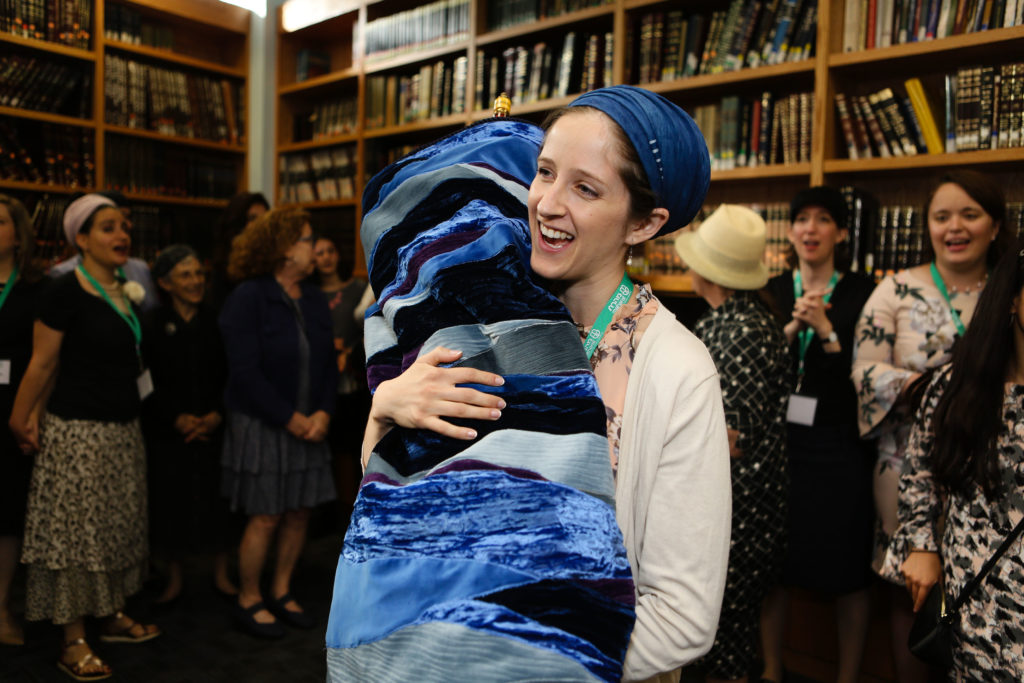
When the decade began, there were almost no American Orthodox clergywomen. When it ended, there were 33.
The 2010s saw a revolution in the Modern Orthodox world, as a seminary for Orthodox women, Yeshivat Maharat, turned out ordained graduates year after year starting in 2013. The last graduating class was the largest with eight members.
The graduates — some of whom take on variations of the title “rabbi” — have made a splash. Nine work in synagogues, many in pulpit positions. The others work in leadership roles throughout the Jewish world. They’ve also sparked a backlash, with two umbrella Orthodox groups — the Orthodox Union and the Rabbinical Council of America — issuing bans on female clergy.
But the bans have not stopped the growing ranks of American Orthodox women receiving ordination, joining the ranks of Conservative and Reform women who have been rabbis for decades. Just months before the decade ended, a graduate of Yeshivat Maharat founded the first-ever American Orthodox synagogue led by a woman.
— Ben Sales
Domestic anti-Semitism is back
In 2013, the Anti-Defamation League reported the lowest levels of anti-Semitism since it started tracking the phenomenon in 1979. By 2018, the trend had fully reversed: There were 1,879 anti-Semitic incidents, the third-highest total ever recorded by the ADL. The incidents included the killing by a white nationalist of 11 worshippers at the Tree of Life synagogue in Pittsburgh — the deadliest anti-Semitic attack in U.S. history.
Not even a year later, on April 27, 2019, a woman was killed and three others were injured at a Chabad synagogue in Poway, California. And on Dec. 10, four people were killed in an attack that ended at a kosher supermarket in Jersey City, New Jersey. On Dec. 29, a man entered a rabbi’s house in Monsey, New York, with a machete and stabbed five people.
The spike included a dramatic increase in attacks on predominantly Hasidic men in Brooklyn, who are more easily targeted by would-be assailants than other Jews because of their distinctive dress. Jewish Americans are afraid of this becoming the new normal: Some 31 percent of respondents to a recent survey by the American Jewish Committee agreed that they “avoided publicly wearing, carrying, or displaying things that might help people identify you as a Jew,” and 25 percent “avoid certain places, events, or situations out of concern for your safety or comfort as a Jew.”
— Laura E. Adkins
The Pew study found new high rates of intermarriage in the Jewish community. (iStock/Getty Images)
The Pew study counts American Jews
The Jewish organizational world was rocked in 2013 by the release of a study by the Pew Research Center on American Jewish demographics. The study counted how many of us there were, whether we were marrying other Jews, what denominations we identified with and how we observed Jewish ritual. It found that that the rate of intermarriage was sharply rising, the number of Conservative Jews was falling and nearly a third of Jews were unaffiliated.
Since its publication, the study has been used by Jewish journalists, activists and leaders to guide their decisions and justify their opinions. It has also helped push Jewish organizations to shift from trying to prevent intermarriage to trying to engage interfaith families.
The study additionally found that many define their Judaism around remembering the Holocaust, leading an ethical life and working toward justice. It showed that most Jewish Americans feel some attachment to Israel. And it found that nearly all Jewish Americans — 94 percent — are proud to be Jewish.
— Ben Sales
Abbi Jacobson and Ilana Glazer at an event for their series “Broad City” at Sony Hall in New York City, March 27, 2019. (Dave Kotinsky/Getty Images for Comedy Central)
The rise of Jewy and Israeli TV
Jews have long found success in Hollywood, and for decades television has been fertile ground for Jewish cultural references (see: Seinfeld, Jerry). But the 2010s saw the rise of a number of celebrated television shows and movies that are either explicitly centered on Jewish themes or imported directly from the Jewish state.
The Golden Age of Streaming brought a deluge of parochially Jewish shows that still found a mass audience: “The Marvelous Mrs. Maisel,” which won a raft of awards portraying a Jewish 1950s housewife turned comedian; “Broad City,” the comedy about two Jewish millennial women in Brooklyn; “Crazy Ex-Girlfriend,” in which protagonist Rebecca Bunch engages in a “JAP Battle”; and “Transparent,” about a Jewish family in Los Angeles struggling with gender identity and which filmed a season mostly in Israel.
While “Transparent” went to Israel, a number of Israeli shows came to the U.S. Americans binge-watched “Srugim,” about Modern Orthodox singles in Jerusalem; “Shtisel,” about ultra-Orthodox singles (and marrieds) in Jerusalem; “Our Boys,” about the murders of children in and around Jerusalem; and “Fauda,” about Israeli commandos in the West Bank. There were also a bunch of forgettable movie dramas about Israel, at least three of them starring Ben Kingsley.
All of it added up to viewers across America watching and enjoying a range of Jewish characters, foibles and stories.
— Ben Sales
Judge Rachel Freier offers her business card in the New York City Council chamber. In November 2016, she became the first Hasidic woman in U.S. history to be elected to public office. (Andy Katz/Pacific Press/LightRocket via Getty Images)
Haredi women have their say
On Dec. 22, 2016, Rachel “Ruchie” Freier was sworn in as a civil court judge in Kings County, New York: She was the first Hasidic woman ever elected to public office in the United States.
Unlike some other segments of the wider Orthodox world, Hasidic Jews largely reject engagement with the secular world unless necessary. Both men and women follow restrictive dress codes, and women in particular are not encouraged to hold public leadership positions.
Raised in a Hasidic enclave in Brooklyn, Freier in recent years has become a symbol of female Orthodox women who want to assume more public roles without compromising traditional values or severing ties to their cloistered communities. In 2011, Freier founded an all-female volunteer EMT service, Ezras Nashim, after the Jewish EMT service Hatzolah refused to allow women to serve. The group’s fight for an ambulance has become politicized and their full acceptance in the ultra-Orthodox world is a long way off, but there’s little question that Freier and women like her have carved out space for haredi women to take on positions of greater influence and visibility in their communities.
— Laura E. Adkins
(Pixnio)
The Passover kitniyot revolution comes to America
The year 2016 saw an important if obscure change in American Jewish life: The Conservative movement officially declared kitniyot, or legumes, acceptable for Ashkenazi Jews to eat on Passover.
The ruling gave an imprimatur to what already was a quiet revolution taking place in a growing number of liberal observant homes. For centuries, traditional Ashkenazi Jews have abstained from peanuts, beans, rice, lentils, chickpeas and other foods that, according to the rabbis, could be misconstrued as hametz, or leavened food that is anathema on the holiday.
According to Sephardic Jewish practice, those foods have always been fine to eat on Passover. In Israel, where most Jews are of Sephardi heritage, kitniyot are widely available on Passover. A significant portion of Israeli Ashkenazim eat them even as they observe the holiday’s other dietary laws. Many Israeli families are mixed Ashkenazi-Sephardi, blurring the lines even further.
The past decade has seen the Israeli kitniyot trend cross over to America, as parts of America’s largely Ashkenazic Jewish population adopted the Sephardic custom. With a major Jewish movement approving the practice, the stacks of hummus on kosher-for-Passover grocery store shelves could grow.
— Ben Sales
(fdecomite/Flickr)
Spain and Portugal invite their expelled Jews home
In 2015, Spain and Portugal offered citizenship to descendants of Sephardic Jews who had been persecuted and expelled more than 500 years before. The laws were intended as atonement for the historic wrong of the Inquisition, which destroyed one of the most accomplished Jewish communities in the world. At a time of rising anti-Semitism around the world, the laws were cheered by Jewish leaders.
“Spain is roots, beloved and painful memories,” Israeli President Reuven Rivlin said in a 2017 visit, adding that it’s “not just nostalgia but an actual home: a place where Jews need not be told to feel at home.”
In practice, the application process was anything but simple. Spain’s law, whose window for applications ended in October, required applicants demonstrate an affinity with Spanish culture and have their family trees vetted. In Portugal, where the law is open ended, one of the two Jewish communities that the government tasked with vetting applications approves only people who are currently Jewish.
Despite millions of potential applicants, the laws resulted in only about 132,000 applications in Spain and another 50,000 in Portugal. The low response owes to multiple factors.
Most Sephardim live in affluent economies, which may limit their appetite for a second citizenship. Non-Jewish descendants of Sephardim often have no proof of their lineage. About 50,000 citizenship applications have been approved, two-thirds of them by Spain. — Cnaan Liphshiz
Rabbi Angela Buchdahl speaks at an interfaith prayer vigil on Oct. 30, 2018, at the Central Synagogue in New York City for victims of the Tree of Life Synagogue shooting. (Michael Brochstein/SOPA Images/LightRocket via Getty Images)
Jews of color gain greater exposure
Jews of color have long pushed the wider community to better acknowledge its racial and ethnic and diversity, but a number of high-profile Jews of color made that fact much harder to ignore in the 2010s.
In 2014, Angela Buchdahl became one of the most prominent Jews of color in the world when she was named senior rabbi of Central Synagogue in New York, one of the largest synagogues in the country. The daughter of a Buddhist mother and Jewish-American father, Buchdahl was born in Korea and became the first Asian-American rabbi in 2001 when she was ordained by the Reform movement’s Hebrew Union College.
She was far from alone in drawing public attention to Jewish diversity.
Barack Obama’s election in 2008 helped raise the profile of Rabbi Capers Funnye, an African-American rabbi in Chicago who also happened to be first lady Michelle Obama’s cousin. Amar’e Stoudemire, the former NBA star who told the Jewish Telegraphic Agency in 2013 that he believed he had “Hebrew” roots, would eventually convert to Judaism and play in Israel. Tiffany Haddish, the actress and comedian who only learned at 27 that her father was an Eritrean Jew, threw herself a star-studded bat-mitzvah at age 40 presided over by Sarah Silverman’s sister, Rabbi Susan Silverman.
In 2019, the American Sephardi Federation and the Morocco-based Association Mimouna hosted the first conference focusing on Jews in Africa that was not exclusively for academics — a step Funnye said represented a major step forward.
“It means a great deal to the African-American Jewish community [and] the Jewish community of West Africa because we’ve been a long time in saying we’re here,” Funnye told JTA. — Ben Harris
(JTA) — A Washington, D.C.-area rabbi referred to the attacks on a rabbi’s home in Monsey, New York, and on a Texas church the following day in his prayer opening a pro forma session of the U.S. House of Representatives.
Rabbi Arnold Resnicoff, a Navy veteran and retired Navy chaplain, called on listeners to “look ahead with hope, but with eyes wide open to prejudice, hatred, terror that remain — fueling violence like the anti-Semitic Hanukkah party attack Saturday, the Texas church attack Sunday …”
A pro forma session takes place when either the House or Senate is technically in legislative session but when no votes are held and no formal business is typically conducted.
Howard Mortman of C-Span told the Washington Examiner that it was the first time that anti-Semitism in America was mentioned in a prayer opening a House session.
Resnicoff delivered the prayer, the last in Congress for the decade, from the House floor wearing a tie decorated with menorahs. It was his 16th prayer in Congress, the most by any rabbi.
The rabbi ended by quoting the song “We Shall Overcome,” which became a mantra for the civil rights movement and the Rev. Martin Luther King Jr.: “We shall overcome, we shall overcome, we shall overcome someday. Deep in my heart, I do believe. We shall overcome someday.”
Resnicoff also delivered a prayer in the House in the wake of the shooting at the Tree of Life synagogue building in Pittsburgh, which referred to the attack and noted that “we pray, reflect, meditate in different ways but unite when hatred rears its ugly head.”
Proud to offer this prayer — last prayer of the decade — this morning. Sad to make last-minute additions re Hanukkah party attack and Texas church attack over the weekend. #weshallovercomehttps://t.co/pKdFS2h3LG
Q: When I audition, instead of worrying about being ‘word perfect’ on the sides, I’m more truthful when I express what I know I’m saying in the dialogue and can paraphrase it to a certain degree. Is that a turn-off for cd’s and a director?
This is a great question in service of improving your auditions as we move into a New Year!
Acting and writing are two separate crafts, and when at their best, are working in concert with each other. A writer has crafted a story with purpose and made more choices about style and tone and language and your character’s expression than one could count. Then it is your job to imbue it with life. For an actor to bring someone else’s words to life, his craft must also be in full force. You need to be able to craft a role by making the words feel like they are something that you would say. You find ways to inhabit the life of the character, until you believe you are the character when you are acting it. This is an equally complex craft that deserves respect. So how can we optimize the experience for both artists while also respecting their singular crafts?
What you’ve discovered intuitively is that memorization is not only a mental exercise for an actor. The whole body mind and spirit must get involved, for the words to come naturally. It makes perfect sense that you enjoy putting the dialogue in your own words! In fact, this is a technique I often use as a director and as a coach. What it allows the actor to do is find a personal reason to say those words. Then you are closer to identifying with the character. And of course, by doing that, you believe you are the character more, and are then more truthful. But this is something that must be done only in your preparation. Granted, I have seen actors improvise in an audition and get cast. But I don’t suggest it for professional work. Your job is to explore in this way while preparing your part, and then to bring what you discover to the dialogue that is written.
One concern actors have, particularly if you have one night to learn ten pages of dialogue, is: how am I going to learn all of these lines verbatim? Again, that is your job. But saying the words without personalizing them is an exercise in futility. The good news is, if you personalize them, they will be must easier to memorize.
So, prepare using this technique you’ve come upon- which is saying the lines in your own words, speaking the subtext, or expressing the words as you would say them. Then, pay attention to how this excites your inner life. What are you aware of? What are you experiencing emotionally? What do you need to express? What to you need to do? This technique will lead you to a personal sense of urgency, which acts as a motivation. That motivation lives in your body in a certain way: as a sensation.
Next, connecting to that sensation, turn back to the text. Now your whole instrument, conscious and unconscious, will rally.
You will have created an actual need to express the words. Before you know it, they will be memorized, and you will also be in character, ready for action. And you will be playing the role in a way that only you can play it, because you’ve made it your own.
Try this out and let me know how it goes for you! Happy holidays to you, and to all of you reading!
Please send your specific questions about the art of acting to staytuned@gmail.com and Kymberly will respond to a different question each week! There are no invalid questions, as long as they pertain to your craft and life as an actor.
Kymberly Harris is an actor’s director. She specializes in character-driven stories, whether the genre is drama, comedy, thriller, or action. Her extensive experience as a method acting coach to professional actors of all ages has led actors to seek her out to direct them towards their best performances in film, television, and theatre projects.