fbpx

November 14, 2019

State Department Condemns EU Court’s Mandate of Israeli Settlement Product Labeling

The U.S. State Department condemned the European Court of Justice’s (ECJ) Nov. 12 ruling mandating food and beverage products from Israeli settlements in the West Bank to be labeled as being from the settlements rather than Israel or the West Bank.

State Department spokesperson Morgan Ortagus said in a statement that the ECJ’s ruling was biased against Israel and furthers the boycott, divestment and sanctions (BDS) movement.

“The United States unequivocally opposes any effort to engage in BDS, or to otherwise economically pressure, isolate, or otherwise delegitimize Israel,” Ortagus said. “The path toward resolving the Israel-Palestinian conflict is through direct negotiations. America stands with Israel against efforts to economically pressure, isolate, or delegitimize it.”

According to the Jerusalem Post, Israeli Prime Minister Benjamin Netanyahu thanked Secretary of State Mike Pompeo for standing with Israel on the matter.

“While the [European Union] chooses not to join the sanctions on Iran, it imposed economic-diplomatic restrictions on Israel,” Netanyahu said.

The ECJ ruling states that EU regulations require all food and beverage products to be labeled with their country of origin and the EU doesn’t recognize Israeli settlements in the West Bank as being part of Israel. The ECJ also concluded that consumers need to know whether they come from an Israeli or a Palestinian.

Lawfare Project Executive Director Brooke Goldstein said in a statement, “The decision to codify religious discrimination into law is embarrassing for Europe. There is no legitimate reason for products produced by Muslims and Jews in the same geographic place to be labeled differently. In fact, treating people differently because of their religion is the definition of bigotry and we know what happens when Europe goes down that track. Muslims living under Palestinian Authority rule are as much ‘settlers’ as are Jews—they are both legally allowed to settle under the same treaty, the Oslo Accords.”

The Times of Israel (TOI) reported that a study from the European Middle East Project – which is a Pro-Palestinian organization, per TOI – found that around 90% of wines emanating from Israeli settlements in the West Bank and Syria’s Golan Heights don’t follow the EU regulations the ECJ upheld.

The Jerusalem Post’s Benjamin Weinthal argued in a Nov. 14 analysis piece that the idea of labeling products as being from Israeli settlements came from “Germany’s main neo-Nazi party.”

State Department Condemns EU Court’s Mandate of Israeli Settlement Product Labeling Read More »

IDF Retaliates to Gaza Rockets Fired After Ceasefire

The Israel Defense Forces (IDF) launched further retaliatory strikes against Islamic Jihad after rockets were fired from the Gaza Strip following a ceasefire reached on Nov. 14, the Times of Israel reports.

The ceasefire was reached between the Israeli government and Islamic Jihad on the morning of Nov. 14; since then, four rockets were fired from Gaza toward Israel. The IDF tweeted, “We are currently striking Islamic Jihad terror targets in Gaza. This comes after rockets were indiscriminately fired from Gaza at Israeli civilians today.”

Schools in Israeli communities along the Gaza border remained closed until Nov. 17.

From Nov. 12 to Nov. 14, Islamic Jihad had fired approximately 450 rockets until Israel in response to the IDF killing Islamic Jihad Senior Commander Bahaa Abu al-Ata. There have been 34 Palestinians killed and 58 Israelis injured due to the strikes, according to Jewish Telegraphic Agency; most of the killed Palestinians were members of Islamic Jihad.

The IDF tweeted out a video on Nov. 13 explaining that Islamic Jihad is an Iranian proxy whose sole purpose is engaging in terrorism against Israelis. The IDF pledged in the video to protect Israeli civilians from terrorists like Islamic Jihad.

IDF Retaliates to Gaza Rockets Fired After Ceasefire Read More »

34 Palestinians Killed, 58 Israelis Injured in Rocket Attacks from Gaza and Israel This Week

(JTA) — Fifty-eight Israelis were injured during the wave of rocket attacks fired by terror groups from Gaza this week. Thirty-four Palestinians, most of them reported to be members of Islamic Jihad and other Gaza terror groups, were killed in retaliatory strikes.

The attacks cost the Israeli economy $315 million and three homes were directly hit, the Consulate General of Israel in New York said in a statement Thursday.

After the Israel Defense Forces killed two Palestinian Islamic Jihad senior commanders — Baha Abu al-Ata and Rasmi Abu Malhous — in targeted airstrikes, a total of 450 rockets were fired from Gaza at Israel between Tuesday morning and Thursday morning’s ceasefire.

One of the rockets hit an an assisted-living facility in the southern Israel city of Ashkelon, injuring a woman in her 70s. Israel retaliated in an operation it called Operation Black Belt.

The initial airstrike into Gaza also killed at least eight members of Malhous’ family. BBC reported that 111 Palestinians were injured in the exchange of fire.

“Israel is not interested in an escalation, and quiet will be met with quiet. However, Israel will take all necessary steps to protect its citizens and will not tolerate attacks by terrorist organizations that target Israeli civilians,” the consulate’s statement added.

34 Palestinians Killed, 58 Israelis Injured in Rocket Attacks from Gaza and Israel This Week Read More »

Progressive Zionist Student Condemns Left-Wing Anti-Semitism in NYT Op-Ed

George Washington University student Blake Flayton, a self-described progressive Zionist who is gay, wrote an op-ed in The New York Times on Nov. 14 decrying anti-Semitism in progressive circles on college campuses.

Flayton begins the op-ed stating that he is a staunch defender of Israel but he also opposes the “occupation of the West Bank. It is my Zionism that informs my view that the Palestinian people also have the right to their own state.”

However, he pointed out that many progressive activists have shut down supporters of Israel as being “racist” and accused of supporting “apartheid.” Flayton recounted how at a recent political club meeting, the organization urged against “normalizing” Zionism. When Flayton suggested that the club bring in more Jewish voices, he was told the organization already had anti-Zionist Jews who provide input on anti-Semitism.

“I expected this loophole, as it is all too common across progressive spaces: groups protect themselves against accusations of anti-Semitism by trotting out their anti-Zionist Jewish supporters, despite the fact that such Jews are a tiny fringe of the Jewish community,” Flayton wrote. “Such tokenism is seen as unacceptable — and rightfully so — in any other space where a marginalized community feels threatened.”

He went onto say that if progressive Zionists like himself call out left-wing anti-Semitism, they risk “losing friends or being smeared as the things we most revile: racist, white supremacist, colonialist and so on.” 

Flayton pointed to a May Day rally on GWU’s campus in 2019 focusing on higher wages for GWU staff featured speakers from Students for Justice in Palestine and Jewish Voice for Peace equating higher wages to Israel’s treatment of Palestinians in the Gaza Strip and West Bank.

“The students saw no reason to decry labor conditions or human rights violations in any other university, city, state, region or country,” Flayton wrote. “Reasonable people recognize that conflating the Jews with being money-hungry or cheap is anti-Semitic. How is tying the Israeli-Palestinian conflict to janitors not getting paid enough at an American university any different?”

He later added: “This is the reality of being a politically active Jew on many American college campuses. If you call yourself a Zionist because your family fled to Israel from a Middle Eastern country as a means of survival, you are complicit in ethnic cleansing. If you call yourself a Zionist because your family fled Germany to escape a concentration camp, you are a colonialist. If you call yourself a Zionist because your family made aliyah to Israel because of their religious or spiritual beliefs, you are complicit in apartheid.”

Flayton concluded his op-ed with asking if anti-Zionist progressives if they believe that Jews should be given the same political weight as they give other minorities. “I fear the answer to that question,” Flayton wrote.

Zioness Director of Grassroots Organizing Carly Pildis tweeted, “This article from local @ZionessMovement activist @BlakeFlayton moved me to tears. We have your back – we will not allow you, or anyone else, to be kicked out of movements for your own rights.”

Anti-Defamation League CEO Jonathan Greenblatt tweeted, “Bravo @BlakeFlayton for your brave account in @nytopinion of #antisemitism on college campuses. I’ve heard this story many times over from Jewish students excluded, demonized and isolated in progressive circles. @ADL will not stop pushing universities to address this bias.”

The American Jewish Committee tweeted, “Too many students share the experience of isolation @BlakeFlayton describes in this must-read @nytimes piece. Excluding Jewish voices isn’t just anti-Semitic, it does a serious disservice to the discourse at our universities.”

Progressive Zionist Student Condemns Left-Wing Anti-Semitism in NYT Op-Ed Read More »

‘Schindler’s List’ Producer and Holocaust Survivor Branko Lustig Dead at 87

(JTA) — Branko Lustig, the Oscar-winning producer of the Holocaust film “Schindler’s List,” has died.

Lustig died Thursday at his home in Croatia at the age of 87. His death was announced by the Festival of Tolerance, a Jewish film festival held in the Croatian capital of Zagreb for the last 13 years.

Born to a Jewish family in 1932, Lustig was imprisoned in Auschwitz during the Holocaust. Much of his family was killed by the Nazis, including his father and grandmother.

He began his film career in the Yugoslavian film industry in the 1950s and worked as a production supervisor on the 1982 Hollywood film “Sophie’s Choice,” part of which was shot in Yugoslavia.

Lustig’s work on American films helped him move to Los Angeles in the 1980s, where he met Steven Spielberg, who directed “Schindler’s List.” The film won the Oscar for best picture in 1994.

“My number was 83317,” Lustig said in an emotional speech at the award ceremony. “I’m a Holocaust survivor. It’s a long way from Auschwitz to this stage.”

Lustig went on to recall the people he saw die in the camps, who urged him to be a witness to their murder.

“By helping Steven to make this movie, I hope I fulfill my obligation to the innocent victims of the Holocaust,” Lustig continued. “In the name of the 6 million Jews killed in the Shoah, and other Nazi’s victims, I want to thank everyone who acknowledge this movie.”

Lustig went on to work with other Hollywood luminaries. He produced the 1997 film “The Peacemaker” starring George Clooney and Nicole Kidman and served as executive producer of the 2001 Ridley Scott film “Black Hawk Down.” He won another Oscar for producing Scott’s 2000 film “Gladiator,” which also won best picture.

A decade ago he returned to Croatia to become president of the Festival of Tolerance.

‘Schindler’s List’ Producer and Holocaust Survivor Branko Lustig Dead at 87 Read More »

The Baker: Chapter Seven

At last, in 1945, the Allied forces had the Germans on the run.

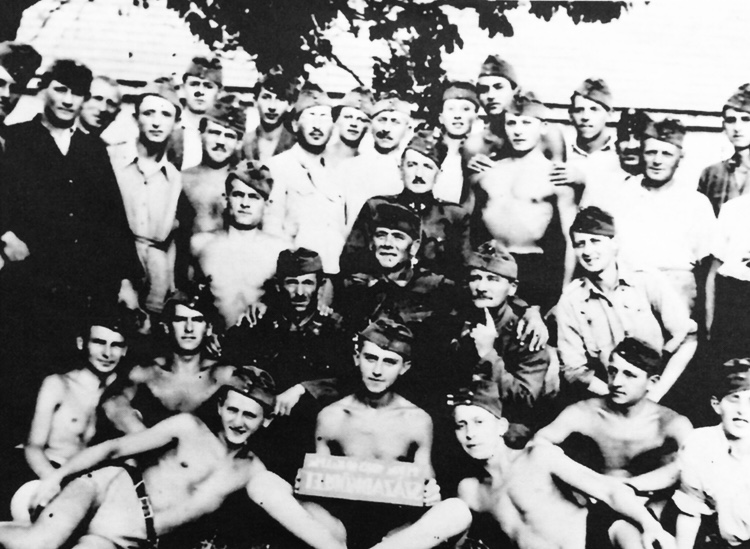
Knowing the end was near, the Nazis forced the men from Ernie’s camp to make an arduous march toward the Austrian border. Many were given Russian uniforms to confuse the Allies. Others trudged on without shoes, their numbed feet wrapped in ripped-up shirts.

Ernie recalled that the men tried to march slowly, not wanting to reach Austria, sensing Allied liberation was near.

At one point, a German SS officer jumped down from his tank and began striking prisoners with a long iron stick. One Jew — as it turned out, Ernie’s uncle — had half his ear sliced off. 

Men were screaming, Ernie recalled.

Finally, a Hungarian officer stepped forward.

“Leave them alone,” he told the German officer.

The Nazi ignored him, continuing to hack away at any Jew within his reach.

The Hungarian officer drew his service revolver. But he was not acting as any protector, merely protecting what he considered his, like property.

“If you don’t stop, I’ll shoot you,” he said. “Those Jews were given to me. I kill them. Not you.”

In time, the retreat became mired in confusion. Prisoners peeled away from the ranks. Amid the madness, Ernie recalled, a Hungarian soldier approached him.

“Let’s run away,” he said.

Where? Ernie asked.

“Just come with me.”

The Hungarian had a gun – and a plan.

“I know a place,” he said. “I met a woman in the village. Her husband is not home. She is pretty cute. That’s mine. You just come along with me. I will save you.”

The two found the right moment to break off and headed into the forest, but quickly encountered a party of Hungarian military police looking for deserters.

An officer yelled for them to stop.

“And we thought: that’s it,” Ernie later told interviewers. “They’re going to shoot us because we ran away from the brigade.”

The Hungarian traveling with Ernie told the officers that the two had been separated in the confusion of the retreat and were trying to find their brigade.

To their surprise, the ruse worked.

“Leave them alone,” the officer told his men.

And then to the escapees: “You guys; go and find your brigade.”

Ernie and the Hungarian spent hours hiding in the bomb shelter of a house in a nearby village, waiting out the night, laying low from the constant sound of gunfire in the woods.

They wondered: Were those Germans shooting out there, or the oncoming Russians?

At daylight, they had their answer.

The men lifted the lid off their earthen sanctuary. 

It was quiet.

Then the horror: Everyone in the village was dead, slaughtered by retreating Germans.

“Let’s go,” the Hungarian told Ernie. “It’s a big forest. Maybe we’ll find somebody.”

The men stumbled through the trees, finally running into some Russian soldiers.

They waved their arms, hailing them in both Russian and Czech. 

They’d been saved, or had they?

The Russians brought them to a nearby camp, where they’d begun inventorying the various stragglers they’d encountered in the woods: 

Russians, Czechs and Yugoslavs were fed and encouraged to go home.

The Hungarians, however, were punished for siding with the Nazis.

“All the Hungarians, they got them together,” Ernie recalled of the scene. “It didn’t matter, Jew or no Jew, a Hungarian was a Hungarian. And they took them all to Siberia.” 

The Hungarians were lined up. Many were beaten. 

“It was like Mengele, the German doctor: You go left. You go right.” Ernie recalled.

Ernie then repaid the Hungarian soldier who saved his life. 

He stood up to the Russian officers, taking a risk out there in the middle of nowhere. He told them that he would not be alive without the assistance of that Hungarian soldier.

He appealed for clemency.

And to his surprise, the Russians let the Hungarian soldier go.

Ernie never saw the man again. 

For this enterprising baker, taken from the arms of his family, forced to cook for men he despised, the long war was finally over. 

Yet another battle was about to begin. 

The Baker: Chapter Seven Read More »

In Ukraine, Aid for Needy Jews Comes With a Catch

ODESSA, Ukraine (JTA) — Alina Feoktistova always knew she was Jewish, but the first time she sought contact with the community was to see if it could pay her tuition.

Feoktistova’s family couldn’t afford to send her to college, but the local Jewish community provides an alternative in the form of the Jewish University of Odessa, an accredited institution that offers tuition and room and board at no charge. Founded in 2003, the university features five-year programs in a number of fields, including foreign language, early childhood education, law, business and Jewish studies.

“I was crying. I really didn’t want to do it,” said Feoktistova, 28, who studied literature at the school. “[My family had] no funds for college for me. The Jewish community was there for us.”

After graduation, Feoktistova found work as an office administrator with Tikva, the Orthodox group that runs the Jewish University of Odessa along with a host of other identity-building and educational programs. And though she married a Jewish man and raises her two children in an observant home, Feoktistova does not fit the stereotype of an Orthodox Jewish woman.

On a Saturday evening earlier this month, she wore a black leather biker jacket over a long dress with a matching studded kerchief in her hair as she smoked her first post-Shabbat cigarette.

“I’ve accepted my fate,” Feoktistova joked.

About 360,000 Jews are estimated to live in Ukraine, most of them in Odessa and other major cities, and Jewish groups have used their robust welfare systems not only to help those in need, but also to overcome the indifference and aversion to Judaism that was instilled here during the communist era.

The American Jewish Joint Distribution Committee, or JDC, provides assistance to any Jewish applicant it deems needy, regardless of their participation in communal activities. But other Jewish organizations often require communal engagement, from enrolling children in Jewish educational programs to attending synagogue, in exchange for help.

In Odessa, the estimated 30,000 Jews are eligible for free services through the Jewish community’s various institutions, which include two community centers, a dozen schools and two orphanages. Families and the elderly can get hundreds of dollars a month — a significant sum in a country where the average monthly salary is about $300.

The Federation of Jewish Communities of the CIS, a network affiliated with the Chabad Hasidic movement, also runs a Jewish university in Odessa, which it describes on its website as “a path out of poverty and into Jewish service.”

The engagement-for-aid model has had a meaningful impact on “breathing life into the dry bones” of a moribund community, according to Rabbi Binyomin Jacobs, director of intergovernmental relations at the Chabad-affiliated Rabbinical Center of Europe.

“Some might even call it a bribe, but it’s legitimate – and it works,” said Jacobs, citing the medieval Jewish philosopher Maimonides, who allowed parents to use candy to motivate children to study.

“Of course, Russian-speaking Jews are not babies, they’re sophisticated people, but from a Jewish perspective they are like captured babies – people who know nothing about Judaism because of oppression,” Jacobs said. “It’s OK to offer them something they need as a way to acquaint them with Judaism so they can decide in an informed way if they want it in their lives.”

Many young Ukrainians in this city and beyond seek a connection to Judaism without financial incentives. The Limmud FSU conference here last month attracted 600 participants who paid nearly $200 to attend the weekend event at a resort.

One participant, Vlodymyr Zeev Vaksman, a 38-year-old active in the Odessa Jewish community, said he sought out the Jewish community after suffering bullying in school. Connecting with his Jewish identity, Vaksman said, “helped restore my pride in it because it’s hard to be a proud Jew when you’re being beat up in school almost every day for being Jewish.”

Others, however, are clearly induced to get involved out of necessity.

Rivka Bendetskaya attended a Chabad school in the eastern city of Zaporizhzhia where she grew up. Her family was poor and not religious, but the Chabad school offered free meals and long hours. At 16, Bendetskaya came to Odessa to pursue a degree in business management at Chabad’s Jewish University. The five-year program would have cost about $17,000 at a regular university, an unaffordable sum for her family.

Sergey and Elena Yarelchenko had little to do with the organized Jewish community before they were forced to flee their home in Lugansk during the 2014 revolution. At a Jewish refugee camp set up outside Kyiv by Rabbi Moshe Azman, who named it Anatevka after the fictional hometown of Tevye from “Fiddler on the Roof,” the Yarelchenkos not only found shelter, but work and a sense of community.

“I never thought I’d go to synagogue, much less live in a Jewish village,” Sergey told JTA.

For other Ukrainian Jews, the community was a ticket to big city life.

Haya Saphonchik, a 27-year-old kindergarten teacher, enrolled in a Jewish school in Odessa primarily to escape her impoverished hometown of Kremenchuk.

“My mom had no money to send me to Odessa,” Saphonchik said. “She asked me when I was 17: ‘Do you want to stay in Kremenchuk in a regular school, or do you want to go a Jewish school in Odessa?’ Of course I went to Odessa.”

After graduating from high school, Saphonchik went on to study at the Jewish University in Odessa, where she met her husband, Uriel, who came to study computer programming from his native Russia. Though she came initially for financial reasons, she stayed because the school offered her more than just an education.

“I found great beauty,” Saphonchik said, “a great mutual responsibility for each other that I didn’t know existed and which ended up giving me the best things that I have in life.”

In Ukraine, Aid for Needy Jews Comes With a Catch Read More »

AFM Wrap Up

The American Film Market is ending and I can’t say enough about how much I learned and absorbed through this event.  The workshops there cover all aspects of filmmaking and television production, from conception, to screenwriting techniques, to funding, to fine-tuning your elevator pitch, to finding your cast, crew and location, to marketing and sales and distribution.  They had discussions about all the various platforms you can stream or view on these days, and the number of outlets is truly astounding.  Still, the overall theme remains that quality stands out; and also the importance of soft skills.  Building trust, communication skills, people skills, being organized and not an over-inflated egoist.  One speaker said memorably, he does three things for someone before he ever asks for one favor in return. 
 
I met a number of industry contacts, made some new friends, enjoyed the numerous parties and events, and even got to see a real live princess at the Thai Film Commission event.  She was elegance and poise personified. 
 
I also attended a marketing for filmmakers seminar put on by Russell Schwartz and Katherine MacDonald.  They have a new book out, The Marketing Edge for Filmmakers.  Filled with tips and advice about marketing smaller budget films, the same advice can also be applied to many other fields. 

Another distribution conference session I attended was called The Rise of AVOD (ad-based video on demand).  Julian Franco, Senior Director, AVOD at Vudu said:  “Most people go for free over paid…if you offer 10,000 movies available for free, chances are that most people just want to watch something to relax and unwind with.” He added,  “People go for the free stuff, but a lot of our partners like Disney and Warner Bros. do a great job of creating demand for big blockbuster tent poles as well as independent films. They’re still really smart about how they release them so they will day-and-date them on TVOD sometimes and we will come in and license an AVOD window exclusively so we’ll take it on day 91 after the Home Entertainment window. This is the first year that we’ve seen that more people are engaging with free over a transaction, but the transaction is still a much larger piece of the overall revenue.”

I would certainly recommend AFM to anyone interested in any kind of filmmaking, directing, cinematography, film distributing or producing.  The information and contacts there can really change your career and life.  They also have some great parties, too.  Now go out there and dream up your next project! 
 
For more information about AFM, visit americanfilmmarket.com.  For more photos I took, visit my Flickr page here:  flickr.com/joybennett.​

AFM Wrap Up Read More »

Santa Clarita’s Jewish Community Responds to Saugus High School Shooting

Representatives from Santa Clarita synagogues spoke with the Journal Thursday morning following the shooting at Saugus High School that occurred at approximately 7:40 a.m.

Congregation Beth Shalom Synagogue Administrator Robin Ceppi, said the congregation put its preschool community on lockdown after hearing reports of the shooting.

“The minute the public schools [from the William S. Hart District] are on lockdown, we go on lockdown,” she said. She added that one of the congregation’s members attends Saugus High but that student is safe. 

“It’s horrendous,” Ceppi said. “We’re close but not that close. It’s our area in Santa Clarita, but we’re not around the corner. We do have members who live up there. It’s part of our community.”

Temple Beth Ami Office Manager Susie Unkeless told the Journal her home’s backyard overlooks the school. She said her synagogue’s community was safe and she had not heard of anything from the congregation’s families to indicate anyone was involved in the shooting.

Nevertheless, she said, “It’s really scary. It’s too close to home.”

As of noon Thursday, one person has been reported killed, and five people wounded, including the victim. They were transported to Henry Mayo Newhall Hospital, among other area hospitals.

The suspected shooter, a 16-year-old boy, is believed to be a student at the school and is currently in custody.

This is an ongoing story and the Journal will provide updates as more details become available. 

Santa Clarita’s Jewish Community Responds to Saugus High School Shooting Read More »