fbpx

October 15, 2019

Why Do College Students Regularly Protest Jewish and Israeli Speakers on Campus?

Yom Kippur was the day before the Hannah Arendt Center for Politics and Humanities’ conference on “Racism and anti-Semitism.” The holiest day of the Jewish year, Yom Kippur is a day of atonement and repentance. Like many Jewish people, I spent the day fasting in shul. Since I attend services on Bard College campus, this meant I also spent the day with students. Between morning services and evening services, the students told me about a planned protest against one speaker: Harvard Professor Emeritus Ruth Wisse.

For the next two hours, I talked with students about the protest. They all were Jewish, with some being members of Students for Justice in Palestine (SJP). Some students were supportive of the protest, some were not. One of the students pulled out her computer and read me a statement Professor Wisse had made, cited on Wikipedia: “Palestinian Arabs [are] people who breed and bleed and advertise their misery.”

I told them that personally and politically, I did not agree with everything Wisse had said, but she had a right to speak. I made my case as the assistant director of the Arendt Center. I said Professor Wisse is 83. She’s a survivor. She has dedicated her life to the Yiddish language. It is not responsible to protest her. I told them this is a panel about anti-Semitism and the protest will be seen as anti-Semitic. 

The students proceeded with their mostly nonverbal protest and were removed when they verbally interrupted Professor Wisse’s talk. When Wisse finished her remarks, there was a thoughtful discussion between her, Batya Ungar-Sargon, Shany Mor and members of the audience. (Watch the video here.) 

The following day, at the beginning of the panel discussion “Racism and Zionism: Black and Jewish Relations,” Ungar-Sargon read a statement condemning all the conference participants for not calling out the student protestors as anti-Semitic, and being complicit in anti-Semitism. She left the conference, refusing to engage her fellow speakers and the audience in conversation.

In response to this, I offered a session so people could discuss what was happening. They asked many serious questions: Why was the only panel protested the only all-Jewish panel dedicated to a discussion of anti-Semitism? Was the protest anti-Semitic? How might we reconcile that charge with the fact that many of the protesting students were Jewish? What is our role as educators if not to prompt students to examine their thinking and the rationale behind their political opinions, without preempting their right to peaceful protest?

Anti-Semitism is a very real problem on college campuses, and we need to address the underlying political causes motivating students to protest Israeli and Jewish speakers. There were plenty of controversial speakers at our conference against which the students could have spoken out. If they had tried to shout down a speaker of color, there would be enormous outcry.

Students today do much of their protesting online, “calling out” and “canceling” students deemed insufficiently loyal to a party line on racial and social justice issues. Protest is, in part, a culture of performance where students parade their virtue − but they do most of this online and in non-public situations. It is highly disturbing that protesting speakers who defend Israel now is seen as an act that gains students social capital. It is evident that even if the protesters themselves had sound political motives and were not in the least anti-Semitic, their protest exists within a larger context of campus culture that sees criticism of Israel to be not only allowable but ennobling.

“It’s our job as educators to help students see how dangerous and prevalent anti-Semitism is right now and how their actions can perpetuate a culture of anti-Semitism.”

BDS protests such as the one we saw last week play off anti-Semitism and contribute to it. Political slogans such as “Zionism = Racism” are persuasive to college undergraduates and fail to reckon with the complex history of Israel and Palestine. But simply calling students anti-Semitic is not enough. Call-out culture from the left and right is not going to help us combat anti-Semitism on college campuses.

In 1969, Theodor Adorno and Herbert Marcuse had a debate about student protests. Adorno was against them; Marcuse was for them. Having escaped the Holocaust, Adorno pleaded with Marcuse to see the rise of left fascism on college campuses. Adorno appealed to Marcuse by reminding him what they withstood, and that protesting Jewish speakers is a form of left-wing authoritarianism.

We need to have this debate again − today.  

If we are going to stop perpetuating a culture of anti-Semitism, we need to address the mobilization of groups like these on college campuses and the chilling effects these protests can have on Jewish life. We must ask why Israel has become a focal organizing point for radicalizing students. It’s our job as educators to help students see how dangerous and prevalent anti-Semitism is right now and how their actions can perpetuate a culture of anti-Semitism.

This is why the Arendt Center actively is working to create spaces to have these difficult conversations. We are working to address anti-Semitism on college campuses by developing workshops to educate students so they can form political opinions based on facts instead of talking points political organizers hand them. We must protect free speech, but we also must address these protests and ask why speakers such as Professor Wisse and Shany Mor end up paying the cost for free speech.

Last spring, we held our first Campus Plurality Forum on Israel and Palestine with students and experts including David Bernstein, Riham Barghouti, Jamil Dakwar, Letty Cottin Pogrebin and Sarah Schulman. Over the course of two days, students from Students for Justice in Palestine and from the Jewish Student’s Organization sat together in conversation, read, talked, listened to experts and engaged in critical dialogue.

We are at the beginning of this work, and we are dedicated to opening spaces for conversation so students are equipped to discuss these serious issues. Hannah Arendt was a fierce defender of free speech. She believed it is “Only in the freedom of our speaking with one another does the world, as that about which we speak, emerge in its objectivity and visibility from all sides.” 

To mark the beginning of Sukkot, I had dinner with friends, neither inside nor outside, in their sukkah. In many ways, the sukkah resembles the conference and conversation spaces we work to make: openness on many sides, all parties sitting together, experiencing the vulnerability and growth that comes from exposure to that which is unfamiliar. A space where no one is silenced by others, no one disinvited, where there is no evasion of challenging questions. Rather than building walls, we are proud to create an open forum where people with different opinions can come together to stop and think.

At one point over dinner, as we talked about the conference, my friend’s 8-year-old daughter asked, “What is anti-Semitism?” I told her Professor Wisse defines it as any politics organized against Jewish people. She wanted to know how a Jewish person could be anti-Semitic. A few days after Yom Kippur, on the eve of Sukkot, this child affirmed my immediate response to the protest: What students need is not to be called anti-Semitic; they need education. It is our job as professors to teach students how to think, not what to think.


Samantha Hill is Assistant Director for the Hannah Arendt Center for Politics and Humanities at Bard College.

Why Do College Students Regularly Protest Jewish and Israeli Speakers on Campus? Read More »

Swastika Graffiti Found on New Jersey Stairwell

A swastika, as well as anti-gay graffiti, were found on a stairwell landing in front of a few New Jersey homes on Oct. 12, across the street from a church that was similarly vandalized with Satanic graffiti in Trenton, New Jersey, the Trentonian reports.

The swastika with the words “f—s live here” next to male genitalia were spray-painted in black on the stairwell landing. The Trenton Church of God of Prophecy was vandalized with red spray paint that read, “Suck the devil’s d—.”

Trenton Police Capt. Stephen Varn told the Trentonian that both instances of graffiti are being investigated as hate crimes and that they could be connected.

Trenton Mayor Reed Gusciora condemned the graffiti in a statement to the Trentonian, saying, “Hate speech has no place in a diverse city such as Trenton. It has caused alarm. We hope this is a singular incident and not a pattern. This also seems to be reverberating across the county, the freely practiced politics of destruction.”

According to the Anti-Defamation League (ADL), anti-Semitic incidents in New Jersey increased from 216 in 2017 to 236 in 2018.

ADL New York and New Jersey Director Evan Bernstein tweeted, “Very disturbing image and report of horrible hate #graffiti in #Trenton. This is becoming the new normal locally and nationally. We as a society cannot let that happen. Thank you to local law enforcement for investigating.”

Swastika Graffiti Found on New Jersey Stairwell Read More »

Oct. 18, 2019

For full screen, click here. 

View more of our archives here.

Oct. 18, 2019 Read More »

German State Anti-Semitism Commissioner Likes Facebook Post Calling for ‘Zionists, Nazis’ to be Unfriended

A German state commissioner against anti-Semitism liked an Oct. 15 Facebook post from an account calling for “Zionists, Nazis” to unfriend him, the Jerusalem Post reports.

The post in question read, “Zionists, Nazis and radicals should quickly remove themselves from my friends list.” Baden-Württemberg Commissioner Against Anti-Semitism Michael Blume liked the post.

The Post noted that the International Holocaust Remembrance Alliance’s definition of anti-Semitism lists comparisons of Israel and Israel supporters to Nazis as an example of criticism of Israel that veers into anti-Semitism. 

Associate Dean and Director of Global Social Action Agenda at the Simon Wiesenthal Center Rabbi Abraham Cooper told the Post, “German Jews deserve a total commitment to fight antisemitism in all its ugly manifestations. If they cannot rely on all authorities to lead an aggressive and unequivocal fight to weed out anti-Semitism – whatever its source – the future of Jews in Germany is in serious doubt.”

In March, the Post reported that Blume compared blogger Malca Goldstein-Wolf, a critic of the boycott, divestment and sanctions movement, to Adolf Eichmann, who is considered to be one of the main Nazi architects of the Holocaust. The Simon Wiesenthal Center’s Jerusalem office head, Dr. Efraim Zuroff, called for Blume to step down at the time, telling the Post, “The comparison of this sort is outrageous and clearly shows that the commissioner has no grasp of issues related to anti-Semitism.”

The Post also noted that Blume “attacked Israelis on his blog last year and helped mainstream pro-Hamas and pro-Hezbollah politicians.”

Blume is not the only German official to draw controversy over liking a social media post in 2019. In July, German diplomat Christian Clages, who heads the German Mission to the Palestinian territories, liked an April 10 tweet from former Ku Klux Klan member David Duke about how “Jewish supremacists invaded the Palestinian village of Deir Yassin” in 1949. The German Foreign Ministry disavowed Clages’ like of the tweet and said they are investigating the matter.

The recent increase in anti-Semitism in the country has caused German Jews to feel “under siege,” especially after the Oct. 9 shooting at a Halle synagogue, the Wall Street Journal reported on Oct. 10. There was an increase of almost 20% in reported incidents from 2017 to 2018, according to the German Interior Ministry, although some in the German Jewish community argue that there are several instances of anti-Semitism that have not been reported.

American Jewish Committee Berlin Acting Director Remko Leemhius told the Wall Street Journal, “We have seen a rise in anti-Semitism for years now, we see it across society. We see it on the right, on the left, in Islamism, and in mainstream society. Right now, it feels like it’s coming from everywhere.”

German State Anti-Semitism Commissioner Likes Facebook Post Calling for ‘Zionists, Nazis’ to be Unfriended Read More »

5 Jewish Things to Watch for at Tonight’s Democratic Debate

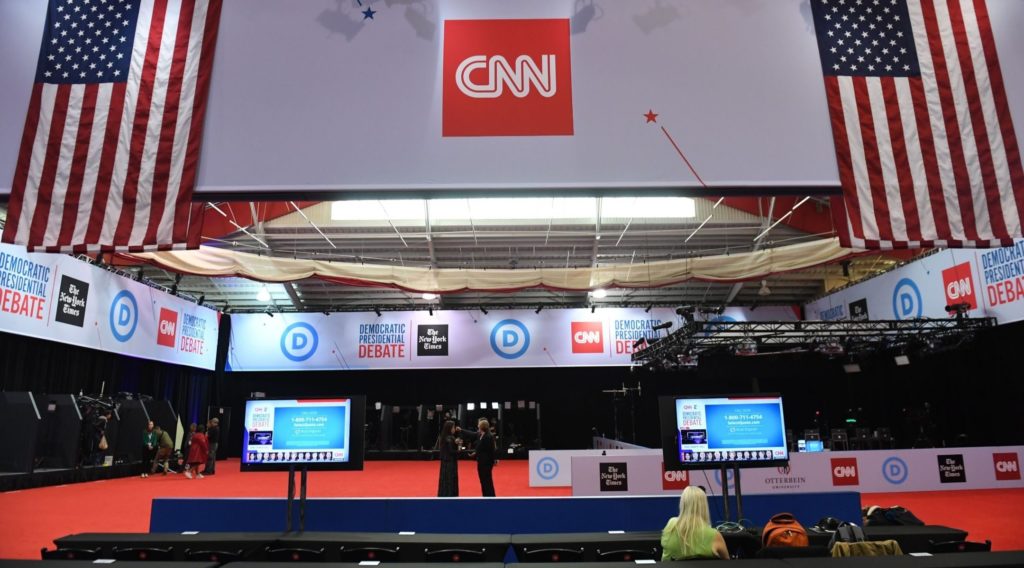
WESTERVILLE, Ohio (JTA) — Twelve candidates will crowd the debate stage tonight at Otterbein University in a suburb of Columbus, the capital of Ohio, a key swing state Democrats hope to regain after losing it to President Donald Trump in 2016.

As the chaos in Syria unfolds, expect foreign policy to be a main feature of the discussion — unlike in the past few debates. Foreign policy wonks were left searching for crumbs after those, in which the focus was chiefly on bread and butter issues like health care and education costs.

Bread and butter will loom large in a rust belt state that still hurts because of job losses over the last two decades, but Democrats will undoubtedly seize on the opportunity to unite in bashing Trump for a move that has been harshly condemned even by some of his Republican allies — giving Turkey the green light to invade Syria and target its pro-American Kurdish minority.

Here are five things from a Jewish perspective to watch for when Democrats take the stage:

1. An unstable Syria is a threat to Israel.

Trump had for the first two and a half years of his term dominated the pro-Israel space by pulling out of the Iran nuclear deal that Israel’s government reviled, moving the U.S. embassy from Tel Aviv to Jerusalem, recognizing Israel’s claim to the Golan Heights and running a peace process that, while ultimately stalled, tilted heavily toward Israel.

It was a record that led Trump to believe he could accuse Jewish voters of “disloyalty” for voting for Democrats, and for him to call the Democratic Party anti-Semitic. Not helping was the party’s left-wing, which has increasingly questioned the parameters of the U.S.-Israel relationship, and comments by two freshman congresswomen that were seen as involving anti-Semitic tropes.

But Trump’s orders in recent weeks to pull U.S. troops out of Syria has drawn protests of alarm in Israel. No U.S. presence in Syria makes it much more likely that Iran, which openly calls for Israel’s destruction — and is a key backer of the Syrian Assad regime — will set up a permanent stake in the country. Furthermore, the U.S.’ abandonment of a close ally like the Kurds is not a harbinger of good things for Israel.

Even Israeli Prime Minister Benjamin Netanyahu, who is next to no world leader in his friendship with Trump, has decried the decision (while not naming Trump directly).

Expect the Democratic candidates to frame their condemnation of Trump’s retreat as endangering Israel, and to try to reclaim some of the pro-Israel territory their party has lost.

2. Tulsi Gabbard could have a tough time.

Rep. Tulsi Gabbard, D-Hawaii, a veteran, has in the past sounded conciliatory toward Assad, calling his opponents “terrorists” and meeting with him without informing Democratic party leaders.

She also has echoed some of Trump’s “end to endless wars” rhetoric in calling for withdrawals of U.S. troops from the Middle East and elsewhere. She has in the past blamed Netanyahu and “neocons” for endangering U.S. interests in the region, and in the process has staked out a tiny but loud isolationist wing of the Democratic Party.

Gabbard has clarified some of her past comments, and has since called Assad a “brutal dictator.” She has also condemned Trump for mishandling the Syria pullout.

Still, the debate moderators and her opponents will likely scrutinize these past Syria associations Tuesday night. Watch for how she reacts when she’s in a defensive crouch — does she invoke pro-Israel neoconservatives?

3. How are you feeling, Bernie?

Bernie Sanders, the Vermont senator who through tireless campaigning in 2016 made history by becoming the first Jewish candidate to win major nominating contests, had a heart attack last month. He has vowed that it will not impede his campaigning.

The 78-year-old has returned to a robust schedule and his rivals on the stage are unlikely to bring his health up — Rep. Eric Swalwell, D-Calif., who has since quit the race, took hits for making age an issue in the first debate, and former Housing Secretary Julian Castro didn’t do himself any favors when he appeared to mock former Vice President Joe Biden’s age in the last debate.

But moderators will not let Sanders off the hook, and he will have to reassure the voters who he appears to be losing to fellow progressive Sen. Elizabeth Warren, D-Mass.

4. Expect plenty of impeachment talk, involving Ukraine’s Jewish president.

The impeachment machine shifted into high gear after revelations last month that Trump had pressured Ukraine into prosecuting Biden, on the basis of no evidence.

A lot of the players in this burgeoning scandal are Jewish, chief among them the country’s president, Volodymyr Zelensky, but also two Ukrainian-American businessmen with ties to Trump and his lawyer, Rudy Giuliani, who were just arrested on campaign finance violation charges.

Lev Parnas and Igor Fruman have close ties to Jewish institutional figures stateside and in Ukraine. No candidate will mention their Jewish identity, but for Jewish debate watchers, the wince factor will be high every time any of these players are mentioned.

5. Rising anti-Semitism might get mentioned on the big stage.

The one issue that has consistently loomed large in each of the last three debates has been the perception among Democrats that Trump’s blunt-edged nationalism and anti-immigrant rhetoric fuels all kinds of bigotry, including anti-Semitism.

That theme, and at least a mention of anti-Semitism, is likely to show up in the fourth debate, for three reasons:

  • An anti-Semitic white supremacist opened fire outside of a German synagogue on Yom Kippur, killing two people and rekindling concerns about rising anti-Semitism around the world. Trump had earlier this year played down the importance of far-right terrorism, rolling back and shutting down programs to address it, although last month his Department of Homeland Security once again made white nationalist violence a priority.
  • The other major role Jews are playing in the impeachment scandal is the actual prosecution. Three of the House committees leading the impeachment charge are chaired by Jewish lawmakers: Adam Schiff of California (Intelligence), Eliot Engel of New York (Foreign Affairs) and Jerry Nadler of New York (Judiciary). Some Democrats — including Alexandria Ocasio-Cortez — have described attacks on Schiff by Trump and his coterie as crossing over into anti-Semitism, and those charges could figure in the debate.
  • Tom Steyer, the billionaire philanthropist who was among the first to call for Trump’s impeachment, has for the first time qualified for the debate stage. Steyer’s father is Jewish, and a rabbi officiated at his wedding, although he now attends an Episcopalian church. But Republican attacks on Democratic funders have placed him in a trio with two other liberal philanthropists who are Jewish, George Soros and Michael Bloomberg. That’s a grouping that white supremacists (who generally don’t note or care that Steyer no longer practices Judaism) have for years used to argue that Jewish influence is nefarious and pervasive. Steyer has said the attacks are anti-Semitic, and he may bring that up during the debate.

5 Jewish Things to Watch for at Tonight’s Democratic Debate Read More »

Thousands March in Berlin Against Anti-Semitism

(JTA) — More than 10,000 people marched in Berlin against anti-Semitism and in a show of support for the victims of anti-Semitic violence in the city of Halle.

The march on Sunday left from Bebelplatz, significant as a site of Nazi book-burning, to the New Synagogue in central Berlin. Several thousand others marched on Saturday in the streets of other German cities including Hamburg and Marburg.

The march comes days after a German man with anti-Semitic and white supremacist motives in a livestreamed attack tried and failed to enter the synagogue in the eastern German city of Halle with explosives and then turned his gunfire on a woman outside and a man in a nearby kebab shop, killing both.

The marchers carried Israeli flags and banners with slogans reading “No Nazis” and “Far-right terror threatens our society,” ABC News reported.

The rally was organized by the civil rights group Unteilbar, or “Indivisible,” under the slogan “We stand united.”

Thousands March in Berlin Against Anti-Semitism Read More »

Israeli Flag Defaced with Swastika and White Supremacist Symbols Found at Cape Cod Synagogue

BOSTON (JTA) — – An Israeli flag defaced with a swastika and white supremacist symbols was found on the grounds of a Cape Cod synagogue hours after the end of Yom Kippur.

Police are investigating the incident at Falmouth Jewish Congregation after being notified by the synagogue’s rabbi, Elias Lieberman, who found the flag on Thursday morning, the Cape Cod Times reported.

Lieberman said the incident occurred between the end of Yom Kippur on Wednesday night and the following morning. He believes the defaced flag, spray painted with a red swastika over the flag’s Star of David and with the numbers 14 and 88, symbols that refer to Hitler and white supremacy, may have been left elsewhere, perhaps in the synagogue’s courtyard, and was blown to the bushes by wind.

The rabbi notified the New England Anti-Defamation League and local police.  He said it’s the first such incident in his nearly 30 years leading the Reform congregation.

The Falmouth Police Department is providing extra patrols during services and increased security, Lieberman told JTA Tuesday and said he was scheduled to meet with the police later in the day.

Religious leaders from local churches expressed support for the congregation.

Sukkot festival services and programs have continued as scheduled and Lieberman said he has heard that many people from outside the synagogue community will attend the congregation’s open Sukkah program on Saturday afternoon, he told JTA.

Swastikas and sexual images were found at another location in Falmouth and at a public high school in a nearby town during the same week. Both are being investigated by local police.

Last year, the Anti-Defamation League recorded 144 anti-Semitic incidents in Massachusetts, including 82 acts of vandalism, the second highest year of incidents recorded in the state, the ADL’s audit reported.

Israeli Flag Defaced with Swastika and White Supremacist Symbols Found at Cape Cod Synagogue Read More »

Trump Sanctions Turkey for Invading Syria

President Donald Trump announced on Oct. 14 that his administration will be implementing sanctions via executive order against the Turkish government for invading northeast Syria.

According to Trump’s statement on the matter, the sanctions will be imposed “against current and former officials” of the Turkish government; additionally, tariffs on Turkish steel will see a 50% percent increase and negotiations for a $100 billion trade deal between Turkey and the United States will be halted.

“Turkey’s military offensive is endangering civilians and threatening peace, security, and stability in the region,” Trump said in the statement. “I have been perfectly clear with [Turkish] President [Recep Tayyip] Erdogan: Turkey’s action is precipitating a humanitarian crisis and setting conditions for possible war crimes.”

He later added, “I am fully prepared to swiftly destroy Turkey’s economy.”

Turkey’s invasion came after the Trump administration announced on Oct. 6 they were ceasing their opposition to Turkey’s “long-planned operation into Northern Syria.” The Israeli government, as well as the governments of European nations, have signaled their opposition to Turkey’s actions. Erdogan’s communications director, Fahrettin Altun, told Agence France-Presse on Oct. 15, “We will continue to combat all terrorist groups, including [ISIS], whether or not the world agrees to support our efforts.”

Trump Sanctions Turkey for Invading Syria Read More »

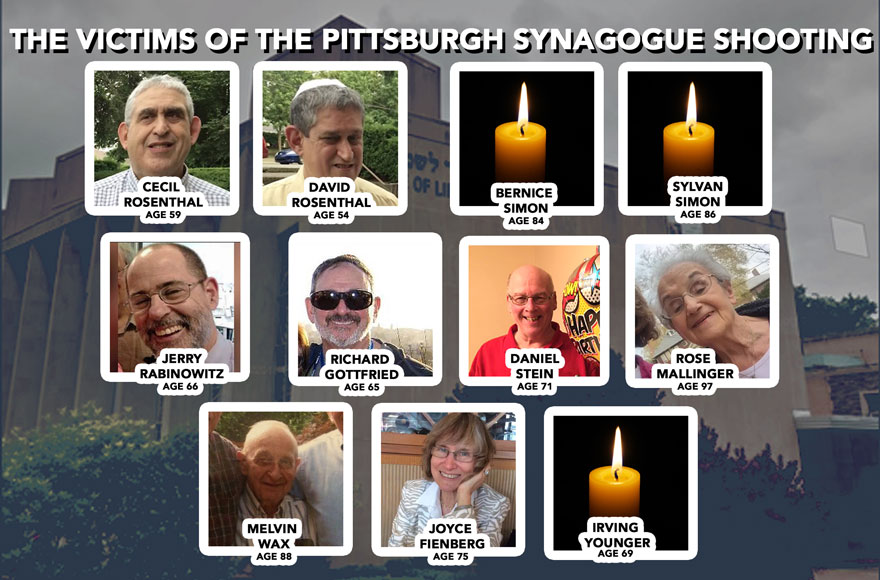
‘Pause for Pittsburgh’ to Mark One Year Since Synagogue Attack that Killed 11

(JTA) — People across the United States and around the world will join together virtually on the one-year anniversary of the attack on the Tree of Life synagogue building in suburban Pittsburgh.

The virtual commemoration, called “Pause with Pittsburgh,” is scheduled for 5 p.m. on Oct. 27. The moment of solidarity and remembrance for the 11 people who were killed during the attack will include, for those in North America, a text including a video with the mourning prayer and a link to Pittsburgh’s local community public memorial service via livestream, and an opportunity to post on a community message board. Overseas participation is through email.

The program is a project of the Jewish Federations of North America.

“Rather than become desensitized to the terror of a never-ending cycle of senseless deaths, we must focus on doing what we do best: building and sustaining community that brings people together,” Mark Wilf, chair of the Board of Trustees of The Jewish Federations of North America, said in a statement.

‘Pause for Pittsburgh’ to Mark One Year Since Synagogue Attack that Killed 11 Read More »

Jewish Prisoners in Michigan Will Get Certified Kosher Meals Under Proposed Settlement

(JTA) — Jewish prisoners in Michigan could start receiving certified kosher meals due to a proposed settlement to a class-action lawsuit against the Michigan Department of Corrections.

There are about 200 Jewish prisoners in Michigan jails who have requested kosher meals but have since 2013 been provided with a vegan meal that is supposed to be appropriate for prisoners of all non-Christian religions, the Detroit Free Press reported. But the vegan diet lacks meat and dairy and is not prepared in a kosher kitchen, the lawsuit contends.

The settlement of the lawsuit backed by the Michigan American Civil Liberties Union was reached over the weekend.

The suit was filed originally in 2013 on behalf of inmate Michael Arnold, who has since been released from prison and removed from the complaint. It was refiled in October 2017 in U.S. District Court in Flint against the Michigan Department of Corrections.

The proposed settlement will be subject to a fairness hearing before U.S. District Judge Linda Parker in Detroit, according to the newspaper. Under the settlement the department would be required to provide a certified kosher lunch and dinner each day to the class members. Meals would have to either be prepared in prison kitchens that are certified kosher or purchased from an outside kosher vendor. There currently are no kosher kitchens in the prison system.

Jewish Prisoners in Michigan Will Get Certified Kosher Meals Under Proposed Settlement Read More »