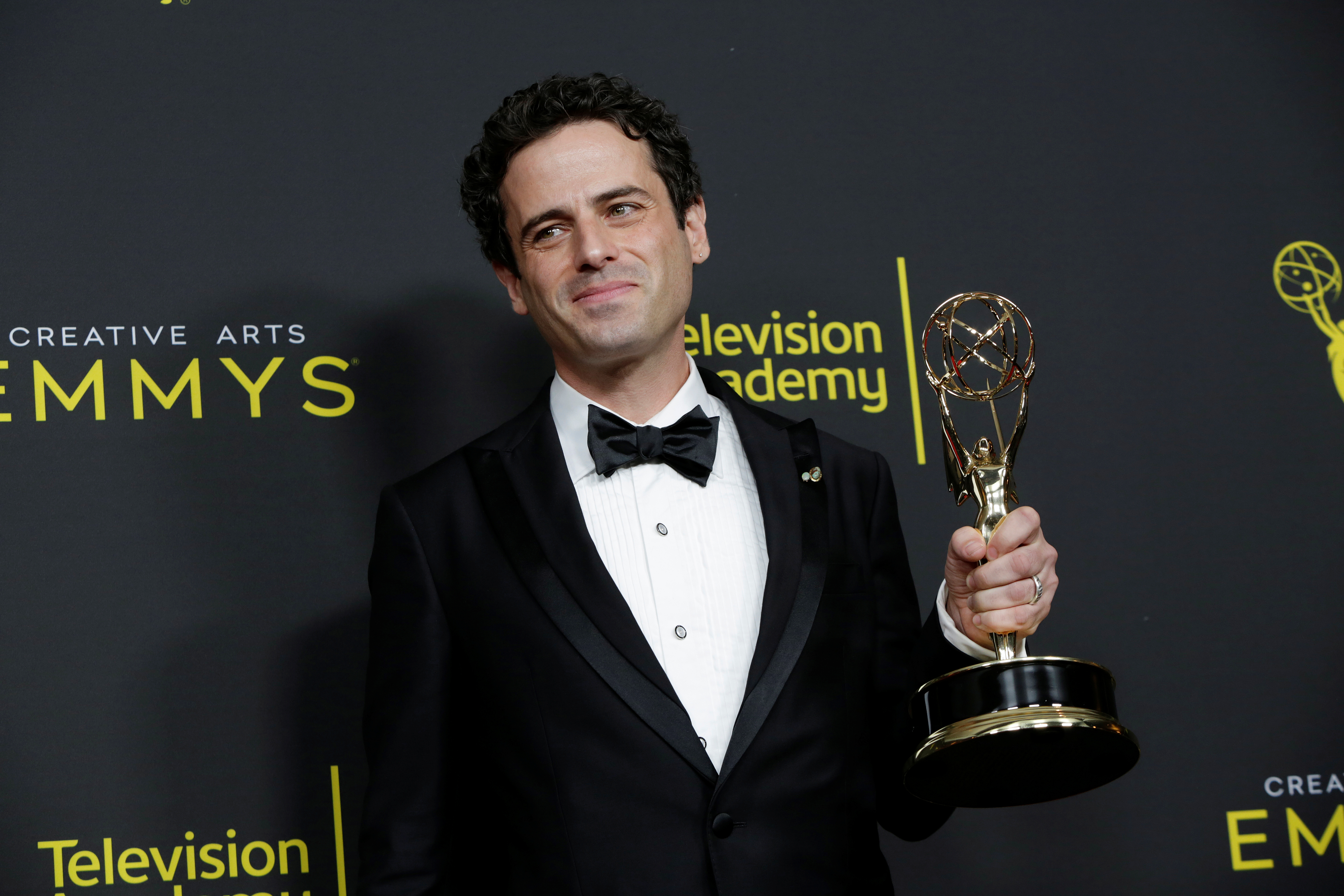
“The Marvelous Mrs. Maisel” cleaned up at the Creative Arts Emmy Awards, winning in six craft, technical and guest actor categories. Luke Kirby won his first Emmy for playing Lenny Bruce and Jane Lynch took the statuette, her fifth overall, for her role as Sophie Lennon.
“Maisel’s” 1950s period costumes and hairstyling were honored, as was its cinematography and music supervision. Creators/showrunners Amy Sherman-Palladino and Dan Palladino share the latter award with Robin Urdang.
Luke Kirby poses with his Emmy Award for Outstanding Guest Actor in a Comedy Series for his role as Lenny Bruce in “The Marvelous Mrs. Maisel.” REUTERS/Monica Almeida
Norman Lear, 97, became the oldest-ever Emmy winner in history when he picked up the trophy for outstanding live variety special for “Live in front of a Studio Audience: Norman Lear’s ‘All in the Family’ and ‘The Jeffersons.’ His previous five wins were for “All in the Family” in the 1970s
Rachel Bloom won for writing the music and lyrics for the final season of “Crazy Ex-Girlfriend,” sharing the honor with co-writers Adam Schlesinger and Jack Dolgen. Explaining why she was barefoot on the red carpet, Bloom shared the happy news she’s three months pregnant with her first child.
The Ruth Bader Ginsburg documentary “RBG” tied in the documentary category with HBO’s “The Sentence.”
Highlights from the two-night ceremony will air Sept. 21 at 8 p.m. on FXX. The Primetime Emmy Awards will air live on Fox Sept. 22 at 5 p.m.
For centuries after the Arab Islamic conquest of Iran, my Jewish community in Iran were the primary source that was retaining and maintaining the country’s musical heritage as music was forbidden in Shiite Islam that had taken over the country. The Jews became among the only musicians and instrument manufacturers in the country and many were also musicians for the royal courts of many kings that ruled Iran. Even for the last four decades as the majority of Jews have fled or have been exiled from Iran after the 1979 Islamic revolution, Iranian Jews in America, Europe and Israel have still maintained a love for listen to and performing Iranian traditional and modern music. In Los Angeles and New York, Iranian Jews are among the largest supporters and patrons of Iranian musical performances and singers.
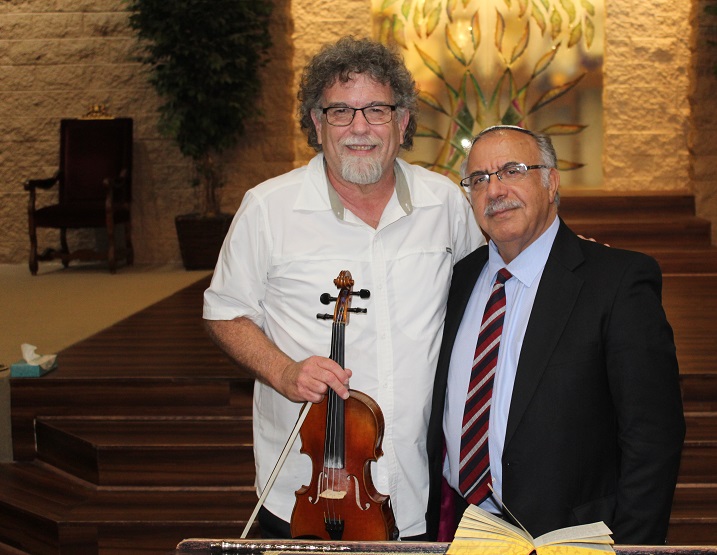
While music has become a part of religious services for many Iranian Jews attending Ashkenazi synagogues, the traditional Iranian synagogues have not incorporated any music into their services. Yet on September 19th history will be made as L.A.’s Rabbi Ruben Malekan will be chanting a selection of the traditional Selichot prayers with the traditional Mizrahi melodies along with traditional Persian instrumental music for the community in a rare spiritual performance. I recently caught up with Malekan to discuss his motivation for the Selichot services where he will be singing the traditional Jewish prayers of repentance, but also be accompanied by the instrumental performance of Manoochehr Sadeghi, who is considered the world’s foremost grandmaster Santur musician. The Santur, or a Persian hammered dulcimer is a string instrument which produces a distinctly Persian or Middle Eastern music. Likewise local Temple Aliyah’s Ashkenazi Cantor Michael Stein and his son violinist Jared Stein will be performing at the gathering which Malekan believes “will elevate people’s souls and better prepare them for high holy days of Rosh Hashana and Yom Kippur”. Sadeghi, who is not Jewish but from the Bahai faith, is not only respected by all in the Iranian community but consider a virtuoso of the Santur worldwide.
For many Iranian Jews who will never have a chance to return back to Iran because of the current radical Islamic regime in power there, the traditional music of the country helps re-connect them to their cultural and even religious heritage. Many Iranian Jewish community members I have interviewed over the years have told me they are moved spiritually and feel more connected to their ancient Jewish heritage when they hear prayers chanted in their traditional Mizrahi melodies. The Selichot prayers themselves are pleas for mercy and their melodies are sad and yet when chanted properly, the prayers are an expression of emotional despair that one feel while separated from God and the desire to change and repent. No doubt the powerful words of the prayers from Malekan and instrumental accompaniment will stir and move those during this special holiday season for the Jewish community.
For more information on the Selichot musical performances at the IAJF synagogue visit their site.
The following are some of the brief portions of Malekan’s moving prayers and his performance with Temple Aliyah’s Cantor Michael Stein which I was able to capture…
Q: As a working Actor who is also studying, learning and expanding a new craft I was wondering what the right way to compartmentalize new and old “methods” are. If there is a right way? I have studied Lee Strasberg’s Method for two years and I am currently studying Meisner’s work. I have been told in the past not to study other types of work while learning a new method. Should I be practicing Meisner work on set? Or with what I am most comfortable with, Strasberg’s Method?
First of all, it is commendable that you are taking your training so seriously. It’s also necessary. While the actor’s greatest desire is to live freely in the moment, the purpose of technique is consistency. You may have natural instincts that lend themselves to the role, but there will be a moment when you need the support of your technique to accomplish the moment. And your question is a great one, which techniques to use, and when?
Stanislavski said: “Create your own method. Don’t depend slavishly on mine. Makeup something that will work for you! But keep breaking traditions, I beg you.” This is ironic, because the most prominent American teachers, Lee Strasberg, Stella Adler, and Sanford Meisner, all developed their techniques building on Stanislavski’s principles. At the end of the day, you’re preparing your role to be able to live on the stage or screen without stopping to think about what technique you are using. But it takes a lot of preparation before you can get to that state of living truthfully. It takes a lot of study of the script and your specific relationship to your part, before you can let go and live. Much like playing scales as a piano player, or training as an athlete. Once you’re in the concert or the game, you aren’t thinking about your prep anymore. But you can’t play unless you’ve prepared.
Strasberg and Meisner chose different concentrations, but fundamentally they both valued living truthfully and in the moment. The option Strasberg gives you that Meisner doesn’t is sensory work. In a nutshell, Meisner concentrates on listening, but I would say that technique is also required in the Strasberg method. I always find that sensory work is interesting to the actor, because it particularly engages not just the conscious mind, but also the unconscious and subconscious mind. In life, every human being is engaged consciously and subconsciously at all times. So, when creating the life of a human being- your character- engaging in your preparation in this way greatens your chances of fully living your part. The chances of totally committing in a way that is personal to you are greatened by the sensory work.
Sensory work also allows actors to find a way to live the circumstances of the script truthfully, even if you haven’t experienced them in your life. John Travolta said that when he played a heroin addict in “Pulp Fiction” but had never done heroin, he had to do some research (no he didn’t go out and do heroin, it’s not a documentary). He researched by talking to current and former addicts and asked about how the drug feels. He was told that the sensation was like drinking whiskey in a hot tub. So, he did that- an experience he felt comfortable with- in order to experience that sensation. And then he knew what to create when he “did the drug” in the movie. He had a real sensation that he felt and believed. And then, so did we.
Same with an emotional sensation, like grief. Perhaps your character is grieving the loss of their grandmother, but you’ve never lost a grandmother. You can imagine it yes, and Adler would say that imagining it should take you there. But in my experience, it is even more effective to recreate a moment of loss that you have personally experienced, so you understand how that loss feels in your body. Then you have a specific sensation that is the feeling of grief to you. Now when you enter the circumstances of your grandmother’s death in the story, it lives inside you in a personal way, which is more interestingly active for you.
In Tracy Letts’ play, “August: Osage County,” the stage directions say the house is HOT. You can imagine you’re hot. OR, you can recreate heat in a sensory exercise and really experience being hot. Which seems like it’s going to help you feel more connected?
I believe there are many instances where sensory work is essential, and at least beneficial, in serving the actor’s process. Another great quote from Stanislavski is: “In the language of the actor, to know is synonymous with to feel.” Feeling is sensation, so act from sensation. You need to merge with the character truthfully, or you won’t believe you are the character, and the audience won’t believe you are the character, either.
Having said all this, there are parts that can be played from the trained actor’s instincts, and there is great value in discovering a moment spontaneously. This is not mutually exclusive with sensory work. It’s another way of discovering an experience that may lend itself to knowing who you are while inhabiting the character. Sometimes you will get a role that flows from you intuitively and simply being in the moment and listening motivates natural responses. This is always the goal, regardless of how you prepare. But I would still prepare by associating specific sensations with world of the script, before playing.
Mostly, you must listen to your body. They call it “gut instinct” for a reason. If you believe you have prepared rightly, you will feel compelled to act and your role will flow from you. If moments arise and you’re distracted from the world of the character, you know you need to fill in those blanks with personal associations, however you create them. Ask yourself what you need to believe you are in the circumstances of the piece, and then choose the techniques that you think will best serve you. Perhaps that will come from your training in Strasberg’s or in Meisner’s techniques, you will only know once you try. Once you truly feel personally motivated to play, you know you are prepared for action.
“You’ll never see two good actors approach their part in the same way.”- Stanislavski
Please send your specific questions about the art of acting to staytuned@gmail.com and Kymberly will respond to a different question each week! There are no invalid questions, as long as they pertain to your craft and life as an actor.
Kymberly Harris is an actor’s director. She specializes in character-driven stories, whether the genre is drama, comedy, thriller, or action. Her extensive experience as a method acting coach to professional actors of all ages has led actors to seek her out to direct them towards their best performances in film, television, and theatre projects.
Boston-rooted rock band Rubikon has returned with “The Record,” its first new album in four years. Out on Sept. 20, via Round Hill Records, “The Record” brings the group back to the basics, with hard-rocking songs and hook-heavy vocal melodies.
Loudwire included the track “Blood On My Hands” in its Spotify “Weekly Wire Playlist” and ABC News Radio premiered the video.
“The Record” follows up the success of 2015’s “Delta,” which spawned the Top 40 Active Rock single “Live That Lie.” “The Record” features the usual Rubikon suspects – Jae Sims (vocals), Josh Gruss (guitars), Dave Raymond (guitars), Hugh Eaton (bass), and Doug Arsham (drums and vocals) – and also includes guest spots from Elisha Hoffman (mandolin, banjo, acoustic guitar), Drew Belk (pedal steel), and Randy Leago (saxophone). Aside from a few overdubs, the album was recorded live in the studio and was mastered by Alex McCollough (Robert Plant, John Prine, Amanda Shires).
I had the pleasure of doing Q&A with guitarist Josh Gruss, who also has found success as the CEO and Chairman of Round Hill Music. Gruss also holds an MBA from both Columbia University and London Business School, is a Berklee School Of Music trustee, and served six years in the U.S. Coast Guard. Highlights from our chat are below for your reading pleasure.
Jewish Journal: How or when in your life did you know that you would be earning a full-time living related to music?
Josh Gruss: Starting from an early age, I was passionate about music but the music industry and becoming a rock star didn’t seem possible. It seemed far, far out of reach. Maybe because of self-esteem issues, I don’t know, it just didn’t seem possible. I recall at age 16 I did an internship at a recording studio called Hip Pocket in New York City. Pictures of Miles Davis and Sting recording there plastered the walls. All I could think was “I’m not worthy, I’m not worthy!”
JJ: “The Record” is the band’s first new album in four years. How long did you actually spend writing and making it?
JG: Four weekends drinking beer in a stale, cockroach ridden, poor-sounding rehearsal space in Boston — I say that lovingly as that’s been our practice space for over 10 years — and two weekends at Sienna Studios in Nashville. One for basic tracks one for overdubs.
JJ: Did you feel pressure when making the album, given that “Delta” spawned a Top 40 Active Rock single?
JG: Ah no. For better or worse we don’t take ourselves seriously enough to care about pressure like that. The only pressure relates to our three omnipresent questions. Are we still having fun? Are we improving our songwriting along the way? Is this record better than the last? The answers to all three is an unequivocal YES! So we’re good.
JJ: Do you have a favorite song on “The Record?”
JG: My favorite songs are going to be the ones that are most fun to play. “Lost September” is the winner in that regard.
JJ: When in the process of making “The Record” did that become its official title?
JG: I have no idea. Is that what we’re calling it? The band always leaves me out of these things. I kid! (laughs) To us, the titles of records are quite stupid and meaningless which is why we went with that title. It’s tongue-in-cheek and I think pokes fun at album titles and the general absurdity of them. But it also refers to a recurring theme we have on this record, which is: there are no records anymore. No physical albums, no records, just singles and digital streams. How sad is that? So for the younger generation, we’re reminding them of what a record is supposed to be.
JJ: What do the next few months look like for Rubikon?
JG: Lots of diapers — I’m about to have kid number five — kids’ sports, work, making our wives happy, and trying to squeeze radio dates and shows with the band to support this awesome album we have given birth to.
JJ: The hard rock and heavy metal worlds are filled with people of Jewish origin, including past and present members of KISS, Guns N’ Roses, Anthrax, Van Halen, Foreigner and Disturbed. Who was the first Jewish musician that you were really aware of?
JG: Bands that I was listening to early on were Europe, Def Leppard, Tesla, Ratt, Yngwie Malmsteen — all goyim. Only now am I realizing guys like Slash were really named Saul. [Editor’s Note: Slash is not M.O.T. but former GNR drummer Steven Adler was.]
JJ: How do you manage the intersection between Rubikon and Round Hill Music? Or do you aim to keep them separate?
JG: Rubikon inspired me to start Round Hill. Many years ago I realized while I was working for a hedge fund that true happiness for me meant combining work with my passion for music. I thought it could apply the same work ethic and passion that I put into the band, into my job, I would be successful in work and in life.
I don’t keep them separate. I proudly display to my colleagues that I am a musician. And it really really helps with work. My job is to invest in music. And if I wasn’t a musician I would be listening to music and just ascertaining a very basic understanding of the music. But as a musician, I am hearing it in a much deeper way. I’m listening to the chord changes, the songwriting, the harmony, the instrumentation, the guitar tone, the technique, the production, the dynamics on and on.
And so that combined with the fact that I’ve been listening to music for 35 years, attended Berklee College of Music — where I dove deep into jazz — buying every issue of Guitar Player magazine since 1986, been playing in bands since eighth grade, I’ve put in the 10,000 hours to know music inside and out and that is vital to Round Hill’s investing success. Another aspect is that I can sit with a musician and speak their language. This helps with getting musicians comfortable and open to doing business.
JJ: When not busy with music, or Judaism, what is life like for Josh Gruss?
JG: Family, friends, and fishing, in that order.
JJ: Finally, Josh, any last words for the kids?
JG: I’m very proud of my Judaism and my family has done a lot of philanthropically to help Jewish causes. The Beracha Foundation was started by my grandfather and has helped hundreds of organizations in Israel and the U.S. including helping the Rimon School Of Music in Tel Aviv, the alma mater of many fellow hard rockers.