fbpx

July 5, 2019

41 Percent of Young European Jews Have Considered Emigrating Due to Anti-Semitism

(JTA) — Forty-one percent of young Jews in Europe have considered emigrating because of safety concerns, according to the findings of a survey published Thursday.

Some 2,700 respondents aged 16-34 said they wanted to leave “because they did not feel safe living there as a Jewish person,” the European Union’s Agency for Fundamental Rights agency wrote in a statement.

The data comes from an analysis of a 2018 survey conducted by the agency. There is no margin of error.

Along among the young people grouping, 45 percent said they choose not to wear, carry or display distinguishable Jewish items in public because there are concerned about their safety.

The young Jews surveyed come from Austria, Belgium, Denmark, France, Germany, Hungary, Italy, the Netherlands, Poland, Spain, Sweden and the United Kingdom.

Overall, 44 percent of the young respondents said they had experienced anti-Semitic harassment, which is 12 percent higher than their elders in the survey of more than 16,000 respondents. Eighty percent of young victims do not report harassment to the police or any other authority, according to the survey.

More than 80 percent of the young Jewish Europeans declared the strength of their Jewish identity to be high.

Nearly two-thirds, or 62 percent, of young respondents said they have a “strong attachment” to Israel, a proportion nearly identical to their attachment level to their own countries. Only 35 percent reported having the same sentiment toward the European Union.

“Young Jewish Europeans are very attached to their Jewish identity,” the EU commissioner for justice, consumers and gender equality, Vera Jourova, said in a statement. “I am saddened that they fear for their security in Europe, do not dare to wear a kippah and some even consider emigrating.”

41 Percent of Young European Jews Have Considered Emigrating Due to Anti-Semitism Read More »

Second Son of Hamas Co-Founder Speaks Out Against Terror Group

Suheib Yousef, son of Hamas co-founder Sheikh Hassan Yousef, defected from Hamas and spoke out against the terror group’s corruption and racism in a July 3 interview with Israel’s Channel 12.

According to the Times of Israel, Yousef explained that he had been working in a Hamas operation in Turkey that aimed to gather intelligence on Palestinian leaders in the West Bank as well as other Arab leaders; the operation also attempted to enlist Palestinians to launch terror attacks against Israelis in the West Bank.

“The point of the attacks in the West Bank is to kill civilians, not for the aim of resistance, nor Jerusalem; not for liberating Palestinian land, and not even because they hate Jews,” Yousef said. “They send out these innocents because they want to export the crisis [from Gaza] to the West Bank.”

He also said that Hamas would sell the intelligence they gathered to Iran.

Yousef left the terror group in June because he was fed up with the terror group’s lavish lifestyle, pointing out that in Turkey, Hamas members would frequently eat $200 meals at fancy restaurants.

“They pay $200 for one course for one person and a family in Gaza lives on $100 per month?” Yousef said.

Hamas paid its members in Turkey around $4,000 to $5,000 a month, according to Yousef, where they lived “in fancy hotels and luxury towers.”

Yousef also criticized Hamas’ use of civilians to terrorize Israelis at the Israel-Gaza border during the weekly riots, saying that it’s an example of how Hamas “is a racist terror organization that is dangerous for the Palestinian people.” He went onto say that he doesn’t hold any anti-Semitic views.

However, Yousef distanced himself from his elder brother Mosab, who worked as a double agent for Israel’s Shin Bet to funnel Hamas intelligence to the Israeli government from 1997 to 2007.

“I was loyal to [Hamas],” Yousef said.

Mosab sought refuge in the United States in 2010, where he published a book titled “Son of Hamas: A Gripping Account of Terror, Betrayal, Political Intrigue, and Unthinkable Choices” about the terror group and why he chose to leave it; the book was turned into a documentary titled “The Green Prince” in 2014.

Hamas and members of Fatah, Palestinian Authority President Mahmoud Abbas’ party, are rallying to Sheikh Yousef’s defense. Hamas is claiming that Yousef’s comments against Hamas are part of a “Zionist plot” against Hamas; Hamas also organized a rally at Sheikh Yousef’s West Bank home in support of the Hamas co-founder.

Second Son of Hamas Co-Founder Speaks Out Against Terror Group Read More »

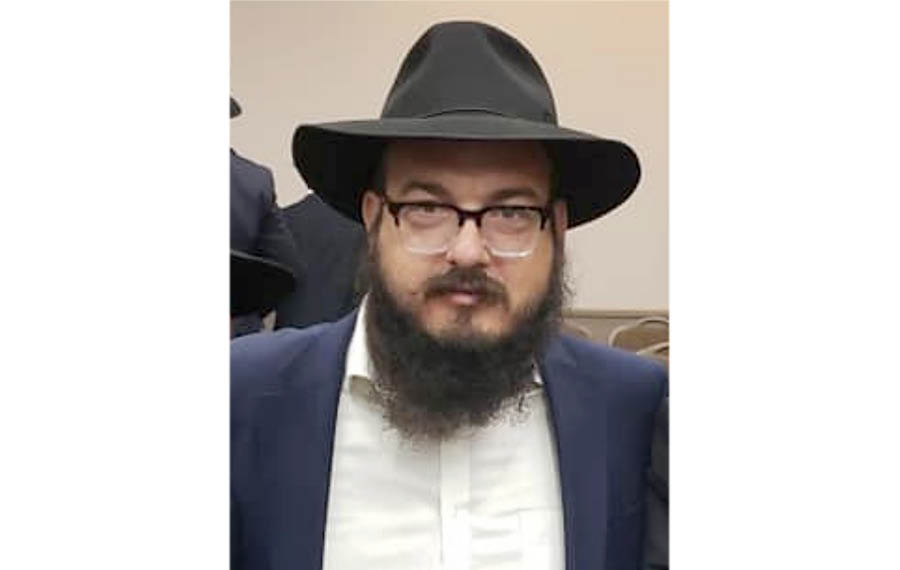
Chabad of Century City Rabbi Tzemach Cunin, 43

Asked what it was like to grow up with Rabbi Tzemach Yehoshua Cunin, who died suddenly on July 5, his brother Rabbi Chaim Cunin told the Journal, “He was the youngest of our brothers but he was the biggest younger brother I could ever have. He was a complete angel in physical form.”

Tzemach, 43, the founder and co-director of Chabad of Century City, was an easily recognizable figure in the neighborhood, where he could be seen walking and “spreading the light of Torah mitzvot,” his brother said. It was a role that came naturally to Tzemach. His father, Rabbi Shlomo Cunin, and his mother, Miriam, were among the first to bring Chabad to the West Coast, and his brothers also joined the Rabbinate. 

Tzemach was a man of grand vision, able to handle large projects for the Chabad Center, which he established in 1999, and he built Beis Chaya Mushka, a Chabad-Lubavitch school for girls in Los Angeles.

 He was equally adept at dealing with his congregation’s members on a one-to-one basis. Chaim said the family has been overwhelmed by the stories that were told during shivah for Tzemach. 

Tzemach recently discovered that a family had fallen behind on its day school tuition and personally paid the $4,000 owed. Asked how he could afford to do this, Tzemach said, “We’ll figure all that out later. This child needs to be back at a Jewish school.”

The day before he died, Tzemach was scheduled to appear at an event marking the 25th yahrzeit of the Lubavitcher Rebbe Rabbi Menachem Mendel Schneerson. He called his brother to tell him he wasn’t feeling well and might be late. Even so, Chaim said Tzemach spent the next few hours texting and making phone calls, reminding others to attend. 

But no matter how busy he was, Tzemach’s family always came first. If one of his children needed him, he was there. “No matter how small the event,” Chaim said, “it was the most important thing in the world to him.”

Tzemach is survived by his parents; his wife, Ada; his five children, Mendel, 17, Goldie, 16, Levi, 13, Chaya Mushka, 6, and Chana Bluma, 5; four brothers and seven sisters. A fund has been established to help the family.

Chabad of Century City Rabbi Tzemach Cunin, 43 Read More »

ADL Says Betsy Ross Flag Is ‘Not a Thing in the White Supremacist Movement’

Anti-Defamation League’s (ADL) Center on Extremism Senior Research Fellow Mark Pitcavage told the Associated Press (AP) on July 3 that the Betsy Ross flag is “innocuous” and isn’t typically used as white supremacist imagery.

Nike announced on July 2 that they were pulling shoes featuring the Betsy Ross flag – the original America flag depicting the 13 colonies at the time of America’s founding – after former San Francisco 49ers quarterback Colin Kaepernick said that white supremacists were appropriating the flag. Nike made Kaepernick the face of its “Just Do It” campaign in 2018.

Pitcavage told CNBC that while white supremacists occasionally use the flag, he has never seriously thought about adding the Betsy Ross flag to the ADL’s database of hate symbols.

“We view it as essentially an innocuous historical flag,” Pitcavage told the AP. “It’s not a thing in the white supremacist movement.”

Nike said in a statement that they pulled the shoes because they didn’t want the shoes to “unintentionally offend and detract from the nation’s patriotic holiday.”

The Betsy Ross flag previously came under controversy in 2016, when students at Forest Hills Central High School in Michigan held the flag in the opponents’ stands during a football game against Ottawa Hills High School. Ottawa Hills parents said at the time that the flag made them feel uncomfortable because Ottawa Hills has a high number of black students and parents. Forest Hills Superintendent Dan Behm said at the time that the flag was being waved as part of school’s “red, white and blue” theme night and that the students didn’t mean any harm. He later apologized.

The New York Times found a couple of instances where the Ku Klux Klan utilized the flag in 2017.

According to History.com, General George Washington asked Betsy Ross to sew the first American flag it what was believed to be in 1776 or 1777; however, there is some doubt on if Ross actually had a role in the creation of the first American flag.

For varying perspectives on the Nike and Betsy Ross flag debate, check out the Jewish Journal’s July 3 Roundtable here.

ADL Says Betsy Ross Flag Is ‘Not a Thing in the White Supremacist Movement’ Read More »

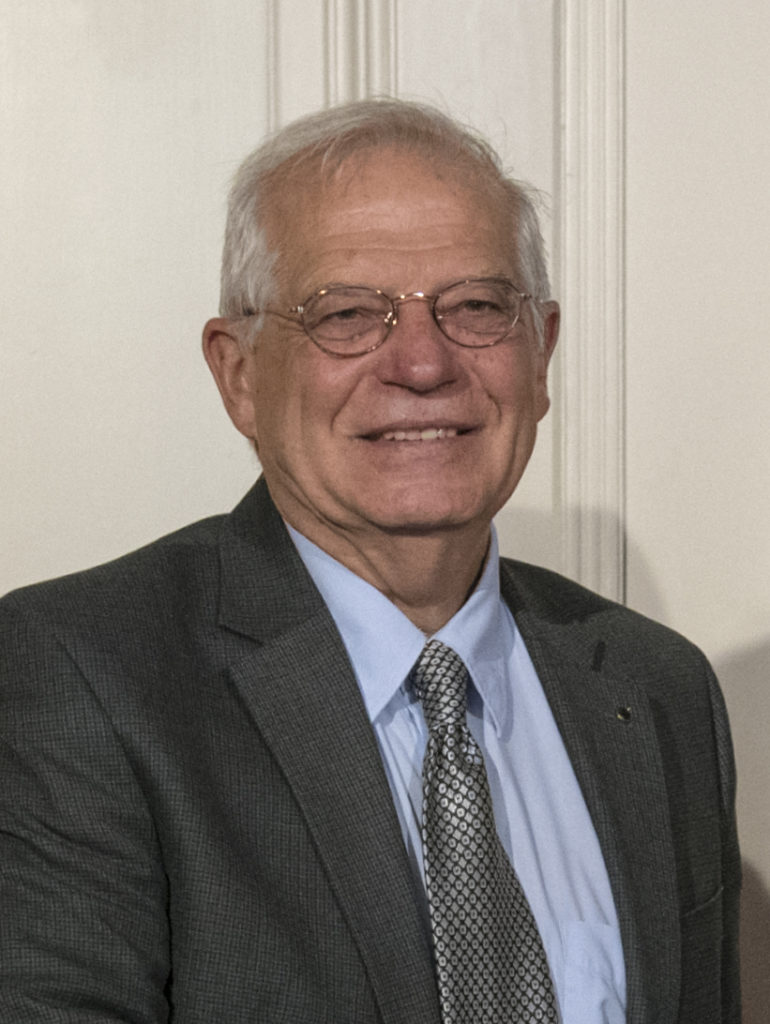
EU Foreign Policy Nominee Said World ‘Has to Live With’ Iran Wanting to Destroy Israel

Spanish Foreign Minister Josep Borrell Fontelles, the nominee to be the European Union’s next foreign policy czar, said in February that the world has “to live with” Iran’s ambitions to destroy Israel.

Politico asked Borrell if the Trump administration “had a point” regarding its decision in May 2018 to leave the Iran nuclear deal given Iran’s frequent threats to destroy Israel. Borrell replied, “We have our own prospects, interests and strategy and we will continue working with Iran. It would be very bad for us if it goes on to develop a nuclear weapon … Iran wants to wipe out Israel; nothing new about that. You have to live with it.”

The European Council nominated Borrell to the foreign policy position on July 2; he is expected to be confirmed.

According to The Jerusalem Post and Times of Israel, Borrell has also made myriad past statements that are critical of Israel, including criticizing Israel’s response to the Hamas-led May 2018 riots at the Israel-Gaza Strip border as reflecting “the dehumanization of the Palestinians by a large part of the Israeli political class and society.” He also lamented Israel’s “terrible bombings” targeting Hamas.

Additionally, Borrell tweeted in February, “Today marks 40 years of the Islamic revolution of #Iran. This regional power has changed a lot during this time. In 1976, the literacy rate was 35 percent. Now it’s 84 percent. In 1980, 5 percent of the women employed were university students. Now they are 47 percent, but only 16 percent of the workforce is female, and the unemployment rate of women is double that of men.” He also tweeted that the United States “has an obsession with Iran,” adding that “Iran can survive the sanctions if Trump is not re-elected. Otherwise, the regime could reactivate the nuclear program for military purposes and multiply its interventions in the region.”

However, in 2005 Borrell proclaimed Israel’s right to exist “as a Jewish state.”

The Anti-Defamation League tweeted, “Especially at a time of increasingly heightened tensions with Iran, EU foreign policy nominee Josep Borrell should clarify and retract his earlier statement” on having “to live with” Iran wanting to destroy Israel.

EU Foreign Policy Nominee Said World ‘Has to Live With’ Iran Wanting to Destroy Israel Read More »

Woman Charged for Allegedly Killing Valley Village Holocaust Survivor

A 68-year-old woman was charged on July 2 for allegedly killing a 91-year-old Holocaust survivor Gennady Bolotsky in Valley Village on June 17 in a hit-and-run.

Bolotsky was walking his dog at around 5:40 a.m. when a vehicle struck him at the corner of Magnolia Boulevard and Wilkinson Avenue. Video footage shows the car running over Bolotsky and then driving away. Paramedics eventually arrived to the scene and took Bolotsky to the hospital, where he died.

The woman being charged for killing Bolotsky, identified as Joyce Bernann McKinney, was reportedly arrested on June 21 in a separate incident of alleged battery and public nuisance. The Los Angeles County District Attorney’s Office announced that McKinney faces a maximum of 11 years in state prison under charges of vehicular manslaughter, hit-and-run driving resulting in death and assault with a deadly weapon. Police say McKinney was homeless and lived in her 2006 GMC Sierra truck.

Bolotsky escaped Nazi-occupied Ukraine in 1941; he immigrated to the United States in the 1970s. His granddaughter, Adriana Bolotsky, told reporters, “No one deserves this, especially not my grandpa who came and survived literally everything. We wish you had a human soul to stop and call, and not leave him lying on the ground.”

Woman Charged for Allegedly Killing Valley Village Holocaust Survivor Read More »

The New Netflix Show ‘Family Business’ is a French-Jewish Version of ‘Breaking Bad’

(JTA) — One fan’s recent description on Twitter of the new Netflix series “Family Business” isn’t too far off: a “French Breaking Bad but with weed.”

The French series, which debuted last week, is a wacky comedy about a Parisian Jewish family, the Hazans, that turns its failed kosher meat shop into a marijuana factory. And while it lacks the macabre violence of “Breaking Bad,” the two shows do share a reliance on witty dialogue and strong acting.

Boasting a solid 7.3 score on IMDB, the series has wide appeal likely in large part to how it mixes race and family relations with fart jokes and surrealist scenes. (One features the Hazans narrowly avoiding arrest by telling police that the weed-stuffed dead pig in their kosher meat truck has been genetically engineered to receive rabbinical approval.)

For Jewish viewers in particular, the series has multiple hidden layers of meaning, and offers astute observations about Judaism’s ability to adapt and survive even when all seems lost — in France and beyond.

The decline of the Hazan family’s meat shop in the Marais district, for instance, echoes the real-life departure of Jews and their businesses from the area that once was the beating heart of French Jewry. Previously full of kosher restaurants, butcher shops and other Jewish-owned small businesses, the Marais has changed radically since the 1980s, becoming a bar hub and mecca for boutique fashion shoppers.

Instead of selling and packing up, the Hazans decide to stay and adapt, largely thanks to a web of lies and manipulations spun by the show’s main character, Joseph, a failed, smooth-talking startup entrepreneur played by the French-Jewish comedian Jonathan Cohen.

The daring plan, which involves growing $3 million worth of dope in time for planned legalization, is also partly born out of crisis in Joseph’s family. His Sephardic father is not adjusting well to the recent loss of Joseph’s Ashkenazi mother.

The fusion of Sephardic and Ashkenazi ancestry is celebrated in the family’s diet, which insiders will recognize both as an accurate reflection of reality in many French Jewish households and a tribute to one of the French Jewish community’s greatest achievements: Its ability to transcend the Ashkenazi-Sephardic divide.

In one scene, in which the Hazans find themselves serving food to an entire police precinct inside their illegal growth lab, the family dishes out typically Eastern European foods alongside North African mloukhiya stew. In another, Joseph’s father, Gerard, the Sephardic one, asks his Ashkenazi mother-in-law to cook kishke — or as he calls it “that awful stink of a dish” — to camouflage the scent of budding marijuana plants from the cops working next door.

The family’s trademark product — the parallel of Walter White’s blue ice in AMC’s “Breaking Bad” — is called “pastraweed,” a mashup of pastrami and weed.

Yiddish phrases like “bubbeleh” pepper the dialogue, along with North African Jewish slang like “ya rab” and “miskin.” The show’s intro features klezmer music.

Another inside joke is about one of French Jewry’s legendary figures, singer Enrico Macias, who at 81 delivers a hilarious and self-deprecating portrayal of himself as a cheap, slightly clueless and ultimately kindhearted geezer.

Between the lines, the show’s creator, Igor Gotesman, also used the family biography to build a sort of microcosm of French Jewry — from the liberal elements represented in Joseph’s lesbian sister, Aure, to the conservative ones, represented by Gerard.

The Jewish identity of the characters is omnipresent, especially in shots that include mezuzahs, menorahs and even the hamsa symbol, which dangles from the rearview mirror of the Hazans’ delivery truck. The attention to symbols is appropriate in a community where thousands of members insist on wearing Jewish jewelry and yarmulkes even though it exposes them to anti-Semitic attacks.

This aspect of reality, however — a rising anti-Semitism in the country that has led to the departure of about 30,000 French Jews to Israel over the past five years — is almost entirely missing from the series. There’s a single reference to the community’s security situation, and even then it’s in a scene where police blow up an important suitcase left by mistake by one of the main characters in front of the meat shop.

The series’ writers also didn’t seem to make much of an effort to explain why the Hazans — a well-to-do middle-class family with a country estate and children who attended universities — are very close to a blue-collar Muslim family in which one of the sons is an Uber driver and another is a drug dealer. Joseph lives with a Muslim woman from that family, and her brother is one of Joseph’s best friends.

Such relationships certainly exist in France. But they are rare, born out of unusual circumstances that the series does not attempt to explain and often strained in ways that it shies away from exploring.

Perhaps such treatment is too much to expect from a goofy summertime crime comedy. But in a country whose society is currently tearing at the seams over issues of race and class, “Family Business” ignores such issues at the expense of its relevance both to France’s Jews and the zeitgeist.

Still, “Family Business” has its meaningful moments. In one of the final scenes, Gerard, the family’s grumpy patriarch, offers Joseph a rare compliment that seems to encapsulate one of the main themes of Jewish history.

“I’m proud of you,” he tells Joseph. “You fall, time and time again. And each time you fall, you rise up again.”

The New Netflix Show ‘Family Business’ is a French-Jewish Version of ‘Breaking Bad’ Read More »

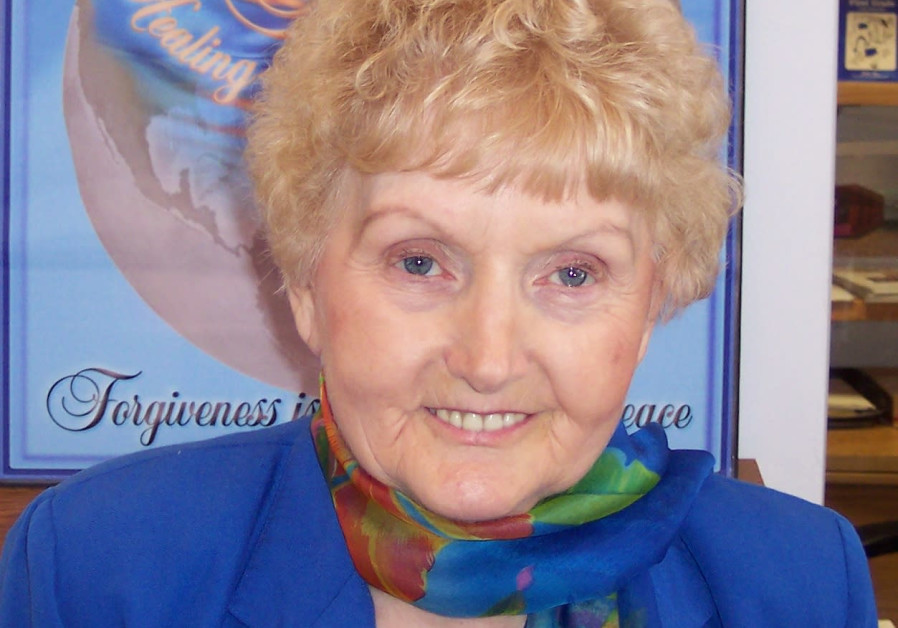
Eva Mozes Kor, Survivor of Mengele Twin Experiments Who Preached Forgiveness, Dies at 85

(JTA) — Holocaust survivor Eva Mozes Kor, who underwent experiments in Auschwitz together with her twin sister, has died at the age of 85.

Kor, of Terra Haute, Indiana died on Thursday morning in Krakow, Poland, the CANDLES Holocaust Museum and Education Center she founded said in a statement. She was in Poland with the museum’s annual trip to visit Nazi camps.

Kor and her sister were one of some 1,500 sets of twins who were experimented on by Josef Mengele. CANDLES stands for Children of Auschwitz Nazi Deadly Lab Experiments Survivors. She founded the museum in 1985.

Kor and her twin sister Miriam, who were born in Romania, were the only members of her family to survive the Holocaust, after being sent to Auschwitz in 1944. They were liberated 18 months later by the Soviet army.

Kor moved to Israel, with her sister, in 1950 where she served in the Israeli army as a Sergeant Major in the Engineering Corps. In 1960 she married fellow survivor, an American, Michael Kor and they moved to the United States.
Her experiences during the Holocaust became public due to the 1978 miniseries “The Holocaust.”

She returned to Auschwitz to share her experience with groups during tours of the site, including annually with groups from CANDLES.

Kor frequently spoke about the power of forgiveness and publicly forgave Mengele and the Nazis. Her embrace in 2015 of 94-year-old Auschwitz guard Oskar Groening, during his trial in Germany, made headlines.

The CANDLES museum wrote in its announcement of Kor’s death: “The themes of Eva’s life are apparent. We can overcome hardship and tragedy. Forgiveness can help us to heal. And everyone has the power and responsibility to make this world a better place. We hope Eva’s story continues to change the lives of those who hear it for many years to come.”

The museum will remain closed until Tuesday to honor her.

Eva Mozes Kor, Survivor of Mengele Twin Experiments Who Preached Forgiveness, Dies at 85 Read More »

Celebrity Physician Dr. Mike Provides Emergency Treatment to Birthright Participant on Flight

(JTA) — The celebrity physician known as Dr. Mike may have saved the life of a Birthright participant aboard the flight to Israel.

Mikhail Varshavski administered emergency treatment to a 26-year-old who was having an acute allergic reaction about two hours after takeoff, Ynet reported. Flight attendants asked whether there was a doctor aboard, according to the report Thursday on last week’s incident.

Varshavski, himself a Birthright participant 10 years ago, monitored the patient’s condition until the plane landed.

This time, the 29-year-old Russia native was a guest of the group America’s Voices in Israel, which performs advocacy work by bringing celebrities to the Jewish state.

Varshavski, whose family immigrated to the United States when he was 5, has been featured on BuzzFeed and in People magazine’s 2015 issue of The Sexiest Man Alive. He has a YouTube channel that provides medically themed educational entertainment.

Celebrity Physician Dr. Mike Provides Emergency Treatment to Birthright Participant on Flight Read More »

Report From the Peace to Prosperity Workshop

I have read much about the Peace to Prosperity Workshop in Bahrain, and the economic plan that Jared Kushner, senior adviser to President Donald Trump, presented at that workshop. Most of what I have read or heard is far different from what I witnessed in Bahrain.

I attended the entire workshop, read the plan and moderated a panel on “Unleashing Economic Potential” of the West Bank, Gaza and the surrounding region. Clearly, if the Peace to Prosperity Plan is successful, it will transform the region, improve millions of lives and bring peace to the people who live in the region. I don’t understand why so many are unfairly attacking a plan that was so well received at the workshop and that the White House appears so committed to making work.

Kushner opened the workshop with a very focused and thorough presentation of the plan and its goals. The plan addresses in great detail exactly how the money would be invested, where it would be invested (the West Bank, Gaza, Egypt, Lebanon and Jordan — a truly regional plan) and the measurable outcomes to be expected from the plan. The plan is based on extensive research and an attempt to learn from past efforts that have and haven’t been successful in this region and elsewhere. For example, the plan states that it is based on the study of business-friendly countries that had built modern economies with an emphasis on investment-led growth such as South Korea, Singapore, Taiwan and Japan; models used by Germany and Sweden to train, develop and employ men and women as business and civic leaders; countries that had used strategic locations to flourish as regional financial hubs such as Dubai and Singapore; and lessons from Poland from the 1990s and, more recently, Egypt and Tunisia, where enterprise funds have had proven success promoting growth by using public sector seed money for investment funds targeting private equity and credit.

If the Peace to Prosperity Plan is successful, it will transform the region, improve millions of lives and bring peace to the people who live in the region.

Kushner’s presentation was followed a discussion titled “The Time is Now: Building a Coalition for Middle East Prosperity” featuring Stephen Schwarzman, chairman and CEO of New York-based investment firm Blackstone, and Mohamed Alabbar, chairman of United Arab Emirates-based Emaar Properties PJSC. Schwarzman and Alabbar could not have been more positive or optimistic about the plan and its goals. This environment of optimism and goodwill continued with every panel throughout the workshop and in the conversations during lunch and in the hallways.

The final session was a discussion lead by U.S. Treasury Secretary Steven Mnuchin with his colleagues from Saudi Arabia, the United Arab Emirates and Bahrain, again emphasizing support of the plan as a regional strategy with a key element being private-sector investment and a business climate that will encourage such investment.

In between, attendees heard from the managing director of the International Monetary Fund, the president of the World Bank, the chairman and CEO of AT&T, former British Prime Minister Tony Blair and many other experienced business leaders and government officials from various countries. Participants at the workshop included a number of Israeli and Palestinian businessmen.

I had the privilege of moderating the panel titled “Unleashing Economic Potential” with Christine Lagarde, managing director of the International Monetary Fund and who is poised to become the next president of the European Central Bank; Mohammed Al-Sheikh, minister of state, member of the Council of Ministers and member of the Council of Economic Development Affairs for Saudi Arabia, who also during his career worked at the World Bank; Tony Elumelu, an experienced and accomplished investor and banker from Nigeria and founder of the Tony Elumelu Foundation; and Willem Buiter, special economic adviser to Citigroup, former chief economist at Citigroup, as well as an experienced economist with expertise in finance and political economy. Each of the panelists made it clear that the plan had the proper focus to provide adequate capacity building, as well as policy initiatives to provide a reliable rule of law and property rights where there could be a free flow of investment, people and materials.

An environment of optimism and goodwill continued with every panel throughout the workshop and in the conversations during lunch and in the hallways.

The panelists discussed successes and failures that they had seen in their own and other countries. The plan provides for infrastructure development in the areas of transportation, water, health and education. One of the most valuable resources of the area is a highly intelligent, young work force. It was pointed out that in the 1990s, a similar effort to provide economic opportunity in the region did prove successful without private investment; and if there were successes 25 years ago with little private investment before a fading hope for peace, the plan could be and should be successful now with far broader participation as long as the people of the region feel included, respected and that there is a real hope of a meaningful future with peace, dignity and prosperity. This will require goodwill by all involved including private, public, international organizations, the parties on the ground and their neighbors.

I left the workshop with far more optimism than I had when I arrived. I commented that the plan and the remarks by so many of the panelists prompted me to recall the teachings of my dear friend and teacher Rabbi Harold Schulweis (z”l), who used to talk about “is” and “ought.” He would say “is” faces me toward the present, “ought” turns me toward the future. “Ought” challenges my creative imagination, opens me to the realm of possibilities and to responsibilities to realize yesterday’s dreams. Without “is,” the genius of our past and present collective wisdom is forgotten. “Ought” demands not only knowledge of history, but of exciting expectation. “Is” is a being; “ought” is a becoming.

The Peace to Prosperity Plan is all about moving from what “is” to what “ought” to be. With bold leadership and a will to succeed, the plan has a chance and would forever transform that region. I wish more of the commentators could focus less on what has been and more on what could be. I see no downside and tremendous upside in supporting the White House’s Peace to Prosperity Plan. I commend Jared Kushner and Jason Greenblatt, Trump’s special representative on international negotiations, on the thought and effort behind this plan, and remain hopeful that this plan can be successful, where other attempts haven’t been.


Richard Sandler was the previous chair of the board of trustees of the Jewish Federations of North America and past chair of the board of The Jewish Federation of Greater Los Angeles.

Report From the Peace to Prosperity Workshop Read More »