fbpx

April 29, 2019

Columbia SJP Calls for Boycotting Pro-Israel Groups on Campus

Columbia Students for Justice in Palestine (SJP) published a statement on April 28 advocating for the boycott of all pro-Israel organizations on campus.

SJP issued the statement after Columbia’s Students Supporting Israel (SSI) invited SJP and Jewish Voice for Peace to discuss the Israel-Palestinian conflict. SSI also sent the invitation to the Columbia College Student Council.

Columbia SJP said they rejected the invitation because of SSI’s “racist, belligerent, and downright bizarre anti-Palestinian activities on campus.” SJP said those events included SSI’s campus event earlier this month that it hosted with Act.IL (a joint project of the Israeli American Council [IAC]), the Interdisciplinary Center (IDC) and the Maccabee Task Force that combats anti-Semitism online) and The Lawfare Project, (which fights the boycott, divestment and sanctions and protects Jewish students through legal means.) They also cited SSI chapters’ nationwide partnership with pro-Israel groups including StandWithUs, the Committee for Accuracy in Middle East Reporting in America (CAMERA), and the Hasbara Fellowships.

Columbia SJP also stated that in 2017 Columbia SSI filed harassment claims against SJP members; the university threw out those claims in 2018.

SJP’s statement downplayed SSI’s claim that the university isn’t doing enough to protect Zionist students on campus.

“We believe that racist ethno-supremacism should, in fact, be challenged on campus,” the statement read. “We also believe that social ostracization is a powerful tool that the student body can use to voice their rejection of Zionism, white supremacy, anti-Semitism, and other oppressive ideologies. The claim that such a challenge would entail actual, physical or psychological violence against individual Zionist students reflects a racist—but all-too-common—strategy that depicts pro-Palestinian advocacy as inherently prone to violence, escalation, and ‘terrorism.’”

The statement also denounced SSI Columbia’s mission statement that SSI is part of “an indigenous rights movement,” calling Zionist claims of being indigenous to Israel “laughably false” as part of “racist co-optation of genuine anti-colonial struggles and organizing.”

“We believe organizations like SSI, given their racist rhetoric and their recorded history of harassment, must be effectively de-platformed,” Columbia SJP said in the statement. “Changing people’s ideas is an important part of any movement for social justice. However, groups that have explicitly demonstrated their anti-Palestinian racism, despite all attempts to hide this fact behind a veil of civility, cannot be treated as “normal” conversation partners. Engaging in dialogue only makes violent ideas and practices seem acceptable within political discourse on campus. We refuse to put the humanity of Palestinians up for debate.”

The statement continued that the boycott should be extended to “all pro-Israel advocacy groups and clubs.”

SSI Columbia responded on its Facebook page, stating, “SSI’s invitation to host a joint event came as a result of SJP claiming that they want to promote dialogue on this issue on campus. After reasserting their anti-normalization policies and miserably attempting to present skewed facts about SSI’s activities in past years, they have asked all other Columbia clubs and organizations for the direct boycott of all pro-Israel advocacy groups on campus. This is downright preposterous, frustrating and reprehensible.”

The statement continued: “We hope that SJP members come to their senses and instead of making aggressive public Facebook posts targeting other student groups on campus, work with us towards a better future for both the Israelis and the Palestinians. Despite their vicious and false rhetoric, we, SSI Columbia, are holding the higher moral ground and we insist that the invitation to hold a joint event is still open.”

Avi Gordon, executive director for Alums for Campus Fairnness said in a statement to the Journal, “The statement issued by Columbia Students for Justice in Palestine is meant to isolate Jewish and Zionist students on campus and demonize Israel. We speak as one alumni voice to make it clear that this bigotry will not be tolerated. Universities should be pillars of truth, academic freedom, and open discourse. SJP’s rhetoric directly threatens these values. We call on the University administration to condemn SJP’s clear discrimination against students who support Israel.”

Brooke Goldstein, executive director of The Lawfare Project, said in a statement to the Journal, “SJP’s call to boycott Zionist organizations and isolate other members of their campus community is bigoted and discriminatory. Their slander against The Lawfare Project and other organizations is yet another attempt to marginalize the Jewish community and stifle free speech.”

Goldstein added, “The Lawfare Project will continue to defend the rights of Jewish students and encourage equitable campus discourse.  We call on Columbia University to suspend campus-sponsored organizations engaging in discrimination like SJP.”

Max Samarov, executive director of Research and Strategy at StandWithUs said in a statement to the Journal, “If SJP wants to boycott those who spread hate on campus, they should start by boycotting themselves.”

The university did not respond to the Journal’s request for comment.

Columbia SJP Calls for Boycotting Pro-Israel Groups on Campus Read More »

Federal Authorities Foil L.A. Terror Attack

Federal authorities foiled a terror plot Monday targeting numerous locations throughout the Los Angeles area.

According to a federal affidavit, Army veteran Mark Domingo, 26, was allegedly plotting the terror attack as retaliation for the New Zealand mosques shootings in March. Domingo had also posted on social media stating that there needed to be another massacre akin to the October 2017 Las Vegas shooting and expressed support for ISIS.

Per the affidavit, Domingo considered targeting “Jews, churches, and police officers” as well as military personnel. Among the locations he considered were the Santa Monica Pier and an LA freeway. Domingo eventually decided to detonate IEDs at an April 28 white nationalist rally in Long Beach. Domingo didn’t expect to survive the attack and told an FBI informant posing as Domingo’s co-conspirator that if he survived his first planned attack, he would then target the Port of Long Beach in an effort to harm the United States economy.

When Domingo purchased what he “thought were completed IEDs” from an undercover FBI agent, federal agents arrested him.

“Law enforcement was able to identify a man consumed with hate and bent on mass murder and stop him before he was able to carry out his attack,” United States Attorney Nicola Hanna said at a news conference Monday. “All of these plans were related to Mr. Domingo’s stated belief in violent jihad and that Americans should pay for attacks on Muslims around the world.”

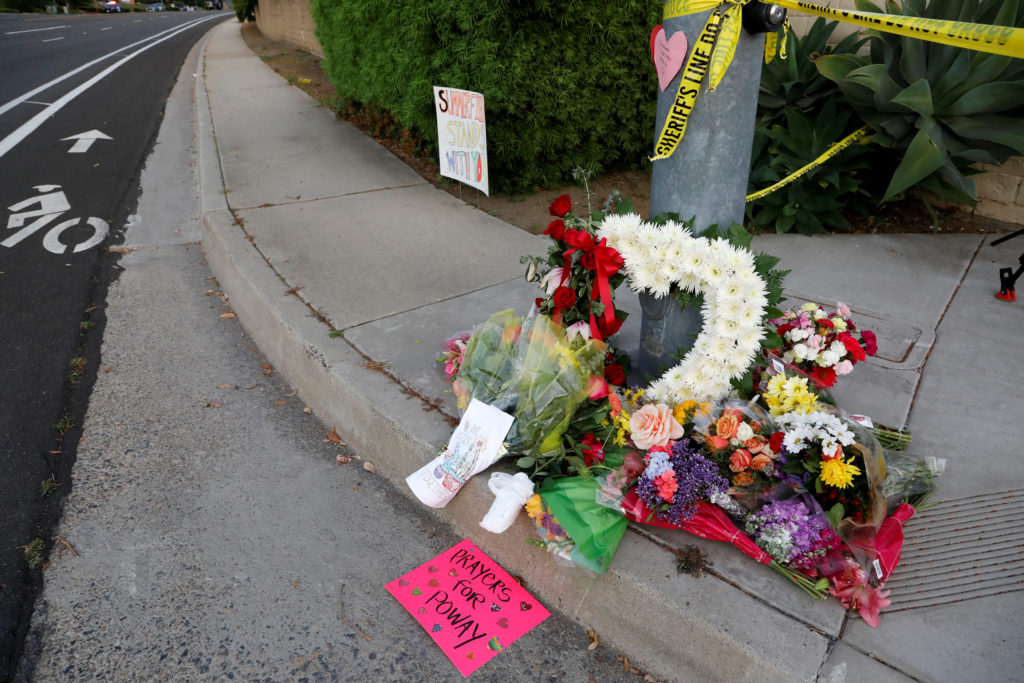
The thwarted terror attack comes just two days after the shooting at the Chabad of Poway that killed Lori Gilbert-Kaye, 60, and injured three others. The incident has sparked discussions about the need for heightened security at places of worship.

Federal Authorities Foil L.A. Terror Attack Read More »

Anti-Semitic Incidents In Canada Rise to Record Number for 3rd Straight Year

MONTREAL (JTA) — Anti-Semitic incidents in Canada rose to a record high for the third consecutive year, according to an annual audit by B’nai Brith Canada released Monday.

The audit showed 2,041 anti-Semitic incidents recorded last year in Canada – 16.5 percent more than the 1,752 incidents in 2017.

“To put that in stark perspective, this represents the third straight record-breaking year for anti-Semitism in Canada, reflecting a ‘new normal’ regarding the landscape of anti-Semitism here,” said Ran Ukashi, director of B’nai Brith Canada’s League for Human Rights.

The group said the surge was fueled by social media and was a worldwide trend.

According to the audit, despite the troubling increase in incidents, they remain a “marginal phenomenon” in Canada. Nearly 90 percent of the incidents took the form of “harassment,” and 80 percent came from online platforms such as Facebook, Instagram and YouTube.

Specific incidents included lit fireworks being thrown at Hasidic Jews in Quebec and two students in Saskatchewan province being harassed and beaten.

B’nai Brith Canada President Michael Mostyn said equally worrying is that anti-Jewish hatred is “surfacing in areas typically less prone to such prejudices.” Most incidents were recorded in Ontario and Quebec, but there was a marked increase elsewhere, apparently due to the online rise.

Anti-Semitic Incidents In Canada Rise to Record Number for 3rd Straight Year Read More »

San Diego Synagogue Rabbi: ‘Today Should Have Been My Funeral’

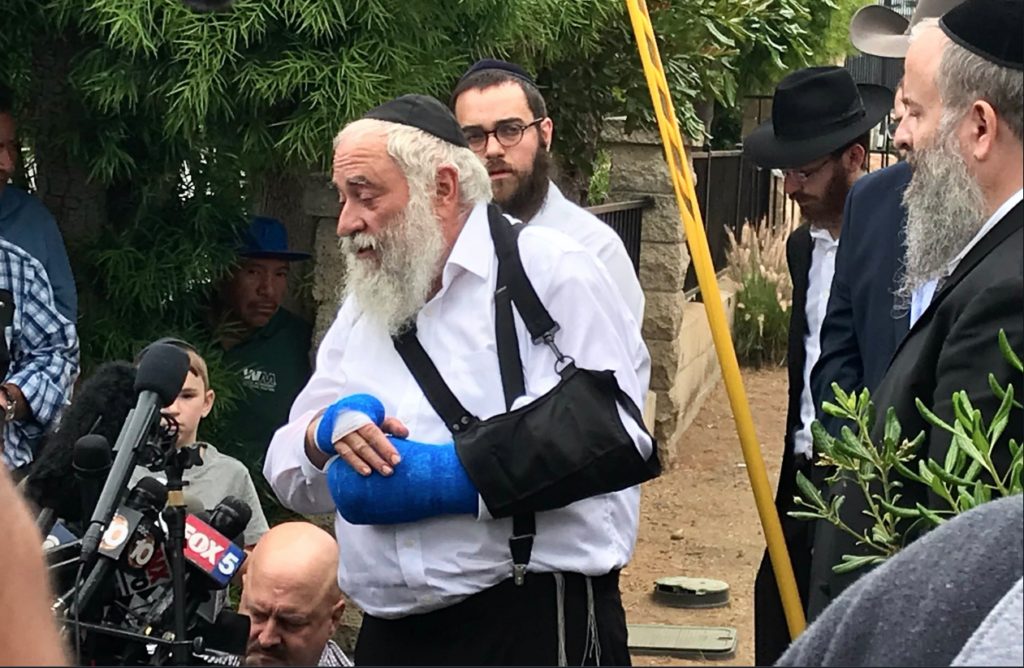
Rabbi Yisroel Goldstein of the Chabad of Poway wrote in an April 29 New York Times op-ed that “today should have been my funeral” after surviving the April 27 shooting.

The shooting, which occurred at around 11:30 a.m., was allegedly conducted by 19-year-old John Earnest, targeting congregants who were celebrating the last day of Passover. Lori Gilbert-Kaye, 60, was killed in the shooting and three others were wounded.

Goldstein wrote in the op-ed that he heard a “bang!” as he was getting ready to deliver his sermon, prompting him to go to lobby where he found Gilbert-Kaye “bleeding on the ground” with the alleged shooter standing over her.

“He was standing there with a big rifle in his hands,” Goldstein wrote. “And he was now aiming it at me. For one reason: I am a Jew.”

Goldstein added that the alleged shooter began firing at him, striking both of his index fingers. Goldstein’s fight-or-flight response kicked in, screaming that the congregants needed to evacuate the premises as soon as possible.

The shooter’s gun suddenly “jammed,” Goldstein wrote, providing off-duty Border Patrol agent Jonathan Morales and Army veteran Oscar Stewart an opportunity to run toward the shooter, prompting the shooter to run away from the synagogue.

“I do not know why God spared my life. I do not know why I had to witness scenes of a pogrom in San Diego County like the ones my grandparents experienced in Poland,” Goldstein wrote. “I don’t know why a part of my body was taken away from me. I don’t know why I had to see my good friend, a woman who embodied the Jewish value of hesed (kindness), hunted in her house of worship. I don’t know why I had to watch Lori’s beloved husband, a doctor, faint as he tried to resuscitate her. And then their only daughter, Hannah, sob in agony as she encountered both her parents collapsed on the floor.”

Goldstein concluded his op-ed by stating that he was going to use his “borrowed time” to become more “brazen” about his Jewish identity and encouraging others to do the same.

“We are a people divinely commanded to bring God’s light into the world,” Goldstein wrote. “So it is with this country. America is unique in world history. Never before was a country founded on the ideals that all people are created in God’s image and that all people deserve freedom and liberty. We fought a war to make that promise real. And I believe we can make it real again.”

In an April 28 press conference, Goldstein said that “a lot of light will push away” the darkness in the world.

“We all need to teach everyone, we need to do random acts of kindness, we need to tilt the scale,” Goldstein said. “There’s so much darkness now in the world but you and I have the ability to change.”

San Diego Synagogue Rabbi: ‘Today Should Have Been My Funeral’ Read More »

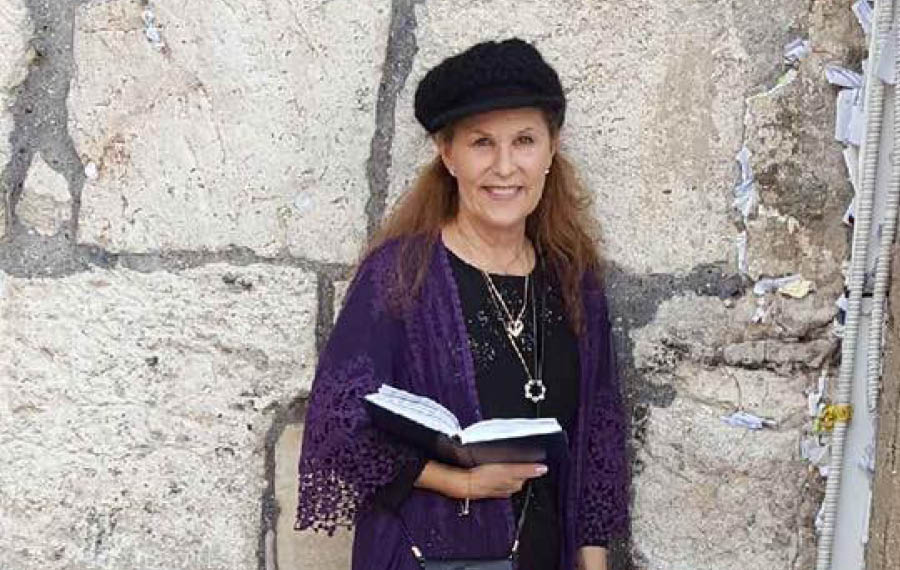
Lori Gilbert-Kaye, Slain in Poway Synagogue Attack, Mourned by Jewish Groups

(JTA) — Jewish groups mourned the death of their member, Lori Gilbert-Kaye, who was shot and killed in the attack at a Chabad synagogue in suburban San Diego.

“We mourn the loss of AIPAC member Lori Gilbert-Kaye, and pray for the recovery of Rabbi Yisroel Goldstein, 8-year-old Noya Dahan and her uncle, Almog Peretz,” the American Israel Public Affairs Committee said Monday on Twitter.

An alleged white supremacist opened fire at the Chabad of Poway on Saturday morning, the last day of Passover, killing Gilbert-Kaye and wounding the three people named by AIPAC.

Hadassah and Chabad also mourned Gilbert-Kaye.

Hadassah, the Women’s Zionist Organization of America, said Gilbert-Kaye was a member of its Bat Harim group in the San Diego area.

“Learning that the woman who died in the horrendous shooting in San Diego was a Hadassah member doesn’t make this despicable act worse, but it does bring it closer to home,” the organization said Monday in a statement.

Chabad on its news website called her “a pillar of the Chabad of Poway community, which she joined in the early 1990s.”

“Kaye, a woman remembered for her kindness, sensitivity, enthusiasm and generosity, spent her last minutes on earth in the lobby of the synagogue and community center she had done so much to see into reality,” it said.

Lori Gilbert-Kaye, Slain in Poway Synagogue Attack, Mourned by Jewish Groups Read More »

Alleged Poway Synagogue Shooter Charged with Murder

(JTA) — The alleged gunman in the attack on the Chabad of Poway synagogue near San Diego was charged with murder.

John Earnest, 19, was charged on Sunday afternoon with one count of murder in the first degree and three counts of attempted murder in the first degree, according to records posted on the website of the San Diego County Sheriff’s Department.

Lori Gilbert-Kaye, 60, was killed in the Saturday morning attack and three people, including an 8-year-old girl, were injured.

Earnest is not eligible for bail, according to the Sheriff’s Department. He is scheduled to be arraigned on Wednesday afternoon.

Local officials have accused Earnest of a hate crime. Authorities are working to determine whether state hate crimes laws can be applied and if he violated federal civil rights laws, the Daily Beast reported.

Earnest called in the shooting to police after fleeing the scene. He was taken into police custody several blocks from the synagogue, reportedly emerging from his car with his hands in the air. An assault rifle was found in the front seat of the vehicle, as was an action camera, indicating that he had planned to film the synagogue shooting.

Earnest also claims that he set fire to a mosque in Escondido, California, in the weeks after the shooting at two mosques in Christchurch, New Zealand. The claim is under investigation.

A nursing student, Earnest is on the dean’s list at California State University, San Marcos.

In a manifesto he is believed to have posted on 8Chan, a conspiracy theory message board, the writer says that he was inspired by the Tree of Life synagogue gunman in Pittsburgh along with the New Zealand mosque shooter. He also calls President Donald Trump “Zionist, Jew-loving, anti-white.”

Alleged Poway Synagogue Shooter Charged with Murder Read More »

A 15-Year-Old Teen Started the GoFundMe for Chabad of Poway

(JTA) — On the Shabbat morning of April 27, a 19-year-old with a gun killed Lori Gilbert-Kaye and injured several others at the Chabad of Poway outside of San Diego.

But before the sun had set and observant Jews were able to see the news, another teenager decided to take action.

The 15-year-old, who asked to be identified only by his first name, told the Jewish Telegraphic Agency that while he had “never been to Poway,” and doesn’t personally subscribe to the rules of Shabbat, he didn’t want to waste any time in helping raise money.

“I thought it was important to get it up and running as soon as possible,” said Cameron, who asked to be identified only as someone who lives across the country from California.

GoFundMe certifies that donations made through its site always go to the intended beneficiaries, and Cameron said the company had indeed reached out to confirm that the funds would be sent directly to the Chabad of Poway.

“I can’t control or see the money, all I do is edit the page,” he told JTA.

Asked what motivated him to move so quickly, Cameron said the only thing worse than a tragedy is “when you can’t do anything about it.”

At the time of publication, the GoFundMe effort had raised $53,421.

A 15-Year-Old Teen Started the GoFundMe for Chabad of Poway Read More »

Poway and the Power of Chabad

With anti-Semitism on the rise, the deadly shooting at the synagogue in Poway last Shabbat had a tragic familiarity. Here we go again: Six months ago we had Pittsburgh, now it’s Poway. What’s next?

It’s even worse in Europe, and especially in France, where the cliché “you can walk the streets as long as you don’t wear a yarmulke” is now well established.

But every time I hear that warning, a question puzzles me: What about Chabad? They don’t wear just yarmulkes — they wear complete Chassidic garb that screams Jewish, and they’re certainly not afraid to walk the streets of the hundred or so countries in which they practice the art of Jewish outreach. Doesn’t that blatant visibility make them the choice targets for Jew-haters everywhere?

One would think.

Here you have thousands of obviously Jewish emissaries operating in sometimes dangerous neighborhoods around the world, and, somehow, the haters seem to leave them alone. What gives? Of course, it’s not as if Chabad has been immune from the poison of terrorism — let’s not forget the horrible attack in Mumbai in 2008 and a recent assault in Nigeria.

But relative to its immense visibility, attacks on Chabad are remarkably rare. How does one explain that? At a time when so many Jews feel under siege, how do you explain that Chabad emissaries can be so visibly Jewish and yet so fearless?

At a time when so many Jews feel under siege, how do you explain that Chabad emissaries can be so visibly Jewish and yet so fearless?

In other words, is there something about the “Chabad way” that perhaps disarms aggression?

“The way we combat anti-Semitism is by being happy and proud of who we are and what we represent,” my friend Rabbi Chaim Cunin of Chabad of California told me after the Poway shooting.

Many of us have experienced what Cunin is referring to — a joyful, positive vibe that seems to be wired into every Chabad rabbi and rebbetzin. As Rabbi Shmuel Herzfeld of Washington, D.C. posted on Facebook: “I don’t believe that there is a Jew alive that hasn’t been impacted in some way by the powerful spiritual energy of Chabad…[They have] an infinite love for all Jews and indeed for all humans.”

This positive energy means you’ll rarely see a Chabad group get angry and lead demonstrations against some form of injustice. They leave that important work to others; their specialty is love.

It is certainly the specialty of Rabbi Yisroel Goldstein, who was wounded in the Poway attack and witnessed the killing of synagogue member Lori Gilbert-Kaye.

While paramedics were eager to take him to the hospital after the suspected killer had left the premises and people were still in shock, the rabbi, with a few blown-off fingers bleeding profusely, willed himself to get up and speak words of peace, defiance and unity. He wouldn’t allow the force of darkness to get the last word in his own synagogue.

A day later, with the glare of media cameras on him, he repeated his message that “We need to battle darkness with light.”

It turns out that when Goldstein confronted the shooter, he couldn’t see his eyes. All he saw was darkness. 

At this moment, thousands of emissaries like Goldstein are walking the streets of the planet looking for Jews who may need a Shabbat meal in Nepal, a mezuzah in Denmark, a kosher kitchen in Costa Rica or a Jewish kindergarten in Bakersfield.

“Here is a young man with a rifle, pointing right at me,” he said. “And I look at him. He has sunglasses on. I couldn’t see his eyes. I couldn’t see his soul. I froze.”

It was as if Goldstein wanted a chance to look the killer in the eyes and see his soul. Who knows what might have happened then? The Chabad way is to believe in miracles.

While so many of us were fuming with outrage at the evil of Jew-haters and making plans to combat that evil, Rabbi Goldstein was telling the world that “a little bit of light pushes away a lot of darkness.”

In fact, he called for more than a little: “A lot of light will push away a lot more. And the Rebbe (the late Lubavitcher Rebbe, spiritual leader of Chabad) would say we all need to teach everyone, we need to do random acts of kindness, we need to tilt the scale. There’s so much darkness now in the world, but you and I have the ability to change.”

Goldstein doesn’t rely solely on kindness and miracles. He’s savvy enough to institute security training at his synagogue and take other precautionary measures, as all Jewish spaces must do.

But that’s only his starting point. His journey is to spread the light of goodness and kindness through Torah.

At this moment, thousands of emissaries like Goldstein are walking the streets of the planet looking for Jews who may need a Shabbat meal in Nepal, a mezuzah in Denmark, a kosher kitchen in Costa Rica or a Jewish kindergarten in Bakersfield.

Who knows, maybe it really is disarming to see people who are so joyful, loving and giving—and who are utterly unafraid to look so proudly Jewish. 

Poway and the Power of Chabad Read More »

Jointer CEO Jude Regev on Making Real Estate Investing Affordable, Attainable and Interesting

A next-generation commercial real estate platform, Jointer was established in 2017, as based in both Silicon Valley, California and Tel Aviv, Israel. The company is a growing leader in artificial intelligence, tokenization and blockchain-based technology innovation for the commercial real estate industry. In short, the company issues debt tokens to borrow money from the public to help property owners instantly unlock their equity at zero costs.

Jointer recently grabbed some headlines when it submitted a bid for the iconic Chrysler Building in New York City. Ultimately, Jointer appears to be the first company to take the extra step to tackle public tokenization of assets rather than private tokenization which all current tokenization platforms provide. Currently, tokenized properties are only available to the very wealthy, which runs counter to the principles of blockchain.

Jointer’s CEO Jude Regev is an international digital currency expert, who taught himself English while he was rolling out his own business. I had the pleasure of doing Q&A with Regev, and below are highlights from that interview.

Jewish Journal: How would you describe Jointer to someone not yet familiar?

Jude Regev: The easiest way to understand Jointer is to look back at another major problem in real estate: historically, landlords wanted to lease large amounts of office space, but tenants sought to only rent a desk. WeWork stepped in and solved this issue by providing the landlord with one check while giving tenants the ability to lease one desk.

Similarly, in the commercial real estate industry, there is a problem that has existed for over 200 years. Investors want to diversify their portfolios and because of this, sponsors cannot receive one check and they have to do syndication to raise funds. This is a very time-consuming process and causes sponsors to miss out on lucrative deals since real estate is time sensitive.

Enter Jointer and our new tokenization model. Investors will receive tokens for their investments that are pegged to the Global Select REIT Index rather than one property. This process allows Jointer to provide sponsors with one check forming a JV partnership. To attract sponsors and investors to this new and scalable process, Jointer is offering to double their current returns.

JJ: When did you first become interested in real estate?

JR: Since the big subprime crisis in 2007. I started to underwrite properties and realized that property gets sold below its value because the public follows the lead of fears and psychology. Then I realized that if I follow the numbers, eventually I’ll identify opportunity before the public does.

JJ: A lot of people took notice when Jointer submitted a bid for the iconic Chrysler Building in New York City. Any update on that?

JR: The deal is in progress, and it’s a shame that the organizations involved in the sale did not have the foresight to see the value of our new tokenization model, especially as major companies such as JPMorgan Chase have recently announced they will issue their own token and Facebook announced a $1 Billion crypto project, the Facebook coin. Tokenization is here to stay.

JJ: Chrysler bid aside, what is coming up for Jointer?

JR: We’re beginning to fill the trust with properties to increase the cross-collateral investors receive. The more properties we tokenize, the more reduction in risk we are able to provide our investors.

We are also preparing to close our Series A round which will provide us the fuel needed to handle our waitlist of properties to tokenize.

JJ: Given the split operations of Jointer, how much time of the year do you usually spend in Israel?

JR: I try to get to Tel Aviv at least twice a year for a few weeks to visit and meet with Lior Gal, our Chief Technology Officer.

JJ: Is there anything that you’re as passionate about as real estate?

JR: I’m passionate about building companies like Jointer and our other company, the Element Zero Network, which fell out of the Jointer project. I’ve been involved in five start-ups and three exits. I LOVE what I do, and believe that people should work as much as they like on the stuff they love. I have a great international team and I am energized by their talent and their commitment to building solutions for the benefit of all, not just a chosen few.

JJ: I feel compelled to ask: Can you share a memory about your bar mitzvah?

JR: At the time of visiting the Western Wall, I remembered thinking, “Why do people go all the way to Rome to see 2,000 years of history of one religion, when right here we have 5,000 years of amazing history covering all religions?” And that all the world is missing it.

JJ: Finally, Jude, anything else you would like to add?

JR: I think the Jewish community has a proud history of leadership in the Commercial Real Estate industry. Real estate has traditionally been a means for immigrants to develop an independent source of income and rise out of their circumstances. But in today’s marketplace, high investor minimums, coupled with the traditional real estate process makes commercial investment unattainable for many who wish to enter the market.

Through Jointer’s tokenization model, it is our goal to open the market to all who want to participate, not just a chosen few. I hope your readers will visit our website, Jointer.io to learn more about us. We are on a mission. And we hope this community will support our vision.


More information on Jointer can be found online. 

Jointer CEO Jude Regev on Making Real Estate Investing Affordable, Attainable and Interesting Read More »