fbpx

March 8, 2019

Dr. Noam Wasserman Appointed New Dean of Yeshiva University’s Sy Syms School of Business

Yeshiva University announced March 8 that Dr. Noam Wasserman will be the new dean of the Sy Syms School of Business effective May 2019.

Wasserman will take over the responsibilities of interim dean Michael Strauss, who led the school for two years and served as associate dean for six years before that.

“As chair of the search committee, I can attest to Dr. Wasserman’s passion and commitment to driving YU and Sy Syms to the next level,” Strauss said in a statement. “He brings a new perspective to our school during this critical period of change in the landscape of business education.”

“I am very excited to be the next dean of the Sy Syms School of Business,” Wasserman said. “YU is the world leader in bringing the timeless wisdom and ethics of Judaism to cutting-edge real-world problems, and I plan to work with our faculty, staff and students to deepen and extend that tradition.”

Wasserman holds a PhD in organizational behavior and a master’s degree in sociology, and has been teaching for over 15 years. He is also holds the Lemann Chair in Entrepreneurship at the University of Southern California (USC) and is the founding director of USC’s Founder Central Initiative.

“Dr. Wasserman embodies the values for which Yeshiva University stands,” YU President Dr. Ari Berman said in a statement. “His appointment represents our commitment to growing the quality of our education, preparing our students for greater success in the marketplace of tomorrow and bringing Jewish values to the world.”

Dr. Selma Botman, provost and vice president for academic affairs at YU also shared her excitement via statement saying, “Dr. Wasserman brings to YU a rich background in research, scholarship and teaching. There is no doubt that he will provide transformative leadership to our growing Sy Syms School of Business.”

Dr. Noam Wasserman Appointed New Dean of Yeshiva University’s Sy Syms School of Business Read More »

Hazon Issues Cease and Desist to Israeli Group Claiming Same Name

The New York-based Jewish nonprofit Hazon, has issued a cease and desist letter to a new Israeli organization using the same name. Founded 20 years ago, Hazon (vision) bill itself as a “Jewish Lab for Sustainability” and has legally trademarked the name.

The nonprofit’s Israeli law firm issued the letter earlier this week to the new Israeli organization, which recently published a series of billboards attacking the Israeli LGBTQ community and the Women of the Wall group.

“Hazon works to create a healthier and more sustainable Jewish community, and a more sustainable world. It is frankly distressing to see our name being attached to billboards and pronouncements that so radically stand against all that we have done, and all that we have tried to do, since our founding in 2000,” Hazon’s Chief Executive Officer Nigel Savage said in a statement to the Journal. 

The New York-based Hazon is an agency of UJA-Federation of New York and a member of the Jewish Social Justice Roundtable. It has offices in Connecticut, Detroit, Boulder, Denver and Israel. 

Hazon’s senior staff member Rabbi Aharon Ariel Lavi, said in a statement that the New York Hazon stands for connecting people of all sectors in order to build sustainable communities. “We believe that the sustainability of Israel and of our faith lies in honest conversation, despite deep disagreements, not in attacking people for their identity or their beliefs or anything else,” Lavi said. “This new Israeli Hazon is doing exactly the opposite of this. I hope that they will end this campaign.”

According to the Jerusalem Post, the new Israeli group said its goal is “returning the Jewish character to the national agenda in Israel.”

The new group recently released a banner titled, “A father and a mother = a family.” The poster was later taken down after LGBT activists complained.

Former American Jewish World Service CEO Ruth Messinger, who was also a Hazon trustee said in as statement, “Hazon has consistently been on the side of so much that is good and right in Jewish tradition, and it has, as well, a longstanding commitment to pluralism and inclusive community. It is quite awful that this group in Israel is inciting bigotry, let alone in the name of Jewish tradition. I hope that anyone who opposes this—as I and my colleagues strongly do— will go to Facebook and like the Hazon page, to make clear that this organization does not in any way speak in our name.”

JTA reported that Rabbi Dror Aryeh, one of the leaders of the Israeli group, told the publication Srugim, that the new organization is dedicated “to the Temple, to health, to purity.” Aryeh added that the new organization has collected 123,000 signatures in 36 hours and gained the support of major rabbis on a petition to define marriage as the union of a man and a woman.

Hazon Issues Cease and Desist to Israeli Group Claiming Same Name Read More »

Update: Women of the Wall Activists Shoved, Spat On During 30th Anniversary Event

Protests broke out at the Western Wall on March 8 when thousands of women who were part of the egalitarian group Women of the Wall were reportedly spat on and shoved by ultra-Orthodox Jews.

The ultra-Orthodox men and women tried to prevent the Reform group from praying at the site; the service marked the 30th anniversary of Women of the Wall and coincided with International Women’s Day.

Women of the Wall is a feminist prayer group that advocates for equality of worship at the Kotel.

One of the women coming to pray alongside Women of the Wall was Rabbi Laura Geller of Temple Emanuel in Beverly Hills. Geller has been a supporter of Women of the Wall since its origin and said she’s never seen anything like this in all her years attending services at the wall.

“I once had my tallis confiscated, there has been lots of time where there has been harassment but I have never personally experienced direct violence but it was really bad,” Geller told the Journal Monday adding it was “so bad that for the first time in 30 years we stopped prayer in the middle of hallal, and we evacuated ourselves out which was miraculous in itself.”

Currently, there are three sections at the Wall: a female-only side, a larger men-only section and, since 2000, an egalitarian section south of the main plaza where men and women pray together.

Orthodox Judaism prohibits men and women from praying together.

According to the Israel Public Broadcasting Corporation, 6,000 Charedi protesters gathered to protest the 150 female activists of Women of the Wall.

Geller said busses of orthodox men and women showed up that morning to harass the women and men who were supporting the women’s group. The rabbi added that it came from billboards and posters of the new Israeli conservative group Hazon encouraging followers to protest.

One flyer read, “Reform Jews at the Kotel? That’s not normal! The question of whether, on Friday, there will be sanctification of God or, God forbid, the opposite, depends on the attendance of each and everyone of you, and your encouragement of friends and family to join and organize additional shuttles! Below are a list of subsidized shuttles, and contact people. Sign up in advance! Hazon: Setting a Jewish agenda in the country.”

“What we were doing ‘which was offensive’ was praying out loud, wearing tallit, wearing tefillin,” Geller said. “Those behaviors initially, it wasn’t legal to do because the wall is essentially an ultra-Orthodox synagogue. But it is now legal. It is legal for women and most recently on March 6, the day before Rosh Chodesh, the attorney general sent a letter to the rabbi of the wall saying it is not a violation of local customs. So nothing we were doing was illegal.”

In a statement, Rabbi of the Western Wall Shmuel Rabinowitz said, “the Western Wall plaza is not a…demonstration area and asked [for attendees] to refrain from provocations, and to guard the Western Wall as a unified place, and not a place of division.”

Police intervened and the wall worshipers said they were spat on and shoved by girls attending the religious seminaries, the report from Israel Public Broadcasting Corporation said. The Women of the Wall activists moved to the egalitarian plaza, known as the Ezrat Yisrael section, to prevent further backlash.

New York Times reporter Bari Weiss, who attended the Women of the Wall event at the Kotel, tweeted: “I had never been spit on in my life before this morning — when I went to the Kotel to check out Women the Wall. Turns out their opponents are *really* into spitting.”

Police confirmed a 20-year-old ultra-Orthodox man had been arrested after he tried to attack an officer in the area, the Jerusalem Post reported.

“We are not at war,” Women of the Wall wrote on Twitter. “We just want to pray as we believe.”

This story was updated Monday, March 11 to incorporate quotes from Rabbi Laura Geller. 

Update: Women of the Wall Activists Shoved, Spat On During 30th Anniversary Event Read More »

What Ilhan Omar Can Learn from the Mistakes of the Women’s March

The discourse surrounding anti-Semitism and Rep. Ilhan Omar (D-Minn.) feels like a black hole. Its darkness is consuming, sucking in complex nuances around Jew-hatred, Islamophobia, race, whataboutism and partisanship. Each voice dogpiling onto the conversation seems to pierce the edges of this gravitational field, scraping our most intense anxieties.

Black holes form when massive stars collapse at the end of their life cycle.

Omar is a star. Not only is she first Muslim refugee to be elected to Congress, but with her hijab proudly on display in the Capitol under a reputed Islamophobic administration, she is the full embodiment of resisting bigotry.

Earlier this year, we witnessed four other stars rupture in the social justice sky.

Their names? Women’s March co-chairs Linda Sarsour, Tamika Mallory, Carmen Perez and Bob Bland.

The troubled Women’s March dynamic is nearly identical to the controversy exploding around the congresswoman. Omar and the Women’s March Inc. co-chairs are progressive figures who entered the national stage, symbolizing the fight for tolerance, but failed at achieving their mission because of their personal biases against Jews.

After these women were implicated in anti-Semitic attitudes and beliefs, their supporters and critics used the same tactics.

Jews on both sides of the aisle condemned their actions as anti-Semitic. Mainstream Democrats pulled their support; the Democratic National Committee ended its sponsorship of the Women’s March, and party leadership denounced Omar’s anti-Semitic tweets.

The right, predominantly non-Jewish Republicans, weaponized the harm done to Jews by these leaders to attack their racial and religious identities. Rather than addressing the festering beehive of anti-Semitism in their own backyard, they used “fighting anti-Semitism” as a cover to spew Islamophobia and racism at their opponents.

Meanwhile, supporters of the Women’s March and Omar painted all of their critics as those bad-faith actors determined to victimize them. They gaslit Jews, employing more anti-Semitic tropes to silence them, alleging this was a Jewish scheme to silence criticism of Israel.

Supporters said Jews couldn’t talk about prejudice against them unless they met ever-shifting social justice goalposts. Rather than working on their personal bias, they leaned into it, depicting Jews as buzzkills concerned only with their oppression.

This fiasco didn’t leave Women’s March Inc. unscathed. It lost hundreds of sponsors, including Emily’s List; The Southern Poverty Law Center; NARAL, a proc-choice nonprofit; GLAAD, a nongovernmental media monitoring organization that tracks LGBTQ representation; and the Human Rights Campaign. Participation dropped from 500,000 in 2018 to around 60,000 in Washington D.C. Worst of all, its legacy will forever be tied to anti-Semitism.

Unlike that of the Women’s March co-chairs, Ilhan Omar’s service to the American people doesn’t center around one march. Her star is waning, but she has her entire term to shine.

To stop the Democratic Party from becoming a similar black hole, we can learn from the failures and successes of the Women’s March leadership when faced with a deep, painful anti-Semitic supernova.

1. Don’t victim-blame.

Throughout the Women’s March controversy, co-chairs consistently painted critics of their relationship with Nation of Islam leader Louis Farrakhan as right-wing haters. They ignored the voices of progressive Jewish, trans and queer women, even erasing anti-racist activists like Ashlee Marie Preston. Depicting their critics as saboteurs, they denied marginalized women advocacy when they needed it most.

Omar repeatedly has implied that lawmakers with more mainstream views on Israel are being bribed, that they are disloyal to the United States, and that the American-Jewish community is on a bigoted witch hunt to get her. The ADL, American Jewish Committee, Union for Reformed Judaism (URJ) and even J Street condemned her behavior and attacked her religion. They just want her not to use anti-Semitic rhetoric whenever she discusses Israel.

2. Don’t cherry pick token voices.

By associating only with the Jews who can assure them they did nothing wrong, the Women’s March evoked more disdain. There are fringe Jewish organizations willing to be used as a prop for those accused of anti-Semitism. The Women’s March leadership railed against the Anti-Defamation League, and Sarsour has made several lists of the “good Jews” who unwaveringly support her, even asking people to boycott Jewish institutions that have criticized her.

When Omar props up the same fringe groups who think she did nothing wrong, it reflects she has no interest in listening.


3. Call in respected Jewish leadership and give it real power.

Adding Jewish leaders to its steering committee was a successful way the Women’s March rebuilt trust and avoided descending further into a wormhole. Transgender activist Abby Stein, Ayecha’s Yavilah McCoy, and the URJ’s April Baskin have real credibility in mainstream Jewish spaces. Not just retweeting, but hiring them was a healing call.

If Omar followed suit and hired someone on her staff with a documented history of advocating against anti-Semitism, it would demonstrate an effort to build bridges.


4. Educate yourself on anti-Semitic tropes, and apologize for using them, even if you didn’t intend to.

Having implicit bias toward groups you aren’t a part of isn’t an anomaly. When Mallory tweeted that she had the “same enemies as Jesus” it played into ancient tropes that “Jews killed Jesus.” It’s likely she didn’t know the history of this trope. When Jews expressed hurt at her tweets, she accused them of projecting things onto her.

Even if she didn’t intend to employ anti-Semitic rhetoric, it caused hurt. Mallory should have apologized and educated herself on these tropes. Instead, she left an open wound.

Omar grew up in Somalia; she likely never met a Jew until she came to the United States as a 12-year-old. She needs to acknowledge that and study up on anti-Semitic tropes before speaking on Jewish issues without the cultural competency to do so. But the more times she employs dangerous stereotypes when she discusses these issues, the less ability we will have to forgive her actions as uninformed mistakes.

Omar, like the Women’s March leadership, has a choice: She can accept that she does indeed hate Jews or stop spreading hate against them. Four stars already have gone out. Unless we learn from the destruction their black holes caused, there will be none left in the sky.


Ariel Sobel is a Los Angeles-based writer filmmaker and activist whose writing has appeared in Haaretz, Out Magazine, The Jewish Daily Forward, Tablet, Hey Alma, The Huffington Post, Pride.com, Jewish Telegraphic Agency and The Advocate. 

What Ilhan Omar Can Learn from the Mistakes of the Women’s March Read More »

U.S. Officials Meet Disabled Israeli Soldiers

United States Ambassador to Israel David Friedman and former Chairman of the U.S. President’s Advisory Committee on People with Disabilities Chris Neeley, visited the Palmachim Air Force Base this week together with a delegation from the Jewish National Fund (JNF) Task Force on Disabilities.

They went to observe and learn how the Israeli Defense Forces (IDF) incorporates 50 young men and women with assorted disabilities into military life through the program Special in Uniform. The long-term goal is to adapt the program for soldiers in the United States Armed Forces.

“A year ago, I read an article on the internet about Special in Uniform, and I’m overjoyed that I now have the opportunity to see it up close,” Neeley said in a statement. “It’s an incredible program by any estimation and we look forward to introducing a sister program back home in America.”

Special in Uniform focuses on ability, not disability, helping participants to find a role within the IDF that encourages them to contribute to Israel’s military and help keep their citizens safe. The program is funded through JNF through the organization Lend A Hand to a Special Child.

“It’s our moral obligation to ensure that each and every Israeli enjoys a life of dignity, belonging, and purpose,” JNF President Dr. Sol Lizerbram said in a statement.”

Currently 400 youth with special needs in 30 bases participate in Special in Uniform across Israel. According to the statement it was rare, if not impossible, to meet a soldier with autism or Down’s syndrome only a few years ago, but now they are incorporated in many bases in Israel and valued as integral members of the IDF with each soldier contributing his utmost to defend the country.

One of the soldiers Friedman and Neeley met was Roi Schiffman, who has cerebral palsy. Schiffman works in the Palmachim infirmary where he prints and issues documents.

“I’ve visiting many army bases and observed the arms and brain of the IDF. Today, I see the heart of the army,” Friedman said in a statement.

Chairman of Lend A Hand to a Special Child and one of the founders of Special in Uniform Lt. Col. (res.) Gabi Ophir shared through a statement that she joined the project 27 years ago when her daughter Ronit, who has William’s syndrome, was integrated into the Anatot Base.

“I was fortunate and blessed to observe the incredible changes that it made in her life, yet I never dreamed how far it would go or how it would transform the fabric of the IDF and nation itself,” Ophir said. “I’m proud of our military and Israel which is the world’s pioneer of inclusion.”

Israel is currently the only country that integrates citizens with special needs and disabilities into its military.

U.S. Officials Meet Disabled Israeli Soldiers Read More »

Thomas Friedman Gets AIPAC Wrong

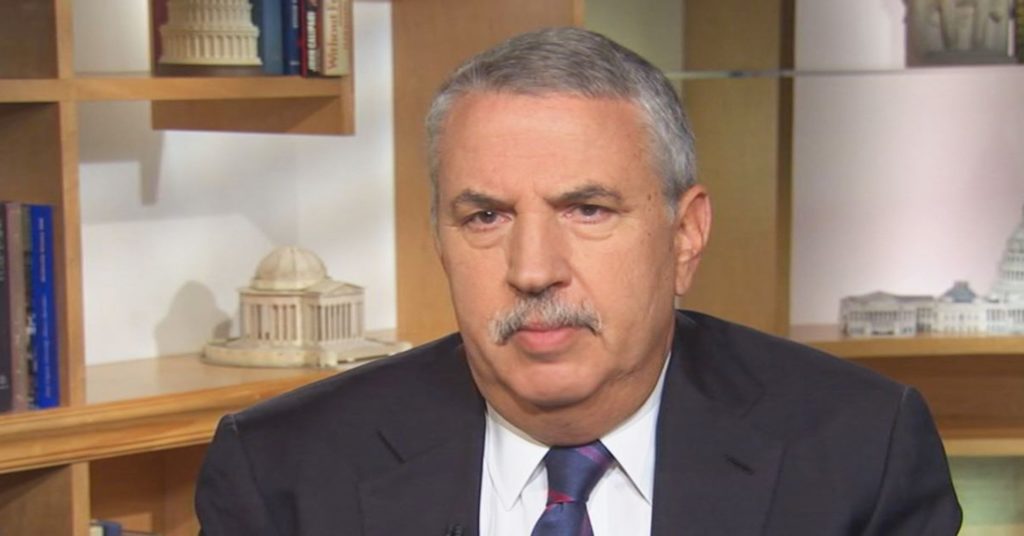
Thomas Friedman, the venerable Middle East commentator, has a problem with the American Israel Public Affairs Committee (Aipac), the pro-Israel lobby group whose mission is “to strengthen, protect and promote the U.S.-Israel relationship in ways that enhance the security of the United States and Israel.”

In his most recent column in the New York Times, Friedman accuses Aipac of being “a rubber stamp on the right-wing policies of Prime Minister Benjamin Netanyahu, which has resulted in tens of thousands of Israeli settlers now ensconced in the heart of the West Bank, imperiling Israel as a democracy.”

When I read that, I thought: What is Friedman asking for, exactly? Would piling on the attacks on Netanyahu really help Aipac’s mission to strengthen, protect and promote the US—Israel relationship? Aipac is a lobby group, not a think tank. As a rule, it respects and honors the democratic choices of Israeli voters, whether they choose Labor leaders like Shimon Peres, Yitzchak Rabin and Ehud Barak, or Likud leaders like Netanyahu, Ehud Olmert and Ariel Sharon.

Friedman seems to blame Aipac for Israeli voters who have put their faith in more security-driven, right-wing coalitions over the past decade. And if anyone is to blame for Israel becoming a more partisan issue in Congress, which Friedman also attributes to Aipac, I would look first at the alarming anti-Semitic, anti-Zionist vibes arising out of new members like Ilan Omar and Rashida Tlaib. If anything, Aipac’s efforts are mitigating this trend.

Apparently, in Friedman’s fantasy world, there’s no end to Aipac’s power. If only Aipac had taken on Netanyahu, if only they had attacked his right-wing policies that have resulted in “tens of thousands of Israeli settlers now ensconced in the heart of the West Bank,” maybe the Palestinian leaders would have come to their senses and a two-state solution would have been more likely.

Never mind that there were already “tens of thousands of Israeli settlers” well before Netanyahu took office, and it was the Labor party not the Likud party that started the settlement enterprise in the first place.

And as much as people may hate Netanyahu, he was still the only Israeli prime minister who implemented a settlement freeze that former Secretary of State Hillary Clinton called “unprecedented.” And despite the constraints of his right-wing coalition, according to a January 2019 piece in the Jerusalem Post, “The growth rate in the settler population has slowed under Prime Minister Benjamin Netanyahu to its lowest point in over 23 years and possibly its lowest point ever.”

Never mind all that.

In full melodramatic mode, Friedman wants to put the weight of the highest Jewish ideals on Aipac’s back: “I don’t like Aipac,” he writes, “because I strongly believe in the right of the Jewish people to build a nation-state in their ancient homeland — a nation-state envisaged by its founders to reflect the best of Jewish and democratic values.”

Is he implying that Aipac doesn’t believe in all that?

It’s clear that by putting so much undue pressure on Aipac, Friedman is unfairly maligning the group. First, he should know better. He should know, for example, that it’s not Israeli policies—right wing or left wing—that have most stymied the peace process, but the pathological rejectionism of a Palestinian leadership that refuses to do anything that might be good for the Jews or even their own people. Israeli voters have figured that out. 

But by implying that Aipac could have done something about an epic failure to resolve an intractable conflict that has jeopardized “the best of Jewish and democratic values,” Friedman is doing more than unfairly maligning Aipac.

Unwittingly, he’s reinforcing the age-old canard of dark, all-powerful Jewish forces that control the levers of power and can get anything done.

No Israeli government, left or right, has succeeded in making peace with the Palestinians. By suggesting Aipac has the power to influence that, Friedman is treating the group the way anti-Semites treat any Jewish lobby group: Too powerful. 


Thomas Friedman Gets AIPAC Wrong Read More »

Rosner’s Torah Talk: Parshat Pekudei with Rabbi Jay Rosenbaum

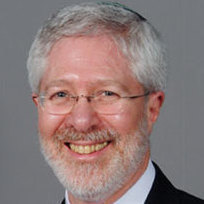
Our guest today is Rabbi Jay Rosenbaum of Hertzl-Ner Tamid synagogue, in Mercer Island Washington. Rabbi Rosenbaum has been HNT’s spiritual leader since 2002. With degrees from NYU (1972), Rutgers University (1974) and Jewish Theological Seminary (1980), Rabbi Rosenbaum has more than thirty-six years of rabbinical experience.

In Parshat Pekudei, the Mishkan is completed and all its components are brought to Moses, who erects it and anoints it with the holy anointing oil. Aaron and the priests are given their clothing for work in the Sanctuary. A cloud descends upon the Tent of Meeting, and God’s presence fills the Mishkan.


Previous Torah Talks on Pekudei (and Vayakhel)

Rabbi James Ponet

Rabbi Jaquline Mates-Muchin

Rabbi Dan Orenstein

Rabbi Richard Steinberg

Rabbi David Singer

Rabbi Tom Heyn

Rabbi Elissa Sachs-Kohen


Rosner’s Torah Talk: Parshat Pekudei with Rabbi Jay Rosenbaum Read More »