fbpx

November 18, 2018

TV Host Marc Summers’ On Thanksgiving and His Bar Mitzvah
Marc Summers, Darren Paltrowitz, Jewish Journal, food, On Your Marc, Double Dare, Unwrapped
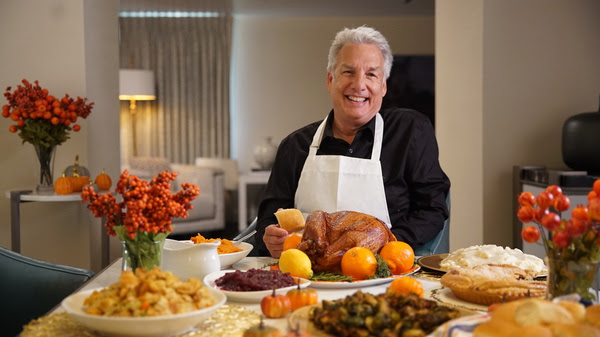
Marc Summers will host the “Thanksgiving Movie Feast” Nov. 22 on HDNET.

Simply put, Marc Summers has been a fixture of television for decades. Most likely you first discovered Summers for his work as a host of game shows (“Double Dare,” “Couch Potatoes,” “What Would You Do?”) and food-based programming (“Unwrapped,” “The Next Food Network Star”), yet Summers has also found success behind the scenes as a television producer (“Restaurant Impossible,” “Dinner Impossible,” “Food Feuds”). Later this month on HDNET Movies, Summers will be the host of the day-long “Thanksgiving Movie Feast” on Nov. 22.

Beyond hosting the aforementioned “Thanksgiving Movie Feast,” Marc Summers keeps busy with a variety of projects. This includes touring with “Double Dare Live!,” which is in addition to a recent tour he wrapped of screenings of the forthcoming documentary – as executive produced by Summers – “On Your Marc.” The Indiana native has also popped up in cameos from time to time, including appearances within “Workaholics,” “Robot Chicken,” “The Cleveland Show” and a Good Charlotte music video.

I had the pleasure of speaking with Marc Summers – born Marc Berkowitz – by phone. He was every bit as warm, jovial and energetic as an interviewer would hope for. In addition to the highlights featured below, more of my chat with Summers will be featured on an upcoming episode of my podcast, the Paltrocast With Darren Paltrowitz.

Jewish Journal: How’s your day been going so far? Fine?

Marc Summers: Yeah, Darren, it’s been fantastic.  You realize you’re talking to Marc Berkowitz? My real name. (laughs)

JJ: I was going to ask you about that later on.

MS: Paltrowitz and Berkowitz. (laughs) Yeah, my grandfather came over from Hungary,  and he was here for years. His real name was Max Berkovitz. He thought it was too Jewish, so he changed it to Max Berkowitz. (laughs) I thought that was the best story ever. (laughs)

JJ: Where did the moniker “Summers” come from?

MS: I woke up one day and the “Son Of Sam” was discovered and they said his name was David Berkowitz. I thought, “Oh for the love of god, of everybody out there, it had to be [Berkowitz].” The guy was adopted, it wasn’t even his real name. But Berkowitz, my agent called 10 minutes after it was on “Good Morning America” and said “Change your name, I won’t be able to get you a job anywhere.”

So there was a DJ in Indianapolis, where I grew up, his name was Dick Summer, who I admired a lot. When I went to college in Boston, I did radio up there, and I just took an “s” and added it to “Summer,” and it became “Summers.”

Of course we know that some of the most anti-Semitic people in show business are other Jews, so when I was Berkowitz, I couldn’t get a job. When I became Marc Summers, I was working like crazy. Howie Iskowitz, a very funny comedian, trying to work like crazy, couldn’t get arrested. Changed his name to Howard Stevens, started to work a lot. People in our industry who are of the faith were somehow negative about using our real names back in the day.

I don’t think that holds anymore. I think you can be anything you want these days. But when I started, back in the 60s and 70s, it was different.

JJ: I’m surprised that you didn’t do the thing where you use your middle name as the last name.

MS: You know, I don’t have a middle name, which is fascinating. The story goes is that when I came out, I looked so strong that I didn’t need a middle name. I’m just Marc Berkowitz, a.k.a. Marc Summers, at this point. The only one in the family that doesn’t have a middle name, so there’s nothing to choose from.

JJ: What can you tell me about your bar mitzvah? Did it have a theme? There were not a lot of bar mitzvahs in Indianapolis back then I would assume.

MS: (laughs) No, back in the day there were no themes. That started after me. I was bar mitzvahed in 1964, Nov. 7, so tomorrow will be the anniversary of my bar mitzvah, in fact. It was actually a turning point in my life in many ways and I’ll tell you why.

I liked getting in front of people and telling jokes and stories, but I didn’t know about performing. When I got on the pulpit and was doing my bar mitzvah, it was a very powerful moment for me. It was at that point that I decided I wanted to be in the entertainment business.

For many years I thought I wanted to be a rabbi – I talk about that in my book “Everything In Its Place” – I was so inspired. But then I got into my love of television, and the assistant rabbi at our synagogue Rabbi Weitzman, had originally majored in radio and television broadcasting and then had become a rabbi. I rode my bike at age 13 over to the synagogue, knocked on his door on Monday at 4:00 p.m. and said, “Can I talk to you?” He said, “Sure.” I said, “I know you started in radio and TV and you became a rabbi.” He said, “Why do you want to become a rabbi?” I said, “I want to help people.” He said, “I want to tell you something. In the entertainment business, you can help a lot of people a little, as a rabbi you can help a small amount of people a lot. No matter what you choose, I think you’ll make the right decision.” I chose to help a lot of people a little.


Marc Summers can be found online at www.marcsummerstv.com.

TV Host Marc Summers’ On Thanksgiving and His Bar Mitzvah Read More »

Wrestling with Food Traditions: A Thanksgiving D’rash

Jewish and partaking in a Thanksgiving meal this year? It’s time to wrestle with the impact of participating in the most food-centric American holiday.

Many if not most Jews in the US have come to celebrate Thanksgiving as a secular holiday with secular origins since its proclamation as a national holiday in 1863. Influenced by the food traditions that have emerged since that time (which reflect few, if any, of the actual ingredients the original pilgrims would have had available), Jewish Thanksgiving tables mirror their fellow Americans’ in featuring the requisite cranberry sauce, stuffing, and—most of all— a turkey.

At the Jewish Initiative for Animals, we’ve worked for several years to help Jewish communities understand why, of all factory farmed animals, broiler birds—that is, intensively hybridized chickens and turkeys bred and raised for meat—suffer the most egregious abuses of any land animal we raise for food. The Los Angeles Times featured an article in 2016 explaining why the Broad Breasted White, which is essentially the only type of turkey Americans eat anymore, endures an especially horrendous life. As articles like these surface and enlighten the broader public, Jewish communities are taking action. Earlier this year, our partners at Hazon committed to no longer serving conventional turkey at their central campus retreat center, because the product does not align with their religious and ethical values. In addition, they committed to incrementally transitioning their poultry to kosher heritage chicken—chickens raised from healthy genetic lines outside of the factory farming system.

Heritage turkeys are available, too, but not yet in the kosher market. So what is a kosher-keeping Jew to do for Thanksgiving?

The Torah portion that coincides with Thanksgiving this year imparts some relevant wisdom. Parshat Vayishlach includes the seminal scene in which Jacob wrestles with an unnamed “man” in an evening-long struggle. Finally, Jacob triumphs over the angelic being and receives a new name: Israel, a compound title meaning “to struggle with God. ” That scene births the Jewish archetype for wrestling with the biggest questions of faith, identity, and tradition. The narrative conveys to us the need for introspection to become who we are, and that process can be challenging, if not painful. Curiously, the story ends with our first ever negative commandment in the Torah: a dietary restriction. During the encounter, Jacob sustains an injury to his hip. The text introduces a law in commemoration, prohibiting people from consuming the sciatic nerve in bovids (e.g., cattle and sheep), which runs along the lower back into the hindquarters (Genesis 32:33). Kosher meat companies and kashrut-observant Jews abide by the rule to this day. And as with the rest of kosher food preparation, we have little reason to investigate the practice ourselves—with farms out of sight and out of mind, we rely on kosher certifiers to ensure that an animal is slaughtered and processed in accordance with Jewish law. We trust the system.

But in a time when halacha doesn’t necessarily mean that animals were spared awful treatment in industrial hatcheries and farms, how do we make an informed, values-based decision about the meat we eat? Even if slaughter was carried out to the letter of kashrut, can we, as the People of Israel, consume factory-raised turkey in good conscience?

As a ritual to which we have no particular religious ties, Thanksgiving may be the perfect opportunity for considering the impacts of our food traditions. Maybe, in taking a more honest inventory of our participation in the holiday, in addition to the animal welfare implications, we could also examine how we respectfully take part in a day that is rife with trauma for other minority communities. For many indigenous peoples, the holiday is a somber reminder of surviving genocide. One of the ways indigenous peoples continually practice cultural reclamation also happens to be through food: native food educators and chefs research and promote “decolonizing” indigenous diets by uncovering and reinstating a food heritage that relies on original native ingredients. This process involves eschewing what has become a typical westernized US diet, high in animal protein and processed grains and sugars. Importantly, decolonizing food is about restoring a more respectful relationship between humans and the plants and animals we use for sustenance. Perhaps the extreme suppression of that very impulse—to live in a state of reverence towards nature and other living beings—is what allowed, and allows, people to mutate, torture, and consume en masse the Broad-Breasted White turkey.

Jewish author Jonathan Safran Foer highlights the Thanksgiving turkey as the quintessential paradox of eating animals today: what we do with their carcasses may feel right and enjoyable, but how we breed, confine, and ultimately kill turkeys paves an evil-strewn path towards the relatively short-lived pleasure of human consumption. Toward  the end of the book, Foer contemplates:

And what would happen if there were no turkey… Is the holiday undermined? Is Thanksgiving no longer Thanksgiving?

Or would Thanksgiving be enhanced? Would the choice not to eat turkey be a more active way of celebrating how thankful we feel? Try to imagine the conversation that would take place. This is why our family celebrates this way. Would such a conversation feel disappointing or inspiring? Would fewer or more values be transmitted? Would the joy be lessened by the hunger to eat that particular animal? Imagine your family’s Thanksgivings after you are gone, when the question is no longer “Why don’t we eat this?” but the more obvious one: “Why did they ever?”

Most Jewish people have a plethora of choices for creating a healthy, delicious, and often less pricey vegetarian or vegan meals. It only takes a quick Google search to find an array of plant-based recipes compiled by Martha Stewart, The Food Network, and countless food bloggers. Some Jewish people and institutions can afford to spend more on a kosher heritage chicken or 100% kosher grass-fed beef, instead of conventional kosher meat. But most of all, all of us have the ability to consider alternatives to a food system that, animal treatment aside, continues to devastate our natural ecosystems, heightens the threat of climate change, and disproportionately burdens lower-income communities of color.

Perhaps before Thanksgiving this year—in the same spirit as a Passover seder, where we hold up each food and consider its significance to the holiday and to us as people—we will consider the turkey, and wrestle with its meaning. Maybe we will question what it is to have a more gracious, harmonious relationship with animals, nature, and other people, and how that should be reflected in all of our meals. Perhaps, just like Jacob, we will emerge from that intellectual and physical struggle with a new sense of self and purpose that defines our tradition—and our dietary choices—for generations to come.

Wrestling with Food Traditions: A Thanksgiving D’rash Read More »