fbpx

August 19, 2018

Did Ronald Lauder Help or Hurt Israel?

I don’t know Ronald Lauder, one of the most powerful Jews in the world, but I’m guessing he was satisfied with himself after writing a heartfelt critique of Israel in The New York Times last week. In a piece titled, “This Is Not Who We Are,” the president of the World Jewish Congress came across as a lover betrayed.

“When Israel’s government appears to be tarnishing the sacred value of equality,” he wrote, “many supporters feel it is turning its back on Jewish heritage, the Zionist ethos and the Israeli spirit.”

Going through a litany of well-known complaints against Israel— the new nation-state law prominent among them– Lauder concluded that “This is not who we are, and this is not who we wish to be. This is not the face we want to show our children, grandchildren and the family of nations.”

The irony, of course, is that by writing in the world’s newspaper of record that “this is not the face we want to show,” Lauder was doing precisely that. He was showing a face of Israel he didn’t want to show; a face much of the world already sees as mean and oppressive.

Given that Lauder is a longtime supporter of Israel and that he was writing to a global audience, it’s worth asking: Why did he think his opinion piece would be helpful to Israel? It’s not as if the world needs another op-ed criticizing Israel; God knows there are more than enough of those.

But if piling on is not the way to go, then what is? Could Lauder have written something more useful to the community conversation and to Israel?

I think so. While not ignoring Israel’s problems, Lauder could have introduced something that rarely gets mentioned in the daily avalanche of Israel bashing: The enormous corrective mechanism inherent in Israel civil society. In other words, he could have highlighted the thousands of social activists and non-profit groups who have the freedom to fight daily to make Israel a better place.

While acknowledging the injustices in Israel, he could have mentioned, for instance, the New Israel Fund, which has provided over $300 million to more than 900 justice-fighting organizations in Israel since its inception in 1979.

For every problem Lauder spotlighted, he could have added context and perspective. A Conservative rabbi who got arrested for officiating at a marriage? Horrible. But authorities had so much egg on their face the rabbi gave a Torah class at the President’s house the following day.

The nation-state law? Knowing that Israel’s enemies are using the law to falsely malign Israel as an apartheid state, instead of just piling on, Lauder could have added some crucial balance to tone down the hysterics. He could have quoted Bret Stephens, for example, who wrote in the Times:

“What the bill is not is the death of Israel’s democracy— it was enacted democratically and can be overturned the same way. It is not the death of Israeli civil liberties — still guaranteed under the 1992 Basic Law on Human Dignity and Liberty and visibly reaffirmed by the large public protests following the bill’s enactment. And it is not apartheid— a cheap slur from people whose grasp of the sinister mechanics of apartheid is as thin as their understanding of the complexities of Israeli politics.”

While not ignoring Israel’s problems, Lauder could have introduced something that rarely gets mentioned in the daily avalanche of Israel bashing: The enormous corrective mechanism inherent in Israel civil society.

Lauder waxed nostalgic about the founding ideals of Israel’s Declaration of Independence in 1948, which he reminded us guarantees “complete equality of social and political rights to all its inhabitants irrespective of religion, race or sex.” But what he failed to mention is that up until 1966, Israeli Arabs lived under the thumb of the military and had virtually none of the freedoms and rights they enjoy today. How did this progress come about? Maybe it’s that corrective mechanism Lauder chose to downplay.

In sum, overwhelmed by his disappointment with Israel, Lauder overlooked the complexity of Israeli society. He applauds Israel for being a “miracle,” but one of the key reasons Israel is a miracle is that Israelis—Jews and non-Jews alike– are not a passive bunch who quietly accept their fate. They’re not intimidated by authority. They protest, they argue, they fight.

They know their country is far from perfect; they know Haredim have too much power; they know their government makes plenty of blunders. While living in a state of virtual siege surrounded by Jew-hating armies who’d love nothing better than to wipe them out, Israelis struggle to balance the imperative of survival with the ideal of justice for all.

That noble struggle is also the face of Israel, and as a global champion of Israel, Lauder should feel no shame in showing it.

Did Ronald Lauder Help or Hurt Israel? Read More »

Becoming smarter news consumers: The guide to not falling for media hidden agendas

The part the media have in our lives is not something to undermine. Each and every one of us relies on one of the various media forms to receive information on recent events. In the last couple of decades, the news sources we rely on become more and more varied. From the choice between a sole news channel on television and a daily paper, we can now choose between a variety of websites, channels and papers. The many choices help us to be able to read the custom content we are interested in. This customization can make people from two far ends of the world come together, but on the other hand, it can enlarge the differences between different communities.

The common perspective we have of journalists is of people who are the voice of truth, and that news channels/newspapers/websites provide us with impartial information regarding recent events. What many of us are unaware of, is that the media is in no way “impartial” or “balanced.” In fact, journalists have an important role in shaping the reader’s perspective on various issues.

By picking certain stories and themes, the media dictate to us what to talk about and what to think about these topics. Researchers have shown that the more headlines a certain topic receives via media, the more the people find it important. Stories which appear on the left side of the paper will subconsciously be perceived to be more important than the ones on the right side.  A story that will still be discussed in the media the next day will also be the story we will keep talking about.

Journalists basically frame relevant topics and issues, so that the exact same story can be presented in different ways on different media. While appearing completely objective and neutral, the articles read or viewed always have a hidden agenda. Even if it is not explicit or intentional, it’s always there, sneaking into our minds, and shaping our point of view.

Israeli researcher Izhak Roe’e presented a unique way of looking at news reports. Roe’e claimed that the average news report often portrays a plotline which is familiar with the fairytales and fictional stories we’ve often read as children. Those plotlines portray values we were taught. A news report is often similar to a fiction story by having a clear plotline, including an opening line, a conflict and a lesson for us to learn. Sometimes, a suggestion for further treatment of the subject is added.

There are several rather recognizable plotlines that appear in Israel-related articles. These repeating plotlines, conveying certain messages, are the framing each media source chooses to use. Familiar themes which often appear on articles regarding Israel are “us against the world”, “good vs. bad”, “strong against weak”. These themes can be used both ways, depending on the tone of the article, and the side which its writer picks. If those themes sound familiar to you, it’s because they are. Those plotlines are used in many stories we know. “Us against the world”, for instance, reminds me of Romeo and Juliet. “Strong against weak” reminds me of the story of David and Goliath. It may strike your imagination in a different way, but the bottom line is that those new plotlines, which resemble a fictional story, attract the readers.

The framing of news, using familiar and somewhat legendary themes, not only attracts us to the article, but also plays with our minds a little bit. Reading an article which tells how the UN Human Rights Council examines Israel instead of Syria, makes us see Israel as the poor kid in class, whom everybody picks on. As readers, we tend to feel sorry for the kid. The same effect can be implied in an article that tells the sad story of the Palestinians living in the West Bank, who, after constant suffering and ignorance by the Israeli government, had to turn to the UN for help.

Take the Jerusalem synagogue terror attack from last November. Those who read Ynetnews saw it as a terror attack against Jews in Israel, but those tho read CNN saw it as a random attack against both Jewish and Palestinians:


How can we overcome the framing obstacle and dig out the news from the stack of agendas?

1. In order to notice the media framing and read the news beyond the agenda, we must become “critical readers.” That means to try and read important news on several newspapers/websites/channels. The differences between the coverages would help us tell apart the actual news from the version of the news.

2. The second thing we need to do is to ask ourselves the following questions while reading a news story: Who is being presented and who does not? Which side is being presented first? Which last? What words are being used by the editor in the headline (“pro-Palestinians,” “anti-Israelis” and “human rights activists” are descriptions used in papers for the same group of people.)  Who represents each side (Prime minister/ a citizen/ “the police”?) What words are being used in relation to quotes coming from those representatives (“claims”/”says”?) On what aspects of the story does the report/coverage focus?  What does NOT appear in the coverage and perhaps should?

Remember to always be aware that behind the words you read sit people with opinions. Even though their job is to hand us the truth, plain, simple and agenda-free – it is almost never the case. Always think before you “take in” what you read, always question what you read, always try to learn more. Only then, make up your mind.


For more updates about the day-to-day life in Israel, you can follow Israelife on Facebook here.

Becoming smarter news consumers: The guide to not falling for media hidden agendas Read More »

Koby Bernstein Brain Injury Walk Photo August 2017

The Power of Positivity: How Did One Teenager Handle Having Multiple Concussions?

The Power of Positivity: How Did One Teenager Handle Having Multiple Concussions?
AN INTERVIEW WITH KOBY BERNSTEIN

We are pleased to introduce Koby Bernstein, a 17-year old student at the Dalton School in New York City. Koby is this year’s youth honoree of the Brain Injury Association of New York and his team is raising funds for The March On-Long Island 5K. Koby takes us through his experiences with a traumatic brain injury, how he stayed positive and is an amazing example of how one person can change the world!

Video: Who Was the Youth Honoree for 2018 BIANYS?

Q —Can you tell us about your brain injury and how it happened?

A —My first concussion happened in the middle of 9th grade. I was playing high school basketball. I was driving the ball and collided with an opposing player. I thought I was fine but during my last class I had a headache, was nauseous, felt dizzy and most of all I just did not feel  “right.” Some of my symptoms lasted for over 3 weeks. I was fully back at school and sports after about 4 weeks. My second concussion happened in 10th grade. I was trying out for the varsity basketball team and was at a practice in the gym. The back of my head collided with a taller player’s chin. I don’t think it was a harder jolt than my first concussion, but this time my symptoms were much worse and I was out for the entire basketball season. It took me 3 months to fully return to school and sports. I have had a few other bumps since then, like the time a friend threw a football in the park to the back of my head, that would ordinarily not be anything to think too much about, but when these bumps have happened to me following my other concussions, I am much more sensitive and I experience concussion symptoms that someone else would not have.

Koby Bernstein volunteering with the Brain Injury Association of New York August 2017

Q —Can you describe to us how you are doing now? Have you fully recovered from your injuries?

A— Even though I have recovered, I am not the same as before.  I have chronic pressure in my sinuses and head. After trying different medications, having a cat scan and nasal endoscopy, the doctors cannot relieve the pressure. I now see a chiropractor regularly and also started acupuncture treatments.  

Q —What was it like to be sidelined from school and sports for extended periods of time?

A— It was honestly very isolating and depressing. My whole identity has been wrapped up in my athletic persona and team sports, so not being able to play was very challenging. Not only because I enjoy playing and am so passionate about it,  but also not getting to do what I love was hard, yet it was much more than that – I missed seeing my friends  and teammates everyday. I also experienced a withdrawal of endorphins. I went from several hours of exercise per day to nothing. On top of all of that, there was very little I could do at home.  I could not watch television or play on my phone- I was staying away from all digital screens because my eyes were sensitive to light and loud sounds bothered me too. I had to get up from chairs or beds slowly so I didn’t get dizzy. My whole system was completely off. Missing school may sound great to someone who is healthy, but it was really tough. I hated getting more and more behind every day. I slowly got back to school. Some days I could go for one class or two. It took a long time before I could handle an entire day, keep up with homework, and be fully functional. I also have to point out that when you have a health issue that people cannot see, it makes it that much harder for people to understand your issue and accept it.  When you see someone with a physical disability, you recognize that they may need accommodations. It was very different with traumatic brain injury as there was no outward signs like a cast or crutches. In my experience, some teachers were more understanding than others.

Q — Why did you create Simply Concussions?

A— I had found that some things helped me like a particular ice pack that wrapped around my head, blue light blocking glasses, and some supplements that I was taking. These were not necessarily things that are on a typical treatment plan and they are not things that your neurologist or pediatrician tell you about. I wanted to share with others what helped me. I also needed to connect with others to see if I could find anything else that might help me. Without regular contact with my friends and teammates, I needed a community to connect with that understood what I was going through. Concussions are all unique, but people who have experienced them were much more understanding than others.

VIDEO: Simply Concussions with Koby Bernstein

Q —What inspired you to work with the Brain Injury Association?

A— I wanted to find a way to raise concussion awareness and I discovered that the Brain Injury Association had a chapter in New York, which is a non-profit entity that advocates on behalf of individuals with brain injuries and their families. I started out volunteering at their Long Island Walk. From there, I got more involved. It helped me turn around my negative feelings. By doing something good, I started to feel more hopeful and positive.

I also wanted to raise concussion awareness in my community and raise funds for the Brain Injury Association. During March, which is March Madness for basketball fans and also Brain Injury Awareness Month – I created and organized a fundraiser, “Basketball for a Cause.” I was fortunate to have a lot of help from friends at the New York City High School Leadership Academy, a non-profit leadership development program where I am the president.  Together we invited kids of all ages to shoot hoops, compete in contests, learn about concussions. I partnered with Dr. Elizabeth Barchi and the NYU Concussion Center; Dr. Barchi helped take some of the confusion out of concussions. I also connected through instagram with an organization called Protect Your Skull; two former football players created a lifestyle clothing brand all around concussion awareness, and they generously donated clothing to help our fundraising efforts. I learned a lot about organizing an event, building a community wide effort, and more importantly, how to turn my individual nightmare from playing basketball into something positive for the greater good.

Koby Bernstein with Dr. Elizabeth Barchi, NYC Concussion Center
Koby Bernstein with Dr. Elizabeth Barchi, NYC Concussion Center, March 4, 2018

Q —What has been the best part of your experience?

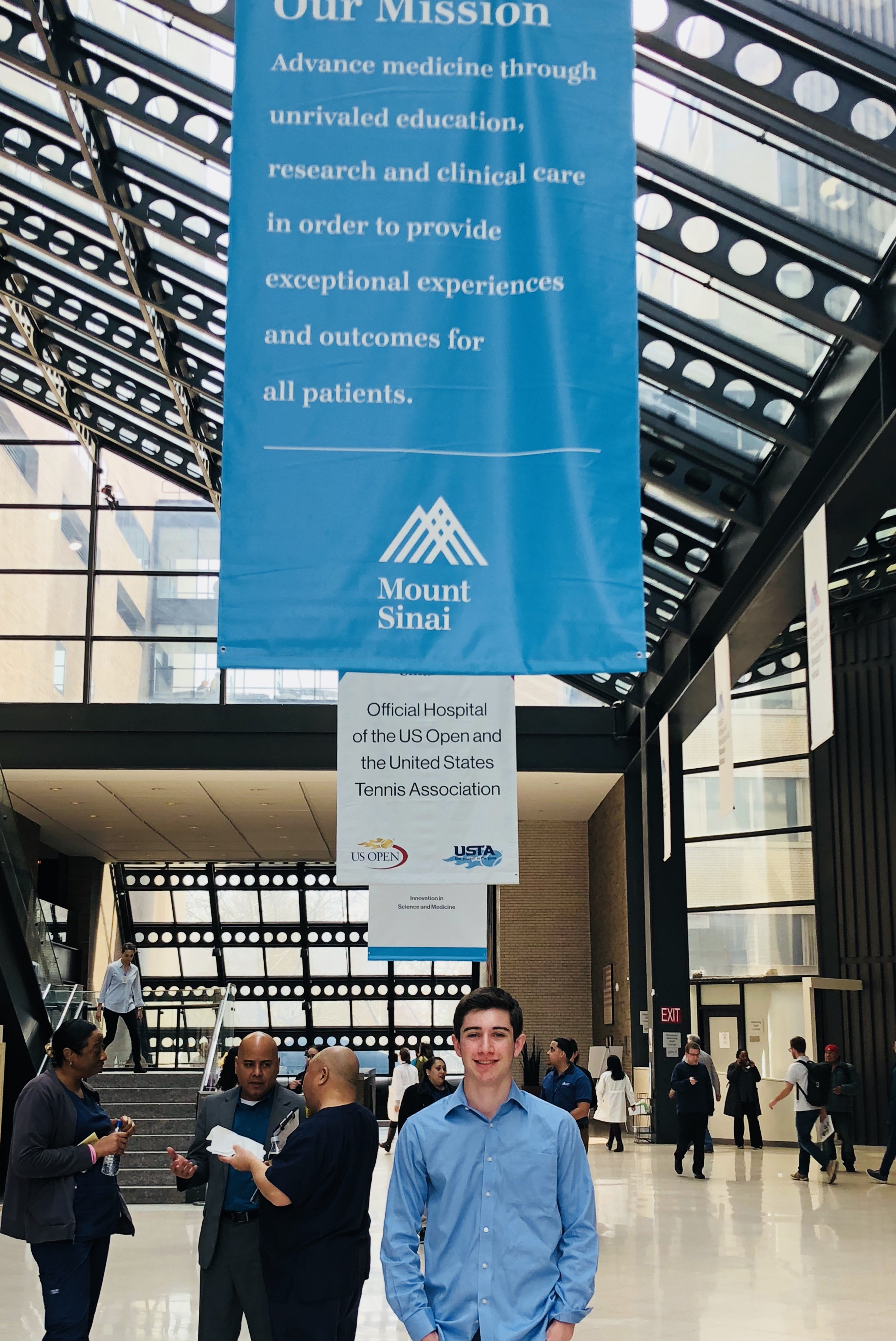
A— I had a great opportunity this past Spring to participate in a Concussion Roundtable at Mount Sinai.  That was an incredible experience. I was the only student in a room filled with doctors, nurses, clinicians, athletic trainers and more. The Roundtable was focused on discussing best practices for concussion treatment. We collaborated on protocols that work and don’t work. I was able to provide the student perspective and share the challenges that I faced in returning to school and sports. There is so much emphasis in schools on the protocols to return to play, but very little procedures exist on best practices and support to return to school. There needs to be more focus on returning to life too. Being able to advocate for changes in the system was empowering. I found that I have a voice and, even as a teenager, I can help effect real change and do something meaningful through advocacy. I got so much out of my time participating in the roundtable.

“I found that I have a voice and can help effect change.”

–Koby Bernstein

Koby Bernstein speaking at the Concussion Roundtable at Mount Sinai Hospital, April 2018
Koby Bernstein speaking at the Concussion Roundtable at Mount Sinai Hospital, April 12, 2018


Q — What is your message to others with traumatic brain injuries?

A—I had to stop thinking about all of the things I could not do and was missing out on.I realized I had no alternative but figure out how to move forward.I learned to appreciate Nelson Mandel’s message that “the greatest glory in living lies not in never falling, but in rising every time we fall.” My greatest discovery was learning to be positive and resilient in the face of setbacks. My message to others with traumatic brain injuries is to not give up; whatever you can do on a given day is just enough for that day. You are stronger than you think and happiness is a choice you get to make for yourself. I call my formula the 4 P’s: positivity, persistence, perseverance and perspective.

Q — Last question – What is next?

A— Right now, I am raising funds for the Brain Injury Association of New York’s 5K Walk on Long Island. It takes place on Saturday, September 15th at the New York Institute of Technology in Old Westbury, New York. I am appreciative of being the youth honoree and I am building a team to raise funds. I am grateful that I have recovered from my concussions,but also for how the tough times have shaped me. I am lucky that I can now help others. The money raised will go towards the Brain Injury Association of New York’s mission, which includes providing education, advocacy, and community support services that lead to improved outcomes for children and adults with brain injuries and their families. The Association offers a toll-free family helpline, chapters and support groups throughout the state, prevention programs, and publications library. And, BIANYS plays a central role in the development of public policy on the federal, state and local level.

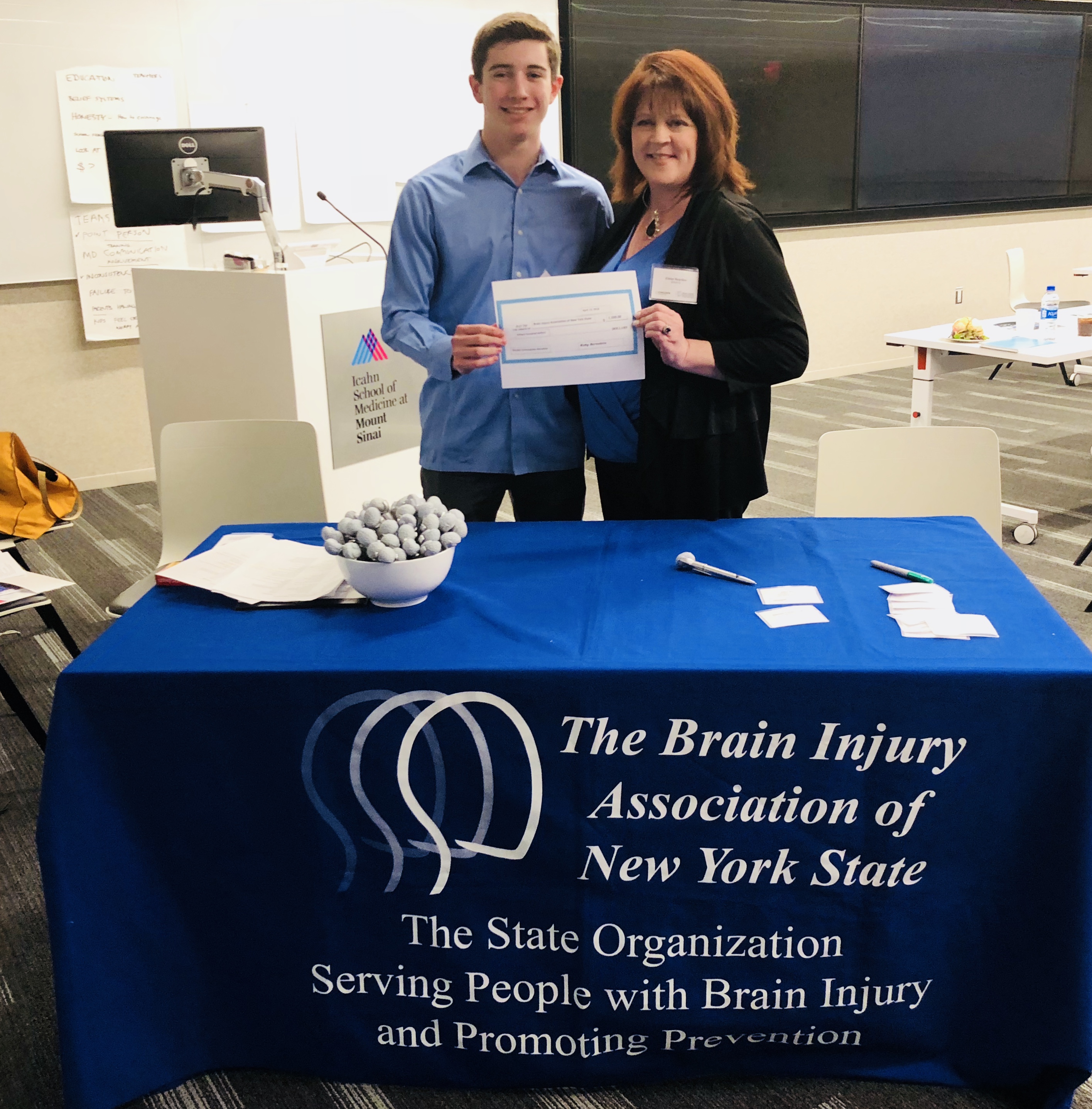
Koby Bernstein with BIANYS Executive Director, Eileen Reardon, April 12, 2018

Are you ready to join Koby’s team? 

Click here to get involved!

What can you do to help yourself or someone you love?

Click here for the products that helped Koby.

Note: We Said Go Travel is honored to share this story. Koby Bernstein is the nephew of Lisa Niver, founder of We Said Go Travel. We hope to see you on September 15 at the The March On-Long Island 5K.

The Power of Positivity: How Did One Teenager Handle Having Multiple Concussions? Read More »

hospital waiting area

Critical Care by Rabbi Janet Madden

I spend my days as a hospital rabbi-chaplain sitting with patients and families who are dealing with the unimaginable: an 18 year old college student-athlete and cancer patient who believes that she has done something to deserve her illness, a 33 year old whose wife died hours after giving birth to their first child, an 80-something member of a prominent show business family who attempted suicide because, for her, life has no meaning now that she is no longer active in the world of the arts.

One of the benefits of my professional life is that I have many opportunities to acknowledge and affirm that life is not fair. I have learned to see life as a mashup of the most wonderful and beautiful and the most terrifying and horrific, as the exquisitely heartbreaking combination of love and pain. I’ve come to see every ordinary and mundane day as, in fact, an extraordinary and wonderful day.

I was having one of those ordinary, wonderful days three days ago when I went to dinner with a friend as part of my birthday festivities. We had just placed our order when I excused myself to pick up a voicemail from my husband. His message was that he had received a call from a hospital emergency room telling him that one of our children was in critical condition and might not survive the night.

During our two hour drive to the hospital, we continued to get calls that were both updates and urgings to hurry. Beginning that evening, our family became—again—one of the families who sit in Critical Care units, waiting rooms, conference rooms and cafeterias, receiving medical updates, sharing them with those who are not physically present, waiting, hoping, praying. With a loved one in a medically induced coma and on life support, we, too, are a family signing consent forms for procedures that may or may not result in positive outcomes. We, too, are a family precariously balanced between, hope for a positive outcome and statistical medical realities.

Every morning, I give thanks that our loved one has survived the night. I do the best that I can to convey my deep gratitude for all of the help that he and we have received: the bystanders who jumped into action, began CPR and called 911; the EMTs who fought to keep his heart beating; the doctors and nurses and respiratory therapists who have kept him alive and are caring for him; the widening circle of those who praying for his healing. Most of all, we are grateful to the Creator who gives life, knowing both that it is indeed a miracle that our loved one is alive at this moment and that should he survive, his life and ours may be very different than they were or what we imagined they would be.

In these weeks of the Shabbatot of Consolation, in our acute awareness of the uncertainly of his prognosis, we find consolation in knowing that although outcomes are far from certain, we feel held by the Compassionate One. We find comfort in being together, in our ability to openly express our hopes and fears with one another and in telling our loved one that we are here and that we will continue to be. We chant the Shehekiyanu as he survives each crisis. Holding tightly to the knowledge that life offers no guarantees, in this time of fear and hope and uncertainty, we are deeply thankful for the precious gift of life and for the critical care of so many.

Rabbi Janet Madden earned her PhD in literature from The National Univer-sity of Ireland. A writer and ritualist, she is Rabbi of Providence Saint John’s Health Center (Santa Monica, CA) and Visiting Rabbi of The Oahu Jewish Ohana (Honolulu).

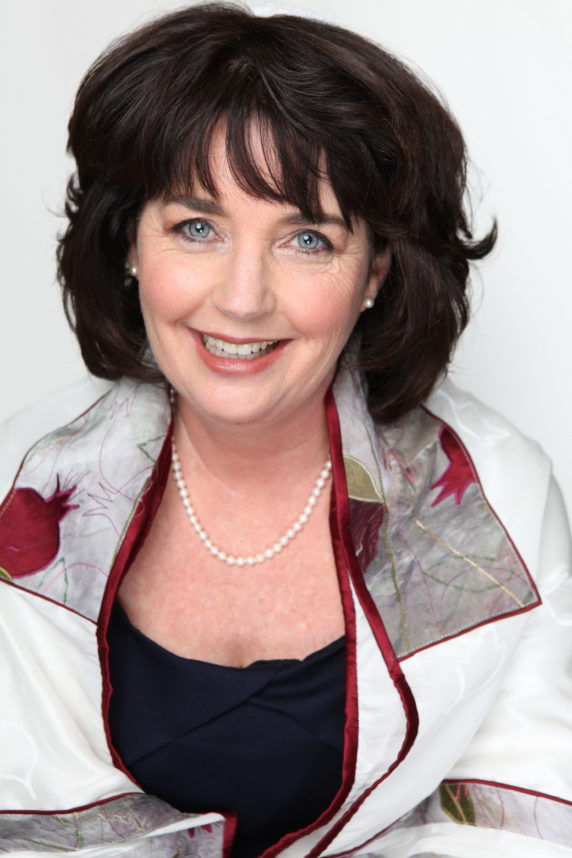
Rabbi Janet Madden
Rabbi Janet Madden


___________

Gamliel Café

Gamliel Students are invited to a free informal online session, held monthly. On the third (3rd) THURSDAY of each month, different person(s) will offer a short teaching or share some thoughts on a topic of interest to them, and those who are online will have a chance to respond, share their own stories and information, and build our Gamliel Institute community connections. This initiative is being headed up by Rena Boroditsky and Rick Light. You should receive email reminders monthly. The next scheduled session of the Gamliel Café is September 20th. More details will be sent out soon.

If you are interested in teaching a session, you can contact us at rboroditsky@jewisgh-funerals.org, rlight@jewish-funerals.org, or info@jewish-funerals.org.

____________________

Taste of Gamliel Series

The 2018 Taste of Gamliel series has concluded, but it is not too late if you want to access the recordings. You can Register for the 2018 series, Your’re Gonna Miss Me When I’m Gone: Jewish Practices of Remembrance, or any of the series from prior years. There are usually five sessions in a series, and each session is approximately 90 minutes.

Registration for Taste of Gamliel is mandatory to access the sessions. Registration $36 for each series to help us defray the out of pocket costs.
Those registered will be sent the information on how to connect to the sessions. To register, click here: register.

_______________

Gamliel Continuing Education Courses

Gamliel students should be on the lookout for information on a series of Gamliel Continuing Education  Courses, advanced sessions focusing in on different topics. These will usually be in groups of three ninety minute sessions (three consecutive Wednesdays) offered roughly twice yearly, with different topics addressed in each series. The goal is to look at these topics in more depth than possible during the core courses. The first course took place in Fall 2017, focusing on Psalms, and the second was on The World to Come and the Zohar.

The next course will be November 28th, December 5th, and December 12th. We will continue to look at death as seen in the Zohar, taught by Beth Huppin.

Registration is required, and there will be a tuition charge of $72 for each three session series. Contact us for information, by email info@jewish-funerals.org, or call 410-733-3700, or simply register online at www.jewish-funerals.org/gamreg/.

_____________________

Gamliel Course

The next course in the cycle of core courses offered by the Gamliel Institute will be Course 4 – Nechama/Comfort. It will be offered online during the Fall from October 9th to December 25th on Tuesday evenings, for 90 minutes each week for 12 weeks. The classes will begin at 5 pm PST/8 pm EST. Primary instructors will be Dan Fendel and Edna Stewart, with guest instructors.

Registration is open – click here.

The course planned for Winter 2019 is Course 2 – Chevrah Kadisha: Taharah & Shmirah. Plan ahead!

_____________________

DONATIONS

Donations are always needed and most welcome to support the work of Kavod v’Nichum and the Gamliel Institute, helping us to bring you the annual conference, offer community trainings, provide scholarships to students, refurbish and update course materials, expand our teaching, support programs such as Taste of Gamliel, the Gamliel Café, and the Gamliel Continuing Education courses, provide and add to online resources, encourage and support communities in establishing, training, and improving their Chevrah Kadisha, and assist with many other programs and activities. There is a matching donation program in progress so your dollars go further. See the website for details.

You can donate online at http://jewish-funerals.org/gamliel-institute-financial-support or by snail mail to either:

Kavod v’Nichum, or to The Gamliel Institute,

c/o David Zinner, Executive Director, Kavod v’Nichum,

8112 Sea Water Path,

Columbia, MD  21045.

Kavod v’Nichum and the Gamliel Institute] are recognized and registered 501(c)(3) organization, and donations may be tax-deductible to the full extent provided by law. Call 410-733-3700 if you have any questions or want to know more about supporting Kavod v’Nichum or the Gamliel Institute.

You can also become a member (Individual or Group) of Kavod v’Nichum to help support our work. Click here (http://www.jewish-funerals.org/money/).

___________

SUBMISSIONS WELCOME

Please note: this blog depends on you for content. Without you it cannot publish new material. If you have an idea for an entry you would like to submit to this blog, please be in touch. Email J.blair@jewish-funerals.org. We are always interested in original unpublished materials that would be of interest to our readers, relating to the broad topics surrounding the continuum of Jewish preparation, planning, rituals, rites, customs, practices, activities, and celebrations approaching the end of life, at the time of death, during the funeral, in the grief and mourning process, and in comforting those dying and those mourning, as well as the actions and work of those who address those needs, including those serving in Bikkur Cholim, Caring Committees, the Chevrah Kadisha, as Shomrim, funeral providers, in funeral homes and mortuaries, and operators and maintainers of cemeteries.

_____________________


Critical Care by Rabbi Janet Madden Read More »