Despite North Korean dictator Kim Jong Un pledging to denuclearize in a recent summit with President Trump, a new report states that the Kim regime is ramping up its nuclear production in hidden areas.
According to NBC News, several members of the intelligence community have concluded there are multiple undisclosed sites where the Kim regime has increased its uranium production. The U.S. has always known about North Korea’s main nuclear production facility in Yongbyon and another undisclosed site; this latest intelligence report is the first to reveal multiple undisclosed nuclear production sites.
“There is absolutely unequivocal evidence that they [North Korea] are trying to deceive the U.S.,” an official told NBC.
Another official stated that it was always believed that Kim would attempt deception, but the fact that Kim has agreed to halt nuclear and missile tests is a positive development.
Kim also doesn’t appear to be ending his murderous ways anytime soon either. The Sun recently reported that a top North Korean lieutenant was executed by firing squad for providing troops with extra food and fuel rations.
An unabashed Nazi is running for Congress in Illinois as the Republican candidate – and Sen. Ted Cruz (R-TX) is urging Republicans in the district to vote against the Nazi candidate.
Arthur Jones, according to The New York Times, believes that the Holocaust was “a greatly overblown nonevent” and that it’s an “international extortion event.” He has told Politico that he’s hoping to defeat the “two-party, Jew-party, queer-party system.” He used to be a member of the American Nazi Party.
Despite all that, he won the Republican primary because the state party couldn’t find another candidate to run against him. The state party also couldn’t find a third-party candidate to run against Jones, prompting him to gloat to Politico, “I snookered them [the state GOP]!”
Now Cruz is calling on his fellow Republicans to take a stand against Jones.
“This is horrific. An avowed Nazi running for Congress,” Cruz tweeted. “To the good people of Illinois, you have two reasonable choices: write in another candidate, or vote for the Democrat. This bigoted fool should receive ZERO votes.”
This is horrific. An avowed Nazi running for Congress. To the good people of Illinois, you have two reasonable choices: write in another candidate, or vote for the Democrat. This bigoted fool should receive ZERO votes. https://t.co/9WYlvCMKaF
The Illinois GOP has roundly condemned Jones’ views.
“Arthur Jones is not a real Republican — he is a Nazi whose disgusting, bigoted views have no place in our nation’s discourse,” Illinois Republican Party chairman Tim Schneider said in a March statement.
Illinois Republican Party spokesman Aaron DeGroot told Politico that the party will find a write-in candidate as an alternative to Jones.
Despite the state GOP’s repeated disavowal of Jones, Politico has detailed how some in the party are concerned that Jones will be an albatross weighing down state GOP candidates across the board in November.
The state party has had trouble finding someone to run against Jones because the district is expected to be a shoe-in for the Democrats. A third-party candidate would have required 14,600 signatures just to be on the ballot in November.
The Politico report also notes that Schneider has been criticized for not claiming that Jones’ signature petitions were invalid, which both parties in Illinois have done in the past to stamp out reprehensible candidates. The state GOP has claimed that they “couldn’t find a legal reason to challenge” Jones’ petition signatures.
Jones himself has refused to file documents with the Federal Elections Commission, telling Politico, “I’m not going to give the Jews an opportunity to harass my supporters until after the election.”
Jones is not the only candidate with Nazi views to receive national attention. Patrick Little ran for Senate in California on the platform to “free [America] from Jews.” Little lost, as the general election is between incumbent Sen. Dianne Feinstein (D-CA) and California State Sen. Kevin de León (D).
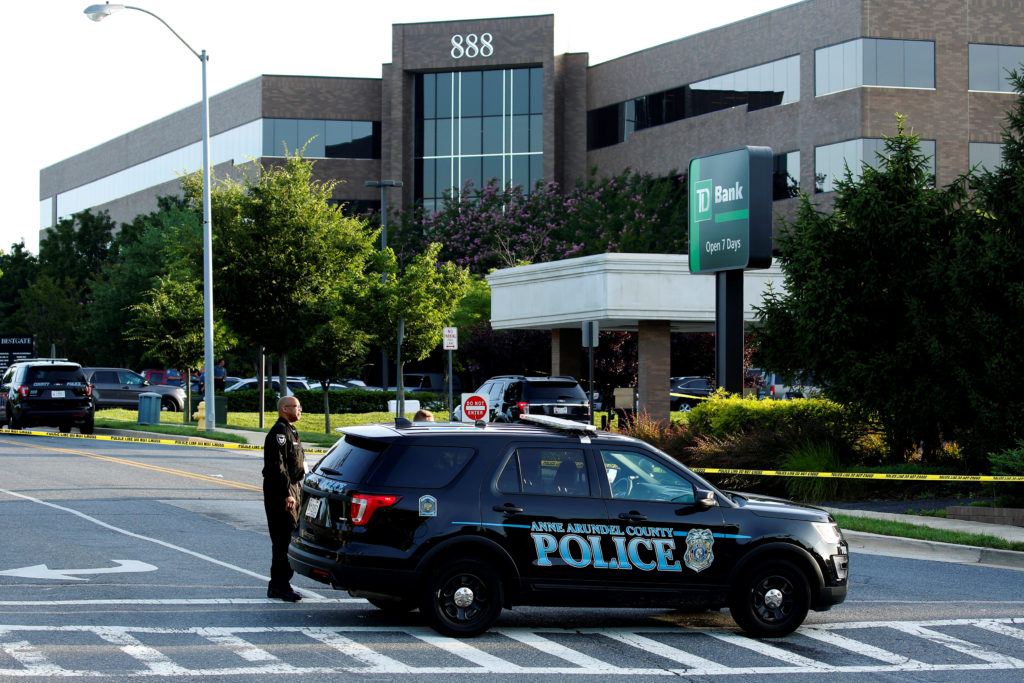
A 38-year-old male who murdered five people and injured two others at the Capital Gazette newspaper on June 28 appears to have a serious vendetta against the paper for reporting on his alleged stalking of a former high school classmate.
The roots of the grudge trace back to 2011, when Capital Gazette writer Eric Thomas Hartley wrote a column describing how the shooter reached out to a female on Facebook he knew from high school. He thanked her for being one of the only people to be nice to him during that period of time and revealed some of the issues he was dealing with.
The messages suddenly became dark and disturbing.
“When it seemed to me that it was turning into something that gave me a bad feeling in the pit of my stomach, that he seems to think there’s some sort of relationship here that does not exist … I tried to slowly back away from it, and he just started getting angry and vulgar to the point I had to tell him to stop,” the victim said in court when she sued him for harassment charges.
She added that he would send her messages that included, “You’re going to need restraining order now” and “Have another drink and go hang yourself, you cowardly little lush.”
The shooter did eventually plead guilty to the harassment charges. However, he was irked by Hartley’s column about the matter, and sued the paper for defamation. His defamation suit was tossed out in court.
“I think people who are the subject of newspaper articles, whoever they may be, feel that there is a requirement that they be placed in the best light, or they have an opportunity to have the story reported to their satisfaction, or have the opportunity to have however much input they believe is appropriate,” Judge Maureen M. Lamasney told him in 2015. “But that’s simply not true. There is nothing in those complaints that prove that anything that was published about you is, in fact, false. It all came from a public record. It was of the result of a criminal conviction. And it cannot give rise to a defamation suit.”
Former Capital Gazette editor and publisher Thomas Marquardt told The Baltimore Sun, which owns the Capital Gazette, that after the column had been published the shooter harassed the paper for years.
“I was seriously concerned he would threaten us with physical violence,” Marquardt said. “I even told my wife, ‘We have to be concerned. This guy could really hurt us.’ ”
One of the attorneys defending the Capital Gazette, William Shirley, told the New York Daily News, “I remember at one point he was talking in a motion and somehow worked in how he wanted to smash Hartley’s face into the concrete. We were concerned at the time. He was not stable.”
Additionally:
"He's a f***** nut job" –woman who says she was stalked by suspect in fatal shooting of 5 people at Capital Gazette in Annapolis…says she warned former police official years ago.."he will be your next mass shooter"
There hadn’t been any tweets issued from the account since 2016, until June 28, when he tweeted, “F––– you, leave me alone.” He had sent the same message to the female victim years ago even though she hadn’t contacted him.
National Review’s Jim Geraghty pointed out that had the shooter been convicted of stalking instead of harassment, it would have been “impossible for him [the shooter] to legally purchase or possess a firearm.”
Hartley and Marquardt are no longer at the paper and were not present at the shooting. None of the victims of the shooting had anything to do with the column that sparked the shooter’s vendetta against the paper.
Jacques Abitbol died May 1 at 77. Survived by daughters Debby, Miryam; son David; 4 grandchildren; brother Chaim; sister Susanne. Chevra Kadisha
Ruth Agronsky died June 11 at 94. Survived by daughter Susan Zarakov; son Don (Jennifer Nelson); 2 grandchildren. Mount Sinai
Phillip Bowers died June 9 at 86. Survived by husband Norman. Hillside
Ilene Brick died June 4 at 94. Survived by 2 grandsons; daughter-in-law Jaqueline Gornicki. Mount Sinai
Phyllis Chean died May 25 at 85.
Survived by daughter Jennifer (Matthew); sons Jeffrey, Michael; 5 grandchildren. Hillside
Gerald Cohen died May 29 at 90. Survived by wife Norma; daughters Barbara (Brad), Diane (Jerry); sons Earle (Jan), Cory (Lynn); 10 grandchildren; 8 great-grandchildren; 1 great-great grandchild; brothers Louis, Sheldon. Hillside
Mina Colton died June 4 at 96. Survived by daughter Shulamith (Thomas); 3 grandchildren; 3 great-grandchildren; brother Nathan. Hillside
Joshua Epstein died June 1 at 62. Survived by cousin Deborah. Hillside
Evelyn Feuer died June 2 at 99. Survived by daughter Joanne; son Kenneth (Anita); sister Roselyn; 1 grandchild. Hillside
Murray Fromson died June 9 at 88. Survived by wife Dodi; daughter Aliza Ben-Tal; son Derek (Ileana Kure); 2 grandchildren. Mount Sinai
Helen Glatt died June 1 at 97. Survived by daughters Ilyne (Robert), Patricia (Joshua); sons Robert (Vickie), Mark (Nancy); 5 grandchildren; 2 great-grandchildren. Hillside
David Goldstein died June 14 at 90. Survived by daughter Linda. Mount Sinai
Seymour Gordon died June 1 at 95. Survived by daughter Barbara; son Bruce; 1 grandchild. Hillside
Stephen Albert Harris died May 26 at 73. Survived by wife Susan; daughter Bethany; son Mitchel (Rena); 2 grandchildren. Mount Sinai
Annette Estelle Kanner died June 19 at 86. Survived by sons Marty, Alan; 5 grandchildren; sister Shirley Shames. Mount Sinai
Martin Laba died June 11 at 90. Survived by sons Stuart (Alison), Jonathan (Doilyn); 3 grandchildren. Hillside
Ursula Levi died June 9 at 85. Survived by daughter Lori (Billydon); son Michael (Lori); 4 grandchildren. Hillside
Martha Lesser died June 5 at 91. Survived by daughters Laurie, Dina; son Scott. Hillside
Leon Lindenbaum died June 2 at 95. Survived by wife Cynthia; daughters Amy (David), Erin (Steven), Nanci (Bill); sons Sydney (Eugenia), Stephen; 2 grandchildren; 3 great-grandchildren. Hillside
Barbra Maguire died May 26 at 69. Survived by sons Aaron (Jill), Jeremey. Hillside
Arlene Marcus died June 18 at 81. Survived by son Gerald (Cori); 2 grandchildren. Mount Sinai
Sue Moss died May 28 at 88. Survived by son Scott (Sally); 1 grandchild. Hillside
Rochelle Nadel died May 30 at 77. Survived by daughters Jessica (Josh), Jennifer (Ken); 5 grandchildren. Hillside
Sheri Rosenblum died June 12 at 51. Survived by father Murray; sister Stacey. Hillside
Otto Seeman died June 14 at 80. Survived by daughter Carolyn (Neil); son David (Gayle) Seaver; 2 grandchildren; brothers George (Hope), Bernard (Gina). Mount Sinai
Judith Linda Shuman died June 14 at 76. Survived by husband Norman; daughter Debra (Mark) Toczynski; son Michael; 8 grandchildren; 11 great-grandchildren. Mount Sinai
Betty Siegel died June 7 at 105. Survived by daughter Maureen (Neil); 3 grandchildren; 6 great-grandchildren. Hillside
Anne Slavik died May 29 at 97. Survived by son Steve; stepdaughter Martha; stepson Matthew; 3 grandchildren; 2 great-grandchildren; brother David. Hillside
Alan Silverback died June 3 at 97. Survived by wife Meredith; son Spencer; 3 grandchildren; 3 great-grandchildren. Hillside
Marion Sirkus died May 30 at 95. Survived by daughters Denise, Alexandra (Dominic); 2 grandchildren. Hillside
Edward Span died June 19 at 82. Survived by daughter Denise (Craig) Whitfield; son Jack (Wendy); 3 grandchildren. Mount Sinai
Raphael Suissa died June 15 at 83. Survived by his wife Susan; sons Rudy, Joseph; sisters Renee Fritz, Perla Jones. Mount Sinai
Bertram Sunkin died May 29 at 89. Survived by nephew Scott. Hillside
Mary Steinberg died May 31 at 92. Survived by daughter Anne (Eric); sons Daniel (Tona), Jonathan; 6 grandchildren; 9 great-grandchildren; brother Leonard (Annette). Hillside
Let there be lights! With summer — and outdoor entertaining — upon us, here’s an idea for creating a warm, festive glow to your activities. These luminarias made from paper bags would look beautiful perched on steps, lining the walkway to your front door or gracing a buffet table.
What you’ll need: Small paper bags Cardboard Pencil Hobby knife Battery-operated tea light
1. Cut a piece of cardboard that fits inside the paper bag. The cardboard will act as a cutting mat so the hobby knife does not cut into the sides or back of the bag.
2. Sketch your design with a pencil onto the bag. For this example, I drew triangles to form a Star of David.
3. Cut out the design with a hobby knife. Be careful while using the knife, and keep it away from children.
4. Place a heavy rock or some sand in the bag so the wind doesn’t tip it over. And for fire safety, only use battery-operated tea lights.
“THREE IDENTICAL STRANGERS” Director Tom Wardle’s acclaimed documentary is about Jewish triplets reunited nearly 20 years after they were separated at birth by an adoption agency and sent to three different families.
What seems to be a feel-good true story takes a dark turn, however, when it’s revealed that the boys underwent secret psychological experiments before their reunion. The film, which screened last winter at the Sundance Film Festival, proves life is truly stranger than fiction. Opens Friday in theaters, including Arclight Hollywood and The Landmark. threeidenticalstrangers.com.
“FLASHPOINTS” The Jewish Artists Initiative (JAI) exhibition “Flashpoints: A Collective Response,” which appeared at the Jerusalem Biennale, features five large-scale murals reflecting the diverse
voices of 19 artists and examines forces that pull people apart, including nationalism and political polarization. An artist-run organization, JAI was formed to promote dialogue about Jewish identity among members of the arts community and foster visual art by Jewish artists. Exhibition opens today and continues June 30 and July 5-7. Noon-5 p.m. Free. MuzeuMM, 4817 W. Adams Blvd., Los Angeles. (323) 533-0085 or (310) 367-5246 for appointments. muzeumm.com.
“THE MUPPET MOVIE” The Skirball Cultural Center’s Outdoor Movies series continues with the screening of this 1979 musical road comedy featuring the late Jim Henson’s beloved puppet characters. Pursuing a film career, Kermit the Frog moves cross-country from Florida to Southern California and encounters Miss Piggy, Fozzie Bear and Gonzo. Arrive early to tour “The Jim Henson Exhibition: Imagination Unlimited.” Musicians Heidi Swedberg and Daniel Ward kick off the evening with a ukulele sing-along to the tune of the Muppets’ “Rainbow Connection.” Cocktails, wine, beer and light fare available for purchase. Doors 6:30 p.m. Ukulele sing-along 7:45 p.m. Screening 8:30 p.m. $12 general admission, $9 seniors, full-time students and children over 12. $7 children 2-12. Free for children under 2. Skirball Cultural Center, 2701 N. Sepulveda Blvd., Los Angeles. (310) 440-4500. skirball.org.
“THE CAKEMAKER” Israeli film director Ofir Raul Graizer’s debut feature follows a young German baker, Thomas, who is having an affair with Oren, a married Israeli man. After Oren is killed in a car crash, Thomas travels to Jerusalem to learn details of the accident. His life eventually becomes entwined with Anat, Oren’s widow. Various times. $13 adults, $10 children 11 and younger, seniors 62 and older. Laemmle Royal, 11523 Santa Monica Blvd., Los Angeles; Playhouse 7, 673 E. Colorado Blvd., Pasadena; and Town Center 5, 17200 Ventura Blvd., Encino. (310) 478-3836. laemmle.com.
JEFF GARLIN Stand-up comedian, actor, director and writer Jeff Garlin, of “The Goldbergs” and “Curb Your Enthusiasm,” brings his latest comedic routine to the Hollywood Improv stage. Doors 8:30 p.m., show 9 p.m. Also July 6 and July 13. 18 and older. $18. Hollywood Improv (The Lab), 8162 Melrose Ave., Hollywood. (323) 651-9050. hollywood.improv.com.
“BEACH BLANKET SHABBAT” Embrace the summer season with Temple Aliyah in Woodland Hills for a bring-your-own-dairy picnic dinner and outdoors Shabbat experience. The first 45 people to arrive at this informal service receive a free beach ball. Picnic dinner 5:30 p.m. Shabbat service 6:30 p.m. Temple Aliyah, 6025 Valley Circle Blvd., Woodland Hills. (818) 346-3545. templealiyah.org.
SHABBAT UNDER THE STARS Get into the spirit of fellowship with an outdoor Shabbat service on the back patio at University Synagogue. Free and open to the public. 7:30-9 p.m. University Synagogue, 11960 Sunset Blvd., Los Angeles. (310) 472-1255. unisyn.org.
SAT JUNE 30
ILIZA SHLESINGER AT THE ICE HOUSE Iliza Shlesinger is the only female and the youngest comedian to hold the title on NBC’s “Last Comic Standing.” Her debut comedy album, “War Paint,” reached No. 1 on the iTunes charts and was named one of iTunes’ top 10 albums of 2013. The video of her “War Paint” stage performance is available on Netflix. She will be joined by Jessica Wellington and Brian Monarch. 18 and older. 7 p.m. $20-$27. The Ice House Comedy Club, 24 N. Mentor Ave., Pasadena. (626) 577-1894. icehousecomedy.com.
SHABBAT MORNING HIKE Join Stephen Wise Temple Rabbi Ron Stern for a morning trek from Trippet Ranch to the Eagle Springs Loop Trail in Topanga. The approximately 6-mile loop is a bit strenuous, but no climbing is required. Wear appropriate boots or sneakers, and bring a bottle of water and a snack or two. Free. 10:30 a.m. RSVP to wisela.org.
SHABBAT LUNCH WITH ENTREPRENEURS FROM ISRAEL Join Sinai Temple’s Men’s Club and the Israel Center as they host a group of entrepreneurs and innovators from Israel who are thriving in the arts, science and tech industries. They will speak at 11 a.m. during services, with lunch to follow. RSVP for lunch at sinaitemple.org. Free. Noon-2 p.m. 10400 Wilshire Blvd., Los Angeles. (310) 474-1518.
POETRY READING Local poet Carol Davis (“Because I Cannot Leave This Body,” “Between Storms”) discusses what makes a poem Jewish. The Mishkon Tephilo congregant also reads from the latest issue of Shirim, a Jewish poetry journal, which she guest edited. 1-2 p.m. Free. Mishkon Tephilo, 206 Main St., Venice. (310) 392-3029. mishkon.org
SUN JULY 1
“KEEPING FAMILIES TOGETHER” Amid outrage over President Donald Trump’s now-reversed policy of separating undocumented immigrant families at the U.S.-Mexico border, the Silverlake Independent Jewish Community Center and several organizations partner to raise funds for the RAICES Family Reunification Bond Fund. The event features family-friendly open play at a playground designed for children 4 and under, food, a bake sale and a raffle. All ages welcome. 10 a.m.-2 p.m. $20. Wiggle & Work, 968 N. Vermont Ave., Los Angeles. Contact Naomi at Wiggle & Work at (323) 407-6766 or naomi@wiggleandwork.com.
“THIS IS NOT HALFWAY” Los Angeles-based Israeli artists Gal Amiram and Shasha Dothan discuss their current exhibition, “This Is Not Halfway, which delves into the meeting points of personal and national identities and their fluctuating transformations. The exhibition, which closes today, examines the impact of L.A. on Israeli artists who have made it their home. Suggesting the urban landscape is a protagonist of artistic action, the exhibition traces the city in their work and their work within the city. 11:30 a.m. Free. American Jewish University Familian Campus, 15600 Mulholland Drive, Bel Air. (310) 440-1572. aju.edu.
“BAD JEWS” A dark comedy about family and what you choose to believe, concludes an extended run at the Odyssey Theatre. Written by Joshua Harman and directed by Dana Resnick, “Bad Jews” follows grandchildren who fight over their late grandfather’s chai necklace. Themes of loyalty and betrayal, honoring tradition, and what defines a good Jew and a bad one are explored. 2 p.m. $15-$35. Odyssey Theatre, 2055 S. Sepulveda Blvd., Los Angeles. (310) 477-2055. odysseytheatre.com.
Talmud Torah Synagogue in Boyle Heights
CHASSIDIM, YIDDISHISTS AND SOCIALISTS OF THE L.A. EASTSIDE Shmuel Gonzales, aka the Barrio Boychik, leads a walking tour of the most historical Jewish and religious Yiddish cultural sites of Los Angeles’ Eastside. The 3.5-mile tour explores the religious Jewish history of Boyle Heights, the old labor and leftist political sites of the Yiddishists in the hills of City Terrace and the history of Chassidim in Los Angeles. The tour stops at the site of the Soto Street Shul of Rebbe Moshe Shmuel Rottenberg, the first Chassidic rebbe to settle permanently in Los Angeles; the old site of Congregation B’nai Israel in Boyle Heights, today an active church; and the Soto-Michigan Jewish Community Center in Boyle Heights, among others. The tour takes about 3 hours. Meet at 11:45 a.m. at the front of Breed Street Shul — Congregation Talmud Torah, 247 N. Breed St., Los Angeles. $20, online fees not included. Children 13 and under free. Limited space. To register, contact shmuel.gonzales@outlook.com or visit eventbrite.com.
From left: Bennett and Allison Rosenthal; L.A. Federation Board Chair Julie Platt; Federation President and CEO Jay Sanderson; Randy and Susan Snyder; and L.A. City Councilmember Mike Bonin attended the groundbreaking ceremony for the BAR Center at the Beach.
The Jewish Federation of Greater Los Angeles on June 11 held a groundbreaking ceremony for the BAR Center at the Beach, formerly known as the Israel Levin Senior Center.
The BAR Center at the Beach is located on the Venice Beach boardwalk. Construction is scheduled to begin this year and is expected to take 16 months. Once completed,
the center will be an intergenerational destination for Jews in Los Angeles, said Jay Sanderson, Federation’s president and CEO.
“BAR Center at the Beach will be a beacon of Jewish life, dynamic programming and more for all generations,” Sanderson said in a statement. “We are excited to launch the groundbreaking of this project, and look forward to the day in which The BAR Center at the Beach will be ready for the entire community!”
Bennett and Allison Rosenthal provided the naming gift for the center. Randy and Susan Snyder provided the lead gift for the project. Architect Hagy Belzberg of Belzberg Architects designed the building.
“When we were presented with the opportunity to be a part of renovating the Israel Levin Center, we were excited to be a part of an innovative addition to the Jewish landscape in Los Angeles,” the Rosenthals said in a joint statement. “We look forward to the creative Jewish engagement, learning and socializing that will take place at The BAR Center at the Beach and the positive impact it will have on the Jewish community for generations to come.”
Attendees included Los Angeles City Councilman Mike Bonin, whose district includes Venice, and Federation board Chair Julie Platt.
“I am so excited by the beauty of the planned structure, and by the beauty of the vision for this to be a multigenerational community center where seniors and toddlers spend some time together,” Bonin said.
Architect Michael Lehrer and Wise School Head of School Tami Weiser attended the 48th annual Los Angeles Architectural Awards, which honored Stephen Wise Temple’s Katz Family Pavilion and Shalom Garden.
Stephen Wise Temple and Wise School were honored during the Los Angeles Business Council’s (LABC) 48th annual Los Angeles Architectural Awards, held June 1 at the Beverly Hilton.
The affiliated temple and school received an award in the education category that honored their Katz Family Pavilion and Shalom Garden for groundbreaking design and commitment to meeting the needs of the Wise and greater Los Angeles communities.
“This year, we received over 275 submissions in 23 design categories, representing a historic number of high-quality projects,” Mary Leslie, president of the Los Angeles Business Council, said in a statement.
Accepting the award from LABC were Stephen Wise Temple SeniorRabbi Yoshi Zweiback, Wise Head of School Tami Weiser, architect Michael Lehrer and Building Committee Chair Leandro Tyberg.
The Katz Family Pavilion serves as the primary athletics facility for Wise School, an early childhood and elementary school serving nearly 500 students that celebrated its 40th anniversary during the 2017-18 academic year.
The pavilion, the new centerpiece of the Wise campus, features an angular roofline pointing toward Jerusalem. It has a glass wall providing expansive views of the outdoors from inside the gymnasium, and it can accommodate additional outdoor seating during events.
Shalom Garden honors the legacy of the temple’s Senior Rabbi Emeritus Eli Herscher, who retired in 2015 after 40 years of service. It features arc-shaped benches, olive trees and Jerusalem Stone dedication pavers, and is used as an area for reflection, gathering and worship.
Valley Beth Shalom Rabbi Ed Feinstein and Malkah Schulweis, wife of the late Rabbi Harold M. Schulweis, appear in conversation at the Valley Beth Shalom “Linking Generations” gala.
More than 350 guests gathered on May 6 at Valley Beth Shalom (VBS) in Encino for its “Linking Generations” gala celebrating Malkah Schulweis, wife of the late Rabbi Harold M. Schulweis.
During the event, Schulweis spoke with VBS Rabbi Ed Feinstein about her upbringing, her life with Harold — who served as rabbi at VBS from 1970 until his death in 2014 — and her strong desire for sacred Jewish traditions to carry on to the next generation.
The event also recognized Sheva Locke, head of the VBS Day School, for her 16 years of leadership and vision.
Rabbi Deborah Schuldenfrei recently succeeded Locke as the new head of school at VBS.
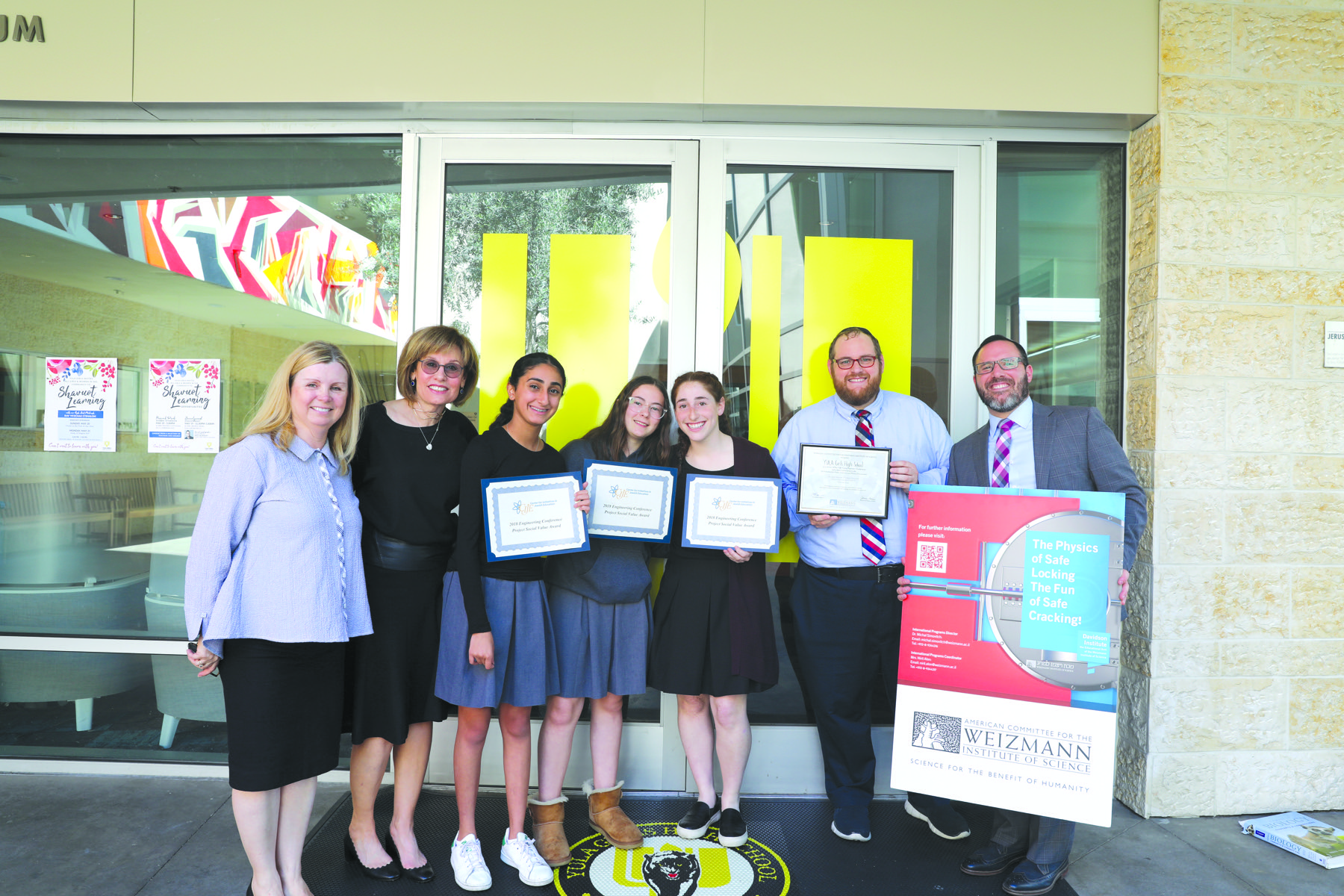
From left: Jane Willoughby of the Center for Initiatives in Jewish Education; Janis Rabin of the American Committee for the Weizmann Institute of Science; YULA Girls students Tehilla Kohanteb, Zahava Reiss and Anat Rimmon; YULA Girls High School faculty member Ethan Piliavin; and YULA Girls Head of School Rabbi Joshua Spodek participated in the CIJE Young Engineers Conference.
Yeshiva University of Los Angeles (YULA) Girls High School was one of two award winners at the Center for Initiatives in Jewish Education (CIJE) West Region Young Engineers Conference.
The conference, held May 6 at the Santa Monica headquarters of automotive information company Edmunds Inc., was attended by 180 prospective engineers from 13 Jewish day schools in California, Texas and Washington. The students showcased their new devices, sensors and robotic innovations before judges from Silicon Beach, who awarded prizes for innovation, engineering, presentation and teamwork.
YULA, an Orthodox high school on Robertson Boulevard, won the Social Value award for “Lockaholic,” which seeks to prevent drunk driving. The Texas Torah Institute of Dallas received the grand prize for “Combating Infant Death,” which aims to save the lives of children left in hot cars.
The winning students earned the opportunity to represent the United States at the 2019 International Physics Tournament at the Weizmann Institute of Science in Israel.
“The students dedicated their projects to saving lives using innovative technology,” Jane Willoughby, vice president and director of education, program research and development at CIJE, said in a statement. “It is fitting that these schools will now have the opportunity to participate in an international competition at the Weizmann Institute, an institution dedicated to improving lives worldwide and nurturing the next generation of pioneering scientists.”
CIJE, which was founded to enhance and enrich the quality of Jewish education throughout the U.S., supports over 40,000 students in 180 schools in 17 states, according to its website.
From left: Robert Schoenberger, Ira Dankberg, Steve Schmitt and Paul Bellaff attended Beth Chayim Chadashim’s 2018 Visions Awards gala.
Progressive congregation Beth ChayimChadashim (BCC) held its 2018 Vision Awards on June 3 at the Skirball Cultural Center.
The event honored U.S. Rep. Karen Bass with the Harriet Perl Tzedek Award. Bass, who was the first African-American woman speaker of the California Assembly, was honored for devoting her life to public service. Additionally, in 2008 Bass officiated the wedding of BCC Rabbi Lisa Edwards and her partner, Tracy Moore.
“Congressmember Karen Bass has a special place in our BCC hearts,” a BCC statement said.
The event also presented BCC member Elizabeth Savage — who has been recognized by the city of West Hollywood and the L.A. County Board of Supervisors for her social justice activism — with the Rabbi Irwin and Agnes Herman Humanitarian Award; and recognized the work of BCC members Maggie Anton and Dave Parkhurst — the wife and husband who “have been active and generous anchors of our synagogue community since 2000” — with the Presidents Award. Anton is a longtime BCC board member and author of the award-winning trilogy “Rashi’s Daughters.” Parkhurst is an attorney, musician and member of BCC’s Shabbat morning minyan.
Attendees included BCC clergy and staff, including RabbiHeather Miller, CantorYuval Porat and Interim Executive Director Lisa Barrett.
BCC is the country’s first synagogue founded by gay women and men.
“Sacred Resistance,” the new one-woman show at the The Braid performance space at the Jewish Women’s Theatre, opens with storyteller-actor Vicki Juditz listing her outings for the week. On her docket is a series of protests, sit-ins and political action meetings about very serious problems, but her delivery — deadpan, earnest, slightly wry — makes this litany of “do-gooding” funny.
At one of these events, she could be arrested. But she’s single and her daughter has gone off to college. “You know, for years, I just didn’t have the time to be incarcerated,” she says, poking gentle fun at her almost obsessive drive to do good.
The play then backtracks to trace the evolution of her highly active social conscience, and her conversion to Judaism.
Juditz was raised Lutheran by German-American parents (though, as she learns, her last name suggests a Jewish heritage). While in her 20s in New York, her main goal was to land a man. She decided to convert to Judaism as a way to lure her noncommittal Jewish beau down the aisle.
She meets with a stern and gloomy rabbi who tells her that, as a Jew, she will never again celebrate Christmas or Easter. She starts crying. “How could I tell him how much I loved Santa? And the Easter Bunny?”
Juditz presents herself in these early years as flighty, marriage-obsessed and a little shallow. She spends a lot of time describing clothing. It becomes apparent that this focus on clothing is a metaphor for her early years of “trying on” identities — literally stepping into each outfit. She buys a “sexy girlfriend” sundress, then, after meeting the rabbi and visiting Williamsburg, N.Y., she buys a Chasidic-stylesweater and “Marlo Thomas wig.” Later, she buys a “respectable German lady” skirt and silk blouse.
The relationship with the equivocal boyfriend ends, as does her conversion. But when she stumbles upon a sukkah at New York University, she sits down with the rabbi inside it and finds herself inexplicably moved.
Later, after moving to Los Angeles, she helps an elderly woman onto a bus. The woman, a Polish immigrant, tells her about a charismatic rabbi offering conversion classes. Juditz attends and begins the conversion process again. The value of the religion grows the more time she spends with it.
Christianity is based on belief, this new rabbi tells her, whereas Judaism is about responsibility. The notion of Judaism as a call toward responsibility forms a core theme of the play. When Juditz invites herself to her octogenarian friend’s home for Shabbat, she learns the old woman lost almost every member of her family in the Holocaust.
Juditz then watches Claude Lanzmann’s 1985 documentary “Shoah,” and visits her (non-Jewish) aunt and uncle in Germany. She hears about their struggles during and after World War II, and empathizes. Yet, she asks herself, does the acceptance of evil and participation in it come from lacking that core sense of responsibility? Without a reminder of your obligation to others, is it too easy for ordinary people to be swayed? After her visit to Germany, she commits to Judaism with new fervor.
Juditz’s story is a complex one, albeit presented in a light, humorous way. It touches people in very different ways. I was moved by the part about her life as a late 20-something — the open, free-flowing quest for meaning and identity that often characterizes that age. For others in the audience, it was more of a Holocaust play. One woman was in tears on opening night. “I lost a lot of family in the Holocaust,” she said.
After the show, Juditz told the Journal, “We’re all human, but the only way we can survive horrible times, like now, is if we look inside to our sense of responsibility. We all have the capability to take responsibility for what’s right. I found it in Judaism, but you can find it elsewhere, too.”
“Sacred Resistance” is at The Braid, 2912 Colorado Ave., Santa Monica. Tickets, $30-$35. jewishwomenstheatre.org.
And the Lord opened the mouth of the ass, and she said unto Balaam: “What have I done unto thee, that thou hast smitten me these three times?” (Numbers 23:28)
Salvador Litvak Accidental Talmudist Does Balaam’s donkey mock him? She disagrees with his plan. She holds fast to her perception of the danger before them. She disobeys his order. These actions do not amount to mockery. Rashi says Balaam feels mocked because he’d been summoned by a king to destroy an entire nation with his words, and now his own donkey won’t follow his orders. The presence of the king’s messengers makes it exponentially worse in his mind. Ramban says this odd encounter is arranged precisely to show Balaam that God is in control. His prophetic power extends only as far as God permits him to see and speak.
One does not have to be a prophet, however, to learn a key lesson from this story. Balaam had already told the messengers that he could not transgress the will of God. What he and we learn from the encounter on the road is that fear of humiliation is a blinding force.
We face problems constantly. All too often, we come up with a solution only to have a relative, friend, colleague or even a stranger challenge us with an alternate answer. If it happens in front of others, that fear of humiliation kicks in with brute force, tempting us to attack the challenger rather than consider her proposal. The next time it happens, let’s remember the donkey’s lesson, and focus on the facts. Onlookers will be far more impressed by a person who’s open to being wrong than one who insists on being right.
Rabbi Ari Schwarzberg Shalhevet High School Sometimes the deepest lessons come from an ass! In this unusual story, Balaam, an ostensibly righteous servant of God, convinces himself that he has the divine blessing to curse the Jewish people. Wooed by Balak, the king of Moab, Balaam is that savvy evildoer who strategically locates an alibi before sinning, lest he be held accountable for his behavior: “If Balak would give me his house full of silver and gold, I cannot go beyond the word of the Lord my God, to do anything, small or great.” And yet, after God grants him permission to go to Balak, it is a clumsy donkey that barrels through Balaam’s obtuseness and awakens his inner consciousness, reminding him that this mission is about serving HaShem’s will, not Balak’s. Sure, Balaam was given the green light to go with Balak’s messengers, but his actions were guided by sinister intentions. Fortunately, his own donkey sets him straight and realigns the true purpose of his rendezvous with Balak, preventing any disastrous results.
The Torah here strikes a profound chord: We tell ourselves all types of stories to justify our actions, but most of the time the right thing to do is so obvious, even a donkey can see it.
Natasha Mann Rabbinical Student, Ziegler School of Rabbinic Studies “We judge ourselves by our intentions, and others by their actions.” This adage characterizes a double-standard that is difficult to avoid in human psychology. We are able to see our actions as the results of complex intentions, motivations and needs. However, the inner lives of others are closed to us, and thus we are left to reverse-engineer intentions from actions.
The fact that Balaam’s donkey speaks is of great interest to many scholars, but few are interested in the details of her dialogue. This is perhaps due to the fact that her lament and confusion at her punishment seem to be a natural response to her situation.
However, in her second moment of speech, the donkey reminds Balaam that in her many years of service, she has never before refused his order. This is Balaam’s donkey asking Balaam to look beyond her actions toward her motivations. It is only then that Balaam’s eyes can be opened to the angel before them.
We are all capable of overlooking each other’s motivations. When we dislike actions or statements, it is especially easy to immediately ascribe ill intent to their origins. However, I believe that Balaam’s donkey speaks to teach us that by assuming motivations instead of asking for them, we may find ourselves missing the angel standing on the path. Perhaps we can all work harder to extend the courtesy of asking about intentions before assuming them.
Rabbi Kerry M. Olitzky Rabbi and author Excerpted from myjewishlearning.com some people write off this portion as biblical fantasy. In Parashat Balak, Balaam has a conversation with a donkey. A dialogue of this nature seems more appropriate for an animated film than a serious religious text. As a result, many ignore and overlook the implicit message of the portion.
In this episode of the evolving saga of the Jewish people, King Balak invites Balaam to put a curse on the Jewish people — an apparently effective military strategy of the ancient world. Before Balaam can do so, however, he is dissuaded and undergoes a change of heart. After seeing the beauty of the ancient Jewish people and Judaism’s traditions, he offers a blessing instead.
Most will say that the donkey persuaded Balaam to transform the intended words of the curse into words of praise. But it is not the medium that persuades Balaam; it is the message. Today, as much as we think that clever marketing is the key to making Judaism appealing to those who are ambivalent toward the community, this Torah portion suggests otherwise.
The message is key, not the messenger. God can and does speak to us in myriad ways, and we have to be ready to accept divine words regardless of how they are delivered. That point is just as cogent today as it once was. No matter how much we manipulate Judaism to do and say what we want, essentially it has to be able to persuade people on its own of its ability to provide meaning and direction.
Rabbi Stephen Lewis Fuchs Bat Yam Temple of the Islands Excerpted from reformjudaism.org It should not surprise us that in this week’s Torah portion, Parashat Balak, the animal that saves Balaam’s life is female. How consistent this is with the theme that it is often the women in the Bible who guide, instruct or shape the events surrounding surprisingly clueless males.
Beginning with Eve, women like Rebecca, Tamar, the six women of the Exodus, Samson’s unnamed mother, Hannah, Ruth, Vashti and Esther are much more savvy than their male counterparts.
But there is more.
Balaam was a world-class sorcerer. The sages claim that Balaam communicated directly with the Almighty (B. Zevahim 116A) and that he was the gentile equivalent for brilliance of Moses himself (Bemidbar Rabbah 14:20). And yet in the story, Balaam is totally oblivious to the presence of God’s messenger while his animal sees the angel clearly. Wow!
When we think of dumb animals, “asses” are the metaphor! And yet in this case, the ass gets it, and Balaam — the smartest man alive — is clueless.
What does that teach us? There is something we can learn from everyone.
Rabbi Simeon ben Zoma said it best: “Who is wise? The one who learns from everyone!” (Pirkei Avot 4:1)
Helen Sklar is an immigration attorney with Stone, Grzegorek & Gonzalez LLP in downtown Los Angeles. An attorney for 33 years, and with a passion for tikkun olam, Sklar, 65, spoke with the Journal about the Donald Trump administration’s zero tolerance policy toward immigrant families, the president’s June 20 executive order, and why reuniting the children with their parents must be our top priority.
Jewish Journal: What drew you to immigration law? Helen Sklar: I was drawn to it after hearing it described as the embodiment of foreign policy and its sequelae in the United States. Sequelae is when the U.S. chooses a particular foreign policy in a place like Central America that results in furthering conflict and strife. That’s precisely what happened in the ’80s. Large numbers of people came to the United States, and what we’re seeing today in the flight of people northward to safety is directly linked to that period and the policies chosen by the U.S. to avert what is described as communist takeovers in various Central American countries.
Today, the sequelae is the children of migrant families being torn from their stability. I’ve been practicing law since the [Ronald] Reagan administration, so I have seen how immigration has been handled as a matter of policy since 1985, and I have never seen so much damage and chaos as is happening today with this administration.
JJ: When President Donald Trump signed the June 20 executive order saying he would no longer separate children from their parents, he did not abandon the zero tolerance policy and still plans to criminally prosecute those who cross the southern border. Attorneys argued it violates the Flores Settlement Agreement of 1997. What is that? HS: It came out of a lawsuit filed by a nonprofit in Los Angeles. It was a class action that defined all minors who are detained in the legal custody of the immigration authorities. It was designed to protect noncitizen minors detained in the legal custody of what was then the Immigration and Naturalization Service (INS). It created protocols and rules for how long they could be detained and the conditions of their custody.
JJ: Why has the Department of Justice gone to court to try to alter the Flores Settlement Agreement? HS: In order to loosen the restrictions on the conditions that are required for the detention of minors. The exact wording of the settlement states that children must be kept in “the least restrictive setting appropriate to their age and special needs, generally in a nonsecure facility licensed to care for dependent as opposed to delinquent minors.” They must also release minors after 20 days.
If the Trump administration continues to pursue its zero tolerance policy of criminally prosecuting everyone who crosses the border and placing the families in jail-like circumstances, it violates the Flores settlement.
Many of these people are coming to the border and asking for a credible fear interview, so this notion that it makes sense to prosecute them criminally is ludicrous. Other than a few exceptions here and there, this policy has never been pursued heretofore. This is completely a creature of this current administration — this policy to prosecute these people who are coming here to seek asylum.
JJ: What is a credible fear interview? HS: A person comes to the border, gets written up, photographed, fingerprinted, taken into custody and set up for a credible fear interview to explain why they are seeking asylum. Theoretically, they should be given an interview fairly quickly. These are done by trained asylum officers and they are done professionally. A transcript is made of their statement, and that’s important because it becomes part of the evidentiary record. If they are deemed to have a credible fear, many are released — paroled into the United states and advised to appear in court at a certain date and time. But now they’re being transferred to criminal custody and being prosecuted in federal district courts instead of being taken to immigration detention.
JJ: It is not illegal to seek asylum, so how is the government able to criminally prosecute people? HS: Because entry without inspection is a misdemeanor. That’s an irregular entry attempted at a location other than an official port of entry. This was something that was subjected to a discretionary calculation and authorities concluded it made more sense to enforce civil immigration laws than to prosecute people criminally. That’s how it’s been handled up until this administration.
JJ: Why were they not prosecuted this way in previous administrations? HS: There’s probably multiple reasons. Firstly, the system is not set up to engage in that sort of massive burden on the criminal justice system. More importantly, people come here because the conditions they are fleeing are unsustainable. The conditions in Honduras, El Salvador, Guatemala are horrific.
JJ: There are those who argue this is not new and it happened under the Barack Obama administration. HS: No. Under the Obama administration, they were sometimes detained in family detention but they were never separated. Now the children are being taken away and parents are being criminally charged, and they aren’t allowed to go forward with their asylum claim until their criminal case is heard.
JJ: You said that entry without inspection is a violation of law, so doesn’t that mean the government has the right to pursue criminal prosecutions? HS: There’s all kinds of things that are violations of law that don’t get prosecuted, based on a discretionary determination. To prosecute all the violators of a particular law is not in keeping with good policy. That’s what prosecutorial discretion is for.
JJ:Despite the executive order, there’s no clear policy in place to reunite the 2,300 children who have been separated from their parents over the last six weeks. What can people do to help? HS: Call or write the Department of Justice and the attorney general’s office. Reuniting these children with their families should be the Trump administration’s highest priority at this point. There are so many different values at stake when it comes to the loss of a child. There are moral, religious, practical and ethical arguments to be made as well as the notion of the U.S. as a civilized society. It’s so important to [make these arguments] because if this leaves the headlines, those children will never be reunited with their families, and that’s not right.




 1. Cut a piece of cardboard that fits inside the paper bag. The cardboard will act as a cutting mat so the hobby knife does not cut into the sides or back of the bag.
 2. Sketch your design with a pencil onto the bag. For this example, I drew triangles to form a Star of David.
 3. Cut out the design with a hobby knife. Be careful while using the knife, and keep it away from children.
 4. Place a heavy rock or some sand in the bag so the wind doesn’t tip it over. And for fire safety, only use battery-operated tea lights.
 “THREE IDENTICAL STRANGERS”
 “THE CAKEMAKER”
 JEFF GARLIN
 ILIZA SHLESINGER AT THE ICE HOUSE