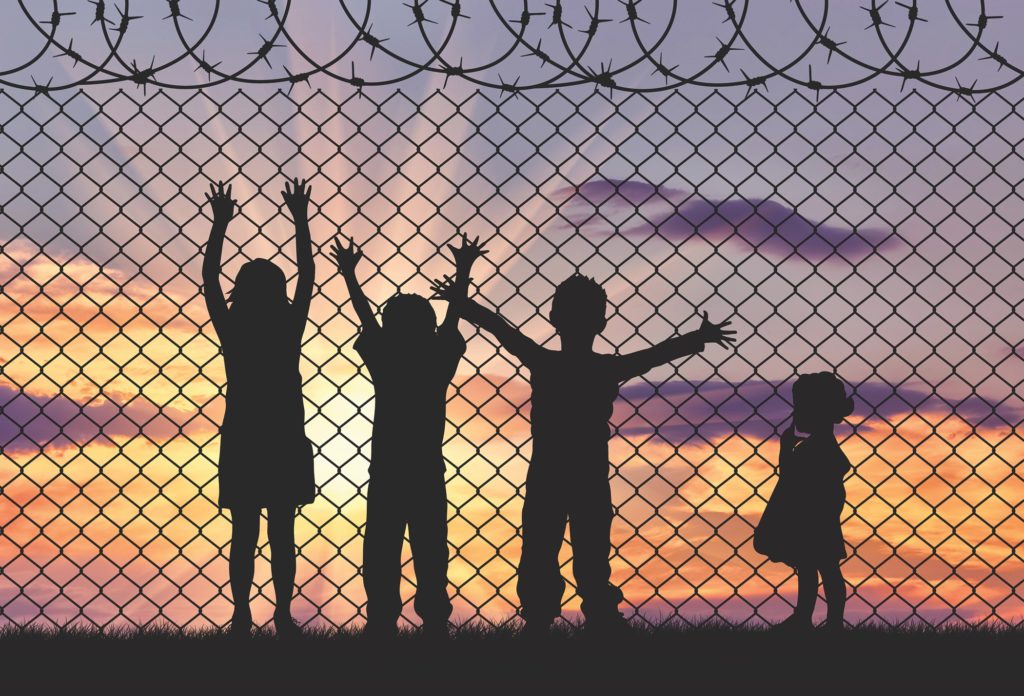
In 2015, the picture of a 3-year-old, Aylan Kurdi, wearing a bright red shirt, blue pants and sneakers, lying face down in the surf near Bodrum, Turkey, focused the world’s attention for a minute on the Syrian refugee crisis. The sight of this helpless, dead, innocent child was needed for people to be able to also see the hundreds of thousands of other Syrians killed in the civil war, and to humanize those who attempted to flee that hell to refuge elsewhere.
John Moore’s picture of a Honduran 2-year-old, wearing clothes in a similar color combination to Aylan’s (red shirt, blue pants, sneakers), her dark hair matted across her face, standing, crying, next to her mother as they were taken into custody near the Mexico-U.S. border, might define the current immigration crisis. It has grabbed people’s attention for this week.
The Donald Trump administration’s so-called zero-tolerance policy toward undocumented immigration, in which children are separated from their parents, has generated wall-to-wall criticism. In the Jewish world, social justice and human rights organizations (Bend the Arc, T’ruah, Jews for Racial & Economic Justice) condemned the move, but so did everybody else, including all the denominational organizations — even the Orthodox Union, which days before had given Attorney General Jeff Sessions an award.
It is hard to find anyone who is defending the unholy trinity of Trump, Sessions and Trump senior adviser Stephen Miller. Even members of Miller’s family are condemning the policy.
Aside from Trump’s blatantly false assertions that these are policies the Democrats put into place and he cannot do anything about it, Sessions’ and Miller’s defense of their policies (they didn’t get the memo that they were Democratic policies) is that they are all about the United States as a nation of laws.
We must hear the cries of the children and their parents. We must stop this criminal behavior masquerading as law. Call your senators, call your representatives. Do not rest until this has been stopped.
Miller is quoted in The New York Times as saying, “It was a simple decision by the administration to have a zero-tolerance policy for illegal entry, period. The message is that no one is exempt from immigration law.”
Sessions, meanwhile, said in a speech on June 14, “Having children does not give you immunity from arrest and prosecution.” He proceeded to back this up with a biblical citation: “I would cite you to the Apostle Paul and his clear and wise command in Romans 13 to obey the laws of the government … because God has ordained them for the purpose of order.”
In addition to the fact that the vast majority of Christian clergy oppose this policy, including Trump’s favorite evangelical, Franklin Graham, this verse has a rather checkered history on these shores.
In an interview in The Washington Post, John Fea, a professor of American history at Messiah College in Pennsylvania said, “There are two dominant places in American history when Romans 13 is invoked. … One is during the American Revolution [when] it was invoked by Loyalists, those who opposed the American Revolution.” The other, Fea said, “is in the 1840s and 1850s, when Romans 13 is invoked by defenders of the South or defenders of slavery to ward off abolitionists who believed that slavery is wrong. I mean, this is the same argument that Southern slaveholders and the advocates of a Southern way of life made.”
Aside from the tendentiousness of the claim of the zero-tolerance policy (that people who cross the border to seek asylum are breaking the law, since the United States is obligated under international law to grant asylum), does our tradition have anything to say about the conflict between laws and values? Should an asylum seeker be able to cross the border illegally in order to be able to make a legal claim of asylum?
Before we answer this question, we have to state clearly that there is no justification for causing lasting harm to children in order to intimidate their parents. The president’s explicit and implicit statements in which he says that the separation of children is a bargaining chip in order to get the border wall funded, or in order to deter future refugees from seeking asylum, has no moral foundation.
Jewish tradition is very clear that pikuach nefesh, or the saving a life, overrides or sets aside all other commandments (except idolatry, illicit sexual relations and murder). Therefore, one is obligated (not merely permitted) to violate the Shabbat to save a life. However, this is not the only time that the rabbis valorize going against the halachah in service to a greater good.
The Talmud (Babylonian Talmud Baba Metzia 82b-83a) establishes very detailed laws and regulations for the responsibilities of a worker who is hired as a porter. The porter, in most cases, is responsible for the well-being of the objects that were assigned to him to carry. At the end of this discussion, however, the story is told of two porters who were hired by a sage to carry barrels of wine. The barrels broke in a manner that would have obligated them to pay. However, when the rabbi who hired them brought them to judgment before Rav, the latter found that the porters should not have to pay the damages and, furthermore, the employer should pay them their wages as they were hungry and had no money for food. Rav’s rationale was not a learned excursus that undermined the previous legal discussion. Rather, the justification was a verse from Proverbs (2:20): “So follow the way of the good, and keep to the paths of the just.” The admonition to do justice set aside the specifics of the case so that the workers would not go hungry. And this case is not a lone instance of moral imperative overriding legal obligation. (The so-called takanat hashavim relieves a thief of the obligation of returning a specific object in favor of paying back its value. A father refuses to allow his son to be assessed for damages as a slave as it would degrade the son, and the Sages approve. And on and on.)
These instances of conflicts between the law and moral obligations, however, would not come into play since refugees who are seeking asylum are fleeing life-threatening situations. However, rather than recognize the right to asylum of people who fear for their lives, in flat legalese the attorney general has limited the number of refugees who might find sanctuary at our borders. In addition to separating children from parents, directing that immigration proceedings were criminal and not civil, he also has excluded victims of domestic abuse and gang violence from applying for asylum. “Generally, claims by aliens pertaining to domestic violence or gang violence perpetrated by nongovernmental actors will not qualify for asylum,” Sessions writes. Then he adds in a footnote: “Accordingly, few such claims would satisfy the legal standard to determine whether an alien has a credible fear of persecution.” A “credible fear of persecution” is the legal basis for a grant of asylum.
It is obvious now, if it wasn’t earlier, that while the separation of children from their families is the latest and most egregious action of this administration, its ultimate objective is to radically reduce immigration. Period. To this end, Trump started his campaign by labeling refugees coming over the southern border as rapists, and now he calls them “murderers and thieves.” The separation of children from their parents, which will traumatize these kids for years and which is a violation of international law, is only a bargaining chip for the president. He is holding these children (and their parents) hostage for funding for his border wall (which Mexico was going to pay for).
So, what can we do?
• Encourage members of Congress to speak out against family separation and hold the administration accountable through statements, letters and social media.
• Urge them to decrease the funding for Immigration and Customs Enforcement (ICE) and Customs and Border Protection (CBP) that enables the administration’s family separation practices.
We must hear the cries of the children and their parents. We must stop this criminal behavior masquerading as law. Call your senators, call your representatives. Do not rest until this has been stopped.
Rabbi Aryeh Cohen is the rabbi-in-residence in Southern California for Bend the Arc: A Jewish Partnership for Justice.