fbpx

April 30, 2018

What? Milk in My Chocolate for Shavuot?

I can’t tell you how many people tell me sheepishly that they prefer milk chocolate bars while others gloat over their dark chocolate preferences. Israel’s Elite chocolate produced a charming video of children tasting chocolate for the first time. It messages that only adults can understand the sophistication of dark chocolate, leaving milk chocolate to untutored naifs. Shifting the Israeli palate from milk to dark defies the famous image on Elite’s red cow wrapper.

The Shavuot celebration coming in May, with its emphasis on dairy foods, seems like a good time to take a look at this milk/dark chocolate controversy. Fortunately, the “Torah” of chocolate has shifted. Today’s craft and artisan chocolate makers smooth over the divide by offering dark milk chocolates. These are chocolates that mix milk solids with cocoa content in the 40 to 60% range, yielding a smooth mouthfeel and rich taste.

Milk chocolate is regulated by food standards and vary around the world. For instance, be aware that the minimum percentage of milk solids required by the FDA runs around 12% while the requirement in European Union countries is 15%. The FDA only requires 10% cocoa solids in those milk chocolates. That means there are a lot of other ingredients in that treat.

For those with dairy allergies, the FDA does not require producers to identify traces of dairy which may be picked up on the production line. Indeed a recent FDA study showed that three in four dark chocolate products contain dairy without identification of such on the label. If you really need to know about the milk in your chocolate, look for a formal pareve, vegan or dairy free certification.

So, why milk chocolate? To celebrate the gift of Torah at Mount Sinai when our ancestors were too busy preparing for the revelation to eat anything but easily prepared milk foods, of course.

What? Milk in My Chocolate for Shavuot? Read More »

Arms Control Expert: Netanyahu Speech ‘Extremely Important’

Dr. Emily Landau, a senior research fellow and head of the Arms Control and Regional Security Program at the Institute for National Security Studies (INSS) told reporters in an April 30 conference call that Israeli Prime Minister Benjamin Netanyahu’s speech was “extremely important.”

Landau stated that while Netanyahu didn’t necessarily provide anything new, it provided “a lot of information and a lot of flesh in regards to Iran’s work in the past on nuclear weapons programs.” For instance, Netanyahu’s speech accentuated the International Atomic Energy Agency (IAEA)’s “damning” 2015 report about Iran’s ambitions to develop nuclear weapons that the P5+1 nations swept under the rug.

Consequently, the fact that Iran has never had to answer for their nuclear weapons program means that pertinent information on the latest developments of their weapons program is not available. But what Netanyahu revealed on April 30 provides concrete proof that Iran was lying in their repeated denials of developing nuclear weapons.

“People should be standing up and saying no that’s a lie,” Landau said, adding that “breaking that false narrative of nuclear innocence is important.”

Landau then pointed out that the IAEA was never allowed to interview Dr. Mohsen Farkhrizadeh, the scientist who lead Iran’s Project Amad program to develop nuclear scientists continued to lead the regime’s efforts at nuclear development under the guise of “scientific knowhow.” She argued that the fact that Iran kept information on their nuclear weapons “in an orderly program” shows that they were never serious about nixing their program.

Therefore, the goal of Netanyahu’s speech was to show “the extent to which Iran has lied and cheated and deceived the international community in the nuclear realm for decades.”

“To think this deal will cause Iran to back away… like it’s on very, very shaky ground,” Landau said.

Landau also pointed out the speech was an “implicit message that Israel has access to inner workings inside Iran.”

Landau highlighted some of the flaws in the deal, including the “convoluted” provisions of the deal regarding IAEA since they can only go to “declared nuclear facilities.” The deal also didn’t cover Iran’s ballistic missiles program.

Despite the deal’s flaws, Laundau thought that the ideal course of action going forward is to “strengthen” the Iran deal since it would be difficult to negotiate a new deal altogether.

“Iran needs to get the message that American and Europe are not happy with a lot of Iran’s activities,” Landau said.

Arms Control Expert: Netanyahu Speech ‘Extremely Important’ Read More »

Lawfare Project Succeeds In Taking Down Anti-Semitic Content Online

The Lawfare Project’s February legal action in Spain has already begun to show success with some online anti-Semitic content being taken down.

The Lawfare Project had sent out cease-and-desist letters in February to Facebook, Yahoo and Google warning them they would face lawsuits if they didn’t comply with Spanish law and take down anti-Semitic content on their platforms, which included Holocaust denialism. According to a press release from The Lawfare Project, three instances of anti-Semitic content have been taken down in response.

“Two of the items removed were articles published on some of Spain’s most popular conspiracist websites, denying the Holocaust while simultaneously blaming Jews for Nazi atrocities,” the press release states. “The third was a thread in a forum that spread the medieval style blood libel that Jews carry out ritual murders of children.”

One of the authors leads a Spanish far-right organization who apologizes for Syrian President Bashar Al-Assad and has been on panels in Iran that openly engage in Holocaust denialism. The Holocaust denial articles were taken down by the authors and the manager of the forum took down the ritual blood libel.

While this is certainly progress for The Lawfare Project, Google and Yahoo have not acquiesced to their cease-and-desist letters. According to Lawfare Project Spanish Counsel Ignacio Wenley Palacios, Google hasn’t taken down the content in question because the legal issue was “complex” and Yahoo hasn’t responded to the letter.

“We are determined to take further steps to demand the enforcement of the law from search engines and social media platforms, and we will file lawsuits if they continue to tolerate blatantly racist and offensive content, when they have been effectively informed by detailed take-down notices,” Palacios said in the press release.

In total, The Lawfare Project plans on filing 10 total court proceedings against IT companies between 2018 and 2020.

As Palacios told the Journal in February, the tech platforms in question tend to be “erratic” when it comes to applying their policies of content being taken down, and should they proceed with their lawsuit there’s a good chance The Lawfare Project would win.

“Our actions are very nuanced, and meet the highest of European standards on free speech, and on liability of Internet providers, matching closely the reasoning of the case-law of both the Supreme Court of Spain, and the European Court of Human Rights,” Palacios told the Journal in an email.

Lawfare Project Succeeds In Taking Down Anti-Semitic Content Online Read More »

Episode 87 – Mossad: Kill or be Killed

A little over a week ago, in the early morning of April 21st, Fadi Al-Batsh was walking down a road in Gombak, a suburb of Kuala Lumpur in Malaysia. He was on his way to the local mosque for dawn prayers. Suddenly, two men on a motorcycle drove up, drew their pistols and gunned down Al batsh with no less than 14 bullets before driving off.

Seven years prior to his assassination, Fadi Al-Batsh had moved to Malaysia from Gaza to research and acquire weapon systems and drones for Hamas, the ruling power in the strip. This, ostensibly, made him a target for Israel’s international spy agency, the Mossad.

Of course, this is not the first such mission undertaken by the clandestine organization. The Mossad, along with the other branches of Israel’s intelligence apparatus, has a long, dark and often contentious history of targeted assassinations dating back to the very founding of the state.

If we listed the qualifications and accomplishments of Dr. Ronen Bergman, we’d have no time left to talk about his incredible new book, Rise and Kill First: The Secret History of Israel’s Targeted Assassinations. Suffice it to say that Dr. Bergman is a senior political and military analyst for Yedioth Aharonot, Israel’s largest daily newspaper, he’s been a guest lecturer at countless universities including Princeton, Yale, Oxford and Cambridge (where he received his PhD in history), he’s written for numerous international newspapers including the New York Times, The Wall Street Journal, Newsweek and The Times and finally, he deserves a special congratulations for recently becoming a staff writer for the New York Times Magazine.

We are thrilled to be joined today by Dr. Ronen Bergman to talk about his new book and Israel’s history of covert killings.

Dr. Bergman’s books on Amazon, his Facebook and Twitter

RSS Subscribe

Direct Download

Episode 87 – Mossad: Kill or be Killed Read More »

11 Comments on Netanyahu’s Iran Speech

1.

You must admire the people in charge of gathering information for Israel. You must admire the fact that they can show you thousands of documents from within the Iranian archives. And as you admire these creative, bold, daring intelligence gatherers, you must also consider the obvious fact: They have documents that you don’t. They have information that no one else could gather. They know Iran well enough to master such stint – getting half a ton worth of secret documents kept inside Iran and shipping them to Tel Aviv. Maybe, just maybe, this also means that their sense of what Iran is doing, where it is going, what its ambitions are like, are better than yours (and mine). If these people tell you that Iran is cheating, if they tell you that the nuclear deal does not work, you ought to listen. Agree – or disagree – but listen carefully, and humbly. There is very little chance that you know better than they do.

2.

Timing is everything. Prime Minister Netanyahu tried and failed to stop the nuclear deal giving a speech to Congress in early 2015. It was a controversial move. The Prime Minister was blamed by many of the speech’s opponents that his main motivation was political, that his true crowd was the home crowd (election in Israel were held a few weeks after the speech). In a phone conversation I had with the PM not long after the speech he defended his decision to go to Washington. This is an important enough issue for Israel for me to utilize all possible means – he said – and if this makes the President of the United States unhappy, then so be it.

The timing was off. Obama had no intention of giving up. He thought he had a deal worthy of a second Noble Peace Prize. John Kerry was maybe hoping to get his first. Netanyahu gave a good speech, a strong speech, but not strong enough. One could only speculate: would he be more successful had he showed them then what he showed us now?

3.

What did you think about Netanyahu’s presentation on Iran? Most likely, this depends less on the material shown (shocking intelligence, but no smoking gun on current Iranian violations), and more on what you previously thought about:

A.    The Iran deal.

B.    Netanyahu.

Try this theory. Look around the web and try to guess in advance what each person, pundit or leader, is going to say about the presentation. In most cases, if you are familiar with the views of these pundits and leaders, you can skip the comment or the article. You know what they are going to say (I assume some readers might same the same about this article).

Would more evidence of Iranian belligerence make a difference? Sure, if Israel had rock solid proof of recent Iranian violations (if it has such information Netanyahu did not show it). But even then, even then… People could always argue that there’s no proof the documents are real, that Netanyahu’s word isn’t worth a dime, that Israel – and most other countries – got it wrong on Iraq’s WMD.

So did Netanyahu change many minds? He surely achieved two objectives: showing Israel’s intelligence prowess, and making Iran a main topic of conversation, for at least a day or two.

4.

He also annoyed some leaders. Many of them are easily annoyed by him. Some of them were quick to point out that the information revealed by Netanyahu did not include things that were not previously known about Iran. The question is: Known to whom? Netanyahu’s presentation clarified things that experts knew before, but that politicians did not always know and that the public was not always aware of.

And anyway, the question remains: Can you alter the opinions of world leaders by showing them information – whether it is old, new, repackaged or reexplained? Are world leaders capable of admitting great error?

The deal with Iran was a mistake. It was a rush mistake. But let’s be realistic: Do you think Obama changed his mind the other day if he was watching Netanyahu? Do you think Kerry did? Timing is everything. Information – evidence – is hardly as important. Many Americans blame President Trump for bringing about the age of fake news, yet what Netanyahu showed us earlier this week is proof that the Iran deal was fake news. It was fake news produced by people more sophisticated than Trump, and thus more successful in selling their make-belief diplomatic achievement to a willing audience.

5.

We have a few days before we can truly assess the impact of Netanyahu’s dramatic appearance of world events. But some things are clear:

Netanyahu was well coordinated with the Trump administration when he staged his press appearance. He spoke on the phone with Trump two days before his presentation. He met with the new Secretary of State not many hours before his presentation. The administration was not surprised. It was well informed, and it was ready to respond – as Trump did half an hour after Netanyahu went off the air.

What was the exact plan? Maybe Trump told him: give me something with which to work – give me something with which to pressure the Europeans. Maybe Trump told him – I can’t convince the Europeans, you try. Maybe Trump told him: I am going to do what’s right, it would be helpful if you can give me some more ammunition.

6.

Can the Europeans, and Russians, and Chinese be convinced?

I am skeptical and here is why: They knew all along that Iran cannot be trusted. They knew its leaders were lying. They knew it was working on a nuclear program. In short, they were cynical when they hailed the deal, and there is no reason for me to think that they are not cynical now. They decided to compromise with Iran not because they think it is a country of great values and honest to god leadership. They decided to compromise with Iran because they see economic potential, and because they think Iran – and its belligerent behavior – is not really their problem.

7.

I’d like to think that Trump is going to change all this, but this is far from being an assured outcome of what we see now. Trump can dump the deal and them lose interest – not a good outcome. He can keep the deal – possibly with cosmetic changes to save face – not a good outcome. He can begin a process of pressuring Iran, and then lose an election and be replaced by a less vigilant leader – not a good outcome. The battle against Iran is long, and to win it the US (or Israel) must be persistent and must have a strategy. Press conferences, speeches, statements, dazzling intelligence achievements – all these have a role in this long battle. But no speech can win this battle.

8.

To Israel’s credit – if one believes the unconfirmed reports by the non-Israeli press – it is not only talking. The same day Netanyahu was speaking, someone was also shooting missiles at Iranian targets in Syria. This was not the first, nor the second, nor the third time in which Iran was the recipient of a clear message: its military presence in Syria will not be tolerated.

Israel made it clear in public statements. It made it clear to foreign dignitaries, including, in recent days, European leaders that were trying to understand why Syria is suddenly becoming such hot potato. Israel told even the Russians that it is dead serious about not allowing Iranian presence in Syria. A senior diplomat was telling his counterpart these exact words: We will not let Syria become a second Lebanon. In Lebanon, Iran’s proxy Hezbollah have thousands of rockets ready for use against Israel. This is hardly a convenient situation, but since the war of 2006 the Israel-Lebanese border was relatively stable and quiet. Israel has no interest in having to watch a second front to the east – this time held not by Iran’s proxies but rather by Iran itself.

Again, only time will tell if the Iranians got the message, and decided that the benefit does not justify the cost – or maybe it’s the other way around: they got the message and are getting ready to up the ante.

9.

What Netanyahu showed was amazing, and also somewhat disappointing.

You are telling us that Iran is lying?

You are proving that the official Iranian position was based on a pile of nontruths?

Did we not know?

Netanyahu did not have a smoking gun to present. It is disappointing but ought to be acknowledged. So, if you are still in the business of believing the Iranians – oh, they lied for three decades, they lied up until mid 2015, but not they are telling the truth and nothing but the truth – I would urge you to stay away from banks, insurance companies and flea markets. You are clearly an easy prey for con artists of all types. Still – Netanyahu can’t show you evidence that they are lying now. I mean, this week. Today. Or maybe he can:

Netanyahu did prove that Iran is still lying about its dishonest past. What he did not prove that it is lying about the present.

10.

Politics: if one wants to be suspicious of Netanyahu’s motivation it is not impossible to do. The speech was made on the first day of the summer session of the Knesset, the Israeli parliament. Netanyahu stole the show. While other politicians were dealing with petty maneuvers he presented himself as a man of action, determination and the big things.

If he has no choice but to call for early election – because the coalition can’t compromise on issues such as the draft of the ultra-Orthodox, or the conversion bill, or the Supreme Court bill – he will now do it as statesman. If his coalition partners were toying with idea of testing his power, they will now have to reconsider.

11.

These are tense days in Israel. Pundits and politicians rush to the microphones to calm the public down – which of course has the opposite effect. If times were truly calm, there would be no need for such appearances.

Remember Independence Day? It was just a week ago. Remember Passover? For weeks ago. May is here, and with it a mountain of worries:

Will the moving of the US embassy to Jerusalem, a happy and well appreciated decision by Trump, ignite protest and violence?

Is Israel ready for the main show in Gaza, in mid-May, when thousands will once again attempt to cross the border?


11 Comments on Netanyahu’s Iran Speech Read More »

Netanyahu EXPOSES Iran’s Nuclear Ambitions In Speech

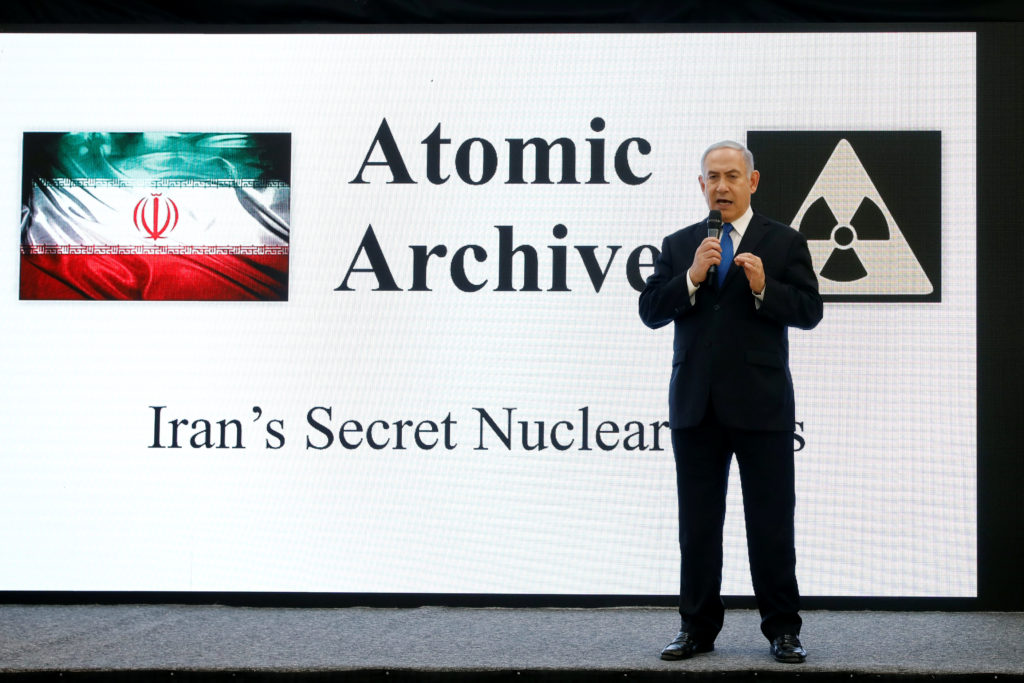
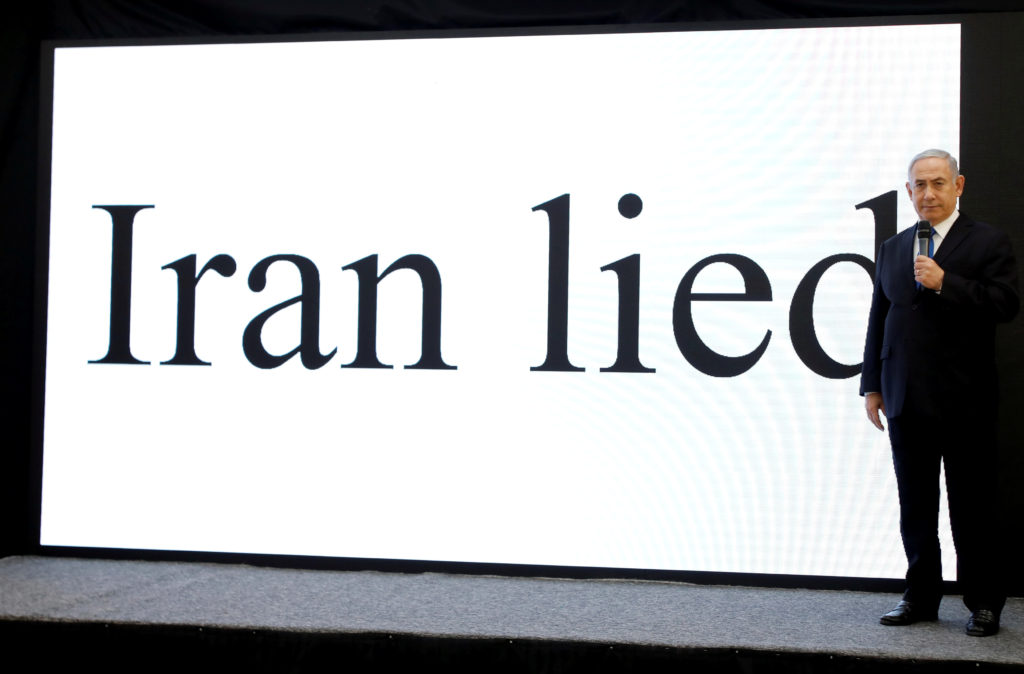
Israeli Prime Minister Benjamin Netanyahu opened the week with a bombshell of a speech on April 30 that exposed Iran’s nuclear weapons ambitions.

Netanyahu told the world that Israeli intelligence was able to smuggle 55,000 files and 183 CDs from Iran that prove beyond a reasonable doubt that despite Iran’s repeated denials, the country has always sought to develop nuclear weapons and never strayed from that goal, even after the nuclear deal was forged.

“I’m here to tell you one thing: Iran lied,” Netanyahu said. “Big time.”

In a slideshow presentation that was only “a fraction” of the intelligence the Israelis had uncovered, the files showed that from 1999-2003, Iran had a secret operation called “Project Amad,” which the files described as “a comprehensive program to design, build and test nuclear weapons.” The project’s stated goal was to develop five nuclear warheads with 10 kiloton TNT yields, the equivalent of five Hiroshima bombs on missiles, per Netanyahu.

Project Amad was broken down into five elements: designing nuclear weapons, developing nuclear cores, building nuclear implosion systems, preparing nuclear tests and integrating nuclear warheads on missiles.

“These files conclusively prove that Iran is brazenly lying when it says it never had a nuclear weapons program,” Netanyahu said. “The files prove that.”

Netanyahu added that facing international pressure in 2003, Iran shelved Project Amad but continued to develop nuclear weapons under the guise of “scientific knowhow” led by Dr. Mohsen Farkhrizadeh, who had also led Project Amad, as well as a lot of the same personnel who led Project Amad.

Additionally, Iran continued their uranium development at the Frodow Uranium Enrichment Facility, which was hidden underneath the mountains so Iran could continue its development of nuclear weapons under the radar.

The Iran nuclear deal allowed Iran to keep Fordow running, so long as they came clean about their nuclear program. But the uncovered files showed that Iran had told the International Atomic Energy Agency (IAEA) in 2015 that they “denied the existence of a coordinated program aimed at the development of a nuclear explosive device and specifically denied the existence of the Amada Plan.”

“Why would a terrorist regime hide and secretly catalogue their nuclear files if not to use them at a later date?” Netanyahu asked.

Netanyahu proceeded to slam the deal as “based on Iranian lies and Iranian deception.”

As Netanyahu had explained earlier in the speech, after the deal was implemented in 2015, Iran moved its secret nuclear files to a secret location in Tehran that only very few Iranians and Israelis knew about. It was from this location where Israeli intelligence was able to smuggle the nuclear files.

Netanyahu explained that the deal basically paves the way for Iran to develop a nuclear bomb, as it allows for Iran to enrich unlimited amounts of uranium after a certain date. The deal also doesn’t address Iran’s ballistic missile program at all, and the consequences of this are seen in Iran continually expanding its missile program.

“This is a terrible deal,” Netanyahu said. “It should never have been concluded.”

Netanyahu pointed out that President Trump will soon make a decision on whether the United States will exit the Iran deal.

“I’m sure he will do the right thing,” Netanyahu said.

Netanyahu EXPOSES Iran’s Nuclear Ambitions In Speech Read More »

Pro-Israel Organizations Call On NYU President to Investigate Student Organizations Who Signed Anti-Israel Statement

StandWithUs and The Louis D. Brandeis Center for Human Rights Under Law issued a letter to New York University President Andrew Hamilton calling on him to investigate the over 50 clubs on campus who signed a statement calling for boycotts against Israel.

The anti-Israel statement, which was signed by the likes of NYU’s Students for Justice in Palestine (SJP) not only called for boycotts of Israeli goods, but also boycotts of pro-Israel clubs on campus due to supposed Israeli “occupation.”

“This year marks the 70th anniversary of the Palestinian Nakba (catastrophe), during which more than 700,000 Palestinians were violently expelled from their homes by Zionist militias, and of the establishment of the State of Israel, which continues its campaign of ethnic cleansing of Palestine to this day in the form of Israel’s military occupation of the West Bank and the Golan Heights and brutal siege of Gaza,” the statement reads. “We support the Boycott, Divestment, and Sanctions movement for Palestinian human rights as it is a non-violent method of resisting Israeli apartheid from abroad. We call on NYU to divest its holdings from companies and funds that are complicit in the Israeli occupation of Palestine.”

The letter from StandWithUs and the Brandeis Center denounced the statement for how it targets Jews.

“There are violations of NYU policy here, and conduct foreseeably undertaken in support of this statement could potentially violate state and federal law,” the letter states. “Moreover, it indicates a reprehensible joint effort to marginalize and stigmatize the Jewish student community at your university. We urge your administration to investigate this matter, and if violations of student conduct rules or applicable laws are found, discipline responsible organizations accordingly.”

The letter pointed out that the statement violates NYU policy, which prohibits discrimination of any kinds, and could violate state law, which prevents boycotts of people of “national origin.” There could also be a federal law violation, as the Department of Education’s Office for Civil Rights stated in 2004 that Jewish students were protected from discrimination.

“This anti-Zionist statement, if not properly addressed by NYU’s administration, could create a hostile environment for students of Jewish and/or Israeli backgrounds on campus,” the letter states.

The letter concluded by calling for Hamilton to investigate the statement, denounce it and then provide training on how such anti-Zionism could lead to virulent anti-Semitism.

In an April 19 town hall, Hamilton condemned the BDS movement.

“The university will not participate in boycotting of academics based in Israel. We believe in academic freedom and the free flow of ideas,” Hamilton said. “Boycotting is antithetical to that vision.”

Hamilton has not responded to the Journal’s request for comment.

Pro-Israel Organizations Call On NYU President to Investigate Student Organizations Who Signed Anti-Israel Statement Read More »