fbpx

April 25, 2018

Portman’s Words Matter

In “Portman-gate,” this week’s scandal of sorts, acclaimed Israeli-American actress Natalie Portman has been variously praised as a hero for speaking truth to power or vilified as a Boycott, Divestment and Sanctions (BDS) dupe. She is neither.

It is a cautionary tale of irresponsibly wielding the political power of celebrity in the digital age, and unwittingly sending a powerful message that, apparently, is contrary to the intended message.

As nearly everyone knows by now, Natalie Portman announced in a statement issued on April 20 that she would not travel to Israel to accept the 2018 Genesis Prize. In the original announcement, her spokesperson stated that “recent events in Israel have been extremely distressing to her and she does not feel comfortable participating in any public events in Israel.” The prize was to be awarded by Israel Prime Minister Benjamin Netanyahu.

The blogosphere erupted. Portman was praised from the left as a truth-telling hero, and vilified from the right as embracing the BDS movement. So she issued a new statement, apparently intended to clarify her actions. “I chose not to attend because I did not want to appear as endorsing Benjamin Netanyahu,” she said. “I treasure my Israeli friends and family, Israeli food, books, art, cinema, and dance,” but “the mistreatment of those suffering from today’s atrocities is simply not in line with my Jewish values.”

Still unclear, at least of this writing, is whether or not Portman feels “comfortable participating in public events in Israel.”

Hopefully, Portman will further clarify her stance, and will announce her intention to re-engage in Israeli public life. But the damage is done. Most will ignore the successive clarifying press releases issued by her people and will regard her simply as the Israeli-American superstar who now despises Israel so much she can’t even go there.

Most … will regard her simply as the Israeli-American superstar who now despises Israel so much she can’t even go there.

Portman, however, is no predictable anti-Israel agitator. To the contrary, her lifelong connection with Israel is bona fide and documented. She’s a native Israeli, born Neta-Lee Hershlag in Jerusalem. She directed and starred in the Hebrew language film adaptation of Amos Oz’s novel “A Tale of Love and Darkness.” She has long vocally opposed Netanyahu’s policies, once noting that she found “his racist comments horrific.” Still, she has previously criticized those who utilize their celebrity to “shit” on Israel. “I don’t want to do that,” she said.

Yet, that is precisely what her original announcement did. It quite clearly signaled that she was boycotting Israel, at least for the time being. That incendiary but remarkably imprecise statement was unabashedly hypocritical. Portman is, after all, also a fierce critic of President Donald Trump. Yet, she is hardly retreating from public events in the United States. Rather, she has been a fixture at the women’s marches, and has participated in the robust anti-Trump protests. She has not retreated from the Hollywood awards scene either, and it’s a safe bet to assume that she won’t decline to accept an Oscar next year because she is distressed about “recent events” in the Trump administration.

Portman states unequivocally in her latest clarification that “I am not part of the BDS movement and do not endorse it.” She may deny that her actions give support to BDS, but she’s wrong. They do. BDS co-founder Omar Barghouti said that “this latest rebuff to Israeli cultural events and accolades, coming from an Israeli-American superstar, is arguably one of the strongest indicators yet of how toxic the Israel Brand has become, even in some liberal circles in Hollywood. I can sense our South Africa moment coming closer.”

And on the other end of the political spectrum, Knesset member Rachel Azaria of Netanyahu’s coalition partner Kulanu party gets it, too. She sees Portman’s cancellation as “a warning light.” “She is totally one of us, identifies with her Judaism and her Israeliness,” Azaria said.

Celebrities of Portman’s stature have a responsibility to carefully vet the wording and reasoning of public pronouncements that they know will have significant impact. Those who love Israel but wish to criticize the government must remember: Tailor your public criticisms accurately and carefully, but don’t inadvertently give aid and comfort to those who deny the very legitimacy of the Jewish state.


Stuart Tochner is an employment attorney in Los Angeles.

Portman’s Words Matter Read More »

Sol Liber, Resistance Fighter, 94

Sol Liber, one of the last known members of the Jewish resistance during the Warsaw Ghetto Uprising, died on March 21. He was 94. His legacy will live on through his three children, eight grandchildren and the testimony of his harrowing experiences at three concentration camps. His interview was No. 50 of 50,000 at the USC Shoah Foundation.

“My father was very focused, primarily on family, work and the Jewish people,” Liber’s son, Sheldon, said at the funeral on March 23. “He was a great teacher that shared lessons about all three [of these things] with great emphasis on personal integrity, honesty, loyalty and taking the initiative to help others.”

Liber was born Dec. 3, 1923, in the town of Grojec, Poland, 40 kilometers south of Warsaw. He was thrust into the trauma of World War II at the age of 15 when he was drafted to fight for the Polish army against the invading Germans. After Poland’s quick surrender, he returned home but was soon chased out. He eventually landed with his father, mother and four siblings in the Warsaw Ghetto.

Desperate, yet resourceful, Liber would sneak beyond the walls to barter goods for food for his family. When word came that the Germans intended to empty the ghetto and disperse those who survived to death camps, Liber was led blindfolded to meet the head of the secret resistance, Mordechai Anielewicz. He was enlisted to help smuggle children through the sewers to groups shepherding them to safety. When the Germans mounted their final attack, Liber was assigned to battle them.

After the German army prevailed, Liber and two surviving sisters were shipped on a tightly packed train to Treblinka. Once they arrived, Liber was pulled aside with 500 other men and watched his two sisters head for the gas chambers.

“If you have the will to live, you will try anything.” — Sol Liber

He was put back on a train and sent to Majdanek. After surviving that torture camp, Liber was shipped to Buchenwald, where he spent each day in an underground munitions factory. Finally liberated by the Soviets in 1945, he returned briefly to his village before making his way to Eggenfelden, a displaced-persons camp.

“My dad was both a simple and complicated man,” his son Rodney said at the funeral. “His school education was cut short at fifth grade when he was placed with a tailor to learn the trade, one he told me several times he never liked. His education on the mean streets of the world, however, was vast, and he wore that early experience everywhere he went and in everything he did.

“He escaped death many times, if not every day in his late teens and early 20s. He told me of at least a dozen close calls but I’m sure there were many more. He was tough and he instilled at least some of that toughness in me, which I hope has served and will continue to serve me well.”

Liber made his way to Marseilles, France, to start training to fight in Palestine, but was persuaded by his cousin that it was not his fight. “You did not survive the atrocities and see your family perish to now put yourself in jeopardy. You must live on!” the cousin said. With that, Liber traveled to Paris, lived with his cousin and helped support the family by working as a tailor.

Liber later journeyed to Canada to see his only surviving family member, his brother Jack, in Winnipeg. Eight months later he traveled to Montreal, where he met his future wife, Bella. They had two children, Sheldon and Susan, before moving to Los Angeles in 1957, where son Rodney was born.

Years later, when asked how he survived, Liber simply replied: “If you have the will to live, you will try anything.”

At his funeral, his eight grandchildren paid their respects with the following statement:

“As adults, knowing more now about his history, about the many lives he led long before our time, about the unspeakable ordeals he endured … we are filled with many emotions: pride, reverence, awe, humility. We all want so much to honor Grandpa Sol, to repay him for all he gave us, to live up to the standard he set and to continue his legacy.”

Sol Liber, Resistance Fighter, 94 Read More »

A Jew’s Duty: Healing Oneself and Others

Key concepts within the longstanding Jewish tradition provide insight into a historical Jewish approach to health and the provision of health care.

This summary of prominent concepts largely reflects the perspectives of the more liberal, progressive Jewish community.

Jewish writings are quite extensive on each topic. The reader must understand that this synopsis cannot fully capture the extraordinary depth and specificity of Jewish law and interpretation through history about Judaism, health, medicine, health care and related issues.

Our bodies belong to God

According to the historical Jewish tradition, our bodies (and everything else) belong to God. They are on loan to us during our lifetimes. Upon our deaths, they return to God. During our lifetimes, we have an obligation, a religious duty, to live lives of holiness and maintain our health as a way of taking good care of God’s property. Taking good care of our bodies is central to Judaism.

Maimonides, the great medieval physician, rabbi and philosopher, outlined obligations we would classify as health preservation strategies: A proper diet, getting sufficient exercise and sleep, maintaining good hygiene and having a healthy mind.

Jewish tradition embraces the idea that body and soul are integrated and that we use our complete selves to perform our obligations to God.

Equally important were obligations not to harm oneself or one’s body. Rabbi David Teutsch states that “keeping our bodies in tip-top shape is what some would call a prerequisite to mental and spiritual hygiene.”

Until more modern times, Jewish law required Jews to live in a community where there was a doctor, public baths and healthy food — specifically, fruit.

Created in God’s image

Jewish tradition holds that divinity is inherent in us. Just as in modern Western culture, Judaism focuses on the fundamental dignity of human life. Judaism strongly affirms that all members of society possess value and dignity. Jews are required to preserve the dignity of self and others. Taking care of oneself and healing others is a way to fulfill this obligation. Because poverty is an affront to the dignity inherent in us as God’s creations, all those who can are obliged to help.

Jewish tradition strongly protects those who are vulnerable and disenfranchised. Each person’s unique value is honored.

Rather than shrinking from differences, the early rabbis determined that one should be required to say a blessing upon seeing someone with a disability. The blessing honors our differences: “Praised are you, Lord our God, who created us as different.”

Jewish tradition also focuses on helping someone with a disability to be productive.

Our Torah ancestors lived long lives. As for aging, Jewish tradition affirms the meaning and wisdom that can occur in later life.

Spiritual development does not stop as one ages. It might intensify. Each person, regardless of age or physical or mental status, has value. We have an inherent responsibility to provide for future generations. Thomas Cole, a leading scholar of aging, health and the humanities, wrote: “One does not retire from the [Jewish] covenant, which provides a fundamental framework and obligation between God and the Jewish people.”

A human being is an integrated whole

Contrary to other Western religions, Jewish tradition asserts that the soul and the body are equally important.

According to Teutsch, “Jewish thought generally treats a living person’s body and soul as fully intertwined.”

Our bodies are as much the creations of God as our minds, wills and emotions. Care of our bodies as well as care of our souls is important.

Jewish tradition embraces the idea that body and soul are integrated and that we use our complete selves to perform our obligations to God. Shalom means “complete, harmonized well-being” in addition to peace. The rabbis understood there was no peace without harmony and well-being — an important concept for the individual and the community.

A daily prayer asking for healing of body and soul is written in the plural. Jews pray that we should all be healed.

Tradition focuses on healing mental health as well as physical health. Rabbinic interpretations maintained that mental health was to be treated as seriously as physical health, given the intricate link between human body and soul.

Saving a life

Pikuach nefesh embodies the Jewish obligation to save lives. Jews are obligated to do everything possible to save a life. Preserving a life takes precedence over almost all other Jewish laws. This obligation is embedded in the belief we are created in God’s image.

As Jews, we affirm God’s presence in the world by healing as many of God’s creations as possible.

The duty to heal

Jewish tradition emphasizes that the duty to heal is an obligation of each person. It must be balanced with the duties to provide other essential services, such as food, shelter and clothing. As opposed to the Declaration of Independence, which begins with inalienable rights, Judaism begins with duties, indeed God’s commandments.

Healing is considered “a duty one has to oneself and to others.” The Torah’s injunction to pursue justice is captured in the imperative in Deuteronomy, “Justice, justice thou shall pursue,” and is tied to communal healing and personal well-being.

Throughout Jewish history, the rabbis took this injunction seriously. Jewish tradition strongly focused on the importance of providing food, shelter, clothing and medical care to those in need, and to use a community’s resources wisely to balance their allocation and make sure the social safety net comprised all these primary needs.

The Jewish concept of tzedakah, “charitable giving in pursuit of justice,” is built on understanding that caring for others, particularly thepoor, is the right thing to do.

We each have the right to receive and the responsibility to provide health care. The Torah admonishes us not to harden our hearts nor shut our hands to the needy. The injunction to heal is for Jews and non-Jews alike.


Rabbi Nancy Epstein, associate professor in the Department of Community Health and Prevention at the Drexel University School of Public Health, worked in the public health field for 40 years.

A Jew’s Duty: Healing Oneself and Others Read More »

A Moment in Time: Shopping for the Soul

Dear all,
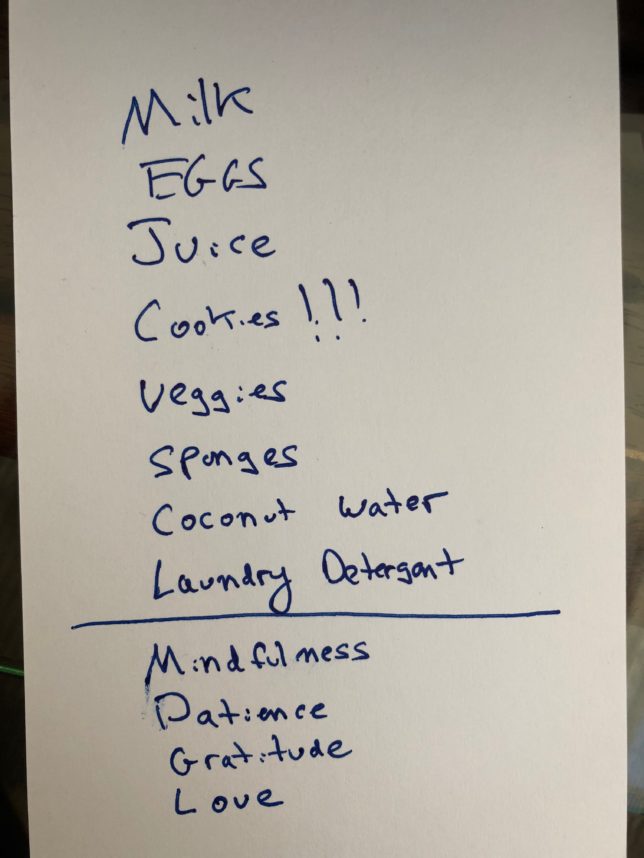
Ron called me the other day to remind me of a few items to pick up.  (Yes, I added the cookies myself).
As I walked up and down the aisles of the grocery store, it dawned on me that in addition to the necessities for the body, there are necessities for the soul as well:
Mindfulness
Patience
Gratitude
Love
But where do we pick these up?  They certainly aren’t in aisle 6.
Or are they?
Every time we smile at a stranger in the store, we practice mindfulness.
Whenever we allow someone with a small handful of items to go before us, we practice patience.
Whenever we thank the bagger at check out, we practice gratitude.
And whenever we buy flowers (even though they weren’t on the list) to give to a special person we practice love.
There are opportunities at every moment in time to go shopping for the soul!
With love and shalom,
Rabbi Zach Shapiro

A change in perspective can shift the focus of our day – and even our lives.  We have an opportunity to harness “a moment in time,” allowing our souls to be both grounded and lifted.  This blog shows how the simplest of daily experiences can become the most meaningful of life’s blessings.  All it takes is a moment in time.
Rabbi Zach Shapiro is the Spiritual Leader of Temple Akiba, a Reform Jewish Congregation in Culver City, CA.  He earned his B.A. in Spanish from Colby College in 1992, and his M.A.H.L. from HUC-JIR in 1996.  He was ordained from HUC-JIR – Cincinnati, in 1997.

A Moment in Time: Shopping for the Soul Read More »

Making Teen Mental Health a Priority

Three years ago, Rabbi Paul Kipnes of Congregation Or Ami in Calabasas received an out-of-the-blue text from one of his young congregants, a 13-year-old girl. The two met soon thereafter. The rabbi discovered she was in trouble despite having a loving and supportive family. She was suffering from severe depression and contemplating suicide. She needed help.

Fortunately, that girl, Dani Pattiz — now 16 and, in her words, doing “great” — got the help she needed. And her struggles, at least in part, inspired what Kipnes called a “transformation” at the temple.

“Every synagogue says they are youth friendly,” Kipnes said. “But it’s a different thing to say we are going to make sure these kids remain in front of our eyes and their families’ too, and we are going to be intensely aware of their needs, their moods and stresses.”

In the past couple of years, employees at the Reform synagogue — from teachers to the bookkeeper to the school registrar — have received extensive training on how to listen to teens and their parents and what questions to ask. All gatherings of preteens and teens at the temple now typically begin with some kind of stress-reduction exercise, whether a few minutes of meditation or calming coloring, or going around in a circle and sharing “joys and oys.”

In addition, the temple has hosted several events designed to support this population, including a Parent-Teen Mental Health & Wellness Summit in February, spearheaded by rabbinic intern Julie Bressler. The half-day gathering, co-hosted by the Caring Community Foundation, a nonprofit that Kipnes started in 2000, drew more than 100 people, primarily parents and therapists — some temple members, many not — as well as a smattering of young people.

“I did have a strong support group. Yet at the same time, I was still threatened by the stigma of whatever imagined consequences might come to bite me if I managed to speak up and ask for help.” — Dani Pattiz

Dani Pattiz, her mother, Debby, and psychologist Gia Marson led a workshop at the event. Its title, “Talk Loudly and Talk a Lot,” was courtesy of Dani Pattiz. She shares that message in her outreach efforts with students, teachers and staff at middle schools, with the goal of removing the stigma of mental health struggles. (She was in middle school when her own descent began.)

“My greatest regret in life is not getting help sooner,” Dani Pattiz said. “I did have a strong support group. Yet at the same time, I was still threatened by the stigma of whatever imagined consequences might come to bite me if I managed to speak up and ask for help.” Consequently, throughout her middle-school years, she suffered silently, maintaining good grades and doing her best to hide her pain. It wasn’t until a close friend from URJ Camp Newman, a Jewish residential camp in Northern California, privately contacted Dani’s parents and told them that Dani wasn’t doing well, that Dani’s mom realized her daughter needed help.

Debby Pattiz, too, while admitting the topic is still emotional for her, has become an outspoken advocate for talking about mental health. She is also refreshingly frank about the factors that contributed to her not recognizing that her daughter was in crisis, starting with the popular parental notion that when girls become teenagers they are going to be “mopey and manipulative.” Consequently, Debby assumed Dani was exhibiting “normal teenage-girl behavior.”

“I wish I had gotten Dani’s own advice: talk loudly and talk a lot,” Debby Pattiz said. “I wish that we had been able to talk about mental health and that there had been a societal conversation about it before it happened.

“Like when my kids were 9 and 10, I started talking with them about sex. The idea was, let’s talk about this before it’s embarrassing.

“What if we did the same thing as a society with mental health? What if we talked to fourth- and fifth-graders — not in huge, gory detail and not necessarily about themselves or their particular issues, but this is a thing that happens. … Just have that be a conversation that people have at their dinner tables, in their classrooms, so when it does happen, it’s not this big, terrifying thing that then makes you go into your shell.”

According to the American Foundation for Suicide Prevention, suicide is the second-leading cause of death for children and young people from age 10 to 24. Rabbi Kipnes said 1 in 5 students in the Las Virgenes School District, the school system of many Or Ami families, talk about having suicidal ideation.

Jewish teens may face particular pressures.

“Children of a people whose survival and flourishing has historically depended on our ability to excel, particularly in scholarship and business … are taught explicitly that success in whatever endeavor they pursue is non-negotiable,” Kipnes said.

“Al achat kama v’kama (how much the more so) for Jewish youth today, when our achievements and failures, our talents and our flaws, and whether we are keeping up with the Steins next door, are publicized daily on social media.”

Is My Teen Depressed?

How do you know if your child or a friend of your child is struggling and might need help? Psychologist Gia Marson, who has a private practice in Santa Monica and Calabasas, offered these tips.

Of course, it’s best to err on the side of getting help if you aren’t sure.

• Distinguishing between sadness and depression, and stress and anxiety, is difficult.

• Look for impairment and changes in functioning. For example, is your child, who used to love going out with their friends no longer doing that? Have they stopped finding pleasure in activities they used to enjoy? Are they quitting a once-beloved team or avoiding things you think they normally would not avoid?

• Notice your own biases about mental health.

• Ask the question: Are you OK? And: Would you tell me if you aren’t OK?

• Talk to other adults in your child’s life. Parents of busy teenagers start seeing them less and less. A coach, counselor or teacher might be able to offer additional insight.

• If your teen does open up about his or her struggles, your job is to listen, not to jump in and fix things, but to listen and understand, and together devise a plan.

Making Teen Mental Health a Priority Read More »

Jewish History’s Use and Abuse

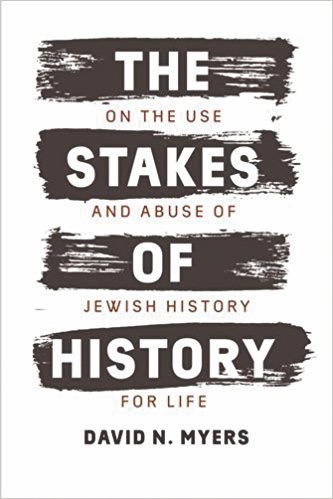
“The Stakes of History: On the Use and Abuse of Jewish History for Life” by David N. Myers (Yale University Press) comes at a moment “beset by its own anxiety,” as the author puts it, “over the worth and meaning not only of history but of humanistic inquiry more generally.”

Myers is not explicitly referring to the rancor that has tainted our public discourse — a phenomenon that he knows well and from personal experience — but to the deeper trends of economic stress, declining college enrollments, and institutional retrenchment that have prompted a reconsideration of what we actually can learn by studying history. But Myers is an optimist at heart, and he insists that he remains “bullish” on both the necessity and the rewards of the search for historical truth.

“Rather than succumb to the despair of the moment, I remained more convinced than ever that historical knowledge and perspective were the necessary ingredients in understanding the world we live in,” he writes, “and were capable of playing a constructive (though not risk free) role in the wider world.” His self-declared goal is to find a “serviceable vision of history”  — that is, not only “getting the facts right” but also making use of historical facts to “draw inspiration, motivation, and clear direction from the past.”

Myers is the president and CEO of the Center for Jewish History in New York and the Sady and Ludwig Kahn Professor of Jewish History at UCLA. His book is based on the remarks he delivered in 2014 as a participant in the highly regarded Rosenzweig Lectures in Jewish Theology and History, which are sponsored by the Program in Judaic Studies at Yale.

History can be abused, Myers points out, and he warns us against those who manipulate, distort and falsify history to justify some goal other than the pursuit of facts. He quotes medievalist Patrick Geary for the proposition that the misuse of history “has turned our understanding of the past into a toxic waste dump, filled with the poison of ethnic nationalism, and the poison has seeped deep into popular consciousness.”

“Rather than succumb to the despair of the moment, I remained more convinced than ever that historical knowledge and perspective were the necessary ingredients in understanding the world we live in.”  — David N. Myers

Above all, Myers wants his readers and his fellow historians to be mindful of the “porous boundary between history and memory.” The study of history is (or ought to be) based on hard data, but the human memory is soft-edged and malleable. And the rich collective memory of the Jewish people, which includes the tales passed from generation to generation in the form of myth and legend, folklore and song, only further blurs the line between history and memory. So we are confronted with “a deep chasm between the rich fabric of premodern collective memory and the sober quality of modern critical history.”

The tension between history and memory is especially acute in Jewish tradition. Simon Dubnow, one of the giants of Jewish historical scholarship, pointed out that Jewish tradition has produced a vast library of books but, until the 19th century, few of them could be called history books. “We have sinned against history,” Dubnow wrote. “The time has come to release it and to reconstruct the remains of its ruins.” Even at the moment of his death during the Holocaust, Dubnow is said to have cried out: “Yidn, shraybt un farshraybt!” (Jews, write and record!).

Exactly here, by the way, is an example of the gap that can open between history and memory. Myers, a careful and disciplined historian, pauses to acknowledge that “[m]ultiple accounts of [Dubnow’s] death exist,” the most heartbreaking of which is that he was shot by a German soldier who had once been his student in Heidelberg. “[T]his former student, Johann Siebert, would boast to Dubnow about the number of Jews that had been liquidated each day, to which Dubnow, who was working without cease, would retort, ‘I will record it all.’ ” And Myers finds himself compelled to characterize the dying words of Simon Dubnow as “a legend.”

Still, as a stirring and superbly well-documented exemplar of how Dubnow’s charge was carried out, Myers singles out the Oyneg Shabbes project, “surely one of the clearest instances of historical research in extremis ever recorded.” Under the leadership of Emanuel Ringelblum, a task force that included not only historians and journalists but even young children gathered and preserved thousands of pages of documentary evidence of what actually happened in the Warsaw Ghetto between 1939 and 1942. Myers praises Ringelblum’s “unyielding devotion to history as a vital medium of truth,” and reminds us that “[h]e and his colleagues harbored the hope that history would serve as an ultimate vindication of the triumph of good over evil.”

“The Stakes of History” is a survey of the work of Jewish historians over several centuries, but Myers insists that “it is in confronting the criminal legacy of the Holocaust that historians — and history — have most directly assumed center stage in seeking justice and planting seeds of memory.” The statement is literally true; after all, Deborah Lipstadt was sued for libel by David Irving on the basis of what could be fairly described as a debate between two historians. Lipstadt’s legal defense was based on proving that “David Irving had repeatedly falsified the historical record in his dozens of books on the history of Germany during the war.” Here was another moment of crisis in the study of history. A verdict in favor of Irving would have been a verdict in favor of Holocaust denial. “This prospect exposed both the fragility and the strength of history,” Myers writes.

Myers concludes that “fastidious attention to sources and concern for veracity” are the “professional tools” of the historian, but he also insists that they “need not be at odds with the goal of planting the seeds of memory for future generations.” Indeed, he argues that they can be used “to liberate, to console, and provide witness.” And he declares that he, like the other historians he describes, are “committed to the proposition that history could and must serve life.”


Jonathan Kirsch, author and publishing attorney, is the book editor of the Jewish Journal.

Jewish History’s Use and Abuse Read More »

American Jews Bat for Israel in ‘Heading Home’

Every four years, 16 countries compete in the World Baseball Classic (WBC). In 2017, Israel wasn’t expected to qualify, let alone win any games. But led by 26 Jewish-Americans with Major League and minor league experience, Team Israel became the underdog success story of the tournament.

“Heading Home: The Tale of Team Israel,” which screens April 29 during the Los Angeles Jewish Film Festival (LAJFF), documents the miracle on the field as well as the players’ personal journeys as they connect to Israel and their Jewish roots.

Since having at least one Jewish parent or grandparent was the only criterion for joining the team, many of the players had little or no connection to Judaism. All but two had never been to Israel before they donned blue-and-white uniforms and Magen David-emblazoned caps.

“I was really curious what it meant for these guys to not only discover their faith and Israel late in life but also what it means to be a Jewish athlete, experience anti-Semitism and deal with your Jewish fan base,” filmmaker Daniel Miller told the Journal. “Do you acknowledge it? Are you proud of your Jewish identity? Do you flaunt it? I was curious about how they were as Jews now and what this experience would make them become.”

The film shows how the players are affected by visits to Yad Vashem and the Western Wall in Jerusalem, and by the challenges of suddenly becoming part of an international news story while trying to focus on winning each game.

Miller, who co-directed and produced the film with Jeremy Newberger and
Seth Kramer, said the focus expanded from the initial question of how Israel would change the men “to how it feels to represent Israel on the world stage, in terms of politics and anti-Semitism. Everyone now knew they were Jews. It wasn’t just a personal journey, but a
public one.”

“Heading Home” has been a crowd-pleaser at Jewish film festivals and a hit with younger audiences.

“Heading Home” also “shatters the myth of Jews as nonathletes,” Miller said.

Santa Monica native Cody Decker, who grew up idolizing Jewish players Sandy Koufax and Shawn Green, suggested that the Mensch on a Bench doll he’d seen on an episode of the “Shark Tank” TV show would make the perfect mascot. He brought the plush figure to practices and games, much to the public’s delight. When Team Israel qualified for the WBC, the company made it a life-size version.

“The Mensch captured the silliness of the situation and the sense of humor underlying it so nicely,” Miller said. “Now we have a guy in a Mensch costume at screenings. People love it.”

“Heading Home” has been a crowd-pleaser at Jewish film festivals and a hit with younger audiences at Hebrew schools, yeshivot and Little League gatherings, Miller said, and he anticipates a similar response at the LAJFF.

“We’re very excited to play L.A. for a bunch of rabid Jewish baseball fans,” he said. The film will be released in theaters in late summer, with online and on-demand availability
to follow.

Miller, who received an Emmy Award nomination for his 1997 documentary “The Trial of Adolf Eichmann,” said he has always felt “very connected to Israel and to my faith.” While that might not have always been true of the American Jews on Team Israel, he believes they benefitted from their shared experience.

“I’m not sure if they’re lighting candles on Shabbat or fasting on Yom Kippur, but all of them have sworn to visit Israel again,” he said. “As a result of doing well in this tournament, their
pride has grown, reinforced by the acceptance of their peers that they’ve done something great.”

“Heading Home” will be screened at the Los Angeles Jewish Film Festival on April 29 at Laemmle’s Town Center 5, 17200 Ventura Blvd., Encino.

American Jews Bat for Israel in ‘Heading Home’ Read More »

Film Festival to Honor Hal Linden With Award

From Broadway to “Barney Miller” to his latest role in “The Samuel Project,” actor, singer and musician Hal Linden, who turned 87 in March, has been entertaining audiences for decades.

“I’ve been doing what I love for 70 years now. Why not keep doing it?” he said in a telephone interview.

Just back from New York, where he shot a guest spot on “Law & Order: SVU,” Linden was looking forward to the world premiere of “The Samuel Project” at the Los Angeles Jewish Film Festival. He will receive the Marvin Paige Hollywood Legacy Award and participate in a post-screening Q-and-A on April 28.

The film is about a teenager whose senior year art project brings him closer to his grandfather, a German Jew, who reveals that he owes his life to a young woman who saved him from the Nazis.

“The story is about the relationship between a grandfather and grandson, brought together by art,” Linden said. “It’s not a Holocaust picture. That’s not the point. I never saw it as a specifically Jewish film. It was meant to appeal to all audiences.”

Linden has many Jewish characters on his extensive resumé, including Broadway roles in “I’m Not Rappaport,” “The Sisters Rozensweig” and “The Rothschilds,” for which he won a Tony Award in 1971.

He’s best known to nontheater audiences for his titular role in television’s “Barney Miller,” but he actually started out as a musician, playing clarinet and singing with big bands.

“It was not until I was in the Army that I had the opportunity to appear onstage and I was fascinated by it,” he said. “It also coincided with the end of the big-band era and the beginning of rock-and-roll, and that was a transition I was unwilling to make.”

“That point between words on a page and flesh on a stage is the most creative part for an actor.” — Hal Linden

Born Harold Lipschitz in the Bronx, N.Y., Linden’s Jewish upbringing was more cultural than religious. His mother kept kosher and lit Shabbat candles for tradition’s sake. He didn’t attend Hebrew school — he had a private tutor for his bar mitzvah — and didn’t quite get why his father, a Lithuanian immigrant who went to synagogue only on the High Holy Days, was such an ardent Zionist.

But hearing about the refugees who were denied entry to Palestine after World War II “got me to recognize the importance of Israel and made me a Zionist,” said Linden, who described himself as “tribally Jewish.”

“I’ve been the national spokesman for the Jewish National Fund for about 20 years,” he said. “I have done fundraisers throughout my career for Jewish causes.”

He’s been to Israel many times, and celebrated his 50th wedding anniversary there in 2008 with his four children and eight grandchildren. His wife, who died in 2010 and was not Jewish, had suggested he visit Israel.

“She wanted the kids to appreciate my passion” for Israel, he said. Today, “some of the kids are more Jewish than others, but they all understand my attachment to Israel, and the need for an Israel.”

His youngest grandson will celebrate his bar mitzvah in November.

Asked about his proudest accomplishments, Linden replied, with a laugh: “I’ve got four kids who still talk to me. I can’t say that for all my friends. Professionally, I was a musician and actor and I never waited tables or drove a cab. How lucky can a human being be?”

Not surprisingly, he wants to keep working as long as he can.

“Acting is a great profession,” Linden said. “You start from zero every time. That point between words on a page and flesh on a stage is the most creative part for an actor. I appreciate the process more than the results. That’s where the joy is.”

“The Samuel Project” screens on April 28 at the Laemmle Music Hall, 9036 Wilshire Blvd., Beverly Hills; and April 30 at the Laemmle Town Center 5, 17200 Ventura Blvd., Encino. Linden’s “Law & Order: SVU” episode airs May 16 on NBC. 

Film Festival to Honor Hal Linden With Award Read More »

Serving Up Laughs in ‘My Son the Waiter’

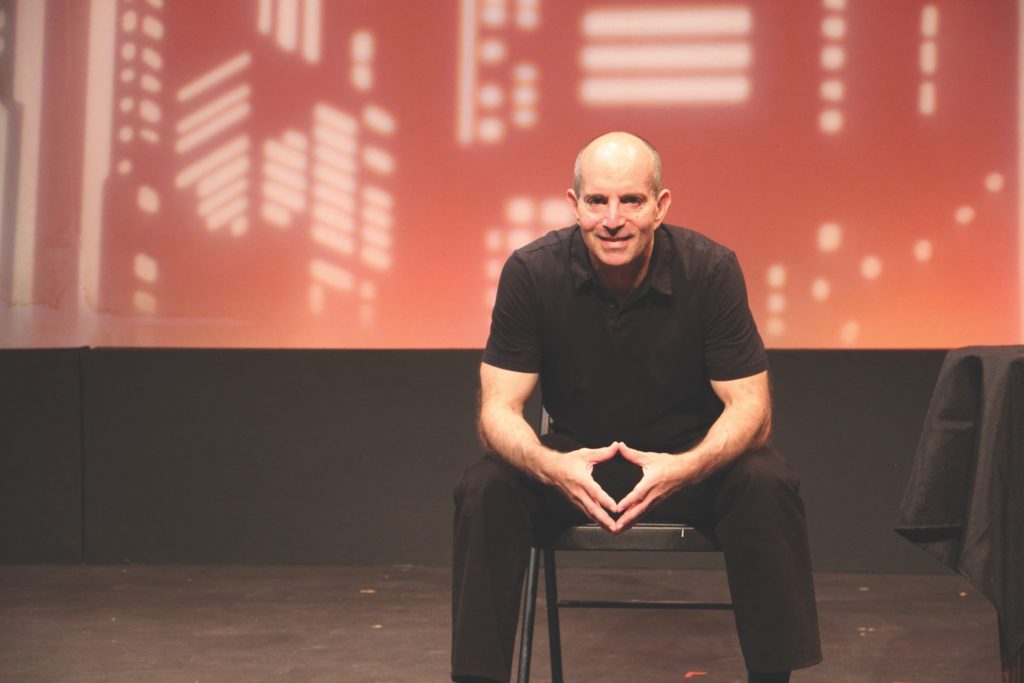
It may be subtitled “A Jewish Tragedy,” but Brad Zimmerman’s one-man show “My Son the Waiter” elicits a lot more laughter than tears. The actor and stand-up comic mines his showbiz struggles, pet peeves and his relationship with his Jewish mother for hilarity in the hybrid stand-up-meets-theater performance, which runs through June 10 at The Colony Theatre in Burbank.

In the 80-minute show, Zimmerman riffs on, among other things, his New Jersey childhood, reality TV and his love life, while acting out both sides of many conversations with his mother — the butt of many of his jokes. His 88-year-old mother, Barbara Zimmerman, has seen the show many times and loves it, he said: “When people ask how she feels about me making fun of her, she says, ‘It’s all true.’ ”

Zimmerman tells the audience that he’s very proud to be Jewish, but is not a practicing Jew. “We were very Reform, though we belonged to a Conservative synagogue,” he said. “We did the things you were supposed to do. You fast and go to temple on Yom Kippur. You get bar mitzvahed. That’s what the grandparents wanted. It was important to them. For me, it never became a priority. But I was born to be a Jew. I have the angst, the medication, no hair. I love the culture and the food. I live to eat.”

As the show’s title suggests, Zimmerman talks about his 29 years waiting tables in New York, 16 of them at Chat ‘n’ Chew, “the kind of place where I could sit down with a customer and schmooze,” Zimmerman said. “I worked at a very fancy restaurant for a short time, but I [preferred] places where I made less money but I could be myself.”

Although he studied acting in college, Zimmerman, now 64, said a lack of confidence prevented him from pursuing his career to the fullest until he took a stand-up comedy class in 1996. Within a few years, he was opening for Brad Garrett, Joan Rivers and George Carlin.

A latecomer to writing, he began working on “My Son the Waiter” in 2005 and honed it by performing it for free. In 2013, an agent saw the show and booked Zimmerman in a Florida theater where the show became a hit and ran for more than four months. That success led to 15 months of shows off-Broadway and a seven-year contract that has taken him all over the United States. He has dates booked through September.

For the last four years, Zimmerman has been working on a sequel to “My Son the Waiter” called “My Rise to the Middle,” which he describes as “a similar story told totally differently. It’s all stories, no stand-up.” He will perform it on June 10, his last night at the Colony Theatre.

“Sopranos” fans may remember Zimmerman for his role as Ron Perse, Johnny Sacks’ lawyer. He hopes to do more television and film roles — “Mix it up a little,” he said.

With his struggling years behind him, Zimmerman said he is grateful for the chance to tell his story, inspire people and make audiences laugh. “The show is very relatable, and you don’t have to be Jewish to appreciate it,” he said. “Struggle is universal.”

“I’m very blessed and very proud of what I’ve done,” he said. “I have only one regret: I wish I had known early on how important saving money is for your future. I didn’t start till I was 58 years old. Otherwise, it played out how it was meant to.”

“My Son the Waiter” runs through June 10 at The Colony Theatre. Visit mysonthewaiter.com for tickets and information.

Serving Up Laughs in ‘My Son the Waiter’ Read More »

Exploring IDF’s Charedi Troops

According to current statistics, Charedi (ultra-Orthodox) Jews comprise 12 percent of Israel’s 6.5 million Jewish population — or about 780,000 people. Among that number, about 6,000 currently serve in the Israel Defense Forces (IDF), and only about 2,000 in combat units. Since the establishment of the Jewish state, Charedim have been allowed by law to forego otherwise mandatory military service so that they can dedicate their lives to studying Torah.

Secular opposition to this policy has increased in recent years, and in September 2017 the Supreme Court of Israel ruled the law unconstitutional.

The controversy surrounding the issue plays out in the Israeli television series “Commandments,” two episodes of which will be screened at the Los Angeles Jewish Film Festival on April 29. In the series, which has had two hit seasons in Israel, Charedi recruits are ridiculed and mistreated by secular soldiers but face far worse from their own ultra-Orthodox communities in the form of banishment or physical attacks.

“Many people are angry at us,” the show’s creator and head writer Yoav Shutan-Goshen told the Journal in a phone interview. He cited the Charedi community’s ire at how the show depicts violence committed by its members against their own. “Violence is part of the reality, and I’d be neglectful if I didn’t tell the whole story,” Shutan-Goshen said. “In the show, we criticize everybody: the Orthodox, the army, the secret service.”

The series concentrates on three young men: innocent, sheltered Ya’akov (Dolev Mesika), charming scam artist Avram (Roy Nik), and Gur Arye (Avi Mazliah), whose behavior becomes increasingly unhinged. The show was shot on a specially built army base a 30-minute drive from Jerusalem, with additional locations in Bnei Brak and the Tel Aviv area.

“People complained about us showing the dirty laundry, but nobody criticized us for not being authentic.” —  Yoav Shutan-Goshen

Shutan-Goshen, a lawyer turned law teacher, fulfilled a long-held dream when he enrolled at Jerusalem’s Sam Spiegel Film & Television School in 2015. At the time, Israel was in an uproar over the secular middle-class Yesh Atid party’s mandate to end military exemptions for Charedim and government subsidies for Yeshiva scholars. He thought the situation had the elements for a good script, and he interviewed people on both sides of the argument.

Shutan-Goshen collaborated with his wife, Ayelet Gundar-Goshen; writer Raya Shuster; and his screenwriting teacher, Avner Bernheimer, to turn the personal stories from those interviews into “Kipat Barzel,” which in Hebrew has a dual meaning: Iron Yarmulke and Iron Dome — the latter being the name of the Israeli missile defense system. (Because the pun might be lost on non-Israelis, the English title “Commandments” was used.)

Since none of the writing team members is ultra-Orthodox, Shutan-Goshen made sure that advisers from the Charedi community participated in every step of the creative process.

“They were in the writing room, helping us to correct mistakes and explaining things about the world that otherwise we could never understand,” Shutan-Goshen said. “They were on the set, making sure that everything looked authentic. We had to be perfect. People complained about us showing the dirty laundry, but nobody criticized us for not being authentic.”

In addition to the secular/ultra-Orthodox divide at the heart of the show, there is a storyline about sexual abuse, with the perpetrator a rabbi. “It’s based on true stories we heard,” Shutan-Goshen said. “Not everybody was happy, but we thought it was very important to talk about.”

When he was growing up, Shutan-Goshen admitted, his secular Jewish family and community talked about Charedi Jews as “parasites.” The standard perspective, he said, was that: “ ‘These people are not going to the army when everyone else has to. They get salaries from the state just for studying Torah. They don’t contribute to the [economy but they take].’

“But now I have a new perspective,” he said. “I understand them and I hope the audience can understand them too.”

The film festival’s screening of “Commandments” will be the first time that episodes of the series are shown outside Israel, and Shutan-Goshen said he is
eager to see how the Los Angeles audience will react.

“I’m very curious to know what American Jews think about this situation,” he said.

Shutan-Goshen, his wife and their two children are living temporarily in the Bay Area while Gundar-Goshen, author of the best-selling novel “Waking Lions,” is teaching a semester at San Francisco State University.

The couple met in the IDF, when Gundar-Goshen, a journalist, was assigned to write a story about his rescue unit. “I gave her one of my short stories and told her I’d like it to be published in her magazine,” Shutan-Goshen said. “She called the next day to tell me it was a lousy story and she would be happy to meet me to explain how bad it was. We met, and the rest is history.”

They will return home to Tel Aviv in May, and plan to continue working on their next project, a drama series set in the restaurant world. They’re also waiting to hear if “Kipat Barzel” will get a third season.

Shutan-Goshen said he is optimistic the show will someday be seen in its entirety on an American TV channel or streaming service.

“I really hope that the audience will change their attitudes toward these [Charedi] youths and communities and understand more about this complicated situation,” he said. “I can understand both sides — why the military wants to recruit these youths and why the youths refuse to join the army.

“Everybody here is right. Nobody is evil.”

“Commandments” will screen at the Los Angeles Jewish Film Festival on April 29 at the Laemmle Music Hall, followed by a discussion moderated by Jewish Journal Publisher and Editor-in-Chief David Suissa. Visit lajfilmfest.org for more information.

Exploring IDF’s Charedi Troops Read More »