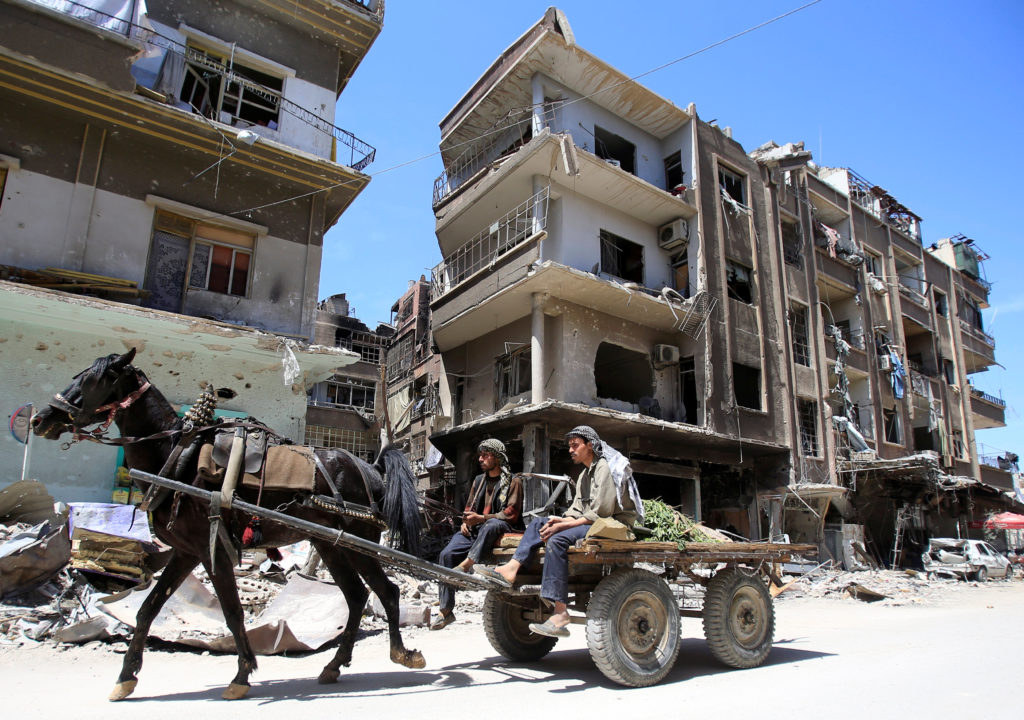
Despite launching airstrikes against Syria over the weekend, the Trump administration is looking for a clean exit out of the country. The Wall Street Journal is reporting that their plan involves establishing an Arab force to fill the vacuum left by the United States’ exit.
The Trump administration has asked the Arab Gulf nations to provide troops and financial support to help Syria recover after the U.S. finishes off the remnants of ISIS. The Arab force would serve as a buffer against the Iran and Russia from controlling the region and help prevent ISIS from mounting a comeback.
However, skeptics of the plan note that it may be difficult to get key Arab nations to participate in the U.S.’s plan, as Egypt is currently preoccupied with exterminating ISIS nearby the Sinai Peninsula while Saudi Arabia and the UAE are tangled in Yemen’s civil war.
“There is just no precedent or established basis for this shaping into a successful strategy,” Middle East Institute Senior Fellow Charles Lister told the Journal.
Those who support the plan, such as Conservative Review’s Jordan Schachtel, acknowledge that while establishing such a force is “a stern challenge,” it is “a shot worth taking.”
“During president Trump’s short tenure thus far, the White House already demonstrated that it has been able to move the Arab world toward dramatic reform and prioritizing counter-terrorism,” Schachtel wrote. “Will President Trump succeed in rallying the Arab world around the cause of countering the Iranian regime’s malignant expansion in Syria?”
The U.S. currently has 2,000 troops in Syria; it is believed that around 5,000-12,000 ISIS terrorists remain in the country.
Prior to the airstrikes, President Trump had announced that the U.S. would be withdrawing troops from Syria. The April 13 airstrikes hit three chemical weapons facilities in response to Syrian President Bashar al-Assad reportedly using weapons against his own people.
As Israel prepares to celebrate its 70th birthday, the Central Bureau of Statistics revealed that 45% of Jews worldwide currently live in the Jewish state.
The Times of Israel reports that the 45% figure is a massive increase from when Israel was created, as only 6% of Jews worldwide lived in Israel at the time. Of the 14.5 million Jews worldwide, over 6.5 million Jews live in Israel today.
Jews consist of 74.5% of the Israeli population; Arabs constitute around 21% of the population and 4.5% are others. The census also found that the number of children produced by Jewish mothers had increased from 2.59 in 1996 to 3.06 in 2016, while on the Arab side that rate decreased from 4.35 to 3.11 over the same timeframe. Israel also has the largest fertility rate among Western countries at 3.11 children per women.
Over 8.8 million people reside in Israel as a whole, a marked increase from the 806,000 that populated Israel when it was first established. The population is expected to increase to 15.2 million in 2048.
Taken together, the numbers that in the 70 years since the inception of the Jewish state, Israel has evolved into a thriving, free nation that has established itself as the true homeland for the Jewish people amidst rising anti-Semitism in certain parts of the world.
“When Israel stands up to Syrian atrocities, it is acting out of a Judaic commitment to prevent the degradation of human beings made in God’s image; when Israel offers a road for European Jews on the verge of extinction, it is acting not merely out of solidarity but out of decency,” Journal columnist Ben Shapiro wrote. “Israel is a decent country, because it was founded on a decent purpose — and because it was founded on the basis of a tradition of decency.”
As Yom Haatzmaut (Israel’s 70th Anniversary approaches) I offer this poem (and more to come throughout this week) to express both the beauty our people have brought to world Jewry as well as the moral and ethical challenges that come with sovereignty.
This poem written by the Israeli poet Aharon Shabtai expresses the aspirations of Zionism, the national liberation movement of the Jewish people, and the political means by which Israel may enhance the dignity of all the people of the Land.
“Zionism was once a pretty young thing / like my cousin Tsila. / Boys caught sight of (her) – / and were ready to die. / Ahh, what days we spent among the cypresses / not far from Wadi Faleek! / What proud, honest mounds of manure I lifted / with Joseph Mintser at Kibbutz Merhavyah! / But political theses can turn into stinking corpses too, / And it’s better to leave them behind – / before we sink into an ethical mire – / In order to take up a new idea that might enlist / the stores of goodness within our hearts: / Namely, that equal rights be granted / to the children of this land as one, / That two cultures should flourish with dignity, / side by side, like beds in a single garden. / Let this be the girl whose beauty thrills us / And about whom we dream towards the summer’s end, / and through the months of winter.”
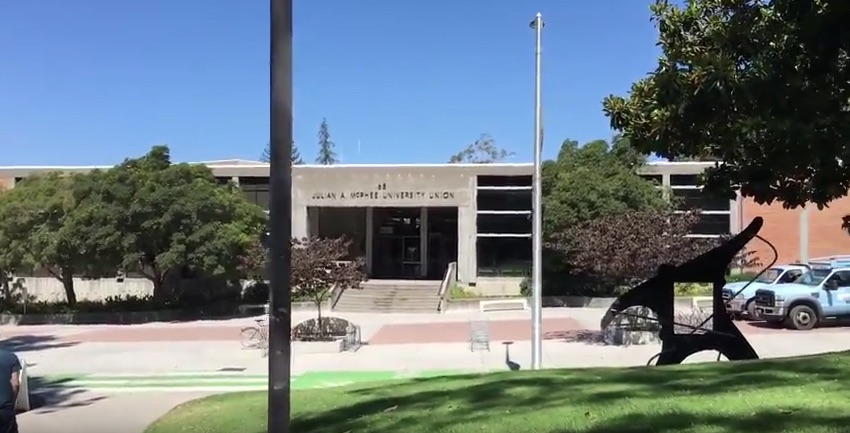
A group of students at Cal Poly San Luis Obispo issued a list of demands on April 13 in response to a racial incident; among the demands included a call for all non-Zionist clubs to have an increase in funding.
Cal Poly’s Lambda Chi Alpha fraternity posted photos online that featured a member donning blackface and other members posed with gang signs with the caption “She want a gangster not a pretty boy.” The university suspended the fraternity, but the fact that they did not expel the students prompted a backlash on campus.
As part of the backlash, a group of students called The Drylongso Collective, which describes itself as a group focused on ending “structural inequality” at Cal Poly, issued a letter with a litany of demands that the university undertake; the most controversial demand in the letter was the one that stated, “We want an increase in ASI [Associated Students Incorporated] funding for ALL cultural clubs, with the exception of organizations that are aligned with Zionist ideology.”
The Drylongso Collective attempted to justify this demand in a statement that was featured on the Cal Poly Multicultural Center’s Facebook page claiming that being anti-Zionist does not mean that they are anti-Semitic. The statement encouraged people to read the works of Jews Against Zionism, Noura Erakat, who happens to be the niece of a Palestinian Authority negotiator, and Angela Davis, who has past associations with the Black Panthers and Communist Party.
“Black folks and other People of Color have a long-standing history of standing in solidarity with Palestinian folks,” the statement reads. “The quotidian experiences of Palestinians include a long history of dealing with violence, colonization (particularly through land dispossession), and oppression. We cannot in good conscience advocate for our own liberation without being mindful of the current and historical liberation struggles of others locally, nationally, and globally.”
Later on, the statement added that The Drylongso Collective was focused on “anti-Black and anti-Brown racism at Cal Poly.”
“To attempt to decenter Blackness from our discussion by focusing on an accusation of anti-Semitism based on a false equivalency of Zionism and Judaism is deeply disturbing and speaks of not only the lack for anti-Semitic acts committed by non-Black/Brown students but also of the coalition work that remains to be done,” the statement reads.
Cal Poly Media Relations Director Matt Lazier told Campus Reform that the university would not consider The Drylongso Collective’s anti-Zionist demand.
“I can tell you that the specific point you reference about organizations aligned with Zionist ideology is not consistent with the university’s values and not something university administration will consider,” Lazier said.
Shiri Moshe of The Algemeiner noted The Drylongso Collective’s “demand would impact Jewish student groups including Hillel of San Luis Obispo, which has supported programming on campus related to Zionism, the movement for Jewish national-self determination in the Levant.”
“No other cultural clubs that cater to students of a particular national or ethnic background would be affected,” Moshe wrote.
The Drylongso Collective has not responded to the Journal’s request for comment.
On Sunday, it was announced that Barbara Bush would discontinue medical treatment for Chronic Obstructive Pulmonary Disease and congestive heart failure. CBS News reported on Monday that Bush “was alert and having conversations over a bourbon.”
“Mom kept us on our toes and laughing until the end,” former President George W. Bush said in a statement. “I’m a lucky man that Barbara Bush was my mother. Our family will miss her dearly, and we thank you all for your prayers and your good wishes.”
George H.W. and Barbara Bush were married for 73 years after meeting at a Christmas dance party in 1941. Barbara Bush was known for being outspoken and blunt and was a major asset to her husband’s presidency as a first lady. Congregation Beth Israel in Houston gave George and Barbara Bush the Mensch Award in March 2017.
In a 1990 commencement address to Wesley College, Bush said, “At the end of your life, you will never regret not having passed one more test, winning one more verdict, or not closing one more deal. You will regret time not spent with a husband, a child, a friend, or a parent.”
As a child, whenever I asked my mother to tell me about her escape from the Nazis, she always had the same answer: “Let me tell you about my arrival in America.”
It was April 19, 1940, when the SS Nova Scotia, a freighter re-outfitted to carry passengers across the Atlantic, steamed into Boston Harbor after a 14-day passage from Liverpool, England. It carried several crates of Irish whiskey and 130 Jewish refugees from Germany and Austria. One of them was 12-year-old Anne Forchheimer, my mother.
She would describe that day in almost epic terms: “There were red, white and blue balloons — bundles of them — tied to the docks and some floating up into the sky. I had never seen balloons before. There was a band on the docks playing music. And there were United States flags waving everywhere I looked. And bunting. And streamers.”
What she didn’t know at the time was that April 19 was a holiday in Massachusetts, Paul Revere Day.
In Boston, Paul Revere has long been a local hero. His famous midnight horseback ride on April 18-19, 1775 — to alert the colonial militia of the approaching British forces — was critical to launching the American Revolution. The state made Paul Revere Day, also called Patriots’ Day, a holiday in 1896. It was observed on April 19 until the state legislature moved it in 1969 to the third Monday in April. The Boston Marathon is run on this day.
In 1940, my German-born mother had never heard of Paul Revere, since she hadn’t yet studied U.S. history. “I had no idea,” she always told us, “that the party was for anyone other than us.”
“I had no idea, that the party was for anyone other
than us.” — Anne Rubin (nee Forchheimer)
Aboard the ship, she and my grandmother, grandfather and uncle, along with the other passengers, waited on the deck for their turns to meet with immigration officers and marveled at the festive tumult around them.
The S.S. Nova Scotia, the ship that carried Anne across the Atlantic. Photo from cruiselinehistory.com.
My mother, Anne Rubin, would always conclude her story the same way: “I saw the flags, the streamers, the balloons, the band, all of it. I tugged on my mother’s sleeve and said to her, ‘What a wonderful country, Mother! Look how they welcome the refugees.’”
Most refugees have fond recollections of arriving in the United States, but I can’t imagine many experienced the awe, wonder and deep affection that inspired my mother that day. She remained a patriotic American from that moment until she died nearly seven decades later.
And every year on April 19 she would remind us how many years she had been in the United States, what a wonderful country it was and how lucky she was — and we were — to be here.
She knew she had done nothing special to merit an entrance visa. She simply was lucky to be born into a family with a relative in the U.S. willing and able to navigate the ever-increasing mountains of paperwork the government required before issuing entrance visas to Jewish refugees.
Although I had heard that story my entire life, it was only a couple of years ago, in the summer of 2016, that I had the chance to visit Boston. My husband and I wanted to get a small taste of what my mother experienced that day, so we took a boat tour of the harbor.
When I told the tour guide my story, she pointed out the now-empty pier where the immigration offices had been in 1940. At the time my mother arrived, the tour guide explained, Boston had been the nation’s second-busiest point of entry for European immigrants. (I learned from my family-history research that at least one other ship carrying immigrants docked in Boston Harbor on the same day.)
“If this is where the ship docked,” I asked the tour guide, “then where was the party?”
“Everywhere!” she answered. “A new arrival to Boston on April 19 could not have missed the party. It was just too big.”
I love the vision of America that my mother saw that day in 1940, an America that celebrated its history and also welcomed refugees with streamers and balloons and flags and music, an America filled with welcome and hope and promise.
That is the America I want to live in.
Rachel Rubin-Green is a writer, mother, grandmother and retired teacher living in Los Angeles. She writes about her mother’s experiences at moreluckthanbrains.com.
Last week the Jewish people commemorated Yom Hashoah (Holocaust Memorial Day), and this Thursday we Jews mourn those killed defending the people and State of Israel on Yom Hazikaron (Memorial Day). On Friday, we turn our mourning into celebration on Yom Haatzmaut (Israel’s 70th Anniversary of Independence).
Throughout the week I will offer poetry that evokes the essence of these days. Here are words of the Russian Jewish poet Shaul Tschernichovsky (1875 – 1943):
“Laugh, smile upon the dreams / It is I, the dreamer, who is speaking / Laugh, for I still believe in humankind / for I still believe in you.
For my soul still yearns for freedom / I have not sold it to a golden calf / For I still believe in humankind / in his strong spirit.
I believe also in the future / even if the day will tarry / Yet, it will come and nation from nation / will carry peace and blessing.