fbpx

February 27, 2018

UCI Exonerates SSI and Reservists on Duty of Alleged Wrongdoing

University of California Irvine (UCI) exonerated the campus Students Supporting Israel (SSI) and Reservists on Duty of wrongdoing alleged by anti-Israel groups.

The controversy began in May 2017, when Students for Justice in Palestine (SJP) disrupted an SSI event featuring five former Israel Defense Force (IDF) members who are part of Reservists on Duty. SJP can be seen on video clapping and chanting “Israel, Israel what do you say, how many kids have you killed today?” and “From the river to the sea, Palestine will be free” during the Q&A session:

“[They] started chanting and pushing and yelling and screaming and cursing in every possible language and they actually shut us down, shut the event down,” Reservists on Duty CEO Amit Deri told the Journal in a phone interview.

UCI responded by slapping SJP with three sanctions that required the organization meet with the dean two weeks before hosting an event, talk about free speech with the dean six times a year as well as being on probation until Nov. 20, 2019. SJP appealed the sanctions, but was only able to get the first one repealed.

SJP also retaliated by accusing the soldiers in Reservists on Duty, who were brought to campus by SSI to counter “Anti Zionism Week”, of verbally and physically harassing Palestinian students. However, UCI Conduct Officer Christopher Cornel issued a letter to SSI stating that he investigated the matter and “was unable to verify any of the allegations.”

“The videos and documents that I reviewed do not indicate in any way that SSI aided or abettedthe Reservists on Duty in violating University Policy,” Cornel wrote. “Based upon the preponderance of evidence standard, I find Students Supporting Israel NOT RESPONSIBLE for ‘aiding or abetting in the commission or attempted commission’ of a University policy violation.”

Deri applauded UCI for exonerating them.

“From the very beginning, we’ve said this is all lies like usual, like they always do,” Deri said. “They lie about Israel, they lie about the facts, they lie about everything, so they lied also about our guys and girls, and we are very, very happy that even the UC Irvine administration decided to clear Reservists on Duty and SSI on campus and say we didn’t do nothing.”

UCI SSI President Kevin Brum stated in a press release that the allegations were denigrating to “the credibility of people who have faced sexual assault, physical harassment, and more.”

“The school saw through what these false accusations were—a disgusting attempt to try to drag SSI down with SJP,” Brum said. “The truth has spoken.”

Ilan Sinelnikov, who is president and founder of the national SSI, said in the press release that the allegations made by SJP and other anti-Israel groups on UCI were part of an effort to “smear, defame, and discredit the pro-Israel community by any means necessary.”

“We’re happy UCI issued this report fully exonerating our UCI chapter,” Sinelnikov said. “It’s important other universities do the same when these groups attempt to use these tactics to discredit our organization, and expose these group’s fraught relationship with truth and facts.”

As of this writing, SJP has yet to respond to the Journal’s request for comment.

UCI’s SJP was also sanctioned in 2016 for being a part of a mob that was banging on the doors and windows around the room in which SSI was showing a movie about IDF soldiers. The mob was reportedly chanting “Long live the Intifada,” among other anti-Israel chants. UCI’s SJP was also among the anti-Israel groups that reportedly held anti-Israel protests during the same week as Holocaust Remembrance Day in 2016.

According to the Canary Mission website, members of SJP throughout the country “frequently intimidate and harass Jewish and pro-Israel students,” including a group of SJP students calling a Jewish student at Temple University a “k—” and then hit him in the face. They also have created “a hostile and unsafe environment on U.S. campuses for all who do not share their anti-Israel views.”

This article has been modified to correct Ilan Sinelnikov’s name.

UCI Exonerates SSI and Reservists on Duty of Alleged Wrongdoing Read More »

Haley: We ‘Need to Take Action on our Own’ on Iran

United States Ambassador to the United Nations Nikki Haley called out Russia for vetoing a U.N. Security Council resolution that would have condemned Iran for arming the Houthi rebels in Yemen and suggested that the U.S. could put matters into its own hands.

“If Russia is going to continue to cover for Iran then the US and our partners need to take action on our own,” Haley said. “If we’re not going to get action on the council then we have to take our own actions.”

According to Reuters and Algemeiner, the drafted resolution first stated that Iran violated an embargo on supplying weapons to the Houthis based on a report from U.N. experts but was later watered down to only express “particular concern” about Iran’s violations to appease Russia. And yet, Russia still vetoed the condemnation, as they were reportedly skeptical of the experts’ conclusions.

Haley’s statement comes as the Trump administration is considering nixing the Iran nuclear deal unless substantial changes are made, and Haley said that the Security Council “doesn’t help” proponents of the deal.

“That just validated a lot of what we already thought, which is Iran gets a pass for its dangerous and illegal behavior,” Haley said.

Iran claimed that the U.S. and Britain were simply scapegoating them for the carnage in Yemen. Tehran has denied accusations that they are arming the Houthis, although their denials are belied by various reports to the contrary. It’s unsurprising that Russia would provide cover to Iran given the two countries have been allies for years due to their shared hatred toward the West.

As the Council on Foreign Relations (CFR) points out, Iran and the Houthis share differing beliefs in Shia Islam but they are aligned by geopolitics since “Iran seeks to challenge Saudi and U.S. dominance of the region, and the Houthis are the primary opposition to [interim President Abed Rabbo Mansour al-] Hadi’s Saudi- and U.S.-backed government in Sana’a.”

The Houthis ignited the three-year civil war in Yemen when they wrestled power from Hadi, prompting Saudi Arabia to intervene in the conflict and fight the Houthis in an attempt to curb Iran’s influence in the region and reinstate Hadi’s power. The U.S. is backing the Saudis in the conflict.

The civil war has been devastating on the civilians, as thousands have been killed and millions more are in dire need of aid.

Haley: We ‘Need to Take Action on our Own’ on Iran Read More »

Three Arab Israelis Indicted for Planning Temple Mount Terror Attack

An indictment has been handed down against three Arab Israelis for allegedly planning a terror attack at the Temple Mount.

According to Jewish Telegraphic Agency (JTA), the Israel Security Agency announced that the three Israeli Arabs, who were arrested in January and February, plotted a shooting attack at the Temple Mount akin to July’s Al-Aqsa Mosque shooting that resulted in the murder of two Israeli police officers. They were thwarted by Israeli intelligence before they could obtain weapons.

The indicted Israeli Arabs have been identified as 20-year-old Mohammad Masoud Jabarin, 20-year-old Ammad Lutfi Jabarin and an unidentified 17-year-old, according to Ynet News. All three are reported supporters of ISIS as well as residents of Umma al-Fahm, the third largest Arabic city in Israel.

“Israelis supporting the Islamic State terror group a serious threat, and even more so those in contact with the group’s activists and those who act under the group’s banner in Israel,” the Israel Security Agency said in a statement. “The Shin Bet will continue monitoring the suspects and take whichever law enforcement measures are required to prevent the dissemination of the Islamic State’s teachings in Israel, as well as to foil any action against the country’s security.”

The trio of Arab Israelis had considered other forms of terror to use against Israelis, including the use of a vehicle as a weapon akin to the terror attack in Nice, France or targeting a church or synagogue.

According to the Jerusalem Post, Israel also thwarted a terror plot by ISIS to attack Israel Defense Force targets in 2015. In 2016, there were two ISIS-inspired shootings conducted by an Israeli Arab and two Palestinians; five people combined were killed. Israel recently started to rescind the citizenship of Israelis who joined ISIS.

Three Arab Israelis Indicted for Planning Temple Mount Terror Attack Read More »

Inclusion

The following is a transcript of a speech at a recent Bnai David-Judea Shabbaton. One part of the program was in conjunction with Yachad.

Yachad, The National Jewish Council for Disabilities is a thriving global organization dedicated to addressing the needs of all Jewish individuals with disabilities and ensuring their inclusion in every aspect of Jewish life.” 


Purim. It’s a story of good guys and bad guys, with a cast of characters that includes an inebriated king; a disobedient queen; a new queen with a secret; a pair of clumsy conspirators; and Darth Vader with a colonial-style hat. And we celebrate וְנַהֲפוֹךְ הוּא — the sudden reversal of fortune — by wearing costumes, putting on silly plays, and eating and drinking way too much.

All this may seem an odd juxtaposition with the subject of inclusion.  Though when you think about it….masks, costumes… Purim is perhaps the one time of year when we’re all judged — in fact want to be judged — by external appearances.  But people with special needs are often and unfairly judged that way all the time.  Though on Purim, costumes allow everyone to be included.

Actually, the tradition to celebrate Purim by dressing in costume is ironic, since the story the Megillah tells is so caught up in identity.  And identity is Purim’s real connection to inclusion.

Consider, for instance, that despite being a people מְפֻזָּר וּמְפֹרָד בֵּין הָעַמִּים, scattered and dispersed, by the time of the Megillah the distinction between the remaining tribes of Israel has been supplanted by a common identity: יְהוּדִים, Jews. He’s not Mordechai the Benjaminite; he’s מרדכי היהודי.  That the Persians used a one-size-fits-all label is no surprise; but the Megillah makes it clear that the exiles adopted it as well.

One could argue that this shared designation is the seed of וְנַהֲפוֹךְ הוּא. For the first time in our history, we’re truly united by a common identity.

Still, it’s a fragile community, as Mordechai instructs Esther to conceal even this fragment of identity (her שארית ישראל, if you will).  So she hides behind a mask and distances herself with a queen-Esther costume.  וְנַהֲפוֹךְ הוּא begins in earnest when Mordechai realizes that Esther’s mask and costume not only hide her, but simultaneously isolate her from the community.  She’s both afraid to be seen and is reluctant to see.  He awakens her to a responsibility towards the נֶּחֱשָׁלִים אַחֲרֶיהָ, the community she’s left behind.

So beneath the broad arc of triumph of good over evil, the Megillah is a story of community and inclusion. Esther’s actions demonstrate that we must remember those who, metaphorically speaking, do not live in the palace. Mordechai is our conscience, reminding us of the נֶּחֱשָׁלִים אַחֲרֵינו.

The word נֶּחֱשָׁלִים appears only once in Tanach — in Parshat Zachor, which we read every year on the Shabbat before Purim:

אֲשֶׁר קָרְךָ בַּדֶּרֶךְ, וַיְזַנֵּב בְּךָ כָּל הַנֶּחֱשָׁלִים אַחֲרֶיךָ — וְאַתָּה עָיֵף וְיָגֵעַ

“Remember what Amalek did to you along the way: when you were weary and worn out, they attacked all who were lagging behind…”

Note that it wasn’t Amalek who was responsible for their exclusion.  We were tired (עָיֵף) and worn out (יָגֵעַ)… and we neglected those in the community who fell behind, הַנֶּחֱשָׁלִים.

But just who are the נֶּחֱשָׁלִים אַחֲרֵינו — the left-behind, the excluded?

Of course, there’s the traditional triumvirate of the גר יתום ואלמנה — the stranger, the orphan, the widow.  But even this excludes those with special needs.

Like Esther, people with special needs sometimes hide, or are isolated, behind their masks.  Esther’s mask is described as יְפַת-תֹּאַר וְטוֹבַת מַרְאֶה, beautiful — but we soon learn that she’s more than just a pretty face.  How often do we give those with special needs a chance to show what they can do?

Consider my daughter Aviya.  She’s happy, friendly, outgoing.  She loves noses and circles.  She particularly enjoys playing with words — saying them backwards, reversing letters.  She doesn’t read books, she reads “koobs”; she comes home from school everyday on the “sub”.  She does this not because of her challenges; she does this because she’s clever and enjoys being silly.  It’s part of what makes her special.  But too often a perceived mask and costume leave her excluded, and leave her endearing traits unknown, unacknowledged, unappreciated.

To be sure, there are some things she can’t do and maybe will never be able to do.  There are some things she may never understand.  But what she does understand are feelings of exclusion.  When she goes up to other kids, they usually stare at her.  Though she doesn’t always understand this, she often feels their silence and their distance.

I worry that soon, when Aviya becomes a young adult, many grown-ups will respond to her the same way.  And despite a tremendous vocabulary, she can be hard to understand — and gets so frustrated at having to repeat herself that she often retreats into herself.  Or hides behind a koob.

She and so many others in our community are the נֶּחֱשָׁלִים בתוכנו — the excluded in our midst.

The word נֶּחֱשָׁלִים is often translated as “weak ones,” from the word חלש. However the shoresh of נֶּחֱשָׁלִים would appear to be  ח-ש-ל, not ח-ל-ש.  But חלש is the word the Torah uses to describe the battle with Amalek:  יהושע and his troops did not “defeat” Amalek; rather, ויחלוש יהושע – he “weakened them”.

So too, it seems נֶּחֱשָׁלִים should really be נֶּחֱלָשִים.  Not חשל but חלש. This is an example of a linguistic process called metathesis — the reversal of sounds or letters in a word.  And it’s not all that uncommon. For instance, כתונת is the source of the english word “tunic”; or the mispronunciation “nucyular”; or Aviya, who comes home everyday on the “sub”.

Usually this flipping of sound can survive to become part of the language only when the mispronunciation would not be confused with an established word. Thus the hebrew word כבש has the synonym כשב.

What makes נֶּחֱשָׁלִים remarkable is that its apparent shoresh, ח-ש-ל, already exists:  חשל is the forging or shaping of metal to strengthen it.  And not just metal — as Kelly Clarkson would say: מה שלא הורג מחשל.

So חשל and חלש have essentially opposite meanings.

Maybe all this is not a coincidence — maybe we’re being told

אל תאמר נֶּחֱלָשִים אלא נֶּחֱשָׁלִים

Don’t describe them by what they are  — weak, excluded — but as what we should all be  — members of a strong community.

Perhaps the text is reminding us not just of the actions of Amalek, but also how to correct our own failings. That, despite a common identity, more is required to forge a community.  For the עָיֵף וְיָגֵעַ — we, the weary and worn out — to be strengthened, we need to include the excluded. וְנַהֲפוֹךְ הוּא.

In other words, Kelly Clarkson got it wrong: it’s really

אלא שמחשלים אחרים, הוא חישל אותו

Those who strengthen others, strengthen themselves.  As individuals.  As a community.

So this Purim,

  • Remember to let Mordechai be our conscience and Esther our action hero.
  • Don’t forget that a mask — yours or another’s —  obscures ones view, and that external appearances are mere costumes.
  • Recall the words of Shoshanat Ya’akov, which we sing after reading the Megillah,
    להודיע שכל קוויך לא יבושו ולא ייכלמו לנצח כל החוסים בך
  • “…to make known that all who hope and trust in You
  • will never be ashamed or humiliated…”
  • Remember that הִתְהַפְּכוּת, reversal, begins with our sense of, and commitment to, the entire community of יְהוּדִים.

We should remember this as we scroll through the Megillah next week… or any time we settle in to read a good koob.

Inclusion Read More »

Conspiracies Suffuse the White House

Donald Trump has been obsessed with “fake news,” it is his go to excuse for facts he dislikes, for accusations he prefers to ignore or for assessments of the world that don’t comport with his.

In an unparalleled example of Freud’s projection theory, Trump constantly accuses news outlets of falsifying facts while he lies at an unprecedented pace.  His veracity is no longer an issue; as The New York Times’ Bret Stephens observed (and most thoughtful people realize), “truth for Donald Trump is whatever he can get away with.”

But there is a darker side to his inability to distinguish between truth and fiction and his lying about things for which there is demonstrable evidence—he tolerates and promotes insidious conspiracy theories that are truly dangerous. He seems unable or unwilling to recognize conspiratorial lies that posit hidden hands and mysterious manipulators pulling strings behind the scenes. Conspiratorial outlooks have been exploited for centuries to threaten and harm minorities, the weak and the unpopular. From Blood Libel to the Protocols of the Elders of Zion, from periodic allegations of “immigrant” crime waves to common assertions of  Black voters engaging in widespread fraud—–conspiracy theories have predictable, if not inevitable, targets.

Trump accepts conspiracy theorists with open arms.

During the campaign he had no compunction about praising Alex Jones (“Infowars”), one of the worst and most widely watched internet-tv extremists. Jones is not a run-of-the-mill political loon, he asserts, among other nonsense, that 9/11, the Oklahoma City bombing, the Sandy Hook elementary school murders and the Boston Marathon bombings were all “false flag” operations perpetrated by the federal government. The list of his bizarre musings is virtually endless.

He is the kind of unstable and extreme character that any respectable candidate with even a modicum of good sense would avoid at all costs. Not candidate Trump; during the campaign he appeared on Jones’ program and told Jones, “Your reputation is amazing, I will not let you down.”

Trump didn’t, and still doesn’t, understand what distinguishes mainstream political actors—liberal, moderate and conservative—from dangerous extremists; their disregard of facts, reason, civility, data and the absence of a capacity to compromise. Not only doesn’t he reject them—he embraces much of their modus operandi. For Trump—-any viewpoint, if it suits his purpose, is as good as another—accuracy, verification, documentation are manifestly irrelevant; all opinions are potentially useful, no matter their pedigree or inaccuracy.

And this pernicious view of what is acceptable in our political lexicon pervades the views of those close to Trump—he’s not the only sloppy thinker.

The wacky views of his briefly serving National Security Advisor, Gen. Michael Flynn and his son (who was to be Flynn’s chief of staff) are well documented and were precursors of what was to come.

Gen. Flynn was known among his staffers for “Flynn facts”—“his habit of making assertions that are not based in fact.” “Flynn facts” and a son with the intellectual vacuity to believe that Hillary Clinton ran a pedophile ring out of a Virginia pizza joint posed no hurdle to their appointment to positions of responsibility in the Trump regime. But for the criminal activity of Flynn senior, they would likely both be serving today in some of the highest positions in our government.

With the Flynn history known widely, it should have come as no shock that the president’s son, Donald Junior, has no greater capacity to distinguish absurd conspiracy notions from facts than his father or Flynn junior.

In the aftermath of the horrific murder of the students in Parkland, Florida Trump Junior had no compunction about “liking” a tweet promoting the absurd assertion that one of the surviving students, an articulate spokesman for gun control, was in fact a fabrication of “the mainstream media.” He “liked” another tweet promoted by a right-wing radio host that intimated that the Parkland youngster was part of a plot to protect the kid’s father, an FBI agent.
The Trump junior tweet is so telling not only because it confirms the familial penchant for absurd assertions but also because it comes from an individual who knows that every one of his keystrokes is being watched by the press, by critics and by those who will evaluate what he chooses to say or not say. He is not an idle social media user out to entertain a few friends. Nevertheless, knowing that he is in a fishbowl, he couldn’t resist expressing his support for truly insidious and groundless conspiracy notions.

As I wrote in late 2016 when the Flynn Junior story first broke,

This is about “reasoning” that accepts fantasy as fact and is willing to suspend intellectual rigor.

What is so troubling about believers in and trumpeters of “fake news” is their obvious abandonment of reason, discernment and good sense. The absence of intellectual honesty in failing to demand evidence and factual corroboration before repeating illogical conspiracy myths suggests a susceptibility to other forms of sloppy thinking and the willing vilifying of opponents. An ominous proclivity for those concerned about bigotry, civility, and a functioning government.

It has become clear in the more than thirteen months since Trump took office, that his lack of intellectual rigor, reason and discernment (as echoed by Trump Junior) reflect a rot in this administration that seeps down from the Oval Office to countless corners of the bureaucracy.

Conspiracy theories that flourish in this kind of environment undermine and threaten minorities and our society’s most vulnerable and are amplified by a complicit commander-in-chief.

Conspiracies Suffuse the White House Read More »

Holocaust Survivor Kalman Aron Dies

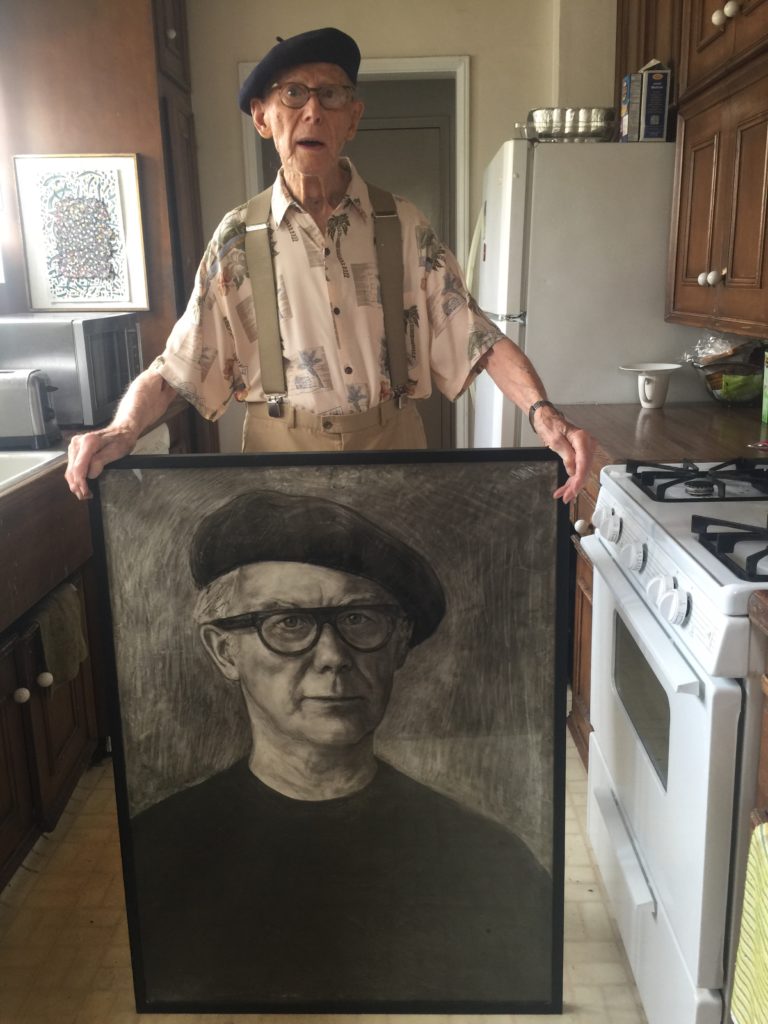
It is with profound sadness, that the world has lost another Holocaust survivor, Kalman Aron. Mr. Aron died in a hospice in Santa Monica, California, Feb 24th, with his son, David Aron, at his side.

I first met Kalman a little over a  year ago, at his humble home and painting studio in Beverly Hills. His spirit and personality were that of a much younger man than the 93-year-old gentleman that was in front of me.

He gave me an incredible tour of his modest home, and then gave me the history of a few of the hundreds of master artworks that were all over the apartment. I felt like I was getting a tour of a miniature Louvre. Every painting was a masterpiece;It was beyond impressive.

Our first meeting was a lovely time, as lovely, as a person could have. Kalman allowed me to film him for the first two hours, and gave me the rights to his life story. We then broke bread and spent time talking about his career and his time in seven Nazi concentration camps.

“I made it through the Holocaust with a pencil,” Kalman declared, with a Cheshire cat grin.

A  Nazi guard came before him with a machine gun, and he was able to draw an exact portrait of the guard in real time. The guard was so impressed that this was the beginning of a Kalman Aron seven Nazi concentration camp tour.

What makes Mr. Aron’s story so very different and unique than any other Holocaust story that one has heard, was that he was treated relatively well, during the entire four and one-half years he was interned.

“I would tell the Commandant or the guard I was painting, if I could just get a little more cheese and bread, I could paint much quicker,” he said with a smile. “This worked often,” says Kalman.

He then told me he was even able to get the Nazis guards to give him extra blankets.

“I had to always be thinking,” said Kalman.

The next time I would meet Kalman, I would bring a very special guest. Now that I had the rights to his life story, I began looking for partners and Executive Producers. I had met Norman Lear 10 years earlier, when he had written me a sizable check for my award-winning film, “Unbeaten.”

I called Norman up, and told him about this incredible man, and asked if he had time to meet him. Mr. Lear did not flinch. The meeting was set, and on a warm Tuesday morning in September 2017, I walked into Kalmans home with the greatest and kindest most iconic TV  producer in the history of Television.

When these two nonagenarian’s met, it was like they had known each other all of there lives. There was laughter. There were tears, and there was great admiration for one another as artists. There was also great profoundness as Norman was a B-17 gunner and radio man, and actually dropped bombs very close to where Kalman was interned. The Nazis could not kill Kalman, and neither could Norman Lear!

The next few months, I would have dinner and lunch with Kalman a few times, and I was very fortunate to be able to have NPR do a global story on him on the program, The World, with Marco Werman. Little did I know at the time, this would be my last time seeing Kalman.

In early January, Kalman took a fall, and would be admitted to Cedars. Always the fighter, he was released in a week, and was back home painting. A month later he would take a turn for the worse, and on Feb. 24th, the world lost one of its greatest  global citizens.

My time with Mr. Aron was brief, but very, very rich. He produced  thousands of paintings through out his long life, including portraits of Ronald Reagan, Henry Miller and Andre Previn, just to name a few. Kalman was the father of ‘”Psychological Realism”

Kalman brought love, joy and peace to all who knew him. Mr. Aron beat the Nazis with a pencil, and he strove for greatness in everything he did. Kalman Aron was a master painter, and very great man. Kalman personified all that is good in human kind. He will be missed.


Steven C Barber is a writer ,director and producer residing in Santa Monica, California. His work can be found at www.vanillafire.com.

Holocaust Survivor Kalman Aron Dies Read More »

Oscars: Doping Documentary ‘Icarus’ Exposes Russian Conspiracy

Inspired by the Lance Armstrong doping scandal, filmmaker and amateur cyclist Bryan Fogel decided to see if he, too, could take performance-enhancing drugs and get away with it.

But what started out as a first-person experiment shifted radically when Fogel sought the help of Dr. Grigory Rodchenkov, the former director of Russia’s anti-doping laboratory. In 2016, Rodchenkov blew the whistle on Vladimir Putin’s state-sponsored doping program, turning him into a fugitive in exile—and giving Fogel’s film “Icarus” cloak and dagger urgency and global significance. It’s nominated for Best Documentary Feature.

“I wanted to show how the anti-doping system in global sport was a fraud and ended up exposing a scandal on a level that I never could have imagined when I started the project,” Fogel told the Journal.

He began corresponding with Rodchenkov via email in February 2014, during the Winter Olympics in Sochi, Russia, and met him that summer at a symposium in Oregon. Rodchenkov agreed to help him, and he began taking the performance-enhancing steroids and hormones—and conspiring with Rodchenkov to substitute frozen “clean” urine samples for drug-contaminated ones.

“I wanted to show how the anti-doping system in global sport was a fraud and ended up exposing a scandal on a level that I never could have imagined.”

At that point, “I knew that he was involved in what appeared to be some wrongdoing at his laboratory but I didn’t know the extent to which he was involved or how deep and vast the conspiracy was,” Fogel said. He later helped Rodchenkov escape to the United States, and felt bound to protect him “because I had no doubt of the validity of what he was showing me and the breadth of the scandal and that it led to the Kremlin’s door.”

When the news broke, “It appeared that the International Olympic Committee was going to continue to sweep this scandal under the rug,” Fogel said. But under pressure from Rodchenkov, his lawyers, and the media, the IOC launched an investigation that corroborated prior investigations and led to the exclusion of Russia from PyeongChang. (some Russians still competed under the Olympic flag as Olympic Athletes from Russia.)

Named for the doomed flyer from Greek mythology, “Icarus” references the fall and comeuppance of “Lance Armstrong and so many others who have all the success in the world but have to push it too far and get greedy,” Fogel said.

He noted that the film, now streaming on Netflix, has had ongoing impact. “The IOC will continue to investigate and decide whether there will be further sanctions and punishments down the line,” Fogel said, adding that FIFA (world soccer) is launching its own investigation into Russian players.

The Los Angeles resident, 45, was born and raised in Denver, Colo., where he grew up “Conservadox. We kept a kosher home. I went to Hebrew school, had a bar mitzvah, all of that,” he said. “I think of myself more as a cultural Jew than a religious Jew now, but I don’t have a family yet. Maybe that will change.”

Fogel started out as a playwright, actor, and standup comedian, and made a splash with the semi-autobiographical “Jewtopia” a romantic comedy that opened Off-Broadway in 2004 after a successful Los Angeles run. He wrote, produced, and starred in it, wrote a book based on it, and directed the film version from his screenplay. He hopes to make both features and documentaries going forward, and has both in early stages of development.

But right now, he’s reveling in the spotlight the Oscar nomination has brought to the film and Rodchenkov, who left his family behind in Moscow “and risked his life to tell the truth. If Russia was willing to go to this extent to win and cheat the world of Olympic medals, there’s little doubt it would meddle in democracies, hack elections and change the course of other political affairs,” Fogel said. “I hope the attention to the film will continue shine a spotlight not only on this conspiracy and corruption but the bigger questions and issues, and be a wakeup call to take action to protect democracies around the world.”

Oscars: Doping Documentary ‘Icarus’ Exposes Russian Conspiracy Read More »

Married Jewish Filmmakers Spotlight Police Brutality Victim in ‘Traffic Stop’

In Austin, Tex. in June 2015, a minor traffic violation turned into a major incident when police officer Bryan Richter used excessive force against African American elementary school teacher Breaion King. The dash-cam footage of the arrest went viral, bringing King the kind of notoriety she never wanted. Filmmakers David Heilbroner and Kate Davis focus on the person behind the infamous footage in their film “Traffic Stop,” which is nominated for an Academy Award for Best Documentary Short Subject.

The married Jewish filmmakers happened to be working on a feature-length documentary for HBO about a similar subject—Sandra Bland, a black woman who was found dead in her jail cell after her arrest for failing to signal a lane change—when they saw the King footage on YouTube. They flew to Texas to meet her and were impressed by her poise, intelligence and accomplishments. King had never been arrested before. She was someone everyone could easily relate to. But she didn’t agree to participate right away.

“She wanted to feel like she could trust us and feel comfortable with us first,” Davis said, speaking to the Journal by phone with her husband. “We worked closely with her to shape the film and find scenes to portray her life, her dancing and her teaching. We wanted to intercut that with the harshness of the dash cam.”

“This is a violent assault on a civilian that did not have to happen. I think Richter was grossly over-reactive and it was a shocking use of force. [King} gently resisted a few of the cop’s commands but was hauled out of the car and tossed around like a rag doll,” Heilbroner, a former prosecutor, said.

King’s lawsuit against the city of Austin is pending.

“I’d like to think she’ll win,” he added. “But sometimes the law isn’t just.”

“This is a violent assault on a civilian that did not have to happen. She was hauled out of the car and tossed around like a rag doll”— David Heilbroner

Calling King “a great role model for kids,” Davis praised her “courage to speak up and stand up to abusive power.” She and Heilbroner are doing what they can to get the film shown in schools, community centers, and police academies, as part of de-escalation training. “Also, I think the film can help people check their behavior more carefully when they encounter law enforcement. It could be a good teaching tool,” she said. “Things can escalate in a nanosecond. People can die. Breaion was lucky that she didn’t.”

The filmmakers found out about their first Oscar nomination when their cell phones began buzzing with congratulatory messages. “The most fun part was calling Breaion and her lawyer to tell them about it,” Heilbroner said. “They were so excited and amazed that her story is going to be at the Academy Awards and our film is going to have a national platform. Even if Breaion loses in the court of law, she may win in the court of public opinion.”

Having made the documentaries “Stonewall Uprising” and “The Newburgh Sting,” in which Muslims and gays respectively were targeted by police, and “Jockey,” an exposé of labor conditions in horse racing, Davis, 57, and Heilbroner, 60, are drawn to socially significant subjects. “I went to law school because I saw it as an agent of change, but I realized I could make a greater difference with documentary film,” Heilbroner said.

The pair met at Harvard in 1979 through their mutual love of music. Davis was a Visual Arts major, but “fell into a filmmaking class by chance and found that it suited me better. Documentaries were a way to use my visual sense with storytelling and political and social justice leanings, and my interests in psychology and music,” she said.

Davis, of Russian- and German-Jewish ancestry, is the daughter of the late Bernard Davis, a Harvard Medical School professor whose father owned a general store. Heilbroner’s mother was not Jewish; His father was the late economist and New School for Social Research professor Robert Heilbroner. His paternal grandfather, a necktie peddler from Germany, became the co-owner of the haberdashery chain Weber & Heilbroner. “It’s a very Jewish story in that our grandfathers were self-made people who came to the land of opportunity and succeeded, and their children became intellectuals and raised us as such,” Heilbroner said.

Neither grew up in a religious home or became bar or bat mitzvah, but feel culturally Jewish. “Katy and I have a really strong feeling about groups that suffer prejudice, marginalization, abuse,” Heilbroner said. “We can identify with someone like Breaion King because there is that in the nature of the Jewish experience. I think we bring that to filmmaking.”

The couple married in 1985 and had two children, Northwestern grad and Democratic campaign worker Quentin, now 23, and Brown University student Katrina, 20. “They’re our most trusted test audiences. They say what they think,” Davis said. “They give us the millennial perspective.” Heilbroner added.

He and Davis are finishing the Sandra Bland documentary, “Say Your Name,” which will premiere later this year on HBO, and Heilbroner is co-directing a biography of singer Dionne Warwicke. “Traffic Stop” is available now on HBO and its On Demand and digital platforms.

Married Jewish Filmmakers Spotlight Police Brutality Victim in ‘Traffic Stop’ Read More »

Sidney Wolinsky: Shaping ‘The Shape of Water’

Out for an early morning walk near his home in Santa Monica with a neighbor, film editor Sidney Wolinsky checked his mobile phone and got the good news about his Oscar nomination for “The Shape of Water.”

“I was excited, pleased, amazed,” he told the Journal. But the film’s 13 nods including Best Picture, Best Director, and three of the four acting categories doesn’t surprise him, after its multiple wins at the Golden Globe, BAFTA, and Critics’ Choice Awards.

An unlikely mix of horror, fantasy, thriller and romance, the Cold War-era story about a mute janitorial worker and an intelligent captive sea creature has resonated with critics and audiences.

“It has a very strong story and an outsider characters that people can really relate to,” Wolinsky said. “It has a very strong antagonist, and people in trouble that you want to see succeed.”

Wolinsky, who worked with director Guillermo Del Toro on the pilot of “The Strain” in 2014, appreciates the working relationship they have. “He’s very open to ideas, very collaborative,” he said, noting that Del Toro’s understanding and mastery of the fantasy-horror genre allayed his concerns about whether “The Shape of Water” would work. “He knew what he wanted to do and executed it beautifully.”

“It has a very strong story and an outsider characters that people can really relate to”— Sidney Wolinksy on “The Shape of Water”

Underwater scenes notwithstanding, the trickiest editing challenge was the climactic escape sequence. “There were a lot of moving parts and it involved all the characters who were all in different locations coming toward each other. You had to maintain the tension and make sure people understood what was going on,” Wolinsky said.

Although this is his first Oscar nomination, the Canadian native has been honored for his television work with three Emmy nominations for “The Sopranos” and a win for “Boardwalk Empire.” His credits also include “House of Cards,” “Ray Donovan,” and “Rome.”

Always interested in film, he chose to go into editing “because it was the most involved in shaping the story,” he said.

Born in Ottawa, where he lived until his parents separated when he was 12 and he moved to Montreal with his mother, Wolinsky got his bachelor’s degree in English and American literature from Brandeis University. “It was full of really smart kids who couldn’t get into Harvard or Yale,” he said, noting that he also applied to those Ivy League schools, “not realizing I hadn’t a hope in hell” of getting in.”

The fact that Brandeis is a largely Jewish school wasn’t a factor for him. “I wanted to get out of Canada,” he said.

Wolinksy’s paternal grandparents were from Belarus, and his mother and her family fled Hungary via Barcelona and Tangier in 1944. His father’s father “was an Orthodox Jew and very much a Zionist. My father stayed kosher, but drove on Saturday. He’d park a block away from my grandfather’s and walk,” Wolinksy said.

His mother’s family was not observant, and he followed suit. “I refused to go to Hebrew school. For my bar mitzvah, I learned the entire thing by rote,” he said. “I’m Jewish, it’s a part of me. But I think religion has created more problems than it has solved.”

Wolinsky, who is married and has one son and two grandchildren, doesn’t have his next project lined up. “When you’re a freelancer, you finish a job and you hope you get another job. I don’t feel that I’m in the position where I can pick directors or projects,” he said. For him, the job is all about the person running the show. “I’d like to work with good directors because you learn the most from good directors and good material.”

Sidney Wolinsky: Shaping ‘The Shape of Water’ Read More »

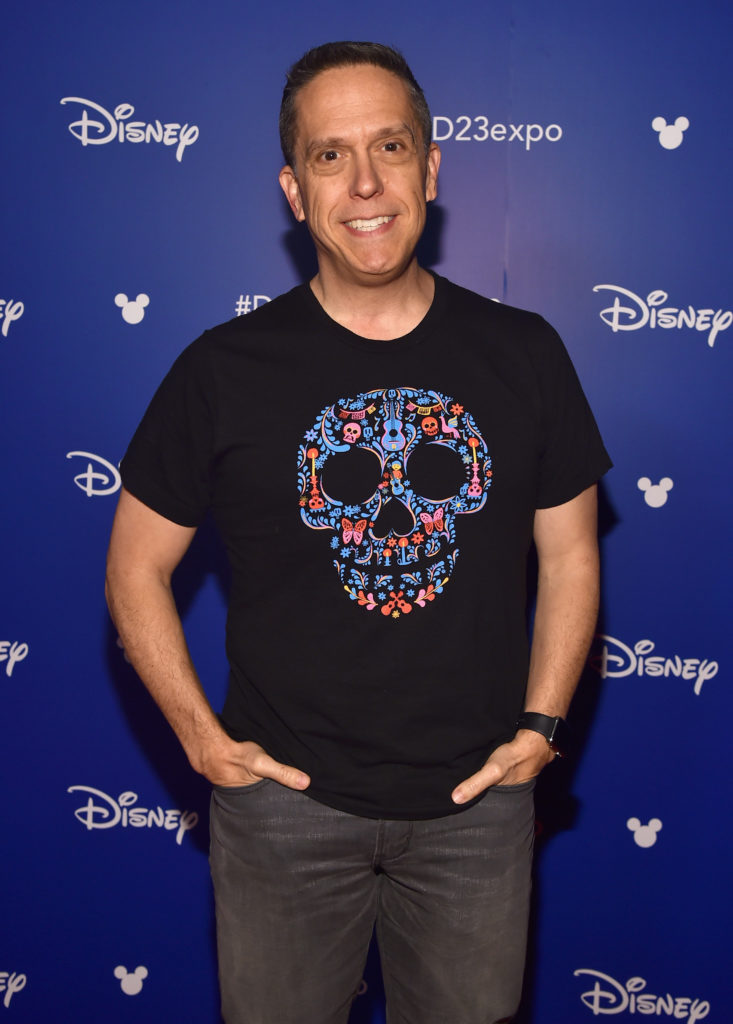
Lee Unkrich: ‘Coco’ Creator is the Frontrunner for Best Animated Feature

Seven years ago, Lee Unkrich won his first Academy Award for Best Animated Feature for “Toy Story 3,” his debut directorial effort for Pixar. He’s favored to win in the category this year for the studio’s “Coco,” a celebration of family and Mexican culture that has grossed over $700 million at the worldwide box office.

“There’s something special about that first time that was mind-blowing. It was like an out of body experience,” Unkrich said of his first Oscar win. “I don’t know that I’ll have the same experience again, but it doesn’t make it any less special.”

Set during the Dia De Muertos festival honoring the dead, “Coco” “is not about death or grieving or loss, though death is certainly part of the story,” Unkrich said. “It’s about family and remembrance and the obligation that we have to pass the stories of loved ones along, and that’s a universal idea. No matter what culture or religion you’re in or even if you’re not religious at all, these are basic human notions.”

Over the course of the six years it took to make the film, Unkrich and his team made many trips to Mexico to take photos, experience Dia De Muertos, and spend time with families in rural parts of the country. “It gave us a specificity that we wouldn’t have dreamed up on our own in a studio in Northern California,” he said.

“’Coco’ is about family and remembrance and the obligation that we have to pass the stories of loved ones along. These are basic human notions.”

Pixar hired expert advisors for the first time. “We had a great responsibility to be as authentic and respectful as possible. Every single decision we made was looking through that lens of cultural appropriateness and respect,” Unkrich said, noting that “Coco” is the top-grossing film of all time in Mexico. “That tells us we did it right.”

Unkrich, 50, a graduate of the University of Southern California’s School of Cinematic Arts, worked in television editing before beginning his career at Pixar in 1994. He worked as an editor on “Toy Story” and “A Bug’s Life” and co-director on “Monsters Inc.,” Finding Nemo,” and “Toy Story 2.”

“Animation wasn’t my background, but I found that I like working slowly and meticulously and thoughtfully to create a story,” he said. “I get the same level of satisfaction that I do from live action if not more. And I love being able to make movies without being surrounded by the film industry, like I was in L.A.”

A movie-loving kid from Chagrin Falls, Oh., a suburb of Cleveland, Unkrich acted in plays and was interested in art and photography, and he felt that filmmaking would combine his interests. He grew up in a Reform Jewish home, raised by an Ashkenazi Jewish mother and a German-Catholic father who became interested in Judaism as a young man and officially converted when Unkrich was eight years old.

“My family was very active in our temple, where I had my bar mitzvah. My father was on the board and my mother was in the sisterhood. She actually ran the services in the summertime,” Unkrich said. “Even though we weren’t a particularly observant household—we didn’t keep kosher—Judaism was a big part of my childhood. I was one of the few Jews in my school. But I went to a Jewish summer camp starting at age 10 and went back every summer until I was in college. My best friends in life are my friends from camp. And I met my wife in the last summer I was there.”

Unkrich and his wife, Laura, live in Marin County and have three children, Hannah, 20, Alice, 18, and Max, 13. He maintains a strong connection to Judaism. “I’m not super-observant,” he said. “But the community has always been very important to me and to my wife, and it’s important that our kids are part of that community.”

As for his next project, it’s to be determined. “I’m still busy with ‘Coco.’ It hasn’t opened everywhere around the world,” he said, not eager to jump into something new. “First, I want to take a long vacation.”

Lee Unkrich: ‘Coco’ Creator is the Frontrunner for Best Animated Feature Read More »