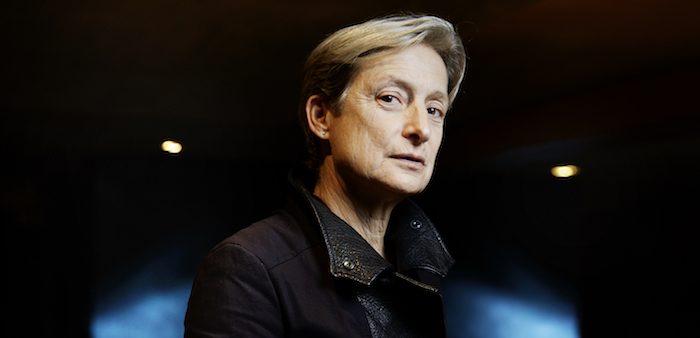
Judith Butler Plans a Stealth MLA Presidency
The Modern Language Association (MLA), the largest academic discipline-based faculty organization in the US has been debating resolutions to boycott Israel or its universities since 2007. I have been involved in fighting this movement both then and since. In 2017 this all came to a head, with competing boycott and anti-boycott resolutions up for debate. The resolution recommending boycotting Israeli universities was defeated in January, and a resolution prohibiting future boycott resolutions was overwhelmingly endorsed by the organization’s members in June 2017. But the diehard opponents of a Jewish state have continued to press their cause, hoping to influence students and faculty members throughout the humanities. Two of the long-term faculty supporters of the BDS (Boycott, Sanctions, and Divestment) movement in the humanities are Judith Butler (Berkeley) and David Palumbo-Liu (Stanford). Butler, sadly, is herself Jewish. She achieved international fame for her innovative work on gender. Her hostility to Israel is more recent but is both fierce and unusual, and she is perhaps the most influential BDS supporter in the US. This essay reports on the effort to resuscitate the BDS movement at the annual MLA meeting this January, focusing on a group planning and strategy meeting falsely promoted as an academic discussion of the issues involved.
“This is not the kind of MLA I want. I want an MLA that will support a boycott resolution, and now I just don’t know if I will get that MLA,” so declared a graduate student attending a widely publicized January 5 event held at New York University during the Modern Language Association’s annual meeting. Headlined “MLA Vote for Justice in Palestine” with MLA in large block letters imitating an official logo, the meeting notice listed several “MLA Co-sponsors,” including Arabic Languages, Literature, and Culture; Race and Ethnicity Forum; and West Asia Languages, Literatures and Cultures. Set to run from 7:30 to 9pm, it billed itself as “free and open to the public. Nonmembers and members of MLA are welcome. No registration required.”
Expecting a series of presentations from the front of the room, with an audience in rows, I decided to attend. My taxi was late, after struggling in the snow for 45 minutes, so I arrived as things were already under way. I walked into a group of 35 to 40 people in a layered circle. As I entered, people looked up, and Judith Butler declared, “Cary, did you make a mistake and come to the wrong place?” I replied “No, I intended to come, perhaps irrationally.” “Well, it’s still a free country, isn’t it?” she remarked. I allowed as how the US president didn’t seem to want it to remain one, foolishly hoping to lighten the atmosphere. She offered me a seat next to her, announcing “Do you really want to sit here?” to the group. I said it was fine.
Those of us who had arrived late were asked to continue the process of introducing ourselves and explaining why we had come. I said that I supported a two-state solution, but opposed BDS because I believed boycotts of Israel would not promote peace, but I was interested in getting a better understanding of how others felt. Immediately a hostile speaker from across the room challenged me with “So you’re interested in our feelings, but not our ideas?” I said I was interested in both. The idea that I was simply to be part of an audience now seemed a distant misreading.
Someone said “You should leave’ and Butler immediately proposed a vote to make that a group decision. Several others quickly supported her and repeated the demand for me to leave. Butler continued: “Will you honor a vote to tell you to leave?” Not answering her directly, I said it was supposed to be an open public meeting. People said that didn’t matter. They were young and vulnerable and I might take down their names and institutions and retaliate against them. After all, I was a person of power. Exactly what power no one volunteered to say. I pointed out I had defended grad students and contingent faculty for decades and had never criticized one by name. I assured people I was interested in hearing ideas. Butler then concluded I was refusing to honor a vote demanding I leave, so they would just have to proceed as best they could. Honest discussion would be impossible with a Zionist in the room.
I hadn’t realized she would be running the meeting, not simply headlining it. She declared that she had several ideas she had wanted to share about how to move the BDS agenda forward in the MLA, but felt it was not safe to do so with me in the room. She clearly understood she would need a neutral persona while serving as MLA president in two years but wanted to strategize with her BDS cohort behind the scenes. She would be posturing as principled in office while quietly working to scuttle the 2017 MLA resolution against academic boycotts. She urged people to contact her after the meeting and told them there would likely be funds to bring some of them out to Berkeley to consult with her.
Although half the hour was spent challenging and berating me, the core strategy Butler and the other senior member there, David Palumbo-Lio of Stanford, were using was nonetheless clear. After more than a decade of debating anti-Israel resolutions, MLA members had their fill. In June 2017 they voted by a 2-1 margin to bar further academic boycott resolutions. MLA’s Executive Director Rosemary Feal immediately pointed out that nothing prevented a vote on a resolution to overturn the 2017 vote, but the BDSers preferred to ignore this option, as it was clear they would lose such a contest. Unwilling to see themselves as a radical fringe group indulging in sour grapes complaints, they were left with one way to explain their loss: as they asserted repeatedly this evening, they were cheated.
“All we wanted was a level playing field,” Palumbo-Liu declared, “but we didn’t get one.” Incredibly, he revived his 2014 accusation that MLA Members for Scholar’s Rights had obtained outside Zionist funding to copy the email addresses of 20,000 MLA members. He was well aware of my public reply at the time because he responded to it: I had paid a student $650 to gather the emails. I didn’t need to contact Baron Rothschild for funds through a seance. But now he lied and complained I never answered him, even though he answered my reply, just as he lied recently in claiming he had run for the MLA Executive Council on an explicit BDS platform. In fact he had run on a stealth platform claiming he was seeking to help grad students and never mentioned Israel.
Members had only received pro-boycott materials, and we wanted them to hear our case. The MLA refused to distribute our anti-boycott dossier. We used the same emails once more in 2017. Palumbo-Liu and Butler both insisted this was unethical, despite MLA assuring members we had followed the rules. Butler incredibly added that the 2017 resolution violated the US Constitution by supposedly restricting speech. Of course speech in 800 MLA sessions was unrestricted, as was anything else anyone wanted to say from sea to shining sea. Members had democratically voted to stop squabbling about Israel and instead focus on humanities disciplines in crisis and exploited academic labor. But for a BDS disciple like Palumbo-Liu that was a cowardly distraction. Seeing it as the only hope for a newspaper headline he resigned from MLA’s Executive Council in January, absurdly protesting that his academic freedom had been violated.
What Butler and Palumbo-Liu managed to do this evening was to convince a group of young faculty and students that only a corrupt conspiracy could have defeated them in their effort to demonize the Jewish state. Their opponents were unethical and unscrupulous. At the end, Butler turned and pointed to me to conclude: “We need to overcome those who are dedicated to making the fight unfair.”
Cary Nelson is Jubilee Professor of Liberal Arts and Sciences at the University of Illinois at Urbana-Champaign and an Affiliated Faculty member at the University of Haifa. His most recent book is Dreams Deferred: A Concise Guide to the Israeli-Palestinian Conflict and the Movement to Boycott Israel.
Judith Butler Plans a Stealth MLA Presidency Read More »
