fbpx

October 18, 2017

Eyal: My Brother, My Best Friend, My Hero

I received an note from a rabbinic e-mail list last month that read, “Please send in your names for notable deaths in 5777.” Carrie Fischer, Sen. John Glenn and even Hugh Hefner made the list.

I responded publicly, “I have learned that every life is a notable death.”

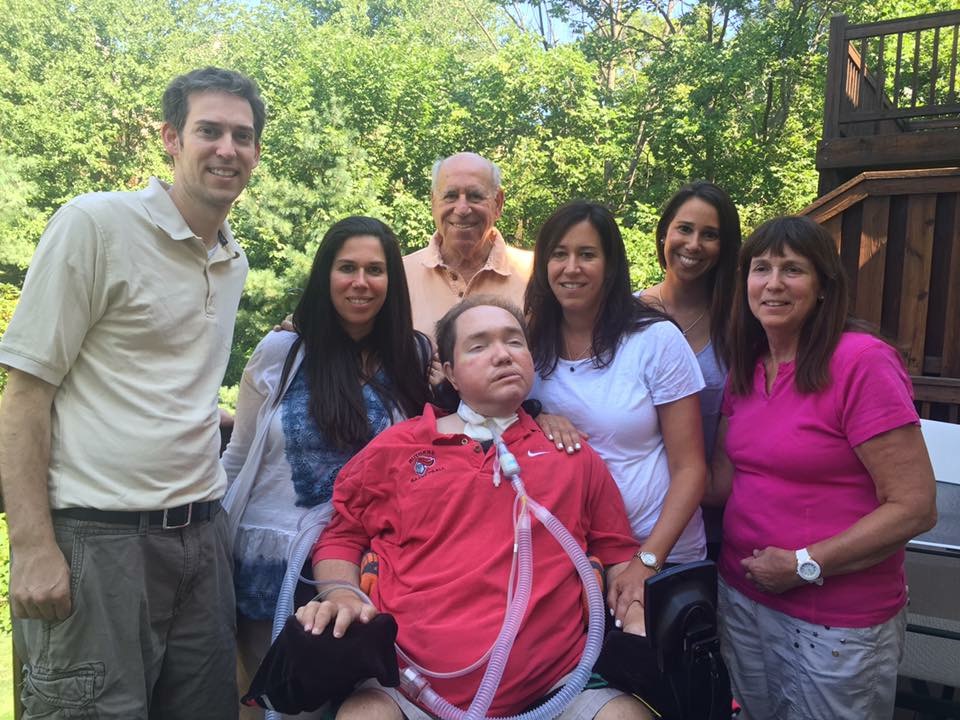
I had been officially an avel, a mourner, for 24 hours. My brother, Eyal David Sherman, 36 years old, passed away, on Sept. 24, my birthday. He had been a quadriplegic for the last 32 years, after suffering a brain stem tumor and subsequent stroke at the age of 4.

Just two days prior, I stood with my congregants of Sinai Temple, and recited the Unetaneh Tokef prayer, who should live and who shall die. Each year, the absence of those lost makes their presence more noticeable. These words were now my reality.

My brother accomplished more in his 36 years than most of us do in our entire lives. He graduated kindergarten, high school and college, even when the doctors told them he would not live past his fifth birthday. He became an accomplished artist, drawing and painting with a mouthstick wedged between his lips.

My father, my sister and my wife are all rabbis, but it was Eyal who became our rebbe.

Our tradition teaches us about shevirat kelim, the breaking of the vessels. The vessels that contained God’s light could not contain them and were shattered. We must put them back together.

Eyal’s death broke the vessel, but the light has emanated out. During this heartbreak, we have also experienced a tikkun, a repair, for as we continue to share Eyal’s story, so many have shared their stories with us.

During shivah, we were honored to host Dr. Mark Helfaer, an ICU attending at Children’s Hospital of Philadelphia, who saved Eyal’s life multiple times. Born in Niagara Falls, Mark was orphaned at the age of 10. He was taken in by his uncle and aunt.

Unfortunately, Mark never celebrated his bar mitzvah, and he carried that resentment through his life. This year, at the age of 60, he marked that rite of passage. My father, Rabbi Charles Sherman, always one to throw in a joke, asked, “Mark, what was the theme of your party?”

His response: “Rabbi … the theme was gratitude.”

Today, Dr. Helfaer, so vibrant and robust and brilliant, my brother’s personal miracle maker, suffers from multiple sclerosis. He walks with a cane and slurs his speech. At shivah, he explained that Eyal was one of his most intellectually stimulating cases, and Eyal’s story inspires him to find meaning in his own battle with a disease that has stopped him from working, but has given him the gift of gratitude.

Yes, gratitude is the ability to say thank you. But gratitude is the gift to acknowledge the blessings around you. Gratitude is the gift of being noticed … gratitude is the gift of a notable life.

For 36 years, Eyal led a notable life. Very few individuals could be so inspirational without saying a word. Eyal was the definition of the kol demama daka, the still silent voice whose actions blasted like the shofar. Just scroll down Facebook and read the thousands of tributes of those — many who never met Eyal in person — have been motivated to make this world a better place.

Every Shabbat, Eyal had an assigned part of the birkat hamazon. He would silently mouth baruch atah adonai boneh yerushalayim, asking God to rebuild Jerusalem. Eyal is the builder of our spiritual Jerusalems.

While Eyal was a miracle, the most miraculous part was that Eyal was simply my brother. A lover of Syracuse University basketball, a passionate sports fan, an unbelievable artist and a lover of family, our righteous parents turned the extraordinary into the ordinary.

Thankfully, it was this ordinary brother that inspired every sermon I crafted. In fact, as I dated my now wife, Rabbi Nicole Guzik, the first gift I gave her was the transcript of my father’s book about the story of Eyal, “The Broken and the Whole.”

Several years ago, my father and I toured the country telling Eyal’s story. The most common question was, “Is Eyal a burden?” They were in awe, as we answered, “Eyal is a blessing.”

Nothing for us will ever be the same with Eyal’s death. He is and will always be my tzadik, my righteous brother. Yet, we know that each and every day on this earth will be guided by Eyal’s still small voice, guiding us on the right path.

Donations can be made to:

The Eyal Sherman Foundation

c/o Estate Bookkeeping

Cozen O’Connor

1650 Market St, Suite #2800

Philadelphia, PA, 19103

Rabbi Erez Sherman is a rabbi at Sinai Temple.


Eyal: My Brother, My Best Friend, My Hero Read More »

Letters to the Editor: Gun rights debate, keeping politics out of temple, Radical Middle and David Suissa

Gun Rights Debate Continues

First of all, congratulations to the Journal for debating an issue that the Supreme court handed down a decision on almost 10 years ago (“Does the Second Amendment Guarantee the Right to Bear Arms?” Oct. 13).

Second, my admiration to Karen Kaskey for her very well-done arguments. In contrast: The best part of Ben Shapiro’s arguments is the headline: “Good Gun Policy Starts With Reality.” His analysis of the facts, though, is superficial and he fails to see the reality that modern society is not the same as it was 200 years ago. Everything in the universe, including American society, is subject to change. He doesn’t understand that the purpose of the constitution of any country is to serve its people and should be subject to change, as well.

As far as the Supreme Court decision on the issue: Yes, the court has the legal authority to clarify the meaning of any part of the Constitution, but that doesn’t mean justices can read the minds of those who wrote it. Nobody can.

Svetlozar Garmidolov, Los Angeles

Regarding Ben Shapiro’s column on the Las Vegas shooting (“Good Gun Policy Starts With Reality,” Oct. 13):

• Congress and the states have the legal authority to ban assault weapons.

• Polls show a majority of Americans want assault weapons to be illegal.

• Shapiro doesn’t even deal with the issue of assault weapons in his column. Instead, he changes the subject to a supposed effort to take away all guns from all citizens, which is untrue and irrelevant to the massacre in Las Vegas.

• Shapiro makes the lame conservative argument that because it’s impossible to stop all shootings, there’s no point in even trying. That makes as much sense as saying that I won’t lock the doors, windows and gates of my house because I can’t stop all burglaries.

• Conservatives love to say that the left can’t see evil when it’s staring them in the face and won’t act against it when they can. The real evil here is that conservatives are just fine with mass shootings, won’t do anything about them because they’re on the payroll of the gun industry, and callously thwart the desire of all Americans to feel safe from the threat of assault weapons.

Michael Asher via email


Leave Politics Out of the Temple

I was in shock when I read “Political Pundits Discuss ‘Trump’s America’ in Debate at Valley Beth Shalom,” (Oct. 13). First, this should never have been organized at this temple. I believe that there are tax consequences, aside from being very distasteful. Peter Beinart and David Frum are looney Jews talking trash about Trump.

Any normal person would be absolutely fed up with this constant line of crap! Trump is a racist, Trump is anti-Jewish, anti-Israel, and on and on. I wouldn’t be surprised if Valley Beth Shalom is losing membership. I know that other “liberal” temples are. Keep houses of worship just for spiritual purposes and leave politics at home!

Alexandra Joans, Los Angeles

Please add my name to those who feel the same as the “heckler” at Temple Israel of Hollywood (“Heckler Interrupts Kol Nidre Sermon,” Oct. 6).

Your “senior writer” seems to have given a new definition to the term heckler. Not long ago, “heckler” would conjure up a picture of someone sitting at length in an audience, making it rough on some budding entertainer.

Your reporter indicated none of that. The man got fed up with the narrishkayt and stated, “This is supposed to be a house of prayer.”

According to your reporter, he was not the only one disturbed by Rabbi John Rosove’s flights into “liberal political rhetoric.” Others voiced their displeasure that our synagogues were being turned into houses of rebellion against the government. He stated his protest — and left. “Stormed”? Tsk, tsk.

My wife and I “stormed” out of Temple Beth Hillel this past High Holy Days, demanding (and receiving) our money back, after the rabbi made sure that the congregation was apprised that Israel is an occupier, that it is non-egalitarian toward women who just want to pray at the Western Wall, that we should be magnanimous enough to welcome all in need to share our boundless country and, oh, yes, that the Reform movement has asked all Reform synagogues to “rise up against this [illegitimate] government.”

As your reporter quoted another irate citizen not afraid to buck the rising liberal nonsense, “We don’t need to listen to this bull—-!”

P.S. Apparently, neither do the fine people of Wilshire Boulevard Temple, who pulled out of the movement for the same reason.

Steve Klein via email

Obviously, there were people attending the Kol Nidre service at Temple Israel of Hollywood who strongly felt that denouncing our president during the rabbi’s sermon was not appropriate — so much so that they walked out; and one man even spoke out in opposition as he stormed out of the sanctuary.

I agree with Rabbi David Wolpe of Sinai Temple about keeping politics out of the synagogue. It is not intended to be a place for expressing political differences.

According to Wikipedia, “politics is the process and method of gaining or maintaining support for public or common action, the conduct of decision-making for groups.” It serves to sway people’s allegiance.

On the other hand, a temple is “an edifice or place dedicated to the service or worship of a deity.”

Whether or not you like our president (I voted against him), the temple is a place for religious worship — certainly not intended for political denunciation of our president.

George Epstein, Los Angeles


Both Parties Leave  the ‘Middle’ Behind

Karen Lehrman Block is completely right, but rather late (“Toward a Radical Middle,” Oct. 6). The “middle” (to which I belong, as well) was written out of the Democratic and Republican parties years ago, and I see no sign of it being able to return because its politicians have morphed into the “establishment” and are functioning only to their own benefit. That’s what Donald Trump ran against and that’s why he was elected.

Your first redesigned issue was excellent.

Stephen J. Meyers via email


Progressives Should  Reconsider Their Ethics

In “Dancing With Darkness” (Oct. 13), David Suissa extols the personal freedom we enjoy in the United States, although it tragically enabled the Las Vegas massacre. American freedom has a particular resonance with Jews because it’s inspired by the Ten Commandments, which assert that true freedom requires moral behavior. The Founding Fathers were so profoundly aware of their Hebrew roots that the Liberty Bell’s sole inscription is from Leviticus; Ben Franklin’s original idea for the Great Seal of the United States was a depiction of the Israelites crossing the Red Sea; and George Washington personally assured the fledgling Jewish community that its members were free and equal citizens.

Despite this history, progressives have for years condemned Christianity and Judaism, the latter by demonizing Zionism. Since turning their backs on Judeo-Christian ethics, progressives have become meaner and less tolerant, like the crowds who cheered Madonna when she mused about “blowing up the White House,” and Linda Sarsour when she praised a convicted terrorist murderer.

After the Las Vegas massacre, a young, Jewish CBS vice president declared she was unsympathetic to the victims because “country music fans often are Republican.” Progressive indoctrination, such as Hillary Clinton calling candidate Donald Trump’s supporters “deplorables,” robbed this woman of her conscience and empathy.

Hopefully, the Harvey Weinstein scandal will lead progressives to reconsider their values, or we may well forfeit the freedom our ancestors died for.

Rueben Gordon, Calabasas


Good Luck, David Suissa

Congratulations to David Suissa on his new role as editor-in-chief of the Journal. The most recent Journal already shows that there is a changing of the guard and a new leadership reflecting a new light shining on different aspects of Jewish life, Israel and the world.

I have been a longtime reader of the Journal and I want to wish you much success in your new position. Go from strength to strength.

Best wishes.

Leila Bronner, Los Angeles

Letters to the Editor: Gun rights debate, keeping politics out of temple, Radical Middle and David Suissa Read More »

Legally Blind Photographer Comes Into New Focus

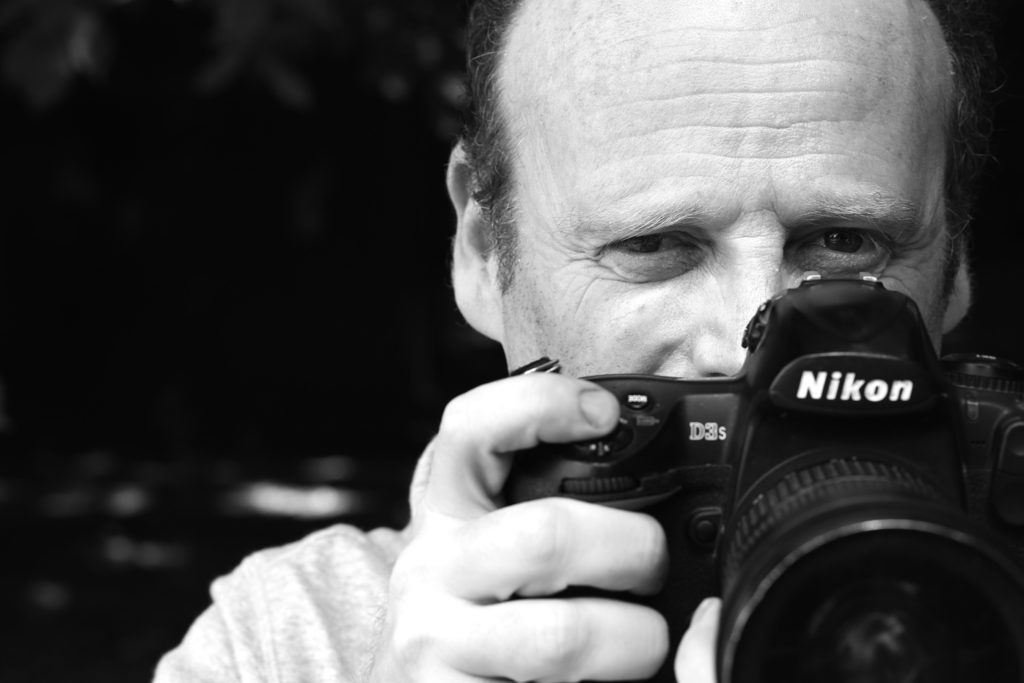
Throughout his career as a photographer, David Katz has snapped portraits of political and entertainment industry titans. The list of those seen through his lens is impressive: Margaret Thatcher, Nelson Mandela, Barack Obama, Michael Jackson, Amy Winehouse, Princess Diana and Queen Elizabeth II, to name a few.

But what’s more impressive is the fact that he did it all while legally blind.

At 3 months old, Katz was diagnosed with ocular albinism, a genetic condition characterized by a lack of pigmentation in the iris. He also suffers from astigmatism, nystagmus (involuntary eye movement) and strabismus (eye misalignment that affects balance).

“Just to say the words ‘legally blind’ is really difficult for me.”– David Katz

An ardent soccer fan, Katz discovered as a child that he could watch games better by using binoculars, since the lens curbed some of the problems arising from his impairment. At age 15, he returned from a family vacation in Israel to his home in the Ilford district of London and showed his father the photos he had taken. Impressed, his father said he had real talent and promised to buy him a professional camera. Later that year, his father died and Katz secured his first photography job at his local newspaper.

While still in his teens, Katz went on to work for famed British tabloids such as The Mirror and the Daily Mail, launching a decadeslong career. He would later become the personal photographer of current Israeli Prime Minister Benjamin Netanyahu, who loved the fact that Katz always showed up early and in a suit.

Yet through it all, no one but Katz’s closest friends and family had a clue about the condition of his eyes. Even today, more than a year after Katz made the decision to “come out of the closet,” as he terms it, he still finds it hard to express himself.

“Just to say the words ‘legally blind’ is really difficult for me,” he said.

Katz always operated from the belief that if the truth were discovered, his career would be over. Competition in the industry is notoriously fierce and he figured his peers would take his blindness as a “golden egg” to topple him.

So to make up for his shortcoming, Katz studied his craft with unwavering diligence. He developed a reputation for risk-taking — always at the front lines of the action instead of hanging back with a long lens. 

“I needed to create a situation where no one could ever say to me, ‘You missed that because you didn’t see it,’” he said.

He also conjured “tricks” so his peers and bosses would never find him out. When digital cameras replaced film — a concern for Katz because it necessitated the use of a computer — he memorized everything about how to use Photoshop in case he was forced to demonstrate something.

Nevertheless, Katz remains proud of his disability, claiming he’s a better photographer because of it, not in spite of it. He said he always knew he eventually would let the world know because he wanted to motivate other people to pursue their dreams, no matter how unattainable they seemed. It was a message hammered into him from an early age by his supportive mother, who insisted, “There’s no such word as ‘can’t.’ ”

“Everything was leading up to this point [of revelation],” he said. “But I needed to reach a certain level before I could have the platform that I have now.

“Otherwise, I’m just another guy with a camera.” 

David Katz chronicled his journey in a documentary which can be seen here. His website is http://throughmylenses.org/

Legally Blind Photographer Comes Into New Focus Read More »

Kurdish Independence Movement Deserves the Support of Western Nations

On Oct. 16, Iraqi armed forces and Iran-supported Shia militias moved into the disputed town of Kirkuk, bringing the country close to civil war. 

The move was Baghdad’s decisive response to the referendum on independence that the Kurds of Iraq held on Sept. 25. The referendum produced a resounding majority for independence and a high turnout — more than 92 percent voted in favor of independence, with a 72.6 percent turnout, reflecting the stubborn determination of the Kurds to maintain and build a sovereign state.

The lines now are clearly drawn, as are the rights and wrongs of the case. 

The Kurdish-controlled part of Iraq is the most peaceful and well-ordered section of that blighted country. The Kurds have given refuge to nearly 2 million of their fellow Iraqi citizens who were fleeing the onslaught of ISIS. In turn, the armed forces of the Kurdish Regional Government (KRG), the Peshmerga, played the crucial role in stemming the advance of that murderous project and then turning it back, in close cooperation with U.S. air power. Many Kurdish fighters died in achieving this. 

For Americans and other Westerners, the KRG has long constituted a unique space. Outside of Israel, it is the only part of the Middle East where public sentiment is solidly and, indeed, passionately pro-American and pro-Western. It also is safe. In Baghdad, Westerners cannot walk the streets in safety. The Iraqi Kurdish capital of Erbil is as safe as any Western city, and safer than many. 

Over the past 25 years, the Kurds have built the KRG into a pro-Western de facto sovereign space, complete with its own armed forces, visa system, economy and parliament. Their ambitions do not end with autonomy, however. Language, outlook and history set them apart from the warring Shia and Sunni Arabs further south.

So the Kurds want independence. They want out of Iraq. The Sept. 25 vote was about kick-starting this process. The success of the referendum led to hopes for a swift negotiating process with Baghdad. 

Instead, the countries surrounding the KRG have united in a vow to prevent Kurdish sovereignty by all available means.

How did we get here?

Iraq is not a historic entity. It was carved by the British out of the carcass of the Ottoman Empire in the post-World War I period, when London and Paris were divvying up the former Ottoman territories of the Middle East. At that time, the Kurdish population lacked an organized national movement, and the Kurdish-majority territories were distributed among the new states of Iraq, Turkey and Syria (with an additional Kurdish population in Iran, outside of the former Ottoman territories). 

This decision has led to much suffering. From the 1950s on, Iraq was governed by a virulent form of Arab nationalism. The rise of the brutal Baath Party in 1963, and then the ascendancy, from within the ranks of the party, of the executioner Saddam Hussein to Iraq’s helm, meant disaster for Iraq’s Kurds. They were deprived of the right to use their language and subjected to arbitrary expulsion from their homes as Hussein and the Baathists sought to leaven the Kurdish areas with Arab newcomers to end any hope of Kurdish sovereignty.

The West should recognize its failure in Iraq and embrace Kurdish aspirations.

The apogee came in 1988 when, in an effort to end Kurdish resistance once and for all, the Iraqi dictator lunched a brutal campaign of ethnic cleansing and slaughter led by his cousin, Ali Hassan al-Majid, henceforth to be known as “Chemical Ali.” In this campaign, between 50,000 and 182,000 Kurds died. The accurate number probably will never be known. What is known for certain is that in the town of Halabja, on March 16, 1988, 5,000 Iraqi Kurds were killed in a poison gas attack. Acording to a report by Human Rights Watch, “It is apparent that a principal purpose of [the attack] was to exterminate all adult males of military service age captured in rural Iraqi Kurdistan.”

This is the bitter legacy that the Iraqi Kurds carry. 

If international affairs were dictated by moral decency, the case for Kurdish statehood would be open and shut. A people who were never consulted as to whether they wished to be joined to the Iraqi state, and who were treated with the most appalling brutality and cruelty by the regimes of that state to which they never wanted to join, and who have proven themselves the most democratic and civic-minded element of the population of that state, now wish to be afforded the liberty to create, finally, their own secure and sovereign country. 

Yet despite the clear facts of the case, the West has chosen to back the Islamist administrations in Tehran, Baghdad and Ankara in their determination to oppose the emergence of Kurdish sovereignty. After the referendum, the government in Baghdad demanded that the Kurds hand over control of all oil revenue and border crossings, as well as control of the international airport at Erbil. Baghdad took unilateral control of Kurdish airspace. (I left Kurdistan on one of the last scheduled flights out of Erbil airport that Baghdad permitted to fly).

With the assault on Kirkuk, the Iraqis have demonstrated their willingness to back up their words with iron and steel. 

Why is the West acquiescing to this?

Ostensibly, the reason has to do with the urgency to complete the war against ISIS. U.S. Special Presidential Envoy to the Global Coalition to Counter ISIS Brett McGurk said the Kurdish referendum was “ill-timed and ill-advised.” This, he added, was the position of the “entire international coalition.” 

But the notion that the referendum damages the war against ISIS by diverting attention from it is unsustainable. The war against ISIS in Iraq is largely won, with the final battle to drive them from their last urban holdings being waged right now. Kurdish independence will not get in the way.

So, what is the real reason for Western opposition? 

First, the U.S. and its allies spent a great deal of blood and treasure in destroying the Saddam Hussein regime and installing a system of elections and formal democracy in Iraq. They are loath to see this project fail. At the moment, Iran-supported forces are in the ascendant in Iraq. The West hopes to assist those forces opposed to the Iranians in Iraqi politics. The Kurds need to remain part of Iraq, it is believed, to act as a counterweight to Iranian influence. 

But Iranian domination of Iraq is quite complete with or without the Kurds. More important than Iraqi Prime Minister Haider al-Abadi and the political structures in Baghdad are the Shia militiamen of the Popular Mobilization Units — 100,000 to 120,000 strong — raised when ISIS was heading for Baghdad but with no intention of disbanding, and controlled by pro-Iranian elements. This independent armed force, combined with other pro-Iranian social and political forces, will remain the principal instruments of Iranian influence in Iraq. 

There’s a deeper cause for the resistance, however: an Arab-centric view of the Middle East that dominates Western universities and the scholars and policy advisers who emerge from them, resulting in a certain lack of interest, even a condescending indifference, to the Kurds, their aspirations and their memories. 

If allowed to triumph, this view will combine failure with disgrace. Failure because Iraq is already dominated by Iran. Disgrace because the justice of the Kurdish case is self-evident.

Instead of denying the Kurds their due, the West should recognize its failure in Iraq and embrace Kurdish aspirations, and then make a strong friend and ally of the new Kurdish state. Instead of acquiescing to Iranian gains in the region, we should be enlisting the Kurds in the effort to roll them back.

But for that to happen, their legitimate demands for self-determination need to be acknowledged and supported.

The hour is late, as the gobbling up of Kirkuk by the militias and the army shows. But it’s not yet too late. The time to support Kurdish statehood has arrived. 


Jonathan Spyer is director of the Rubin Center for Research in International Affairs at IDC Herzliya.

Kurdish Independence Movement Deserves the Support of Western Nations Read More »

Reform Camp Vows to Rise From the Ashes After Massive Fire in Northern California

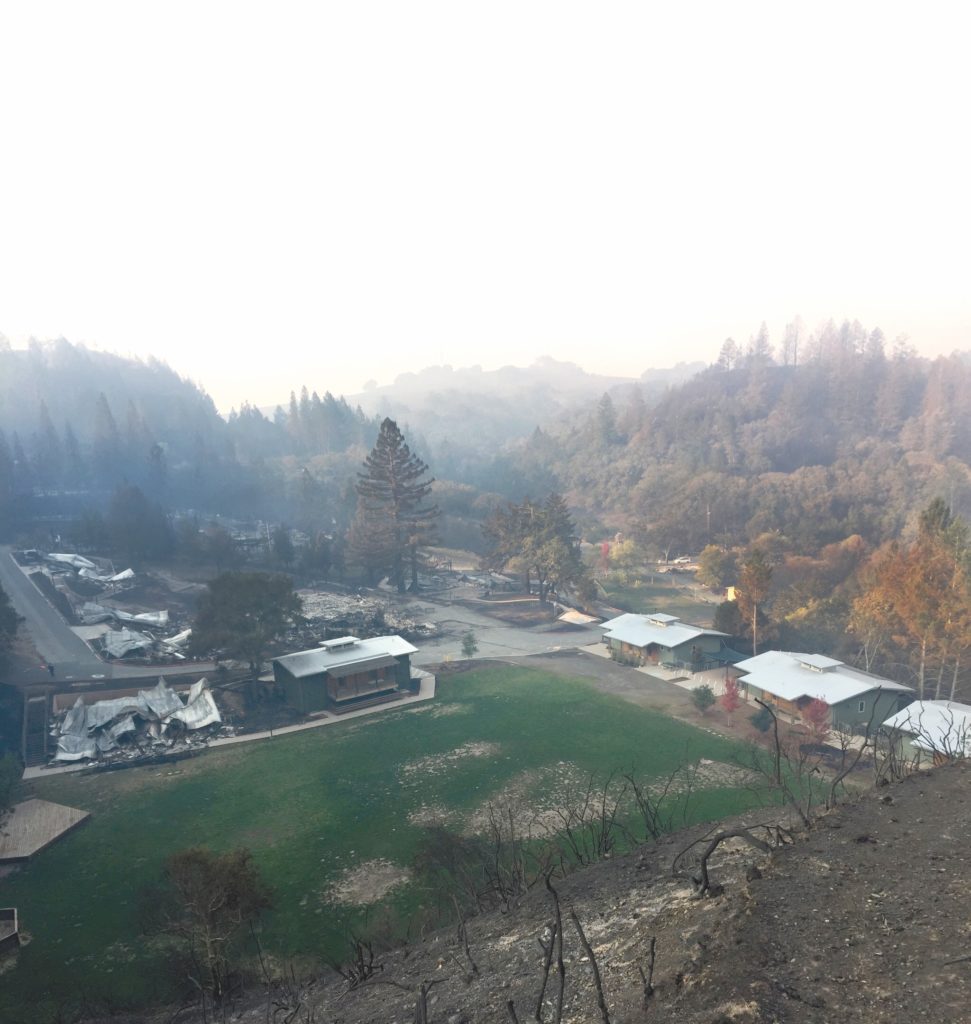
No lives were lost when the Tubbs Fire tore through URJ Camp Newman near Santa Rosa in Northern California, incinerating most of its structures. But as news of the disaster spread Oct. 9, campers and alumni gathered on social media or in vigils across Southern California and throughout the United States, mourning what sometimes felt more like a close friend than a group of buildings.

Rachel Katz, 22, who recently moved to Mississippi from Los Angeles, recalled her physical reaction to hearing word of the calamity. “I couldn’t breathe,” she said. “I was at a loss for words.”

Quickly, her thoughts turned to teens she had mentored as the camp’s counselor-in-training adviser, some of whom now are counselors.

“I’m just heartbroken for my kids,” she said. “You can’t train them for something like this. You can train them for pretty much everything else, but this is where their good hearts and souls that they all had, go into practice.”

“I’m just heartbroken for my kids. You can’t train them for something like this.”–Rachel Katz

Members of the Camp Newman community gathered in homes and synagogues in states including California, Arizona, Nevada and New York in recent days to discuss the outsized importance the Union for Reform Judaism (URJ) camp played in their lives, mourning ties to the camp that often spanned generations. Others took to Facebook and Instagram to tag friends in old photos and share messages of loss.

At Temple Ahavat Shalom in Northridge, Rabbi Barry Lutz invited current and former campers to share their stories during Kabbalat Shabbat services four days after the fire, which turned prayer halls, dining facilities and cabins into piles of twisted rubble and smoking ash. Temple Beth El in San Pedro, Congregation B’nai Tzedek in Fountain Valley and Temple Beth Israel in Pomona were among the spiritual communities that mourned the fire during Friday night services.

A Jewish star stands on the scorched campus of Camp Newman. Photo courtesy of Camp Newman.


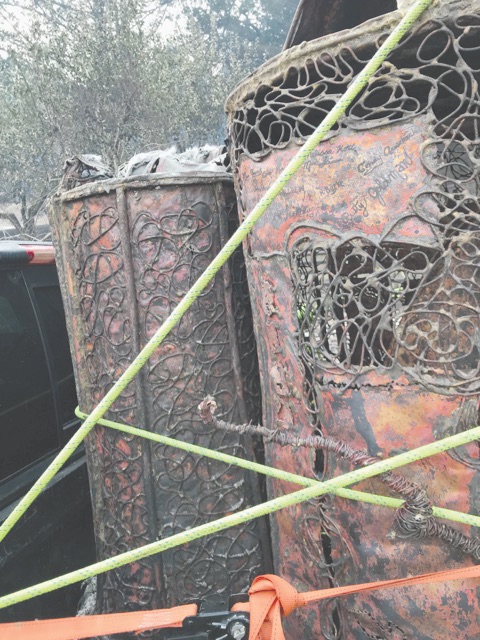
The arks that once held the Torahs at Camp Newman burned in the fire. Photo courtesy of Camp Newman.


The rubble of a burned building at Camp Newman. Photo courtesy of Camp Newman.


Vivian Gee, whose two sons attended the camp and whose daughter, 11, normally spends her summers there, addressed the congregation at the Northridge temple.

“I never went to camp, but all of my money went to camp,” Gee said jokingly.

Her eldest son, Cole, 24, met his current girlfriend at camp six years ago and still lives with three camp friends in San Francisco. Cole’s younger brother, Chandler, “who is not always wanting to be Jewish,” their mother said, nonetheless cherishes his memories of camp.

“It was such a great loss to them,” she said as her daughter, Ashlynn, and husband, Doug, sat in the pews. “It was their second home away from home. Our kids’ motto is, ‘Camp Newman is life — and the rest is just stuff.’ ”

The camp is located in Santa Rosa, a six-hour drive north of Los Angeles. Wildfires raging across Northern California have claimed more than 40 lives and burned more than 220,000 acres since breaking out Oct. 8.

On the first day of the fire, camp staff and faculty followed the news of the massive Tubbs Fire burning nearby. After midnight on Oct. 9, authorities evacuated the five permanent residents of the camp, according to camp director Rabbi Erin Mason. After that, it was a waiting game, she said.

“I was fairly certain that we were going to lose a couple buildings, but we just didn’t know the near-total loss that we were going to experience,” Mason said in a phone interview.

Camp staff was not allowed back on site until Oct. 13, the Friday after the fire, when the impact of the blaze became clear. Everything outside of seven camper cabins, the poolhouse, some staff housing and a storage shed had burned, Mason said.

But even before the scope of the damage was known — no cost estimates were available as of Oct. 17 — the camp community began to discuss how to rebuild. By the time camp staff inspected the site, a donation page launched earlier that week (campnewman.org) had raised about $150,000 — not counting what Mason had collected personally.

During a Simchat Torah celebration Mason attended Oct. 12, she said a camp mom handed her a brown paper bag and told her, “The kids wanted me to give you all their tzedakah.”

Mason said about one-third of the camp’s summer participants come from Southern California. “The connection to our Southern California community is huge and is not something that we take for granted,” she said. “We appreciate knowing people come all the way up here.”

Each summer, the camp plays host to some 1,200 third- through 12th-graders during sessions that last two to eight weeks. It also hosts gatherings for NFTY — The Reform Jewish Youth Movement, as well as schools and families.

Mason said the camp is intent on reviving its programs for the coming summer even as it remains unsure how or where.

“We don’t know what that looks like or where that looks like, but it’s first on our priority list to find out how we run camp next summer in whatever iteration that takes,” she said.

Across the region, some campers cast an eye toward rebuilding while others grieved for losses that can never be recouped.

“I’ve been hearing a lot of people say, ‘But we will rebuild,’ ‘But we’re a strong community,’ ” said Ariella Thal Simonds, a Los Angeles-based attorney. “All of that is true, but that’s not where my head is right now.”

Instead, Simonds said she was thinking about the tile murals she and fellow counselors-in-training had installed together by hand, intended to be a permanent testimony to their time and memories there.

Simonds met her husband, Rabbi Joel Simonds of University Synagogue, at Camp Newman, and the pair “had every intention” of sending their kids, who are 3 and 6, to the camp when the time came, she said.

“When we play the movie in our heads of our memories, of those special times, there’s a backdrop to them, and those places played an important role,” she said, adding, “That’s why it’s so devastating to everyone, even though everybody’s safe.”

This year, the camp celebrated 70 summers since it opened as Camp Saratoga at a nearby location, later became Camp Swig and finally Camp Newman. Rabbi Paul Kipnes of Congregation Or Ami in Calabasas has been on the camp’s faculty since it moved to its current location 20 years ago.

“We’re going to be OK, and camp’s going to end up in a stronger position for the next 70 years,” he said. “The hardest part is for these kids and the staff. These are places where we made memories, where people had their first kiss, where Judaism was deeply spiritual and completely creative.”

On Oct. 11, Congregation Or Ami held a support service for those mourning the loss preceding its Simchat Torah holiday celebration.

Elsewhere across Los Angeles, thoughts of mourning mingled with hope for the future.

Emily Kane Miller, 35, lives in L.A. but grew up going to Camp Newman. Her mother attended Camp Swig.

“As childhood gets further away, knowing there are these places that exist that are touchstones for your memories is something that brings a lot of comfort, and when they go away, it’s extremely sad,” she said. “But camp was never meant to be something that is a time capsule. It’s a living place that helps to greet each new camper’s summer with fresh energy.”

Miller said she and her husband, Nate, still intend to send their kids to Camp Newman, when and where it rebuilds.

“When Nate and I talk about the things that are sort of mandatory for our kids and what we absolutely want them to do to have Jewish identities, summer camp is at the top of the list, because of [my experience at] Camp Newman,” she said. “Knowing that the space is devastated doesn’t change that for me.”

Back at Temple Ahavat Shalom on Oct. 13, Lutz, who has spent more than a dozen summers on the faculty at Camp Newman, led the congregation in song and prayer as Spencer Hyam, 16, accompanied him on the guitar, playing camp melodies.

When it came time for the Hashkiveinu prayer — “Blessed are You, Lord, who spreads a shelter of peace over us” — the congregation enacted a camp tradition, where counselors spread prayer shawls over their charges as the camp director offers blessings. At the Reform temple, parents spread tallitot over their children while Lutz led the prayer.

“Camp Newman will rise from the ashes,” he said afterward.

The fire had threatened the storage shed where the tallitot are kept that are normally used for the Haskiveinu ritual at Camp Newman, Mason said. But when camp staff returned to the site and inspected it, they were surprised by what they found.

“The ground all around that shed is burned; the ground underneath the shed is burned; the water pump behind it is burned; the trees all around it are burned,” she said. “They opened the door to the shed — and all of the siddurim and all of the tallitot are untouched.” 

Reform Camp Vows to Rise From the Ashes After Massive Fire in Northern California Read More »

Trump’s ACA Order Creates Health-Care Chaos

So now we face yet another assault on the health and safety of our nation due to the barrage of efforts by the current administration to dismantle certain provisions in the Affordable Care Act (ACA). This creates great risk and chaos within a system that is aimed at providing both proactive and reactive care to individuals in our country.

As a Jewish community, we should be outraged at the callous attempt to shirk society’s obligation to care for one another, both in terms of last week’s decision to cut subsidy payments to insurers (“cost-sharing reduction payments”) and the ruling to withhold the ACA’s promise of no-cost contraceptive coverage. As conversations and negotiations change by the hour, we are both encouraged to learn of bipartisan cooperation to save the cost-sharing reduction payments while at the same time disappointed with the administration’s insensitive statements and recommendations to eliminate someone’s health care.

This supersedes all other commandments, as it is inferred from one of the most well-known rabbinic teachings, the concept of pikuach nefesh, saving a soul, found in Mishnah Yoma. The text suggests that saving the life of yourself or another is so great that one is permitted to break the laws of Shabbat for the safety of human life. We must interpret this to modern day and protect the lives of millions who will be affected by attempts to cripple the Affordable Care Act. To dismantle a life-saving system is antithetical to the concept of pikuach nefesh.

Furthermore, the book of Leviticus (19:16) teaches that one should not stand idly by the blood of their neighbor. Many among us acknowledge the ACA is not a perfect system and does not go far enough to provide adequate health care to our entire society. Yet, to make provisions that seek to strip health care from any individual is to create a situation in which we as a society will be standing by the blood of our neighbor.

Although negotiations are ongoing, last week’s initial decision by the Trump administration to sign an executive order sends a signal to the insurance companies that their participation in the ACA is not cost-effective for their company. As insurance companies cease their participation in the ACA, it places many people in our society at great risk of losing their health care, putting their lives and the lives of their loved ones at risk.   

The Jewish community must look at the current health care debate and ask ourselves: Is the Trump administration seeking to save lives, or, by suggesting that we eliminate the cost-sharing reduction payments, are its actions creating a risky environment that will harm lives?

The answer is clear. We as Jews have a responsibility to care for one another. If the future health care of an individual is unknown, then we are ignoring our commandment of pikuach nefesh, to save lives.

It is the responsibility of us all to ensure the health and safety of one another.

The administration is taking a further step by issuing rules that would allow employers and insurers to withhold the ACA’s promise of no-cost contraceptive coverage. This is a direct attack on women, who should be the only decision makers for their bodies. Many have celebrated this recent ruling as a win for religious freedom but many organizations have a contrary view.

Any government-backed initiative that allows for discrimination based on religious belief is an affront to our religious freedoms. A provision in Trump’s order puts women’s reproductive health decisions in the hands of their employers and insurers. Our country has a long legacy of religious freedom, and recent attempts to incorporate discrimination into the legislative process based on religious freedom are antithetical to the core beliefs of our religion and the core beliefs of this nation.

We have a strong and healthy tradition of debate and dissent within the Jewish framework, but it seems clear that the dismantling of the ACA creates a dangerous situation in which the health care of many in our society will be in the balance. We must go beyond offering a misheberach for those in need of healing. The ACA and other initiatives that seek to provide sustainable and reliable health care to all link our prayers to our actions as we seek to truly heal those in need. 


Rabbi Joel Simonds is the founding executive director of the Jewish Center for Justice.

Trump’s ACA Order Creates Health-Care Chaos Read More »

Trump’s Changes to ACA Are Worth Celebrating

On Oct. 12, President Donald Trump signed an executive order rolling back a handful of Obamacare’s regulations.

Patients and employers should celebrate the move. The administration is taking action where Congress could not, increasing the number of insurance choices available to Americans — and reducing their cost.

The order directs the Departments of Health and Human Services, Labor and Treasury to come up with regulations that would allow for three key changes.

First, Trump’s order aims to expand access to association health plans, or AHPs. These plans allow small, like-minded employers to join forces to purchase a large-group insurance policy together.

The Obama administration cracked down on AHPs by decreeing that small employers banding together under the banner of an association would not be eligible to buy a large-group policy to cover them all.

That was crucial, because Obamacare imposed many costly regulations and mandates on individual and small-group insurance but not on policies issued in the large-group market.

The administration is … increasing the number of insurance choices available to Americans.

Among those regulations are the essential health benefits mandates, which require all policies to cover 10 benefits, regardless of whether employers or beneficiaries want them.

These mandates inflate the cost of insurance. Many small businesses and employees would gladly take lower premiums and deductibles in exchange for policies that don’t cover expensive services.

But they don’t have that option; their only choice is expensive, comprehensive insurance. So it’s no wonder that only one-third of businesses with fewer than 50 employees offer health insurance — or that just one-third of 1 percent of employees at such firms have coverage through Obamacare’s Small Business Health Options, or SHOP, exchange.

Crucially, those with pre-existing conditions will be protected if their employer opts for an AHP. The executive order emphasizes that employers cannot exclude employees from joining the plan, nor can they charge different premiums to different individuals covered by the plan.

Trump’s executive order also relaxes restrictions on low-cost, short-term health insurance plans. Obamacare set the maximum term for such plans at three months; the executive order will probably extend that term to just under a year and allow the plans to be renewed.

Obamacare slapped strictures on short-term plans to try to force people into the insurance exchanges. But exchange plans have proven too expensive for many individuals, thanks to the many mandates governing them. 

The third component of Trump’s executive order would boost the power of health reimbursement arrangements, or HRAs. These accounts enable employers to allocate tax-free dollars to employees to help them with qualified healthcare expenses.

HRAs are particularly popular with small businesses. Under Obamacare, those with fewer than 50 employees are not obligated to offer health insurance to their workers. Many do so anyway. Others may not be able to afford to provide coverage, especially if their only options are on Obamacare’s expensive marketplaces. HRAs can allow them to give their employees at least some help paying for care.

Under the executive order, the administration is likely to broaden the definition of qualified health care expenses to allow for HRA funds to cover insurance premiums. That could help scores of people who previously could not afford coverage pay for it.

Republicans have promised for the better part of eight years to expand access to low-cost coverage by repealing and replacing Obamacare. President Trump’s executive order finally makes good on that promise, albeit to a small degree.

And, on Oct. 13, President Trump announced that he would immediately stop paying the illegal CSR (Cost-Sharing Reduction) subsidies to insurers.  These payments of $7 billion a year were never appropriated by Congress.  A specific instruction to pay that money is required by the U.S. Constitution before federal money can be paid. 


Sally C. Pipes is president, CEO and the Thomas W. Smith Fellow in Health Care Policy at the Pacific Research Institute.

Trump’s Changes to ACA Are Worth Celebrating Read More »

Teaching the Aleph Bet: Where Hearts and Traditions Meet

Ever since I was a child, I have been terrified of rooms full of children — a strange trait for a Hebrew-school teacher.

Yes, I adore kids one-on-one, but large groups of them scare me.

I thought this fear would abate when I had my own children. I thought that giving birth must endow a woman with some sort of motherly comfort in rooms full of children. I was wrong.

So why do I love teaching Hebrew school?

Two reasons.

First: The fear lasts only a moment until we begin making an aleph with licorice, approximating bet with our bodies and forming gimel in our mouths.

By the time class is over, the kids know the first four letters and how to sing “Happy Birthday” in Hebrew. And we are no longer strangers.

In this mystical view, these letters are the DNA of our universe, a double helix of 22 beautiful shapes that constitute all of existence.

I love teaching children because in that room we do the sacred work of building a community and creating a bridge across which our traditions can be handed down, as so many before us have done.

At some point during the class, magic happens: We begin to see one another not as inscrutable little kids and inscrutable hulking adults, but as people, as Jews — little Jews and big Jews — across the broad divide between our ages.

Second: I love our traditions, and for me the Hebrew letters are where they all start.

Don’t get me wrong; I am a real Diaspora Jew. I write my songs and poems and essays in English. If you put me on a street corner in Tel Aviv, I would sound like a 5-year-old.

But open a page of Torah or the Mishnah and a whole world springs to life for me. I can almost feel the centuries of eyes, hearts and minds focused on these very same words. Whether the people reading them lived in the Middle Ages, the 1980s or today. Whether they went to bed every night in Spain, Africa, Russia, Iran or — like me — the Pacific Northwest.

Wherever and whenever we live, our hearts meet in these sacred squiggles, these letters that contain our stories beyond geography or time.

According to tradition, God looked into the Torah and created the world. It’s a psychedelic idea: The Torah existed before Creation. The world is literally made up of Hebrew letters — the same Hebrew letters we pronounce, haltingly or fluently, whether building aleph out of candy or standing at the front of a congregation, leading prayers.

In this mystical view, these letters are the DNA of our universe, a double helix of 22 beautiful shapes that constitute all of existence. And in practical terms, the alphabet connects us to Jews who have lived before us and will live after us.

And so, for these reasons, I will continue to teach the Hebrew alphabet and the stories our Torah contains, so that these kids can guard this treasure in their turn.

I’ll teach until my body can no longer carry me into the room, until my mouth cannot form the letters, until my ears cannot hear my students’ small voices shouting back to me in chorus: Gimel! Dalet! Hey!

If some of these kids grow up and never enter a synagogue again, if they never say another Hebrew prayer, if they leave the aleph bet behind and never look back, I bless them on their path. But I hope maybe a couple of them will feel called to walk into a room of small children, armed with a guitar, some aleph-bet yoga poses and the wisdom of Hebrew-school teachers before them.

So, I keep teaching.

Every time we teachers and our students enter the classroom, we are doing holy work. We are building a family, welcoming the next generation into the tribe, and giving them the greatest gift we have: the Hebrew alphabet — 22 beating hearts that carry us, generation after generation, through our beautiful, brief lives.


Alicia Jo Rabins is a writer, musician and Torah teacher who lives in Portland, Ore.

Teaching the Aleph Bet: Where Hearts and Traditions Meet Read More »

We Are Dying of Overexposure to Death

Let me tell you what has scarred me for life. 

It wasn’t just the machete, or being beaten to a pulp, or the shock that I might soon be dead as my friend and I were attacked by Palestinian terrorists in 2010. It wasn’t even the humiliation that came from begging for my life from those who thought themselves strong. 

It was witnessing the death of another human being. 

It occurred to me that, should I ever again get into the dreadful situation of witnessing a person being hacked to death, somehow it would be easier — less shocking, less traumatic.

Not just watching, but listening, too. Kristine Luken’s prayers, her pleas with her executioners and her expiring breaths blended to form the last sounds of this innocent woman as she went to meet her Maker.

Invading my friend’s final moments with God was like bursting into the Holy of Holies. Violating her sanctity by unwillingly eavesdropping on her as she was about to die is what has scarred me for life.  

Months later, when I faced the murderers in an Israeli court, I realized just how deep the scars were. As I stared at those whom I had encountered in the Jerusalem forest, I watched them yawn and roll their eyes. Death had anesthetized their souls. They were soulless zombies, bored by death. 

Yet it wasn’t their indifference that horrified me the most. It was me. 

It occurred to me that, should I ever again get into the dreadful situation of witnessing a person being hacked to death, somehow it would be easier — less shocking, less traumatic. In a way, I realized I had the potential to become like them: dead inside.

There is a passage in the Torah (Deuteronomy 21:22-23) in which the children of Israel are commanded to take down before sunset the body of an executed person hanged from a tree. Rashi notes that for the body to be left up there too long would be a degradation of the Divine. It also was a violation of those made in the image of God.

Our forefathers knew that looking at death for too long had a price. We, too, are in danger of paying that price. Metaphorically speaking, we are looking too long at bodies hanging on a tree. 

At our own peril, we are becoming accustomed to death because watching murder is accessible today like never before. However far away we are from the carnage, news and social media see to it that we can satiate our macabre yet natural fascination with death. We observe slaughter in real time, eavesdrop on the pleas of the dying and listen to the desperation of loved-ones trying to help.

With deluded spiritual impunity, we put up our feet and watch footage of people as they breathe their last breaths. One moment we click on a red-faced emoticon after reading about the day’s latest atrocity, and seconds later scroll down to click on a heart, showing our friends how much we love hamsters eating broccoli. Ignorant of the fatal blow the death of others has on our souls, each time we become less moved and less shocked.

We are dying of overexposure to death.

Death has a task. It serves to remind us that life is not forever. The role of death is not to arouse in us fascination or voyeurism as it comes to claim others. The role of death is to instill in us appreciation for life so we can take on the yoke of responsibility that comes with the business of living.

Death reminds us that we are here for a limited and unknown amount of time during which we must act for the good of our families, our communities and the world. It is the certainty of our own death that should spur us to become kinder people.

If and when we do bear witness to the murder of others as they go to meet their Maker — online, on television or by other means — let us do it with appropriate trepidation and caution, because if we look for too long, we stand to invade the Holy of Holies, desecrate others and the Divine. 

In doing so, we deal an irreparable deathblow to ourselves. 


Kay Wilson is a British-born Israeli tour guide, cartoonist, musician and educator for StandWithUs.

We Are Dying of Overexposure to Death Read More »

Sexual Harassment: Is There a Jewish Answer?

When Harvey Weinstein’s long and horrible history was made public, women spanning several continents were disgusted and outraged — but not surprised. We’ve known for eons that this pattern of male brutality repeats itself in any professional setting, no matter the political or social context. But will it ever change?

It’s easy to despair. Tablet’s notorious article — calling Weinstein “a deeply Jewish kind of pervert” — is laughable: Men do it everywhere, to everyone. (The author of the Tablet piece has since apologized.)

In Israel, the scandals have spanned so many social and institutional arenas, that I have questioned whether there might be an Israeli angle. Israel comes to sexual harassment through its specific blend of military-machoism, high social aggression, and history of cover-ups among the tight male military cadres, Indeed, 1 in 6 female soldiers say they have been sexually harassed during their military service, according to a survey by the Israel Defense Forces.

But for those on the receiving end, it’s all the same sleaze. The reaction of women everywhere is similar: With each new revelation, a fresh geyser of awful stories erupts, experiences that many couldn’t summon the strength to reveal at the time. We are in a phase of releasing pressure that has festered inside us for decades.

But there must be a different phase ahead. It will be a stage of evolution in which workplace norms foster positive and healthy relationships, normal human tension notwithstanding.

No one should buy the whining about a dystopian, sterilized work environment. In fact, the foundations of the future already exist.

Dozens of countries have a legal basis for preventing and apprehending sexual harassment at work. Laws can be preventive and punitive. Just as important, they provide symbolic social legitimization of women’s experiences.

In Israel, robust laws against sexual harassment in 1998 led to a stream of accusations and due process that have toppled men from a range of powerful positions, including a president. With all the emotional pain the women endure in the telling, that’s progress.

But sexual-power dynamics are so complex, the risks, shame, rage and trauma so fearsome, that it will take more than laws to make a real change. Many women never even complain, and manipulative men just keep going, feigning shock when exposed. Those men need to change the deep foundations of their interaction with women.

Impossible, antithetical to human nature, utopian? Nonsense.

Great models of constructive, vibrant and supportive male-female relations at work already exist. Let’s talk about those, too.

My first professional mentor hired me when I was too young to believe in my own skills. In addition to working together in an intense environment where I had a huge learning curve, we also went for dinner and drank wine — as adults who appreciated and respected each other. The experience helped me build a professional confidence that, in those early years, I never imagined I could muster.

Over the years, in addition to the jerks I’ll never forgive, there have been excellent relations with creative, collaborative men that I’ll never forget. We can work, joke and drink coffee — or even beer — together without me feeling threatened, without them fearing accusations. 

Why? I believe genuinely supportive, honest men (and women) think differently from manipulative predators. Upright men view women — and hopefully everyone — as individuals, professionals, and most of all as people to be heard. They are in a dialogue, not a monologue.

People in dialogue listen to one another when building a platonic professional relationship, no matter how powerful one of them is. If an attraction happens — and it’s natural — they are much less likely to have “misunderstandings” of the kind that drove Israeli journalist Ari Shavit to maul a reporter from this paper during a professional meeting — which she exposed and which led to his downfall. They look at a woman and believe she desires them, because they see only their own lie. She doesn’t exist.

While the problem certainly isn’t a Jewish one, there is a Jewish voice that can help. Martin Buber taught the value of seeing the other clear through to the soul, as the basis for the art of dialogue. That’s a big, spiritual change from rapacious egotism. We can do it. 


Dahlia Scheindlin is a writer at +972 magazine and a policy fellow at Mitvim — The Israeli Institute for Regional Foreign Policies. She lives in Israel.

Sexual Harassment: Is There a Jewish Answer? Read More »