fbpx

September 4, 2017

Shabbat morning sermon, post-Hurricane Harvey

This sermon was delivered by Congregation Brith Shalom Rabbi Ranon Teller on Shabbat morning, Sept. 2, after Hurricane Harvey. Congregation Brith Shalom hosted members of Congregation Beth Yeshurun because its building was badly damaged and the homes of four of its rabbis flooded.

The formula is simple and clear: Those who didn’t flood help those who flooded. That’s it. That’s how we move forward. The partnership between our synagogues is a demonstration of this formula and dictates the strategy we need to move forward as a Jewish community, as a Houston community and as individuals.

The floodwaters were random. The flood was chaos. Our partnership and the strategy to help those in need bring order. It doesn’t matter which synagogue was affected; it doesn’t matter which rabbis and congregants were affected … it could have been me, it could have been our shul. And if it had been our shul, you would have done the same thing, and I’d be speaking from your bimah today. So, thank you, Congregation Beth Yeshurun, for being here to remind us of that equation.

Rabbi [David] Rosen and Rabbi [Brian] Strauss are here on the bimah. Both of their homes flooded and here they are in their suits and ties and shoes. Together, you are both inspirations and beacons of hope. You represent order in the face of chaos.

My home didn’t flood, but both of my next-door neighbors’ homes flooded. We took them in during the storm for a harrowing night without power, huddled together on our second floor. Last night, as I left my house to come to shul, in my shiny shoes, suit and tie, my neighbors were standing in mounds of wet garbage, throwing away most of their stuff, and packing a U‑Haul with the few possessions that escaped destruction. I walked over to console them, and they spoke the three words that I’ve been hearing over and over again: “It’s just stuff.”

Bellaire never floods. But, by Sunday afternoon, our street had lost power and both houses on either side of us were flooded. Because our house has two stories and is new-ish construction, it hadn’t flooded … yet. We were braced for the floodwaters, but so far they had stopped short of our doorstep.

Our neighbors practically fell through our doorway, exhausted, soaking wet, with their essentials on their backs. We helped them dry off and set them up in our second-floor bedrooms.

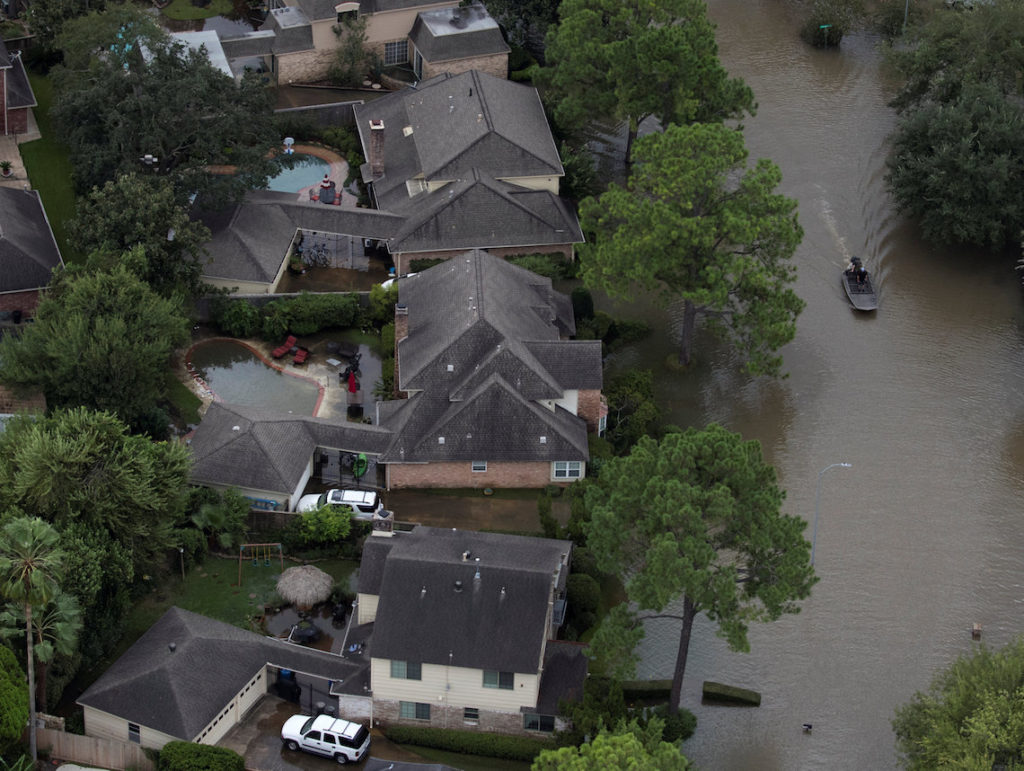
We had lightly prepared for the flood with some extra batteries, food and water, but now that it looked like the waters were on their way in, we set to work. First, we brought the important documents upstairs. Then, we brought up everything else we could lift. The floodwaters were still rising. The water filled the street, the sidewalk, our front yard … it was a river from our doorstep to the doorstep across the street. We were trapped. It was time to shelter in place.

It was time to consider survival strategies. The limbic brain kicked in. Ten people and a dog. Food! The power had gone out hours before. The food in the fridge would go bad at some point soon. Let’s cook the chicken! We’ll need protein to survive. We have a gas stove and matches. No electricity necessary.

We cooked all the chicken from the freezer to start our survival adventure on full stomachs. We turned on our flashlights, set the table, and sat down do eat our last hot meal before the floodwaters breached the front door. Ten people and a dog. We ate, went upstairs, said goodnight to our neighbor-guests, and comforted the children. We were ready for the flood.

The floodwaters never came in. The following day, the waters began to recede and we were able to evacuate until power and safety were restored. We were some of the lucky few. Yesterday, I checked in with one of our neighbors. His home was demolished and he and his family were loading up a U-Haul truck with the few possessions that had survived. We exchanged a few polite comments. Like the rest, he reassured me that, “It’s just stuff,” and he thanked me for my hospitality.

Then, he reported that his church took in water and asked me about my synagogue. I told him that it was dry, and with a tinge of survivor’s guilt, I added, “I can’t explain it.” He replied, “C’mon, rabbi, I think we both know what happened … ” I smiled uncomfortably at the suggestion that because of my rabbinic status, God had protected my family and me, my home and my synagogue from the flood. I smiled and politely took my leave.

On the short walk back to my dry home, my neighbor’s comment inspired my first opportunity for rabbinic reflection. There had actually been a moment before the flood that might have been appropriate for prayer. We were gathered around the table, eating what we thought might be our last full meal together before we went into flood survival mode. I could have gathered us in prayer. I even recalled it having crossed my mind. But I didn’t. I didn’t pray to God to save my home from the water. I was occupied with my preparations. I was occupied with the safety of my family. I was preparing my house for the flood. I was wrapping the couch in tarps. I was gauging the height of the water. I was texting the authorities to prepare an evacuation plan in case the floodwaters reached the second story of our house or we ran out of food. I was not in prayer mode. Except for once … when it was time to sleep.

The guests were set up in their rooms. My wife and our four girls (including our dog, Jessie) were in Ariella’s room, and my son, Jake, and I were in his room. The house was quiet and it was still raining. I told Jake that if by some crazy chance we didn’t flood the next morning, I was going to put on my tefillin and daven the most grateful and heartfelt Shacharit of my life. And that’s what I did.

We don’t pray for God to work for us. We pray for us to work for God. We don’t pray for God to modify the laws of physics and the science of meteorology. We pray to God to help us intensify our response and our compassion and our empathy. Our rabbis teach that planet Earth acts independently of God’s will. In the Hebrew, the rabbinic quote is poetic: “Olam noheg k’minhago.” It translates to something like, “The world turns on its own” or “The world pursues its natural course.”

During a flood is not a time for prayer. As Moses learned before crossing the sea, when it’s time for action, we don’t stop to pray. During a flood is time for action. But, after the flood, for the overwhelming relief effort, prayer is essential.

Before Shabbat, as we were preparing for last night’s service, I turned to Cantor [Mark] Levine and asked, “Are you sure we should be doing this right now? Maybe we should all be helping someone clean out their house.” In the end, it’s a judgment call, and I’m still not completely convinced we should all be here, but I do know this. There is some deep truth to the flood survivor chorus we’ve been hearing: “It’s just stuff.”

The floodwaters came and went. We mourn the loss of over 40 lives. And we who are here today … survived. And now, the relief effort and the healing and the mourning are just beginning. It is a process that will take a long, long time. Today, the process begins, and we’re going to need everything that religion has to offer to rebuild. We’re going to need everything that community has to offer to rebuild our synagogues. We’re going to need everything that prayer has to offer to give us the strength and the determination and the constancy to rebuild our homes.

We’re going to need chesed. We’re going to need leadership and unity. We’re going to need God and all the goodness that God represents. We’re going to need God and all the goodness that God manifests in this world.

Ribono Shel Olam, we have felt separated from You. You have hidden Your face. The deep, dark waters of chaos rose up and smashed Your handiwork of order and justice. Help us to find our way back to You, Adonai, our Rock and our Redeemer. For those affected by the flood, we pray for restoration and healing.

For those not affected by the flood, we pray for strength and determination and wisdom. We pray for compassion. We pray for understanding. We pray for the ability to help others and keep ourselves free of judgment; to meet needs that are rational and nonrational, defined and undefined, typical and idiosyncratic. We pray for mercy and lovingkindness.

And hey, God, this may run counter to the sermon I just delivered, but some sunshine and a cool breeze couldn’t hurt. And together we say: Amen.


Rabbi Ranon Teller is the spiritual leader of Congregation Brith Shalom in Bellaire, TX. Reprinted with permission of author.

Shabbat morning sermon, post-Hurricane Harvey Read More »
Georg Citrom: A Life Transcending Generations

Every generation has its own unique experiences; each new generation receives memory’s inheritance in its own way.   We live in an increasingly mobile and global world, where just two generations can span continents, wars, economic hardship and success; migration and displacement; loss and growth and change. Our identity, which is both fixed and fluid, adapts and changes rapidly as we move physically, economically and socially; our chameleon instincts enable us to survive in new and changing environments. 

Perhaps no group demonstrates the relationship between life lived and memory transferred more than the rapidly reducing number of Holocaust survivors, who every day pass the baton of memory to their families. 

Georg Citrom was born in Romania in 1931.  By the time he was just fourteen he had experienced life in the Oradea ghetto and had survived both Birkenau and Buchenwald – schooled, as some survivors say, in the hardest university of life. He could have been an angry and bitter man; after all, everyone he had grown up with, and all those he had loved, were turned to ashes during the Holocaust. But Georg chose a higher path. Dignified, hard-working and humble, he labored his way from teenage refugee to successful businessmen in his adopted Sweden. His wife Elisabeth, also a Holocaust survivor, raised their two children Evelyn and Joel in a Swedish culture devoid of Jewish influence, yet imbuing in them a keen sense of their Jewish identity.  Evelyn settled in Israel where she still lives today.  Joel settled in the United States, where, after graduating from the University of Southern California, he made a successful business career in New York. Joel’s wife Ulrika, also a daughter of a Holocaust survivor living in Sweden, raised three beautiful children with both Swedish and American citizenship, acutely aware of their deep connection to Israel and their European Jewish identity.  They are a truly global family, just two generations on from the moment the Nazis intended to eradicate their lineage entirely. 

I had several opportunities to spend time with Georg and Elisabeth Citrom, most recently in their home in Stockholm, where they married over sixty years ago. They bestowed me with affection as if I were a part of the family, and lavished homemade fare over a laden Shabbat table, as if I had not eaten for a week. I was enveloped by the warmth of their home and their deeply giving souls. As I left them and stepped into the chill night, I wondered how people who had experienced such darkness could become such shining beacons of humanity.  

This week I was with Joel, Ulrika and family enjoying the Labor Day weekend, when news came through that Georg had suddenly and unexpectedly passed away.  In the silence that ensued, I first felt that beacon flickering out, because for sure, no one can replace the man that was Georg Citrom. But then as I watched, I realized that his family are that light – they not only inherit his story, they are his story.

Should you walk into the reception of USC Shoah Foundation you will encounter a large life-sized photo of a Holocaust survivor surrounded by lights and cameras, documented while giving testimony.  The man in the photo is Georg Citrom on the day he gave testimony in 2010. Over 55,000 survivors and witnesses have given testimony to the Visual History Archive, but as chance would have it, that photo of Georg was picked out by our graphic designer to represent the experience of all of them in the lobby of the Institute.  

The day he gave testimony Georg brought together his traumatic past with his successful present and future legacy, and bequeathed it to his family, and all who are prepared to listen. The legacy that lives on in the story of his family bring together the Jewish community of Oradea; the lost souls of Auschwitz and Buchenwald; the power of survival; the strength of the refugee who thrived against the odds; the father who raised his children to be upstanding citizens of the world; the mortal whose final resting place will be in Israel the country he loved. As his family gather in Israel to say their final goodbyes, they will take on once and for all the bittersweet story of which they are an integral part.   

As Joel left for the airport to be at his mother’s side, he turned to me and said, “Please make sure you always save the photo of my father at USC Shoah Foundation.”  Alongside that photo is the statement in bold letters – “Every Survivor has a Story to Tell” – a story that transcends time, language, geography and generations.

 See the full testimony of Georg Citrom here.

Stephen D. Smith PhD is USC Shoah Foundation Andrew J. and Erna Finci-Viterbi Executive Director.

Georg Citrom: A Life Transcending Generations Read More »

Israel condemns North Korea nuclear test

Israel condemned the nuclear test conducted by North Korea calling it a continuation of the country’s “pattern of defiant activity.”

North Korea carried out the underground test on Sunday, later claiming that it had set off a  hydrogen bomb. The explosion was felt in South Korea and China, making it the most powerful bomb that North Korea has ever set off.

“North Korea must comply with all Security Council resolutions on this issue and refrain from testing and developing weapons of mass destruction and their delivery systems,” Israel’s Ministry of Foreign Affairs said in a statement issued on Monday. “Only a determined international response will prevent other states from behaving in the same way,” the statement also said.

Following news of the nuclear test, the Trump administration warned that even the threat to use such a weapon against the United States and its allies “will be met with a massive military response,” the New York Times reported.

President Donald Trump in a series of tweets also said that North Korea’s “words and actions continue to be very hostile and dangerous to the United States” and that “North Korea is a rogue nation which has become a great threat and embarrassment to China, which is trying to help but with little success.”

Trump also tweeted that the Unites States is considering stopping all trade with any country doing business with North Korea.

Israel condemns North Korea nuclear test Read More »

August 2017 NEWS: Honored to be Published

August 2017 NEWS: Honored to be Published

August 2017 NEWS: Honored to be published in Smithsonian, Saturday Evening Post & POPSUGAR

Lisa Niver published in Smithsonian MagazineYAY! It is time to CELEBRATE! Here are my latest published articles that I am so PROUD of:

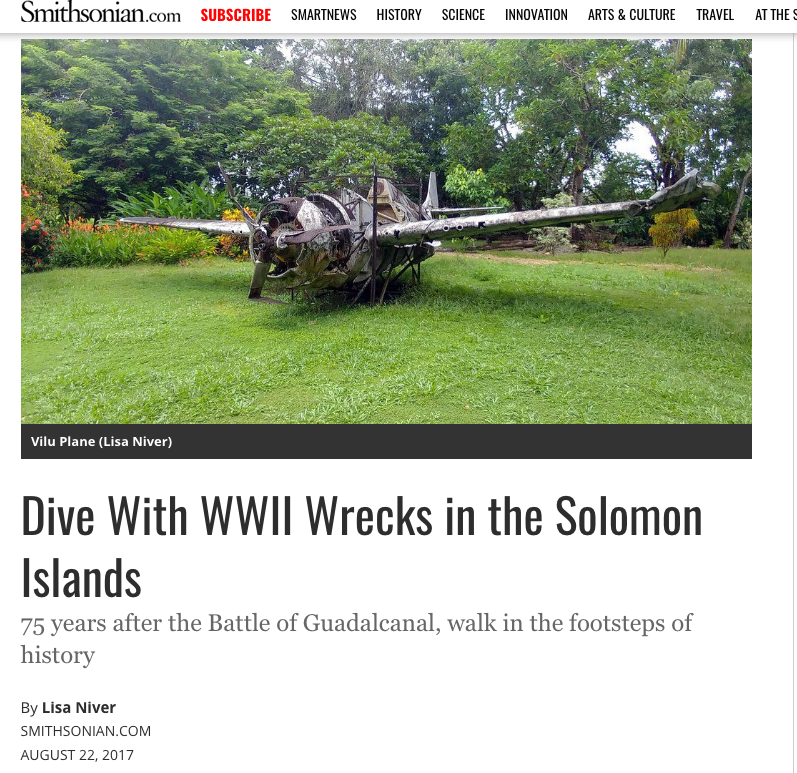
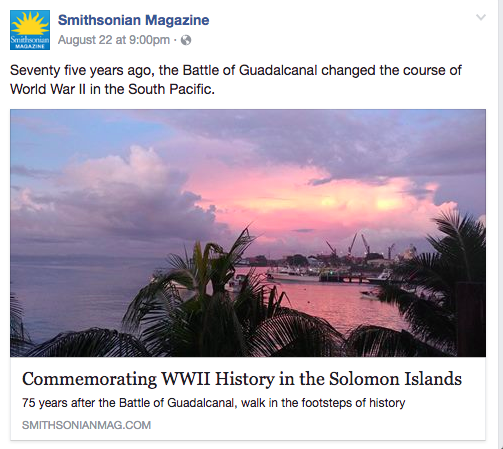
Thank you to SMITHSONIAN for sharing my story, “75 years after the Battle of Guadalcanal, walk in the footsteps of history.”  They included six of my videos from my visit to the Solomon Islands.

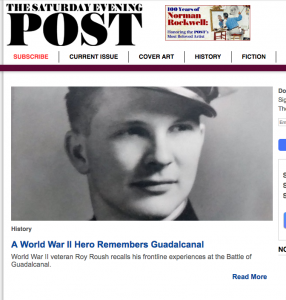
Thank you to SATURDAY EVENING POST for sharing my article   “A World War II Hero Remembers Guadalcanal” about Roy Roush.

August 7 marks the 75th anniversary of one of the most brutal battles of World War II, the Battle of Guadalcanal. World War II veteran Roy Roush recalls his experiences as a member of the 2nd Marine Division during frontline action at this critical campaign.

Thank you to POPSUGAR for sharing my story about being terrified on my first ever Mountain Bike Lesson. I still cannot believe I did it! Here is the article.

More stories about the Solomon Islands: Honiara, Gizo and Munda on my site and

  • MSN: 20 destinations that deserve more tourists: I am quoted about the Solomon Islands “Next month, the Solomon Islands will be celebrating the 75th anniversary of the Battle of Guadalcanal – one of the deciding battles in World War II – making it a special time to visit. What else does the place have to offer? “I went scuba diving, learned to make shell money, and spent time at a cultural village,” says Lisa Niver, travel expert and writer at We Said Go Travel.”
  • FOX TRAVEL NEWS: 9 amazing beaches you’ve probably never heard of: 3. Kennedy Island, Solomon Islands “Although it’s named for one of the most beloved U.S. presidents, Kennedy Island receives only a handful of American visitors each year. (It has just six reviews on TripAdvisor.) While the uninhabited island has great snorkeling, most visitors come for the historical significance. “JFK, who would be 100 years old this May, was stationed nearby when his patrol boat was struck by a torpedo and he swam to this island,” says recent visitor Lisa Niver of We Said Go Travel

Lisa is a Travel Expert:

  • interviewed for Moneyish: 5 Ways to Score Killer Hotel Deals: “Lisa Niver, a travel writer and contributor to USA TODAY‘s 10best column, tells Moneyish: “A lot of times there’s a secret deal price and that price is non-refundable. If your dates change, this can get you into trouble… [and] you can’t dispute the charge and get the money back,” even if you booked with a credit card. So, avoid too-good-to-be-true rates unless you are sure you won’t have to alter your travel dates later.4. Use a booking engine — but not just for booking. Niver also suggests using features like Booking.com’s Map function, which shows you where hotels are located in a particular place. Once you’ve found the one that best suits where you want to be, look into booking directly with the hotel to see if they offer a better price.5. Sign up for loyalty programs. These programs are a no-fuss way to rack up points and perks at leading hotel chains worldwide. Niver says bonuses include luxurious amenities like club floor access, and of course, these programs also help you build up a cache of money-saving points (which you can use to splurge on a dream vacation).
  • How Entrepreneurs Stay Positive and Productive:

    06. Lisa Niver (Travel Journalist and On-Camera Host, Founder of We Said Go Travel)
    – Every morning at breakfast I read part of a book to help me grow my business and inspire my focus for the day. Right now I am reading Unshakeable by Tony Robbins. I read books by nearly all the sharks on Shark Tank and my favorite was The Power Of Broke: How Empty Pockets, A Tight Budget, And A Hunger For Success Can Become Your Greatest Competitive Advantage by Daymond John.

  • THIS WEEK IN TRAVEL Podcast: Thank you to Jen Leo, Gary Arndt and Chris Christensen for inviting me to be on their podcast: THIS WEEK IN TRAVEL!

Where can you find my 749 travel videos?

Here are links to my video channels on YouTubeAmazon Fire Tv, and Roku Player. I hope you enjoy my “This is What it is Like” Episodes! I now have 749 videos, 622,897 views, 1444 subscribers on YouTube AND my total video views across all platforms is now over 1,250,000 (1.25Million)! Thank you for your support!

Find my new videos from my summer trip to Europe in my articles about Monaco (country 97), Ireland, Scotland (country #98) and San Marino (country #99)

Video #749 = Travel Media Showcase in Cabarrus, North Carolina. This conference brings together travel journalists and destinations! I went to the conference in 2016 for the first time and this year I was the GRAND PRIZE Winner for my coverage of Grapevine Texas in 2016.

Next month: Look for Video #750 My first ever Mountain Bike Lesson at NorthStar California Resort with Specialized Bike Academy!

Travel Writing Award: 

Thank you to everyone who has participated in our We Said Go Travel Competitions! Find the winners for the 2017 Inspiration Award here. We are publishing the entries from the 2017 Summer Independence Award. The Fall Gratitude Writing Award will open Sept 11 and close on Thanksgiving.

Travel Photo Award:

Our first ever Travel Photo Award is open! Thank you to our judges, Gary Arndt from Everything Everywhere and Jeana from Surf and Sunshine. Enter here Share your favorite shot! Why do you love it? How did you create it?  Submit a photo taken in the last two years. There is no fee to enter and there are cash prizes!

As my fortune cookies said: “You will find your solution where you least expect it.” and “Your talents will be rewarded and recognized within the month.” I was honored to win a journalism award in June and again this month in August! Thank you for years of support, kindness and sharing your hope with me that I could really make my dreams come true! If you have suggestions for my country #100, let me know! 

Thank you to Stephen Wise Temple for recognizing me for my Southern California Journalism Award for my column in the Jewish Journal!

Thank you for your support. Lisa

Discover more on my social media accounts:  InstagramFacebookTwitterPinterestYouTube.

What do you think of my new site? LisaNiver.com

August 2017 NEWS: Honored to be Published Read More »