It’s hard to root for an attitude. It’s a lot easier to root for an ideology or a team.
More and more, politics has become a “rooting for my team” phenomenon. No matter what happens in the world — even the shooting of U.S. lawmakers — Democrats and Republicans will try to turn it to their advantage. “Partisan animus is at an all-time high,” said Shanto Iyengar, a Stanford political scientist, to the New York Times this week.
Politics seems to have taken over our lives. It colors how we judge people, how we choose friendships, how we experience culture, how we judge ourselves.
How did politics become so all-consuming?
If you ask me, I think it starts at the top. Our last three presidents, from Bush to Obama to Trump, all wanted to play God. Regardless of their differing ideologies, they thought they could transform the world in their image. Instead of making politics more humble, they made it more arrogant, as if politics and policy could solve everything.
No modern president has ever had the guts to tell the American people this simple truth:
“My fellow Americans: The pursuit of your happiness and personal fulfillment is not determined by whether you vote Democrat or Republican. Your vote does make a difference, but so does your character and your willingness to improve the little world around you. In fact, the success of this country is very much dependent on how you act within your families and communities.
“By all means choose your parties, pick your causes and cast your votes. But don’t let those votes define you or how you view our country. America is bigger than that, and so are you. Our government depends on you as much as you depend on us. Regardless of how you vote, will you embrace our liberty with a sense of responsibility? Will you see the humanity in those with whom you disagree? Will you honor your obligations as much as you fight for your rights? These questions are as crucial to our future as our debates about policy.”
Which politician could ever get away with such humility and honesty? Politics is the very opposite of humility. To win our votes, politicians must promise the moon and play to our weakness– to our secret desire to have others take care of our problems. They puff themselves up while diminishing their opponents. And the more they fight, the more entertaining the spectacle becomes, the more the media laps it up.
This dramatic brew of overpromise, hero worship and fierce combat, combined with the social media revolution, has conspired to make politics the pervasive cultural force it has become. Is it any wonder that friendships and families can break up over politics? We’re hypnotized by the team we’re rooting for. When our team is losing, we can easily succumb to anger and even rage. Some of us can lose our minds.
This is not to downplay the importance of policy. For people in dire need of help, and for many others, policy can mean life or death. But when we allow policy and politics to define us to the point that we can’t see the humanity or validity in any “other side,” we undermine the value of both politics and policy. It becomes more about power and winning. Go Lakers.
I’m hardly immune from such bouts of partisanship. I also have a tendency to root for “my team.” At the same time, I’ve noticed that some of my deepest friendships are with those on the opposite side of my political views. I’m not sure why. Maybe it’s because our political differences just accentuate the strength of our human connection.
As much as I love to follow the political scene, the question I try to ask myself is: What will make my life better and more meaningful? Is it to root for my team at the expense of everything else? Is it to block myself off from alternative or inconvenient views? Is it to expect from politics what it can never give me?
While I have my political preferences and I enjoy fighting for my views, I also know that politics has its limits. Politicians can promise me the world, and some of them can even do great things, but I know they’ll never come to my house to set up my Shabbat table or help me raise my kids or play some great music. Not even God can do that.
The subject sat there, surrounded by 23 nursing students from the School of Health and Healthcare at the Alexianer St. Hedwig Hospital in the former Jewish quarter of eastern Berlin. They examined her as if she were an endangered species, ready to be dissected. Some had never encountered such an organism before. After all, in Germany, her type had been endangered for some time.
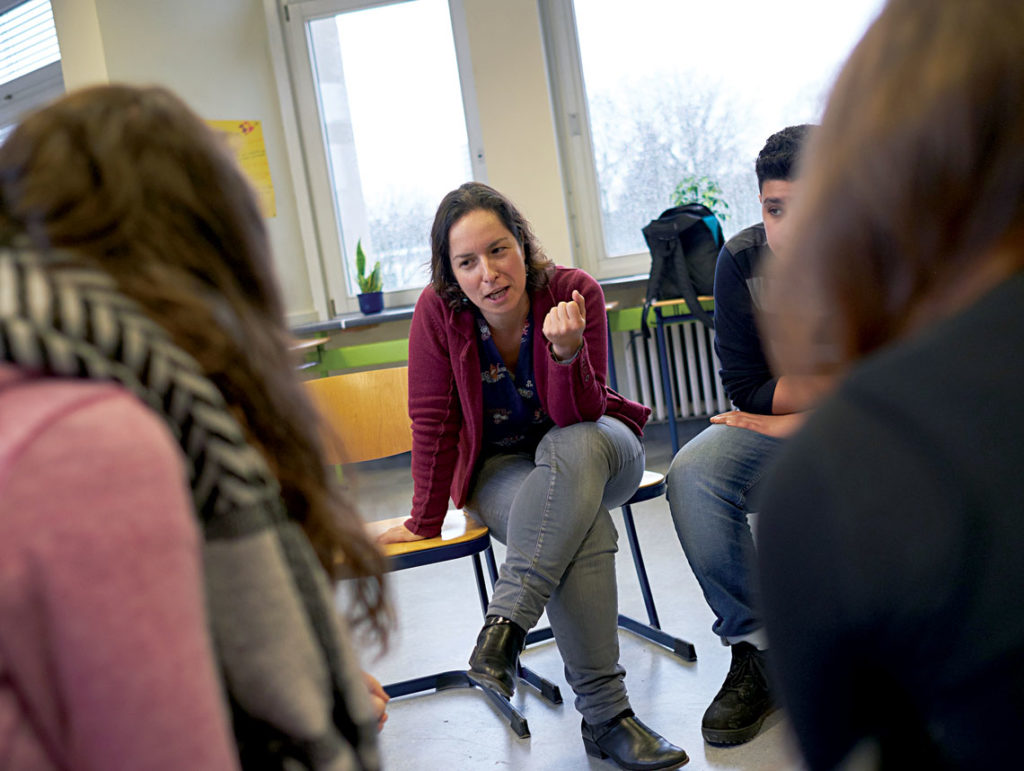
The center of curiosity was Juna Grossman, a 40-year-oldJewish woman born in the former East Berlin. Her grandparents survived the Holocaust, saved by a German family who hid them in southern Germany. With her long, dirty-blond braids and hazel eyes, she sat there, smiling and patient, ready to take questions, as a Jew “rented out” through a German-Jewish program called Rent a Jew.
With its controversial name, Rent a Jew both objectifies and at the same time humanizes what for many young Germans is a novelty: a living, modern Jewish person.
“It’s a bit ironic, but we thought we would embrace the irony in the situation,” said Alexander Rasumny, coordinator of Rent a Jew.
The name, he said, is a provocative description of a speaking bureau of Jews from all walks of German life who are available to German schools and institutions to educate non-Jews about Judaism and to dispel stereotypes and prejudices that have been linked to Jews for centuries.
“We were thinking how to try to change the image of Jews in Germany for the better, and we thought direct contact is the best way to do that,” Rasumny said.
Rasumny co-founded Rent a Jew in 2015 while working as a project manager for the European Janusz Korczak Academy, a Munich-based partner of the Jewish Agency for Israel that seeks to reinforce Jewish identity in German-speaking countries. Rent a Jew has conducted more than 30 sessions across Germany. The 50 to 60 Jewish participants represent a cross section of the German-Jewish population and undergo a screening and training process.
The Rent a Jew website explains its rationale this way: “Talk to us, not about us. We don’t give lectures on Jewish history or religion as experts but talk about what it’s like for us to be a Jew in Germany. Above all, we encourage people to ask questions and yes, voice those stereotypes like: Are all Jews rich? Do they control the media? Or are they really the chosen people? Most importantly, people can talk with Jews instead of only talking about them.”
Photo by Orit Arfa
Rent a Jew is not the first effort to market Jews playfully as a product. A 2013 exhibition on Judaism at the Jewish Museum in Berlin drew criticism when it exhibited “Jew in a Box,” in which alternating Jews sat in a display case to field questions from the public.
Dani Kranz, a Cologne-based anthropologist and expert in Israeli migration to Germany, applauds such tongue-in-cheek attempts to educate Germans about contemporary Jews and Judaism.
“I would say the mere attempt to represent oneself, to take charge, and to communicate as an individual Jew and individual human being is direly needed because Jews are exoticized,” Kranz said. “In some respects, it’s painful to see because it makes the assumed difference between Jews and non-Jews blatantly clear, but it should be addressed.”
And not only for Jews. Kranz, a German-born Jew, said the Arabs and Muslims in her social circle also encounter prejudices and misconceptions.
“There should also be a program for Rent a Muslim or Rent a Palestinian,” she said, although she conceded that the Shoah makes some Germans believe they must handle Jews with special gloves.
When Hitler came to power in 1933, half a million Jews lived in Germany, more than 150,000 of them in Berlin. While the 500,000 accounted for less than 1 percent of the country’s population at the time, many stood out as leaders in academia, banking, media, industry and business. Early 20th-century Berlin was home to some of Jewry’s leading minds, including Albert Einstein, philosopher Martin Buber and scholar Gershom Scholem. They built on a Jewish-German intellectual tradition started in the 18th century by celebrated philosopher Moses Mendelssohn.
After the Nazi atrocities of World War II, fewer than 20,000 Jews remained in Germany, about 8,000 in Berlin. By the time the Berlin Wall fell in 1989, the country’s Jewish population had grown to nearly 30,000.
After Germany’s official reunification in 1990, the new government welcomed Jews from the former Soviet Union to re-establish the community Hitler had decimated. Russian immigrants and their children, such as Rasumny, form the bulk of Germany’s Jewish population, which today stands at more than 100,000 — maybe as many as 200,000. (Precise numbers are elusive because the German government does not require citizens to reveal their religious affiliation, and the dogged question of “Who is a Jew?” further complicates an accurate count.)
According to Grossman, the Jew who visited the nursing students at Alexianer last month, most German students today do not learn the full history of Jewish life in Germany and, instead, focus on the attempted Nazi genocide.
“When you ask Germans what they think when they think of ‘Jews,’ you always have the Holocaust or the typical ‘black-hat Jew,’ ” Grossman told the Journal before her talk at the hospital. “That’s not the reality, is it?”
She said she believes Holocaust education is diminishing in some German curricula as instruction about this time period competes with that of the Cold War era.
Born under communism, which suppressed religious practice, Grossman “returned” to Judaism after the fall of the Berlin Wall, studying at the historic Oranienburger Strasse Synagoguein the former East Berlin,led by a female rabbi and best known for its restored golden dome.
As a program speaker and blogger on Jewish life in Germany, Grossman invites questions from German students that don’t dwell on the Holocaust. In fact, she said, she looks forward to when the Holocaust plays less of a role in Jewish identity and perceptions in Germany so she can feel the ease and normalcy she felt as a Jew living in Boston for several years.
“Here, when you meet somebody not Jewish and you ‘out’ yourself as being Jewish, you get reactions like: ‘Oops, how do I behave now?’ ” she said. “It’s a strange glaze in the eyes, and sometimes they say something about their grandparents.”
Julia Engelhardt, a nursing instructor at Alexianer, heard about Rent a Jew on German television and immediately decided to try it for a class on world religions.
“We thought it would be good for them to know things they should or shouldn’t do if they have Jewish patients,” Engelhardt said before the class with Grossman.
Grossman began her session with an introduction about her German-Jewish background. Across from her on the wall was a statuette of Jesus on the cross; to her left, a model skeleton.
Students slowly raised their hands to ask questions about Jewish life and death, unrelated to the actual life and death of Jewry in the neighborhood of the hospital — a former Jewish quarter, something most students did not know.
Just a few blocks away, on Grosse Hamburger Street, is the memorial site for the Jewish Home for the Aging that the Nazis converted to an assembly camp for deporting 55,000 Berlin Jews. Behind it is the Jewish cemetery that dates back to 1672, where Mendelssohn was buried.
The class included some foreign students, including one from Poland who asked: “What do Jews do when someone dies?” Grossman explained burial and shivah mourning rituals.
“Why do Jews step on a glass cup at a Jewish wedding?” asked an African student. Grossman explained it commemorates the destruction of the Temple.
Grossman’s favorite question came from a German man to her left: “Do Jews believe in an afterlife?” She explained that Judaism differs from Christianity in its lack of emphasis on heaven and hell, although the student said he is comforted by the idea of a paradise in the next world.
“I liked it the most, as he was very respectful and just accepting my other view on things,” Grossman told the Journal. “That’s not really common for Christians, I mean for real active ones. Usually, they seek to convince you of their belief.”
Not all Rent a Jew sessions run so smoothly.
Nirit Bialer, founder of Habait (The Home), a Berlin-based organization that seeks to expose Germans to Israeli culture, was taken aback by some of the stereotypes and misconceptions she encountered from a seventh-grade class at a school in Neukölln, a Berlin district with a large immigrant population.
“There were a lot of kids there with Muslim backgrounds, kids with parents coming in from the Middle East,” Bialer said. “That was a different experience. A lot of politics involved; people confused ideas about Judaism, Israel. Everything was intermingled together. There were many facts they were not sure about.”
She recalled how one student asked if Hitler and the Zionists worked together, while another asked what the Palestinians did so wrong to the Jews.
“It was not an easy situation for me personally, since you are being pulled into the Middle East conflict when trying to talk to a class about Judaism,” Bialer said.
Her previous Rent a Jew appearance had occurred at an adult education class in which participants — curiously and courteously, she said — asked about her experience living in Berlin as an Israeli. Bialer represents a relatively new but significant component of Jewish life in Germany: Israeli expats, although the number of them living in Berlin is difficult to determine. Estimates range from 7,000 to 20,000.
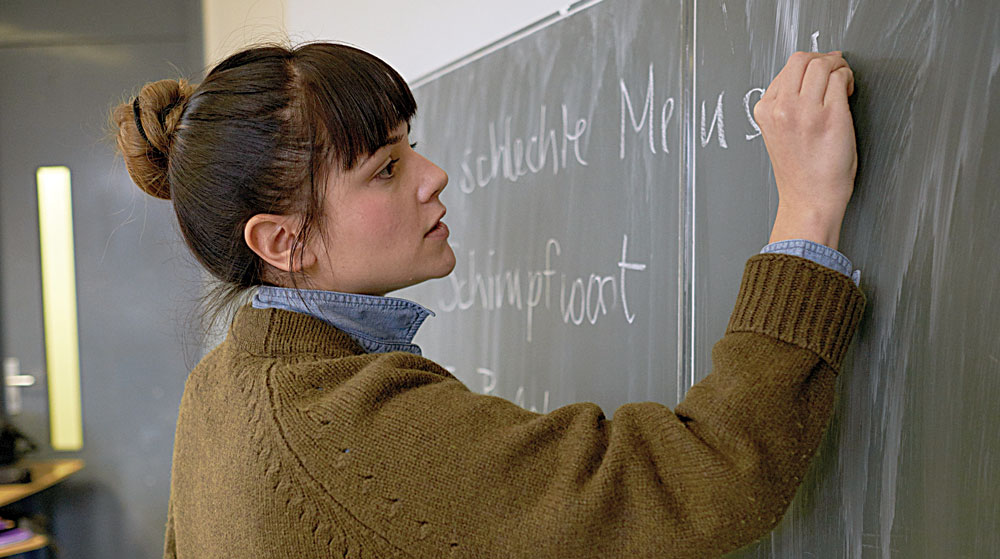
The turning point during the Neukölln session came when her fellow “rented” Jew, a Russian-born woman named Esther Knochenhauer, told the class that she works as a booking agent for German rappers.
“Some of the kids that were talking to her were like, ‘Wow. That’s a cool Jewish girl.’ ”
That’s when the ice broke and the class’ Jewish visitors truly were humanized.
Esther Knochenhauer, a Russian-born Jew who accompanied Nirit Bialer on her school visit in Berlin, writes on the classroom chalkboard. Photo by Gregor Zielke
Increasingly, the Rent a Jew program is bringing knowledge of Judaism to a population generally untouched by the Shoah: first generation and nonnative Germans.
“The students in Neukölln, now, demonstrated a pattern of seeing Jews only through the lens of the Israeli-Arab conflict, which is not uncommon in migrant communities, particularly with an Arabic, but also Turkish, background,” Rent a Jew coordinator Rasumny said.
These communities initially encounter anti-Jewish and anti-Israel propaganda at home, through Arab-language television or Islamic and Turkish nationalist youth organizations.
“So we have to reach them while they’re in the school and at least somewhat open to arguments,” Rasumny said. “The same goes for students who grow up in households with parents holding populist or far-right views. The number of such households should not be underestimated. And, of course, there also is a very distinct left-wing anti-Semitism, which is mostly Israel-related.”
A recent report from the German parliament found that 40 percent of Germans hold anti-Semitic views expressed by hostility toward the Jewish state. Most program participants, however, as with the Alexianer students, were apolitical and limited in knowledge.
Nursing students Elise Senst and Kate Kalhol, both 21, said they came out of the Alexianer session feeling intellectually enriched.
Both grew up in Brandenburg, one of Germany’s 16 federal states, on the outskirts of Berlin, and neither has Jewish friends. At first, they were confused by the program’s name, Rent a Jew. Kalhol had been to the Jewish Museum in Berlin, while Senst received general knowledge of Judaism as a youth. As third-generation Germans from the Nazi era, the Holocaust is not necessarily their immediate association with Jews.
“In my circle of friends, it [the Holocaust] is not even there,” Senst said, although her grandmother lived through the Nazi period and told her stories of Jews fleeing. “I have a couple of friends who did social work in Israel, but they didn’t go because of the Holocaust and that part of German history, but for the country itself. It’s there. We can’t forget about it, but it’s not on top anymore.”
Senst was most surprised to learn that Jewish identity is not dependent on belief in God, as Christianity is.
“I really enjoyed the communication, but the strange thing to me is that if you decided to believe in the Jewish religion, that all the following generations will be Jewish even if they don’t believe in it,” Senst said.
Kalhol said she is inclined to separate Judaism from Israel, while Senst associates Israel with the Jewish people. By showcasing both Israeli and Diaspora Jews, Rent a Jew seeks to discuss the distinction between Judaism as a religious identity and a national one.
“If I meet an Israeli, I’m going to ask what the country’s like, what life is like there, maybe I would also ask if he’s Jewish or what kind of religion he belongs to, but that’s another stereotype,” Kalhol said.
At Alexianer, Engelhardt, the nursing instructor, said she was pleased with the program, especially for clarifying differences between Jewish rituals and practices and those of other religions.
“For example, Juna [Grossman] said that if a Jew dies, don’t lay their hands like a cross the way Christians do, and this is a kind of sensitivity you could have also with other religions,” she said.
Engelhardt said Alexianer will be a repeat customer. She already has booked Grossman again, proving that the name of the program can succeed in challenging another stereotype: Jewish greed.
Secretary of State Rex Tillerson retreated from his department’s commitment to fill the post of envoy to combat anti-Semitism, saying the effort may be more effective without one.
“One of the questions I’ve asked is, if we’re really going to affect these areas, these special areas, don’t we have to affect it through the delivery on mission at every level at every country?” Tillerson said in testimony Wednesday to the foreign operations subcommittee of the U.S. House of Representatives Appropriations Committee. “And by having a special envoy, one of my experiences is, mission then says, ‘oh, we’ve got somebody else that does,’ and then they stop doing it.”
Since Congress established the position with a 2004 law, the role of the envoy has been to train career State Department officers and diplomats in identifying and combating anti-Semitism and to encourage embassies and bureaus to more closely monitor anti-Semitism. The envoy has not functioned as a stand-alone entity but rather is part of the Bureau of Democracy, Human Rights and Labor, and supervises about five career State Department staffers.
European Jewish community officials have said that having an envoy has delivered a message to their governments that the United States is focused on anti-Semitism.
At the subcommittee hearing, Rep. Grace Meng, D-N.Y., asked Tillerson for a timeline for the hire. Earlier this year there were reports that the Trump administration, eyeing massive budget cuts to the State Department, planned to eliminate the role. National Jewish groups and Congress members expressed outrage, and in April a State Department spokesman told JTA that the department did not in fact plan to eliminate the position and was reviewing candidates to fill it.
Lawmakers have noted that because the role was created by statute, the Trump administration cannot eliminate the post. Tillerson said he would seek to persuade Congress to cut the position if he deems it necessary.
“Those that are mandated by statute, we will be back to talk with you about those as to whether we think it’s good to have it structured that way or whether we really think we can be effective on those issues in a different way,” he said at the hearing.
Rep. Nita Lowey, D-N.Y., the ranking Democrat on the foreign operations subcommittee, was appalled by the possibility of the position being eliminated.
“It is outrageous and offensive that Secretary Tillerson would even suggest appointing a Special Envoy for Monitoring and Combating Anti-Semitism is unnecessary, particularly given that his State Department committed to filling the post back in April,” she said in an email to JTA. “As reports of hate crimes against Jews continue to rise in the United States and around the world, it is essential that Secretary Tillerson fill the Special Envoy position immediately.”
Bipartisan legislation under consideration would enhance the position to ambassador level.
“It is essential that the administration fill the position now more than ever, and we appreciate Congress to make sure the administration hears this message loud and clear,” William Daroff, the Washington director of Jewish Federations of North America, told JTA in an interview.
the plane opens its body to me I am alive
on the plane in the coffeeshop in bed in traffic
among the living I’m leaking then cracking open
here here here the alive splinter in me our
neighborhood everywhere How are you? alive
How are you? to be this this
tired one must be must be what
do I even like to eat? How are you?
She’s I say The way she said my name my whole name when I called these details
make life unbearable & without which meaningless
Rachel Zucker is the author of nine books, most recently, a memoir, “MOTHERs,” and a double collection of prose and poetry, “The Pedestrians.” Her book “Museum of Accidents” was a finalist for the National Book Critics Circle Award. She received a National Endowment for the Arts fellowship in 2013. Zucker is the host of the podcast “Commonplace: Conversations With Poets (and Other People).”
Until a few years ago, vibraphonist Terry Gibbs was the oldest performing headliner in jazz. But at 91, he decided to cover his vibes for good. As he told his friend, the late drummer Freddie Gruber, “I’ve worked every day of my life.”
Beyond that, he had fulfilled every professional ambition he ever had, and air travel had long since lost its romance for him. So, what is he doing with a new album, “92 Years Young: Jammin’ at the Gibbs House” (Whaling Sound), that’s making noise on the jazz charts?
“I got a set of drums,” Gibbs said, “because I did a lot of drumming as a young man and I missed it.”
Eager to play again, he asked his son, jazz drummer Gerry Gibbs, to invite a couple of musicians over to jam. Gerry, bassist Mike Gurrola, pianist John Campbell and Terry on vibes had a relaxed session at Terry’s Sherman Oaks home. A YouTube video of the proceedings was posted and it went viral.
Gerry’s label owner then persuaded Terry to tape an album at the house. “I’m amazed how it came off,” Terry Gibbs said, “because with a jam session, you never know what you’re going to get.”
To cite Gibbs for longevity is to damn him with faint praise — he’s had one of the most enviable careers in jazz. After working in the orchestras of Tommy Dorsey, Buddy Rich, Woody Herman and Benny Goodman, Gibbs led his own bands starting in 1950. New York’s Birdland was his home and the ubiquitous vibraphonist shared bills with the biggest names in jazz at places like the Apollo Theater and Savoy Ballroom.
“You used to see the posters and the ads,” Gibbs said. “Count Basie, Joe Williams, Sarah Vaughan and Terry Gibbs.” Later, he directed Steve Allen’s band for 17 years.
Born Julius Gubenko in Brooklyn, Gibbs was among the second wave of beboppers that included tenor saxophonists Stan Getz, Al Cohn and Allen Eager, trumpeters Red Rodney, Johnny Mandel and Shorty Rogers, baritone saxophonist Serge Chaloff, and drummers Shelly Manne and Tiny Kahn.
Though he no longer played professionally when he reached his 90s, Gibbs couldn’t just stop. “I played a lot of drums when I was a kid, in Jewish bands and in the Army, so I played drums for my own enjoyment,” he said.
His father was one of the busiest bandleaders in New York. “He’d play a bar mitzvah, a wedding and a dance in one day,” Gibbs said.
Young Terry played a couple of times with Naftule Brandwein, the legendary Ukrainian-born klezmer clarinetist. “I was young and I had a lot of energy,” he said, “and he’d turn around and yell at me: ‘Gubenko! You’re rushing!’ ” One of the few times Terry played in the Catskills resorts, the band included his sax-playing school chum, future White House counsel Leonard Garment.
And to say that playing with Goodman was a big deal would be an understatement. “Oh, Benny was bigger than Babe Ruth to Jews,” Gibbs said. “Benny was known all over the world. I have a letter of thanks he wrote me that he signed ‘Naftule Brandwein,’ because he knew I played with him; Benny idolized him.”
Gibbs moved to Los Angeles in the fall of 1957 to leave the road and work in the studio. But his ambitions weren’t satisfied by a few hours of recording work each week, so he began playing at now-forgotten jazz clubs in Hollywood, like Peacock Lane, Jazz City and the Sanbah.
Gibbs unwittingly became a catalyst for L.A. jazz when he tried his hand at leading a jazz orchestra. The Terry Gibbs Big Band attracted the area’s hottest players due to its loose decorum and relentlessly swinging Bill Holman arrangements.
“Everybody could solo on that band,” Gibbs said with amazement. “On the last number, I’d turn around to let somebody take a jazz chorus, and they were all looking at me like starving kids!”
So fabled has the band become over the years that it’s simply known as the Dream Band.
“The funny thing is,” Gibbs said, “people thought they were all studio musicians. Only trumpeter Ray Triscari got any studio work. Then a contractor came to see us and saw how they were all reading charts, and they started to get recording work.”
He’s proud of an obscure 1963 album, “Terry Gibbs Plays Jewish Melodies in Jazz Time” (Emarcy). “Quincy Jones produced it,” Gibbs said. “He came in wearing a yarmulke and a tallis! Lalo Schifrin came by with a box of matzos. I wanted to call it ‘Jew Jazz’ but they wouldn’t let me.”
Interestingly, it was black pianist Alice MacLeod, making her recording debut, who impressed Terry the most during the recording session. “She walked off with the honors,” he said. “She outplayed all of us. This was just before she became Mrs. John Coltrane.”
So, does the success of the new album mean Gibbs will reconsider retirement?
“No,” he said. “No more. I’ve been so blessed in my life. I’ve been lucky enough to play with everyone I ever wanted to play with. Besides, there’s no more Benny Goodman, Charlie Parker, Dizzy Gillespie or Max Roach.”
The nonprofit Jewish Women’s Theatre (JWT) was founded in 2008 to bring attention to voices within the Jewish community that don’t always get heard. Its plays have challenged stereotypes, often negative, of Jewish women or Sephardic Jews. Now, the company is turning its focus on the oft-derided millennial generation.
As the troupe approaches its 10th season, JWT artistic director Ronda Spinak said it felt right to “reach out to a younger population to share the wisdom that we’ve gotten over the last nine years about how to create sustainable theater that focuses on Jewish content.”
JWT has launched NEXT @ The Braid, a new arts council of artistic, theater-minded millennials with the help of a $150,000 Cutting Edge grant from the Jewish Community Foundation of Los Angeles. The funds allowed 12 fellows to spend nine months developing a Jewish-themed salon-style series in a theater production called “The Space Between.”
The show will be performed on June 21 at The Braid, JWT’s theater in Santa Monica, and will travel to a downtown Los Angeles loft, Congregation Kol Ami in West Hollywood and Westwood Village Synagogue on June 17, 22 and 25, respectively.
The show’s theme emerged from the tense political climate surrounding the 2016 presidential election and a conversation about the lack of dialogue between different groups. But the show also addresses the issues that 20-somethings in Los Angeles are thinking about.
“We are putting our finger on the pulse of the fact that we are millennials and we see the world — politics, relationships — differently,” said NEXT fellow Amirose Eisenbach, 31.
“The Space Between” is an hourlong play comprising about a dozen stories and songs submitted by members of the public and edited by the fellows. The stories range from humorous to serious. The characters include a young woman losing her mom to cancer, a woman who dates a man and learns he’s transgender, a woman who laments the difficulty of being “always the bridesmaid,” and a funny piece about a hookup gone wrong.
“We all have fears and dreams and feel like the outsider sometimes, but we’re all connected on that level of just wanting to feel like we’re not alone in this world,” Eisenbach said.
Another story is about a teenage girl who goes to a Torah dedication at an Orthodox cousin’s house in Lakewood, N.J., but feels like she can’t look cool wearing long sleeves and a long dress.
“She comes to understand that her cousin is the same age as her, though she wears things that are different and has things that are different, prays in different ways, but at the core they’re still the same, struggling to become adults, struggling to figure out who they are,” Spinak said.
Only some of the show’s content is Jewish-themed. Ten of the 12 fellows are Jewish. The show’s message is meant to be universal and speak to audiences of all backgrounds.
The salon-style show is stripped down, with five actors and no props or costume changes. The actors are dressed in black and sit on stools with their scripts. The intention is for the text and the acting to take center stage.
The fellowship offered training in how to adapt material to the stage and how to cast, direct and produce a theatrical event. All the fellows had input in the selection of the material, and each had a specific focus, ranging from directing to producing to marketing the show.
The program was created to give participants the skills needed to create meaningful work and advance their careers in theater, film and television. It’s also meant to help offset the widespread reduction in arts funding at schools and cultural institutions.
“A lot of younger people are working either one-on-one or in small groups or individually, and so they’re a lot more isolated,” said JWT Managing Director Sharon Landau. “Creating this arts council was an opportunity to create this community where they can collaborate with their peers and have both financial support and mentorship to make theater that’s relevant to their generation.”
The fellows in the program have a variety of experience, from acting in film, television, theater and web series, to hosting podcasts, playwriting and working as a singer-songwriter.
Eisenbach is a writer and producer who has worked at Warner Bros. and Fox Interactive Media, and she launched and ran the independent film division at AMC Theatres. She now has her own event and film company, Radiant J Productions.
“I went out on my own about two years ago because I wanted to make content that really mattered — that not just entertained but that really had social impact,” she said.
Another NEXT fellow, Andrew Fromer, 27, studied theater at UC Santa Barbara and worked for a theater group in Israel. He has acted in feature films, and he edits, directs and hosts his own podcast on the entertainment industry.
“What did I hope to gain? Just the crazy amount of skills that it takes to produce anything,” Fromer said. “Nobody really can concretely say what a producer actually does, and the reason is because a producer does everything,”
JWT’s audience members tend to be over the age of 50. Incorporating millennials into the theater’s creative process may bring in younger people who want to see their stories told onstage.
“We are about giving voice to various kinds of Jews and how we’re Jewish in the world, from various ethnic backgrounds to religious observance,” Spinak said. “So I’m proud and happy that we could put forth a millennial show that will debunk some of the stereotypes and myths surrounding this generation.”
“The Space Between” will be performed June 21 at The Braid in Santa Monica and travel to three venues across the Los Angeles area from June 14–25. For tickets and more information, visit this article at jewishwomenstheatre.org.
Britain’s chief rabbi offered prayers and a local synagogue put out an appeal to help the victims in the deadly fire that destroyed a high-rise apartment building in London.
At least six people were killed and dozens remain missing and are feared dead in the massive fire in Grenfell Tower in the western part of the British capital. Terrorism is not suspected in the blaze, which also injured more than 70.
The Holland Park Synagogue, located just blocks away from the apartment, early Wednesday morning asked its members to donate items to those affected by the fire. The synagogue in its appeal said “the people who lived in the tower have lost everything. Anything you can do to help will be much appreciated,” the news website UK Jewish News reported.
The synagogue said it would collect items, including much-needed toiletries, at its building.
“Images of #GrenfellTower are truly harrowing. My prayers today are with all affected & with the heroes running towards danger to save lives,” Chief Rabbi Ephraim Mirvis tweeted at 2 a.m. Wednesday as firefighters continued to battle the blaze.
Rent in the building is publicly subsidized, and many of the residents were low-income families or disabled people.
The Board of Deputies of British Jewry, an umbrella group, said in a tweet that it was exploring the best ways in which it could help the families displaced by the blaze.
The Holland Park Synagogue, located just blocks away from the apartment, early Wednesday morning asked its members to donate items to those affected by the fire. The synagogue in its appeal said “the people who lived in the tower have lost everything. Anything you can do to help will be much appreciated,” the news website UK Jewish News reported.
Our hearts go out to the victims of the terrible #GrenfellTower fire. We're speaking to Jewish/interfaith colleagues about how best to help
— Board of Deputies of British Jews (@BoardofDeputies) June 14, 2017
The synagogue said it would collect items, including much-needed toiletries, at its building.
Any author who writes a novel with the Holocaust as its setting bears a moral burden. “After Auschwitz,” as Theodor Adorno famously warned, “to write a poem is a barbarity.”
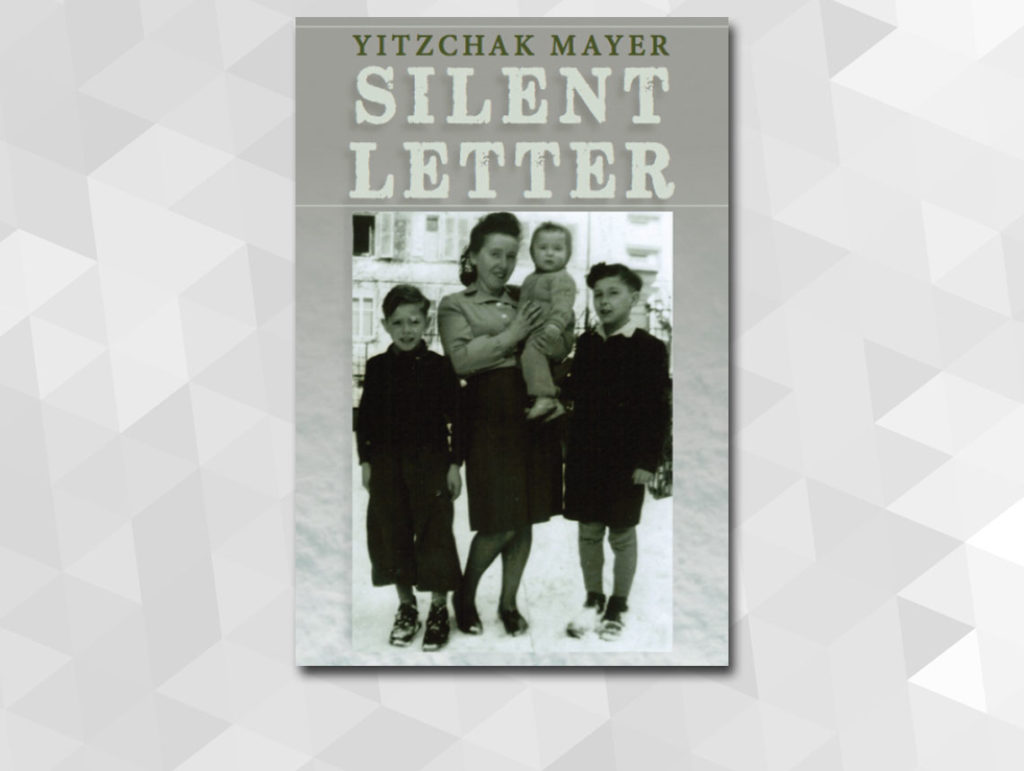
So I approached “Silent Letter,” a work of historical fiction by Yitzchak Mayer (Mosaic Press), with a certain caution. But I soon was won over by the tale that Mayer tells, an account of what it really meant — hour by hour, mile by mile — to save one’s life by seeking refuge in Switzerland.
Mayer brings to his book the credentials of a survivor. Born in Belgium in 1934, his family fled to France, where they were captured by the invading German army. His father died in Auschwitz, but his mother and siblings were able to reach Switzerland, and he made aliyah to Mandatory Palestine in 1946. Today, he serves as senior adviser with the Center for Strategic Dialogue at Netanya Academic College in Israel.
Translated from Hebrew by Binyamin Shalom, “Silent Letter” has the ring of truth precisely because Mayer’s fictional characters are patterned after himself and his family. The narrator, whose voice we hear throughout the book, belongs to his mother, Roszy, whose heart-tugging letters to her missing husband we are privileged to read.
Like all authentic testimony of the Holocaust, “Silent Letter” offers unsuspected details of exactly how one manages to survive. Before Roszy boards the train toward the Swiss border, she packs a block of laundry soap in which her husband had hidden a few diamonds. At his suggestion, she also carries a box of bleach “so that if they asked, I would just tell them I was on my way to do a load of laundry for myself and the boys.”
We learn, too, exactly what it meant to escape from occupied France to Switzerland. The family heads for a small town called Saint-Claude, which Roszy describes as “an open-air survival market teeming with the amateurish cunning, riddled with money-hungry rogues and traitors.” Her husband, who already has disappeared in night and fog, had supplied her with the Swiss francs that meant the difference between life and death.
But they are not yet safe: “There are things that no man knows which take place in wartime all along the train tracks, and no one knows the key to the code that governs them, buried there in the darkness, dictating unseen stations that do not appear on any schedule whatsoever,” muses Roszy. “Perhaps the trains are held up by spirits and demons.” And the demons whom they encounter are ordinary men in uniforms: “Your papers are in order, Madame,” a police officer tells her, “but you, Madame, are not quite right.”
So begins the ordeal. Roszy is separated from her children, who are placed in the custody of a local convent, and she finds herself in a prison hospital, where she addresses her thoughts to her missing husband. Her reveries amount to an extraordinarily rich autobiography, a recollection of her childhood in Hungary, the journey that took her Antwerp, and the war that forced the family to run. She is pregnant, and she broods over the peril that her unborn child is facing.
But she is not resigned to her fate, and Roszy manages to find an unlikely savior, a priest who also happens to be a physician at the hospital. “Where did this God of ours manage to find him?” she wonders.
Above all, she attests to the heartbreaking way that her two sons are scarred by what they are compelled to endure. “This huge, awful war that people refer to in terms of conquered lands and continents, wide seas and oceans, kings, presidents, government leaders and generals, attacks first and foremost the men, women and children whose names do not mean anything at all to anyone in the world.”
By giving a voice to his heroic mother, Mayer has honored not only her memory but her courage and strength. And, more than that, he has given names to those men, women and children who would otherwise be forgotten. Thus does Mayer discharge the moral duty that he took upon himself in writing “Silent Letter.”
JONATHAN KIRSCH, publishing attorney and author of “The Short, Strange Life of Herschel Grynszpan,” is the book editor of the Jewish Journal.
Looking back, it sometimes seems that momentous historical events — the American Civil War, World War I, the rise of Adolf Hitler — were inevitable, almost preordained.
Only on closer inspection do we discover how quickly enormous catastrophes could have been avoided through some minute circumstance — a missed meeting, a sudden stomachache or a speech that ended earlier than expected.
Such thoughts are at the heart of “13 Minutes,” which examines how a rural German carpenter, planning and working completely on his own, almost succeeded in assassinating Hitler. The attempt — a bombing that missed its mark by some 780 seconds — took place two months after the Fuhrer started World War II but before the conquest of Europe and before the Holocaust claimed the lives of 6 million Jews.
At the center of the movie by German director Oliver Hirschbiegel is Georg Elser. In 1938, he was a 35-year-old carpenter and talented tinkerer in a small Swabian village, where he played in the town band, enjoyed dancing and was popular with the local women. He had been a Communist sympathizer (but never a party member), who observed with growing concern how the Nazi ideology gradually transformed his village and its inhabitants after Hitler assumed power in 1933.
In the movie, Elser, portrayed by Christian Friedel, watches as a woman he knows is forced to sit on the street, surrounded by brownshirts and townspeople, with a sign around her neck that reads, “In the village I am the greatest swine and consort only with Jews.” (It rhymes in German.) He also sees a propaganda film in which Hitler proclaims that, under his rule, every German will have a radio — then a luxury — and the rutted village roads will be paved and lighted.
At a time when highly educated statesmen and pundits are maintaining that Hitler represents a temporary aberration or can be appeased, the carpenter becomes convinced the Fuhrer will plunge Germany into war — and that if nobody else will stop the Nazi dictator, he will do the job himself.
Elser’s plan begins with the knowledge that Hitler addresses his earliest followers at Munich’s largest beer hall every Nov. 8, the date of his foiled 1923 putsch to seize power in the Bavarian city as a base to overthrow the Weimar Republic. Starting in late 1938, Elser visits the beer hall repeatedly, taking careful measurements of the columns flanking the speaker’s podium. After getting a job in an armaments factory, he smuggles out explosives, dynamite sticks and detonators.
As the date for the next anniversary of the 1923 putsch gets closer, Elser labors night after night on his knees, holding a flashlight in his mouth to insert the homemade bomb into the column and connect it to clocks timed to trigger an explosion during what he expected to be Hitler’s usual lengthy speech.
On the evening of Nov. 8, 1939, two months after German troops invaded Poland to ignite World War II, Elser takes a train to the Swiss border and awaits news of Hitler’s death. There he learns that the Fuhrer had cut short his speech unexpectedly and departed for Berlin.
As history shows, exactly 13 minutes after Hitler left the podium, a powerful bomb exploded at the precise spot where the dictator had been standing, killing eight people, including, to Elser’s lifelong regret, a waitress.
As Elser tries to cross the border into Switzerland, something about his behavior and the contents of his suitcases arouses the suspicion of a German border guard, who arrests Elser and sends him to Berlin under guard.
Director Oliver Hirschbiegel. Photo from Wikipedia
Hitler is convinced that Elser is only a tool in a vast conspiracy orchestrated by the British government and demands that he be tortured until he reveals the masterminds behind the assassination attempt. Under the most brutal torture, Elser refuses to give even his name and birth date. Only after the Gestapo drags in his longtime lover, Elsa (Katharina Schuttler), who is pregnant with Elser’s child, does he acknowledge the plot, with himself as the sole author.
Nobody believes Elser’s story, but instead of being executed on the spot, he spends the war years in various concentration camps, ending up in Dachau.
In April 1945, as Hitler’s dream of a thousand-year Reich comes crashing down, the Fuhrer remembers Elser and orders that he be executed by a pistol shot through the neck. As shown graphically in the film, the order is carried out, two weeks before American troops liberate Dachau.
“13 Minutes” is the most recent example of German movies — including “Sophie Scholl: The Final Days” and “Rosenstrasse” — showing how individual German men and women stood up against the Nazi regime.
Hirschbiegel, speaking by phone from Vienna, explained that for at least two decades after World War II, most Germans tried to ignore the crimes of the wartime generation, and it took even longer to honor the civil courage of resisters such as Elser. But, he added, there are only a few resisters in every society who embody the spirit of freedom. As an American example, the filmmaker cited whistleblower Edward Snowden, who exposed thousands of secret documents concerning U.S. government surveillance.
“Snowden saw that something wrong was going on and if no one else would do anything about it, he had to do it himself,” said Hirschbiegel, whose filmography includes a remake of “Invasion of the Body Snatchers” as well as “Just an Ordinary Jew” and, perhaps most famously, “The Downfall,” recreating Hitler’s last days in a Berlin bunker.
He believes systems are in place in the United States that would prevent history from repeating itself here. “There are some parallels, but I do not believe that the United States, with its democratic roots and its freedom of speech and of the press, would allow a Hitler-like figure to succeed.”
As for today’s Germany? While members of the younger generation don’t want to hear more about the crimes of their forefathers, it’s crucial that they not forget, Hirschbiegel said.
“As Germans, we have to face it that we are the nation of perpetrators,” he said. “We can’t escape history.”
“13 Minutes” opens June 30 at Laemmle’s Royal in West Los Angeles and on July 7 at Playhouse 7 in Pasadena and Town Center 5 in Encino.
Not much had changed since Rafael “Rafi” Anteby was a little boy who played in
the sand.
Sometimes his immaculate apartment looks like a big sandbox with dozens of bowls filled with colorful sands, which he collects from around the world: purple from Big Sur and Idaho, black and green from Hawaii, red and yellow from Israel, golden brown from Myanmar.
Anteby, 52, who was born in Israel, is a Los Angeles artist who uses sand of different colors to make Hindu and Buddhist ritual symbols known as mandalas. It’s an ancient art form that represents the universe. Some of Anteby’s involve symmetrical designs, while others have featured figures such as a tiger or peacocks. Monks in Tibet work on their mandalas for months at a time, only to discard each one once it’s finished, spilling it into the water.
“It’s their way of letting it go back to nature. Part of the meditation is the practice of letting go,” Anteby said.
His first exhibition of mandalas in Los Angeles is on display Thursdays through Saturdays through July 1 at 929 E. Second St. in the Arts District.
Anteby’s process is different, creating his mandalas using dozens of sand colors, minerals, gold, diamonds and semiprecious stones from the Himalayas and gluing the sand into a canvas so it remains in place. Like the monks, he uses authentic artisanal tools over hundreds of hours to perfect the tedious process of funneling the sand through a metal flute.
His discipline to the practice drew the attention of the Tibetan Lama Adzom Rinpoche, an avid mandala-maker himself. The lama came all the way from Tibet for the exhibition reception on June 4. A portion of sale proceeds are being donated to the lama’s Buddhist institute that educates hundreds of children from remote villages of the Himalayas.
Anteby was drawn to the Far East at first through his fascination with kung fu. He was introduced to martial arts at 14 in Haifa.
“I was a small kid and was often bullied by the boys; even the girls beat me up,” he said. “As a result, I got involved with the bad crowd in town, a group of kids who were troublemakers and everyone feared them. It wasn’t that I was a bad kid, but I felt safer with them. One day, a kung fu teacher came to our school and talked to us about it, and I knew that this is what I want to do.”
Days after he finished his military duty in the Israeli army, he flew to Hong Kong to study with his kung fu master for two years. “I studied in a monastery-style school, 10 hours a day. I also led a life of a monk during that time — no women, no alcohol. I hardly left the place.”
After his two years in Hong Kong, he moved to South Africa and joined a friend, Lance Von Erich, a former American professional wrestler, who had opened a gym. He asked Anteby to help him.
“I was a martial arts instructor at his facility and ended up staying there for eight years,” Anteby said. “During that time, I won the South African championship in kung fu as well as the Shaolin world tournament for kung fu in China.”
Back in the United States, Anteby was diagnosed in 2000 with macular degeneration. He was told that he had one year before he would become legally blind. Anteby refused to accept the verdict. “I told my doctor, ‘No way, not in my book; it’s never going to happen,’ and he answered, ‘I appreciate your positive attitude, but I still encourage you to start thinking about what it’s like being blind, because it is going to happen.’ ”
Anteby found the name of an expert in Chinese medicine in Arkansas, flew to see him and stayed for two weeks, undergoing intensive acupuncture treatment. “After that, I went to see my teacher in Peking, who sent me to a 104-year-old teacher of qigong meditation, which I practiced for six months at the Wudang monastery,” Anteby said. “Only then I went back to see the doctor who diagnosed me. He examined me and was shocked to find out that the disease had disappeared.”
Anteby learned the art of mandala during his frequent visits to Nepal and Tibet, where he noticed monks working on them. “I approached one and asked, ‘ Can you teach me?’ The monk replied, ‘Can you learn?’ ”
At that time, Anteby already was an artist with a clothing and jewelry line called Bullets 4 Peace, which he started after a close friend was shot fatally in South Africa.
“I wanted to raise awareness about the perils of gun violence,” he said. “I took empty bullet shells and transformed the bullet from a symbol of fear to one of love and compassion. This is my way of spreading consciousness of peace.”
Anteby uses bullet casings taken from reload centers, streets and war zones, turning them into necklaces with symbols of peace and love. Among his customers are Jamie Foxx, Rihanna, Beyoncé, Chris Noth and Justin Bieber. Some of them, he said, participate at his annual charity event, which he established in 2008.
Not everyone appreciates the design of the necklaces, however. Airport security personnel have confiscated the items from Gloria Estefan, Snoop Dogg and members of the Pussycat Dolls as they were checking in for flights. (Anteby sent them new ones.)
In July, Anteby is planning another trip to the Far East, to study charcoal powder painting in Thailand, to work with monks in Nepal on a permanent mandala, and to do some sand carving in Myanmar. He also intends to distribute school supplies to orphanages and instruct children in tai chi, kung fu and meditation.
“I know how much it [kung fu] had helped me as a kid, how much self-confidence I received thanks to it,” he said. “It transformed my life for the better, and I know how much it can do for them, as well.”