Gili Dolev wasn’t especially studious as a young kid growing up in Binyamina. However, one of his teachers saw his potential and helped him pave his way to a successful career in animation. The road was not so easy. There were ups, downs, twists and turns but eventually, at 40, against all odds, Gili sold the first Israeli kids animation series to an international TV network, Nickelodeon.
Two Nice Jewish Boys had the privilege to sit with Gili and talk about his work, his career and the deal that changed his life.
With all the talk of renewed diplomacy in the Middle East involving Israel, the Palestinian Authority and Arab states such as Egypt, Jordan and Saudi Arabia, you can bet that one of the most emotionally charged issues will be the status of Jerusalem.
That’s why I looked forward to attending a recent multimedia presentation at the Museum of Tolerance titled “Jerusalem United: Fifty Years of Freedom, Three Thousand Years of Jewish History.” The presenter was Ambassador Dore Gold, a longtime senior Israeli diplomat, author and strategist, who now is president of the Jerusalem Center for Public Affairs.
Gold made a compelling case for the deep, uninterrupted, 3,000-year Jewish connection to Jerusalem. Using artifacts from biblical times, ancient scrolls, recent archaeological discoveries, legal documents from international bodies and other pieces of evidence that appeared on a large screen, Gold was like a trial attorney making his closing argument to a jury.
And like a good attorney, he didn’t skip the emotional part.
When I say emotional, I mean the sense of outrage Gold feels toward anyone who denies a Jewish connection to Jerusalem.
Gold didn’t go through the list of deniers, but we know the list is long. For example, in an August 2012 Jerusalem Post piece under the headline “Abbas Denies the Jewish Connection to Jerusalem,” Palestinian leader Mahmoud Abbas went as far as questioning the very existence of the Jewish Holy Temple, an affront to any historian, archeologist or biblical scholar. He also said recently that Jews have no right to desecrate the holy sites in Jerusalem with their “dirty feet.”
International bodies like UNESCO have had no problem passing resolutions denying a Jewish connection to the Temple Mount and the Western Wall. Even United Nations Security Council Resolution 2334, which President Barack Obama refused to veto, characterized the Western Wall as “occupied Palestinian territory.”
Gold is acutely aware of this pervasive movement to negate Jewish history and strike at the core of Jewish identity. Maybe that’s why he’s so obsessed with evidence. Discussing international efforts to delegitimize the Jewish state, he showed legal documents that he says makes Israel “the most legitimate state in the U.N.,” because it is “the only state whose legality was recognized even before it was founded by both the League of Nations and the United Nations.”
Gold also reminded us that attacks on Jewish legitimacy and identity are hardly new. “Let me tell you one last historical truth,” he said near the end of his presentation. “The Romans understood that to wage war and defeat their enemies, they needed to attack their identity, not just their physical bodies. After crushing the last Jewish rebellion against them, they renamed Jerusalem ‘Aelia Capitolina,’ and Judea was given a new name: ‘Syria-Palestine.’ They wanted to erase the memory of Jewish self-rule forever.”
Preserving and disseminating the truth of this memory is consuming Gold at the moment. Over lunch the next day, he spoke of the urgency of taking his “Jerusalem United” show on the road. “With all the talk of diplomacy right now, Jerusalem will be right in the middle of the discussions,” he told me. “It’s critical that the truth about the 3,000-year Jewish connection comes out loud and clear.”
I couldn’t agree more, but I hope he will accentuate an additional truth that is essential and often overlooked. It’s a truth that deals not with the time frame of 3,000 years but with the time frame of 19 years, between 1948 and 1967, when Jordan was in control of the holy sites of Jerusalem.
The Jewish connection to Jerusalem is not just good for the Jews, it’s good for the whole world.
Here’s what Gold himself wrote in his 2007 book, “The Fight for Jerusalem”:
“After seizing East Jerusalem in 1948, Jordan’s Arab Legion completely evicted the Jewish population from the Old City. The Jewish Quarter was set aflame, its homes were looted, and dozens of synagogues were destroyed or vandalized. Tombstones from the ancient Jewish cemetery on the Mount of Olives were converted into latrines.
“For the following nineteen years, Jews were prevented from praying at their holy sites, including the Western Wall. The Jordanians also barred Christian institutions from buying land and otherwise restricted the rights of Jerusalem’s Christian population, which dropped by over 50 percent during the period of Jordanian rule.”
Now compare those 19 years to what followed: “Upon capturing the Old City in 1967, Israel decided on a new approach to governing the city — it adopted a law protecting the holy sites of all religions and guaranteeing their free access to all worshippers.”
In other words, the Jewish connection to Jerusalem is not just good for the Jews, it’s good for the whole world. Maybe that’s how Gold should rest his case.
David Suissa is president of TRIBE Media Corp./Jewish Journal and can be reached at davids@jewishjournal.com.
This Sunday is the biggest night of the year for theater lovers: It’s the Tony Awards.
Unfortunately, our crystal ball is at the shop for repairs — so we can’t say with certainty who the winners will be. But there’s one thing that’s for sure: The past year has been a standout one for Jewish actors, characters and writers who are plying their talents on the Great White Way.
From a play about Israeli-Palestinian peace talks to a Broadway legend playing a Jewish cosmetics doyenne, here are seven shows with Jewish connections and themes that we expect to win big at the 2017 Tony Awards, which air Sunday evening on CBS.
1. “Oslo”
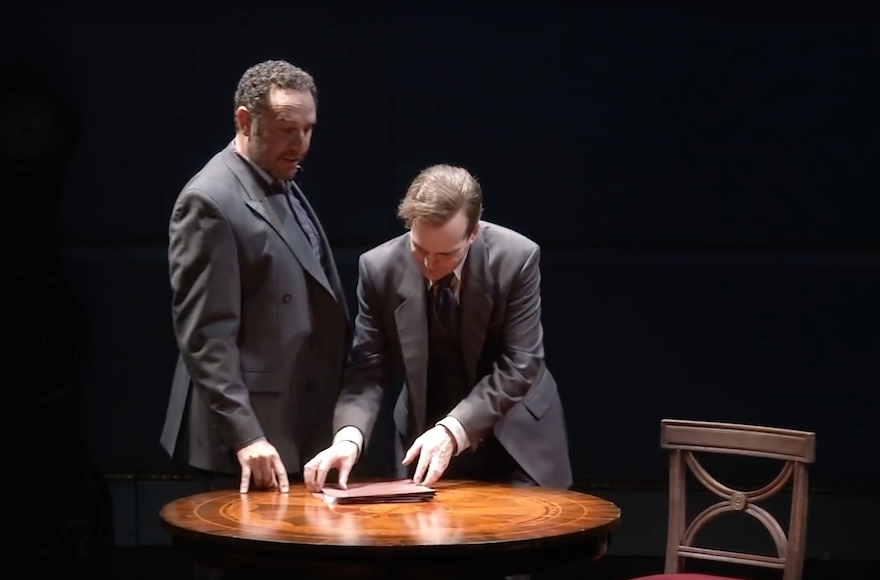
A scene from “Oslo.” (Screenshot from YouTube)
“Oslo,” J.T. Rogers’ play about the 1993 Oslo Accords, is widely considered the frontrunner for Best Play. It’s won nearly every theater award — the Drama Desk, the Lucille Lortel Award, the Outer Critics Circle, the Drama League, the New York Drama Critics’ Circle and the Obie.
The play, in which Israelis and Palestinian negotiators — including Uri Savir, played by Michael Aronov, who is nominated for Best Featured Actor in a Play — struggle to hammer out a peace deal, received rave reviews for turning a complicated history into a fast, entertaining three hours. What’s particularly impressive is how riveting “Oslo” is — even though it’s common knowledge how the peace talks ended.
“Oslo” has five more nominations: Best Direction of a Play (Bartlett Sher), Best Lighting Design (Donald Holder), Best Scenic Design (Michael Yeargan), as well as Best Leading Actor and Actress for Jefferson Mays and Jennifer Ehle, who play Mona Juul and Terje Rød-Larsen, the Norwegian couple overseeing the negotiations.
2. “Indecent”
Another Best Play nominee, Paula Vogel’s “Indecent,” may lack the momentum of “Oslo” — but also tells a very Jewish story. The play recounts the bumpy journey to Broadway of Shalom Asch’s controversial Yiddish play “God of Vengeance.” Seemingly ahead of its time, the 1906 play featured a love story between two women — one a prostitute and the other the teenage daughter of a religious man — and while it found success in Europe, the cast was arrested in New York for obscenity when the production moved uptown.
The play is also nominated for Best Direction of a Play (Rebecca Taichman) and Best Lighting Design (Christopher Akerlind).
Despite the nods, the play has been struggling to sell tickets: Vogel recently tweeted, “Please buy a ticket soon to ‘Indecent,’ asking your support. This show is the best I got in me. Want to share while we can.”
Please buy a ticket soon to Indecent, asking your support. This show is the best i got in me. Want to share while we can.
“Falsettos” may have closed in January, but this musical about neurotic Jews came away with five nominations, including Best Revival of a Musical.
The musical revolves around a selfish but likable man, Marvin, who tries to navigate relationships with his ex-wife, his boyfriend, his psychiatrist and his son, Jason. The second act takes place two years after the first, and centers around both AIDS and a bar mitzvah, which, in the play’s moving conclusion, Jason holds in a hospital room.
Brandon Uranowitz — the only “Falsettos” cast member who is Jewish — is up for Best Featured Actor in a Musical, alongside one of his costars, Andrew Rannells, who may be best known as Elijah from Lena Dunham’s “Girls.” (The other nominees are Christian Borle for Best Lead Actor and Stephanie J. Block for Best Featured Actress.)
If we’re lucky, maybe they’ll open this year’s award ceremony — hosted by Kevin Spacey — with a rendition of the musical’s opening number, “Four Jews in a Room Bitching.” That’s a fitting description of Tony night at my house.
4. “Hello, Dolly!”
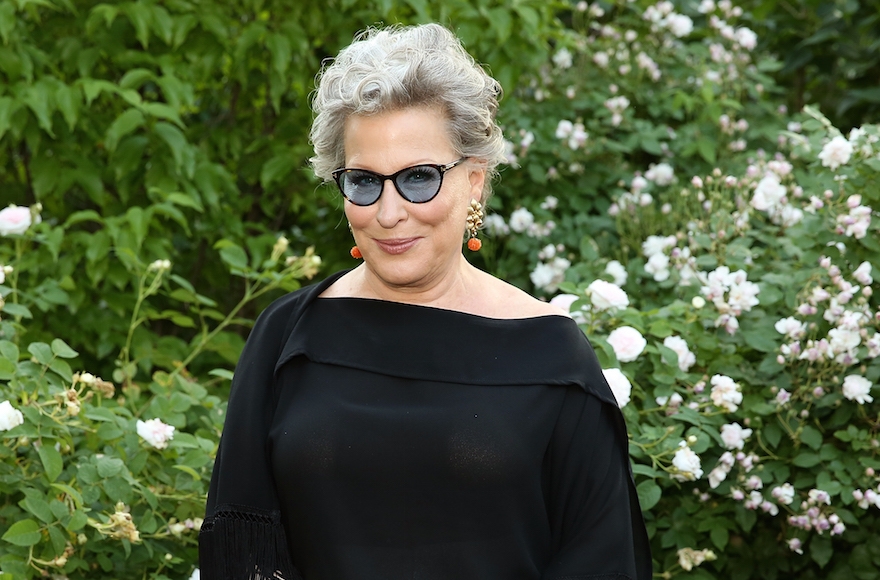
It’s so nice to have our favorite Jewish diva, Bette Midler, back on Broadway where she belongs — and almost everyone agrees.
As Dolly Gallagher Levi in “Hello, Dolly,” Midler has received nearly unanimous raves and is receiving multiple standing ovations a night, both during and after the show, and now she’s nominated for Best Lead Actress in a Musical. And while competition in this category is heavy on theater royalty — see: Christine Ebersole and Patti LuPone — it’s unlikely that anyone will beat the Divine Miss M, who plays a matchmaking meddler enlisted to find a wife for wealthy Horace Vandergelder (played David Hyde Pierce, also nominated), fully intending to marry him herself.
Bette Midler at the New York Restoration Project’s spring picnic at Morris-Jumel Mansion in New York, June 1, 2016. (Monica Schipper/WireImage)
“Hello, Dolly” is nominated for 10 Tony Awards, including Best Revival of a Musical. With only two competitors in that field —”Falsettos” and “Miss Saigon” — this widely-loved production is expected to win.
If you’re hoping to catch Midler singing a tune from the show, you’ll likely have to score a ticket — for which box-office prices top out at $748: Midler was deemed “unlikely” to sing at the Tonys this year.
5. “Dear Evan Hansen”
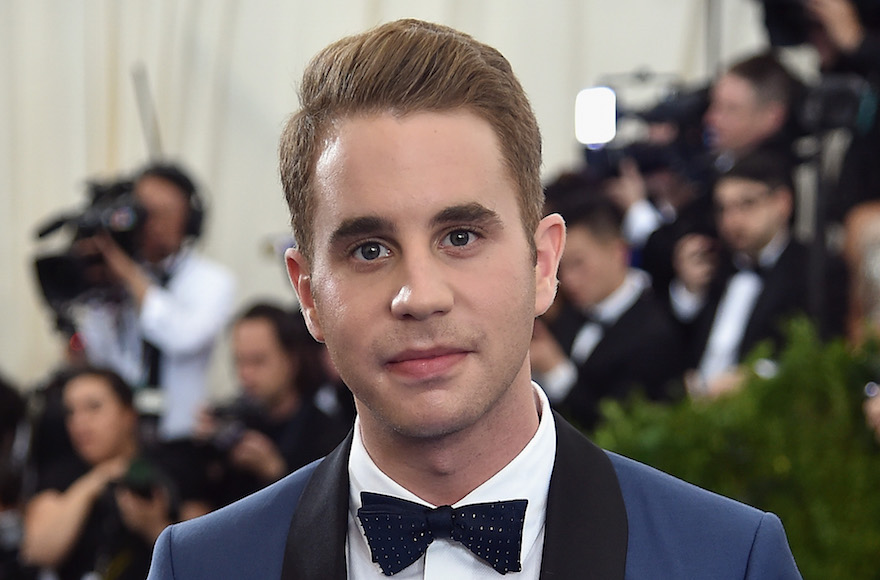
Ben Platt at the Metropolitan Museum of Art in New York City, May 1, 2017. (Theo Wargo/Getty Images For US Weekly)
Speaking of shoo-ins, Ben Platt, another Jewish actor, is probably the closest thing there is to one. I’m not a betting kind of woman, but I would put money on him taking home a Tony for Best Lead Actor in a Musical for his portrayal of anxiety-ridden outsider Evan Hansen, the title character in this dark musical about a boy who gets caught up in a lie after the death of a classmate.
Ben Platt grew up performing at a Jewish summer camp — watch him talk about his Jewish childhood on “Late Night with Seth Meyers” here, where he also sings a rendition of “Luck Be a Lady” in Hebrew.
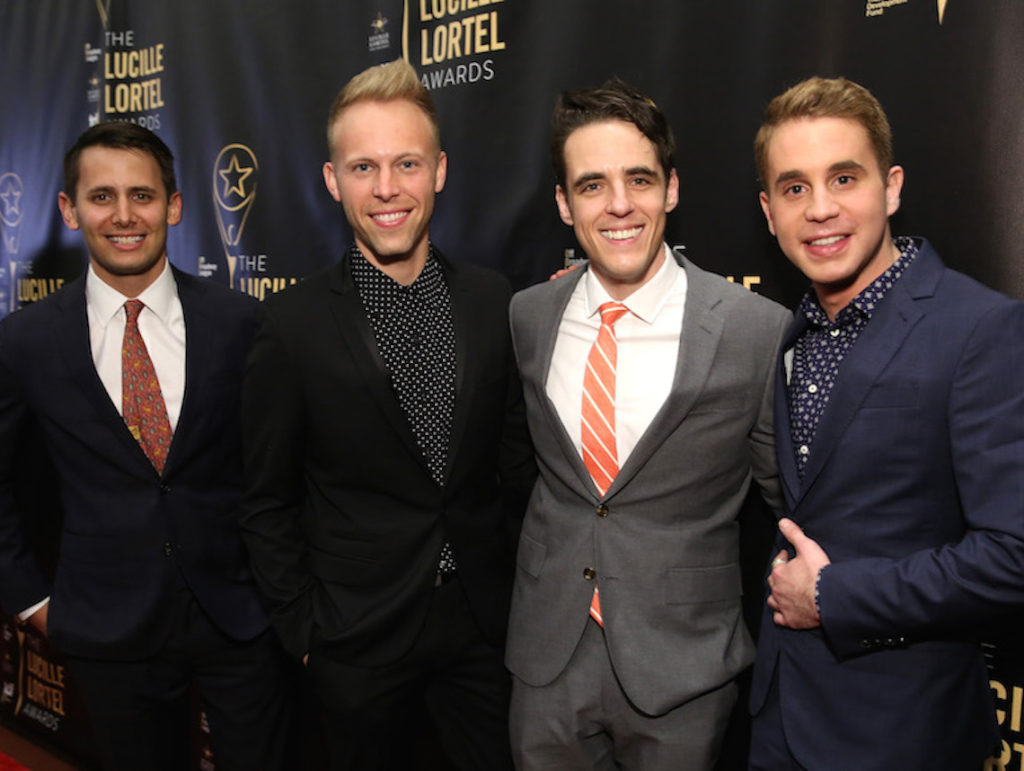
“Dear Evan Hansen” is nominated for nine Tony Awards, including Best Featured Actor in a Musical (Mike Faist), Best Featured Actress (Rachel Bay Jones), Best Original Score, in which Benj Pasek, also Jewish, is nominated alongside Justin Paul. If the songwriters look familiar it’s because they already won an Oscar this year for “La La Land.”
6. “Come From Away”
Though “Dear Evan Hansen” is favored to win Tony’s final award of the evening — Best Musical — don’t rule out “Come From Away,” a touching, based-on-a-true-story musical about a small Newfoundland town. After the September 11 terrorist attacks, the population of Gander temporarily doubled when 38 airplanes were rerouted there.
The musical is about how people come together and help each other through the darkest times. The Jewish connection? Aside from the show’s writers, married couple Irene Sankoff and David Hein (their previous show was called “My Mother’s Lesbian Jewish Wiccan Wedding”), one of the characters of “Come From Away” is a rabbi and, in a very moving scene, he sings “Oseh Shalom” as characters pray in many languages.
Sankoff and Hein are also nominated Best Book for a Musical and Best Original Score. Other nominees include Best Featured Actress (Jenn Colella) and Best Direction (Christopher Ashley).
And now, she’s nominated for Best Lead Actress in a Musical in “War Paint,” which chronicles the rivalry between cosmetics magnates Helena Rubinstein (played by LuPone) and Elizabeth Arden (played by Christine Ebersole, also nominated in the same category). The musical, which is up for four Tony Awards, doesn’t shy away from the anti-Semitism that Rubinstein, a Polish immigrant, faced — she was denied an apartment at 625 Park Avenue, for example, but got her revenge when she bought the entire building.
“War Paint” isn’t nominated for Best Musical — but it was just announced there will be a performance from the cast during the awards ceremony.
To get a LuPone fix before then, check out this clip from her recent appearance on “Crazy Ex-Girlfriend.”
The Jewish Journal’s web site, jewishjournal.com, has restored its commenting feature.
When The Journal redesigned the site, we chose to leave the commenting option off. In its previous iteration, we found too many people chose to use commenting for ad hominem attacks. We decided to take the feature off until we could find a way to consistently monitor comments, and encourage the kind of lively and thoughtful discussion Jewish Journal readers expect.
Why are we bringing it back? Several reasons. First, our readers missed it. We received numerous requests to restore commenting. In print and online, The Journal publishes opinions from across the political and religious spectrum. People wanted to be able to talk back, weigh in, challenge or second these opinions, and we understood their frustration at being prevented from doing so. Secondly, as a community-based media organization, we believe in the mission in bringing in as many community voices as possible. Through the Internet, our “community” has grown to be international (about 70 percent of our traffic is outside our home base of Los Angeles). The Internet has given us the opportunity to broaden the conversation— not having comments prevented us from fully doing that. Lastly, we missed you. We missed having your insights, ideas, challenges, compliments and story leads. Comments were a constant source of all of those.
So please go ahead and comment. It’s free and easy. Let us know what you think. Comments will be monitored according to our terms of use, which you can read here. Occasionally we will use the comments as Letters to the Editor in our weekly print edition (remember print?). We encourage our writers, editors, contributors, bloggers and columnists to monitor comments and respond. The Jewish Journal has always been a place that gathers the widest possible variety of thoughtful opinion — we are very happy that you’ll be able to share yours with us, again.
Maestro Vladimir Spivakov and the acclaimed Moscow Virtuosi Chamber Orchestra return to Los Angeles as part of their North American tour. Spivakov, one of the world’s most prominent violinists and conductors, has led the Moscow Virtuosi since 1979. The orchestra will be joined by soprano Hibla Gerzmava. 7 p.m. Tickets start at $55. Wilshire Ebell Theatre, 4401 W. Eighth St., Los Angeles. cherryorchardfestival.org.
BEST FRIENDS IN CONCERT
Renowned singers, songwriters and musicians, including headliners Doug Cotler and Julie Silver, will perform a concert, which will be followed by a wine-and-cheese reception, coffee and dessert. 7 p.m. $54. Congregation Or Ami, 26115 Mureau Road, Suite B, Calabasas. (818) 880-4880. orami.org.
SUN JUNE 11
LOS ANGELES YOUTH ORCHESTRA
The Los Angeles Youth Orchestra, conducted by Russell Steinberg, presents a special community concert before embarking on its international tour. Get a sneak peak of its Italy tour program. Works on the program include Rossini’s “Barber of Seville Overture,” Beethoven’s “Coriolan Overture,” Schubert’s “Unfinished” Symphony, Mozart’s Symphony No. 32 and Steinberg’s “Alternative Energy.” 3 p.m. Free. Encino Park, 16953 Ventura Blvd., Encino.losangelesyouthorchestra.org.
BACK TO THE CATSKILLS: A TRIBUTE TO THE BORSCHT BELT
Join Annie Korzen, Tom McGillen, Karen Rontowski and others for a live dance performance from the iconic Catskills film, “Dirty Dancing.” Snacks, desserts, surprises and prizes will be available. Reception 2 p.m.; Showtime 3 p.m. $35; $40 cash at the door. The Clark Building, 861 Valley Drive, Hermosa Beach. (714) 914-2565. seniorcomedyafternoons.com.
VIGIL FOR THE MS ST. LOUIS
The Los Angeles Jewish community is hosting a vigil to remember the anniversary of when the United States turned away the refugees — including many Jews who later were murdered in the Holocaust — aboard the MS St. Louis in 1939. Come take a public stand for refugees along with congregations across the country and help send the message that history must not be allowed to be repeated. 4 p.m. Free. Los Angeles Museum of the Holocaust, 100 The Grove Drive, Los Angeles. lamoth.org.
MON JUN 12
DESTINY: THE ULTIMATE DRAMA OF HUMAN HISTORY
All heroic stories follow a typical plotline — an underdog hero fighting evil for the sake of humanity. This event will explore the uniqueness of Jewish history and reveal the truth behind many stories we may consider fantasy. Explore the crucial role the Jewish people have played in the greatest stories of all time. 7:30 p.m. $5; $10 at the door. The Aish Center, 9100 W. Pico Blvd., Los Angeles. aishla.com.
HOW JEWS SHAPED THE MUSIC OF THE ’60S
This one-day class will explore how Jews helped shape much of the music of the 1960s. From Leiber and Stoller and Neil Sedaka to Carole King and Paul Simon, Jews influenced the sound of the decade. Sid Jacobson, a songwriter in the legendary Brill Building, will share his observations about the Jewish role in the era’s popular music. 7 p.m. $36 for members; $72 day of, for nonmembers. Kol Tikvah, 20400 Ventura Blvd., Woodland Hills. (818) 348-0670. koltikvah.org.
TUES JUNE 13
DISCOVERING and ATTAINING CAREER PASSION
Are you seeking a career change? Hear what Chanel Halimi has to say at this workshop. A marriage and family therapist, Halimi will use her expertise to guide young people and adults toward a more satisfying and fulfilling career. 7:30 p.m. Free. Sinai Temple, 10400 Wilshire Blvd., Los Angeles. (310) 474-1518. atidla.com.
WED JUNE 14
AUTHOR DANNY GOLDBERG
Danny Goldberg will discuss and sign “In Search of the Lost Chord: 1967 and the Hippie Idea.” Goldberg’s new book is a subjective history of 1967, the year he graduated from high school; the Doors, the Grateful Dead, Jimi Hendrix and Janis Joplin issued debut albums; the Rev. Martin Luther King Jr. publicly opposed the war in Vietnam; and Israel won the Six-Day War. It is a new analysis of the era and its political causes, spirituality, music and psychedelic movements. Exhaustively researched and informed by interviews with Allen Ginsberg, Timothy Leary, Ram Dass, Tom Hayden, Cora Weiss and Gil Scott-Heron, the book provides a unique perspective on how and why the legacy of 1967 — the year of the word “hippie” — lives on today. Goldberg will be in conversation with Pamela Des Barres. 7 p.m. Free. Book Soup, 8818 Sunset Blvd., West Hollywood. (310) 659-3110. booksoup.com.
WOMEN IN ENTERTAINMENT AND MEDIA
Young women in the fields of entertainment and media are invited to an intimate discussion with Creative Artists Agency marketing executive Chelsea Gosnell and other guests. 7:30 p.m. $10; $15 for two. Tickets must be purchased online at yala.org/womeninentertainment. Creative Artists Agency, 2000 Avenue of the Stars, Los Angeles. yala.org.
When U.S. Marine Sgt. Rich Garcia was on a mission in the Korengal Valley in Afghanistan, an improvised explosive device destroyed the vehicle he would have been on had he not moved to another to take over for a Marine who was ill.
He credits a siddur, of all things, with keeping him safe.
“That was the first time I carried a siddur out on patrol,” Garcia told the Journal. “After that, I carried that siddur everywhere.”
Garcia, 33, was a Marine from 2002 to 2011, serving in Iraq and Afghanistan. He was raised by a Jewish father, who also was a Marine, and a Catholic mother. They separated when he was young and he lived with his father.
As a Marine, Garcia went to Shabbat services at boot camp and wore a Star of David necklace under his combat gear. He began converting to Judaism in 2014 through the program Judaism by Choice. Today, his connection to Judaism is not just spiritual but professional as the head of security at Sinai Temple.
“I think since he has chosen Judaism, he has made a connection with our families, and it’s more than just a job,” Sinai Temple Rabbi Erez Sherman said. “It is a sense of duty.”
Born in Corsicana, Texas, Garcia grew up outside of San Diego, raised mostly by his father, Richard Levine. Garcia said his father encouraged him to go to synagogue on Shabbat at a Conservative congregation.
“He pretty much said, ‘Hey, you can pick whatever religion you want … but let’s go to synagogue,’ ” Garcia said at Sinai, a handgun holstered at his side.
On Sept. 11, 2001, his father woke him up to watch on television as the second plane flew into the World Trade Center. A high school senior, he skipped school that day and visited a military recruiter.
“I grew up in a very patriotic household,” he said. “Honestly, I probably knew what terrorism was when other high school kids were not even thinking about it.”
During boot camp in San Diego, he participated in Shabbat services. It was then that a rabbi on base gave him the siddur he would carry with him throughout his service.
After his discharge, Garcia moved to Los Angeles, drawn to its large Jewish community and the job opportunities in private security. He began working at Sinai Temple last year, around the time that he completed his conversion coursework, led by Rabbi Neil Weinberg.
“He is a single man who wanted to become Jewish because he loves the Jewish religion and the Jewish people. He did all the requirements in our program — keeping Shabbat every week, going to synagogue weekly and keeping kosher,” Weinberg said in an email. “I am very proud that he converted to Judaism through our Judaism by Choice program.”
At Sinai, Garcia runs a team of former military men. He said providing employment to military veterans is a way of helping them after their service. “Give them a role, make them feel like they’re needed, because in the military we were needed, we had a role,” he said.
Garcia, who lives in the San Fernando Valley, is an employee of Centurion Group, a full-service security company that serves houses of worship, among other clients. A member of Sinai Temple, he holds a degree in criminal justice from the University of Phoenix and he plans to earn an Emergency Medical Technician certification.
His Sinai team attends the annual High Holy Days security briefing organized by the Anti-Defamation League. He works closely with The Jewish Federation of Greater Los Angeles and the Consulate General of Israel in Los Angeles in keeping abreast of security threats.
As a Marine, Garcia went to Shabbat services at boot camp and wore a Star of David necklace under his combat gear.
Gone are the days of discovering improvised explosive devices in Afghanistan. These days, he is more likely to order an evacuation after a suspicious package is spotted at a bar mitzvah. Recently, a spate of threats targeting Jewish community centers put his team on higher alert.
“It kept my guys on their toes — we took it personally,” he said. “This is our home, and we’re not going to let anybody destroy our community.”
In March, he traveled to Israel for the first time and participated in the Jerusalem Marathon as part of a delegation that included Sherman as well as other Sinai congregants . He ran in memory of Marcus Preudhomme, a fellow Marine who was killed in action in Iraq in 2008. Preudhomme’s name is inscribed on a bracelet on Garcia’s wrist.
During the trip, Garcia became a bar mitzvah at the Western Wall. Sherman was by his side as he recited an aliyah — Parashat Vayakhel.
Though he spends his free hours at the gym, he ran the half-marathon instead of the full.
“I ran the half, I’m not going to lie to you. Oh, my gosh, that was hard,” he said. “It was hills. I’m in the Jewish community. I wish they would’ve told me Jerusalem is all hills — they knew I was going. But it was great.”
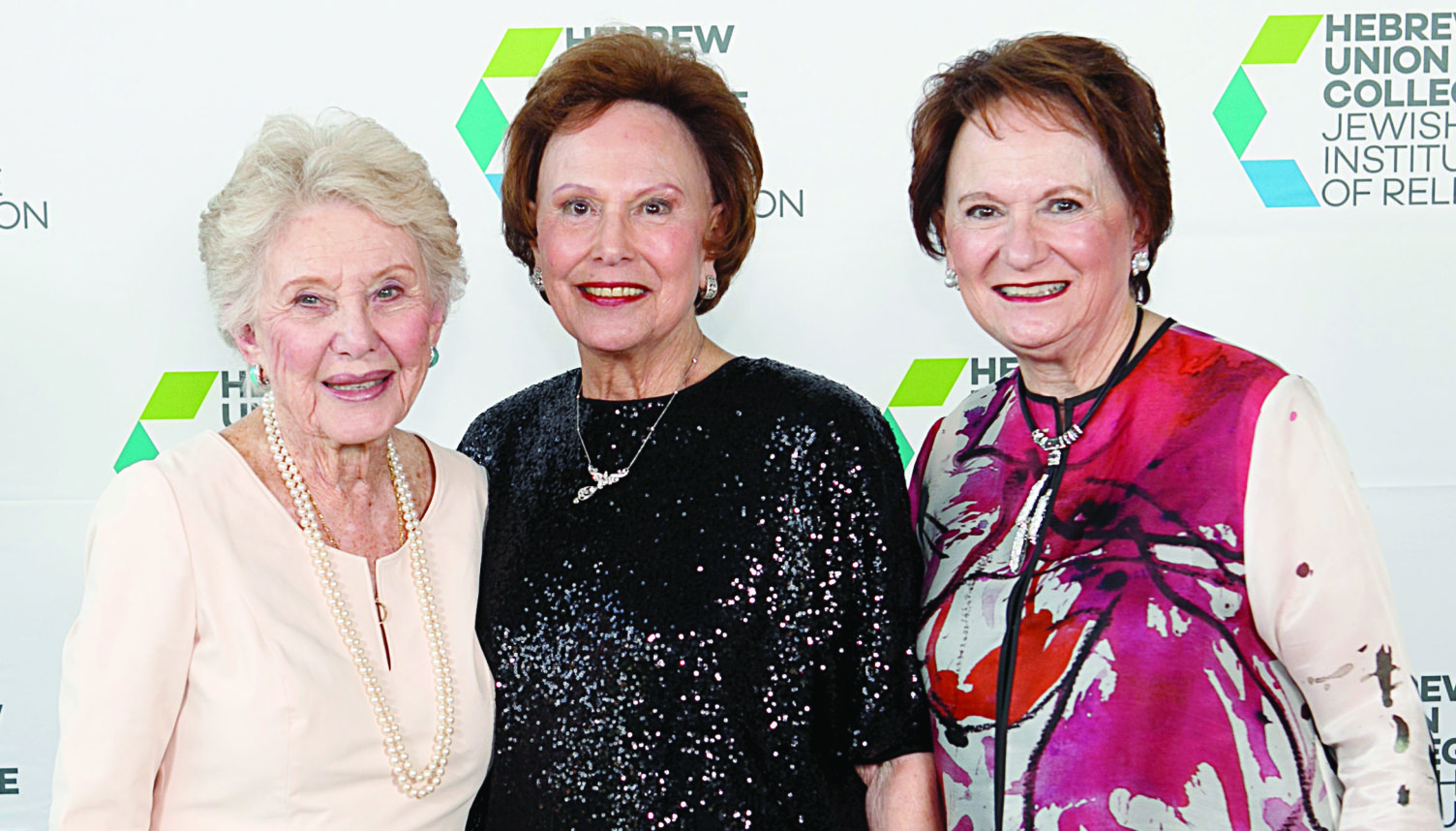
The Hebrew Union College-Jewish Institute of Religion’s (HUC-JIR) fourth annual benefit gala, held at the Skirball Cultural Center on May 16, honored Peachy Levy, Rhea Coskey, Rochelle Ginsburg and other women leaders of the Western region.
Levy sits on the board of overseers of the HUC-JIR Jack H. Skirball Campus in Los Angeles. Coskey became involved with HUC-JIR when her daughter, Laurie, entered rabbinical school, and she went on to mentor students and chair the school’s advisory board. Ginsburg is the chair of the HUC-JIR’s national school of education advisory council.
Sally Priesand, an HUC-JIR ordinee who in 1972 becamethe first woman rabbi to be ordained in America, was featured in the ceremonies.
Hebrew Union College-Jewish Institute of Religion honored (from left) Peachy Levy, Rhea Coskey and Rochelle Ginsburg at its fourth annual benefit gala. Photo by Edo Tsoar
The more than 430 attendees included Temple Emanuel of Beverly Hills RabbiLaura Geller; Leo Baeck Temple RabbiKen Chasen; Kol Ami RabbiDenise Eger; Los Angeles City Controller Ron Galperin and his husband, Temple Akiba RabbiZachary Shapiro; Stephen Wise Temple SeniorRabbiYoshi Zweiback; and Shana Penn, executive director of the Taube Foundation for Jewish Life and Culture.
“It was our biggest turnout ever,” HUC-JIR Public Affairs Associate Joanne Tolkoff told the Journal.
Proceeds from the event benefit HUC-JIR students and faculty.
Founded in 1875, HUC-JIR is a Reform seminary focused on academic, spiritual and professional leadership development, with campuses in Los Angeles, New York, Cincinnati and Jerusalem.
“From Generation to Generation,” a community celebration concert, was held May 25 at Sinai Temple on the occasion of Joseph Schoenberg becoming a bar mitzvah. Approximately 1,200 people attended.
His parents, Pamela and Randol Schoenberg, sponsored the event, which was held in memory of Joseph’s great-grandfathers, composers Arnold Schoenberg and Eric Zeisl.
Participants in the musical program included conductor Nick Strimple, associate professor of choral and sacred music at the USC Thornton School of Music and an expert on the works of composers persecuted by the Nazis. Strimple led the Los Angeles Zimriyah Chorale. Additional participants were Los Angeles Voices, the BodyTraffic dance company, and London-based pianist and organist Iain Farrington.
BodyTraffic, which included new addition Natalie Leibert, performed to liturgical works for chorus and organ by Schoenberg and Zeisl, and a newly commissioned work for chorus and organ by composer Samuel Adler.
Randol Schoenberg is an honorary director of the Los Angeles Museum of the Holocaust. He is an attorney who has worked to retrieve artwork stolen by the Nazis during World War II, as was depicted in the film “Woman in Gold.”
Joseph, whose bar mitzvah was May 27, volunteered with Food Forward, which saves local produce that otherwise would go to waste, leading up to his bar mitzvah. He donated produce from his bar mitzvah weekend to hunger-relief agencies and, through the website reusablecenterpieces.org, had environmentally friendly centerpieces at his luncheon.
A celebration and fundraiser held in honor of the 13 years since the founding of the egalitarian spiritual community IKAR was held May 21 at Playa Studios in Culver City.
The “bat mitzvah” event raised about $370,000 and drew a crowd of more than 375 founders, members and supporters, including Richard and Ellen Sandler, Marvin and Sandy Schotland, and actress Lisa Edelstein.
The party had a 1980s theme, with music from that decade playing throughout the event. Attendees viewed a video retrospective on IKAR’s place in the community and were treated to a classic b’nai mitzvah-style candlelighting ceremony.
Attendees dressed in costumes that featured neon tights, blue eye shadow and other staples of ’80s fashion, with some guests invoking Ferris Bueller, Madonna and Michael Jackson. Mini Rubik’s Cubes, slap bracelets and centerpieces featuring jellybeans, malted milk balls, Reese’s Pieces and Good & Plenty candy adorned the tables. IKAR members Shelley and Steph Altman, who own Playa Studios, donated use of the venue, and Diana Kramer designed the interior theme, which featured full-size video game machines and other era-appropriate décor.
The Rev. Michael-Ray Mathews, director of clergy organizing with PICO National Network, the largest grass-roots, faith-based organizing network in the United States, offered words of welcome. “History is past, present and future all at the same time. We are all one people,” he said.
“It took a lot for us to get this thing off the ground, none of it with any assurance of success,” IKAR founding Rabbi Sharon Brous said. “Thank you for casting your lot with us. This is about fighting for civil society.”
— Esther D. Kustanowitz, Contributing Writer
The Center for Initiatives in Jewish Education (CIJE) West Region held community events on May 16 and 18 at the Westside Jewish Community Center.
On May 16, the CIJE Co-Ed Engineering Conference featured SpaceIL co-founder Yonatan Winetraub as its keynote speaker. Addressing approximately 150 teenagers, Winetraub discussed how his organization is aiming to make Israel the fourth country to land a spacecraft on the moon. Additional speakers included Sari Katz, Western Region director for Rambam hospital in Israel. Katz announced a partnership between Rambam and CIJE that would provide a scholarship to students who develop an outstanding biomedical device in 2018.
Students from day schools in Los Angeles, Orange County, San Diego, Seattle and Dallas attended.
“Nobody knows precisely what jobs will be around when you all graduate from college within the next eight to 10 years,” CIJE President Jason Cury told the students. “Which is why it’s so important to develop the skills which will be required, and to be prepared for whatever challenges and opportunities that present themselves.”
From Tarbut V’Torah in Irvine, students Mika Ben-Ezer, Zeke Levi and Julian Wiese received the Award for Innovation for their “Sonic Jacket,” which serves the visually impaired. Harkham-GAON Academy in Los Angeles students Aliza Leichter, Oze Botach and Shani Kassell won the Award of Social Value for designing a car seat that detects when a child is alone in the vehicle. And the Award for Best Visual Display went to Mendy Sacks, Aryeh Rosenbaum and Daniel Jackson from YULA Boys High School for a digital portable piano teacher known as “Teachapii.”
CIJE Vice President Jane Willoughby gave the closing remarks.
The May 18 Girls Engineering Conference drew students from YULA Girls High School and Valley Torah Girls High School.
In the keynote address, engineer Yvette Edidin discussed how “the different fields of engineering need and would benefit from more women,” a CIJE press release said.
Valley Torah’s Adina Ziv, Meital Shafgi and Aviya Gaviel were awarded Project of the Year for their sensor that detects when automobile drivers are getting sleepy and alerts them using a vibrating device.
At the 2017 ADL Entertainment Industry dinner, “Big Bang Theory” co-creator and ADL honoree Bill Prady (second from left) joins (from left) award presenter Wil Wheaton, ADL Regional Director Amanda Susskind and event emcee Joshua Malina. Photo courtesy of the Anti-Defamation League
The Anti-Defamation League (ADL) honored Bill Prady, co-creator and executive producer of “The Big Bang Theory,” at the 2017 ADL Entertainment Industry dinner on May 24 at the Beverly Hilton.
Actor Joshua Malina (“Scandal”) served as master of ceremonies and actor Wil Wheaton, a recurring guest star on “The Big Bang Theory,” presented the award to Prady.
“While preparing my remarks for this evening, I emailed Bill and asked him if it will be honest and accurate to tell you that Bill is an outspoken voice for the most vulnerable among us,” Wheaton said. “And Bill said, ‘There is no sentence that begins with, Bill has been vocal about — that is not true.’ ”
Prady, in his speech, talked about his childhood in Detroit.
“Anti-Semitism was a pretty abstract idea. I knew what it meant only from a distance,” he said. “I knew it from the punchline from a Woody Allen movie. Growing up in my Jewish Detroit suburb, I didn’t know anti-Semitism. And it’s not only that. For me, racism was something in social studies class. And hatred of immigrants? I never heard of such a thing. My world was filled with immigrants, so many that I thought that when you grow up, you have an accent. But I know all these things now. We hear it on the news, from our politicians, online.”
Prady explained why he is a supporter of the ADL, which was established in 1913 to combat hate and bigotry.
“After the election, I made a decision to change my personal focus from politics to the front line. The ACLU (American Civil Liberties Union) was battling the attack on freedom, and Planned Parenthood was fighting for women reproducing rights, but who was fighting to dig out the weed of hate that had taken root in modern technology? It was the Anti-Defamation League,” Prady said. “So I called them up and I asked what I can do to help. And they said to do this, and I said, ‘It’s going to be a pretty boring night.’ So, I called the Barenaked Ladies.”
The Canadian band, which wrote and recorded “The Big Bang Theory” theme song, provided the evening’s entertainment.
Additional speakers included An Nguyen, the daughter of Vietnamese immigrants and an ADL National Youth Leadership delegate.
— Ayala Or-El, Contributing Writer
Moving & Shaking highlights events, honors and simchas. Got a tip? Email ryant@jewishjournal.com.
As British voters went to the polls in a fateful Thursday election, the results were a nail biter that left Tory Prime Minister’s House of Commons majority and prime ministership hanging in the balance.
New York Times columnist Roger Cohen a few days earlier came out in an opinion piece (“A Case for Jeremy Corbyn, June 5) outright endorsing not only the Labour Party but radical Labour Party leader PM Jeremy Corbyn.
He’s against incumbent May not only for trying to preserve the U.K.-U.S. “special relationship” during the turbulent times of the Trump Administration, but for doing so in a way that Cohen deems, let’s be frank, unseemly sucking up to President Donald Trump.
Cohen, an important columnist, has a right to his opinion. But he was sucking up to Jeremy Corbyn and this is deplorable and, indeed, despicable and a threat to democracy in troubled times.
The UK election campaign occurred in an election atmosphere not only permeated by anxieties over renewed terrorism but in a miasma of anti-Semitism.
At the Bear Pit, an outdoor popular venue in Bristol, a giant campaign banner showed Prime Minister May in Star of David-shaped earrings, which some Jewish observers called “anti-Semitic.” The banner listed positive statements about Labour Party leader Corbyn and negative ones about May. One Jewish Bristol citizen asked, “I can’t believe stuff I haven’t heard of, or seen since I was a child is now happening again. It makes me sick.”
In Surrey, Alex Goldberg, the Jewish Chaplain at the University of Surrey and Chaplain to Surrey Police, said in a post on Facebook Sunday that he is proud of his daughter, Hannah, “for standing up to sexism, racism and religious abuse,” but was “Less proud of the police service that I have worked with for over two decades in failing to respond to three girls being attacked and racially abused.” Hannah Goldberg and her two friends, who her father said were identifiable as religious Jews due to their long skirts, were in a London-area park on May 27 when they were attacked by teens playing basketball. A bystander call the police, which did not show up for two hours, pleading a communications mix up.
According to London’s Jewish Chronicle, in Manchester, where the terrible terror attack of a few weeks ago claimed 22 lives, police reported that arson attacks on two kosher restaurants that are “anti-Semitic hate crimes” occurred within five days of each other.
The Labour campaign was also embarrassed by revelations that in 2002 Corbyn addressed a rally attended by 300 members of extremist group Al Muhajiroun where audience members shouted slogans calling for Israelis to be gassed. Khuram Butt, one of the three London Bridge/Borough Market murderers, was a supporter of and an associate Al Muhajiroun leader and jailed hate preacher Anjem Choudary.
Corbyn’s left-wing views are not the problem. It is his beyond-the-bounds apologetics for Mideast terrorism in many forms both during and after his campaign. It is fine that he is sympathetic to the Palestinians, but not that he embraces Hamas as well as Fatah, and celebrates Palestinian terrorists as martyrs. Ditto his admiration for the Tehran Mullahs. And his coddling up with U.K. Muslim incendiary preachers like those who helped inspire the recent London Bridge attack. He vilely has attacked Israel. He has impugned reporters who ask him tough questions as Jewish and suggests somehow having relatives who died in the Holocaust disqualifies them from doing so. He has equated Zionism with the Nazis and Hitler.
That such a man should become U.K. PM is unthinkable. The only historical analogy to Cohen’s endorsement we can think of comes from the 1930s when French rightists rejected Socialist Leon Blum under the slogan “Better Hitler than Blum.” Corbyn is not Hitler, but he is bad enough. Cohen’s endorsement of him is pure political nihilism.
Even those of us who usually do not take partisan positions in elections, here and abroad, sometimes do have to take a moral position.
Conservative columnist Ross Douthat, also in the New York Times (“A Very British Radical, June 7), pointed out that the mainstream international press was understandably outraged by France’s right-wing presidential candidate Marine Le Pen insufficient attempts to distance herself from the anti-Semitic history of her party, France’s National Front, and her father Jean Marie Le Pen. But at the same time they treated Corbyn’s refusal to even attempt to distance himself from his anti-Semitic past I an entirely different manner: “Le Pen was cast as the madwoman in the attic, poised to set fire to the mansion. But outside Britain’s right-wing newspapers, Corbyn is portrayed more as the balmy uncle in the conservatory, puttering around with tulips and murmuring about the class struggle. Nobody exactly thinks he would be a good prime minister, but there isn’t a palpable fear that his election would be an emergency for liberal democracy.”
Roger Cohen is wrong. For the sake of democracy and decency, let us hope that Jeremy Corbyn does not squeak out an upset victory become the next Prime Minister of the United Kingdom.
Historian Harold Brackman is a long-time consultant for the Simon Wiesenthal Center and its Museum of Tolerance in Los Angeles. The views expressed here are not the official position of either the Center or the Museum.
Morris “Fritz” Friedman needed help to vote in the election for chair of the California Democratic Party, which took place on May 20, a Saturday.
As an Orthodox Jew, Friedman was forbidden from picking up a pen during Shabbat. So he asked a convention volunteer, Sean Kiernan, to fill out his ballot and sign it for him, casting it for Eric Bauman.
Bauman has since declared victory by a narrow margin of 62 delegates among some 3,000. But now, Friedman’s vote is at the center of an effort to unseat Bauman, himself an observant Jew from Los Angeles.
In contesting the election over alleged voting irregularities, the campaign for Kimberly Ellis, Bauman’s opponent, pointed to Friedman’s ballot as an example of double voting. Ellis is refusing to concede despite calls from Democratic leaders, including the speaker of the State Assembly, to back down.
“We believe deeply that not only did we not lose by 62 votes, but that we won this election outright and pretty handily,” Ellis said in a June 7 interview with the podcast “Working Life.”
In a June 5 “ballot review” on the campaign website, Ellis alleges that the signature of an employee of the Kaufman Legal Group, the law firm representing Bauman, appeared on multiple ballots. Kaufman Legal Group later identified the employee as Kiernan, who aided Friedman with his vote.
Some pro-Israel Democrats seized on Ellis’ challenge of Friedman’s vote as the latest transgression of a campaign with a shaky record on Jews and Israel.
“In challenging mismatched signatures, Kimberly Ellis is effectively targeting Orthodox Jewish delegates,” a group called Democrats for Israel Los Angeles said in a statement posted on Facebook.
The group also pointed to a vocal Ellis supporter who posted a cartoon on Facebook last month featuring an Israeli flag with the Jewish Star of David replaced by a swastika.
But Bauman said the double voting accusation is more likely an example of unscrupulous electioneering by the Ellis campaign than animus toward Jews.
“They’re casting about, and they have no real evidence that anything is actually wrong,” he said.
“I don’t think the singling out of a couple of Orthodox Jewish men was, per se, anti-Semitic,” he said. “I think it was just that they were grasping for straws.”
Paul Kujawsky, like Friedman, is an Orthodox Jew and served as a delegate to the May 20 convention. He believes he and Friedman were the only two Orthodox Jews to vote in the election for party chair. He said that having a helper sign the ballot on his behalf is a well-established practice that he’s used many times when votes occur on Saturdays.
“It’s pretty clear that [the Ellis campaign] knew it was not an issue of double voting but claimed it was, anyway,” Kujawsky said. “So it’s not about anti-Semitism, but it is about integrity.”
Neither Ellis nor her campaign responded to repeated requests for comment.
The party has referred the matter to its Compliance Review Commission, a body that adjudicates internal disputes. But Ellis’ campaign hopes to put the election in the hands of an independent third party, fearing the California Democratic Party itself is unduly influenced by Bauman, according to its June 5 statement.
Bauman, a former union organizer, has headed the Los Angeles County Democratic Party since 2000 and served as vice chair of the state party since 2009. LA Weekly has called him a “powerful boss” and a “kingmaker,” while the Los Angeles Times named him a “consummate party insider.”
A self-identified Zionist, Bauman is a member of two Los Angeles-area synagogues, the Orthodox Shaarey Zedek in Valley Village and Adat Ari El in North Hollywood, a Conservative synagogue where he wraps tefillin on weekday mornings. He keeps a kosher home in North Hollywood with his husband.
Culturally and politically, Bauman and Ellis are about as different as two California Democrats can get.
Ellis headed Emerge California, a nonprofit that aims to increase the number of women in elected office in California, from 2010 until this year, when she quit to focus on her run for party chair.
An African-American woman from the Bay Area, she attracted liberals disaffected with the party establishment, including many who supported Sen. Bernie Sanders in the Democratic presidential primaries, by pledging repeatedly to “redefine what it meant to be a Democrat.”
But before Ellis announced her run in August 2015, Bauman’s ascendance often was treated as a foregone conclusion. When friends wanted to draft her into the race, Ellis said in the June 7 “Working Life” interview, she told them, “That’s a preposterous idea and I’m not interested.”
Now, she claims to have won the election.
“Based on the information contained here, the actual vote count is in question,” her campaign said in a June 5 statement outlining the allegations. “It is believed that the wrong individual is serving as chair.”
Nicky Silver’s dark comedy “The Lyons,” now running at The Road on Lankershim in North Hollywood, depicts a family whose members are totally isolated from one another. The first act takes place in a hospital room, where Ben Lyons (James Handy) lies dying of cancer. His wife, Rita (Judith Scarpone), is leafing through House Beautiful magazine as she talks about redecorating their home once he is gone. Ben spews expletives in the face of her apparent indifference to his condition.
Soon, the couple’s grown children arrive, and they all begin to air the monumental issues that plague them. The alcoholic daughter, Lisa (Verity Branco), still is drawn to her ex-husband, while her brother, Curtis (Chad Coe), who is gay, avoids letting them meet the current man in his life. When Curtis reveals that his sister’s ex-husband hit her repeatedly, she takes revenge by telling everyone that his supposed boyfriends never existed, and that he is too terrified to actually have a relationship.
Rita exposes her bitterness at having spent her life married to a man she never loved, and her terror at the prospect of being alone, while Ben, who loved Rita, vents his anger at never having had his love returned.
Speaking from his home in New York, Silver said he wrote the play, which was produced on Broadway five years ago, after his father was misdiagnosed with Parkinson’s disease in 2009.
“He died, actually, before it opened, but he didn’t have Parkinson’s disease. But that’s what got me thinking about mortality,” Silver said. “I was really [going] after a way to write the simplest play I could and just put four people in a room, in real time, and see what happens.”
The four people he has put together are Jewish, as is Silver, who believes the angst his characters experience is universal, but as Jews they reflect a cultural difference by communicating more freely.
“Having been in the room of dying people a few times in my lifetime, I would say that Jews — this sounds terrible, but I’m going to say it anyway — Jews tend to talk more,” Silver said.
“Gentiles tend to sit on their feelings more, and maybe they explode finally, or fall apart finally. But in my experience — the Jews I’ve known, and being one — we’re pretty verbal about our feelings. So it makes for a more interesting play than people sitting around not talking about things.”
Silver said he also believes there is something singular about Jewish humor and that his affinity for comedy comes from his parents.
“Their ethnicity informed their sense of humor,” he said. “There is something in the Jewish identity, I think, where we often self-identify as sort of put upon in some way. And Jews find humor to get them through the worst of times. And I think that quality informs my work, in a way where gentiles find liquor to get them through the worst of times.”
The humor in the play, especially in the first act, verges on theater of the absurd because of the disconnect between someone in the hospital, dying of cancer, and the behavior of his family, which ostensibly has come for what may be a final visit. One would expect the situation to be somewhat sentimental, with emotional goodbyes, deeply felt interactions, bittersweet revelations and a heartwarming release.
“That’s the setup,” director Scott Alan Smith said. “It is anything but that. Nobody seems to care too much about the fact that he’s dying, and that’s where the comedy comes in. And that’s where the dark humor comes in.”
Smith added that there is no hope for this family. “That’s what I think Nicky is talking about with this play,” he said. “The family, which is usually the source of providing you with a sense of self and launching you into the world, is not the place that’s helping any of them. So it has to destroy itself for them to all move forward with their lives.”
And Silver explained that, after Ben dies, the remaining three do move in a healthier direction. “It’s not that the death of Ben liberates all of them,” the playwright said. “It puts them in a position where they have a choice. They can do nothing and molder in their own self-loathing, or they can take a chance. When confronted with the opportunity to move past a family that didn’t fulfill them and didn’t support their needs, they take the opportunity and take baby steps toward a new beginning.”
At first, Curtis makes an inappropriate, aggressive move on another man, gets beaten and ends up in the hospital. His mother and sister visit him, and Lisa says she has decided to offer some comfort to a dying man. Rita, meanwhile, is off to Aruba in an unconventional relationship, on her own terms.
In addition, Curtis reaches out to his nurse. “Curtis is inching toward having some kind of real connection, not a sexual, romantic connection, but he takes that risk, and he asks that nurse her name, and she sits down and they’re going to talk,” Silver said.
Beyond wanting his audiences to laugh at the dark humor in his play, “I want them to think about the traps we allow ourselves to stay in,” Silver said, “because that’s what I think the play is ultimately about. It’s about people who find a way out of the traps they’ve built for themselves.”
“The Lyons” is playing through July 16 at The Road on Lankershim in North Hollywood. For tickets and more information, visit this story at jewishjournal.com.