Batya Shmueli grew up living on the banks of the Blue Nile in Ethiopia. When her family landed at Ben Gurion Airport in 1991, she remembers that her grandfather bent down and kissed the runway tarmac to express his intimate joy for the land he had prayed for his entire life. She recalls being stunned to see white Jews because in Ethiopia all Jews were black. With her family, she lived in a caravan adjacent to a small town in the Galilee.As a teenager, Batya sought to fully identify as an Israeli girl and leave behind her past as an Ethiopian Jew. She recalls rebelling against her family’s traditions and taking on all things Israeli. She learned Hebrew, did very well in school, had lots of friends, dressed and behaved as young Israeli teens do. Her new life, however, contrasted dramatically with the traditions of her family and most especially with her beloved Ethiopian Jewish grandfather who was not at all happy about the changes he witnessed in her.
After high school, Batya served in Israel’s Navy with an elite naval commando unit. When she completed her military service and before entering the university, she traveled to New York but felt overwhelmed by the city, and then west to Los Angeles (a bit less intense) where she lived for a year in the Pico-Robertson neighborhood populated by thousands of Jews. She worked at the Israeli Haifa Restaurant, made friends, and attended an orthodox shul.
Being far from her family and friends Batya yearned to return home. However, her grandfather, whom she loved so dearly had died, and she regrets to this day that she didn’t reconcile with him and thank him for the Ethiopian Jewish traditions that he sought to sustain in her family.
Batya discovered much about herself during her formative years. Especially, she learned what it means to be Israeli with Ethiopian Jewish ancestry and roots. She learned that everyone is accountable, that playing the victim to outside forces that sought to keep her down is self-destructive, that she could create her own life anew. She learned as well the importance of placing value in her ethnic and religious tradition yet at the same time to participate fully in the general Israeli culture. As a young person growing up in Ethiopia and Israel, she learned how important it is to clarify her goals, to learn as much she could, and to work hard to fulfill her dreams.
Upon Batya’s return to Israel, she entered the University of Haifa, received her Bachelor’s Degree studying teaching and the history of the Jewish People. She married, became the mother of three children, and now serves as Resource Development and Community Relations Manager for Yemin Orde Youth Village in the Carmel region of Israel where she is responsible for finding established Israelis who are willing to give their time, experience and capital to help the students and graduates of Yemin Orde Youth Village succeed in Israeli society.
Batya is a bright, wise, thoughtful, practical, kind, and loving woman. She is one of several hundred full-time teachers and staff at Yemin Orde and is a compelling role model for the 435 teenagers who live there.
The students come on their own from Ethiopia, the former Soviet Union (Russian, Ukraine, etc.), Poland, Turkey, Zimbabwe, France, Argentina, Brazil, and other countries. There is also native Israeli youth who come to the village from broken and dysfunctional homes and from tough crime-ridden Israeli neighborhoods. For all of them (boys and girls ages 14-18) Yemin Orde is their home, the only safe and nurturing home they have in Israel. Even after graduation, they return and stay close to their teachers and mentors to whom they owe so much.
Batya told us that Yemin Orde helps students to become honest, responsible, and accountable for what they do and don’t do, to take appropriate risks and accept their limitations, to cope with failure, to handle themselves with dignity when they feel that their teachers, future commanders, and bosses don’t like them, to seek help when they need it from teachers and counselors, to refuse to think and act as victims, to look forwards and not backwards, and to pursue their interests with passion, perseverance and commitment.
The educational philosophy executed by talented Yemin Orde staff such as Batya actually saves lives.
Over the course of the 64 years of its existence, Yemin Orde’s graduates have served in elite units of the army, become leaders in Israel’s hi-tech industry, in the law, medicine, science, education, and business. Some have risen as political leaders and become mayors of towns and cities, and even as Members of the Knesset.
In her own life, as a teacher, counselor, and staff at Yemin Orde, Batya Shmueli is among the brightest lights that my synagogue leadership group met in Israel.
While Donald Trump was dancing and swinging swords with his fellow billionaires in Saudi Arabia, his budget director and minions were back in Washington singing far more dangerous swords, slashing the social safety net of millions of poor, elderly, disabled, hungry and disadvantaged Americans.
It is no coincidence that his draconian budget was released while Trump was gobbling up the headlines on his first foreign trip, where he’d be hob knobbing with kings and princes, presidents and prime ministers and a pope. There was a lot to run away from in that budget.
Trump is a former Democrat who ran as a populist and is governing like a tea party conservative. Many of the victims of his budget are his election base in the rural south, the bible belt and among veterans.
Money that would have gone for food stamps, Meals on Wheels and school lunch programs, or for medical and scientific research or education, for environmental protection and farm subsidies, for student federal aid and to caring for veterans, will be going to build Trump’s cockamamie wall if he gets his way and even more than that for huge tax cuts that will benefit only the very rich – like Trump and his family.
Budget Director Mick Mulvaney called it a “taxpayer first” budget that puts money back in the pockets of taxpayers, which sounds good until you look at where he is taking it from. A more accurate description would be a Reverse Robin Hood budget that takes money from the poor, the middle classes, the neediest in society and uses it to cut the taxes of the Trumps and their mega-wealthy friends.
If there is any good news it is that this budget is so cruel and unrealistic that many Republicans are already declaring it Dead On Arrival.
Mulvaney is a former tea party congressman from South Carolina and co-founder of the far right Freedom Caucus. A small government advocate, his goal is to slash the safety net by starving the Treasury and strangling the federal government. Rep. Mark Meadows (R-NC), head of the Freedom Caucus, called it “the most conservative budget we had under Republican or Democratic administrations in decades.”
Trump promised during the campaign “there will be no cuts to Social Security, Medicare & Medicaid,” but his very first budget proposal did just that. Social Security Disability Income and Supplemental Security Income will get deep cuts under this budget. Mulvaney has long advocated overhauling and privatizing parts or all of both Social Security and Medicare. President George W. Bush tried to push privatization in 2005 but ran into stiff bipartisan opposition and dropped it.
Trump wants to cut $800 billion over the next 10 years from Medicaid, the state-federal program that provides health care to low income Americans, plus another $192 million from nutritional assistance, $72 billion from disability benefits and $272 million from welfare programs
The Congressional Budget Office predicts that 14 million Americans will lose their coverage as a result. Nearly half of all Medicaid beneficiaries, 46 percent, are children.
Senate Minority Leader Chuck Schumer (D-NY) said Medicaid helps one in 10 veterans, about 1.75 million Americans.
One reason it was released while the President was overseas is that it is a complex document that Trump probably doesn’t understand and certainly can’t discuss in detail if asked at a press conference or meeting with Members of Congress. It is based on some delusional assumptions, most notably that massive tax cuts for the wealthiest would spur unprecedented growth and thus bring in billions in new revenue.
The State Department comes in for cuts so deep that Trump’s secretary of defense warned against it last year when he was head of U.S. Central Command. Gen. James “Mad Dog” Mattis told Congress, “If you don’t fully fund the State Department, then I need to buy more ammunition.” A similar message was sent to the White House by hundreds of business leaders and retired former ranking military officers.
Foreign aid is barely one percent of the federal budget and shrinking fast under Trump’s plan. Israel and Egypt are expected to protected against cuts, at least initially; the two comprise more than half of all U.S. foreign military assistance globally.
This budget calls for switching military aid from grants to loans. It is that practice that put Israel and many other allies so deep in debt until reversed by the Reagan administration in the 1980s. Israel was using much of its foreign aid to service old debts incurred in prior wars, hobbling its ability to prepare for future contingencies. We don’t do our friends any favors or help them defend themselves by driving them deeper into debt and destabilizing their economies.
Moreover, nearly all foreign military assistance is spent in the United States, which creates jobs here and protects friends abroad.
Despite all the slashing of the social safety net, Trump’s budget does find room for adding $25 billion a year for his daughter Ivanka’s pet project, six weeks of family paid leave for new parents.
Rep Hal Rogers (R-KY) called much of the Trump budget “draconian, careless and counterproductive,” and predicted the foreign aid cuts “will not stand,” according to CNN. “We can’t afford to dismantle” our diplomatic programs.
Rep. Jan Schakowsky (D-IL) called Trump’s budget “a collection of broken promises to the American people” that “would leave Americans poorer, sicker, less educated, and less able to achieve a decent standard of living.”
The American Jewish community, with extensive social service programs that depend to a great deal on degree on government funding, and many needy elderly could face a genuine human service crisis, which is why most major Jewish groups will strongly oppose the radical Trump budget proposal
Trump’s message to poor and black voters last year was “What have you got to lose?” by voting for him. Millions are about to find out as he swings his budget sword. And so will many in our own community.
The Fox News Channel removed stories based on unfounded allegations that Seth Rich, a Democratic National Committee staffer slain last year, was targeted because he was leaking information to WikiLeaks.
“On May 16, a story was posted on the Fox News website on the investigation into the 2016 murder of DNC Staffer Seth Rich,” Fox said Tuesday on its website.
“The article was not initially subjected to the high degree of editorial scrutiny we require for all our reporting. Upon appropriate review, the article was found not to meet those standards and has since been removed. We will continue to investigate this story and will provide updates as warranted.”
The Daily Caller, a conservative news site, removed a similar site; the story now redirects to a not found page. Breitbart, a conservative news site that had picked up the Fox story, still has its story online.
Last week, Rich’s family had called on Fox to retract the stories and threatened legal action.
Rich, 27, a Jewish Nebraska native, was shot dead while walking home before dawn on July 10, 2016. Police have speculated that he was the victim of a robbery gone awry. Rich’s body was found about a block from his home with his wallet, watch and cellphone still in his possession.
His death sparked several conspiracy theories, including that he was a source for WikiLeaks.
Several days after Rich’s death, WikiLeaks released a collection of Democratic National Committee emails that U.S. intelligence officials now say was related to Russian interference in the 2016 presidential election.
Fox’s Washington affiliate in its original story linked Rich’s death and the email dump, citing statements from Rod Wheeler, a private investigator who said he is working with the Rich family. Wheeler said, among conflicting comments, that there is evidence of emails between Rich and WikiLeaks.
The report also cited an unnamed federal agent, though Rich’s family told BuzzFeed that no federal agency is working on the case. Wheeler has since backed off his claims.
In August, WikiLeaks offered a $20,000 award for information leading to the conviction of Rich’s killer. WikiLeaks founder Julian Assange in an interview on Netherlands TV suggested that Rich may have been a source for the leaks clearinghouse, reigniting conspiracy theories. Assange refused to substantiate his implication.
It was not clear whether Fox pulling the story from the website will stop some of its commentators from trying to advance the story. Fox personalities, including Sean Hannity, Newt Gingrich and Geraldo Rivera, in recent days have fervently embraced the conspiracy theories.
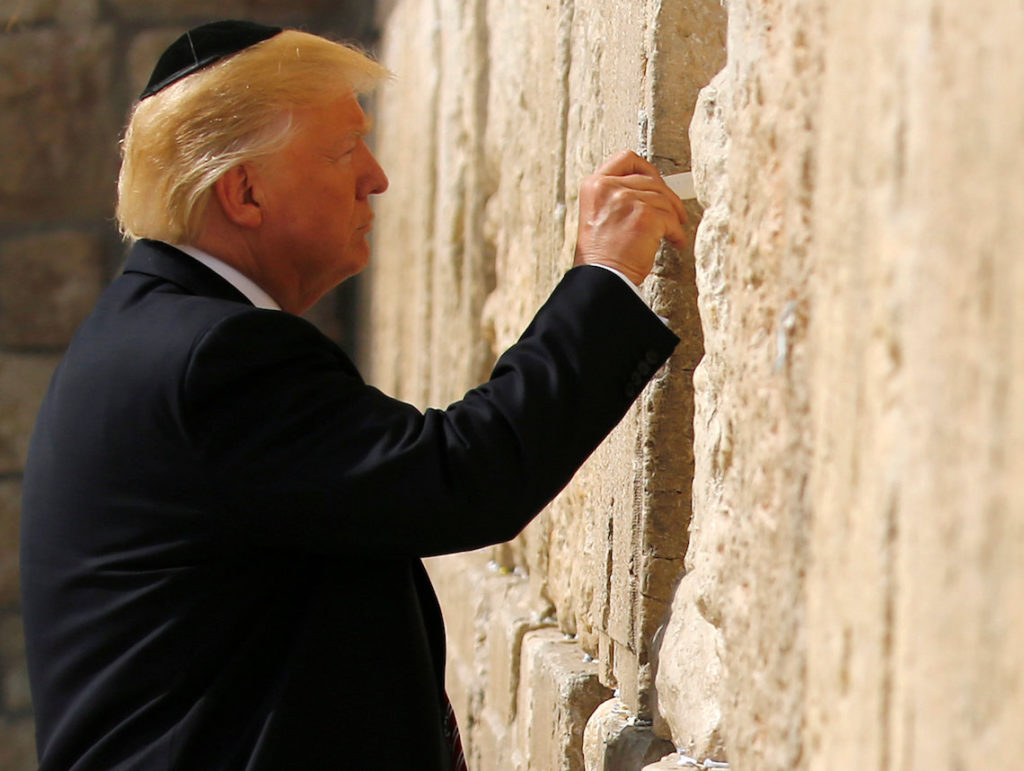
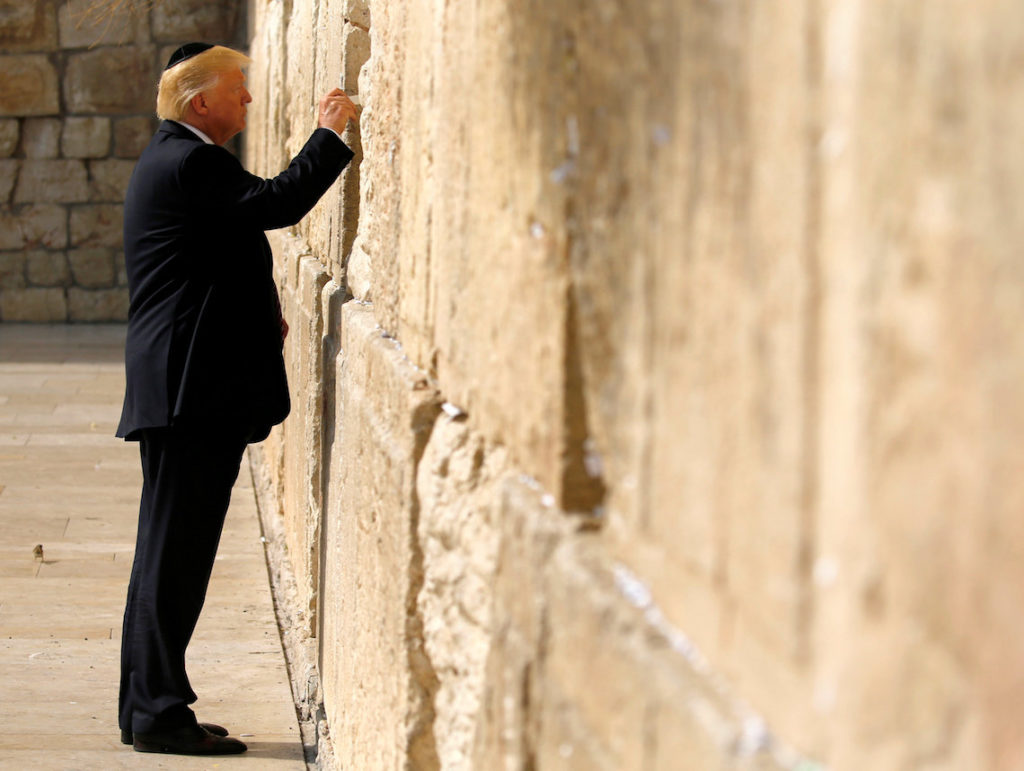
Let the record show: On May 23, 2017, the president of the United States updated his Twitter header to display a photograph of himself standing at the Western Wall. Not saluting an American flag, not kissing a Latino baby or speaking at a Midwest rally or shaking a veteran’s hand, but communing with Judaism’s holiest site.
I have nothing cynical to say about it. For a man whose self-worth is in direct proportion to the size of his Twitter following (30.2 million), and who likely checks his feed more often than his briefing papers (OK, that was a little cynical), this means something.
The most powerful person in the world is demonstrating the power of that place. President Donald Trump is linking the sovereignty of the Western Wall to the State of Israel, despite the demurrals and hedging of his advisers and representatives. Tel Aviv may be one of the most dynamic, creative and delicious cities on earth, but only a fool, or the former head of a large oil company, would say, as Secretary of State Rex Tillerson did, that it is the “home of Judaism.”
The Palestinian-Israeli conflict, which must be solved sooner rather than later in a just way for both sides, is not going to be solved by ignoring or minimizing the narratives each side claims as its own.
In their justified desire for a homeland, Palestinians have sought to deny the primacy of Jerusalem in the Jewish narrative. This week, one prominent Palestinian activist wrote that the holiness of the Western Wall is a post-1967 development, not an age-old tradition. When I read that I laughed and looked up at my study wall, at a photo taken in the late 1800s of Jewish men and women packed up against the ancient stones, in prayer.
In defense of their rights to Jerusalem, many Jews have negated the Muslim claim on the city. There seems to be an online cottage industry in this, in fact. Don’t fall for it. Do your own research. Jerusalem is a holy place in Islam — that big gold-domed atop the Temple Mount might be your first clue.
Jerusalem has been wracked by a long history of dumping on other people’s history. And I mean this literally. To assert their own primacy over the holy city, the Byzantine rulers turned the Jew’s Temple Mount into the city dump. In the “Encyclopedia of Religion,” professor Reuven Firestone relates the legend that it was the Muslim caliph Umar who, after vanquishing the Christians, ascended to the desecrated area, rolled up the sleeves of his robe and began cleaning up the soiled Muslim and Jewish holy place himself.
The caliph then built the Dome of the Rock, not as a mosque, Firestone writes, “but rather as a monument celebrating the presence and success of a new faith.”
We are just about a week away from the 50th anniversary of the Six-Day War, when the Israelis ascended to the Dome, captured East Jerusalem and united the city.
That moment when Israeli soldiers gathered where Trump stood this week, and wept and prayed that the Wall was back in Jewish hands, remains the iconic image of the war, the Jewish Iwo Jima. The emotion, the sacrifice, the sense of historical and religious destiny has affixed in Jewish minds the idea that from that moment on, all of Jerusalem belongs to Israel.
“Har HaBayit b’yadenu,” Lt. Gen. Motta Gur proclaimed as his troops captured the Old City, the most famous single sentence of that war. “The Temple Mount is in our hands.”
But the irony of Trump’s visit is that if the president gets his way, the grip will have to be loosened. For years, Jews and the groups that pander to them have proclaimed intractable sovereignty over every square inch of the city. “Jerusalem will never be divided,” has been the go-to applause line for every Jewish or Israeli speaker — despite the reality that the city even now is pretty much divided.
The truth is every serious final status solution ever put forth by an Israeli prime minister, and any agreement that would ever be agreed to by the Palestinians, would include some shared sovereignty over Jerusalem. What’s the alternative — constant fighting? You can’t pray for the peace of Jerusalem and want to see it, like Aleppo or Damascus, reduced to pieces.
I don’t know how serious Trump is about making what he calls “the ultimate deal.” He has a short attention span, a disdain for details and a lot of ’splaining to do back in Washington. But this week, he leveraged Saudi Arabia and the Gulf states to crack open negotiations, demonstrated the kind of support for the Israelis they need to feel secure, and showed the proper respect to the Palestinians.
A dear friend and die hard Israeli leftist I know e-mailed me as Trump departed for the Vatican.
“The bastard gave a fantastic speech that was even given compliments by Barak Ravid from Ha’aretz,” he wrote, citing the left-leaning columnist. “He’s going about this whole Middle East thing in a completely opposite manner than Obama, and it may be that he is hitting the spot. Oy vey….”
If Trump continues on this path, and doesn’t shy away from confronting each side with the truths the other holds dear, the president might just have a prayer.
ROB ESHMAN is publisher and editor-in-chief of TRIBE Media Corp./Jewish Journal. Email him at robe@jewishjournal.com. You can follow him on Instagram and Twitter @foodaism and @RobEshman.
Britain’s bloodiest terrorist attack in over a decade occurred Monday just two miles from Rabbi Yisroel Cohen’s synagogue.
Yet one day after the deadly bombing in Manchester, Cohen told JTA he has no intention of changing security arrangements at his congregation.
In fact Cohen, a Chabad emissary who works in a Jewish enclave in the northern part of the city surrounded by a heavily Muslim area, said there is little room for improving security across his tight-knit community.
After all, the Jewish community in Manchester — one of the U.K.’s fastest-growing spots thanks to an influx of immigrants and young couples seeking alternatives to pricey London — has been on its highest alert since long before the explosion that killed 22 people and wounded 50 at an Ariana Grande concert. On Tuesday, ISIS claimed responsibility for the act.
“Well, the radio equipment is working, the residents have been briefed, police are patrolling, security professionals from the Jewish community have been in place since the attacks in Belgium” last year, Cohen said when asked about security. “There is only so much you can do – except pray.”
On Kings Road, a busy street of the heavily Jewish borough of Prestwich, residents keep an eye out for strangers. Any abnormal behavior – particularly photography or the gathering of information — quickly invites polite but firm inquiries by both passers-by as well as shopkeepers who cater to the local population of haredi and modern Orthodox Jews.
The vigilance in Jewish Manchester owes much of its preparation and training to the local police, the Community Security Trust organization and other groups. But it is also born of circumstance: Manchester’s some 30,000 Jews are concentrated in a relatively small area. This makes them an easy target, but it also means that the community’s institutions are easier to protect and vigilance is easier to instill.
While there are also concentrations of Jews in North London, in Manchester — a city of 2.5 million, where 15.8 percent of the population is Muslim — there is added tension because the Jewish and Muslim communities live in close proximity. Kings Road, for example, is sandwiched between the Judaica World bookstore on its western end and the Masjid Bilal mosque on its eastern one.
This juxtaposition in recent years has generated some friction, including in the harassment of Jews on the street and the occasional violent incident.
At least one more premeditated plan to attack Manchester Jews was uncovered and foiled five years ago. In 2012, a British judge imprisoned a Muslim couple, Mohammed Sajid and Shasta Khan, for seven years for gathering intelligence on Manchester Jews for an attack.
“That incident came at a time of reassessment about the threat to Jews in Manchester, and it was one of the reasons that led to a complete overhaul,” Cohen said.
“So today, we in the Jewish community are perhaps less surprised than others at what happened,” the rabbi added, though he also said that Mancunian Jews are “shocked at the horror” witnessed at the concert.
Paul Harris, editor of the city’s Jewish Telegraph weekly, told JTA he generally agrees that Manchester’s Jewish community is well prepared to deal with any emergency or fallout thereof, but he also flagged one weak point: On evenings and afternoons, observant Jews in the city congregate outside synagogue — a habit that makes them an easy target and which, for that reason, has largely been abandoned in at-risk communities in France and beyond.
“Maybe that will change now,” Harris said.
In a statement Tuesday following a suspect’s arrest, Prime Minister Theresa May said the bombing was a “callous terrorist attack” that targeted “defenseless young people.” Police believe a homemade explosive vest was detonated by a suicide bomber who may or may not have been working alone.
The explosion ripped through the 21,000-seat Manchester Arena at 10:30 p.m. after Grande, a 23-year-old pop singer from the United States, had already left the stage. At least 12 of the 22 killed in the attack were children younger than 16. News of the explosion sent worried parents to the arena, where children, teenagers and young adults streamed out of the main exit in a state of panic.
Cohen said that Chabad was not aware of Jewish fatalities in the attack.
The attack happened a little over two weeks before the June 8 general election in which hardliner Theresa May from the Conservative Party is running against Jeremy Corbyn, leader of the Labour Party. The attack may further increase May’s lead in the polls on Corbyn, a left-leaning promoter of outreach to Muslims who has called Hezbollah and Hamas his friends.
Last year Corbyn — amid intense criticism in the media and from members of his own party for his perceived failures in curbing expressions of anti-Semitism within Labour’s ranks — said he regretted expressing affection to the two Islamist terror groups. Following the attack Monday, all parties agreed to suspend campaigning for three days.
Israeli Prime Minister Benjamin Netanyahu at a joint news conference Tuesday in Jerusalem with President Donald Trump, who was visiting Israel, referenced the attack in criticizing incitement to terrorism by the Palestinian Authority under its president, Mahmoud Abbas.
“President Abbas condemned the horrific attack in Manchester,” Netanyahu said while standing next to Trump. “Well, I hope this heralds a real change, because if the attacker had been Palestinian and the victims had been Israeli children, the suicide bomber’s family would have received a stipend from the Palestinian Authority. That’s Palestinian law. That law must be changed.”
Speaking in Bethlehem, Trump joined other world leaders who condemned the attack.
“I won’t call them monsters because they would like that term. I will call them losers,” he said.
Back in Manchester, Rabbi Shneur Cohen of the Chabad Manchester Center City organized a food and drinks distribution to police officers who were stationed outside the arena where the attack took place.
“We are Manchester, we stand together,” Cohen told reporters at the scene.
But Harris, the Jewish Telegraph editor, said that despite such gestures, “there is definitely a silence, a shocked silence” in the city following the attack.
President Donald Trump changed his Twitter profile’s background picture to feature a photo of his prayer at Jerusalem’s Western Wall.
Trump or one of the people he trusts with his personal Twitter account posted the photo on Monday after Trump had prayed at the wall. The previous picture showed Trump seated in the Oval Office surrounded by staff.
Trump’s feed also included tweets reflecting his assessment that his Middle East tour this week was a success.
Israel, Saudi Arabia and the Middle East were great. Trying hard for PEACE. Doing well. Heading to Vatican & Pope, then #G7 and #NATO.
President Donald Trump has come and gone from his trip to the Middle East, his first foreign excursion since taking office earlier this year. He arrived — first in Riyadh, Saudi Arabia, then Jerusalem and Bethlehem in Israel — with strong words about Iran as the neighborhood bully and, like so many American presidents before him, buoyant words for the Israeli and Palestinian people.
Optimistic words. Hopeful words. They all conveyed a vision and new possibility for peace in the region, a prospect “I’ve heard,” he said, that is “one of the toughest deals of all. But I have a feeling we will get there eventually, I hope.”
Good for Trump. A new American president. A new chance for a solution. A new team to get it done.
But where were the new ideas Israeli leaders are so certain he has? What is the new approach? How does he propose to untangle the thorny issues on the ground — boundaries, settlers, Jerusalem, etc. — that have left so many presidents before him bloody with failure?
Peace between Israelis and Palestinians was a topic of much discussion when Trump visited Jerusalem and Bethlehem. It was front and center, but not necessarily the first item on the agenda. In his speech to the Arab world in Riyadh days before, in his unscripted photo-op with Prime Minister Benjamin Netanyahu, in his later remarks in the prime minister’s house, Trump was more focused on Iran as the source of menace in the region. He and Netanyahu suggested that there are new opportunities in the region. Countries must unite against a common threat — Iran. That’s an opening that can be explored.
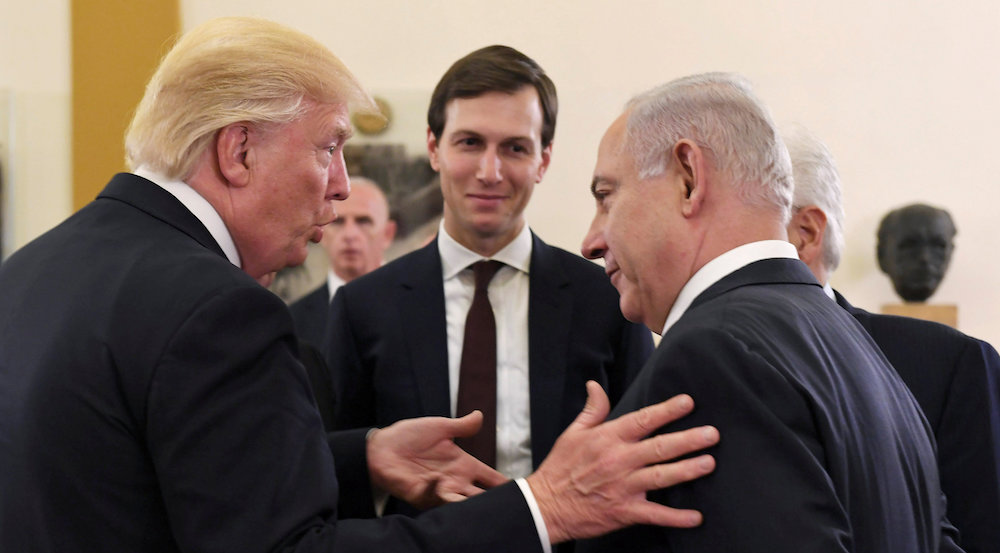
U.S. President Donald Trump and Israeli Prime Minister Benjamin Netanyahu chat as White House senior advisor Jared Kushner is seen in between them. Photo by Kobi Gideon/Courtesy of Government Press Office
Michael Oren, historian, former Israeli ambassador to the United States and currently Israel’s deputy minister for diplomacy, said he believes that this new reality is a conduit of a “tremendous” shift. If once it was assumed that a peace with the Palestinians could lead to reconciliation of Israel with the rest of the Arab world — the situations is now reversed: A peace with the Arab world could lead to a deal with the Palestinians. If the Saudis come on board, if other Gulf states come on board, if the Arab world realizes that fighting against Israel makes no sense in this era of radicalism, the Palestinians might realize that the train of peace is leaving the station and that they’d better hurry so they don’t miss it.
Maybe this is what Israeli leaders mean when they constantly talk about “new ideas.” Trump is a devotee of “new” ideas, “bold” ideas, “different” ideas. For Israel, to resist his push for a deal would be a mistake. But it might be able to convince him that his predecessors failed because of their conventional thinking — and that he, a man bold enough, ought to reformulate the meaning of the ultimate deal. The “two-state solution” is old, tired — and it is so Clinton and Obama. Trump could make his mark by thinking outside of the box, that is, by dropping old ideas and replacing them with new ideas.
Israeli President Reuven Rivlin sang the praises of new ideas after his meeting with Trump: “Our destiny — Palestinians and Jews — is to live together in this land,” he said. “In order to achieve this, we need new ideas, new energy that will help us move forward, together.”
But move where? Rivlin has his new ideas; he supports one state, or a confederation of Israelis and Palestinians. Naftali Bennett, the head of the Jewish Home Party and the leader most forthright in attempting to directly tell Trump what needs to be done (“We expect you to be the first president to recognize a united Jerusalem,” he said, to which Trump responded, “That’s an idea!”), has different new ideas. He supports an autonomy for Palestinians and annexation of the rest. Other leaders also have new ideas, including the oldest “new” idea of sticking to an improved status quo.
Does Trump have new ideas? If he does, we were still waiting to hear what they are as he departed for Europe. It was worth noting that Trump refrained from using the term “two-state solution” during his visit. It is possible that he is more open than his predecessors to considering alternative ideas, assuming he has them. In Saudi Arabia, in Jerusalem and in Bethlehem, he kept hinting that his deal is partially built on the goodwill of the conservative Arab regimes of Jordan, Egypt and Saudi Arabia. Former President Bill Clinton failed to get them on board at Camp David. He was disappointed by their refusal to help him push the late Yasser Arafat, chairman of the Palestine Liberation Organization, toward accepting the deal that was offered to him. Trump and some of his top advisers believe circumstances have changed in a way that could make such a push more realistic today.
His brief trip was barely a beginning of a long process of exploration of these assumptions and ideas. Although it sent a symbolic message of involvement and new energy, it did little to advance a detailed vision of a peace process. And of course, involvement is crucial, as both Arab and Israeli leaders made clear in their remarks, taking a swipe at the Barack Obama administration.
“We are happy to see that America is back,” said Rivlin, usually not the type to bash the former president. Netanyahu, not surprisingly, was more direct: “I want to tell you also how much we appreciate the reassertion of American leadership in the Middle East.”
President Donald Trump with Israeli President Reuven Rivlin in Jerusalem on May 22. Photo by Jonathan Ernst/Reuters
The new American president ought to know that there is no correlation between the number of visits to the Middle East and the level of success in handling Middle East affairs. Yes, Trump made “history” — a word used much too often to describe routine events — in going to Israel and Saudi Arabia earlier in his term than any other president. He made “history” again by being the first sitting American president to visit the Western Wall. So what? Nixon made history by being the first president to travel to Israel. Shortly afterward, he was forced out of office. Clinton made history by coming to Israel more than all other presidents, four times. It did not guarantee his success.
The only presidential visit that really made a change was Jimmy Carter’s in 1979. That was a dramatic visit, with ups, downs and crises. It was a make-or-break visit: Carter traveled to Egypt, then to Israel, and forced the hand of the late Israeli Prime Minister Menachem Begin to accept the peace deal that was proposed to him. A few years ago, Israel’s state archives released documents from that visit, including a cable that was sent from Zvi Rafiah, Israel’s then-liaison to the U.S. Congress. Carter briefed congressional leaders when he was back in Washington, D.C., and Rafiah reported to his superiors in Jerusalem that during this meeting, Carter described his meeting with the Israeli cabinet as “terrible.”
“Terrible” and “horrible” are two of Trump’s favorite words. So maybe he will also describe parts of his visit as terrible. Maybe he did not appreciate the food, or the heat, or the forced selfie with Knesset Member Oren Hazan. But as far as we know, by the end of his visit on May 23, nothing truly “terrible” happened. Everybody was nice to him. Everybody agreed with him. Everybody encouraged him to keep doing what he is doing, whatever that is.
A time for confrontation might still come, when a more detailed plan emerges, and a real price is demanded of the parties. Already, Israel and the Palestinians got a taste of the future. Israel watched reluctantly, yet silently, as the Saudis bought weapons in quantities that might put Israel’s military edge at risk. The Palestinians witnessed an American president visiting the Kotel. They heard an American president, not for the first time, raise the issue of terrorism as an obstacle they need to overcome to achieve their objectives. They heard him say “peace” but not “a Palestinian state.”
And so. There was a visit and it went smoothly. For Trump, that is certainly an achievement. Everybody was trying to convince everybody that the visit was successful and that Trump is exactly what they expected him to be.
But there was reason for caution. On the evening of May 22, about an hour before Trump and Netanyahu made their joint statement in Jerusalem, I was sitting in a radio studio in the city of Modi’in. The interviewee on the line was Member of Knesset Ahmad Tibi, an Arab legislator, an articulate critic of Israel’s policies, and a frequent visitor at the offices of Mahmoud Abbas, the Palestinian president.
He was cautious. Very cautious. Wisely cautious. Tibi has hopes, but he isn’t letting them get too high. He knows Trump changes his mind, he said. He knows it is not yet clear what Trump wants, beyond the generalities of having a “deal” and brokering “peace.” He knows Trump won’t always have the patience necessary to see a bumpy peace process through. And so Tibi’s message was simple: I’ll believe him about his Israeli-Palestinian peace effort when I see it.
When I asked Tzachi Hanegbi, Israel’s communications minister, about Trump reportedly walking back on his campaign promise to move the American embassy to Jerusalem, Hanegbi didn’t even blink before explaining that a visit to the Western Wall is much more important than moving the embassy. And when Tibi was asked if he was annoyed by Trump’s visit to the Kotel, Tibi didn’t even blink before explaining that it was an insignificant event that reinforced the fact that the U.S. does not recognize the site as Israeli.
Despite what did and didn’t happen, give Trump credit for this: He was polite, almost gaffe free and vague enough to keep the valuable posture of a Rorschach test: for now, all interpretation of his actions and intentions are still in the eye of the beholder.
Finally, after about an hour of partisan arguments from both sides, I heard something that got my attention.
I was attending an event sponsored by the UCLA Debate Union, billed as “A Spirited Debate on BDS (Boycott, Divestment and Sanctions).” It featured, on one side, professor Judea Pearl, who was born in Tel Aviv, and students Philippe Assouline and Joseph Kahn, and, on the other, professor Saree Makdisi, who is of Palestinian descent, and students Ahmad Azzawi and Wali Kamal.
In front of a diverse audience of about 100 people, Pearl’s side argued the motion that “BDS is not moral.”
Nothing surprised me too much in the back and forth. The Pearl side reiterated the well-known arguments against BDS — namely, that it is out to undermine the Jewish state rather than search for peace — while the Makdisi side framed BDS as fighting the Israeli occupation with the best nonviolent tool available.
While we’ve heard many of the arguments before, it was helpful to hear them all in one place and in a polite manner, with no yelling or insults. You could feel some underlying tension throughout the debate, but the panelists made a genuine effort to conduct themselves with civility.
Makdisi based many of his arguments on universal values such as fairness, equality, justice and so on. Focusing on those values helped him finesse the Achilles’ heel of the BDS movement — the fact that it doesn’t recognize the legitimacy of the Jewish state. Promoting the “right of return” of millions of Palestinian refugees to Israel, for example, means the effective end of the Jewish state, what a panelist on the Pearl side called “national suicide.”
Makdisi took that word — suicide — and ran with it, almost ridiculing it as an example of needless hysterics from the Zionist side. You could see where he was going. What kind of just society would treat the arrival of Palestinians as a national suicide? Sure, there may be a huge number of Palestinians who would enter the Jewish state, but what’s wrong with Arabs and Jews living side by side, in full equality, in the same state and under the same government?
My grandparents in Morocco never got to fight for their rights, as Arabs do in Israel. They weren’t allowed.
Then, he really got the audience’s attention when he blurted out these words: “What’s wrong with Jews being a minority?”
There was a gasp among pro-Israel supporters. Pearl made a grimace, commenting that minorities are not treated very well in the Middle East.
I have a feeling Makdisi himself regretted his words as soon as he said them.
Why? Because he’s no fool. He’s a knowledgeable professor, and he surely knows what’s wrong with Jews being a minority in a country in the Middle East.
He knows that, for centuries, Jews in Arab and Muslim countries were treated as second-class citizens, or dhimmis. He knows that many of those Jews were persecuted and expelled after the birth of Israel in 1948.
He knows that there are 50 Muslim countries in the world, but only one Jewish state.
He knows that in many of those 50 countries, minorities are routinely persecuted and oppressed.
And he knows that in the Jewish-majority country of Israel, the Arab minority has more civil rights, freedom, legal protections and economic opportunities than Arabs have virtually anywhere else in the Middle East.
He knows all of that.
So, when he said, so innocently, “What’s wrong with Jews being a minority?” he probably forgot who was in the audience. Maybe he thought he was talking to a Students for Justice in Palestine crowd, for whom a Jewish minority in the Jewish state would be like manna from heaven.
But he wasn’t. There were some proud Zionists in the audience, and I was one of them.
I’m a Jew who was born in an Arab country, where my ancestors were a minority for centuries. The stories I heard were not of human rights and equality. They were stories about surviving by behaving — by keeping our heads down and never forgetting our second-class status. My grandparents in Morocco never got to fight for their rights, as Arabs do in Israel. They weren’t allowed.
That’s why, for 1,900 years, Jews from all over the world yearned to return home to Zion and Jerusalem. That’s why the Zionist movement fought so hard for the rebirth of the Jewish state — because the Jewish experience of being a vulnerable minority in a hostile land is not one we want to relive.
When Makdisi suggested that Jews should become dhimmis again in their own country, he confessed what the BDS movement is really about — and it isn’t very moral.
David Suissa is president of TRIBE Media Corp./Jewish Journal and can be reached at davids@jewishjournal.com.
Some 74 Palestinian employees of SodaStream, who lost their jobs when the company shut its West Bank plant in the face of international pressure, will return to work at its factory in southern Israel.
The employees’ work permits, which allowed them to enter Israel from the West Bank, expired in February 2016.
The Israeli government agreed to reinstate the permits after persistent requests from SodaStream and its CEO Daniel Birnbaum, The Jerusalem Post reported Sunday.
“We are delighted to welcome back our 74 devoted Palestinian employees, who are able to join their 1,500 friends at our Rahat facility in the Negev,” Birnbaum told the newspaper. “The Israeli government did the moral and honorable thing to grant work permits to our employees, who can now provide for their families and also prove that coexistence is possible.”
In October 2014, SodaStream announced it would close its factory in Maale Adumim and move to southern Israel in the face of pressure from the Boycott, Divestment and Sanctions movement, or BDS, which seeks to hurt Israel’s economy over its policies toward the Palestinians. The movement claimed that SodaStream discriminated against Palestinian workers and paid some less than Israeli workers.
Some 500 Palestinian employees lost their jobs at that time. Israel gave the remaining 74 employees permission to enter the country and continue to work for SodaStream until February 2016.
The company now has more than 1,400 employees in the Idan Hanegev industrial park near Rahat, one-third of them Bedouin Arabs from the surrounding area.
The Palestinian employees will have to leave for work at 4:30 a.m. in order to make the long commute and be there on time, but at least one told the Post that he does not care.
“SodaStream is our second home,” Ali Jafar, 42, told The Jerusalem Post on Sunday. “When you have the opportunity to return home, you return.”
Secretary of State Rex Tillerson refused to answer whether Jerusalem’s Western Wall or Kotel is part of Israel when asked by Pool reporters on Monday morning before arriving in Tel Aviv for his first ever visit. The top US diplomat followed the same approach to National Security Advisor H.R. McMaster who also declined to clarify if he believes that the holy Jewish site is under legal Israeli sovereignty when pressed by White House reporters. On Capitol Hill, Members of Congress switched their traditional roles on this sensitive issue when responding to the Trump administration’s policies as the city of Jerusalem continued to play a key role during President Donald Trump visit to Israel.
“I think they’re being sensitive. Much like, what I would be sensitive. They are in the midst of some very interesting times and are being wise with what they want to weigh in and how they want to handle things,” Representative Tom Emmer (R-MN) told Jewish Insider on Monday evening. “I wouldn’t begin to second guess what they are doing because I don’t know the pressures that they are under.”
However, Democrats critiqued the administration for this policy decision. Rep. Anna Eshoo (D-CA) emphasized that she “very much” believed that the Kotel is part of Israel. “It’s a lack of understanding of the holiness of the site i.e. understanding the faith and the history that’s attached to it.” On a similar note, Rep. Joseph Crowley (D-NY) said, “I recognize that the Western Wall is part of Israel. I think most members of the House do.”
While Republicans were frequently quick to condemn the Obama administration for criticism of the Netanyahu government, Rep. Buddy Carter (R-GA) refused to criticize senior Trump administration officials: Tillerson and McMaster regarding the Western Wall. “I don’t know their reasons for not being able to answer, so I can’t comment on that,” Carter noted.
Assessing Trump’s first overseas visits to Saudi Arabia and Israel, Carter lavished praise upon the President. “I think he’s done a great job. It’s certainly a better situation for America. Instead of our chief elected official, going over and apologizing for everything we’ve done, we finally have someone who is going over there and asserting themselves and American interests. I’m proud of that.”
But, Crowley offered a more restrained assessment. “So far, the world hasn’t fallen apart so I give him credit for that. I would have liked him to say something about the inequities and the human rights violations that take place in Saudi Arabia.”
At the same time, Rep. Mark Pocan focused on the President’s potential impact on the humanitarian catastrophe in Yemen when visiting Riyadh on Sunday. “I’m more concerned about what he’s (Trump) doing in Saudi Arabia with whatever deals he made regarding the arms sales in Yemen because if the major port in Yemen is bombed, we are told a half a million people will go in famine. We are trying to keep laser focused on the Yemen issue. It’s a big armed sales with no preconditions whatsoever,” he explained.