fbpx

April 3, 2017

Leader of anti-BDS group: Israel’s bill gives ammunition to its enemies

Despite the partisan sniping at this year’s AIPAC conference, one issue that garnered consensus among the lawmakers and lobbyists was the backing of bills targeting the Boycott, Divestment and Sanctions movement.

So it might have been jarring for some of the activists to be approached by an avuncular, kippah-clad fellow who lobbied against an anti-BDS bill — and even more jarring when they learned that their interlocutor was Gerald Steinberg, the founder of NGO Monitor, which targets the very groups advancing BDS.

Steinberg’s target was not the AIPAC-backed congressional bills that punish businesses that boycott Israel and its settlements — the measure uses penalties in place since the 1970s on businesses that comply with the Arab League boycott. Nor was it the many state laws divesting pension funds from businesses that comply with BDS.

It was an Israeli bill, adopted last month by the Knesset, that bans entry to foreigners who publicly call for boycotting the Jewish state or its settlements. The measure has already scored a hit, keeping out a prominent British pro-BDS activist.

Steinberg argued that the bill accomplishes little — Israel, like every country, already has broad discretion about whom to let into its borders.

Instead, he said, critics of Israel are using the bill as evidence of the Jewish state’s anti-democratic tendencies. Steinberg added that liberal allies of Israel in studies associations, who are seeking to block anti-Israel resolutions, are being undermined.

“The visa law doesn’t do anything, but it alienates the allies we have for these fights,” he said.

It may seem odd to hear Steinberg extol liberal allies — he and NGO Monitor have had a contentious if not adversarial relationship at times with the liberal end of the Zionist spectrum, particularly the New Israel Fund. (NIF will not fund “global” BDS activities against Israel, but will support groups that targets goods and services from settlements.)

But he suggested those fights are among family. Steinberg looked horrified when he recalled how Jennifer Gorovitz, an NIF vice president, was detained and questioned by Israeli authorities for 90 minutes upon arriving in the country in February.

Steinberg said it’s time for liberal pro-Israel Americans and right-wing Israelis to come together in fighting BDS.

“It would be useful for American Diaspora groups, including Reform and progressive groups, not just to whack back at Israelis, but to take time to educate” about the best ways of combating BDS, he said.

(In an earlier interview, Rabbi Rick Jacobs, the president of the Union for Reform Judaism, said his movement was doing just that, and made clear to Israeli Prime Minister Benjamin Netanyahu in their most recent meeting how critical it was to combat BDS to maintain support for the two-state solution. “Without a strong commitment on two states, it’s pretty hard to work on BDS,” said Jacobs.)

Steinberg, a political science professor at Bar-Ilan University, tried to reach out to the Israeli sponsors of the bill, but his appeals have fallen mostly on deaf ears. He said the sponsors were thinking domestically and trying to show their backers they were tough with Israel’s enemies.

So last week, he worked the AIPAC halls. He wouldn’t say with whom he met, but Steinberg made it clear that he believed some of the biggest movers and shakers in the American Jewish community could persuade Israeli right-wing politicians to stand down from provocations.

“I don’t think anyone involved in this legislation had any idea it was going in this direction,” he said.

Leader of anti-BDS group: Israel’s bill gives ammunition to its enemies Read More »

How to Make Brisket If You Don’t Have a Dutch Oven

I’m going to assume that you have already read my recipe for The Best Brisket Ever and would love to have the world’s most delicious brisket come out of your oven too. Only thing….you don’t have a dutch oven.

Can you still make a delicious brisket without one? The answer is yes. And let me tell you how.

First, you need to understand what the dutch oven does so you can replicate the process without one.

The dutch oven is ideal because you can sear the meat in it (an important first step to producing great flavor), and then, after adding the aromatic ingredients like onions and herbs, and after adding the liquid necessary to slow cook your brisket into “fall-apart-with-a-fork” tenderness, you can put the same dutch oven into your actual oven and not have more than one pan to clean up. Genius!

Furthermore, the dutch oven is made with enamel-covered cast iron. The cast iron part makes your dutch oven quite heavy, and hence it insulates your brisket really well while it cooks. It doesn’t allow liquids to steam out through cracks, risking a dry piece of meat. It keeps all the flavor in, like a hearth. The enamel coating makes it easy to clean, and this ceramic-like coating tends to add more flavor goodness to the cooking process.

I freaking LOOOOOVE my Le Creuset Dutch Oven and I strongly encourage my cooking students to invest in one. It costs a good chunk of change – around 300-400 dollars, but will last a life time. It’s worth it if you can do it. But if you don’t want to spend that kind of money on kitchen tools right now, or are planning to make a brisket RIGHT NOW and don’t have a dutch oven in your cupboard, then here is what you do:

1. Sear your meat in a large pan. It will be hard to find a pan large enough to hold a brisket, but you can cut your brisket in half, or thirds, to accommodate. Cutting your brisket will not mess up the cooking process, but not searing your meat at the get-go will.

2. You will essentially follow the rest of the recipe but instead of cooking it in a dutch oven, you will use a ceramic (or glass) casserole dish that can accommodate your brisket. You can also use two casserole dishes if you have a really big brisket. As per my recipe – – You will lay the chopped onions on the bottom of the casserole, place your brisket, fat side up, in there, and then cover with the carrots, celery, tomatoes, wine and herbs.

3. You will cover your casserole dish VERY VERY well to simulate the insulation that the dutch oven provides. That means, don’t just give it a piece of tin foil on top. Wrap it ENTIRELY, multiple times, with heavy duty aluminum foil so that no steam or juices could possibly escape. Both the bottom, top and sides of your casserole dish will have several layers of heavy duty foil on it and this will make it function like a dutch oven.

4. Bake as directed, and continue with recipe from there……

Here’s to delicious brisket and to many happy eaters!

If you would like my Free Passover Recipe Bible with 21 recipes for the Jewish holidays, you can find it here.

How to Make Brisket If You Don’t Have a Dutch Oven Read More »

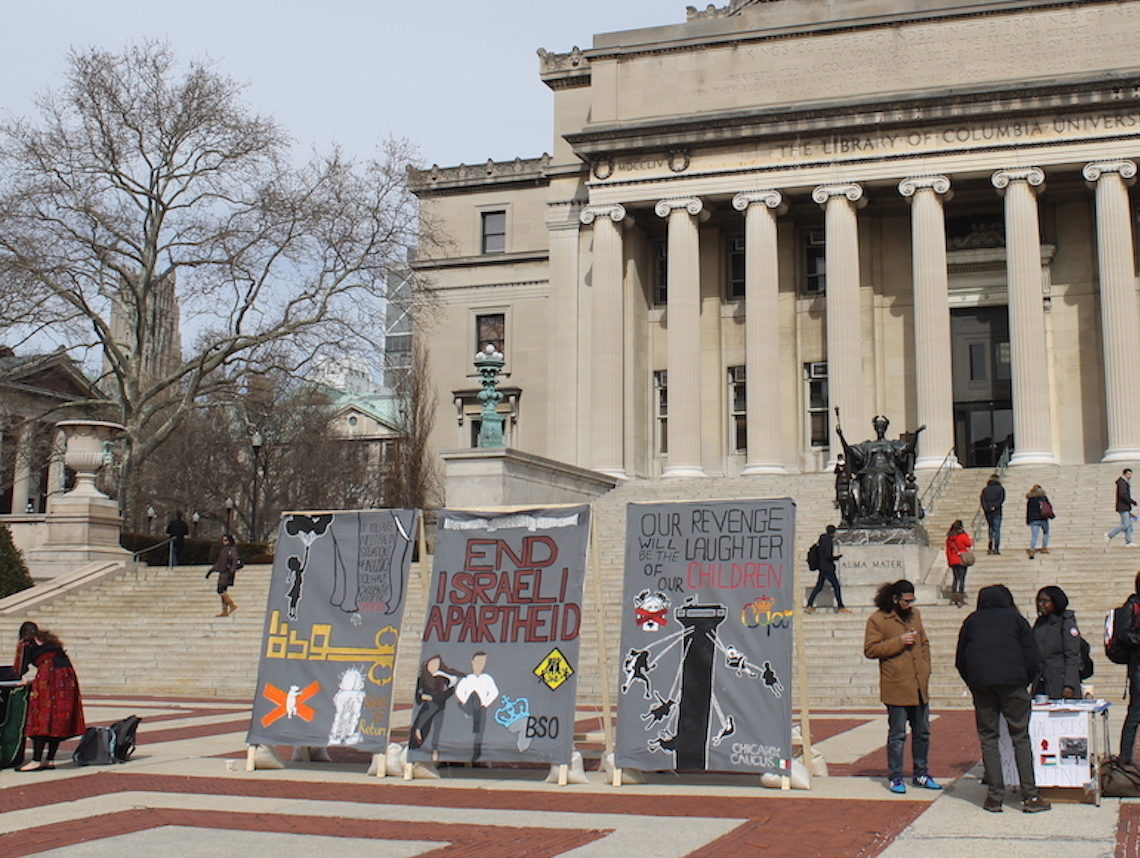
Columbia student council votes down adding BDS referendum

A student council at a Columbia University college voted not to add a question asking about support for the Boycott, Divestment and Sanctions movement to a student referendum.

The Columbia College council decided Monday that it would not include the resolution, which was proposed by the student group Apartheid Divest, to the ballot, according to The Columbia Spectator.

Critics of the resolution said its wording would divide students, especially using the term “apartheid,” to describe Israel. Proponents said it was not intended to change anyone’s opinion but rather that the results would provide information that could be used to encourage divestment from Israel, the Columbia Spectator reported.

Prior to the vote, council members heard presentations from various student groups, including Columbia University Apartheid Divest, Students Supporting Israel, Students for Justice in Palestine and Jewish Voice for Peace.

Columbia student council votes down adding BDS referendum Read More »

Rasmea Odeh, Linda Sarsour slam ‘Zionists’ at Jewish Voice for Peace summit

A Palestinian woman who is being forced to leave the United States for not telling immigration authorities that she was imprisoned in Israel for two terror attacks told a U.S. Jewish group that they must stop the “Zionists” from their “land grab.”

Rasmea Odeh was the keynote speaker on Sunday in Chicago at a summit of the Jewish Voice for Peace, a group that backs the Boycott, Divestment and Sanctions movement against Israel.

Odeh, 69, accepted a plea bargain last month that forces her to leave the country and strips her U.S. citizenship. She had been fighting in the courts for years.

Also speaking at the conference was the Palestinian-American activist Linda Sarsour, who raised hackles among liberal American Jews recently by saying that those who identify as Zionist cannot be feminist because they are ignoring the rights of Palestinian women.

Meanwhile, during Odeh’s address, the Israel advocacy group StandWithUs held a memorial ceremony at the same hotel for Edward Joffe and Leon Kanner, the two men killed in the 1969 bombing in Jerusalem for which Odeh was convicted by an Israeli military court. The group had been denied a request to rent a conference room at the insistence of Jewish Voice for Peace.

Odeh spoke about having to leave the United States.

“I thought when I came to the U.S., and made it my second home, it would be the last station in a journey of struggle that I shared with my Palestinian people in response to the Nakba [catastrophe]  and the occupation of 1967,” she told the audience of about 1,000, referring to the Palestinians’ perception of Israel’s founding, including their forced and voluntary displacement to neighboring countries.

She added: “Now I face a similar Nakba, forced to leave the country and the life that I built for myself over 23 years in the U.S., but I will continue my struggle for justice for my people wherever I land.”

Odeh, a leader of the grassroots International Women’s Strike, reminded the audience that Americans are “in the streets” resisting President Donald Trump every day.

She continued: “Of course, Zionists aren’t going to stop their land grab in Palestine either. The Palestinians there and the Palestinians and our supporters here have to stop them with our resistance and our organization.”

In 1970, Odeh was sentenced to life in prison for two bombing attacks on behalf of the Popular Front for the Liberation of Palestine and spent 10 years in prison before being released in a prisoner exchange in 1980.

In 2015, she was sentenced in the U.S. to 18 months in prison for covering up her conviction and imprisonment in Israel when she entered the country in 1995 and applied for citizenship in 2004, but the conviction was later vacated to allow Odeh to show that she suffered from post traumatic stress disorder over her alleged mistreatment while in prison.

Sarsour, an organizer of the Women’s March on Washington who recently raised thousands of dollars to repair anti-Semitic vandalism at three U.S. Jewish cemeteries, told the crowd: “If what is being asked of me by those who pronounce themselves and call themselves Zionist is that I, as a Palestinian American, have to somehow leave out a part of my identity so you can be welcomed in a space to work on justice, then that’s not going to be the right space for you.”

“We, as Palestinian Americans, as Arab Americans, as Muslim Americans, we will not change who we are to make anybody feel comfortable. If you ain’t all in, then this ain’t the movement for you,” she said.

StandWithUs rented a regular hotel room and held its memorial there.

In a statement, the Joffe family described Jewish Voice for Peace as “another deeply misguided so-called ‘Jewish’ organization.”

“She will soon be forgotten by her supporters who have so misguidedly championed her,” the statement said, “but the memory of Edward and Leon will live on forever.”

Rasmea Odeh, Linda Sarsour slam ‘Zionists’ at Jewish Voice for Peace summit Read More »

The myth and function of the Passover plagues

Passover is a wonderful holiday. It is a time to gather together with family and friends. It provides an opportunity to reconnect with the millennia old line of the Jewish People. On Passover, we reach back through the mists of time to the myths of our national origin. We seek to find lessons from the distant past which might guide us in our present.

The highlight of the festival is the reading of a story from the Haggadah, literally meaning “the story.” The story tells of the enslavement of ancient Israelites in the land of Egypt and their release from bondage following a series of ten calamities, commonly understood as plagues, which devastated Egypt. Those plagues, in the order of the story in the Book of Exodus are blood, frogs, lice, insects, pestilence, boils, hail, locusts, darkness and the death of the Egyptian firstborn. (See Ex. 7:14-12:30.)

Today that core story, and its centuries of embellishments, is read, sung and discussed throughout the Passover seder (a ritual meal, literally “order”). All along the way we are requested to, challenged to, even required to ask questions, to probe into the meaning of the story. The whole exercise is quite dramatic, sometimes even including costumes and choreography. No wonder Passover is an incredibly popular Jewish holiday, with more Jews participating in a seder than fasting on the traditional holiest of holy days, Yom Kippur.

The Passover story is so powerful that its magic has not been dimmed by the increasing recognition that the premise of the story lacks a solid historical foundation. The Hebrew Bible states that six hundred thousand Israelites males, formerly slaves, along with woman, children and others left Egypt as part of a national exodus. (Ex. 12:37.) According to the traditional timetable, this mass migration occurred near the beginning of the thirteenth century B.C.E. As has been discussed here and elsewhere, however, that idea has been largely rejected.

First, there is no evidence to date of any mass slavery of ancient Israelites during the relevant time period. Second, consider the nature of the reported biblical caravan. According to the late biblical scholar Nahum Sarna, a group of about 2,000,000 individuals would have come out of Egypt. (See Sarna, Exploring Exodus (Schoken Books 1986) at 95.) If a group of that size marched twenty abreast, there would have been 100,000 rows of participants, exclusive of animals, carts and other things. If those rows were separated by just ten feet, the entire entourage would have, by application of simple mathematics, extended for around 190 miles. Aside from the problems that result raises with the sea crossing tale, there is no evidence that any movement of a population of that magnitude ever occurred into the Sinai Peninsula and up to the east bank of the Jordan River. Third, there is no evidence of any new settlement patterns established west of the Jordan by a substantial influx of new immigrants in the 13th century BCE. If the narrative were intended to be history as we moderns understand it, that is, a reasonably accurate statement and chronology of actual events, the story fails.

Now, if there were no mass enslavement of Israelites and no mass exodus of them, then surely there would not have been any need for liberating plagues either. Some still maintain, though, that the there is significant evidence for the biblical plagues outside of the biblical text. One such advocate is Israeli Egyptologist Galit Dayan who cites as proof of the biblical plagues an ancient Egyptian document known formally as the Admonitions of Ipuwer. The Ipuwer papyrus describes a time of considerable social and political chaos in Egypt. Dayan translates the hieroglyphs as follows: “Plague is throughout the land. . . . the river is blood . . . and the hail smote every herd of the field . . . there is a thick darkness throughout the land . . . the Lord smote all of the firstborn in the land of Egypt (including) the first born of Pharaoh that sat on his throne . . . .”

There are, however, a number of serious problems with the claim that the Ipuwer papyrus is evidence of the biblical plagues. One is that the Ipuwer papyrus contains a longer and more complex story than Dr. Dayan implies, and her list of events similar to certain biblical plagues amounts to a cherry picking of like situations, while failing to explain the absence in the Ipuwer papyrus of other biblical plagues like lice, insects and locusts. Moreover, the ordeals Ipuwer describes are not seen as coming from a powerful god acting on behalf of his people, but as the result of the ineptitude of an unnamed king. The social dynamics of Ipuwer’s story are also directly contrary to those in the biblical tale. Ipuwer’s story concerned the immigration of foreigners into Egypt, not the emigration of slaves from it. Perhaps most importantly, while there is a debate among Egyptologists regarding the dating of the events related in the papyrus, with some setting the story in the First Intermediate Period (c. 2200-2100 BCE) and others in the late Middle Kingdom (c. 2100-1700 BCE) (see Sarna, above, at 69), both of those dates are centuries before the 13th century date traditionally assigned to the Exodus.

The Ipuwer papyrus also has an extra-biblical competitor. Israeli born producer, director and writer Simcha Jacobovici argues that a 3,500-year-old Egyptian monument known as the Tempest or Storm Stela provides archeological evidence for the Exodus. He contends that a new translation of the stela proves that a massive eruption of a volcano on the Greek island of Santorini generated a storm which flooded Egyptian temples, and plunged Egypt into darkness for days. As in the biblical plague story, loud voices were heard and the Egyptians were seized with terror. (See Ex. 9:29, 15:14.) Jacobovici claims that the stela proves that the Pharaoh at the time, Ahmose (r. 1550-1525 BCE), the storm and the contemporaneous expulsion of certain Asiatics known as the Hyksos are the basis of the Exodus story.

Jacobovici’s argument displays the same defects as the claim based on the Ipuwer’s papyrus. While there clearly was a massive volcanic eruption on Santorni, which scientists date to between 1645 and 1600 BCE, and that event may even have had some impact more than 450 miles away in Egypt, it occurred at least half a century before Ahmose’s reign. Timing aside, there is no claim, much less any proof, that the volcanic eruption generated a series of plagues in Egypt as related in the Exodus story. Finally, no convincing explanation is offered to fill a long historical gap and connect the expulsion of some (but not all) Hyskos in the 16th century BCE with the emergence of a recognizable Israel community in the late 13th century BCE and a kingdom in the 10th century BCE.

Not only are the attempts to establish the historicity of the Egyptian plagues wanting for lack of hard proof, there is also no basis for the initial assumption that the Passover story generally and the plagues specifically were even intended to be taken literally, to be historical statements, as we moderns understand that concept. To the contrary, both the text of the Torah we have today and other references in the Hebrew Bible strongly suggest otherwise.

Exclusive of the recitation of ten plagues in the Book of Exodus, plagues in Egypt are discussed two separate times in the Hebrew Bible, both in Psalms. (See Psalm 78:42-51 and Psalm 105:28-36.) In both of the recitations in Psalms, there are only seven plagues, though, and the seven are neither the same in both lists nor is their order the same. What does this mean?

The presence in the Hebrew Bible of these different accounts is actually quite instructive. First, it indicates that when elements of the text were being collected and collated, the editors were familiar with more than one tradition respecting plagues. This is no different, and therefore no more surprising, than the retention in the Torah of alternative traditions concerning such matters as creation, the flood, the Ten Commandments and the spies, to name a few instances where different renditions of traditional stories have been maintained.

The larger story, as found in Exodus, itself appears to be an edited and conflated version of several traditions. Referencing classic biblical source criticism, Yale biblicist Christine Hayes teaches that each of the primary biblical sources known as J, E and P supply some, but not all of the ten plagues. Specifically, she says that J is the source of eight plagues, E provided three and P supplied five, but there are some overlaps. (See Transcript, 1/12.) Significantly, Hayes does not identify D as a source for any of the plagues. In discussing the exodus in Deuteronomy, Moses merely obliquely references “signs” and “wonders,” and fails to mention any specific plagues at all, save perhaps boils and locusts (or crickets). (See Deut. 4:34, 28:27, 38, 42.)

Literary analysis of the plagues lists is also instructive. Each list in Exodus and in Psalms was written as if complete, signaled by either seven or ten components. In the world of biblical symbolism, those numbers indicate wholeness and perfection. (See Sarna, above, at 74.) Further, the more extensive narrative in Exodus is structured carefully, not only as three series of three plagues each, with a stunning climax, but also including within each series repeated patterns of and phrasing for elements of the story.

In short, the theme of plagues seems to have been common during the extended time the Hebrew Bible was being formulated, but the details of the story were quite fluid. There can be little doubt, then, that the story of the plagues in the Torah we have received today is a product of craftsmanship rather than reporting.

But all this begs a critical question: why include a plague story at all in the larger Exodus drama? If the authors merely wanted to convey a spectacle of the majesty and triumph of the Israelite God, they could have invoked images of God splitting of the Nile, a feat more difficult than simply turning it red as even Egyptian magicians could do. (See Ex. 7:22.)They could have had God appear as alternate pillars of cloud and fire, as later claimed during the trek though the wilderness. (See Ex. 13:21.) Or God could have created an oasis, a tiny Eden, or rained down quail and manna instead of hail and locusts (see Ex. 16:13-15), not only to demonstrate creative and fulsome power, but to illustrate the rewards that Egypt could earn through conciliation with the Israelites. That is, the story could have offered divine carrots instead of sticks.

Clearly the purpose of this carefully designed and structured composition was not meant merely to demonstrate either awesome supernatural power generally or the control of nature specifically. It certainly was not meant to induce behavior with compassion and beneficence. Rather, the purpose of invoking plagues seems to have been an exceptionally clever use of a story that was itself dramatic and had some broad acceptability in the popular culture in order to advance a theology at least of monolatry, if not monotheism.

As the Torah text explicitly states, the plagues were selected to defeat and humiliate the gods and symbols of imperial Egypt. They were aimed “ubechol elohe Mitzrayim,” that is, at all the gods of Egypt. (Ex. 12:12.) This view is corroborated later in the Torah. Describing the day after the first Passover, the text claims success for the onslaught: “Yahweh made judgment on their gods.” (Num. 33:4.) The ancient Egyptians had many deities, and the names and roles changed over time. But it is possible to construct a list of the plausible targets of the biblical authors.

The attack begins with the lifeline of Egypt, the Nile River. (Ex. 7:19.)Turning the river to blood would cripple all agriculture and commerce which depended on the river, which is to say most of the Egyptian economy. For the biblical authors, it also represented a multi-pronged assault: the defeat of Hapi, the guardian the Nile, of Khnum, the god of the inundation of the Nile, and of Osiris, god of the underworld, for whom the Nile served as his bloodstream. The second plague was directed to a god symbolized by a frog, that is, Heqet, the goddess of fertility. The Egyptian god of the earth was Geb. Turning the dust of the earth into lice (or perhaps fleas) showed his impotence.

The war on the Egyptian pantheon continues in the second series of plagues. The definition of the fourth plague, arov, is uncertain. It suggests a swarm or horde of insects, often understood as flies. But the text also says that the swarm would fill not only the Egyptian houses, but the land under them. (Ex. 8:17.) Quite possibly the reference is to the scarab or dung beetle, as one of the most prominent Egyptian insect gods, Khepri, was depicted with the head of a scarab. Striking cattle with disease on cattle surely would have embarrassed any one of several Egyptian gods represented by animal heads, such as Apis, the bull, and Hathor, the goddess of the desert and symbolic mother of Pharaoh. Similarly, the spread of boils illustrated the impotence of Imhotep, the god of medicine and healing.

In the third series, the rain of very heavy hail would demonstrate the weakness of Nut, the sky goddess, and mother of other prominent deities. The swarm of locusts that ate everything apparently could not be stopped by any of the agricultural gods and goddesses like Renenutet, the goddess of the harvest, or her son Neper, the grain god, or by the god of wind and chaos, Seth. The final plague in the series, that of a thick multi-day darkness in all the land of Egypt, was surely an act of war, and a successful one at that, on the supreme sun god known as Ra (or Re) or Horus, and often depicted with a man’s body and the head of a falcon.

The import of the story so far, then, was that the gods of Egypt were incapable of protecting their respective domains, and that Pharaoh could not protect his subjects. With the final, and most devastating plague, that of the death of Egypt’s first born males at midnight, we learn that Pharaoh could not even protect his own household or the system of primogeniture on which Egyptian law was based. Neither Renenutet, the guardian of Pharaoh, nor Selket, the guardian of protection and healing, were of any use.

As Rutgers Jewish historian Gary Rendsburg teaches, modern readers of the Hebrew Bible, unfamiliar with the authors’ society and the cultural clues contained in the text will “miss many of nuances that make the stories so fresh and loaded with meaning.” (At 3/4.)That is true, of course, and important. Still, we are left with critical questions. Why was any account of plagues ultimately included in the Torah? What function did it serve? What did the final redactors want their immediate audience to learn?

Unfortunately, we cannot say with precision when particular stories were first written or when they were incorporated into the canon. Much work appears to have been done in the 8th through the 6th centuries BCE, with final revisions coming during and after the Babylonian Exile. Arguably, given the inconsistencies between Ezra and Nehemiah about something as seemingly basic as a fall holiday, one could argue, as does University of Michigan scholar Lisbeth Fried, that the canon was not even set by the end of the Persian Period. Obviously, this is quite an extended time.

Moreover, this was a time of considerable turmoil, politically and theologically. A member of the educated class, attuned to cultural cues, might well have recognized the Egyptian motifs referenced in the story of the plagues. If he did, then he would also know that the story was not an eye-witness account of events, but a symbolic war between the then dominant Israelite god, Yahweh, and the gods of Egypt, headed by the Sun-god Ra. At the same time, Egypt’s influence over the Children of Israel was not as strong during this period as it once was. The Assyrians crushed the Northern Kingdom of Israel around 720 BCE, and the Kingdom of Judah having barely survived a subsequent assault existed at the sufferance of the Assyrians. The Assyrians subsequently fell to King Nebuchadnezzer and the Babylonians. Then, following a series of invasions at the beginning of the 6th century BCE, the complete destruction of the Judahite capital, Jerusalem, and the transfer of Judahite royalty and leadership to Babylon, Judah became a vassal state of Babylon. Babylon, in turn, fell to Cyrus about sixty years later. While Cyrus allowed Judahites to return home, their province, now known as Yehud, was now a small province in the Persian Empire and ultimately subject to Persian control. Toward the end of the 4th century BCE, Persia, and with it Yehud, fell to Alexander and the Greeks.

In the midst of this extended geopolitical war, a multi-faceted religious battle continued as well. With the advent of the reform prophets in the 8th century BCE, polytheism came under increased attack from both those who favored either the supremacy of Yahweh over lesser gods and those who recognized Yahweh as the sole god. And those camps contended with each other. The latter monotheistic view seems to have gained ascendance in the 7th century with the rise of the Deuteronomistic school, but fate, in the form of the death of King Josiah of Judah and the ascendancy of King Nebuchadnezzer of Babylon, intervened.

The destruction of Jerusalem could have ended this nascent monotheism. After all, if Yahweh were the sole true god, he certainly did not protect his treasured people, or his promised land, or even his house, his temple, from ruin. Ironically, though, far from ending monotheism because of the impotence of the deity, the exile from and return to Judah was understood by Judahite leadership differently. Influenced by the Deuteronomists, they argued that the people failed Yahweh, not the other way around. The solution of the surviving and returning leaders, like Ezra, was a stronger commitment to what they saw as the one true god. This was the broad context in which the contents of the Torah seem to have been finalized. And, if so, this context helps us understand how the plague story may have functioned at that time.

Rather than directed to a sophisticated reader in Judah or even in the established community of Judahite emigres in Egypt, who would understand the references to the Egyptian pantheon, the story of the plagues may well have been intended to underscore for post-exhilic Judahites who had returned, or were thinking of returning, that the worship of false gods of any kind, whether Canaanite or Babylonian or Persian or of any other origin, was improper and destructive. That is, beyond the explicit message, lay an implicit lesson: just as the gods of Egypt were no match for the Israelite God, neither are any of the current local gods. In a time that required nation building, the story served, then, to provide a unifying theological feature in the larger text which functioned as a unifying statement of a people’s creation and history and a unifying anthology of its traditions.

Myth based Judaism has generated compelling stories and, at its best, a compassionate culture. The story of the Israelites’ escape from bondage serves as a beacon to all who are oppressed and as a reminder to those of us fortunate enough to be free to remember what slavery might have been like, how it must have felt to have been a stranger in a strange land. During the seder, as the plagues are mentioned, we remove some wine from our cups to diminish the sweetness of the Israelite’s escape, to recognize the suffering of others and to temper our joy. These are worthy lessons.

But myth based Judaism has its limits, and pretending that myths are reality is not only intellectually indefensible, it can be counter-productive, even self-destructive, as well. If we take bible stories as statements of historical truth, when they are not, and if we purposefully avoid trying to understand what the authors intended their audience to learn, we act as nothing less than illiterate literalists.

Reality based Judaism acknowledges that neither the Exodus nor the plagues occurred as depicted, that the plagues are a myth within a larger myth, set in a time when humankind often identified each aspect of nature, of life itself, with a separate god. Some may conclude from that acknowledgement that the Jewish freedom narrative lacks not only foundation, but merit. But reality based Judaism also rejects the nihilism of superficial contemporary readers who fail to come to grips with both the original intent and redeeming transcendent value of the story. Rather, reality based Judaism accepts the challenge of Passover to dig deeply into the tale, to ask a question and then another and yet another. It seeks to wrestle with the text and extract both truth and wisdom from this powerful story. When we do, when we struggle with the broader myth, and the more troubling one contained in it, we recognize that the authors had matured enough to grasp the fallacy of false gods.

If we want to build a Judaism for tomorrow, we need to look back to the origins of our texts and traditions. We need to try to understand not just what our foundational texts say, but why they say it. We need to become familiar with the context of the content of those works to determine what end the founders sought to achieve. This is the challenge and this is the opportunity of reality based Judaism, as we, too, need to reject false gods and be guided by truth and wisdom.

A version of this essay was previously published at www.judaismandscience.com.

The myth and function of the Passover plagues Read More »

Israel sends condolences, support to Russia following deadly subway bombing

Israeli Prime Minister Benjamin Netanyahu sent condolences to Russian President Vladimir Putin after at least 10 people were killed in a bombing attack on a St. Petersburg subway.

“On behalf of the Government of Israel, I send condolences to President Putin and to the families of those who were murdered following today’s bombing on the St. Petersburg subway,” Netanyahu wrote Monday in a statement hours after the afternoon blast, which also injured dozens more. “The citizens of Israel stand alongside the Russian people at this difficult time.”

The homemade bomb filled with shrapnel detonated in a moving subway car after Putin had arrived in his hometown for a visit. A more powerful bomb was discovered later at a nearby train station and defused.

The attack shut down the entire subway system in St. Petersburg, Russia’s second largest city.

No group has claimed responsibility for the attack.

Israel sends condolences, support to Russia following deadly subway bombing Read More »

Jared Kushner in Iraq for update on fight against ISIS

Jared Kushner, the Jewish son-in-law of President Donald Trump and a senior adviser, is in Iraq to receive an update on the campaign against the Islamic State.

Kushner arrived Monday in the Middle Eastern country with the chairman of the U.S. Joint Chiefs of Staff Gen. Joseph Dunford, according to the Department of Defense.

National Public Radio reported that White House press secretary Sean Spicer confirmed to its reporter early Monday morning that they had arrived.

Dunford invited Kushner and Homeland Security Adviser Thomas Bossert to receive an update on the campaign against the Islamic State, or ISIS, a spokesman for Dunford told reporters. They will be meeting with Iraqi, American and coalition officials.

The spokesman, Navy Capt. Greg Hicks, also said that Kushner is “traveling on behalf of the president to express the president’s support and commitment to the government of Iraq and U.S. personnel currently engaged in the campaign” against the Islamic State.

Trump has charged Kushner with making peace between Israel and the Palestinians, and has involved him in other foreign policy issues. Kushner also has been tapped to lead a new White House office that would streamline the government, using ideas borrowed from the business world.

Jared Kushner in Iraq for update on fight against ISIS Read More »

GHOST IN THE SHELL Movie Review

GHOST IN THE SHELL is based on a 1989 Japanese manga (comic) by Masamune Shirow. Scarlett Johansson‘s Major is a human brain transplanted into an engineered yet human-looking body.  She’s designed as the perfect soldier in a future that makes us question the limits and benefits of technology.  Rupert Sanders (SNOW WHITE AND THE HUNTSMEN) directs Juliette Binoche, “Beat” Takeshi Kitano, Pilau Asbaek, Michael Pitt, Chin Han and Lasarus Ratuere.  The diverse cast represents eight different nationalities.

Ever since Scarlett Johansson’s casting, the Internet has been abuzz with talk of “whitewashing”.  This process is substituting a white actor in place of another race, despite source material which seems to dictate otherwise.  It’s actually a bit ironic that American audiences have been so vocal about the casting. Manga (comics) and anime (cartoons) are littered with characters who have distinctly Western features.  Japanese cultural norms are such that an entire population of women seek to fulfill a new standard of beauty based on Western media exports.

From a sociological perspective, this is certainly an issue within the country and will likely continue to be one for the foreseeable future.  However, in examining the movie from within this prism, Johansson’s casting is the perfect choice.

History dictates American audiences have no problems substituting one Asian actor for another.  Twelve years ago,  the distinctly Japanese story MEMOIRS OF A GEISHA cast a Chinese actress in the title role.  Ziyi Zhang is undoubtedly a great actress, but isn’t her casting just as egregious as Scarlett Johansson’s?

For more about “whitewashing” in GHOST IN THE SHELL, as well how gender and Japanese culture were integrated, take a look below:

—>Looking for the direct link to the video?  Click here.

GHOST IN THE SHELL Movie Review Read More »

When Judaism Becomes a Brand

“Jewish culture is in the mainstream, it’s popular, and that’s something any brand would want to jump on,” says the founder of a startup profiled in the new issue of Bloomberg Business Week. It “seeks to sell [an] accessible version of Jewish traditions,” explains Danya Shults, whose for-profit company, Arq, offers workshops, retreats, and meals in addition to items like seder plates.

The organized Jewish community supports a number of nonprofits that take a similar approach. Aliza Kline, executive director of the social dining app One Table, observes, “Not that long ago, it would have felt dirty to talk about branding Jewish culture.” One Table supports Shabbat dinners for Jews and non-Jews with the help of grants from several prestigious Jewish foundations and federations.

Jewish funders increasingly support immersive experiences as a way to keep Jews “in the tent,” but the content of those activities typically has little Jewish substance beyond the “brand.” For all the talk of Jewish ‘culture,’ there’s little Jewish literature or music in these new initiatives. There aren’t many excursions to Jewish theater, or meetups to discuss Jewish history or artists or folklore. Instead, there are meals and athletics and travel whose connection to Jewish identity is tenuous at best.

What does this trend say about communal values? For one thing, it embodies the understandable hope that “enlarging the tent” will create new options for intermarried Jews. When Danya Shults thinks about what Arq might sell, her “ultimate test case” is whether her Presbyterian husband would be interested. OneTable’s community is 10-15% non-Jewish.

At the same time, it suggests that our communal organizations don’t have much confidence in the things that make Jews distinctive. Judaism as a religion, Jewish thought, and Jewish customs are treated as liabilities that will alienate millennial Jews and non-Jews alike. Communal leaders therefore tacitly treat those who care about Jewish ideas, culture, and practice as a low priority. They prefer to focus on the least committed in the hope of not losing them.

As it happens, that approach is the very opposite of best practices in marketing. Breweries, for instance, know that 80% of the beer is consumed by 20% of the beer drinkers. That 20%—the frequent drinkers—are the core consumers, so that’s where brewers spend most of their marketing budget. That’s where they get the most cost-effective results.

The Jewish community takes the opposite tack. For the last 25 years, many funders, institutions, and startups have taken greater interest in the “fringe” market, the 80% of Jews who have the weakest connection to Jewish life. With that strategy, it’s no surprise that the indicators of Jewish involvement have continued their long decline. Yet communal leaders still act as if these new efforts are somehow making a difference.

Why not invest more communal resources in those who are interested in the distinctive qualities of Jewish life? That would actively strengthen Jewish identity. It could spur newly formed groups to explore Jewish ideas, creativity, and history. Most importantly, it would treat our variegated heritage not as a marketing liability, but as a source of pride and inspiration.

When Judaism Becomes a Brand Read More »

Bob Dylan gets his Nobel diploma and gold medal in small Stockholm ceremony

American singer-songwriter Bob Dylan has received his Nobel diploma and his gold Nobel medal in Stockholm.

The Swedish Academy met on Saturday with Dylan in a private ceremony in order to present him with the trappings of his Nobel Prize for Literature, Sara Danius, secretary of the Swedish Academy, said Sunday in a blog post.

“Spirits were high. Champagne was had. Quite a bit of time was spent looking closely at the gold medal,” Danius wrote.

The small and intimate ceremony without media present was requested by Dylan, who shuns the spotlight.

Danius and several other members of the Swedish Academy attended one of Dylan’s two sold-out concerts on Saturday night at the Waterfront concert house in Stockholm.

Dylan must deliver a Nobel lecture by June, or forfeit the $927,740 prize, though he will still be considered the laureate. Danius said in a blog post last week that he will likely send a taped version of his lecture to the Academy at a later date.

After the announcement in October that he had been awarded the Nobel Prize for Literature, Dylan told the Swedish Academy that he would be unable to travel to Stockholm for the December ceremony to receive his Nobel Prize, citing “pre-existing commitments.”

Dylan’s prize was announced on Oct. 13 “for having created new poetic expressions within the great American song tradition.” The academy said later that after five days of trying to contact Dylan to inform him of the award, it had given up. Dylan acknowledged the prize two weeks later.

Born Robert Allen Zimmerman and raised Jewish in Minnesota, Dylan wrote some of the most influential and well-known songs of the 1960s. His hits include “Blowin’ in the Wind,” “Like a Rolling Stone” and “The Times They Are a-Changin’.”

Dylan, 75, was the first artist seen primarily as a songwriter to win the literature award, a fact that has stirred debate in literary circles.

Bob Dylan gets his Nobel diploma and gold medal in small Stockholm ceremony Read More »