The names appear through leaves like the driftings of crocus.
Occasionally, a stone hoists its prayer note
higher than the winch of knots along a linden root,
and a bole props the space between two rocks like a lean-to.
From a distance all rise like barks unhinged in a barren forest,
none higher or lesser in the corms of May.
Don’t let the earth lie too heavy on the heart,
the Rabbi prays in whispers lifting every stone.
He no longer believes in the martyrdom of silence.
What words he fails to say, each son or daughter,
alchemized by death, plants as monuments to sod.
At night they sleep in the darkness of their slopes.
Each time a mother picks cotyledon near the path at Terezin,
she breathes the shem of life into the mud and clay.
“The Old Prague Jewish Cemetery” appeared in “The Hunger Wall” (Grove/Atlantic Press). James Ragan is a playwright and author of eight books of poetry, including “Too Long a Solitude.” He is the subject of the documentary “Flowers and Roots” (Arina Films) and for 25 years directed the Professional Writing Program at USC.
Rosine Ackerman died March 1 at 61. Survived by husband Alfonso Cruz; son Alexander (Lorraine); 2 grandchildren; father Irving. Hillside
Judy Barila died March 5 at 72. Survived by daughter Leesa (Tony) Baraz; son Jason (Megan) Steinberg; 5 grandchildren; brother Lance (Diana) Askenasy. Mount Sinai
Lois Brodax died March 2 at 93. Survived by daughters Lynn (Barry) Berkowitz, Laura; 10 grandchildren; 38 great-grandchildren. Mount Sinai
Marvin Chalek died Feb. 26 at 90. Survived by wife Susan; daughters Cheryl, Jody, Michele Schwemmer; 4 grandchildren; 2 great-grandchildren. Hillside
Iris Dervin died Feb. 8 at 60. Survived by aunt Faye Frankel. Hillside
Ruchla Ferdman died March 6 at 92. Survived by daughters Ida (Kelly), Sara (Irwin) Ferdman-Tauben; son Benny (Shari); 5 grandchildren. Hillside
Dyanne Cheryl Fleming died March 2 at 71. Survived by daughters Dawn (Steve Varjabedian), Shannon; father Bernard Chud; sisters Vicki Chud, Jacki Miller. Mount Sinai
Harvey A. Frank died March 10 at 84. Survived by sons Greg, Byron (Beverly); 2 grandchildren. Mount Sinai
Adele Gelbman died Feb. 26 at 98. Survived by son Andrew (Julie); 2 grandchildren. Mount Sinai
Burton Green died March 1 at 81. Survived by wife Isabel; sons Mitchell Shepard (Lori), Donald (Ann), Jonathan; 4 grandchildren. Mount Sinai
Jason Irwin Green died Feb. 25 at 86. Survived by wife Marjorie; daughter Nancy (Evan) Crain; sons David (Laura), Matthew (Mary Bridget); 8 grandchildren. Mount Sinai
Sherril A. Hops died March 6 at 83. Survived by wife Nadine; daughter Jackie (Stan) Meyer; sons Jeffrey (Brian Heck), Jonathan (Lori); 3 grandchildren. Mount Sinai
Herbert Hyman died March 5 at 99. Survived by sons Milton (Sheila), Paul (Nancy); 8 grandchildren; 15 great-grandchildren. Mount Sinai
Mark La Vine died Feb. 28 at 85. Survived by daughters Elyse Ortiz, Terise Parnes; son Ronald; stepson Barry Wishengrad; 10 grandchildren. Hillside
Phil Levine died March 2 at 95. Survived by daughter Susan Frankel; son Alan; 4 grandchildren; 4 great-grandchildren. Hillside
Lilly Lindenbaum died Feb. 26 at 90. Survived by daughter Rachel (Walt) Wilson; son Samuel; 2 grandchildren. Hillside
Edward Neidich died Feb. 27 at 86. Survived by son KC. Mount Sinai
Robert Nick died Feb. 23 at 77. Survived by wife Esther; daughters Gina, Fedora; 4 grandchildren; brother Howard. Chevra Kadisha
Donald Orenstein died Feb. 27 at 83. Survived by daughter Pamela (Barry Fogel) Hodes; son Steven (Randi) Orenstein; 1 grandchild. Mount Sinai
Sam Pollack died Feb. 28 at 91. Survived by daughter Debra (Brad) Glover; son Mark (Lori). Hillside
Justin Meryl Purchin died Feb. 25 at 89. Survived by wife Arlene; sons Jefferey (Melissa), Andrew (Scotty) Purchin-Brookie, Marc (Steven) Purchin-Escobar; 2 grandchildren; sister Daryl Piesner. Mount Sinai
Laura Reinstein died March 6 at 93. Survived by son Paul (Adele Mills); daughters Carol, Elizabeth; sister Sue (Mike) Gibson. Mount Sinai
Faye Rich died March 3 at 92. Survived by husband Arnold; sons Alan (Pam), Edward (Lisa), Joel (Ramona); 2 grandchildren. Hillside
Cynthia Richman died March 7 at 80. Survived by husband George; sons Andrew Bruce (Susan), Darryl Steven (Heather); 2 grandchildren. Mount Sinai
Teri Owen Rose died March 1 at 56. Survived by husband Eric; daughter Emily; son Kyle; mother Anita Schultz; father Stuart Silver; brother Mark Silver; stepson Max Rose.
Ida Salomen died March 7 at 95. Survived by daughters Linda Shapiro, Cheryl (Jack Hertz) Feldman, Andrea (Simon) Waiau; 5 grandchildren; 8 great-grandchildren. Hillside
Joseph A. Schneider died March 1 at 71. Survived by wife Candace; daughter Erin; son Daniel. Mount Sinai
Jeanne Segal died Feb. 25 at 77. Survived by husband Robert; daughter Hilary (Jamie) Royce; son Jeffrey (Viktoria); 4 grandchildren. Hillside
Naum Shteynverts died March 1 at 77. Survived by daughter Irina Mitnik; son Alex (Svetlana) Krupnik; 4 grandchildren; brother, Avraham (Golda). Mount Sinai
Marilyn Smith died March 1 at 79. Survived by husband Gilbert; daughters Deborah Klein, Allison (Oscar) Rudnick; 3 grandchildren. Hillside
Bernard Snyder died March 4 at 85. Survived by daughter Dawn (Glen) Atrenzoff; son Bradley (Rhonda), 4 grandchildren. Hillside
Irene Starre died Feb. 25 at 87. Survived by daughter Darlene (Mike) Hamilton; sons Gary (Laurie), Ken; 6 grandchildren; 7 great-grandchildren. Mount Sinai
Sandra Rodin Sugarman died Feb. 22 at 80. Survived by daughters Cheryl (Rob), Tina (Steve); sons Barry (Lainie), Richard (Debra); 10 grandchildren; sister Carole Rodin Silbar. Hillside
Joseph Wagner died Feb. 27 at 88. Survived by wife Dolores; daughter Susan; son Larry (Kathy); 2 grandchildren. Hillside
Joseph Albert Wapner died Feb. 26, at 97. Survived by wife Mickey; sons David (Edna), Fred (Audrey Schlesinger); 4 grandchildren; 2 great-grandchildren; sister Irene Franklin. Mount Sinai
Perry Lee Wechter died Feb. 20 at 63. Survived by mother Jean; father Sam; sisters Pamela (Jack) Wechter-Scapa, Allison (Ray) Waters. Chevra Kadisha
Ronald Ellis Weiner died Feb. 25 at 72. Survived by wife Carole; daughter, Ilana (Paul) Orea; sister Marlene (Steve) Wilson. Mount Sinai
Marvin Wernick died Feb. 25 at 89. Survived by wife Helene; daughters Trina Celise, Arin Pollett; son David (Jaqueline); 7 grandchildren; 8 great-grandchildren. Hillside
Janina Zamanski died Feb. 25 at 70. Survived by sister Julia. Hillside
Lillian Zukerman died Feb. 27 at 96. Survived by brother Alvin (Ruth). Hillside
The aromas of flour, olive oil, apples, basil, pomegranates and sun-dried tomatoes filled the kitchen as modern-day Jews, young and old, made matzo just as their ancient Israelite ancestors did in their haste out of Egypt on their journey to the Promised Land.
Members of Cool Shul, a Westside synagogue associated with the Jewish Universalism movement, participated in a recent pre-Passover cooking class in a private home in Marina del Rey, led by chef Danny Corsun from Culinary Kids Academy. In addition to matzo, the group of about 25 helped Corsun put together charoset and pesto.
“Somehow, some way, we can look at what we are being given in the Torah and use it as a guide on how to live our own lives,” Corsun explained before inviting the class to chop apples and knead dough. “So, what we do at Culinary Kids is, we take things that happened 3,500 years ago and show you that, actually, you can use this stuff today in 2017.”
Experiencing the biblical Exodus by making matzo is an example of how Culinary Kids and Cool Shul are creating a hands-on form of Judaism, what Corsun calls an attempt at making it personal.
“It’s a way for them to be involved in their Judaism where they’re not just sitting in front of a book or sitting in the sanctuary,” said Helen Nightengale, board president at Cool Shul.
Cool Shul has worked with Corsun before other holidays to use food as a teaching tool. Rabbi and Cantor Diane Rose, spiritual leader at Cool Shul, worked with Corsun during her previous stint at Beth Shir Shalom, a Reform synagogue in Santa Monica.
“We take things that happened 3,500 years ago and show you that, actually, you can do this stuff today in 2017.” — Danny Corsun, Culinary Kids Academy
“He’s the perfect way to do experiential education,” Rose said of Corsun’s cooking class. “Historically, he’s always done it with us with the kids, but there’s no reason why all the adults don’t need experiential Jewish education, as well, so it’s a really good partnership. All those adults signed up to come learn how to make matzo — it’s a Cool Shul family educational event.”
As the class began, children and adults gathered around Corsun as he demonstrated how to make matzo — take the flour; make a hole in the middle and add salt, olive oil and water; put the dough together; flatten the dough with a rolling pin; put it in a pan; stretch it, making it as flat as possible so it comes out thin and crispy; blast in a 500-degree oven for 18 minutes.
“We’re going to talk about a story today while the matzo is baking, but it’s about actually taking ownership,” Corsun said. “What we’re trying to do is make Judaism personal. I’m no longer doing it because my mother told me to. I’m no longer doing it because the rabbi tells me to. I’m doing it because I’m getting something out of it. This is actually informing my decisions on how I’m forming my life.” n
When a Jordanian army corporal killed seven Israeli schoolgirls exactly 20 years ago, King Hussein traveled to Israel to kneel before the parents of the victims. In what may have been his finest moment as a leader, he told them, “Your daughter is like my daughter. Your loss is my loss.” His profoundly moving gesture generated a flicker of hope for Jordanians and Israelis. From the public reaction to the killer’s recent release, however, we learn that the late monarch’s humanity is no match for the hatred generated by Muslim clerics.
During his lifetime, Hussein saw it all. As a teenager, he was at the side of his grandfather, King Abdullah I, when he was assassinated at Jerusalem’s Al-Aqsa Mosque, for his willingness to seek peace with the Jews. The assassin was a former terrorist connected with Haj Amin Al-Husayni, the Grand Mufti of Jerusalem, collaborator with Hitler, and architect of militant Palestinian anti-Semitism. Fifty years ago, Hussein joined in then-Egyptian President Abdel Nasser’s war with Israel in 1967, only to lose half his kingdom. In the end, he rose above the hate and fear to make peace with Israel. And on that day in northern Israel, Hussein displayed a nobility of compassion the world will never forget.
That nobility did not find its way to the people. Before Cpl. Ahmad Daqamseh’s trial, 200 lawyers and the Jordanian Bar Association competed for the privilege of defending him. Four years later, his mother reflected, “I am proud of my son, and I hold my head high. My son did a heroic deed and has pleased God and his own conscience. My son lifts my head and the head of the entire Arab and Islamic nation. I am proud of any Muslim who does what Ahmad did.”
Ahmed Daqamseh had 20 years in prison to reflect on his murder of the seventh- and eighth-grade students as they alighted from a bus at the “Island of Peace,” a joint Jordanian-Israeli tourist location under Jordanian control. He took pains to shoot some of his victims at close range, and later lamented only that his M16 had not worked properly, so he was unable to murder the entire busload of students.
Daqamseh learned nothing during his incarceration. After walking out of prison, he said: “They (Jews) are human garbage. … This garbage should be burned or buried.” Upon his release, hundreds of enthusiastic supporters traveled to his hometown to welcome their “hero.”
With one exception, his “heroics” went unchallenged in the Jordanian media. Not surprising, when you consider a 2009 Pew Research Center poll that reported that negative attitudes toward Jews in Egypt, Jordan, the Palestinian territories and Lebanon reached 95 percent to 98 percent. The percentage plummeted to 35 percent among Israeli Arabs, who actually live among Jews — demonstrating that indoctrination, rather than personal experience, is the key factor in bigotry. Contempt for the “other” didn’t end with Jews. Forty percent of the Arab respondents held negative views about Christians.
Where does this hate come from? Egypt President Abdel Fattah el-Sisi challenged the clerics of Al-Azhar, the world’s oldest Sunni university, during a 2014 visit:
“Is it possible that 1.6 billion people [Muslims] should want to kill the rest of the world’s inhabitants — that is 7 billion — so that they themselves may live? Impossible! I say, and repeat again, that we are in need of a religious revolution. You, imams, are responsible before Allah.”
Attitudes in the Middle East are shaped to an outsize degree by mosque and madrassa, where Muslim clerics hold the keys. Many Muslim religious leaders point fingers at ISIS and al-Qaida, hoping to distract attention from the fundamentalist message they serve up regularly, teaching contempt — and worse — for Jews, Christians, Westerners and gays. Recently, Mufti Muhammad Hussein, Palestinian President Mahmoud Abbas’ appointee as chief religious authority, publicly stated that killing Jews — accepted in Islam as the “people of the Book” — is a Muslim obligation. God knows what fate he will command upon Hindus and Buddhists, who are regarded as pagan.
One Israeli mother harbors a different message. Nurit Fathi’s daughter Sivan was 13 years old when Daqamseh murdered her. Nurit misses “her laughter, her smile, her joy of life,” but insists, “Despite the murder, we are for peace.”
When the great Chassidic Rabbi Levi Yitzchak of Berditchev was asked how a charity campaign was going, he replied that he was halfway there. “I’ve gotten the poor to agree to receive. Now all I have to do is convince the rich to give.” In the Middle East, there are people who lost their children to terrorists yet still yearn for peace.Others embrace the preachers who teach the “holiness” of hate.
In 2017, it seems, we are barely halfway there.
RABBI ABRAHAM COOPER is associate dean of the Simon Wiesenthal Center and Museum of Tolerance. RABBI YITZCHOK ADLERSTEIN is director of Interfaith
Relations for the Simon Wiesenthal Center.
As the current chair of The Jewish Federation of Greater Los Angeles, and a past chair of that organization and current chair of The Jewish Federations of North America, we both have seen more than our fair share of communal outrage. During the presidential election, our inboxes filled with emails from people who expressed outrage against one or the other of the candidates. And since the election, they are again filled with emails from people expressing outrage about what they think Federation should or should not do or what we should or should not say.
This past presidential election has activated people in this country — the Jewish community included. Newspaper subscriptions, which were on the decline, are higher than they have been since the 1980s. An activated community is a healthy one. A highly divided partisan and outraged community is more challenging. These challenges at this particular time, a time like no other we have experienced, have consequences that we worry about every day. We take these challenges very seriously, for at the end of the day, we have a responsibility to our community to make sure that the most serious issues that affect our community are being addressed properly, that Jews in need are being taken care of, and that we are ensuring a Jewish future based on Jewish values for our children and grandchildren. It is important that our community understand that we are acting in the best way we know how to fulfill our responsibilities and our mission.
The mission statement of the Los Angeles Federation states “based on Jewish values, The Jewish Federation of Greater Los Angeles convenes and leads the community and leverages its resources to ensure the continuity of the Jewish people, support a secure State of Israel, care for Jews in need here and abroad, and mobilize on issues of concern to the local community, all with our local, national and international partners.”
And that is what we do. We are focused on Jewish values, not a particular value that may or may not support a political or philosophical position. We are focused on the community as a whole and what is in the long-term best interest of the community as a whole. We realize there are issues that are complex and upon which reasonable, intelligent people can differ. Balancing the needs of an activated community, while ensuring the potency of our voice, is our collective challenge. And to do it well, we must work together and push ourselves to focus on the community as a whole.
At a time when outrage is everywhere, it is incumbent on us to be judicious and thoughtful about how we use our voice. The decision to safeguard our community and continue to service the most vulnerable and the next generation is exactly where our voice should be most prominent by the actions we take. Our Community Security Initiative is working with local Jewish institutions and law enforcement to make sure we are prepared and acting in a responsible manner during this time of increased threats. Our national organization, The Jewish Federations of North America, also is working closely with federal law enforcement with respect to recent incidents of anti-Semitism. The Federation system is active on Capitol Hill encouraging Congress and the Trump administration to take action on issues that are critically important to our community, including urging immediate action to bolster security at Jewish and other nonprofits, and opposing cuts to social service programs that affect our local agencies and our community. At the same time, we are working with our local agencies as they prepare for the possibility of such cuts.
We remain committed to the values of our tradition and to our community. We encourage our entire community to start engaging in internal civil discussions on the issues that concern so many. Our Federation, as convener, will work in the months ahead to bring people together as we confront the serious issues of our time. And we will continue to devote ourselves to our community and continue to respect those caring and thoughtful members of our community who may not always agree with us.
JULIE PLATT is chair of The Jewish Federation of Greater Los Angeles. RICHARD SANDLER is a past chair of the organization and current chair of The Jewish Federations of North America.
In the late 1930s and early 1940s, Europe and Asia became embroiled in conflict. The American public, remembering the horrors of the First World War, were reluctant to enter into another bloodbath. American military and political leaders needed to make clear what was at stake. So they turned to Hollywood.
“Five Came Back,” a three-part docu-series premiering March 31 on Netflix, tells the stories of five directors who interrupted their lucrative careers to go to the front lines of battle.
In the prewar years, more than half of American adults went to the movies at least once a week, and this quintet of artists — John Ford, Frank Capra, William Wyler, George Stevens and John Huston — were responsible for some of the biggest blockbuster films of their time. Their popularity helped drive box office attendance for their war films, which in turn mobilized a divided America to support the war effort.
Rather than use traditional war-related interview subjects, such as historians, family members and veterans, “Five Came Back” takes a novel approach. It pairs one of five contemporary directors — Steven Spielberg, Francis Ford Coppola, Guillermo Del Toro, Paul Greengrass and Lawrence Kasdan — to each of the five WWII-era filmmakers. The depth of the younger directors’ knowledge about their subjects is impressive, and they reflect on the influence these earlier directors had on their own careers.
“Each of them participates on an epic scale in the grandest interventions and the largest war the world has ever seen,” del Toro says in the film.
This project came out of a long collaboration between Laurent Bouzereau, director of “Five Came Back,” and Spielberg. Bouzereau was tapped by Amblin Television in 1995 to make a documentary for the re-release of Spielberg’s comedy “1941.” The project coincided with the rise of home entertainment, first with LaserDiscs and then DVD, and film distributors were looking for special features to add to the films.
“There was a real need for documentary filmmakers like myself to document older movies and also new productions,” Bouzereau said.
Bouzereau made retrospective documentaries about “Jaws” and “E.T. the Extra-Terrestrial,” as well, and then, beginning with “A.I. Artificial Intelligence,” Spielberg asked him to join him on set to capture the filmmaking process. He also made a documentary about Spielberg’s longtime collaboration with composer John Williams included with a just-released music score box set.
Through Spielberg’s connections, Bouzereau forged his own relationships with filmmakers like Brian De Palma, Roman Polanski and William Friedkin, and has documented more than 150 films.
The Netflix documentary is based on journalist Mark Harris’ best-selling 2014 book “Five Came Back: A Story of Hollywood and the Second World War.” Harris wrote the script for the documentary and took an active role in the making of the film.
“It’s not only about Hollywood, it’s about history. So there’s a real responsibility toward it,” Bouzereau said. “I had to embrace the subject matter and make sure it was faithful to the book, and also cinematic.”
The filmmaker-experts speak directly to the camera. Bouzereau used documentarian Errol Morris’ “Interrotron” technology; it enables the director to shoot through a simple two-way mirror with a video monitor mounted under the camera lens, enabling him to film his subject while making direct eye contact from the exact same angle. This approach adds an additional level of intimacy and drama. Bouzereau resisted using the technology at first but came around to the idea after trying it with Spielberg and seeing the results.
The film is structured chronologically, weaving together the stories of the five filmmakers. Their paths cross at some points, as in the case of the Normandy invasion, when Gen. Dwight D. Eisenhower, Supreme Commander of the Allied Expeditionary Forces in Europe, sent George Stevens and John Ford to film the D-Day landing. The images preserved the memory of that historic event, and influenced future films, including Spielberg’s “Saving Private Ryan.”
The series is divided into three parts, each roughly an hour. Meryl Streep provides the narration. Bouzereau and his editing team combed through more than 100 hours of archival and newsreel footage, watched more than 40 documentaries and training films directed and produced by the five directors, and reviewed clips from 50 studio films and more than 30 hours of outtakes and raw footage from their war movies.
Part 1 covers the buildup to the war, including the United States’ hesitation to enter the conflict and the prewar feature films that established these filmmakers as major Hollywood auteurs. It also explained the government’s rationale for wanting to incorporate the directors into their plans, especially to counter the work of Leni Riefenstahl and other Axis-power filmmakers.
“Cinema in its purest form could be put in the service of propaganda. Hitler and [his minister of propaganda Joseph] Goebbels understood the power of the cinema to move large populations toward your way of thinking,” Francis Ford Coppola says in the movie.
Part 2 shows each filmmaker finding his place in the war, doing something that had never been done before: showing American audiences exactly what it was like to serve on the front lines of battle. The films had mixed receptions at the box office, but they showed audiences a gritty portrayal of combat that differed from the glorified battle scenes of earlier feature films. The films revealed how a soldier’s life can be terrifying at times, and at other times monotonous.
Part 3 covers the D-Day invasion and the culmination of the war. It also includes shocking footage inside the Dachau concentration camp. The images are unforgettable: corpses piled up like garbage, survivors in states of shock, and the brutal mechanisms of extermination. George Stevens had to convince his crew to keep filming, to understand that these pictures would serve as an indictment and official record of the Nazi death camps. Some of the films were shown during the Nuremberg trials.
“These documentaries that the five filmmakers made were powerful for American audiences,” Spielberg says in the film. “These filmmakers that came back with footage about the truth of that war were changed forever.”
“Five Came Back” is a stark reminder that when U.S. soldiers went to fight and die for their country, Hollywood went along with them and brought the reality of the war home to Americans. For the first time, the film industry lent its storytelling abilities to a patriotic purpose, and it changed the course of history.
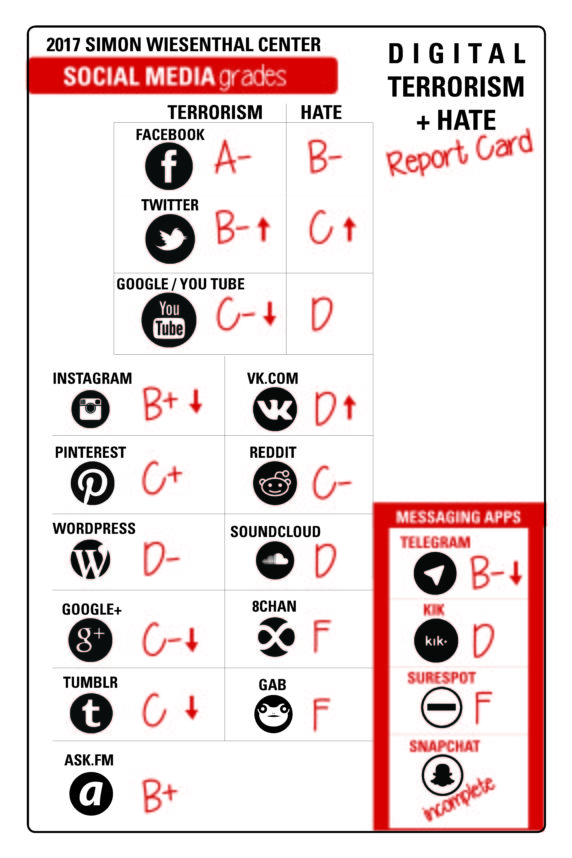
The video-sharing site YouTube and its parent company, Google, fared poorly in the Simon Wiesenthal Center’s annual social media report card for their handling of hate- and terrorism-related material.
The Wiesenthal Center, a Los Angeles-based nonprofit that fights hate speech, says YouTube is being exploited by terrorists to encourage acts of violence and instruct would-be attackers in their methods. The site received a C- in the category of “terrorism” and a D for “hate.”
“Google/YouTube is rightfully under fierce criticism for placing digital ads from major international brands like AT&T and Johnson & Johnson next to extremist videos celebrating terrorist attacks that should never have been allowed on its platform in the first place,” Rabbi Abraham Cooper, the Wiesenthal Center’s associate dean, said March 28 at the media briefing where the grades were unveiled. It took place at the New York City comptroller’s office, four blocks from ground zero.
Courtesy of Simon Wiesenthal Center.
He said the Wiesenthal Center awarded YouTube its low grades for allowing terrorism “how to” videos to proliferate on its platform, and for failing to take down thousands of posts by hate groups. He pointed to a number of videos posted on the site in the wake of a recent terrorist attack outside the Houses of Parliament in London, praising the attack and encouraging others to follow suit.
YouTube did not immediately respond to a request for comment.
A more in-depth report, “Digital Terrorism + Hate,” available at digitalhate.net, details the ways in which terrorist groups use social media to recruit, network and instruct potential attackers. The report names a number of accounts, tactics and pages associated with terrorism.
“Frankly, one of the things that we need is for the companies to be more responsive to their responsibilities,” Cooper told the Journal. “Almost all the companies set rules, and some try a lot harder than others to live up to them.”
He lauded recent changes at Twitter, whose grades have improved since the Wiesenthal Center began issuing the report cards in 2015. The company’s grade for “hate” rose from a D to a C since last year. Cooper said the change was due to Twitter’s move to deactivate hundreds of thousands of accounts associated with terrorism and hate speech.
Facebook received the highest marks because of its “sophisticated in-house system of blocking” objectionable accounts and content, according to Cooper. Other platforms, such as YouTube and Twitter, are reactive rather than proactive, he said.
But in general, Cooper said Silicon Valley has demonstrated a lack of leadership when it comes to fighting hate online. He said the Wiesenthal Center hopes to convene social media companies to comprehensively address the problems of digital hate speech and web use by terrorists. Failing that, the nonprofit would look into other, more drastic measures.
“If they don’t get a handle on this, we can be looking at the horrible R-word — regulation,” he said in the interview. “I’m not particularly enamored with that solution. It’s always messy when you go to Washington.”
However, he said he will be educating public officials about the trends highlighted in the report.
At the press conference, Cooper also announced that the Wiesenthal Center will be offering tutorials for high school students “to empower young people to deal with the tsunami of hate.” The center plans to pilot the tutorials with teens in New York City.
He told the Journal, “Since they usually see [online hate speech] before the adults anyway, we’re going to do our best to try to empower them with some guidelines about how to deal with it.”
I fell in love with my boyfriend, Lewis, and he with me, impulsively and ferociously, figuring everything would work out in time. He sold his house in Florida, moved himself and his two cats in with me in Los Angeles in January 2013, all within four months of our meeting. And yes, we met online and knew we were very different from each other; but we were so in love that nothing mattered except that we wanted to be together.
We’re older than most “second-chapter” couples — in our 70s. He had been widowed for less than a year after a 22-year marriage. I had been divorced for 41 years.
Sure, I had read his postings: He was passionate about opera, golf and European art and was looking for a once- or twice-a-week relationship. I was still teaching, listened only to rock ’n’ roll and was a political junkie. He doted on Maggie and Gracie, his two cats, and I was not a pet person. But we both had grandchildren we adored and valued friends.
So, after conversing through emails and phone calls, we decided to meet. We liked each other’s sense of humor. He thought it was clever that I called him “Kareem” because he spelled Lewis like the former UCLA basketball star, Lew Alcindor, who played for the L.A. Lakers under the name Kareem Abdul-Jabbar. And I liked that he was independent because, in my decades of being unattached, I often traveled and went to plays and movies solo. I laughed off his coming out to meet me, thinking nothing really mattered anyway unless we had chemistry. “If I can’t look at you and think I can kiss you, it won’t work.” Yeah, maybe we’d have one good date, we’d wish each other well, and he’d return to his Boca Babes in Boynton Beach.
Boy, was I wrong! When he walked into my condo, amid the 20 phone banking volunteers for Obama who I hosted four nights a week, I thought how nice that one of them had brought me flowers. I asked his name so I could apply a name tag so he could start making phone calls, but he replied, “No, I’m Lewis. Kareem. Your date.” And without skipping a beat, I looked at him and replied, ‘Yes, I could definitely kiss you.’ ”
And from that moment on, our dates never ended, and we fell madly, happily in love even though his best friend had put a hex on our relationship, not wanting him to move away from Florida. He showed me his grandson’s grandparent booklet, in which he had given advice, “Never make a hasty decision.” And my own adult children asked if I was insane to let him move in so quickly.
And now, it’s been 4 1/2years of living together, along with the cats. His family pictures intermingle with mine, his Shakespeare and Scrabble books are side by side with my Oprah magazines. And all of his friends and my friends know one another.
And I wish, oh, how I wish, I could say we live in a state of bliss. But reality sets in. Life experiences set in. The ways we’ve done things for decades have set in. And so we see our differences, and we deal with them.
He uses enough spices on his food to qualify our place as an Indian restaurant; I cook blandly. He believes all clothes can be worn no matter how old, how stained, how shredded. I throw my clothes into a Goodwill bag as soon as a button goes missing or a spot won’t come out in the wash. He watches hourlong dramas; I’m a sitcom maven and relish “The Bachelor.”
So, now, do I dare change this wonderful mensch, who I love? After all, there are the expressions: “You can’t change anyone but yourself.” “You can’t teach an old dog new tricks.” “A leopard doesn’t change its spots.” Right?
Well, let’s just say, sort of. You see, a year ago when I was buying a new car, my Kareem told me he’d pay the difference if I’d get a bigger engine. I quickly told him, “No problem. I’ll pay it myself if you’ll just let me go through your clothes and give away 10 pieces that are torn, old or stained.”
And he said OK.
So now, let me end this little romance ditty because I’m off to Goodwill again. Negotiating may not mean change, but it works for me. And his shirts and pants are ripe for the taking.
Do you have a story about dating, marriage, singlehood or any important relationship in your life? Email us at meant2be@jewishjournal.com.
BARBARA AZRIALY is a volunteer, writer, retired special education teacher and grandmother living in Westwood.
Celebrity chef Pati Jinich grew up in Mexico City, where she spent Shabbat dinners at her bubbe’s house.
“When we walked into her house,” Jinich fondly recalls of her grandmother, “the first thing she had was a big, gigantic bowl of guacamole, but it was a Yiddish version, because it was a combination of chopped egg salad and guacamole. Next to that, she would have a big bowl of gribenes” — crisp chicken or goose skin — “with fried onions. And then she already had sliced challah. So you would grab a slice of challah, put the chopped egg guacamole mixture on top, and then you top it with gribenes.”
This Mexican-Jewish fusion runs deep in Jinich’s family, as it does for many other Mexican Jews.
“It’s become fashionable to do a Latin theme on Jewish foods, but a lot of people don’t realize that Mexican-Jewish cuisine is really deeply rooted,” says Jinich, who stars in the hit national PBS cooking show “Pati’s Mexican Table.” “It’s not just, ‘Oh, I’m gonna throw a chili in here, or some spices.’ There’s a full Mexican-Jewish vocabulary that has existed for centuries.”
Jinich’s bubbe also made p’tcha (pickled calf foot), but instead of serving it with horseradish, she served her version with pico de gallo.
Sephardic Jews fleeing the Spanish Inquisition first came to Mexico more than 500 years ago. Larger waves of Jewish immigrants arrived over the past 150 years, most of them from Eastern Europe, Syria and the former Ottoman Empire. Today, the Jewish population in Mexicois close to 50,000, most of them living in Mexico City.
So the idea of Mexican-Jewish fusion is not something new for Mexican Jews like Jinich; it was part of life while she was growing up. For example, Jinich points to Gefilte Fish a la Veracruzana, which has a sauce of tomatoes, capers, pickled chilies, olives, cilantro and parsley.
“The Jewish community thought of using it for fish patties — gefilte fish,” she said. “So that’s a standard — a must — in many Jewish Ashkenazi homes. Instead of eating the gefilte fish cold with aspic, which you need an acquired taste to love, Mexican-style gefilte fish is served warm, in that thick, spicy tomato broth. And it’s really irresistible.”
Jinich, 44, traces her roots to Poland and central Europe — her grandparents fled pogroms and immigrated to Mexico City in the early 20th century. As a young adult, she became an immigrant herself, following her Mexican-Jewish husband to the United States 20 years ago. Jinich, now a mother of three boys, lives in Washington, D.C., where her television show, currently in its fifth season, originates in her home kitchen.
Although Jinich is a natural in the kitchen and on camera, she began her career as a policy analyst, focused on Latin American politics. But her passion for food — and especially the cuisine of Mexico — brought her to culinary school in 2005. Before becoming a chef, she taught Mexican cooking to friends and neighbors while living in Dallas in the late 1990s and served as a production assistant on another PBS food series, “New Tastes From Texas,” a show that featured guest hosts such as Mexican food pioneers Diana Kennedy and Patricia Quintana.
Jinich has published two cookbooks, “Pati’s Mexican Table: The Secrets of Real Mexican Home Cooking” (2013) and “Mexican Today: New and Rediscovered Recipes for Contemporary Kitchens”(2016). And her television show, which screens all over the world, has been nominated for two Emmys and two James Beard Awards, the Oscars of the food world.
Pati Jinich. Photo by Michael Ventura
In short, Jinich has become a 21st-century ambassador to Mexican cuisine in the United States. But she brings a modern sensibility to the foods of her native country, which are being rediscovered with renowned chefs such as Denmark’s René Redzepi of Noma, who is opening a satellite of his famed restaurant in Mexico, and Enrique Olvera, who has been featured on Netflix’s popular series “Chef’s Table.”
Jinich sees the culinary world’s recent attention to Mexico as inspiring.
“For a long time, everyone took Mexican food for granted,” she explains. “It took this new cadre of chefs looking at Mexican cuisine and taking all the traditional elements and presenting them in a more sexy, modern way. Not only for the outside to recognize the richness and sophistication of Mexican cuisine, but also for Mexicans. Mexicans are so excited about their own cuisine. Now, it’s going back to the roots — sometimes to the extreme — and really highlighting what makes Mexican food so unique. And I think Mexican cuisine is having a very big moment. There’s so much to explore.”
With recipes such as Asparagus, Mushroom and Goat Cheese Enchiladas with Pine Nut Mole Sauce or Mexican Thanksgiving Turkey, Jinich has an approach that is more accessible than many of the chefs currently helming the Mexican dining scene. She lives by the credo that any home cook can bring the warmth and color of Mexico into the kitchen.
And although Jinich is Jewish, her recipes are, for the most part, Mexican. She did not grow up attending Jewish schools or eating kosher food. At the same time, following in the footsteps of her bubbe, as well as an Austrian grandmother who taught her how to make matzo ball soup (recipe below), she treasures the dishes of her Mexican-Jewish repertoire
“What happened with Ashkenazi food, which is sort of bland, is that it got blessed with all the warmth and colors and flavors of Mexico. It was like a gift to Ashkenazi cuisine.”
“Blessed” is how Jinich also describes her own multifaceted identity. Despite feeling “shaken” by the current political climate in the U.S., she sees herself as simultaneously Mexican, Jewish and American.
“I used to tell my children as Mexican Americans, you’ve been doubly blessed, but you’re doubly responsible,” she says. “You have to be proud about being Mexican, and you have to make Mexico proud, and you have to make your Mexican family proud. And at the same time, you have to be grateful to America and responsible as an American citizen. And one cannot forget the third element, which is about being a Jew and the Jewish values.”
It’s a recipe for life Jinich clearly embraces.
MATZO BALLS WITH MUSHROOMS AND JALAPEÑOS IN BROTH
From “Mexican Today: New and Rediscovered Recipes for Contemporary Kitchens” by Pati Jinich (Houghton Mifflin Harcourt, 2016).
– 1 cup (2 2-ounce packages) matzo ball mix
– 2 tablespoons fresh parsley, finely chopped
– 1/4 teaspoon grated nutmeg
– 1 1/2 teaspoons salt, or to taste
– 4 large eggs
– 1/2 cup canola or safflower oil, divided
– 2 tablespoons sesame oil
– 1 tablespoon sparkling water (optional)
– 1/2 cup white onion, finely chopped
– 1 garlic clove, finely chopped
– 2 jalapeño chilies, seeded if desired and finely chopped, more or less to taste
– 1/2 pound white and/or baby bella (cremini) mushrooms, cleaned, dried, part of the stem removed,thinly sliced
– 8 cups chicken broth, homemade or store-bought
In a large mixing bowl, combine the matzo ball mix, parsley, nutmeg and 3/4 teaspoon salt.
In a small bowl, lightly beat the eggs with 6 tablespoons of vegetable oil and 2 tablespoons of sesame oil. Fold the beaten eggs into the matzo ball mixture with a spatula. Add the sparkling water if you want the matzo balls to be fluffy, and mix until well combined. Cover the mixture and refrigerate for at least 30 minutes.
In a large soup pot, bring about 3 quarts salted water to a rolling boil over high heat. Bring heat down to medium and keep at a steady simmer. With wet hands, shape the matzo ball mix into 1- to 1 1/2-inch balls and gently drop them into the water.Reduce heat to low, cover and simmer for about 25 to 30 minutes, or until matzo balls are completely cooked and have puffed up.
Meanwhile, heat the remaining 2 tablespoons oil over medium heat in a soup pot. Add the onion, garlic and chilies and sauté for 4 to 5 minutes, until they have softened a bit. Stir in the sliced mushrooms, add 3/4 teaspoon salt, stir and cover the pan. Steam the mushrooms for about 6 to 8 minutes, remove the lid and continue to cook uncovered until the liquid in the pan evaporates. Add the chicken broth and bring to a simmer. Taste and adjust seasoning. Add the cooked matzo balls (use a slotted spoon if transferring from their cooking water) and serve.
Makes 8 servings.
GEFILTE FISH A LA VERACRUZANA
A standard in Jewish homes across Mexico. Courtesy of Pati Jinich.
– Gefilte Fish Patties (recipe follows)
– 3 tablespoons safflower or corn oil
– 1/2 cup white onion, chopped
– 1 can (28 ounces) crushed tomatoes
– 3 cups water
– 2 tablespoons ketchup
– 1 teaspoon salt, or to taste
– 1/4 teaspoon ground white pepper, or to taste
– 1 cup Manzanilla olives stuffed with pimientos
– 8 pepperoncini peppers in vinegar brine/chiles güeros en escabeche, or more to taste
– 1 tablespoon capers
Prepare Gefilte Fish Patties; set aside.
Heat the oil in a large cooking pot over medium-high heat. Add the chopped onion, and let it cook for 5 to 6 minutes, stirring, until soft and translucent. Pour the crushed tomatoes into the pot, stir and let the mix season and thicken for about 6 minutes. Incorporate 3 cups water, 2 tablespoons ketchup, salt and white pepper, give it a good stir and bring to a boil. Turn down the heat to low, to get a gentle simmer, as you roll the Gefilte Fish Patties.
Place a small bowl with lukewarm water to the side of the simmering tomato broth. Start making the patties, about 2 1/2 inches by 1 inch and about 3/4-inch thick. Wet your hands as necessary, so the fish mixture will not stick to your hands. As you make them, slide them gently into the simmering broth. Make sure it is simmering and raise the heat to medium if necessary to keep a steady simmer.
Once you finish making the patties, cover the pot and turn the heat to low. Cook them covered for 25 minutes. Take off the lid, incorporate the Manzanilla olives, pepperoncini peppers and capers. Give it a soft stir and simmer uncovered for 20 more minutes, so the gefilte fish will be thoroughly cooked and the broth will have seasoned and thickened nicely. Serve hot with slices of challah and spiced-up pickles.
Makes about 20 patties.
GEFILTE FISH PATTIES
– 1 pound red snapper fillets, no skin or bones
– 1 pound flounder fillets, no skin or bones
– 1 white onion (about 1/2 pound), quartered
– 2 carrots (about 1/4 pound), peeled and roughly chopped
– 3 eggs
– 1/2 cup matzo meal
– 2 teaspoons salt, or to taste
– 1/2 teaspoon ground white pepper, or to taste
Rinse the fish fillets under a thin stream of cool water. Slice into smaller pieces and place in the food processor. Pulse for 5 to 10 seconds until fish is finely chopped but hasn’t turned into a paste. Turn fish mixture onto a large mixing bowl.
Place the onion, carrots, eggs, matzo meal, salt and white pepper in same bowl of food processor. Process until smooth and turn onto the fish mixture. Combine thoroughly.
Lara Rabinovitch Neuman works for Google as a food writer and regularly teaches food culture courses at the Skirball Cultural Center.
Maybe I watch too many cooking shows, but it seems like TV chefs have the best tools and gadgets. Of course, they have the same essentials that most of us have in our kitchens, like pots and pans, knives, colanders and blenders, but it’s the items that aren’t essential that make cooking easier and more fun. Those are what catch my eye and make me run out to the store. Now I don’t see how I lived without them.
Mise en place bowls
A French culinary term meaning “everything in its place,” mise en place bowls help you separate and organize your cooking ingredients. They free up room on your cutting board after you’ve done all your chopping, and having those little bowls holding all your ingredients actually makes it easier to follow recipes. Another advantage: Your kitchen counter becomes Instagram-ready. (Set of eight at Williams-Sonoma, $24.95)
Microplane zester/grater
Would you believe these graters originally were used by woodworkers to smooth wood? Now they grate lemon and lime zest, ginger, garlic and even hard cheeses in seconds. (Target, $14.95)
Salt cellar
Instead of constantly pouring kosher salt from a big box every time a recipe calls for it, use a salt cellar to store your salt. Its small profile takes up very little room on your kitchen counter, and salt is always conveniently at hand. Just spoon out a little, or grab a pinch as needed. (Acacia salt cellar at Crate & Barrel, $9.95)
Silicone garlic peeler
You already may know the trick of peeling garlic cloves by smashing them with the flat blade of a chef’s knife, but if you want to keep your cloves intact without being crushed, a silicone garlic peeler is a miracle worker. Just place a clove in the silicone tube, roll the tube with your hand, and the peel comes right off. (Penneli garlic peeler at Amazon, $9.03)
Silpat baking mat
A must for baking cookies or anything gooey or sticky, this silicone mat provides better results than lining a cookie sheet with foil, and you don’t even have to grease the pan. And here’s a bonus idea: When I’m rolling pastry or pizza dough on a piece of parchment paper, I place a Silpat mat underneath the paper to keep it from sliding. (Bed, Bath & Beyond, $24.99)
Plastic food-safe gloves
Now here’s something I wish more TV chefs would use. Notice how they’ll chop a raw chicken and then, without washing their hands, move on to something else? How do they not get food poisoning? To avoid cross-contamination, I always wear disposable plastic gloves that are rated safe for food handling. They also come in handy for tossing salads and massaging kale leaves.(Smart & Final, $9.99)
Jonathan Fong is the author of “Walls That Wow,” “Flowers That Wow” and “Parties That Wow,” and host of “Style With a Smile” on YouTube. Youcan see more of his do-it-yourselfprojects at jonathanfongstyle.com.