fbpx

March 10, 2017

A cartoon protest threatens to redefine free-speech

There are few countries in the world – perhaps a few Islamic countries, India, Ireland – that define themselves for the world as being inextricably identified with their majority religion as Israel.  Israel is the “Jewish” state.  It wants to be seen as the Jewish state.  In certain arenas – say in negotiations with Palestinian entities – it demands to be acknowledged as the Jewish state.  I make no judgments about that. 

But if you’re going to identify as Jewish, seriously Jewish, there’s no way you can separate that identity from the Torah.  It’s the primary source of our learning, the blueprint for how Jews are supposed to live as a community, the foundation of the Jewish people.  And what more basic element could there be in the Torah than “The Ten Commandments,” mentioned twice in the Torah:  Exodus 20:2, and repeated in Deuteronomy 5:6, and of which “Thou shalt not steal” is number eight (acknowledging that this can vary with interpretations – just as there are a number of interpretations of what “steal” exactly means).  “Steal” might mean steal another person – kidnapping.  It might mean taking what doesn’t belong to you.  It might mean a lot of things, but there is so much in our teachings, including about a dozen mitzvoth regarding respecting private properties and just due process, not to mention the Tenth Commandment regarding coveting the possession of others, that we all pretty much get the picture. 

So if the Ten Commandments and other mitzvot are at least one of the cornerstones of the Torah, and the Torah is the foundation of Judaism, and Israel is the Jewish state, then someone who decides to draw a political cartoon using the Ten Commandments to criticize Israeli policy would appear to be on pretty solid ground.  That’s what a UCLA contributing cartoonist, Felipe Bris Abejón did when he published a cartoon in the “Daily Bruin” newspaper, a cartoon now notorious for having been criticized as anti-Semitic and withdrawn by the paper with apologies.  The cartoon  in question, shows Israeli Prime Minister, Benjamin Netanyahu, standing in front of two commandments, one (listed as #6) with a word crossed off:  “Though shalt not steal” and another (listed as #7) “Thou shalt not kill.”  The caption says, “Israel passes law seizing any Palestinian land,” and Netanyahu is saying, “#7 is next.” 

The caption, of course, refers to the Netanyahu controlled Knesset recently passing a law retroactively legalizing both housing and  makeshift “outposts,” at the time illegally built on Palestinian land and bringing them under Israeli sovereignty.  Some are recent; some go back decades.  Palestinian landowners would have to accept either “alternate plots” or financial compensation.  Clearly the “Regularization Law,” doesn’t mean “any Palestinian land.”  On the other hand, it does look a lot like theft of the weaker party by the stronger – never a good marketing image.  You can say it’s not theft because compensation is involved, but if someone 6’ 8” and 275 pounds, with a gun, stopped you on the street, took your watch, and offered you fifty bucks for it, take it or leave it, you’d probably still want to call a cop.  The law has been vigorously opposed by the opposition in Israel and will be appealed to its Supreme Court.   

Netanyahu’s threat to do the same thing with number seven – killing – is more problematic.  That commandment is usually meant to mean, thou shalt not murder, and once again, there are is a raft of commentary on this commandment.  To attribute to the Prime Minister the intention to implement as law, a policy to murder or in some way kill (the implication being Palestinians) is going pretty far, although there are those – and not just bizarre outliers – who would argue that this has been de facto policy for some time. 

The cartoon was strongly protested and condemned by various groups – some calling it anti-Semitic – including the anti-Defamation League, campus organizations, and even state legislators.  The ADL called it “deeply offensive….and impugning core Jewish beliefs.”  Many were outraged that the cartoon “mixed politics with religion.”  Danny Siegel, president of UCLA’s Undergraduate Student Association Council, declared in a statement: “As a Jewish student at UCLA, I am disgusted by the anti-Semitic claim in my school newspaper that the Israeli government is purposefully using my Jewish faith to justify policy matter.”

But is that what it was doing, and is the cartoon anti-Semitic?  To me the cartoon isn’t using Jewish faith to justify policy – quite the opposite.  It’s pointing out that policy is violating tenets of Jewish faith.  It doesn’t say that Judaism calls for theft and murder; it cries out that Judaism abhors theft and murder at a fundamental level, and any attempt to legitimize it through acts of law are extremely troubling and should be scrutinized in the cold, harsh sunshine of First Amendment exposure. 

As for anti-Semitic, does the cartoon call for the destruction of the Jewish people – the spurious argument by those who label the BDS movement (which I categorically reject as wrong and wrong-headed) anti-Semitic?  No, it does not?  Does it equate Netanyahu with all Jewish people or even all Israelis?  No, it does not?  Does it equate Judaism with the abandonment of it’s mitzvot?  No, it does not.  Rather it accuses the Prime Minister of having somehow lost his way as the head of the state he so aggressively insists is Jewish, an accusation made in a variety of arguments by the opposition in his own country. 

Condemnation of the cartoon decried the fact that Abejón dragged religion into his commentary, but how can mixing politics with religion be out of bounds when discussing Israeli settlement policy, when the entire settlement history is inextricably entwined, from day one, with religious fervor and aspiration.  Somehow, the very use of religion, despite the fact that Israel identifies its very existence as religiously-based, is a taboo crossing into forbidden territory.  No one chose to defend the cornerstone of American democracy – free speech. 

Yes, Jewish history is unique.  Yes, we have been persecuted since the days of Sinai, and yes, in particular for our religion.  But that doesn’t not inoculate either Israel or Judaism from pointed and aggressive argument, and it does not allow for increasingly self-serving definitions of anti-Semitism.  The effort to steadily and relentless expand the definition of anti-Semitic, in confrontation with free speech, does not do us credit, just as the equally steady and relentless effort to equate criticism of Israeli policy with anti-Semitism does Jews equal harm.  The “I know it when I see it” argument was dubious when used to define pornography; it is not improved when a certain segment of our demographic is allowed to define anti-Semitism for everyone, particularly public educational institutions – where the marketplace of ideas should most energetically flourish. 

The “Daily Bruin” quickly apologized and more. “This was a mistake that should have been caught at any point in the process, and it didn’t get caught,” said editor-in-chief, Tanya Walters. Was it?  Apparently no one thought so as it went to press.  I’m assuming a lot of people saw it.  I’m sure what they thought they saw was edgy, provocative commentary, not beyond-the-pale anti-Semitism.  Criticism that reminds us of our roots, our heritage, our connection to God may be uncomfortable – perhaps should be uncomfortable.  But it’s not illegal, not anti-Semitic, and should not be suppressed. 


Mitch Paradise is a writer, producer and teacher living in Los Angeles. 

A cartoon protest threatens to redefine free-speech Read More »

SXSW 2017: 5 don’t-miss Jewish events

Austin, Texas, is known for several things: authentic barbecue, hot weather, cowboys — and, increasingly each year, the ever-growing South by Southwest festival.

What began as an indie music event in the late 1980s has swelled to include multiple conferences on film and technology. Last year, over 70,000 people registered to attend the nine-day extravaganza.

As always, this year’s installment, which starts on Friday and runs until March 19, will feature plenty of Jewish artists, innovations and forums — including a session with the Anti-Defamation League’s CEO, Jonathan Greenblatt, about the recent uptick in anti-Semitism. And of course, at least one Purim party.

If you’re headed to SXSW, here are some Jewish events you shouldn’t miss.

Trolls: Lessons from Online Anti-Semitism’s Rise  (March 12, 12:30 – 1:30 p.m., Hyatt Regency Austin)

After writing an article on Melania Trump in GQ last spring, journalist Julia Ioffe received so many anti-Semitic messages, including death threats, that she filed a police complaint. Sadly, she was just among the first of many Jewish journalists and other Jews active on social media to be targeted by anti-Semitic “trolls” — a term commonly used to describe belligerent online provocateurs — over the course of the 2016 presidential campaign. Ioffe, who now writes for The Atlantic, will speak with Chabad Rabbi Mordechai Lightstone about how trolls, once relegated to the fringes of the internet, are now feeling empowered.

Kosha Dillz (March 16, 1:00 a.m. – 1:25 a.m., Scratchouse)

It shouldn’t be a surprise that a rapper whose stage name is a Jewish delicacy isn’t your typical hip-hop artist. The Israeli-American Kosha Dillz (real name Rami Even-Esh) has wowed crowds with his freestyle abilities for more than a decade — and he is also known for being able to rap in English, Hebrew, Spanish and Yiddish. According to his South by Southwest bio, he now teaches a class at synagogues around the country on “how to be a Jewish rapper in 45 minutes.” You can catch him at the festival as part of his Oy VEY USA tour, likely spitting tracks from his latest album “What I Do All Day And Pickle,” which he released last year.

YAASSS Queen Esther Purim party (March 12, 3:00 p.m. – 7:00 p.m., Jackrabbit Mobile)

You likely have to be a fan of “Broad City,” the uber-hip sitcom created by Abbi Jacobson and Ilana Glazer, to get why the title of this event is so clever. But you won’t have to get the joke to enjoy this Purim party. Hosted by the Chabad Young Professionals group in Austin, the event will include a traditional holiday megillah reading, a hamantaschen fondue bar, plenty of Purim gifts (known as misloach manot), an open bar and — what do you know — beats from Kosha Dillz.

Orkestar Kriminal (March 15, 1:00 p.m. – 1:40 p.m., Austin Convention Center; March 18, 9:00 p.m. – 9:40 p.m., Russian House)

Orkestar Kriminal is the rare band that lives up to its name, in multiple ways. The Montreal-based group plays (or steals, as band leader Giselle Webber says) songs from the Yiddish-speaking musicians who populated the the criminal underworlds that once flourished in cities such as Warsaw, Odessa and Istanbul. Think one part hyped-up klezmer, one part gypsy rock, one part utter chaos — and a heck of a live show.

Faith & Technology Meet Up (March 12, 11:00 a.m. – 12:00 p.m., Hyatt Regency Austin)

Jews aren’t the only religious group looking to connect their faith with technology at this year’s festival. This discussion will feature the Anti-Defamation League’s Austin Community Director Renee Lafair, who, alongside Christian and Muslim speakers, will address the ways religious communities are joining together on social media to fight online hate.

SXSW 2017: 5 don’t-miss Jewish events Read More »

Some Coffee Bean stores opt out of kosher standing

After years of assuring customers that everything sold is kosher, a handful of Southern California Coffee Bean & Tea Leaf shops can no longer make the promise.

Kosher LA, which oversees the kosher certification of The Coffee Bean & Tea Leaf stores in the region, announced last month that several privately franchised stores have opted out of being kosher. Previously, all Coffee Beans in Los Angeles, including the corporate-owned and franchised locations, were kosher.

The locations no longer certified include those at Paramount Studios, USC Cinema, USC Roland Building, the Santa Barbara Airport and two at Los Angeles International Airport (LAX) — the Tom Bradley International terminal and Terminal 1. In May, the store at LAX Terminal 5 will not be kosher.

JJ Smith, vice president of franchise operations for Coffee Bean, said in a telephone interview those locations became non-kosher after their supplies of kosher-certified snacks and sandwiches ran out and were replaced by non-kosher items.

“When they wanted to change their grab-and-go items, we discussed it with our rabbi, and he said they needed to take down their certification,” Smith said. “These locations are not kosher as of right now, but we’re working to get them back up to status.”

In a statement, the company said, “All of our Company-owned stores and the vast majority of our franchise stores in Southern California are certified Kosher. The relatively few franchise locations not fully Kosher are so at the discretion of the franchisee due to their specific business requirements.”

The Coffee Bean & Tea Leaf, owned by two Jewish brothers who are kosher observant, is the oldest and biggest privately owned specialty tea and coffee retailer in the United States.  The company was founded in 1963, with the first store opening five years later in Brentwood. Today, there are more than 1,000 Coffee Beans worldwide, including a large presence in Asia and one store on Jaffa Street in the heart of Jerusalem.

The company-owned stores are in California, Arizona, Singapore and Malaysia, and the rest are franchise locations.

All of the corporate-owned stores will remain kosher, according to Smith, who acknowledged the need to satisfy kosher customers.

“Working with the Jewish community is such an important part of our heritage and our future,” he said. “And being kosher is extremely important to us and our guests.”

For now, some Coffee Bean regulars say they are upset about not being able to rely on the kosher certification. “When you keep kosher, your options are so limited,” said Nina Safar, a kosher chef who owns Kosher in the Kitch. “It was a great relief knowing that on the West Coast, there was always a Coffee Bean nearby, and at the airport, especially.”

Most Coffee Bean locations not only sell kosher certified drinks, they also offer a mix of pareve and dairy kosher salads, sandwiches, fruit cups, yogurt, muffins, cookies, bagels, challah bread, gummy bears, chocolate and nuts.

The store at Beverly and Alta Vista boulevards near Hancock Park also provides cholov yisroel drinks as well for customers keeping the stricter kosher status for dairy.

Rebecca Klempner, a writer living in Pico-Robertson, said the changing kosher status of the coffee chain poses an inconvenience.

“Jews in California will have to plan more carefully while spending the day out or traveling around the state. It’s not a tragedy, by any means, but it is a hassle.”

Despite the recent changes, the company insists it will remain true to halachic standards.

“Kosher products are our heritage,” Smith said. “It’s our brand image. It’s who we’ve been and who we are as Coffee Bean & Tea Leaf.” n

Some Coffee Bean stores opt out of kosher standing Read More »

Mike Pence to keynote AIPAC conference

Vice President Mike Pence and a bipartisan slate of top members of Congress are scheduled to address AIPAC’s upcoming annual conference.

An American Israel Public Affairs Committee official confirmed to JTA that Pence will keynote the conference scheduled for March 26-28 in Washington, D.C.

Pence, who enjoyed a long relationship with the pro-Israel lobby as a congressman and later as Indiana governor, spoke last month at the Republican Jewish Coalition’s annual confab and has taken a lead in condemning recent anti-Semitic incidents.

Also scheduled to speak will be top lawmakers from both parties, including Sen. Bob Corker, R-Tenn., the chairman of the Senate Foreign Relations Committee, and Sen. Ben Cardin, D-Md., its ranking member; and Rep. Kevin McCarthy, R-Calif., the U.S. House of Representatives majority leader, and Rep. Steny Hoyer, D-Md., the minority whip.

Hoyer and McCarthy likely will continue a tradition of top Republican and Democratic lawmakers appearing to claim that while they may differ on some issues, they are agreed on support for Israel. However, fissures between the parties have emerged, with Democrats still forcefully backing a two-state solution to the Israeli-Palestinian conflict, while President Donald Trump has retreated from explicitly backing that outcome.

Jewish Insider reported on Friday that a letter to Trump from House members asking him to reaffirm support for the two-state solution — led by Reps. David Price, D-N.C., and Gerry Connolly, D-Va. — has so far gathered 115 signatures, only two of them from Republicans.

Additionally, Democrats want to preserve the Iran nuclear deal reached by President Barack Obama, while Trump is skeptical of the deal and has said he might want to pull out of it.

AIPAC continues to back the two-state solution and backs measures that would subject the deal to a review.

Another area where there might be partisan tension is around support for funding the Palestinian Authority. Republicans propose cutting funding to the PA as long as it disburses compensation to families of terrorists, while Democrats oppose the measure, saying that the authority helps keep the West Bank stable, which is critical to Israel’s security.

Mike Pence to keynote AIPAC conference Read More »

115 House members sign letter warning about one-state outcome

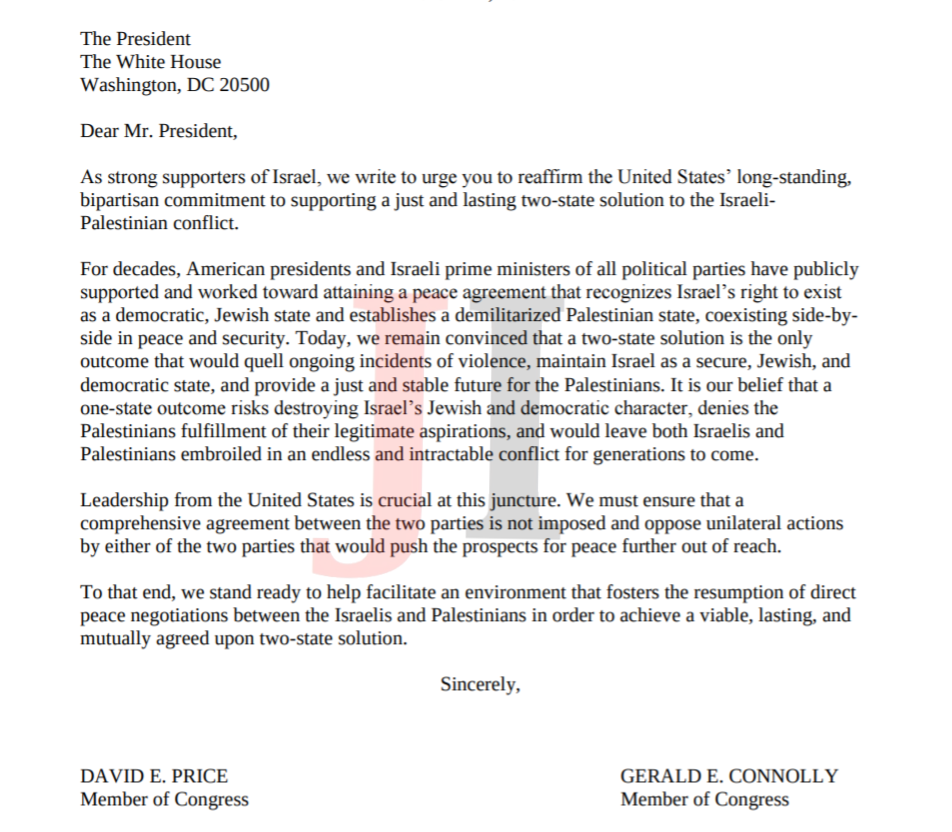
Representatives David Price (D-NC) and Gerry Connolly (D-VA) have circulated a letter calling on President Donald Trump to “reaffirm” America’s support for the two state solution while warning against a one state scenario, which would lead to “endless conflict”.

Connolly told Jewish Insider on Thursday evening that at least 115 Members of Congress have co-signed the letter including two Republican Reps. Walter Jones (R-NC) and John Duncan (R-TN). Jewish Insider has obtained the text of the letter, which has not yet been publicized.

The Congressional letter expresses concern about a one state reality. “It is our belief that a one-state outcome risks destroying Israel’s Jewish and democratic character, denies the Palestinians fulfillment of their legitimate aspirations, and would leave both Israelis and Palestinians embroiled in an endless and intractable conflict for generations to come.”

In a conversation with Jewish Insider, Price cited the President’s press conference with Israeli Prime Minister Benjamin Netanyahu on February 15 as motivating the letter. “So I’m looking at two-state and one-state, and I like the one that both parties like. I can live with either one,” Trump said.

“Today, we remain convinced that a two-state solution is the only outcome that would quell ongoing incidents of violence, maintain Israel as a secure, Jewish, and democratic state, and provide a just and stable future for the Palestinians,” the letter states.

Connolly explained that controversial subjects — such as the current situation in Gaza — were not included in the text to ensure that the letter would receive maximum Congressional support.

The letter has obtained over support from over 25 percent of the House including Brad Sherman (D-CA), Ranking Democrat on the House Intelligence Committee Adam Schiff (D-CA) Deputy DNC Chair Keith Ellison (D-MN), Elijah Cummings (D-MD), John Lewis (D-GA), Yvette Clarke (D-NY), Jan Schakowsky (D-IL), and Jamie Raskin (D-MD). 

“There are those who argued that this is just a party line letter, so when we got two Republicans, I was able to say, ‘not anymore,’” Connolly added.

Screenshot-2017-03-10-at-11.29.05-AM-1

“Leadership from the United States is crucial at this juncture. We must ensure that a comprehensive agreement between the two parties is not imposed and oppose unilateral actions by either of the two parties that would push the prospects for peace further out of reach,” the letter added.

115 House members sign letter warning about one-state outcome Read More »

Medications are not the first choice of treatment for low back pain

Low back pain is very common. The vast majority of people reading this sentence have had low back pain at some time in their lives. It is one of the most common reasons for physician visits in the U.S. and results in an estimated $100 billion in annual costs. Given the very high prevalence of low back pain, you would think that we would already have noninvasive treatments that are proven to be safe and effective. You’d be wrong.

Recently the American College of Physicians (ACP) reviewed existing studies about noninvasive treatments for low back pain. (Noninvasive means that they did not consider surgery or injections. These invasive treatments are required in only a small minority of cases.) In February the APC used this evidence review to publish new recommendations for the treatment of low back pain.

For patients with acute (less than four weeks) or subacute (four to twelve weeks) low back pain, the ACP recommendations remind us that most patients improve regardless of treatment. Treatment without medication is recommended first (for example, with superficial heat). If medications are desired by the patient and the physician, nonsteroidal anti-inflammatory drugs (NSAIDs) and muscle relaxants are recommended.

For patients with chronic (longer than twelve weeks) low back pain, the ACP again recommends nonpharmacological treatment with exercise, rehabilitation programs, acupuncture, or mindfulness-based stress reduction. If that doesn’t help, the first-line medicines to consider are NSAIDs. The second line medications are tramadol (Ultram) or duloxetine (Cymbalta). Opioids should only be considered in patients for whom the above options have been ineffective and if the potential benefits outweigh the risks for the individual patient.

The recommendations above are based on moderate-quality evidence. (The ACP uses a formal ranking of the quality of evidence in the studies reviewed.) Some of the recommendations are based on low-quality evidence, which I didn’t include above.

The striking difference between the current recommendations and the previous ones is that medications are no longer recommended as first-line treatment. This isn’t because the nonpharmacological treatments are proven to be so effective. It’s because we’ve learned how modestly effective medication is for low back pain, and we’ve come to appreciate the side effects that medications can cause.

So these are not so much new recommendations about new effective treatments for low back pain, but rather a retraction of the prior recommendations because of how much we realize we don’t know. The recommendations don’t include any high-quality evidence, because there have been no large well-designed randomized trials evaluating various therapies for low back pain.

The bottom lines are these. For chronic low back pain none of the known therapies are extremely effective, and all medications have side effects, so the prevailing philosophy is: if you’re going to prescribe placebo, at least make it a safe one. For acute and subacute back pain, almost everyone gets better regardless of treatment. So the best treatment is time. Perhaps that’s why we call you patients.

Learn more:

Noninvasive Treatments for Acute, Subacute, and Chronic Low Back Pain (summaries for patients, Annals of Internal Medicine)
Low Back Pain Treatment (American College of Physicians video)
No Drugs for Back Pain, New Guidelines Say (Wall Street Journal)
Forget the drugs, the answer to back pain may be Tai chi, massage (USA Today)
Noninvasive Treatments for Acute, Subacute, and Chronic Low Back Pain: A Clinical Practice Guideline From the American College of Physicians (Annals of Internal Medicine)

My previous posts about prescription pain medicine abuse:

The Scourge Of Prescription Pain Medicine Abuse (2014)
Surgeon General Vivek Murthy Releases Report On Addiction Epidemic (2016)

Medications are not the first choice of treatment for low back pain Read More »

How Trump made me a Second Amendment American

We called ourselves Bonnie and Clyde for the day.

We felt dangerous and powerful holding the gun between our fists, laying our eyes on the target, spraying bullets into the air.

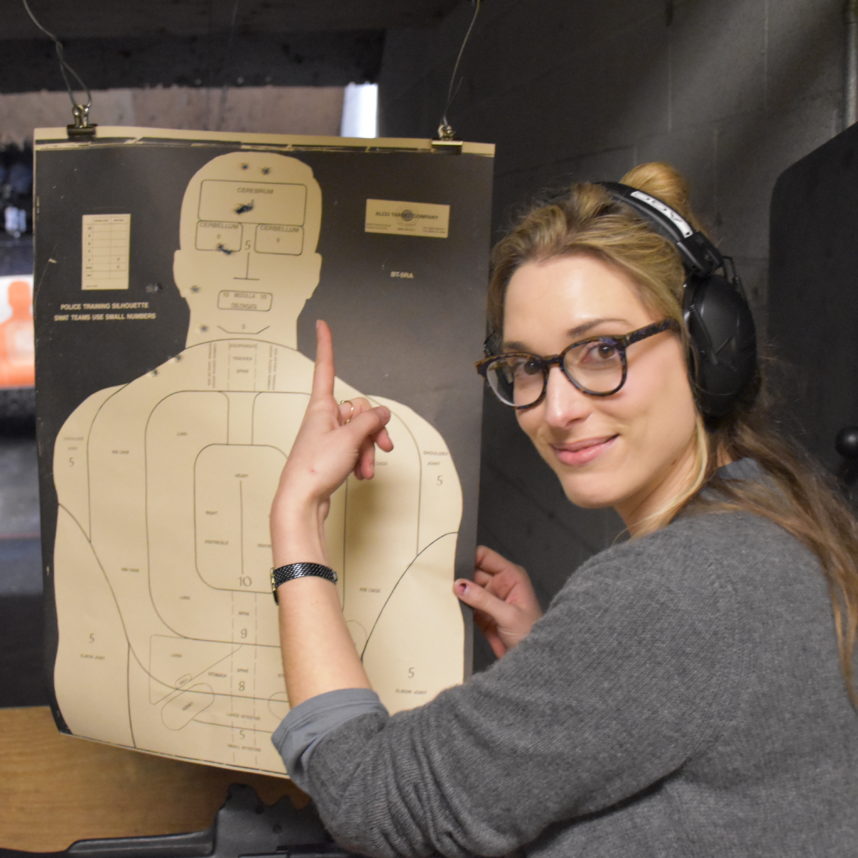
Boom! Bullet to the head.

Boom! Bullet to the eye.

Boom! Boom! Boom! Thigh, kidney, heart.

I never imagined I’d be a good shot. But there I was, spending a Friday afternoon at the Los Angeles Gun Club, shooting a weapon for the first time.

Something about the frenzied atmosphere of paranoia caused by the Donald Trump Administration — with its covert Russian ties, autocratic tendencies and growing contempt for the press (not to mention the surge of the alt-right) — inspired me to get a handle on self-defense.

I wasn’t alone. The New Yorker recently reported that Silicon Valley and Wall Street executives are buying foreign landing strips and underground luxury apartments, and stocking up on ammunition, preparing for the “crackup of civilization.” It’s a bit hysterical, I admit, and the moral calculus of the über-wealthy seeking only to spare themselves is disturbing. But it got me thinking: What recourse do the rest of us have if we can’t afford an end-of-days investment in former missile silos?

Enter: The Gun.

F8B29601-2AC7-4290-9688-CF70FC51FE4B

Growing up, I never encountered one. “Mom was a little freaked out about them,” my dad said. So, we didn’t have one in the house. Guns, for me, were exotic and unfamiliar — the domain of Hollywood movies, faraway wars or my dad’s Republican cousin. As an adult, I came to associate guns with mass shootings and politics; at shul, I frequently heard sermons on behalf of gun control, but my exposure to the real thing was limited.

“I’m taking you shooting,” my friend, musician Rick Sorkin, said to me.

So, off we went to a nondescript building on a quiet block downtown. Inside, the L.A. Gun Club offers a dazzling array of firearms for rent and a small indoor shooting range.

DSC_0030

Guns were everywhere — symmetrically layed out in glass cases, mounted on walls and sitting in the holsters of the clerks who work there. An assortment of paper targets was plastered throughout for your shooting pleasure — a terrorist in a bush, a sketch of the human anatomy, or a plain old bull’s-eye. It was like a library, devoted to the culture of killing machines.

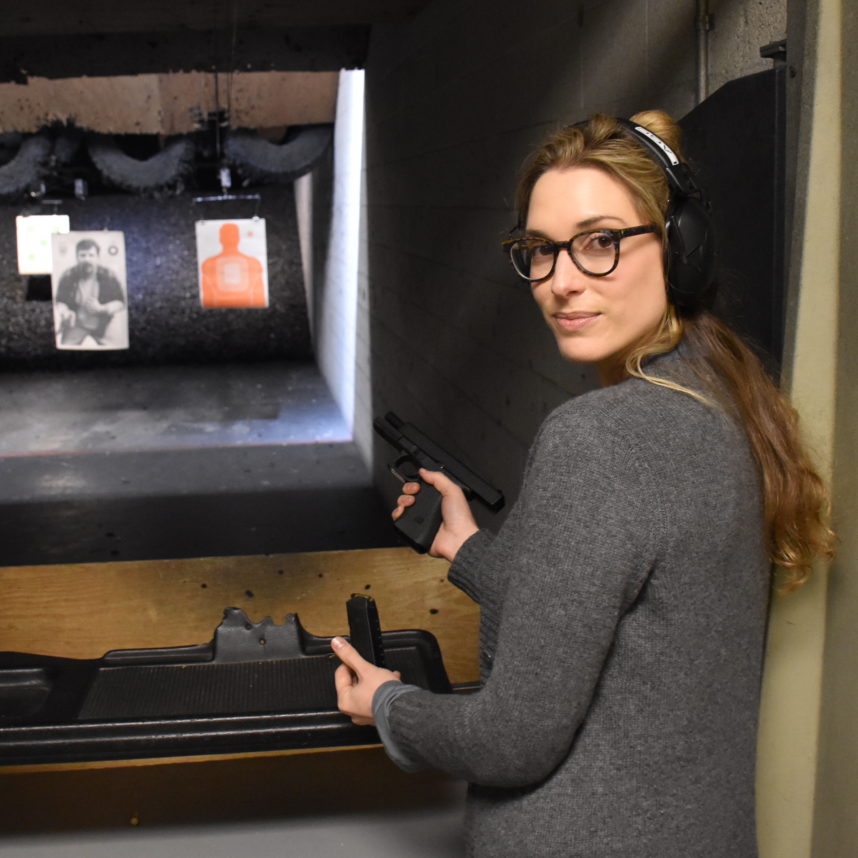
To get a gun, all Rick and I had to do was sign a release, then leave a fingerprint and a driver’s license. Minutes later, I was holding a Glock 17 in my hands — “popular with law enforcement,” the clerk said. Since it was my first time, he performed a brief demonstration, showing me how to lock, load and shoot before we entered the range.

DSC_0048Rick clicked in a round of cartridges, then handed me my first loaded gun. My nerves simmered as I gripped it, one hand over the other, index finger flat on the side, right above the trigger.
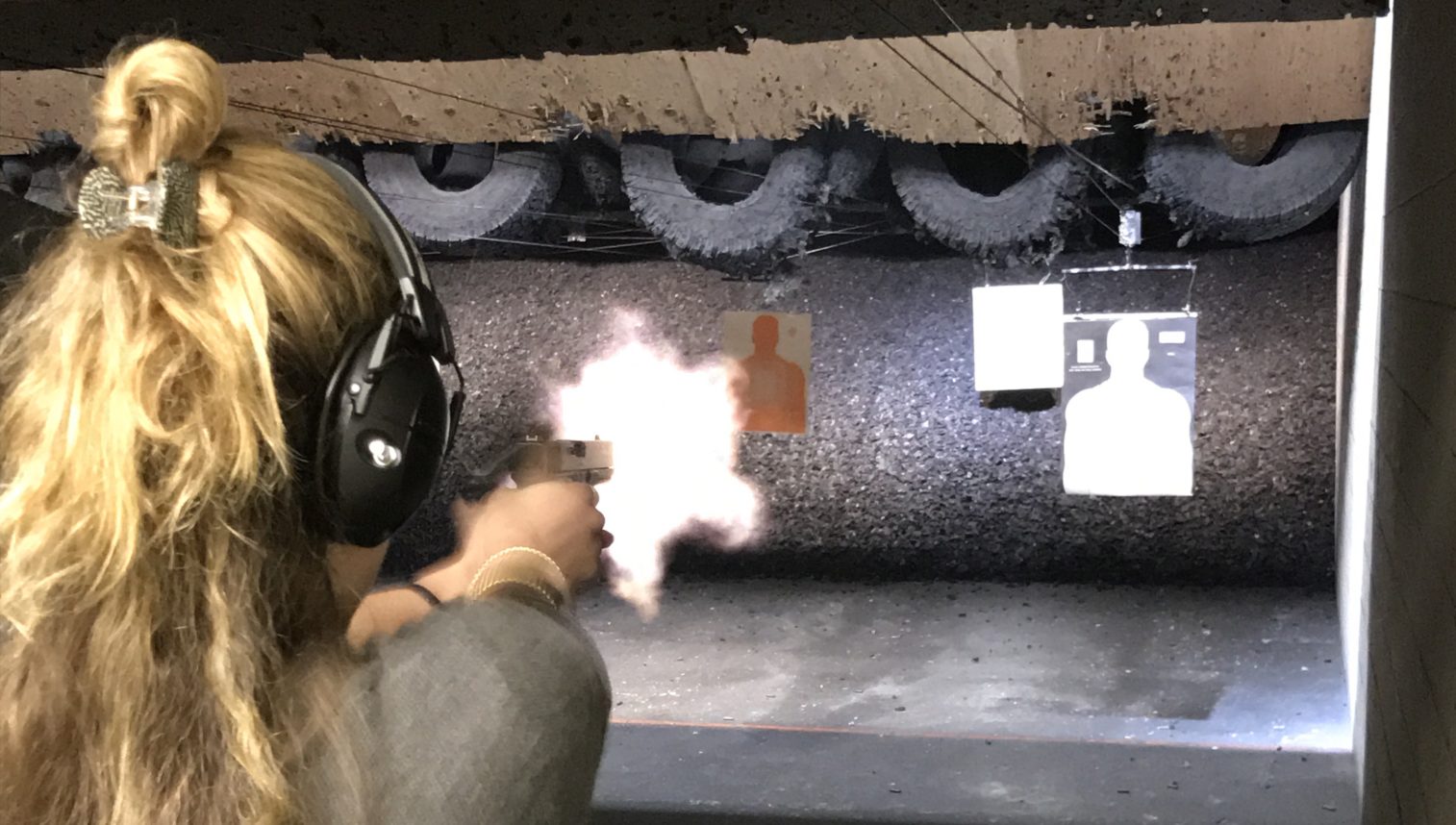
I stood in our little chamber as the sound of rifles exploded all around us, so loud it was dizzying, despite the fact I was wearing both earplugs and earmuffs. Feet firmly apart, I lifted the gun and aimed at the target.

“Take a deep breath, then pull the trigger on the exhale,” Rick said.

But I could barely breathe, I was so overwhelmed. I was sure the thing either was going to accidentally kill someone or backfire in my face.

“I don’t think I can do it,” I told him.

But there was no way I was going to chicken out while a guy had all the fun.

I squinted over the top of the barrel and aimed for the head on the target.

Boom! Right through the brain.

IMG_5432

Blood surged through my veins in a heady rush of adrenaline and excitement. I had metaphorically killed a man with my very first shot. That’s how easy it is to end a life.

Shooting a gun, it turns out, can be exhilarating, especially when you’re good at it. It also demystifies an object associated with death and destruction. As a woman, it’s empowering to hold a weapon in your hands and know how to use it. But it’s a complicated power — God forbid you ever need to exercise it.

DSC_0158The more I pounded my paper target, the more I realized the dissonance of what I was doing: Target practice is fun, even a bit addictive, but let’s be honest, it’s not the reason guns exist. They were created to kill animals and human beings.


That doesn’t mean, given the current political atmosphere and the history of our country, that I’m not grateful for the constitutional right to bear arms. I like that more than 200 years after the Second Amendment was adopted, a relatively defenseless urbanite like myself can walk into a gun range, get some instruction and learn a new way to protect myself — though I’m also aware of the risks of gun ownership and that I’d need more training and practice before I ever felt comfortable, God forbid, using a gun to save myself or someone else.

I also know the religious tradition I love aspires to a prophetic vision of a world of nonviolence, where swords will turn into plowshares and “nation shall not lift up sword against nation, neither shall they learn war any more.”

DSC_0335

But from one afternoon, the Demon Gun now feels a little less demonic. And me? I feel a little more American.


Danielle Berrin is a senior writer and columnist at the Jewish Journal.

How Trump made me a Second Amendment American Read More »

Poll: 87 percent of Democrats, 53 percent of Republicans say anti-Semitism a ‘serious’ problem

Seventy percent of American voters see anti-Semitism in the country as a “very” or “somewhat serious” problem, up from 49 percent a month ago, according to a new poll.

The responses differed by party identification, with an overwhelming majority of Democrats, 87 percent, seeing anti-Semitism as a “very” or “somewhat serious” problem, and slightly more than half of Republicans, 53 percent, seeing it as such, according to the poll released Thursday.

The survey was was conducted by Quinnipiac University at the beginning of March.

Jewish institutions, including community centers and Anti-Defamation League offices, have been hit with more than 100 bomb threats so far this year, all of them hoaxes. In the past three weeks, Jewish cemeteries were vandalized in Philadelphia,St. Louis, and Rochester, New York.

Respondents were split on President Donald Trump’s response to the bomb threats and vandalism, with 37 percent approving and 38 percent disapproving. Most Republicans, 71 percent, approved of Trump’s response, while most Democrats, 66 percent, disapproved.

The poll also found that 63 percent of American voters think hatred and prejudice has increased since Trump’s election, while two percent say it has decreased and 32 percent say it has stayed the same.

Trump has come under fire for his delayed response to the incidents. Concerning the threats on Jewish establishments, Trump at first deflected questions – and in one instance shouted down a reporter who asked him about it – before calling them “horrible.”

Last month, the president noted the bomb threats and vandalism of cemeteries in his first address to a joint meeting of Congress.

“Recent threats targeting Jewish community centers and vandalism of Jewish cemeteries, as well as last week’s shooting in Kansas City, remind us that while we may be a nation divided on policies, we are a country that stands united in condemning hate and evil in all its forms,” Trump said.

The Kansas City incident occurred after a patron ejected from a bar after hurling racial epithets at two workers from India allegedly returned with a gun and killed one of the men and wounded another.

Poll: 87 percent of Democrats, 53 percent of Republicans say anti-Semitism a ‘serious’ problem Read More »

Trump invites Abbas to the White House

President Donald Trump invited Palestinian Authority President Mahmoud Abbas to the White House.

Abbas and Trump spoke on Friday and a Palestinian Authority spokesman soon after reported the invitation, saying the meeting would be aimed at reviving the Israeli-Palestinian peace process, which has been dormant since 2014.

Sean Spicer, the White House spokesman, confirmed the invitation later Friday but did not add details.

Trump met at the White House last month with Israeli Prime Minister Benjamin Netanyahu, a meeting both leaders said would lead to improved ties after eight years of tension between Netanyahu and President Barack Obama.

Netanyahu, however, appeared taken aback at Trump’s request during a press conference that Israel stop settlement building for now. Israelis are also wary of U.S. leaders assuming an oversized role in peace-making, while Palestinians have traditionally welcomed it.

Trump has said he is open to outcomes to the conflict that don’t necessarily end in two separate states. The Palestinian Authority still embraces a two-state outcome, as does Netanyahu. Trump’s retreat from the two-state solution have led some Israeli Cabinet members on Netanyahu’s right to call for annexing portions of the West Bank.

Trump invites Abbas to the White House Read More »