fbpx

March 7, 2017

Wild finish thrills Milken Wildcats’ faithful

With just seconds left and time for one final play, Ilana Shirian, parent of a Milken student, scanned the crowd of approximately 1,000 fans of both boys basketball teams — Milken Community Schools and Shalhevet High School. All around her, students, parents, faculty members, alumni and board members filled the bleachers on both sides of the gym, which was electrified with excitement, nervousness and joy.

“Look at the energy in the room,” she said.

In a way, it almost didn’t matter which of the Jewish teams won the California Interscholastic Federation Southern Section (CIF SS) division 4A championship on March 1. This was a game — and a moment — few would forget. It was close for almost all of its 32 minutes, with Milken hanging on for a 54-52 victory in the Crespi Carmelite High School gymnasium in Encino.

According to jewishhoopsamerica.com, a resource for Jewish high school basketball in North America, the game marked the first time two Jewish high school teams have squared off in a California sectional championship. And it was Milken’s first sectional championship victory.

After its victory over Shalhevet, Milken was slated to compete in the first round of the 2017 CIF state boys basketball championships in Division 4, visiting West High School in Torrance on March 8. Tickets are $9 at the door.

Meanwhile, Shalhevet, which also qualified to compete in the CIF state playoffs, elected instead to travel to New York to compete in the March 2-6 Red Sarachek Basketball Tournament at Yeshiva University in New York. The Firehawks lost, 49-47, in the championship game to the Frisch School Cougars of Paramus, N. J.

To many in the crowd just a few nights earlier, though, the victory belonged to Milken and Shalhevet students who helped created an atmosphere of unprecedented school spirit in support for their teams. 

“This is probably the closest thing I’ve experienced here to a real Midwestern sporting event,” said Kelly Shepard, Milken department chair of performing arts, who was raised in Indiana, where basketball is a way of life.

Standing beside Shepard was Kimberly Schwartz, Milken upper school principal, who said the team was “riding the biggest wave of school spirit Milken has ever seen.”

Rabbi Ari Segal, Shalhevet head of school, said the game was about more than winning or losing. “I say with no joke, the thing that gives me the most pride is that this is the menschiest team you’ll ever see,” Segal said of the Firehawks. “These are great, great boys.”

The teams were closely matched over the course of the season. Milken, coached by Mike Whiting, had a record of 21-6 going into the game against Shalhevet; Shalhevet, coached by Ryan Coleman, was 26-7 going into the game.

Milken Community Schools junior Amitai Afenjar drives to the basket during Milken's championship game against Shalhevet High School. Photo by Richard Hartog
Milken Community Schools junior Amitai Afenjar drives to the basket during Milken’s championship game against Shalhevet High School. Photo by Richard Hartog

“Most of these kids are friends, off the court. They know each other, they’re part of the same community. We had a great turnout for the entire community and more than that, they played hard, the right way,” said Milken Head of School Gary Weisserman, who created a Kiddush Cup that went to the winning squad. “Either team could have won.”

Roars, chants and applause resounded at the tipoff. Milken took several minutes before it founding its groove, as Kian Zar, a senior, sank the team’s first basket, a three-pointer, 3 minutes, 20 seconds into the game.

Sharp three-point shooting had helped propel Milken to victory over Riverside Notre Dame High School on Feb. 25 in one of the semifinal games, said CIF SS communications director Thom Simmons.

At the half against Shalhevet, Milken led, 29-26, after Doron Matian, a junior, made a half-court shot at the buzzer.

With two minutes left in the game, Milken clung to a 51-47 lead, which closed to 54-52 with 17.8 seconds remaining. Shalhevet called timeout. Then, with three seconds left, senior Eitan Halpert of Shalhevet made a final drive to the basket but missed a layup.

“I’m so happy!” Milken junior Stephanie Afari said, watching her boyfriend, Josh Afshani, receive a championship T-shirt.

Shalhevet senior Ben Harel felt differently.

“We could’ve won. We had a good chance of winning. Our good player missed a layup, a very important layup,” he said.

It didn’t take long for Halpert to bounce back from his team’s loss. The Shalhevet senior scored 26 points and had 15 rebounds against Frisch at Yeshiva University.

Eitan Halpert, a guard on the Shalhevet High School Firehawks, attempts a layup during the school's matchup against Milken. Photo by Ezra Fax
Eitan Halpert, a guard on the Shalhevet High School Firehawks, attempts a layup during the school’s matchup against Milken. Photo by Ezra Fax, The Boiling Point 

In the locker room at Crespi, Milken’s 6-foot-4 junior forward, Amitai Afenjar, 17, sat with bags of ice taped to his ankles. If he were in pain, no one would have known. He led the Wildcats with 18 points.

“This is our moment, this is our big moment. We are about to make history,” Afenjar told the Journal. “We are making history.”

The season, the game and the thrilling final seconds contributed to a swell of team spirit that was something of a new phenomenon at Milken, junior Mira Berenbaum said.

“It’s pretty incredible,” she said. “The school didn’t have much spirit before the playoffs. “Now the whole school here is here.”

Even school administrators appeared to catch the fever. During halftime, Leon Janks, a member of the Milken board of trustees (and a Jewish Journal board member), said what was probably on the minds of many in the stands:  “[Whoever wins], at least one of the teams will be Jewish.”

Wild finish thrills Milken Wildcats’ faithful Read More »
White House condemns new bomb threats against Jewish sites

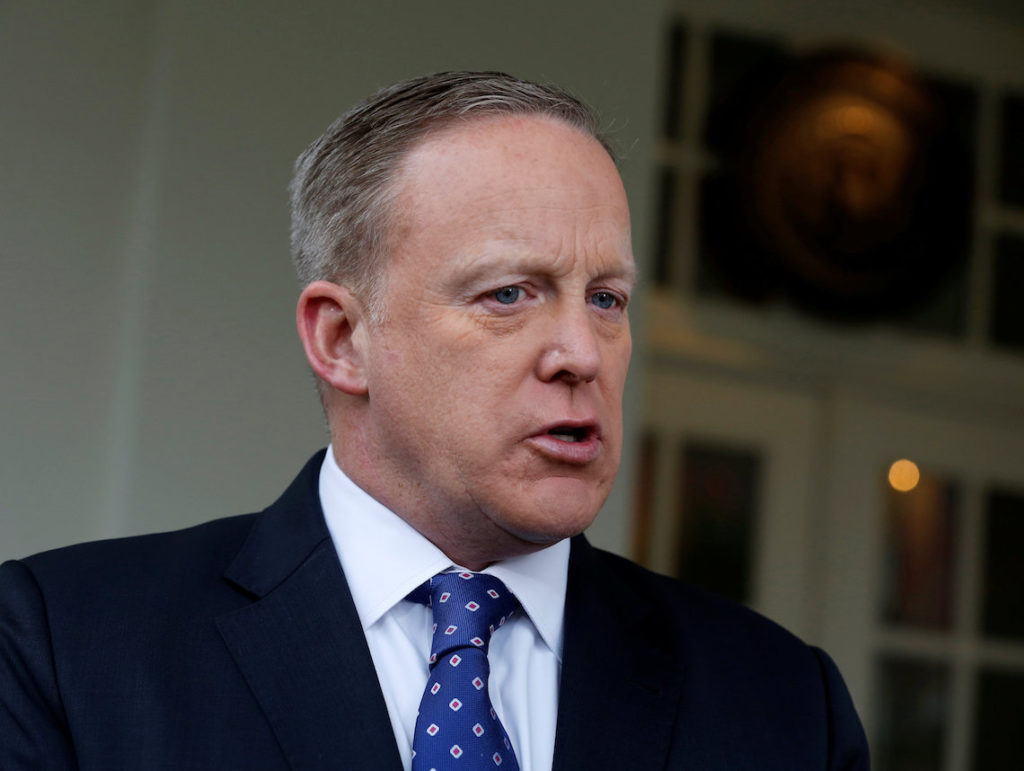
White House press secretary Sean Spicer condemned a new wave of bomb threats against Jewish sites, including Jewish community centers and Anti-Defamation League offices.

“I want to acknowledge that there’s been an additional wave of threats to Jewish community centers and Anti-Defamation League offices,” Spicer told reporters at a press briefing on Tuesday.

“I share the president’s thoughts that he vehemently hopes that we don’t continue to have to share these reports with you. But as long as they do continue, we’ll continue to condemn them and look at ways in which we can stop them,” he said.

As of midday Tuesday, at least a dozen Jewish institutions across North America had received threats of lethal attack, the sixth such wave since the beginning of the year. Among those targeted were at least 10 community centers, a pair of Jewish day schools and four regional offices of the Anti-Defamation League. More than 100 Jewish institutions, most of them community centers, have been targeted since the beginning of the year.

Trump, who has come under fire for delayed responses to the threats, noted them during his address to a joint session of Congress last week.

“Tonight, as we mark the conclusion of our celebration of Black History Month, we are reminded of our nation’s path toward civil rights and the work that still remains,” Trump said at the opening of his speech. “Recent threats targeting Jewish community centers and vandalism of Jewish cemeteries, as well as last week’s shooting in Kansas City, remind us that while we may be a nation divided on policies, we are a country that stands united in condemning hate and evil in all its forms.”

White House condemns new bomb threats against Jewish sites Read More »

JCC bomb threats are weapons of fear

The “fear itself” thing? FDR was on to something.

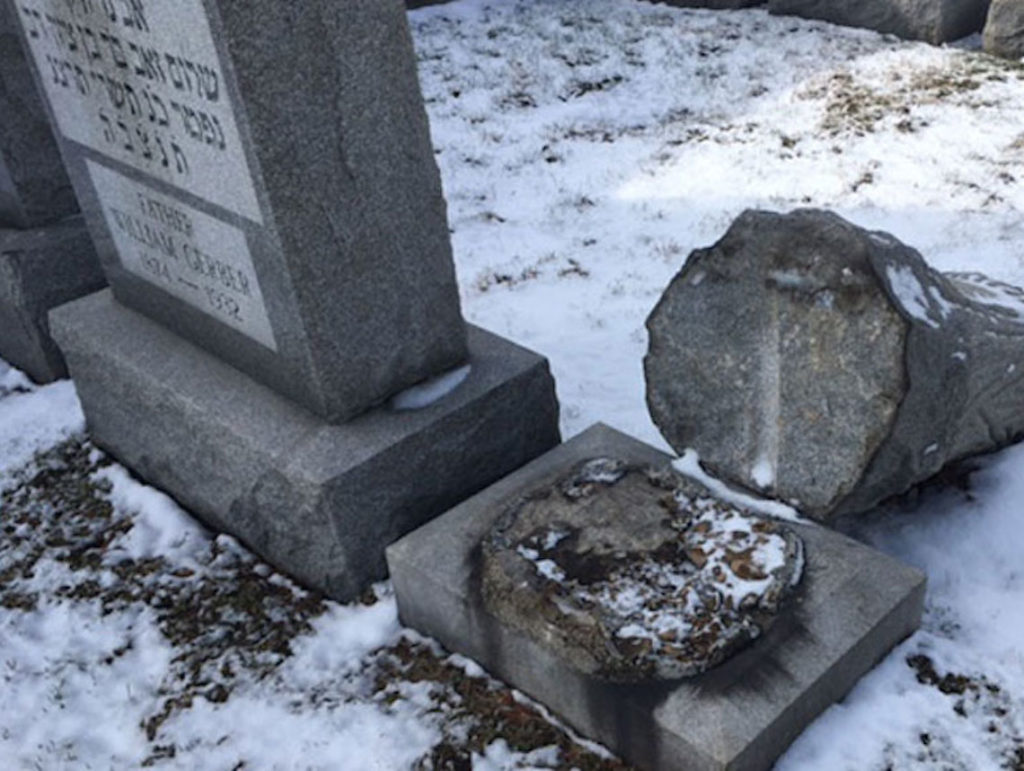
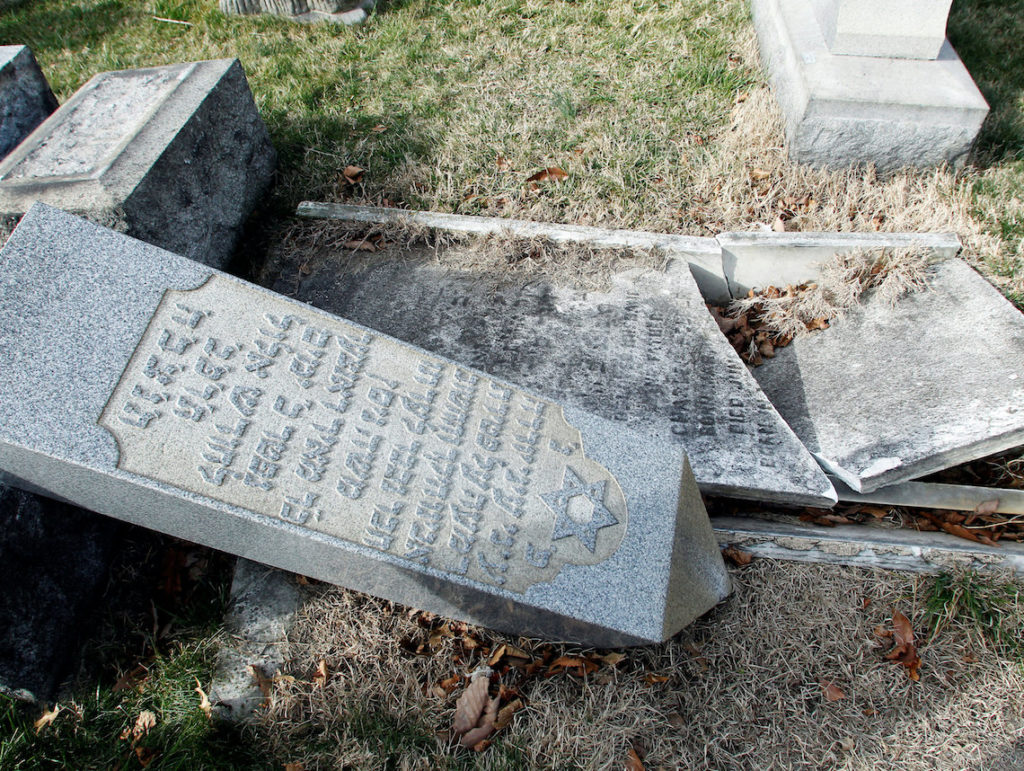
The rash of JCC bomb threats and cemetery desecrations, combined with a general sense that the country is becoming more intolerant, has Jews on edge in ways they haven’t been in years. The head of a major American Jewish organization wrote to me that the recent outbreak of anti-Semitic activity “is the worst America has seen since the 1930s.” (It’s not.)

Ronald Lauder of the World Jewish Congress has declared that “in recent weeks and months we have witnessed an unprecedented and inconceivable escalation of anti-Semitic acts in the United States” — again, an exaggeration.

The stats, tracked rigorously but narrowly by the Anti-Defamation League and haphazardly by the FBI, aren’t in for 2016 or early 2017, the period covering the presidential campaign and that presumably would include the kinds of “spikes” many would like to attribute to Donald Trump’s racially and ethnically charged campaign and emboldening of the “alt-right.”

One of the more worrisome accountings came from the NYPD, which found that anti-Semitic incidents were up 94 percent in the city over this time last year, with 35 anti-Semitic incidents reported in January and February.

But such numbers don’t yet point to an “unprecedented and inconceivable escalation” in anti-Semitism. And they don’t take into account the counter-evidence, like a Pew study that found that Jews are the most “warmly” regarded religious group in the U.S. (“Great news!” said parents and staff huddled outside an evacuated JCC). Or the acts of kindness and concern that followed many of the attacks, from Muslims raising money to restore a vandalized cemetery to the unanimous Senate letter urging the White House to boost security measures at Jewish institutions and assure the investigation and punishment of hate crimes.

Nor can it be overlooked that American Jews are as comfortable and accepted as they have ever been in history. No school, no neighborhood and no profession is off limits. Jews are over-represented in politics, academia and media. Even the high rate of intermarriage is a sign of social acceptance of Jews. Unlike many parts of Europe, where armed guards protect synagogues and observant Jewish men often hide their kippot under caps, American Jews can be out, proud and as loud as they want to be.

But the numbers and sociology can’t account for the way Jews feel, and right now many are not feeling good. The high levels of Jewish anxiety owe t0 a combination of the commander in chief, the political mood, the nature of the JCC attacks and the media.

Let’s start with President Trump: Most Jews didn’t vote for him, and regarded his campaign antics as particularly unsettling, from his appeal among white supremacists and ethno-nationalists to his willingness to exploit the country’s racial and ethnic divides.

In his embrace of a fiercely chauvinistic “economic nationalism,” White House strategist Steve Bannon represents something “unprecedented and inconceivable” in the minds of many Jews. Until Trump, resurgent nationalism seemed very much a problem for Europe, where economic malaise, fear of immigrants and the ghosts of the 20th century have combined into a particularly toxic brew on the right.

Recent Republican and Democratic administrations alike gave at least lip service to the idea of America as a vivid tapestry in which people of all races, religions and nationalities are welcome. Bannon, you’ll recall, is not just a foe of illegal immigration, but of legal immigration, which has “kinda overwhelmed the country,” as he said in a 2016 radio interview with (wait for it) Trump advisor and speechwriter Stephen Miller.

Even for those who believe Trump is the savior Israel has been waiting for, and who accept his disavowals of the alt-right, it upset Jewish assumptions about their position as a privileged minority when Trump couldn’t bring himself to forthrightly denounce the JCC threats and other anti-Semitic acts.

The nature of the JCC attacks are diabolically brilliant in their ability to unsettle Jews. I imagine a lone wolf or a team of hackers, armed with some cheap electronics and a motive to maximize mischief, working off an easy to find list of institutions with “Jewish” and “community” in their very names. There are far fewer JCCs than synagogues, but targeting JCCs assures you of hitting at least one easily identifiable Jewish institution in every consequential Jewish community across the country. I’m betting it’s only an unhappy accident that the hoaxer picked one of the few Jewish places that cuts across all movements and ideologies, and even attracts non-Jews to their fitness centers and childcare programs. That potentially puts every Jew on edge.

Coverage of these attacks, while unavoidable, also instills fear. As the editor of a Jewish news service, I feel implicated: What if in the name of informing the community, we are merely spreading anxiety? Readers rely on us to cover acts of anti-Semitism large and small. These include nasty anti-Zionist demonstrations on college campuses, grotesque internet “memes” originating with the alt-right and increasingly bizarre examples of swastika graffiti, including some carved in snow and one shaped out of human feces. 

But do these various acts, in a country of over 300 million, represent a growing trend or the salacious exception?

And what if we and the anti-Semitism watchdogs are wrong? What if the JCC attacks aren’t the vanguard of the New Anti-Semitism, but a weird and personal vendetta on the part of the hoaxer? Sure enough, Juan Thompson, a suspected copycat charged last week in at least eight of the JCC attacks, turns out to be an unhinged young man whose apparent motivation wasn’t even anti-Semitism but revenge on an old flame.

That doesn’t make the targeted Jew or Jewish institution feel any better. Fear has its own dynamic. JCCs aren’t talking about the members or preschool students they’ve lost as a result of the hoaxes, but word is getting out that the numbers might be significant. You can’t blame the families who just don’t need the tsurris, but you can look at your own behavior and ask in what ways you are making a bad situation worse.

So yes, we need strong enforcement of our hate crimes laws. And institutions that have the security they need. And careful monitoring of anti-Semitism in all its forms. And government leaders who have the backs of targeted minorities and pledge to defend the diversity of multicultural America.

But we also need a reminder that Jews have it pretty good here, and that we shouldn’t give too much power to a kid with a Sharpie, or a hacker with a speed-dial, or a disturbed, disgraced stalker. We have to stand up and say these institutions are ours, and we’re here to stay.

JCC bomb threats are weapons of fear Read More »

No Esther in sight

The role of Achashverosh, the vain king who prefers to drink from goblets of gold, who is ready to turn over a nation to a minister who offers ten thousand talents of silver, is too easily filled this year’s Purim. Haman and Bannon practically rhyme. It’s a facile elision I’m not sure I agree with, but it comes naturally. But where is our Esther, and where is our Mordechai? 

I don’t think people are still pinning their hopes on Ivanka and Jared. They couldn’t do anything to stop the erasure of Jews from the White House statement about the Holocaust. And Trump still denounced the Orthodox Jewish reporter who pitched him that softball question so he could denounce anti-Semitism.

It was only after the first Jewish cemetery was vandalized that Trump finally had something to say about the subject. That gave Jews on the right a glimmer of hope that the Haman and Achashverosh shoes wouldn’t fit. Was Ivanka working behind the scenes?

But after more Jewish cemeteries were vandalized, Trump shared another brilliant insight. He thinks it’s possible that anti-Trump people might be knocking down Jewish tombstones in order to make him look bad. Of course, David Duke said it first – not that Trump notices or cares where he gets his ideas from. That’s right up Achashverosh’s alley: everything bad happens to him; his is never the flaw or fault that allows it.

If there’s one thing Trump loves to talk about, it’s not crimes of hate but the crime rate. Despite Trump’s fantabulism, it’s increasing across the U.S. for real in just one way, hate crime. But he won’t talk about the seven African American transgender women who were murdered. Or give an ounce of reflection to how his rhetoric against immigrants might have played a role when an Indian engineer was murdered by a crazy white man who screamed “Get out of my country!” 

But that’s old news. Like Peter denied Jesus (l’havdil – not to morally compare them), Trump and his entourage won’t talk about how the perpetrators could be following the lead of his rhetoric. Every day we keep learning in new ways that Trump does not have the capacity or desire to understand what’s going on, or to take responsibility, the way we would want a president to do in order to lead the nation.

But if Trump doesn’t get it that cemetery vandalizers are undoubtedly anti-Semitic, how could his two closest Jews, Ivanka and Jared, not? It’s inconceivable that neither of them understands what kind of a person you have to be to knock down Jewish tombstones.

Any or all of these three things must be true: Jared and Ivanka are too cowed by Bannon to do anything, or they don’t have the power to change Trump’s course when Bannon is pushing him, or they are willing to let it slide as long as Jared gets what he wants for Israel.

I would guess number three, but whichever it might be, it means neither of them is prepared to be Esther. Not that I wouldn’t like to see Jared in a diadem (on Ivanka it would be redundant), but I don’t think the most beautiful crown will make either one a queen.

The bottom line is that with all that is happening, many right-wing elements in the Jewish community, like Jared, are willing to trade our safety here for the sake of letting Israel do whatever it wants as it trades Palestinian lives and land to build more settlements.

It would be as if Esther were to go to Achashverosh and beg to spare only the lives of a particular Jewish sect in the holy land, while letting Haman carry out his plot against all the other Jews throughout Persia’s empire.

Their bet seems to be that it will work out in the grim end, that Israel and the U.S. don’t need democracy as much as they need more control. They may also be betting that stateside Jews will come out with our privilege intact after everything goes down – that we will get to stay “white,” and not get grouped with Muslims and Latinos. (Never mind that Jews are all races, or that Sephardim may look like Arabs.)

That can only happen if we willingly separate our lives from the lives of Muslims and immigrants and Latinos and Black people and queer people. And maybe some American Jews could have done that, since we have almost forgotten that not too long ago, Jews were not considered white, and that our essential identity was one of refugees. But the world has been conspiring to remind us. 

Trump wants us to believe that we will stay white no matter what happens, as if his opinion will matter, while the cemetery destroyers desperately want us to to know that we never were white. Whoever is wrong, when pushing comes to shoving, I don’t think we will make it through unscathed.

So far, the most extreme extremists in the U.S., the ones who target Muslims and Jews equally, are outside the halls of power – it seems like a litmus test for White House staff is that one must be willing to target Muslims but not say anything against Jews. (And maybe there are too many Hanukkah books, after all.) That makes the Trump administration a natural fit with Jews who accept the idea that the enemy of my enemy is my friend. But how long will it be before the wall between being anti-Jewish and anti-Muslim falls as other walls go up? How long before anti-Semitism gets to embody its full meaning: hatred of the descendants of Noah’s son Shem, which includes Ishmaelites and Israelites, Jews and Arabs?

Facing his fear that Esther will fail, Mordecai promises that “help will arise from another place” – and then Esther comes through. Maybe it’s not too late for Ivanka. But for now, we need to be looking for help from that other place. Our best prospect may be the compassion that has been passing back and forth from Muslims to Jews and Jews to Muslims, as we each step in to help when the other is attacked. A Muslim community given the key to a synagogue after its mosque was burned down; Muslims raising funds and giving time to repair Jewish headstones.

Mishloach manot and matanot la’evyonim, sending nourishment to one another, exchanging gifts of encouragement to revive our lives, which are being impoverished by these times. Just like the Jews did for each other at the end of the Scroll of Esther.

Not exactly a silver lining, but if the powers that be can’t generate an Esther, then we have to step into those royal shoes. Let’s step lively.

No Esther in sight Read More »

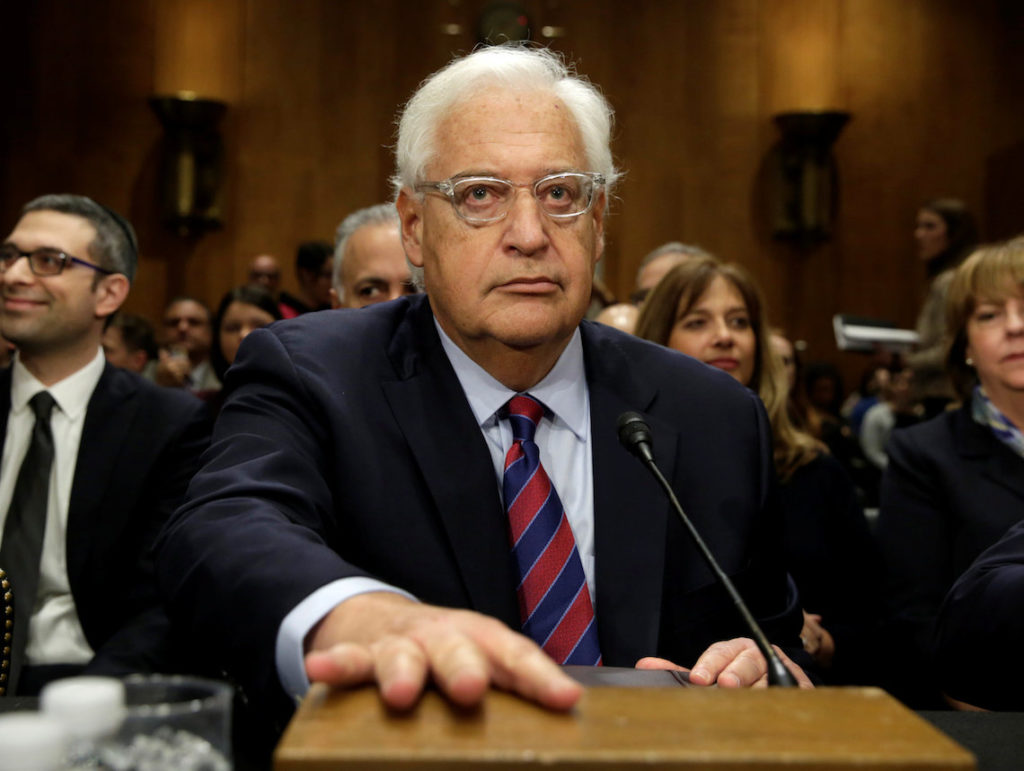
Senators Van Hollen, Duckworth troubled by Friedman’s nomination

Two Senators added their concern on Tuesday regarding David Friedman’s nomination for U.S. Ambassador to Israel. Senator Chris Van Hollen (D-MD) told Jewish Insider, “At this moment, I do not intend to support his nomination.” The Maryland lawmaker added, “His record clearly indicates that he is not in the bipartisan tradition of seeking out the two state solution. He is much more an advocate for some kind of one state solution. I think his views are so far out of the bipartisan mainstream.”

[This story originally appeared on jewishinsider.com]

Senator Tammy Duckworth (D-IL) shared a similar viewpoint with Jewish Insider. “I’m deeply concerned about his nomination. His past comments have been pretty incendiary, and I don’t think he would help with any type of movement towards reconciliation and a two state solution,” she noted.

On Thursday morning, the Senate Foreign Relations Committee (SFRC) will vote on Friedman’s nomination. No date has been announced for a Senate wide vote. Senator Rand Paul — the most independent minded Republican on the SFRC — told Jewish Insider on February 15 that he is “favorably disposed” to Friedman’s candidacy. It appears likely that all of the other Republicans on the committee will back the New York attorney propelling him to a floor wide vote.

Yesterday, Senator Dianne Feinstein (D-CA)  published an op-ed in the San Francisco Chronicle where she described Friedman as “unfit” for the posting because of his previous support of settlements and calling J Street “worse than Kapos.”

Senators Van Hollen, Duckworth troubled by Friedman’s nomination Read More »

Stop celebrating Muslim decency: Being congratulated for basic civility is no compliment

Since the recent wave of anti-Semitic bomb threats, vandalism, and cemetery desecrations, journalistic and social media have vocally celebrated condemnations, fund-raising, and volunteer efforts by Muslim groups in an attempt to bolster interfaith cooperation and rehabilitate the reputation of the Islamic community precisely when its very welcome in America is being questioned like never before.

But nobody deserves congratulations for basic decency. Condemning bomb threats and making donations to repair damage from bias crimes is something good people of all backgrounds do. Liberal hoopla over proper Muslim responses to anti-Semitism is no more than a religious riff on the soft bigotry of low expectations. When Muslims go to extraordinary lengths to show they embrace their Jewish neighbors – and they sometimes do – public praise is appropriate. But headlines about Islamic press releases condemning cemetery vandalism send the opposite message – that in normal circumstances Muslims are callous and heartless.

 Imagine these headlines:

• Asian Driver Arrives At Work Without Incident

• Jamaican Musician Passes Drug Test

• Black Man Marries His Children’s Mother

While those headlines aim to challenge nasty stereotypes, they actually reinforce their legitimacy.

News stories about broad community efforts to help besieged Jews that contain a sentence “Even the local Muslim community turned out in force” are entirely appropriate. But special congratulations when Muslims act like, well, people are not compliments.

I know how it feels to have my own group celebrated for simple propriety.

As a Zionist, I am perpetually annoyed by hasbara (roughly, propaganda) that celebrates Israeli actions that are only minimally admirable – like an Israeli soldier who shares her sandwich with a starving Palestinian child or an Tel Aviv hospital that provides an impoverished dying Arab woman with free medical care. Yes, I understand that these examples are intended to debunk the idea that Israelis are not decent (although I have yet to see anti-Israel discourse accusing Israelis of withholding sandwiches from orphans). But the very act of highlighting basic decency legitimizes the slander, which is particularly offensive given the many good Israeli actions that are far from just minimally proper.

The people spotlighting Muslim attempts to repair desecrated cemeteries may think they’re rebutting negative stereotypes. But they aren’t. Sorry to say it, but Americans who fear or hate Muslims don’t do so because they think Muslims tolerate vandalism. They do so because they think Muslims tolerate terrorism. These stories will not dent that perception.

Americans are rightly proud of the way its citizens of many groups came together to help one group among them recover in a time of distress – and Muslims should be part of that celebration. But breathless reports that American Muslims aren’t jackasses after all help nobody – including American Muslims.

David Benkof is a columnist for the Daily Caller, where this essay first appeared. Follow him on Twitter (@DavidBenkof) and Muckrack.com/DavidBenkof, or E-mail him at DavidBenkof@gmail.com.

Stop celebrating Muslim decency: Being congratulated for basic civility is no compliment Read More »

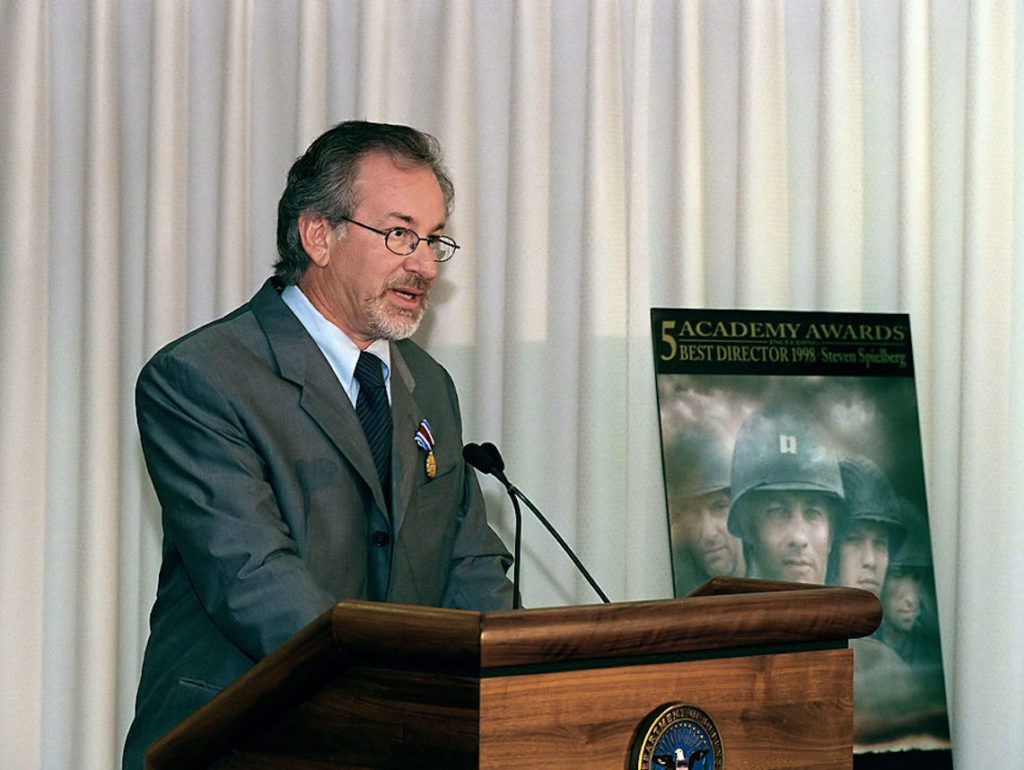
Steven Spielberg to direct film about publication of Pentagon Papers

Director Steven Spielberg has signed on to direct Tom Hanks and Meryl Streep in a film about the Washington Post’s publication of the Pentagon Papers in 1971.

Hanks will star as Washington Post editor Ben Bradlee and Streep as publisher Kay Graham, who challenged the federal government in the Supreme Court over the right to publish the leaked classified documents about U.S. involvement in the Vietnam War, the entertainment website Deadline first reported.

Amy Pascal’s Pascal Pictures purchased the script, and Pascal will serve as a producer, along with Spielberg and Kristie Macosko Krieger.

Spielberg is currently in post-production on the Warner Bros. film “Ready Player One” and is also in pre-production on “The Kidnapping of Edgardo Mortara,” about the struggle of Jewish parents to regain their son who was forcibly taken to be raised as a Christian.

Steven Spielberg to direct film about publication of Pentagon Papers Read More »

Senate unanimously signs letter to Trump administration urging action on threats to Jewish institutions

The U.S. Senate unanimously joined in urging the Trump administration to take action to stem the wave of threats against Jewish community centers and other institutions, saying their viability had been made vulnerable by the harassment.

“We are concerned that the number of incidents is accelerating and failure to address and deter these threats will place innocent people at risk and threaten the financial viability of JCCs, many of which are institutions in their communities,” said the letter sent Tuesday.

The letter, which was coincident with a sixth wave of nationwide threats against Jewish institutions on Tuesday, was signed by all 100 senators and addressed to Homeland Security Secretary John Kelly, Attorney General Jeff Sessions and FBI Director James Comey.

“We encourage you to communicate with individual JCCs, the JCC Association of North America, Jewish Day Schools, Synagogues and other Jewish community institutions regarding victim assistance, grant opportunities or other federal assistance that may be available to enhance security measures and improve preparedness,” the statement said. “We also recognize the anti-Semitic sentiment behind this spate of threats and encourage your Departments to continue to inform state and local law enforcement organizations of their obligations under the Hate Crime Statistics Act and other federal laws.”

The letter was spearheaded by Sens. Gary Peters, D-Mich., Rob Portman, R-Ohio, Marco Rubio, D-Fla., and Bill Nelson, D-Fla.

The threats, which have reached well over 100 institutions since the beginning of the year, are under investigation by the FBI and other federal authorities. Federal officials have briefed Jewish community leaders.

Lawmakers in recent weeks have suggested additional measures. Last week, members of the U.S. House of Representatives caucus to combat anti-Semitism proposed that Trump name someone to coordinate the investigation across government agencies. A separate Senate letter is circulating that proposes more than doubling the $20 million now available to non-profits for security upgrades, from $20 million to $50 million.

Senate unanimously signs letter to Trump administration urging action on threats to Jewish institutions Read More »

Capitol Hill staffers find common Jewish bond

With Capitol Hill deeply divided, one outlet remains for those in the Jewish community interested in transcending the partisan tensions. Founded about 20 years ago, the Congressional Jewish Staffers Association (CJSA) attracts members both Republicans and Democrats from the chief of staff level all the way down to new interns and staff assistants.

[This story originally appeared on jewishinsider.com]

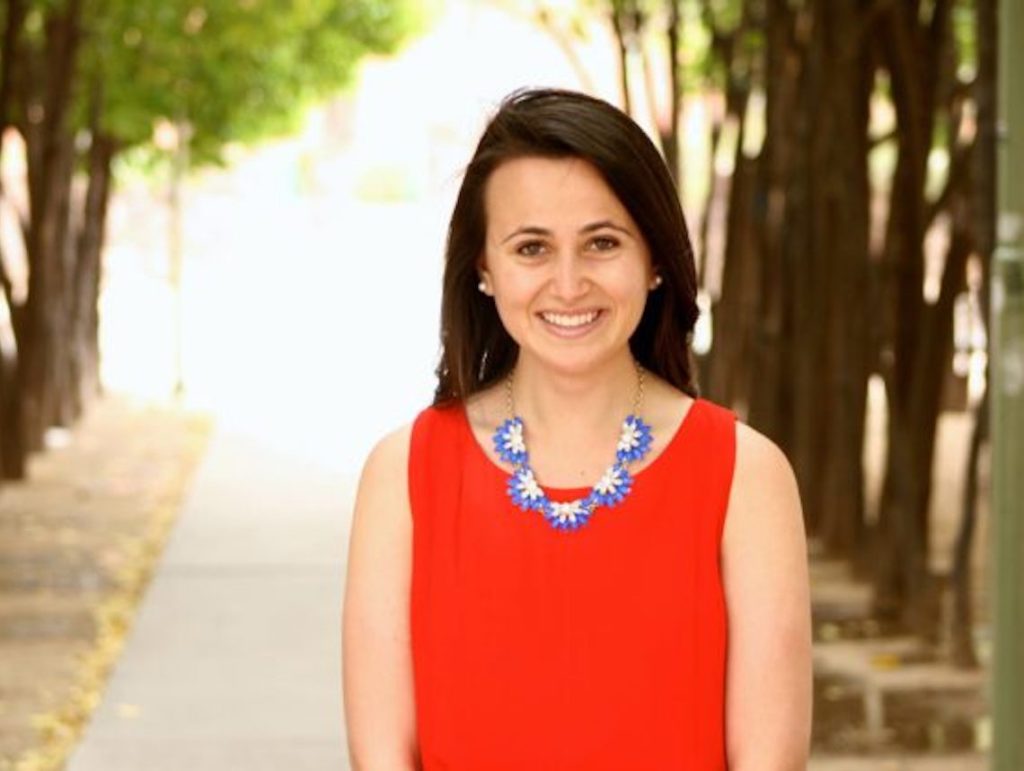
Becca Brukman, president of CJSA, told Jewish Insider that the group “provides a much needed sense of community and promotes a sense of togetherness and I really like connecting people.”

Serving as the Communication Director of Representative Dwight Evans (D-PA), Brukman previously worked as Deputy Press Secretary for Rep. Alan Lowenthal (D-CA).

The non-denominational, bicameral group meets monthly for Shabbat dinners, happy hours, and programing around Jewish holidays. Its largest annual program — a Passover Seder — will be held this year on April 13. With 500 Congressional staffers on CJSA’s email list, the group has a relatively wide reach.

“It’s a big city but this kind of gives you a little bit of a niche and makes you find your home and place,” she said.

Brukman cautioned that the organization does not include any programming about Israel. “The group is not political. People can seek that out in other channels and that’s not something we promote or push,” she added. At the same time, she also connects Congressional staffers with local Synagogues and Torah study sessions across the city.

Brukman noted that the organization is looking to increase its community service volunteering connecting with the Jewish value of “Tikkun Olam” or repairing the world. “It’s really nice to find common ground in the workplace, especially at a time when there are so many different opinions and political perspectives.”

Capitol Hill staffers find common Jewish bond Read More »

Orthodox rabbis urge “spiritual resistance” against Trump policies

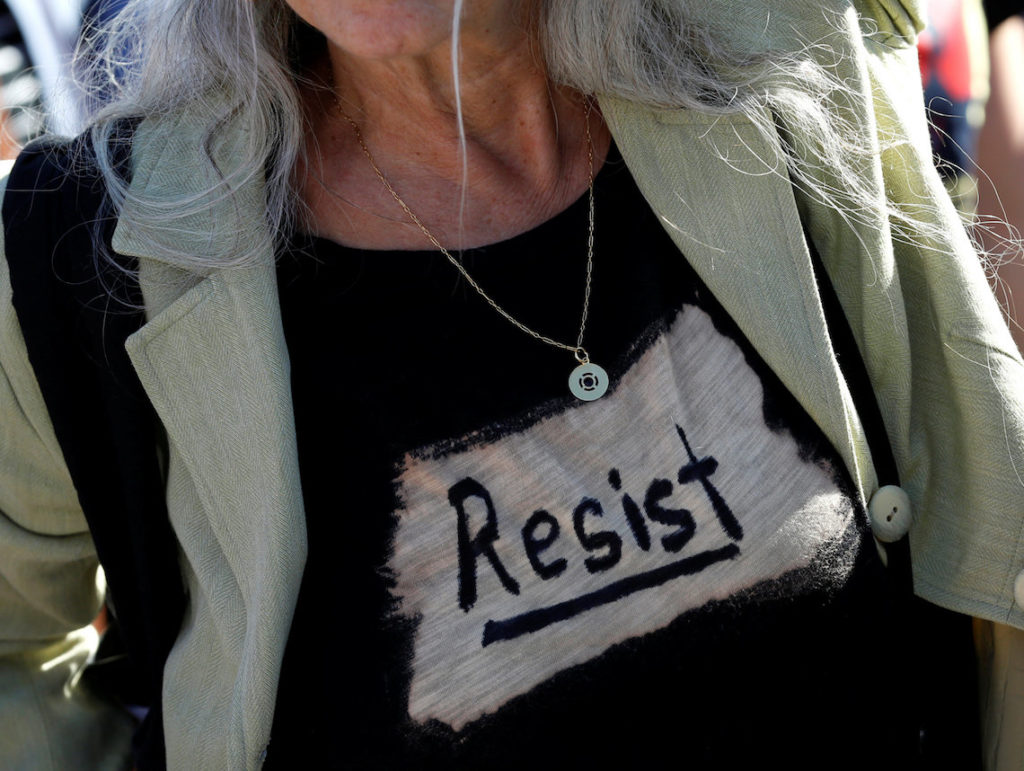
Twenty-two Modern Orthodox rabbis signed a statement last week urging their communities to commit “non-partisan acts of spiritual resistance” in order to push back against “an administration that poses a grave threat to our democracy.”

“We call upon our community to pursue righteousness and justice vigorously, challenge oppressive and dangerous policies enacted by the current administration, and to ensure that justice rolls down like a river and righteousness like a never-ending stream,” the rabbis wrote in the letter that went online March 3.

Led by Rabbi Shmuly Yanklowitz, the Scottsdale, Ariz.-based founder and president of the Orthodox social justice organization Uri L’Tzedek and a leader in the Open Orthodox movement, the signatories belong to a group of some 70 pluralistic, progressive rabbis who came together during the recent presidential campaign, he said.

While American Jews voted for Democrat Hillary Clinton at a rate of about 71 percent according to some estimates, a Pew Research Center poll in September found that 50 percent of Orthodox Jews favored then-candidate Donald Trump.

“Since the election, the Orthodox community has been silent or supportive of the new administration,” Yanklowitz told the Journal on March 5. “We felt it was time that we called upon the Orthodox community at large to join the rest of the Jewish community.”

He pointed to a long tradition of Jewish spiritual resistance, from Moses and the Exodus, to Mordecai and Esther’s struggle with Haman in the Purim story and finally to the Holocaust.

Today, he said, rabbis can demonstrate spiritual resistance through activism — what he called “the normal stuff,” such as boycotts and protests — and as well as through their positions, by incorporating political consciousness into prayer spaces, for example. He noted that he fasted on Inauguration Day as an act of spiritual protest.

Yanklowitz insisted the letter was aimed not at President Donald Trump himself but rather administration policies that might target vulnerable communities.

“This is not an anti-President Trump statement, but we’re resisting any hateful policies emerging from this administration,” he said, pointing to the ban on travel to the United States from certain countries and policies targeting asylum seekers as examples.

Rabbi Chaim Seidler-Feller, director emeritus of Hillel at UCLA and one of the letter’s signatories, said his goal in signing was not to recruit more rabbis to join up but rather to push Orthodoxy to take stock of its values and how they comport with the administration.

“We’re not making a movement; that’s not what I care about,” he said.

Instead, he sees the letter as a challenge to Orthodox communities to evaluate their Torah-bound responsibility to the vulnerable and needy.

“What are we going to be able to say to the next generation of Jews that are looking at us and saying, ‘You taught us that these are the core principles of Judaism, and now you’re silent?’ ” he said.

To critics who say politics has no place in the sanctuary, Yanklowitz said Orthodox congregations often incorporate right-wing Israel politics on a daily and weekly basis. “Far right-wing politics in Orthodoxy have become as dogmatic as some theological positions,” he said.

He hopes that by activating the American Orthodox community, the letter’s signatories can bring a Torah-centered approach to resisting administration policies they see as hostile.

“This community hasn’t stepped up yet, and they should,” he said. “And there may be a unique approach that this community can offer.”


Orthodox rabbis urge “spiritual resistance” against Trump policies Read More »