fbpx

February 13, 2017

When Netanyahu slept at the Kushners — and other media tales of Trump’s Jewish confidantes

Jared Kushner once lent Benjamin Netanyahu his bed.

That’s a juicy takeaway from Jodi Kantor’s deep dive into the first son-in-law and his relationship with Israel published over the weekend in The New York Times.

Netanyahu has long been a friend of the Kushners, and particularly Jared’s dad, Charles Kushner, a major donor to pro-Israel and Jewish causes. One time, Kantor reports – she doesn’t specify when – Jared gave up his bed and moved to the basement so Netanyahu could spend the night at their home in Livingston, New Jersey.

Politico and The Washington Post also shared inside reporting about Kushner and his wife, Ivanka Trump, and the Times joined the Post in fleshing out the profile of Stephen Miller, President Donald Trump’s senior adviser and frequent opening act.

Here are some other surprising facts from the coverage this weekend of the Jews in Trump’s inner circle.

* A  flagpole at the Joseph Kushner Hebrew Academy, named for Jared’s grandfather, is dedicated to the memory of Alisa Flatow, an alumna who was murdered by terrorists.

Jared Kushner attended the school – then named the Hebrew Youth Academy in Livingston – with Alisa’s younger sister, Ilana. When Alisa, 20, was killed in 1995, in a bus bombing in the Gaza Strip, Jared and Ilana were eighth-grade classmates.

The school “couldn’t fathom how a young man can load himself up with dynamite and blow himself up in a van and have his parents celebrating his death,” Stephen Flatow, the girl’s father, told the Times.

* Jared stopped wearing his kippah when he attended Harvard. The Times reported that Kushner maintained other Orthodox observances at the university – JTA has reported his closeness to the university’s Chabad House – but the head-covering was gone.

* Jared’s dad still looms large in his life. As close as he is to Ivanka’s dad, Jared remains his own father’s son. Charles Kushner joined the meeting in September of Netanyahu, Trump and Jared Kushner, the Times reported.

* In fact, all might not be so serene between Jared and Donald – or for that matter between Ivanka and Donald.

Jared Kushner’s first diplomatic coup was to organize, with Foreign Minister Luis Videgaray of Mexico, a calming of the waters between the U.S. and its southern neighbor. On Jan. 25 – not a week into Trump’s term – Kushner, backed by Videgaray, persuaded the new president to tone down remarks he would give as he ordered a wall built along the U.S.-Mexico border, fulfilling a campaign promise, The Washington Post reported.

The Mexicans liked what they heard – “a strong and healthy economy in Mexico is very good for the United States,” Trump said. Mexican President Enrique Peña Nieto was set to come to Washington, a visit that would have upended notions that Trump’s election had set relations between the neighbors on a downward spiral. All was right with the world.

For at least an afternoon or so, that is. Later the same day, Peña Nieto reiterated that Mexico would not pay for the wall, prompting Trump to angrily post on Twitter the next morning that the summit should be canceled.

“Kushner seethed with frustration at the outcome,” the Post reported, although it did not say whom he principally blamed: the Mexican president for bringing up payment for the wall or his father-in-law for not heeding his advice.

* Speaking of not heeding advice: Ivanka Trump, according to Politico, rebuked White House counsel Kellyanne Conway for using Ivanka’s eponymous fashion line as political fodder when she urged Americans last week to buy Ivanka now that Nordstrom dropped the line.

That set off an ethics controversy, and not just in the media, but within the family as well, Politico reported, suggesting that Conway was acting on Donald Trump’s orders and that Ivanka was unhappy, both with Conway and with her dad.

“In her attempt to do Trump’s bidding, she may have crossed one of the people closer to Trump than herself — Ivanka Trump,” Politico wrote. “A source close to Trump said that his daughter scolded Conway for dragging her brand into an ethics mess and told her not to mention it again on TV. This was a continuation of a conversation that Ivanka Trump had with her father weeks earlier about leaving her business out of the politics, a conversation that Conway wasn’t aware of.”

Ivanka had the keep-your-politics-out-of-my-business conversation with her father “weeks earlier,” yet on Feb. 8, he posted on Twitter: “My daughter Ivanka has been treated so unfairly by @Nordstrom. She is a great person — always pushing me to do the right thing! Terrible!”

* Jared Kushner has bonded with two ambassadors: Ron Dermer of Israel, according to the Times, and Yousef Al Otaiba of the United Arab Emirates, according to the Times and another profile in Politico.

“He is in almost constant phone and email contact with Otaiba, whom he met last June on the campaign through a mutual friend, the billionaire real estate investor Tom Barrack, one of Trump’s closest friends and the chair of his inaugural committee,” Politico reported.

Trump has tasked Kushner with brokering a Middle East deal, and his friendship with Oitaba jibes with Netanyahu’s agenda of making peace from the “outside in” — i.e., forging ties first with Sunni Arab states, growing closer to Israel because of a shared apprehension of Iran. Kushner also secretly talked Israel with Haim Saban during the campaign, Politico reported. Kushner has long admired the Israeli-American entertainment mogul and backer of all things Hillary Clinton. It’s not clear why Kushner was reaching out to Saban — it didn’t diminish Saban’s support for Trump’s rival.

Kushner has also met with Henry Kissinger, who as secretary of state in the 1970s laid the groundwork for Israel-Egypt peace. Kissinger left the meeting with little clarity about Kushner’s actual role.

“It’s not clear to me in what way he’s in charge of it, whether he’s in charge of it with supervision from the White House, or whether he’s supposed to be the actual negotiator,” Kissinger told Politico. “Nor has it been defined what they’re negotiating about.”

— Stephen Miller, a senior adviser to and speechwriter for Trump (and his opening speaker at campaign rallies) earned two major profiles, in the Times and The Washington Post.

Miller, 31, the child of liberal Jewish Democrats from California who was first drawn to conservatism because he favored gun rights, appears to be well liked in Trumpland. Stephen Bannon, Trump’s chief strategist, told the Times that Miller is “a loyal and faithful soldier in the Trump movement, a warrior for the working class.”

Arch-conservative David Horowitz launched Miller’s career by introducing him to then-Sen. Jeff Sessions, R-Ala., who was the first senator to endorse Trump and now is the U.S. attorney general.

“One of the things that struck me when I became a conservative was that conservatives don’t have any fight,” Horowitz told the Post. “They don’t have any stomach for it. … Stephen Miller had that from the get-go.”

Miller also blitzed this weekend’s Sunday shows, and it wasn’t so pretty.

His performance, avoiding questions about whether Trump was ready to sack his national security adviser, Michael Flynn, for being less than truthful about a conversation he had in December with Russia’s ambassador, was widely derided by various fact-checking sites.

“I don’t have any information one way or another to add anything to this conversation,” Miller, who had been invited on the Sunday shows to talk about Flynn, told George Stephanopoulos on ABC’s “This Week.”

Stephanopolous blasted Miller for backing up Trump’s claim that he lost New Hampshire because of fraudulent voting. Miller kept making assertions of fraud without presenting evidence (“widely known,” “very real” were his terms of art).

“Just for the record, you have provided absolutely no evidence,” Stephanopoulos said.

Miller also seemed to have problems with constitutional notions of speech protections and co-equal branches of government. Referring to court rulings staying his boss’ ban on the entry of refugees or of travelers from Muslim-majority nations, he seemed to argue that Trump’s authority – at least in this area — was unchallengeable in every forum.

“The end result of this, though, is that our opponents, the media and the whole world will soon see as we begin to take further actions that the powers of the president to protect our country are very substantial and will not be questioned,” he told CBS’s “Face the Nation.”

One area where Miller cast a little clarity: his association with Richard Spencer, the white separatist, when they were both at Duke University.

The coupling was always odd: Miller is Jewish, Spencer believes in a white Christian ethno-state that excludes Jews (although he is happy to deal with Jews living in a state of their own). Miller, when first asked in October by Mother Jones about their days at Duke, would only say he had “absolutely no association” with Spencer.

In The Washington Post profile, Miller for the first time owned up to an association that was minimal – but that also comports what was previously reported: Miller and Spencer interacted as members of Duke’s Conservative Union, and once joined, in 2007, to organize an immigration debate. But Miller also said that was where it ended.

“I condemn him. I condemn his views. I have no relationship with him. He was not my friend,” the Post quoted Miller as saying. “Our interaction was limited to the activities of the organization, of which he was a member, and thus ceased upon graduation.”

That was backed by another member of the club, David Bitner, who called Spencer’s claim that he “mentored” Miller “scurrilous.”


When Netanyahu slept at the Kushners — and other media tales of Trump’s Jewish confidantes Read More »

When Did You Lose Yours?

This article is dedicated in memory of Rabbi Shlomo Schwartz Aka Schwartzie (May the Schwartz B W U)

When did you Lose yours?

Was it the first time you heard the whisper of death creep into your wake?

Did you lose yours upon seeing illness?

Or was it upon feeling betrayal?

Did you lose yours the first time you lost love or the moment you noticed shame?

Mine was lost as a child, then again as an adult.

I’m sure you can remember the exact day you lost your innocence.unnamed

The exact moment you no longer saw the world with the same black and white colors. Like a baby adjusting to the light, as the tinge of grey began creeping into your vision, when you suddenly saw that veil lift as a crystal clear unblemished truth began to change you. Not at first. But soon. And the truth invaded your body with realism and cynicism and confusion. Not right away. But eventually.

Some lose their innocence when they are children.  As time moved forward I began to understand how the impact of loss was informing my decisions and my fears.

When my father passed away, my innocence crept away completely. Gone forever like a shadow muttering my name before I even had one. That impact made me remember how my innocence was something I wished I could hold onto. I began to resent my innocence and looked at it with distrust. I used to close my eyes and pretend I was preserving my innocence longer, wondering what it might feel like if it stayed in tact. If I had lost my innocence older, would it have  mummified inside, making the ability to see truth that much more burdensome? Would truth have been more difficult to recognize? Or would it have been easier to adjust to?

We are fortunate to have Marianne R. Klein’s artwork included in this essay. About the artist- A holocaust survivor, Marianne was born in Budapest, Hungary. Her art collection is a series of acrylic on canvas impressionistic and figurative works that depicts a symphony of colors. She also enjoys experimenting with different mediums and techniques. Her screenplays are currently under consideration. When Marianne is not painting, she is busy writing. Her recently published book entitled “All the Pretty Shoes” is now available on Amazon.com and can be viewed at www.alltheprettyshoes.com. Marianne’s artwork will be exhibited on February 4th-15th 2017 in Santa Monica, California at the Bergamot Station, Building G – Room G#8 starting @ 5:00 p.m to 9:00 p.m.

Learning truth after innocence fades feels like squinting at first, like the light is so large and so colossal our brains are unable to interpret the full scope of the information pounding down the pavement.  I wish I could look at truth with a sort of unadulterated awe. Instead it has become quite loud and colossal and very disruptive. I have a hard time accepting truth. It is not a construct I like very much. Yet it is necessary. It is affirming yet alarming. Discerning yet indifferent.

We are very crafty. We can look at the large mountain of truth and still find a way to completely avoid it’s rearing head. For years we can pretend reliable information is false. We can build strategies that allow truth to lie under the bed just a little while longer. We can even become brilliant at alternate reality storytelling, because the hurt, the betrayal, the realness of it all is just too much to bear. It is just too much.

unnamed-1

As we get older new stories, new revelations, new shocks can seep into our system. And one day we finally look into the mirror, like deeply look, and really stare and suddenly our own truth looks foreign to us as well. We do not know our own truth anymore, so we begin wearing other people’s eternal verities. We adopt new garments of information that become our own and fixate our bodies into these threads of perceivable isms until we forget who we are completely. We can’t even feel our bodies anymore. I have done this quite brilliantly. Ignoring body parts, suppressing pain became a habit I had not even recognized I was doing until it became too difficult to rely on any longer.

We can do pretend for many reasons, but mainly because truths, which become to difficult to swallow has the ability to prevent us from feeling everything and gives us permission to go on autopilot. The danger in this mechanism is that it can allow illness take over, because the blocks in our bodies become huge gaping  holes for the feelings of dis-ease to settle into. Discomfort, disbelief, and our own disconnection with power can become unrecognizable and alien. Our voice is lost at sea, our consciousness asleep, our bodies rejecting truth becomes the exercise we cannot stop without intervention.

But imagine if we stopped that train from heading down the reckless path before the illness set in. How do we stop it?

By asking questions of ourselves. By noticing the patterns, how losing that innocence has affected our daily living routines.  By feeling ourselves suppress our convictions and emotions hiding behind the decay. By noticing our bodies and how our bodies are reacting to the loss. By seeing, not just looking. By feeling, not just touching. By listening, not just hearing. By literally smelling the damn roses for once. For just once.

Before we become too despondent maybe we can reawaken that glimmer of hope that still simmers on a low flame. Before it leaves us slowly extinguishing into a prolonged termination.

Before we layer. Layer with outside labels and immerse ourselves with exterior stereotypes. Before we create ideas that become more external ideas so as not to have to face the person who lives under the truth. The person who hides behind the realism that relies on falsehood as a mechanism to find truth. It is quite startling, really, that we have the audacity to  search for truth using pretend. As if the pretend wills the truth away.

Truly, we don’t want her to leave,  the hope. If we are honest with ourselves, we want her to stay, to re-infuse our souls and re-install our vibrancy. We want her to bathe our cynicism  and doubt into submission. But in order to do that, we must have  enough trust in ourselves, in our voice, in our power to will that into being.

If we are honest with ourselves, do we not want to get to that place where truth lives and thrives? Where the veil is no longer casting that shadow only to find us awake? Not the awake where we tease ourselves into a living that looks pretend, but the sort of living that is rooted in the deepest layers of soul. Because our soul, the instrument that keeps us awake and opens our heart, refuses to live in falsehood and has been catching us from the beginning.  It has been activated and operates on unwavering authenticity- and paradoxically on loss of innocence.

And while there are still moments we catch ourselves still aching and longing for that time of falsehood when innocence still lay intact, we are better for all of our innocence finally leaving on the whisper she flew in on. Yes, truth is more complicated, yet it is also more defining and the birthplace of creation. The creation of our new  more powerful, more beautiful, more compelling, persuasive intact new self we have finally allowed ourselves to meet.


When Did You Lose Yours? Read More »

Tuition-free college would rev up California’s economic engine

[As part of Community Advocates continuing efforts to illuminate issues that warrant attention and action, its consultant, Morley Winograd, wrote this op/ed in today’s Sacramento Bee for Community Advocates. It makes clear that California’s multi-level post-secondary public educational structure is doing something right, we just need to do more of it. The policy makers who can make a difference are in our state capital and read the Bee. – David A. Lehrer]

sacramento-bee

Tuition-free college would rev up California’s economic engines

                                        by MORLEY WINOGRAD

Higher education is the key to economic mobility in America. A recent study with unprecedented access to individual and family incomes has proved the case for this proposition beyond a reasonable doubt.

The study done for the Equality of Opportunity Project rated every college in America on how well they did in improving their students’ income after their college experience, seal-of-the-state-of-californiawhether they graduated or not, compared to their families’ income before they entered college.


The top 10 colleges with the best track record of moving students from families in the bottom 20 percent of all incomes in America when they entered to individual incomes in the top 20 percent when they left included three public colleges in California.

Cal State Los Angeles had the highest “Mobility Rating” of any college in the country, moving almost 10 percent of its student body from the bottom to the top levels of income after their college experience. Glendale Community College ranked seventh, moving 7 percent of its students up the economic ladder, just about tied with the performance of the City University of New York. Rounding out the top 10 of mobility engines was Cal State Polytechnic University’s Pomona campus, where 6.8 percent of all students from the lowest income quintile ended up in the top quintile after taking classes there.

The UC system’s results also earned it some bragging rights. UC Berkeley moved a higher percentage of its students whose family incomes were in the lowest 20 percent to the top 1 percent of incomes than any other elite college, as the study’s authors called them, in the country. And UCLA had the highest percentage of enrollment of students from the lowest quintile of incomes than any other such university in the country, even though their post-graduation income success was not as great as some others.

But the real stars of the report were what the researchers call “working class colleges,” such as Cal State University or community colleges, that earned their high marks by having the most success with the greatest number of students from lower income families.

How did these colleges achieve this outstanding performance? It wasn’t by spending more money than elite colleges. The average per student instructional expenditure at places like Stanford is $87,100. By contrast, the average per student expenditure for working-class colleges that were able to achieve Ivy League levels of completion was only $24,600, or less than a third of what elite schools spent.

Overall, the study demonstrated that places such as Cal State and community colleges were contributing the most to our state’s need for economic mobility by providing the broadest access possible within their unique academic roles and at a much more reasonable cost.

To rev up the state’s economic mobility engine, we need many more of California’s families to gain access to a higher education experience. Today, many families think they can’t afford college for their children, even though they know, as this study shows, that it is key to their economic success. But experience also shows that when states eliminate that worry by making a promise that tuition will be free, enrollment rates soar. For instance, in Tennessee in the first year of its Promise scholars program, which makes all of the state’s two-year institutions tuition-free for high school graduates, enrollment in the community colleges rose 24.7 percent.

Now that we have incontrovertible data showing that going to college is the key to upward mobility and that we know how to do it with reasonable levels of expenditures, California should enact a Promise program to make tuition free for two years at Cal State or any of our community colleges. Without spending very much money at all, such a program would open the floodgates of economic opportunity to families throughout the state and provide California with the workforce it needs to remain competitive in the global economy.

Morley Winograd is president and CEO of Campaign for Free College Tuition. He can be reached at morley@freecollegenow.org. This op-ed was written in association with Community Advocates Inc. of Los Angeles.

Tuition-free college would rev up California’s economic engine Read More »

These incredible photos show members of an Indian-Jewish ‘lost tribe’ moving to Israel

One hundred and two members of the Jewish community in India, who trace their heritage to one of Israel’s lost tribes, are moving to Israel this week.

The immigrants, who hail from the northeastern Indian state of Mizoram — home to the second largest concentration of the country’s Bnei Menashe community, as they are called — will arrive in Israel on Tuesday and Thursday. The move is being facilitated by Shavei Israel, a nonprofit that seeks to connect “lost” and “hidden” Jews to the Jewish state.

The group plans to live in the city of Nazareth Illit, where other members of their community have already settled. Some 3,000 Bnei Menashe have immigrated to Israel in recent years, with another 7,000 remaining in India.

Members of the “Bnei Menashe” Jewish community in Aizawl, the capital of Mizoram, India, Feb. 12. Photo courtesy of Shavei Israel

Their move represents the first time in three years that members of the Bnei Menashe community from Mizoram have moved to Israel, according to a statement by Shavei Israel.

Members of the “Bnei Menashe” Jewish community at the Indira Gandhi International Airport in New Delhi, India, en route to Israel, Feb. 13. Photo courtesy of Shavei Israel.

“After 27 centuries of exile, this lost tribe of Israel is truly coming home,” said Shavei Israel founder Michael Freund. “But we will not rest until all the remaining Bnei Menashe still in India are able to make aliyah as well.”

Freund, a conservative writer and former aide to Israeli Prime Minister Benjamin Netanyahu, said his organization was hoping to bring more than 700 Jews from India to Israel this year.

Members of the Bnei Menashe Jewish community from across northeastern India gathering in Churachandpur, in the Indian state of Manipur to celebrate Hanukkah, Dec. 8, 2015. Photo courtesy of Shavei Israel.


Members of the Bnei Menashe Jewish community from across northeastern India gather in Churachandpur, in the state of Manipur, to celebrate Hanukkah on Dec. 8, 2015. Photo courtesy of Shavei Israel.


Members of the Bnei Menashe Jewish community from across northeastern India gather in Churachandpur, in the state of Manipur, to celebrate Hanukkah on Dec. 8, 2015. Photo courtesy of Shavei Israel.

These incredible photos show members of an Indian-Jewish ‘lost tribe’ moving to Israel Read More »

German Chancellor Angela Merkel cancels joint Cabinet meeting with Israel

German Chancellor Angela Merkel has canceled a planned top-level joint Cabinet meeting with Israeli leaders, reportedly out of frustration over Israel’s controversial new settlements law.

The binational consultation was set for May 10 in Jerusalem. The Israeli daily Haaretz reported that Merkel’s office offered the  September national elections in Germany as the reason for the cancellation, but the chancellor appears to be taking a more critical stand toward Israel in order to improve her chances of winning a fourth term.

Surveys repeatedly show that many Germans are critical of Israel because of how they believe the Palestinians are treated there. A 2015 poll by the Bertelsmann Foundation found that 48 percent of Germans shared the negative view.

An unnamed Israeli government source told Haaretz that the chancellor and the German Foreign Ministry were extremely upset over the bill passed in Israel last week that allows Israel to take possession of private Palestinian land on which West Bank settlements or outposts were built, as long as the settlers were not aware of the status of the land when they were built.

Reportedly the law, which can still be challenged, retroactively legalizes 4,000 settler apartments built on private Palestinian property in the West Bank. Palestinian landowners who come forward are entitled to generous compensation.

The law has drawn criticism in Israel and abroad, including from France, the European Union and the United Nations. Israel’s attorney general, Avichai Mandelblit, has suggested the law could violate the Fourth Geneva Convention. The United States has not condemned the law, though it has said the settlements do not help peace efforts.

In March 2008, Merkel and Israel’s then-prime minister, Ehud Olmert, launched joint annual top-level government consultations on a wide range of topics. It was the first time Germany engaged in Cabinet consultations with a non-European country.

Merkel, the first foreign head of government to address the Knesset, said Israel’s security “will never be negotiable for me,” calling it part of Germany’s “raison d’etat.”

German Chancellor Angela Merkel cancels joint Cabinet meeting with Israel Read More »

Rabbi’s expulsion rattles Russian Jews fearful of Kremlin crackdown

Three years ago, Rabbi Ari Edelkopf and his wife, Chana, worked around the clock for weeks to show off their community and city to the many foreigners in town for the Winter Olympics in Sochi.

The Chabad emissaries from the United States came to the city on Russia’s Black Sea coast in 2002. By the time the Olympics opened, they could offer three synagogues, five information centers and 24/7 kosher catering to thousands of people in the city, which has only 3,000 Jews.

The Edelkopfs were celebrated in the local media for these considerable efforts, which the Kremlin marketed as proof that Russia welcomes minorities — including by inviting a Russian chief rabbi to speak at the opening.

This month, the couple is in the news again but for a different reason: They and their seven children have been ordered to leave Russia after authorities flagged Ari Edelkopf as a threat to national security — a precedent in post-communist Russia that community leaders call false and worrisome, but are unable to prevent.

Occurring amid a broader crackdown on foreign and human rights groups under President Vladimir Putin, the de facto deportation order against the Edelkopfs is to many Russian Jews a sign that despite the Kremlin’s generally favorable attitude to their community, they are not immune to the effects of living in an increasingly authoritarian state. And it is doubly alarming in a country where many Jews have bitter memories of how the communists repressed religious and community life.

The Edelkopfs’ deportation order drew an unusually harsh reaction from the Federation of Jewish Communities of Russia, a Chabad-affiliated group that has maintained friendly and mutually beneficial ties with Putin.

The order, which included no explanation or concrete accusation, “raises serious concerns for the future of the Jewish communities in the country,” Rabbi Boruch Gorin, a federation spokesman, told the L’chaim Jewish weekly last week. Gorin is a senior aide to Beral Lazar, the chief rabbi who spoke at the Sochi opening ceremony.

Gorin also called the order “an attempt to establish control” on religious communities in Russia, including the Jewish one, which he said is serviced by some 70 Chabad rabbis, half of whom are foreign.

Many Sochi Jews consider Edelkopf, a Los Angeles native, a popular and beloved spiritual leader with an impeccable record and a close relationship with Lazar. They reacted with dismay and outrage to the deportation order.

“This is absurd,” Rosa Khalilov wrote in one of the hundreds of Facebook messages posted to Edelkopf’s profile, in which he offered updates from his failed legal fight to stay in Russia. “Deportation without proof and thus without proper defense for the accused. I am utterly disappointed.”

Typical of such discussions, comments by Russian speakers abroad tended to be more outspoken than the ones authored domestically.

“Somewhere along the way our country changed without our noticing,” wrote Petr Shersher, a 69-year-old Jewish man from Khabarovsk who lives in the United States. “We’re suddenly not among friends and compatriots but in another brutal and indifferent atmosphere.”

Since the fall of communism in 1991, the Federation of Jewish Communities of Russia — essentially Chabad’s Russia branch, and by far the country’s largest Jewish group — only on a very rare occasion had publicly questioned the viability of Jewish life in the country or the authorities’ tolerance of religious freedoms.

The strong reactions to the Edelkopf edict seem to be less connected to the actual expulsion – at least seven rabbis have been sent packing over the past decade over visa and residence issues — than to the assertion that Edelkopf endangers Russia, a claim the rabbi denies.

“This serious allegation is a negative precedent that we had never seen directed at a rabbi before in Russia, and it is a very, very big problem for us,” Gorin told JTA. “What are they saying? Is he a spy? We can remember very well the times when Jews were last accused of endangering state security,” he added in reference to anti-Semitic persecution under communism.

Behind the expulsion of Edelkopf and the other rabbis, Gorin added, is an attempt by the state to limit the number of foreign clerics living in Russia – an effort that has led to expulsions not only of rabbis but also of imams and Protestant priests.

“It’s not targeting the Jews,” he said.

Alexander Boroda, the president of Gorin’s federation, told Interfax that he was “dismayed” by the expulsion and suggested it was the work of an overzealous official eager “to check off the box” after being ordered to curb immigration.

Boroda also told Interfax that the deportation was not anti-Semitic. He recalled how Putin’s government has facilitated a Jewish revival in Russia — including by returning dozens of buildings; educating to tolerance; adding Jewish holidays to the national calendar, and offering subsidies to Jewish groups. Lazar, who was born in Italy, often contrasts the scarcity of anti-Semitic violence in Russia with its prevalence in France and Great Britain.

The government has also tolerated criticism by the Chabad-led community. Under Lazar and Boroda, the Federation has largely ignored xenophobia against non-Jews but consistently condemned any expression of anti-Semitism — including from within Putin’s party and government.

The federation even spoke out against Russia’s vote in favor of a UNESCO resolution last year that ignores Judaism’s attachment to the Western Wall in Jerusalem.

Still, the Edelkopf deportation is part of a string of recent incidents in which Jews have suffered the effects of growing authoritarianism in Russia – a country where opposition figures are routinely prosecuted and convicted. Since 2012 the country has slipped in international rankings of free speech and human rights; Freedom House’s “Freedom on the Internet” index slipped recently from “partly free” to “not free.”

Under legislation from 2012, a Jewish charitable group from Ryazan near Moscow was flagged in 2015 by the justice ministry as a “foreign agent” over its funding from the American Jewish Joint Distribution Committee and its reproduction in a newsletter of political op-eds that appeared in the L’chaim Jewish weekly.

Ari Edelkopf and wife Chana in 2009 in Sochi, Russia. Photo courtesy of Federation of Jewish Communities

Last year, a court in Sverdlovsk convicted a teacher, Semen Tykman, of inciting hatred among pupils at his Chabad school against Germans and propagating the idea of Jewish superiority. Authorities raided his school and another one in 2015, confiscating textbooks, which some Russian Jews suggested was to create a semblance of equivalence with Russia’s crackdown on radical Islam.

Before that affair, a Russian court in 2013 convicted Ilya Farber, a Jewish village teacher, of corruption in a trial that some Jewish groups dismissed as flawed, in part because the prosecution displayed some anti-Semitic undertones in arguing it.

While the incidents differ in their local contexts in the multiethnic behemoth that is Russia, seen together they demonstrate that the Jewish minority not only thrived under Putin but is feeling the “collateral damage as the government drastically tightens its grip on all areas of life,” according to Roman Bronfman, a former Israeli lawmaker from Ukraine and a staunch critic of Putin.

Natan Sharansky, the chairman of the Jewish Agency, recently named the anti-democratic measures of Putin’s government — along with the halving of the Russian ruble against the dollar amid sanctions and dropping oil prices — as a major catalyst for an increase in immigration to Israel by Russian Jews.

Last year, Russia was Israel’s largest provider of immigrants with some 7,000 newcomers to the Jewish state, or olim – a 10-year high that saw Russia’s Jewish population of roughly 250,000 people lose  2 1/2 percent of its members to Israel.

But to Lazar, Russia’s Chabad-affiliated chief rabbi, the numbers tell a different story, he told JTA last week at the Limmud FSU Jewish learning conference in London.

“I don’t know if Jews are leaving because of these steps,” he said, referring to limitations on freedom of speech and other liberties in Russia. “But I think it’s a testament to the revival of the community, which has instilled Jewish identity to provide many olim, whereas 15 years ago this phenomenon just didn’t exist.”

Rabbi’s expulsion rattles Russian Jews fearful of Kremlin crackdown Read More »

I know how you feel about Trump

Remember when we couldn’t wait to say good riddance to 2016? We’d had it with that abusive spouse of an election year. We were sick of the emotional rollercoaster. We needed an armistice, a breather. We were desperate to rise from the political sewer to the shining city on the hill.

Fat chance. This 2017 thing is even worse. I know how you feel: beat up, battened down, fetal, furious. But just remember, there’s nothing wrong with you. It’s not you – it’s him.

Of course you’re depressed. You know that the news is toxic to your spirit, and you admit you’re addicted to it, but really, with all these nonstop horribles, who wouldn’t be obsessed by political disaster porn? Even though the news leaves you feeling not informed and empowered, but helpless and fearful; even if your neocortex knows that Trump’s game is to hijack your attention, and the media’s game is to monetize it; still, your reptilian brain won’t permit you to peel your eyes from the screen, won’t let you stop refreshing your feed, keeps you texting and posting and tweeting and screaming, “Can you effing believe this?” Your news addiction feels no less compulsive than, but is the reciprocal of, an opioid addiction. You’re hooked on pain.

No wonder you’re ambivalent. You have empathy for voters whose struggle to make ends meet and whose loathing of corruption helped put this president in office, but you find yourself rooting that the real harm he’ll do them – robbing their health care, wrecking their public schools, risking their retirement, rolling back their rights – will awaken them to the colossal con they’ve enabled and will eventually rouse them to resistance.

It makes sense to be incensed. You’re enraged by the cowardice of Republican legislators who’ve put protecting their political skins above protecting the Constitution. You’re livid that Trump’s pooh-poohing of “political correctness” has exempted racists, homophobes, misogynists, anti-Semites and other haters from being shunned and shamed. You’re infuriated by the toadies, fools, vipers and shmatta hucksters now wearing staff passes to the West Wing. You’re angry there’s no accountability for the Trumps’ blatant conflicts of interest, no punishment for stonewalling his tax returns, no penalty for his bullying, laziness, lying and ignorance.

It’s perfectly normal that you’re freaked out by how fragile American democracy is, how vulnerable the Enlightenment machinery our Founders designed turns out to be. It’s unsettling that the power of a free press to check political power has itself been checked by the conquest of journalism by entertainment, the displacement of reason by ratings, the substitution of Internet anarchy and networked nihilism for the norms of civil discourse. It’s chilling to concede that the separation of powers between executive and legislative branches can be so completely sabotaged by one-party rule. It’s galling to know that a switch from Trump to Clinton of only 38,873 of the 13,890,836 votes cast in Wisconsin, Michigan and Pennsylvania – call it the Kremlin margin, or the Comey gap – would have thrown the Electoral College to Clinton. The whole master narrative of the 2016 election – Forgotten Americans Give Trump a Mandate! – would never have drawn a breath had there been a ridiculously tiny 0.28% flip. No wonder our so-called president keeps peddling a cock-and-bull voter fraud story; he knows how puny his legitimacy actually is.

True grit is truly exhausting. “I can’t go on, I’ll go on,” Samuel Beckett said, but it’s awfully draining to be whipsawed between despair and determination. One day you’re uplifted by millions of marching women; the next, another state outlaws abortion. You’re heartened to see so many town halls where the Indivisible movement, already more potent than the Tea Party, is holding congressional feet to the fire, but you’re powerless to prevent the most unfit Cabinet in our history from being confirmed. When a senator says a Supreme Court nominee told him he was “demoralized” by Trump’s attack on the judiciary, you let yourself be hopeful, but when cable yakkers call that a ploy to create an aura of independence for the judge, you feel spun like a chump.

The storm still gathering over Team Trump’s footsie with Putin invites us to imagine a sudden end to the 45th presidency. If evidence turns up that Trump swapped softer sanctions on Russia for Putin’s feeding his Clinton email hacks to Wikileaks, maybe Paul Ryan would let the House vote to impeach him. Or maybe Trump’s megalomania will be so undeniably sociopathic even to his own Administration that the 25th Amendment will be invoked to replace him. Maybe Trump’s misery in his job – White House aides are leaking he wishes he’d never run – will culminate in a resignation. Or maybe SNL, CNN and the dishonest New York Times will finally make his head explode.

Then again, maybe it’s just same old yoyo of hope and dread. You go up – okay, I go up – at the prospect that our national nightmare will be over sooner rather than later. Then I go down at the thought of President Pence. There’s a way out of that, though, and the prairie fire sweeping congressional districts points the way: fight like hell, right now, for a Democratic House or Democratic Senate, or both, in 2018. Implausible? No one knows. But pushing to make it possible is a sure-fire prescription for feeling better.


Marty Kaplan holds the Norman Lear chair at the USC Annenberg School for Communication and Journalism. Reach him at martyk@jewishjournal.com.

I know how you feel about Trump Read More »

Jews gather at rallies across U.S. urging support for refugees

Over 100 years ago, Barnett Levine was greeted by the New York skyline and the Statue of Liberty as he arrived in the United States, having fled anti-Semitism and pogroms in his native Poland.

On Sunday, his grandson saw those very same sights when he joined about 700 others in this city’s Battery Park downtown at a rally protesting President Donald Trump’s executive order banning all refugees from the country for 120 days.

“I am the grandchild of four immigrants who came here when the gates of the United States were wide open and they made a life here,” Harold Levine, a 60-year-old marketing consultant, told JTA. He added: “I think that it is the duty of the Jewish community to pay this forward to other immigrants who are trying to come to the United States.”

The rally was organized by HIAS, formerly known as the Hebrew Immigrant Aid Society, part of an initiative by the immigrant resettlement group called the National Day of Jewish Action for Refugees.

The president issued his order last month, which also banned citizens of seven predominantly Muslim countries for 90 days. On Thursday, a federal appeals court ruling upheld a stay on the ban, a move praised by Jewish groups, including HIAS.

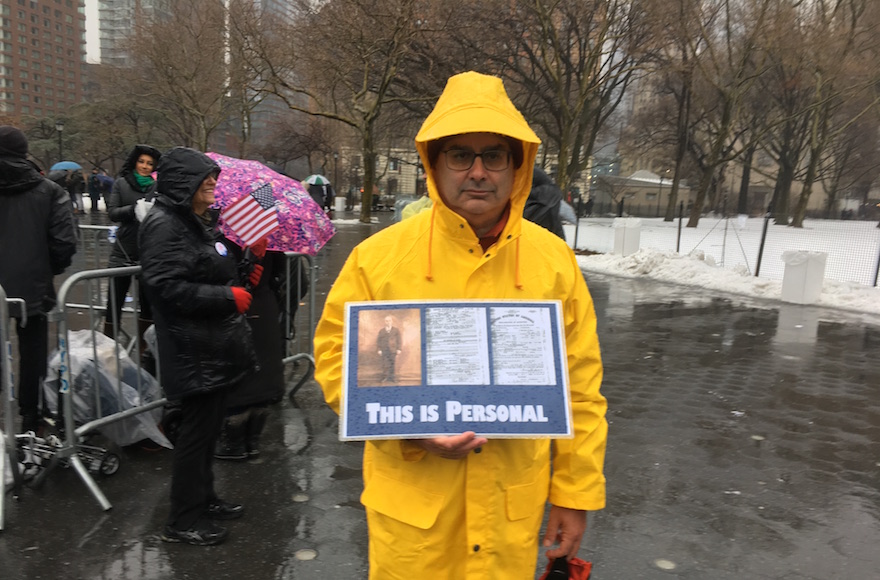
Harold Levine brought a poster to the New York City rally showing his grandfather, who immigrated to the United States over 100 years ago, fleeing anti-Semitism in his native Poland. (Josefin Dolsten)

Thousands attended rallies on Sunday as part of the HIAS initiative, including in Boston, Washington, D.C, and other major cities, a representative for the group told JTA. The demonstrations had more than 20 co-sponsors, including the Anti-Defamation League, the American Jewish Committee, American Jewish World Service, the Union for Reform Judaism and the Conservative movement’s Rabbinical Assembly.

Mark Hetfield, the CEO of HIAS, said the rallies were a rare moment of joining together in support of refugees.

“I haven’t seen anything like this since I got my start [with HIAS] in 1989, which was at the height of the Soviet Jewry movement,” he said. “This is a galvanizing moment like that, but the difference is that then we were standing up for Jews, and now we are standing up as Jews.”

At the New York rally, participants braved icy wind, hail and rain to join in chants of “When refugees are under attack, what do we do? Stand up, fight back” and “Never again means never again for everyone” between speeches by rabbis and clergy members, politicians and leaders of Jewish groups. Among the speakers were Mayor Bill de Blasio; Rep. Keith Ellison, D-Minn.; Jonathan Greenblatt, national director of the ADL, and Sana Mustafa, a Syrian refugee.

In Boston, speakers at a rally with several hundred participants included City Councilor Josh Zakim, whose father, the late Lenny Zakim, was the longtime director of the New England Anti-Defamation League; Imam Faisal Khan, director of religious affairs at the Islamic Center of Wayland, and Fred Manasse, a child Holocaust survivor who was brought to the U.S. by HIAS.

Speeches — even those given by non-Jewish speakers — were peppered with references to Jewish history and traditions.

“In this city we believe we can live in harmony,” de Blasio said in New York.” It’s not perfect, but we believe we can do something that the whole world is struggling to do, that we can all be together … people of all religions and backgrounds, that is what we’re fighting for — doesn’t that fit beautifully the profound Jewish concept of tikkun olam, of healing the world?”

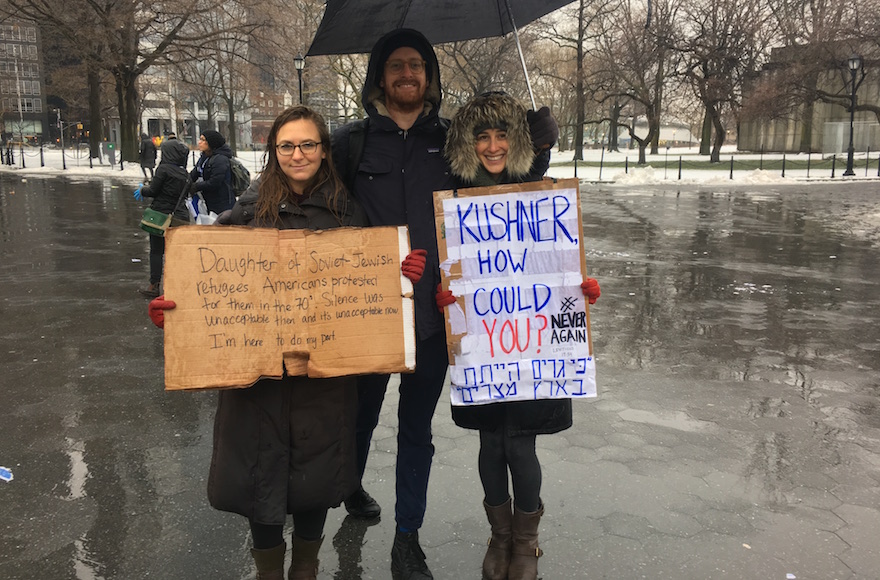
Elianna Kan, left, said the fact that her family members came to the U.S. as refugees from the Soviet Union motivated her to attend the New York City rally with her friends Will Hunt and Sarah Rosen. (Josefin Dolsten)

Ellison, who told JTA that the rally was “one of the main reasons” for his visit to New York, talked in his speech about the MS St. Louis, a ship with 900 Jewish refugees from Germany that tried to enter the United States and other countries but was turned away. He called the incident “a shameful time in our country.”

“All of our officials who worked with this stuff knew about it. We can’t say we didn’t know — we knew,” said Ellison, the first Muslim elected to Congress and a front-runner to lead the Democratic National Committee. “We didn’t want to get involved, we wanted to just mind our own business, we just kind of thought, ‘Oh, this is not our issue.’”

Jewish ritual featured prominently. At one point during the New York rally, representatives of 10 of the co-sponsoring groups went on stage and tore pieces of cloth, mimicking a Jewish ritual in which mourners rend their clothing. The tearing was done to remind attendees of refugees who had died before being able to reach safety, as well as those who are now facing dangerous circumstances.

Bill de Blasio HIAS

New York City Mayor Bill de Blasio speaking at the HIAS rally in New York, Feb. 12, 2017. (Gili Getz)

In addition to co-sponsoring the New York event, the ADL on Sunday also launched a campaign to rally opposition to Trump’s executive order urging people to share on social media their family stories of coming to the U.S. and tagging posts with #ThisIsARefugee.

“We remember that we were once strangers, too, that Jewish refugees fleeing Nazi Germany and oppression during the Holocaust were often denied entry with claims eerily similar to some of the claims that are being made today to deny entrance to refugees, and we think that’s wrong,” Greenblatt told JTA on the phone before the rally.

Participants at the rally said they were compelled to attend for a variety of reasons, both personal and historical.

Lisa Davidson, a 41-year-old professor who attended the New York event, said she saw historic parallels between the Holocaust and the civil war in Syria.

“What’s going on in Syria right now is criminal, and it is sort of reminiscent of what happened in the Holocaust in the ’30s and ’40s, and I think that we don’t want to repeat that again, and we don’t want to sit and say that we did nothing,” Davidson said.

Lisa Davidson, seen at the New York rally, says she sees parallels between the Holocaust and the civil war in Syria. (Josefin Dolsten)

For some the motivation came from their family history. Levine, the marketing consultant whose grandfather immigrated to the U.S. over a century ago, brought with him a poster saying”This is personal” and showing a photograph of his grandfather and his immigration paperwork.

“I couldn’t not come here. The minute I heard about it, I thought I had to come,” he said.

Elianna Kan shared similar reasons for coming. The 28-year-old translator and journalist said her family came to the U.S. in the 1970s as refugees from the Soviet Union, receiving financial and logistical help from HIAS.

“I’m here and have the privilege of being born in a free country because people who were concerned with the plight of my family, whether or not they had a personal connection, were out there, and this seems like an even more extreme case,” she said. “It’s a different case, but the parallels are far too obvious to me.”

(JTA correspondent Penny Schwartz contributed reporting from Boston.)

Jews gather at rallies across U.S. urging support for refugees Read More »

Should Trump’s Mental Condition Disqualify Him as President?

I am not a psychiatrist, psychologist, psychoanalyst, social worker, or any kind of trained therapist. I am a congregational rabbi who has worked in three large congregations in three major American cities over the course of the last nearly 40 years, and I have encountered people with all kinds of emotional and psychological problems.

Since Donald Trump began his presidential campaign, I have asked a number of therapists what they believe is the nature of Donald Trump’s psychology. All of them said that without being able to personally interview, question, and examine him they could not offer anything precise or definitive.

“OK,” I have said to them. “I respect that, but nevertheless, can you venture a considered judgment of his psychology that can offer insight into the man given your many years of experience working with people?”

Each one, as we’ve heard in so many places, said that Trump exhibits signs of classic narcissism.

The Mayo Clinic reviews the common symptoms and causes of a wide range of personality disorders – see http://www.mayoclinic.org/diseases-conditions/personality-disorders/symptoms-causes/dxc-20247656 and http://www.mayoclinic.org/diseases-conditions/personality-disorders/home/ovc-20247654.

Here are some highlights:

Antisocial personality disorder

  • Disregard for others’ needs or feelings
  • Persistent lying, stealing, using aliases, conning others
  • Recurring problems with the law
  • Repeated violation of the rights of others
  • Aggressive, often violent behavior
  • Disregard for the safety of self or others
  • Impulsive behavior
  • Consistently irresponsible
  • Lack of remorse for behavior

Histrionic personality disorder

  • Constantly seeking attention
  • Excessively emotional, dramatic or sexually provocative to gain attention
  • Speaks dramatically with strong opinions, but few facts or details to back them up
  • Easily influenced by others
  • Shallow, rapidly changing emotions
  • Excessive concern with physical appearance
  • Thinks relationships with others are closer than they really are

Paranoid personality disorder

  • Pervasive distrust and suspicion of others and their motives
  • Unjustified belief that others are trying to harm or deceive you
  • Unjustified suspicion of the loyalty or trustworthiness of others
  • Hesitancy to confide in others due to unreasonable fear that others will use the information against you
  • Perception of innocent remarks or non-threatening situations as personal insults or attacks
  • Angry or hostile reaction to perceived slights or insults
  • Tendency to hold grudges

Narcissistic personality disorder

  • Belief that you’re special and more important than others
  • Fantasies about power, success, and attractiveness
  • Failure to recognize others’ needs and feelings
  • Exaggeration of achievements or talents
  • Expectation of constant praise and admiration
  • Arrogance
  • Unreasonable expectations of favors and advantages, often taking advantage of others
  • Envy of others or belief that others envy you

Rabbi Mark Samath posted on the Reform Rabbi list-serve a series of statements about President Trump made by therapists, journalists, current and past government officials, and political leaders. Some of the office holders are Democrats and some are Republicans. Rabbi Samath gave me permission to list what he provided to my colleagues:

  • Ted Lieu, Los Angeles Democratic Congressman, will introduce legislation requiring a psychiatrist to serve at the White House: “I’ve concluded he is a danger to the republic.”
  • Ruben Gallego, Arizona Democratic Congressman: “The President is mentally unstable.”
  • Bernie Sanders, Vermont Democratic Senator, said Trump’s obsession with non-existent voter fraud is “delusional…totally insane.”
  • Elliot Cohen, a senior State department official under President George W. Bush and a member of his National Security Council: “I’ve been in this town for 26 years. I have never seen anything like this… I genuinely do not think this is a mentally healthy President.”
  • Paul Krugman, Economist and New York Times columnist: “This is looking less and less like a political strategy and more and more like a psychological syndrome… If you had an employee acting this way you’d immediately remove him from any position of authority and strongly suggest that he seek counseling.”
  • John Gartner, a NYC psychologist and expert on personality disorders: “Donald Trump is dangerously mentally ill and temperamentally incapable of being president.”
  • Jason Chaffetz, Utah Republican Congressman and Chair of the House Oversight Committee, supports psychiatric evaluation of Trump: “If you’re going to have your hands on the nuclear codes, you should probably know what kind of mental state you’re in.”
  • Nancy Pelosi, Democratic House Minority Leader, questioned Trump’s mental competence calling him a fraud, a bully, and a very sick man.
  • Al Franken, Democratic Minnesota Senator: Trump’s behavior is “not the norm for a human being.”
  • Ben Michaelis, clinical psychologist: Trump suffers from “textbook narcissistic personality disorder.”
  • Joseph Burgo, psychologist and author of “The Narcissist You Know”: Trump is an example of an “extreme narcissist.”
  • Citizen Therapists Against Trumpism noted: “As psychotherapists practicing in the United States, we are alarmed [by Trump].” See http://citizentherapists.com/manifesto/
  • Timothy Egan, New York Times columnist: “Millions of reasonable people are appalled that a madman is in charge of the country.”
  • Judith Herman, M.D. Professor of Psychiatry, Harvard Medical School, in a letter joined by Drs. Nanette Gartell and Dee Mosbacher, as reported in “Grave Concerns About Donald Trump’s Mental Stability: Harvard Doctors”: Trump’s “widely reported symptoms of mental instability [include] grandiosity, impulsivity, hypersensitivity to slights or criticism, and an apparent inability to distinguish between fantasy and reality.”
  • Julie Futrell, NYC clinical psychologist: “Narcissism impairs [Trump’s] ability to see reality;” he falls “toward the pathological end of the narcissistic spectrum.”
  • Jean Fitzpatrick, a NYC relationship therapist: “Trump lacks proper reality testing.”
  • Gersh Kuntzman in the New York Daily News: “It’s a dangerous, pathological detachment from reality.”
  • Steven Rattner, former Obama administration adviser and economic analyst: “Somebody’s gotta do a psychological profile of the guy and find out why he acts the way he acts.”
  • Howard Stern, Trump’s good friend: it’s going to get worse and that the presidency “is gonna be detrimental to his mental health.”
  • David Brooks, NY Times columnist: “The guy will probably resign or be impeached within a year. The future is closer than you think.”

The question for the country is whether a President with this kind of mental condition can be trusted to act in the best interests of the United States, setting aside for the moment Trump’s refusal to release his tax returns, to divest from all business concerns and put everything in a blind trust, and his violation of the emolument clause of the Constitution.

Note: I represent only myself and not my congregation or any other organization.


Should Trump’s Mental Condition Disqualify Him as President? Read More »

Poll: Americans nearly split over support for Palestinian state

Americans are nearly evenly divided over support for a Palestinian state, according to the latest Gallup poll.

Some 45 percent of Americans back the establishment of an independent Palestinian state on the West Bank and Gaza Strip and 42 percent oppose it, according to the poll taken during the first week of February. Some 13 percent said they have no opinion.

One year ago, support for a Palestinian state was at nearly the same level, 44 percent, but a lower percentage, 37 percent, opposed it. At that time, 19 percent said they had no opinion.

Broken down by political party affiliation, 61 percent of Democrats, 50 percent of Republicans and 25 percent of Independents are in favor of a Palestinian state.

The results are from Gallup’s annual World Affairs poll conducted Feb. 1-5. A random sample of 1,035 Americans over 18 was polled. The results have a margin of error of plus or minus 4 percent.

The poll also asked respondents if their “sympathies” lie more with the Israelis or the Palestinians.

Some 62 percent of Americans said they sympathized more with the Israelis and 19 percent with the Palestinians in numbers that are similar to the past several years. Another 19 percent responded with no preference, broken down into 5 percent who say they sympathize with both equally, 6 percent who sympathize with neither, and 8 percent who responded that they have no opinion.

In the splits by political party, 82 percent of Republicans, 47 percent of Democrats and 57 percent of Independents said they sympathized with Israel.

Asked about their opinions of Israeli Prime Minister Benjamin Netanyahu, some 49 percent of respondents said they viewed him favorably and 30 percent unfavorably — both figures the highest recorded in the poll — with 13 percent saying they never heard of him and 8 percent saying they have no opinion.

Broken down by party, 32 percent of Democrats viewed Netanyahu favorably and 41 percent unfavorably, and 73 percent of Republicans viewed Netanyahu favorably and 11 percent unfavorably. In 2015, before Netanyahu spoke against the Iran nuclear deal in Congress, a speech that was boycotted by several Democratic members of Congress, 31 percent of Democrats viewed him favorably and 31 percent unfavorably, and 60 percent of Republicans favorably and 18 percent unfavorably.

Poll: Americans nearly split over support for Palestinian state Read More »