fbpx

November 15, 2016

Stephen Bannon backed in statement from Republican Jewish Coalition board member

A Republican Jewish Coalition board member has issued a statement supporting Stephen Bannon, who was appointed chief strategist for President-elect Donald Trump.

Tuesday’s statement from Bernie Marcus, a co-founder of Home Depot, comes in response to condemnations of Bannon aired since his appointment Sunday, in part from several Jewish groups, including the Anti-Defamation League.

Marcus calls the attacks on Bannon, which criticize him for having ties to white supremacists and anti-Semites, “nothing more than an attempt to undermine the incoming Trump administration,” according to Time magazine.

“I have been shocked and saddened to see the recent personal attacks on Steve,” reads the statement, as tweeted by Time reporter Zeke Miller. “Nothing could be further from the truth. The person that is being demonized in the media is not the person I know.”

Bannon was formerly the chairman of Breitbart News, a site that Bannon called “the platform for the alt-right,” a loose movement of the far right whose followers traffic variously in white nationalism, anti-immigration sentiment, anti-Semitism and a disdain for “political correctness.”

Marcus says in the statement that Bannon is stridently pro-Israel.

“I have known Steve to be a passionate Zionist and supporter of Israel who felt so strongly about this that he opened a Breitbart office in Israel to ensure that the true pro-Israel story would get out,” the statement reads. “What is being done to Steve Bannon is a shonda,” a Yiddishism for a shame or a scandal.

Stephen Bannon backed in statement from Republican Jewish Coalition board member Read More »

Bannon and Breitbart: Friends of Israel, not anti-Semites

In his inspiring book “Words That Hurt, Words that Heal,” Rabbi Joseph Telushkin wrote: “Because words can be used to inflict devastating and irrevocable suffering, Jewish teachings go so far as to compare cruel words to murder.”

Thus it is painful to see the malicious character assassination and false accusations of “anti-Semitism” being hurled against President-elect Trump’s appointee Stephen Bannon and Bannon’s company, Breitbart Media.

[WATCH: Morton A. Klein and Jeremy Ben Ami debate Israel]

In fact, as pro-Israel writer and Breitbart senior editor Joel B. Pollak wrote, Bannon is “an American patriot who defends Israel & has deep empathy for the Jewish people.” Pollak is an Orthodox Jew; would an Orthodox Jew praise Bannon and tolerate spending  six years working with Bannon if he were an ugly Jew hater and Israel basher?

ZOA’s own experience and analysis of Breitbart articles confirms Bannon’s and Breitbart’s friendship and fair-mindedness toward the Jewish people and Israel. To accuse Bannon and Breitbart of anti-Semitism is Orwellian. In fact, Breitbart bravely fights against anti-Semitism. Here are a few of many examples:

* Bannon joined my organization, the Zionist Organization of America, in fighting against anti-Semitic rallies at the City University of New York. He required his Breitbart reporters to repeatedly call CUNY officials and New York Gov. Andrew Cuomo’s aides, urging them to do something to curb these vicious anti-Semitic demonstrations.

* Breitbart courageously publishes articles reporting that the Palestinian Authority defames Israel with blatant falsehoods. On Sunday, Breitbart reported: “The Palestinian Authority’s official TV network has been airing a video several times a day baselessly accusing Israel of poisoning former PA President Yasser Arafat and further claiming that Israel is targeting current President Mahmoud Abbas next. Arafat died at the age of 75 on November 11, 2004, just outside of Paris. A French forensic team examined his remains and concluded that there were no traces of poison in his body. Nevertheless, every year around the anniversary of his death, the PA disseminates the libel that Israel murdered him.” (The emphasis is in the original.)

* On Monday, Breitbart reported the human cost and pain to a Jewish student at the New School of finding a swastika scrawled on her dorm room door.

* Breitbart bravely publicizes Iran’s violations of the nuclear rollback deal that pose an existential threat to Israel. On Sunday, Breitbart reported that “[d]espite a finding published by the UN’s atomic energy agency this week that Iran has — for the second time — stockpiled more heavy water than permitted under the terms of the nuclear agreement it reached with six world powers last year, the US State Department is declining to acknowledge this as a violation of the deal.

Similarly, during the 2015 Iran deal debates, while other media and anti-Israel groups were publishing countless articles condemning Israeli Prime Minister Benjamin Netanyahu and praising the catastrophic Iran deal, Breitbart reported in detail Netanyahu’s webcast address to the American Jewish community making the case why “the nuclear accord between the Iranian regime and world powers is a deal that endangers Israel’s existence as a sovereign state.”

* Also, while actual anti-Semitic outlets twisted the 2010 Mavi Marmara incident and blockade of Gaza into occasions to falsely blame Israel, Breitbart has accurately described what occurred.  For instance, on Nov. 17, 2015, Breitbart explained that the Mavi Marmara’s “passengers fired guns, threw flash grenades, and attacked Israeli commandoes with knives and bars …  [and] took Israeli personnel hostage. The Israeli naval commandos eventually fired back, killing nine ‘activists.’ The report went on to say, “The purpose of the blockade is to prevent shipments of weapons to Gaza, as well as supposedly ‘humanitarian’ supplies that can be repurposed for military uses, such as concrete that Palestinian terror groups like Hamas use to build underground tunnels.”

* Breitbart also reports the damage done by the scourge of anti-Semitic, anti-Israel boycotts, divestment and sanctions. On Nov. 2, Breitbart wrote:  “Reports of anti-Semitic incidents on US college campuses have increased, much of it attributed to the rise of the anti-Israel Boycott, Divestment and Sanctions movement, a new report has found.”

On behalf of myself and the ZOA, I thus welcome the appointment of Stephen Bannon as chief strategist to the incoming Trump-Pence administration.

I also have to ask: Would President-elect Trump’s extraordinarily pro-Israel advisers such as Newt Gingrich, Rudy Giuliani, Mike Pence, Mike Huckabee, Sheldon Adelson, and Orthodox Jews Jared Kushner, David Friedman and Jason Greenblatt ever allow an anti-Semite/Israel hater to work with them? Would Trump’s Orthodox Jewish daughter and adviser Ivanka, whose children attend an Orthodox day school, ever allow an anti-Semite to work with her father?

And given that the president-elect’s platform on Israel is the strongest pro-Israel platform ever, would an anti-Semite be appointed to implement that platform?

Of course not.

I also must ask why Bannon bashers failed to complain when Hillary Clinton advisers and major donors included such harsh critics of Israel like George Soros, or when such critics were placed on the Democratic Platform Committee to determine Arab-Israeli policy.

To now level a phony, indefensible anti-Semitism charge at a friend of Israel and the Jewish people is more than absurd and reckless. It shows an absolute lack of integrity by those promoting this painful and ugly lie.


Morton A. Klein is the national president of the Zionist Organization of America.

Bannon and Breitbart: Friends of Israel, not anti-Semites Read More »

Is the education system to blame for Israel’s economic woes?

This story originally appeared on themedialine.org.

It seems counterintuitive, but a new study posits that education is to blame for the growing gap between the rich and poor in Israel. Researchers at the Shoresh Institute, an Israeli socioeconomic research center, have shown that improving the education system in the country by focusing on weaker students would increase Israel’s GDP by some 300%.

“In general, the schools in Israel are terrible,” Dan Ben-David, a professor at Tel Aviv University, an analyst at the Shoresh Institute and the author of the study, told The Media Line. “And, they are even worse among the Arabs and the Haredim (the ultra-orthodox).” 

In the early 2000’s with the second intifada, which was a period of Palestinian attacks that killed hundreds of Israelis, the country was faced with one of the worst recessions ever in its history. Tourism plummeted and foreign investment dried up, amid fears of instability. The government was forced to spend money to kick start the economy, creating huge deficits while also increasing the national debt from 80% of GDP to 93%, according to Shoresh research. 

To combat this, the Israeli government scaled back many of its initiatives including slashing welfare benefits in three programs: income maintenance, child benefits and unemployment benefits. The cuts in these benefits forced many unemployed people to enter the workforce, which seemed like a positive outcome to the economic crisis. However, according to the study, the policy changes had unintended consequences.  

According to Ben-David, whose study was able to “get a bird’s eye view of what transpired (in Israel) since the major recession (of 2002-2003),” while the government of Israel attempted to repair the economic situation by cutting welfare, the country did nothing to fix its educational system. Therefore, while the rate of employment increased dramatically, it primarily increased in the number of unskilled and uneducated workers, who are largely unqualified to work in a modern job market. 

“It essentially forced a huge increase in the number of less educated workers,” Ben-David said. “Many people who had been living off of welfare were forced to enter the job market. The problem is that nothing was done to upgrade the skill and education level of these people.” 

The Shoresh study shows that a third of Israeli children have scores in math, science and reading that are below the minimum level the Organization for Economic Cooperation and Development (OECD), which Israel is a member of, says is required to work in a 21st century economy. This study does not include the ultra-Orthodox, who do not take the required academic tests. 

“It’s a complicated question of what reflects what,” Michael Gillis, the director of the department of teaching at the Hebrew University in Jerusalem, told The Media Line. “Does society reflect the education system or does the education system reflect society?” 

The school system is not just flawed in the secular system but in the ultra-Orthodox system as well. In most of these schools, which focus on Jewish texts, there is almost no secular education at all, seriously inhibiting their chances of securing a lucrative career. Several attempts to institute a “core curriculum” of math, science and English in the ultra-Orthodox schools failed due to political pressure.

“The issue is the lack of wanting to accept secular education as a necessity to thrive,” a 24 year-old former ultra-Orthodox man who asked that his name be withheld, told The Media Line. “If you aren’t going to work with your hands and you don’t have a secular education then you are stuck.” 

“I don’t have a diploma or a GED, I didn’t get a high school education,” another former ultra-Orthodox man told The Media Line. 

There are similar issues with some of the schools in Arab communities in Israel, which are largely disadvantaged because of economic reasons. According to the study, Arabic-speaking children, who make up some 25% of the population of school-kids, scored, on average, lower on math, science, and reading tests than many third world countries.  

According to Ben-David, together, Arab and ultra-Orthodox children comprise about half of the population of children in Israel. 

“You get this dynamic that educational achievement reflects social economic gaps,” Gillis said. 

According to researchers and analysts, one of the biggest deterrents to a thriving educational system are the teachers, especially the system in which the country chooses, trains, and compensates them. Israeli teachers are not paid well, and many leave the profession.

Michael Gillis, who is responsible for teacher training at the Hebrew University, lamented at the difficulty in attracting people into the teaching profession who have high quality academic backgrounds. 

“The status of the teacher in Israeli society remains an issue,” Gillis told The Media Line. “One expression of status is salary and there are other things as well as how the profession is regarded. There is a problem in Israel.” 

Once hired, teacher retention is difficult as they often deal with large class sizes and a general lack of discipline in the classroom, Gillis added. 

Researchers say that along with changing the way the country hires, trains and pays teachers, introducing a core curriculum that is mandatory and uniform in all schools as well as reforming how the system operates on an administrative and fundamental level, would bring some hope to not just education but the economy as well. 

Closing the gap between the rich and the poor can only be accomplished if the inequalities in the education system are addressed. 

Recently, the ministry of education released a report citing improvements in fifth grade exam results for the 2015-2016 school year; however, the system has a long way to go. Without changing the education system, the country will not be able to produce children who understand basic levels of education, thus perpetuating the issue of increased employment rates in unskilled sectors. 

According to the study, if Israel reformed its system and focused on educating only its weakest students, the country’s rate of productivity would increase dramatically, the rates of poverty would drop and GDP would rise by some 301%. 

“We need an overhaul of the system,” Ben-David told The Media Line. “The focus in policy needs to not be on quantity, but on quality.”


Katie Beiter is a student journalist with The Media Line.

Is the education system to blame for Israel’s economic woes? Read More »

Condemn or court? Bannon appointment a dilemma for Jewish groups seeking access to Trump

Offer an open hand or a closed fist — or maybe both. Name names. Don’t name names, hint. Quietly adjust wording.

Welcome to the second week of the World of Trump, Jewish organizational edition.

Week 1 was fraught enough, with Jewish statements marking Donald Trump’s surprise election ranging from the confrontational to “it’s a new day” accommodation.


Then President-elect Trump named Stephen Bannon as his chief strategist.

The appointment of Bannon, formerly the CEO of Breitbart, the right-wing news site that has been the clearinghouse for the alt-right movement, has been the buzz in the hallways and at lunch tables at the Jewish Federations of North America’s annual General Assembly meeting here this week. More than 3,000 Jewish communal professionals and lay figures from 120 communities are attending.

Comments on the record, though, were rare, a reflection of the bafflement prevalent in the Jewish community at how to deal with a president-elect who has no experience in public office and won the presidency through a scorched-earth campaign.

The Anti-Defamation League and a range of liberal Jewish groups have condemned Bannon’s appointment.

“It is a sad day when a man who presided over the premier website of the ‘alt-right’ – a loose-knit group of white nationalists and unabashed anti-Semites and racists – is slated to be a senior staff member in the ‘people’s house,’” Jonathan Greenblatt, the ADL’s CEO, said in a statement Sunday evening after Trump made the announcement.

Bannon is believed to have authored the Oct. 13 speech Trump delivered in West Palm Beach, Florida, that cast his Democratic rival, Hillary Clinton, as part of a secretive international cabal of international financiers seeking world control — with the assistance of a servile media.

The speech did not mention Jews, but the themes were familiar to anyone with a memory of conspiracy theories featuring Jewish villains.

The sense that the campaign was dog whistling to white supremacists who embrace such theories was reinforced when in its last days, it ran an ad featuring excerpts of the speech accompanied by images of three prominent Jews.

Attendees at the JFNA General Assembly in Washington, D.C., on Nov. 14. Photo by Ron Sachs

Such themes are prevalent at Breitbart, and while the site does not indict Jews per se — with rare exceptions — and is robustly pro-Israel, it also has become a nexus of the alt-right movement, where anti-Semitism has become prevalent, as well as misogyny, white supremacism and homophobia. The site does not remove anti-Semitic comments.

Bannon’s ex-wife has also, in an affidavit, accused him of disparaging Jews; he has denied the claims.

Breitbart employs Jews and confidants of Bannon insist he is not anti-Semitic. Jason Miller, a top Trump campaign official, told CNN on Monday that media examination of Bannon’s alt-right ties was “irresponsible,” and that the focus of coverage now should be on Trump’s planned policies.

Matt Brooks, the director of the Republican Jewish Coalition, speaking on a panel of Republicans reviewing the election at the Jewish Federations assembly, said he wanted to know more about Bannon, although he was confident from his statements that he was pro-Israel.

“I look forward to the opportunity to sit down with him and figure out how to work with him in the coming administration,” said Brooks, whose group, until the final days of the campaign, had avoided advocating for Trump.

The right-wing Zionist Organization of America in a release listed stories showing Breitbart as sympathetic to Israel or to Jews. Its director, Morton Klein, called on ADL to “withdraw and apologize for their inappropriate character assassination” of Bannon and Breitbart.

Liberal Jewish groups were unequivocal in their condemnation of the appointment.

“If President-elect Trump truly wants to bring together his supporters with the majority of the country that voted against him — by a margin that is nearing two million people, Bannon and his ilk must be barred from his administration,” the National Council of Jewish Women said in a statement.

The dilemma posed by Bannon’s hiring is one of access to the executive branch. It is the lifeblood of groups seeking to influence every nuance of Israel policy, as well as groups that partner with federal agencies on a range of domestic programs, including combating bias and preserving the social safety net.

Greenblatt said in a phone interview that the ADL will engage with the government on areas of common interest and strike a critical posture when necessary, as it has in the past.

“We’re prepared to engage optimistically and take the president at his word about bringing the country together but hold the new administration [to account] relentlessly on our issues, which means we’ll speak out when there’s a white nationalist as adviser,” he said.

That’s a formula that has worked with presidents until now – an array of Jewish groups, including the ADL, vigorously opposed last year’s nuclear deal with Iran, but maintained access to the White House. In its statement condemning Bannon’s appointment, the ADL took care to begin by commending Trump’s other major appointment of Reince Priebus, the Republican National Committee chairman, to be White House chief of staff.

But Trump ran a campaign that set new markers for invective, with the candidate hurling insults at reporters, politicians and just about anyone he didn’t like. The fear among Jewish leaders is that the White House will be run the same way.

Rabbi Jonah Pesner, who directs the Reform movement’s Religious Action Center, another group that condemned Bannon’s appointment, said — with resignation — that groups would likely lean more on Congress to advance their agendas.

“We network with Republicans and Democrats,” said Pesner, whose group has forged ties in recent years with Republicans seeking to protect persecuted Christians overseas and preserve voting rights for minorities, among other issues.

Pesner said he expected other organizations to step up.

“American Jewish organizations have to speak up with clarity and strength,” he said.

That did not appear to be happening, in the short term at least, among centrist Jewish organizations. The American Israel Public Affairs Committee refused to comment on Bannon, noting that it did not routinely comment on appointments. (It has, in exceptional circumstances, advocating in the mid-2000s for the Senate to confirm John Bolton as U.N. ambassador; Bolton is now on the shortlist for secretary of state.)

The American Jewish Committee also would not comment on Bannon.

“Of utmost concern is ensuring that policies proposed and put into place make good on President-elect Trump’s Election Night promise, for the benefit of all citizens of our too-divided country, and address the central concerns of the American people and our allies around the world,” said Jason Isaacson, its assistant executive director for policy. “Presidents get to choose their teams and we do not expect to comment on the appointment of every key advisor.”

At the Jewish Federations of North America, the umbrella body’s chairman of the board of trustees, Richard Sandler, counseled Jews unsettled by the election to reconcile with their antagonists and move on. Sandler suggested that Jewish Americans may have an overinflated notion of their importance.

“Let us stop to try delegitimate those who disagree with us,” he said. “We are less than 2 percent of the population of this great country.”

It is precisely the place of Jews in the American firmament that should guide their opposition to Trump, said Rabbi Jill Jacobs, who directs T’ruah, a rabbinical human rights group. Jews have former alliances with other minorities that feel threatened by Trump, and those friendships should now guide the community.

“Shtadlanut is a mode of survival,” she said, referring to the practice of some Diaspora communities of deferring to a leader in order to protect themselves. “But in the long run cozying up to authority never works. The danger for the Jewish community is cozying up to the administration to get something for ourselves but tearing ourselves from our allies.”

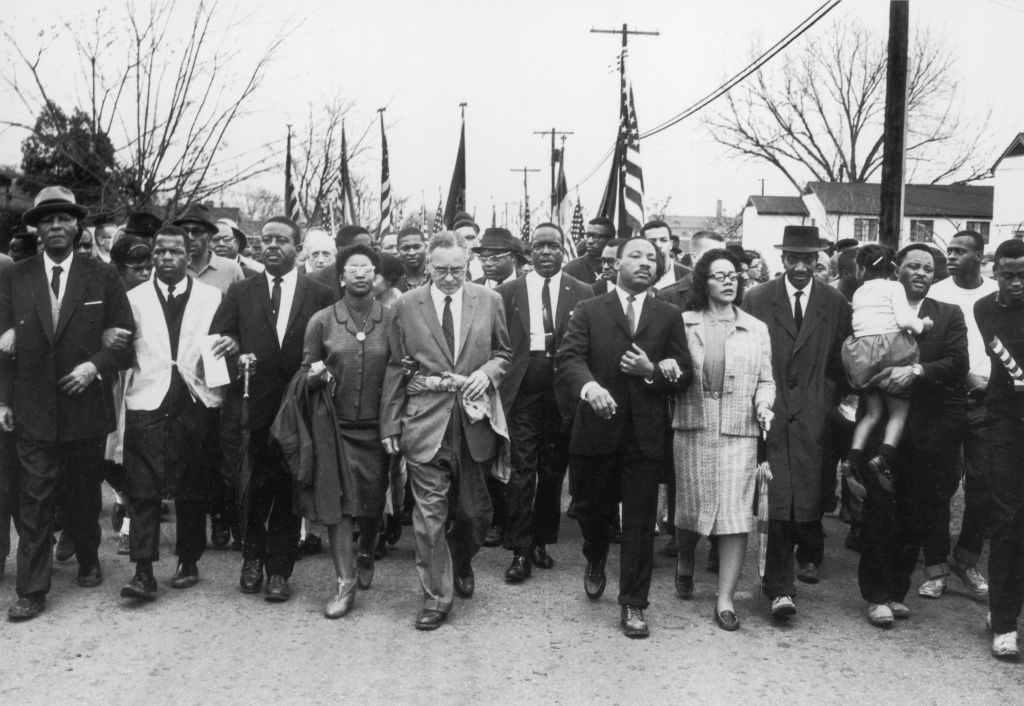
Rep. John Lewis, D-Ga., a civil rights icon who has longstanding relationships with Jewish organizations, said younger Jews should draw inspiration from the alliances of the civil rights generation.

“We are all in the same boat,” said Lewis, who spoke at a General Assembly gathering at the new National Museum of African American History and Culture. “They burned synagogues and black churches because they are a symbol of those who march for justice.”

For Lindsey Mintz, the director of the Jewish Community Relations Council in Indianapolis who is piloting a program building alliances with African-Americans and Muslims, addressing the proliferation of anti-Semitic vandalism in the wake of the election was impossible to tweak apart from attacks on other communities.

“If this is civil rights 2.0, is the Jewish community going to show up — not just to talk but to listen and march,” she said in an interview at the conference. “That’s the question.”

Condemn or court? Bannon appointment a dilemma for Jewish groups seeking access to Trump Read More »

Chemi Peres wishes Trump ‘the best of luck’

This article originally appeared on “>interview, one of the last interviews he gave before his death, “Shall I say, in a nice way, it’s unbelievable, ignorant.”

In his remarks, Chemi Peres thanked President Barack Obama and former Secretary of State Hillary Clinton for their work and close friendship with his father and support of Israel. “I would like to take this opportunity to acknowledge President Obama’s two terms in office, which were filled with inspiration and support of Israel,” he said to loud applause. “His friendship with my father, the honor bestowed upon Israel when he awarded President Peres the Presidential Medal of Freedom, and his support when my father passed away – show the close bond he shares with Israel and its people. I would also like to thank Secretary Clinton for being a close friend to my father and staunch supporter of Israel.”

Israeli Prime Minister Benjamin Netanyahu also addressed the conference via satellite.

Chemi Peres wishes Trump ‘the best of luck’ Read More »

Ivanka Trump tops Forward 50 list of Jews impacting American life

Ivanka Trump, daughter of the president-elect and an adviser to him, tops the Forward 50, the Daily Forward’s annual list of 50 Jews who have impacted American life.

Joining Trump among the top 5 of The Forward 50 list released Tuesday are Bob Dylan, the iconic singer-songwriter who recently won the Nobel Prize for Literature; Theo Epstein, president of baseball operations for the World Series champion Chicago Cubs; Julia Ioffe, a Jewish journalist targeted with anti-Semitic posts on Twitter apparently by supporters of Donald Trump, and Daveed Diggs, a rapper and “Hamilton” actor.

The list, subtitled “A Year of Curses and Many Blessings,”  covers categories including business, community, culture, food, law, media, politics, religion and sports.

The Forward wrote of Ivanka Trump, who converted to Judaism before marrying husband Jared Kushner, that she “carried none of the baggage of the Trump family.”

“Her style of Trump was less gold leaf and loud ties; more pastels and pencil skirts. While her father was the butt of two decades of jokes among New York City’s elite, Ivanka was on the inside, a buddy to Chelsea Clinton and Wendi Deng … All of which made it hard to believe that Ivanka would stick by her father as his 2016 presidential campaign chose a path of racism, sexism, Islamophobia and anti-Semitism.”

Among the 21 women on the list are Aly Raisman, the gold-medal winning U.S. Olympic gymnast, and Sarah Hurwitz, speechwriter for first lady Michelle Obama. Other selections include hip-hop star Lil Dicky (aka David Burd) and Shmuly Yanklowitz, an Orthodox rabbi and fighter for human rights.

The Forward’s editor, Jane Eisner, acknowledged that the list “went to press hours after Trump’s stunning victory, opening an uncertain chapter in the American Jewish story.

Ivanka Trump tops Forward 50 list of Jews impacting American life Read More »

Ginsburg looking forward to Trump’s naming of a ninth justice

Ruth Bader Ginsburg said she was looking forward to Donald Trump’s naming of a ninth Supreme Court justice.

The associate Supreme Court justice, speaking Monday at the annual Jewish Federations of North America General Assembly, was asked what the immediate impact of a Trump presidency would be.

“The most immediate, a vacancy will be filled,” she said. “Eight is not a good number. Perhaps the court will do some work.”

Her welcoming of a Trump appointment could be seen as a peace offering to the president-elect with whom Ginsburg clashed over the summer, saying he was unfit for office and calling him a “faker” with no consistent polices other than self-regard. She later apologized.

The Republican-led Senate has refused to consider President Barack Obama’s preferred nominee, Merrick Garland, who like Ginsburg and two of the other nine Justices is Jewish, for almost a year – a virtually unprecedented blocking in American history. Republican leaders have said they will not consider any Obama nominee.

Ginsburg, 83, might have retired during the coming presidential term had Hillary Clinton, Trump’s Democratic rival, been elected. That’s less likely now as Trump’s replacement of Antonin Scalia, who died earlier this year, will maintain conservatives’ 5-4 majority, and any replacement of a liberal judge will enhance the majority.

Ginsburg told the JFNA her Jewish upbringing helped inform her sympathies for the oppressed. She joked that her parents “got it right” when they settled on a Conservative shul after trying Reform and Orthodox congregations. She got whoops of applause when she said her granddaughter had visited Israel as part of the Taglit-Birthright program for young Jews.

She also appreciated her popularity among liberals who admire her outspokenness and who have dubbed her “Notorious RBG.”

She said the moniker was a natural one: Like the slain rapper, Notorious BIG, “we’re both born and bred in Brooklyn.”

Did she like seeing Notorious RBG gear, like T-shirts, she was asked?

Yes. “Except the tattoos. I don’t like those.”

Ginsburg looking forward to Trump’s naming of a ninth justice Read More »