fbpx

February 12, 2016

French rabbi, Muslim rapper to release song for murdered Jew

A rabbi and a Muslim rapper announced the release in France of a song against racism that they co-produced ahead of the 10-year anniversary of the anti-Semitic murder of Ilan Halimi.

Coco TKT, a well-known rapper who converted to Islam after spending several years in prison for robbery, collaborated with Rabbi Michel Serfaty of Ris-Orangis north of Paris to perform the clip, which the two intend to release online on Feb. 13 – the date on which Halimi, a cell-phone salesman who was kidnapped and tortured because he was Jewish, was found dying in a field outside the French capital.

“A rabbi who goes to prison to look for a rapper who converted to Islam to sing with him for the sake of coexistence it a pretty crazy undertaking,” Coco TKT told the Le Parisien weekly, which reported on the initiative Friday. “But I think he was right: Rap can be the vehicle through which young people can be reached in France.

“Ilan Halimi is the proof that one must must act to fight against anti-Semitism and all that separates the people and communities,” said Coco TKT, whose real name is Julien Cocoa. According to the weekly, he was released last year from prison.

“Rap is used to disseminate many negative messages, but it can also become a tool to reach young people,” said Serfaty. The 72-year-old rabbi and the 30-year-old rapper have collaborated in the past, and are both members of a non-profit Association for Friendship between Muslims and Jews in France, or AJMF.

Separately, the Haverim Jewish organization held a ceremony commemorating Halimi, 26 at the time of his death, on Thursday in a public garden named after him in Paris’ 12th district. Several hundred people attended the event.

French rabbi, Muslim rapper to release song for murdered Jew Read More »

American Jewish leaders meet with Egyptian president

Leaders of the American Jewish community met with Egyptian President Abdel Fattah al-Sisi in Cairo.

During the two-hour meeting Thursday, the delegation from the Conference of Presidents of Major American Jewish Organizations discussed regional issues and U.S.-Egyptian relations, including terror threats, moving forward after the agreement on Iran’s nuclear program and Israeli relations with Egypt, according to a press release.

A statement from the group called the meeting “an open and very productive discussion.”

“We came away with a greater understanding of the challenges and opportunities and how we can play a constructive role in addressing them and fostering international cooperation,” the statement said.

The delegation met Tuesday with Turkish President Recep Tayyip Erdogan, and will arrive in Israel for a four-day summit beginning Sunday.

American Jewish leaders meet with Egyptian president Read More »

Rosner’s Torah-Talk: Parashat Terumah with Rabbi Carl Perkins

Our guest this week is Rabbi Carl Perkins, spiritual leader of Temple Aliyah in Needham, MA since 1991. Rabbi Perkins earned his A.B., summa cum laude, at Haverford College. Before pursuing the rabbinate, he earned his J.D., cum laude, at Harvard Law School, and practiced law for several years in Boston. Rabbi Perkins was awarded a Wexner Fellowship to pursue rabbinical studies at the Jewish Theological Seminary of America in New York, where he was ordained and awarded a Master’s degree in Talmud and Rabbinics. In 2003, Rabbi Perkins received the CJP Rabbinic Award at the General Assembly of the United Jewish Communities in Jerusalem. Subsequently, he participated in a three-year program of study at the Shalom Hartman Institute, at the conclusion of which he was named a Senior Rabbinic Fellow at the Institute. Rabbi Perkins  has served on the Keruv and Publications committees of the Rabbinical Assembly, and on the Boards of Trustees of the Leventhal-Sidman Jewish Community Center, the Solomon Schechter Day School of Greater Boston,  and Mayyim Hayyim Living Waters Community Mikveh and Education Center. He is a past president of the Needham Clergy Association and a past vice president of the New England Rabbinical Assembly, and is currently a member of the board of the JCRC.

This week's Torah portion – Parashat Terumah (Exodus 25:1-27:19) – is largely dedicated to the detailed instructions for the building of the holy Tabernacle and the Ark of the Covenant. Our discussion focuses on the somewhat confusing idea of the divine command to be voluntary generous.

Our past discussion of Terumah:

Rabbi Jason Miller on the character of Bezalel, the chief artisan of the Tabernacle

Rabbi Michael Boyden on the need to build the Tent of Meeting

Rosner’s Torah-Talk: Parashat Terumah with Rabbi Carl Perkins Read More »

Jordan’s king: Solving Israeli-Palestinian conflict necessary to defeat ISIS

The Islamic State cannot be defeated until the Israeli-Palestinian conflict is resolved, Jordan’s king said.

Speaking Friday at the Munich Security Conference, an international gathering of foreign and defense policy leaders held in Germany, King Abdullah II said, “Left unresolved, the Palestinian-Israeli conflict will become a religious conflict of a global dimension,” according to the Times of Israel.

Abdullah noted that the “festering injustice” of the unresolved conflict “continues to be exploited by [ISIS] and its kind.

“Left unresolved, the Palestinian-Israeli conflict will become a religious conflict of a global dimension. And it is only a matter of time before we may be faced by yet another war in Gaza or in south Lebanon,” he said. “This is why reaching a two-state solution should remain a priority for us all.”

Abdullah also called for “a new level of global action” focused on defeating ISIS.

“We, as Arabs and Muslims, have a responsibility and duty to be in the lead in the fight against the Khawarej, or outlaws of Islam. This is a war to protect our religion, our values and the future of our people,” he said, “but it must be global in partnership, just as it is global in scope.”

Jordan’s king: Solving Israeli-Palestinian conflict necessary to defeat ISIS Read More »

Bernie Sanders support for Chabad menorah lightings revealed

Bernie Sanders, who is Jewish, supported Chabad public menorah lightings, according to documents released by Chabad.org.

The U.S. Senator and current democratic presidential candidate fought for the Chabad Lubavitch movement’s right to publicly display menorahs while serving as mayor of Burlington, Vermont from 1981-1989, according to the documents, titled, “Some more info on Bernie Sanders and Judaism.”

According to the post, Sanders interest in defending freedom of religious expression more so than a connection to Judaism is what led him to direct his mayoral administration to defend the pubic lightings in court against those who saw the lightings as an infringement of the separation between church and state.

His support for the lightings pitted him against groups that were otherwise allies of his such as the American Civil Liberties Union, the article states.

Additionally, he inaugurated the Chabad-Lubavitch public menorah at Burlington’s City Hall and recited blessings and lit the candles at the first-ever lighting in Burlington.

And he was an admirer of the rebbe, Rabbi Menachem Mendel Schneerson, according to Richard Sugarman, who is quoted on Chabad.org.

His support for the lightings had far reaching consequences, the article states.

“The early and strong support from the Sanders administration played a significant role in the now widespread phenomenon of public Chanukah menorah celebrations countrywide,” according to Chabad.org.

FOR THE RECORD 2/16/2016: This story was amended to reflect that the information cited here comes from documents released by Chabad.org regarding Sanders, and that the candidate's admiration of the rebbe comes from Richard Sugarman, as quoted on Chabad.org.

Bernie Sanders support for Chabad menorah lightings revealed Read More »

“Spotlight” and the heroic editor of The Boston Globe

“Marty belongs in the pantheon of great Jewish heroes,” Josh Singer, a co-writer of the Oscar-nominated film “Spotlight,” said during a recent interview at a Santa Monica coffee house.

He was discussing the real-life newsman at the center of the much-lauded film about how Boston Globe reporters exposed a conspiracy of silence about pedophile priests some 15 years ago.  Martin Baron, then the Globe’s brand-new editor, seems rather stiff and hardly heroic as he attends a meeting with the newspaper’s investigative team on his first day of work in 2001.

To be sure, it’s not the most welcoming environment for this former editor of the Miami Herald.  Boston’s media had already pointedly noted that Baron – who in real life is now executive editor of the Washington Post – was to become the first Jewish editor at a publication whose readers were 53 percent Catholic, while Baron’s reporters on the Globe’s investigative team all were raised Catholic.  And one character remarks that not only was the new editor coming from Florida, he was also an “unmarried man from the Jewish faith who hates baseball” in a town obsessed with the Red Sox.  Later in the film, a church leader insinuates that Baron is a meddling outsider as he gives the editor a copy of the church’s Catechism, advising him to “think of it as the Cardinal’s guide to Boston.”

Unabashed, the reserved but intense Baron (played by Liev Schreiber) tells his reporters he wants them to look into the highest echelons of the church, because he’s noted a news item about a priest accused of child abuse. He wants to see if there’s more to the story.

The movie unfurls as a tense procedural drama about how Baron and his investigative reporters, members of a unit known as “Spotlight,” meticulously research and ultimately publish a Pulitzer Prize-winning series unearthing story after story of how church leaders protected priests accused of child abuse at the expense of the accusers’ families, shuffling the abusive priests, some repeat offenders, from parish to parish while clandestinely settling cases through payoffs to victims.

Throughout the investigation, Baron remains unperturbed by threats from community leaders, refusing to back down as he pushes his reporters to confront church officials – initially by going to court to force the diocese to turn over incriminating sealed documents.  “You want to sue the church?” one character incredulously remarks in the film.  That sort of thing just hadn’t been done before in Boston.  And Baron makes it clear that he doesn’t just want more stories about pedophile priests; he wants evidence of church cover-ups of abuse. 

“We’re going after the system,” Schreiber says in the film.  Baron’s attitude stands in stark contrast to that of previous Globe editors, who had put out “a vibe from the top down of ‘no more priests; we’re done with that,’” Singer said. 

The film has received laudatory reviews and been favorably compared to the iconic Watergate journalism film “All the King’s Men.” It has also received six Academy Award nominations, including for best picture and best original screenplay, for Singer and Tom McCarthy, the latter of whom is also the movie’s director.

Singer, who grew up in a Conservative Jewish home near Philadelphia, said he was drawn to the project, in part, because, “when you’re raised Jewish, there’s something in our Bible stories that’s all about raising one’s hand up against the status quo.  It’s Abraham having the temerity to break all of those idols in a land where everyone is worshipping them. Or David, a guy with a slingshot, standing up to a giant and knocking him down.”

Pretty lofty comparisons for the likes of a journalist. Yet, he continues, “Marty is a guy who went into a town where he was a total outsider, as a Jew in a pretty Catholic city, and where the Boston Globe was a Yankee Catholic institution.  To go in there and say, we’re going to take on the church, on his very first day – that took a lot of bravery and chutzpah.”

Singer, who is in his 40s, has a Jewish father; his mother, born to a Jewish father and a Catholic mother, converted to Judaism before he was born. Singer grew up singing in his synagogue’s choir; he went on to graduate magna cum laude from Yale and to earn both a law degree and a master’s degree in business from Harvard before trying his hand at screenwriting.

He wrote a spec script on the Israeli-Palestinian conflict that earned him a place in the writers’ room on TV’s “The West Wing” in the early 2000s; another script exploring why a “nice Jewish boy” like George Gershwin would write the great African-American opera “Porgy and Bess” landed him the job penning the 2013 WikiLeaks drama, “The Fifth Estate.”

A desire to delve more deeply into how investigative journalists work spurred Singer to sign on to “Spotlight” when director McCarthy came calling in 2012.  “It was clear that we were going to tell the story through the eyes of the journalists,” he said.  “We felt like there was a good detective story there.”

The screenwriters’ research process was often akin to investigating the investigators; they spent hours speaking with almost every character in the film.

Valuable insight about church culture came courtesy of Richard Sipe, a former priest who had spent decades studying the psychology of pedophile clergy.   It is believed that about half of priests violate their vows of celibacy at some time, Sipe told the screenwriters, so a culture of secrecy prevails within the priesthood that can lead to tolerating and even protecting abusers.

“These priests are predators, so they look for kids from troubled homes who aren’t likely to complain,” Singer said.  “One survivor‘s father had just committed suicide, and his mother was schizophrenic.  And they’re all from pretty poor families where the church is held in high regard.”

The screenwriters met with victims of egregious abuse — among them Phil Saviano, founder of the Survivors Network of those Abused by Priests (SNAP); Saviano described how his parish priest began telling him dirty jokes and showing him pornography at age 11, “until one day he asks you to give him a blow job – and how do you say no to God?” His character says these words in the film.

Spotlight reporter Sacha Pfeiffer recounted how she urged another victim to eschew the word, “molest” in favor of explicit descriptions of his abuse.  “We also wanted to be very specific with our language and terminology,” Singer said of the script – even though the screenwriters avoided flashbacks to scenes of abuse as too sensationalistic.

Singer insists that “Spotlight” does not take issue with the Catholic religion, but rather the institution of the church.  The movie, as well, explores “the wrestling of how one maintains faith in the face of something like this” – especially for Sipe and the Spotlight team’s lapsed Catholic reporters.

Even so, the Jewish screenwriter said he would have had trepidations about exposing abuse within another religious institution had McCarthy not been raised devoutly Catholic.

So far, the church has responded mostly positively to the film, which screened recently for the Vatican’s sexual abuse commission, Singer said.  “But a lot of public statements from the church have been trying to make sure that this is perceived as something in the past,” he added.  “However, the abuse is still going on and they haven’t done enough.  They still need to push for greater transparency and accountability not only for the priests who abuse these kids, but also the prelates who have turned a blind eye in the past.  The Pope announced that he was bringing a tribunal to hold bishops and others accountable, but he’s not announced who’s on the tribunal, what the punishments will be and how the tribunal will work.”

The film also not so subtly makes a case for the need for more investigative journalism at a time when newspapers are slashing budgets or folding.  “The bottom line is that we’ve had more than a dozen metropolitan dailies go out of business in the United States with tens of thousands of employees losing their jobs,” Singer said.

“At the Los Angeles Times, we used to have 19 people covering the state legislature, and now there are four.  I don’t know how you can pick up on graft and corruption with four reporters versus 19, so I think this is a real problem.  When we don’t have enough reporters on the ground, that’s when people get hurt.”

“Spotlight” and the heroic editor of The Boston Globe Read More »

Clinton, Sanders clash over Obama as they vie for minority votes

Democratic presidential candidates Hillary Clinton and Bernie Sanders clashed sharply in a debate on Thursday over their support for President Barack Obama, with Sanders accusing Clinton of “a low blow” after she compared him to Republicans.

As the Democratic race moves to states with large minority populations, both candidates openly courted black and Hispanic votes during a debate that was far more restrained and cordial than last week's contentious debate in New Hampshire.

In the sharpest exchange of the night, Clinton attacked Sanders for being too critical of Obama, who is extremely popular with the black voters who will play a big role in the outcome in South Carolina and other upcoming nominating contests.

“The kind of criticism that we've heard from Senator Sanders about our president, I expect from Republicans, I do not expect from someone running for the Democratic nomination to succeed President Obama,” said Clinton, who served as secretary of state during Obama's first term.

“Madam Secretary, that is a low blow,” said Sanders, a U.S. senator from Vermont. Sanders said he had been an Obama ally in the Senate even if he did not always agree with him.

“Do senators have the right to disagree with the president?” Sanders said.

Clinton, who has eagerly embraced Obama's legacy, said Sanders had called Obama weak and a disappointment, and “that goes further than saying we have our disagreements.”

With Clinton looking to rebound after her crushing 22-point loss to Sanders in the New Hampshire primary on Tuesday, the two also differed over healthcare and Wall Street.

Even so, the restrained exchange on Thursday was unlikely to change the trajectory of a race that has intensified dramatically over two weeks.

Clinton accused Sanders of misleading Americans on his healthcare. She said his proposal for a single-payer, Medicare-for-all healthcare plan would mean dismantling the program known as Obamacare and triggering another intense political struggle.

“Based on every analysis I can find by people who are sympathetic to the goal, the numbers don't add up,” Clinton told Sanders. “That's a promise that cannot be kept.”

Sanders said he was simply moving to provide what most industrialized countries have – healthcare coverage for all.

“We're not going to dismantle anything,” Sanders said. “In my view healthcare is a right of all people, not a privilege, and I will fight for that.”

Sanders also repeated his accusation that Clinton is too beholden to the Wall Street interests she once represented as a U.S. senator from New York, noting her Super PAC received $15 million in donations from Wall Street.

“Let's not insult the intelligence of the American people,” he said. “Why in God's name does Wall Street make huge campaign contributions? I guess just for the fun of it, they want to throw money around.”

Clinton said the donations did not mean she was in Wall Street's pocket, and noted that President Barack Obama had taken donations from Wall Street during his campaigns.

“When it mattered, he stood up and took on Wall Street,” she said.

THE JUDICIAL SYSTEM AND RACE

With an eye to on the minority vote, both candidates decried the high incarceration rate of African-Americans and called for broad reforms of the criminal justice system. Sanders said the disproportionately high rate of incarceration for black men was “one of the great tragedies” in the United States.

He called for “fundamental police reform” that would “make it clear that any police officer who breaks the law will in fact be dealt with.”

Clinton criticized what she called “systemic racism” in education, housing and employment. “When we talk about criminal justice reform  we also have to talk about jobs, education, housing and other ways of helping communities of color,” she said.

They both agreed on the need for immigration reform, an important issue to Hispanic voters, though they clashed over the Obama administration's actions on handling a wave of undocumented children who entered the country alone. Clinton criticized Sanders for voting against a reform measure in 2007, which Sanders defended because of a provision in the bill for guest workers.

Clinton entered Thursday's debate under acute pressure to calm growing nervousness among her supporters after her drubbing in New Hampshire and a razor-thin win the prior week in the Iowa caucus. Both states have nearly all-white populations.

For his part, Sanders, who calls himself a democratic socialist, hoped to harness the momentum and enthusiasm he gained from the first two contests and prove he can be a viable contender to lead the Democratic Party to victory in the Nov. 8 presidential election.

“What our campaign is indicating is that the American people are tired of establishment politics,”Sanders said. “They want a political revolution.”

Clinton dodged an opportunity to distance herself from former Secretary of State Madeleine Albright's recent controversial comments that there was “a special place in hell” for women who don't support other women.

“Look, I think that she's been saying that for as long as I've known her, which is about 25 years. But it doesn't change my view that we need to empower everyone, women and men, to make the best decisions in their minds that they can make,” she said.

On the foreign policy front, Sanders criticized Clinton for her warm relationship for Henry Kissinger, who served as secretary of state under Republican President Richard Nixon during the Vietnam War. Sanders called Kissinger “one of the most destructive secretaries of state.”

Asked by Clinton about who his foreign policy advisers were, Sanders shot back: “Well it ain't Henry Kissinger.”

The race now moves to what should be more favorable ground for Clinton in Nevada and South Carolina, states with more black and Hispanic voters, who, polls show, have been more supportive of Clinton so far.

Clinton, Sanders clash over Obama as they vie for minority votes Read More »

At Utah’s on-slope Shabbat service, ski boots required

It may be the most elevated Shabbat service in the country, and not just because of the spirited singing.

Held in a rustic cabin in the woods off a ski slope at Deer Valley resort, the service is situated at about 8,800 feet above sea level, and it’s the nation’s — and possibly the world’s — only ski-in, ski-out Kabbalat Shabbat minyan.

There’s no way to get there by car or foot; worshipers must buy a lift ticket to Deer Valley ($120), make their way over to the four-person Sterling Express chairlift, ride to the top of Bald Mountain (elev. 9,400) and then ski down to Sunset Cabin. Beginners beware: The steep trail leading to the cabin is designated intermediate blue.

There are a few other important things to know about what’s billed locally as “Ski Schule at Deer Valley.” It’s actually held before the Sabbath, at 3 p.m. on Friday afternoons. Come on time, because the service starts promptly and lasts about 35 minutes; the lifts close at 4 p.m. Dress is definitely casual: Attendees come clad head-to-toe in ski gear, and there’s a custom of clomping around in ski boots during the V’Shamru prayer.

And don’t worry: There will be Kiddush, though it’s a sweet Concord. If you’re hoping for whiskey, you’ll have to wait till après-ski down in the valley. It’s better that way anyway: Skiing while drunk is not recommended.

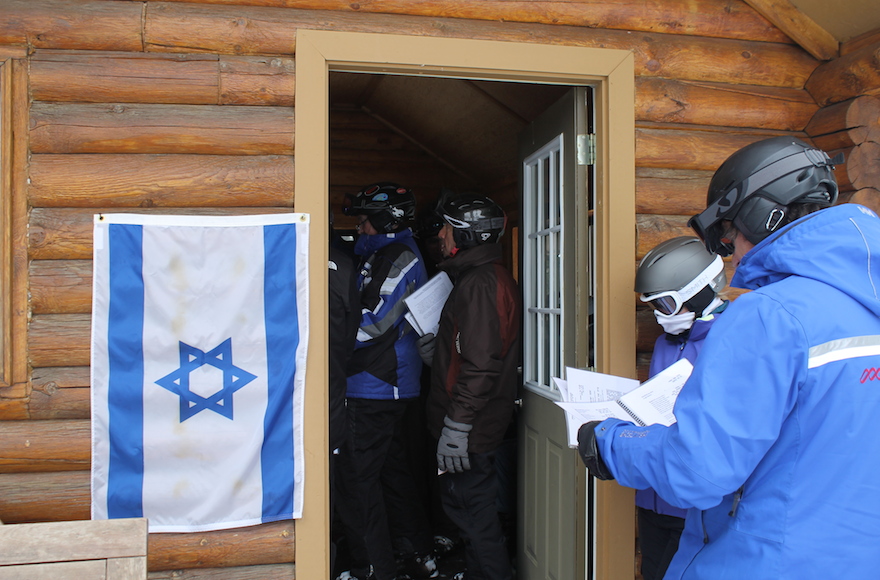
The ski shul is a longstanding tradition at Deer Valley, which is famous for its beautifully groomed runs, snowboard ban (one of only three such ski resorts in the United States) and pampered customer service. There is complimentary overnight ski storage, designated staffers to help visitors load their cars at day’s end and pillow-soft tissues at all 21 lifts. And though the resort is spread across five peaks and has 2,000 acres of skiable terrain, Deer Valley has ubiquitous green-uniformed mountain hosts on hand who can help direct you to the ski shul. Once you’re on the right trail, the cabin is easy to spot: There’s an Israeli flag tacked to the log cabin’s slope-facing wall.

Most of the service’s participants tend to be visitors, not regulars. Some are Deer Valley fans who come back year and a year (a few to vacation homes they own on the mountain), but many others are first-time visitors who learn about the worship service from notices posted around the mountain.

“Quite a few years ago I saw a sign on the bulletin board at the chair lift about the service. Being interested in Jewish life, I of course dragged my family and thought it was fantastic,” said Diane Krieger, a Miami resident who has been coming since the early 2000s, before she bought a vacation home in town. “I find it incredibly uplifting that Jews will choose, even at 8,000 feet, to gather together.”

The service is led by Rabbi David Levinsky, spiritual leader at Park City’s Temple Har Shalom. A relative newcomer to Utah (Levinsky moved here last summer), the rabbi needed some serious practice before taking over the service – making turns in the snow, that is, not reciting the prayers. Levinsky, 48, describes the lessons he took as a “crash course” in skiing – literally.

An Israeli flag is posted at Deer Valley's Sunset Cabin every Friday afternoon to alert skiers to the weekly Kabbalat Shabbat service. (Uriel Heilman)An Israeli flag is posted at Deer Valley’s Sunset Cabin every Friday afternoon to alert skiers to the weekly Kabbalat Shabbat service. 

“I had never skied till I came out here,” said Levinsky, whose favored sport is skateboarding. “I’m a Jewish kid from the suburbs. I wasn’t a big outdoors mountain guy.”

But seven months into his new job, Levinsky — who used to make a living as a rock musician, before getting Reform rabbinical ordination and then a doctorate in religion from Stanford University — says he has started to change. He skis two days a week now (usually for a couple of hours at a time, as many who live here do), and takes long walks with his dog in the foothills of the Wasatch mountain range.

For a rabbi in Park City, (elev. 7,000 feet), mountain activity is practically required.

“One of the goals of Har Shalom is to find interesting ways to blend mountain living with Judaism, and ski shul is one of the ways to do it,” Levinsky said. “The temple is nestled in the foothills of the Wasatch range. Sometimes we take our Judaism up the mountain.”

The Friday afternoon minyan at Sunset Cabin is, for the most part, like many liberal Kabbalat Shabbat services. It’s participatory, held in the round (or the scrum, when it’s crowded), and worshipers use customized laminated prayer booklets. The rabbi’s d’var Torah sermon usually runs about two to three minutes.

The rabbi who leads the weekly Jewish prayer service at Deer Valley ski resort sometimes alters the traditional prayer for rain to a prayer for snow. (Uriel Heilman)The rabbi who leads the weekly Jewish prayer service at Deer Valley ski resort sometimes alters the traditional prayer for rain to a prayer for snow.

On a recent Friday, the rabbi altered the traditional line in the Amidah prayer for “wind and rain” to a petition for “wind and snow.” At the conclusion of the service, which drew about 30 people, skiers wished each other “Shabbat Shalom” and headed back outside, into what suddenly had turned into a serious snowstorm (prayer answered).

Levinsky was in a rush – it was the closing weekend of Park City’s Sundance Film Festival, and the service was the first of three he would be leading that day – but most of the worshipers took their time pulling on their goggles and strapping on their skis.

One woman stepped off the cabin’s wooden platform and immediately sank into snow up to her calf — a reminder that in Utah the snow tends to fall in feet, not inches.

A moment later she had her skis on and was ready to go. “Shabbat shalom!” she called out, and disappeared down the mountain.

At Utah’s on-slope Shabbat service, ski boots required Read More »

White House says it does not support ‘territories’ component of anti-BDS legislation

The Obama administration said it does not support the portion of a new trade law that requires actions against entities that boycott goods manufactured in the West Bank.

“As with any bipartisan compromise legislation, there are provisions in this bill that we do not support, including a provision that contravenes longstanding U.S. policy towards Israel and the occupied territories, including with regard to Israeli settlement activity,” the White House said in a statement Thursday.

The United States does not recognize the West Bank as belonging to Israel.

The Trade Facilitation and Trade Enforcement Act, aimed at removing unfair barriers to competitive U.S. trade, is otherwise acceptable in its current form, the White House said, and the president will sign it. Versions of the bill were passed last year by both chambers, the U.S. House of Representatives passed a reconciled version in December and on Thursday the Senate passed it as well.

The bill, in a lengthy section on promoting U.S. Israel trade, requires non-cooperation with entities that participate in the boycott, divestment and sanctions (BDS) movement against Israel, and reporting on such entities. The section includes within its definition of an Israel boycott actions that would target businesses in “Israeli-controlled territories.”

The American Israel Public Affairs Committee in a statement praised the bipartisan slate of lawmakers who advanced the anti-BDS provision, although the statement did not specify inclusion of the problematic “Israeli-controlled territories” language.

“The provision puts the U.S. firmly on record opposing BDS (boycott, divestment and sanctions) and supporting enhanced commercial ties between the United States and Israel,” it said. “It further establishes new requirements for administration reporting on an array of global BDS activities, including the participation of foreign companies in political boycotts of Israel. The provision also provides important legal protections for American companies operating in Israel.”

Dovish pro-Israel groups, including J Street and Americans for Peace Now, had advocated for the removal of he “Israeli-controlled territories” language.

The European Union, over strenuous Israeli objections, last year adopted a policy requiring the labeling of goods manufactured in Israeli settlements, a practice that would facilitate the targeting of settlement businesses. The Obama administration last summer said it would not object to the policy.

U.S. policy since the 1990s has also required distinct labeling of products manufactured in the West Bank; however, unlike the E.U. regulations, the rule applies not only to settlements, but to goods manufactured throughout the territory, including by Palestinians. Additionally, the George W. Bush administration on at least two occasions issued orders overriding the requirement, allowing goods manufactured in the West Bank to be labeled as made in Israel.

Separately, a bipartisan slate of lawmakers on Thursday introduced legislation that would make it easier for state legislatures choosing to target BDS, authorizing the divestment of state monies from entities engaged in BDS.

The bill, sponsored by Sens. Mark Kirk, R-Ill., and Joe Manchin, D-W.V. in the Senate and Reps. Robert Dold, R-Ill, and Juan Vargas D-Calif., in the House, follows the passage recently of a bill in Illinois targeting BDS. “This bipartisan bill would authorize state and local governments in the United States to follow Illinois’s lead and divest from companies engaged in boycotts and other forms of economic warfare against Israel,” Kirk said in a statement.

The Illinois law specifies protections for companies operating in territories controlled by Israel, as do a number of other proposed bills circulating in legislatures throughout the country. A number of proposed state-level anti-BDS bills do not specify the territories.

Separately, Rep. Ileana Ros-Lehtinen, R-Fla., and Sen. Ted Cruz, R-Texas, on Thursday introduced legislation that would shut down the Palestine Liberation Organization office in Washington until the Palestinian Authority has been proven to end incitement against Israelis, stops paying subsidies to the families of terrorists who are in jail or who have been killed, ends its bid to obtain statehood recognition in international forums outside the framework of negotiations with Israel and pulls out of the International Criminal Court, which is investigating war crimes charges against Israeli officials. Cruz is among the front-runners for the Republican presidential nomination.

The PLO has maintained an office in Washington since 1994, following the launch of the Oslo peace process.

White House says it does not support ‘territories’ component of anti-BDS legislation Read More »

Free Robert Levinson, Senate appeals to Iran in unanimous vote

The U.S. Senate unanimously approved a resolution urging Iran to fulfill its pledge to help find Robert Levinson, a Jewish American who went missing in Iran in 2007.

Five Americans were released last month in a prisoner exchange with Iran timed to mark the launch of the implementation of the sanctions relief for nuclear rollback deal between Iran and six major powers. The Iranians said they would assist in tracking down Levinson; the Obama administration believes he is no longer in Iran.

The non-binding resolution approved Thursday, sponsored by Sens. Bill Nelson and Marco Rubio, respectively a Democrat and a Republican from Levinson’s home state of Florida, “notes the pledges by current Iranian officials to provide their government’s assistance in the Robert Levinson case” and “urges Iran, as a humanitarian gesture, to intensify its cooperation in the Robert Levinson case and to share the results of its investigation into his disappearance with the U.S. government.”

Levinson, 68, of Coral Springs, Florida, a private detective and a former FBI agent, has been missing since disappearing from Iran’s Kish Island during what has since been revealed as a rogue CIA operation.

Rep. Ted Deutch, D-Fla., who represents Levinson’s southern Florida district, is advancing a similar motion in the U.S. House of Representatives. It was approved this week by the House’s Middle East subcommittee.

Free Robert Levinson, Senate appeals to Iran in unanimous vote Read More »