fbpx

February 11, 2016

A tale of two cousins – The Natzlers

The artists, Otto & Gertrude Natzler, were the husband and wife team whose fabulous pottery designs made them famous throughout the 1940s, '50s and '60s. And now their creations are selling for thousands of dollars. One vase of theirs actually sold for nearly $94,000 at an auction in 2011.

Although they became famous in Southern California, first they had to get out of Nazi occupied Austria.

Meanwhile Otto's relatives were playing an important role in my childhood.

But let me start at the beginning.

A few years ago, while watching a particular episode of “The Antique Road Show”, one guest brought some pottery by the Natzlers to be evaluated. And that caught my attention since NATZLER was a name I grew up with.

Dr. Adolf Natzler and his wife, Hedwig, had been very dear friends of my parents ever since they all arrived together in Los Angeles in 1933, as German/Jewish refugees.  Adolph had been a renowned orthopedic surgeon in Germany.

Hedwig & Dr. Adolph Natzler. Photo courtesy P. Vanlaw

But we lost track of them by the time I was ten or eleven.

So, hearing the Natzler name again after so many years, piqued my curiosity. Suddenly I needed to find out if Otto and Adolph were actually related.

A simple search for the surname “Natzler” on the internet linked me to a woman who found that Adolf and Hedwig's daughter, Marlies, was still alive and living in a retirement community an hour's drive away.

Marlies Natzler. Photo courtesy of P. Vanlaw  

I hadn't seen Marlies in over 60 years. So we spent a lot of time catching up. I was able to videotape part of our meeting, which provided much vital information about her family:

Marlies's father, Adolph, was actually Otto's first cousin, although he was 26 years older. They were the sons of two Natzler brothers, Alois and Siegmund, both part of a large enclave of Viennese Natzlers.

But Adolf's family moved to Bavaria when he was still a small child. So, he grew up there and went to medical school in Munich.

As a student, he received a facial scar, which fascinated me as a very young boy. Marlies told me the humorous side of it.

Known as a “Heidelberg Scar”, it was a wound, purposely inflicted during the sport of fencing. Because it was considered a mark of the aristocracy, it was sought after by many students

But Adolf studied in Munich, not Heidelberg. Nevertheless, by acquiring a “Heidelberg Scar” he could prove that, although a Jew, he was from a fighting fraternity. But unfortunately his had been inflicted by a left-handed swordsman. And much to his chagrin, the scar was on the wrong side of his face.

Ironically, he was later assigned to a military hospital in Heidelberg, after becoming a physician in the German Army during WWI, 

Adolph also met his wife, Hedwig, in Heidelberg. She was a Protestant, and a private nurse at the time. Their only child was daughter Marlies, who was born in Heidelberg during the war.

After hostilities ended, the Natzlers moved to Mulheim, where Adolph became a physician in a Catholic hospital. But shortly after Hitler came to power, he learned that the Gestapo wanted him – A frightening prospect since the Natzlers had recently lost a dear friend who'd been murdered by the Gestapo.*

But the hospital nuns took action and hid him and his family within the sprawling hospital facility, allowing Adolf to safely complete his orthopedic schedule before fleeing the country.

However, cousin Otto didn't get out of Vienna until after the “Anschluss” in 1938, when he and his wife, Trude, fled to America.

As a child Otto loved music and studied the violin. But his father wouldn't allow him to become a professional, demanding that he find a profession with SUBSTANCE. So, Otto chose to study chemistry, and the rest is history.

Otto had two older siblings: Paul, born in 1901 and Nellie, who was born sometime in between the two brothers.

Nellie became the true heroine of this saga because of the role she played in getting her entire family to America.

As a very talented artist, she won a $5,000 prize in a Paris art show. But she was prescient enough to send the money to her cousin, Adolf in America, insisting that its sole purpose was to remain in the bank as required proof of financial independence.

That would ultimately allow each member of her family into the U.S.

With cousin Adolph as their sponsor, Otto and Trude were the first to use it to get out of Austria.

Then Otto became the sponsor, using it to get his older brother Paul and wife Cora out.

Finally Paul became the sponsor, and, in turn, used the money to get their parents, Siegmund and Frieda, and ultimately sister Nellie out of Austria.

All arriving safely in America, the elder Natzler lived out the remainder of their lives in Trenton, N.J….on that SAME $5,000.

Meanwhile, Adolph and Otto and their families all settled in Southern California.

Although I had hoped to meet Otto after I found Marlies, he was already 96, and passed away before I could do so. But Marlies and I continued to stay in touch until I got the sad news that she had passed away in October 2012…also at the age of 96.

*For more information on this astounding story read my blog “Conrad Veidt and the Natzlers”- http://forthelifeofme-film.com/2013/11/12/conrad-veidt-natzlers/.

A tale of two cousins – The Natzlers Read More »

“A Moment in Time”

I recently was treated to one of the most beautiful sunsets I had ever seen. I thanked God for nature. I thanked the Nikon company for the camera.

As the sun sank lower, I thought of the limits of time. We have opportunities to capture moments, to engage in conversations, to harness goodness, to do acts of kindness … to make a difference.

But the time is limited. What can we do to mark a difference in our moment in time – before the sun sets?

Let's therefore engage in purposeful acts of goodness, each day, each moment.

“A Moment in Time” Read More »

I’m not your mitzvah project

I have Tourette syndrome, a neurological disorder characterized by involuntary movements and noises called “tics.” My Tourette’s is relatively mild at this point, but I went through a turbulent adolescence when Tourette’s was the most defining thing about me. Between the constant movements and the loud, uncontrollable noises, it was incredibly disruptive.

I now work in the Jewish community as an inclusion advocate, as well as in youth engagement. So I have this cool opportunity to see the Jewish community both as someone with a disability and as one who is supporting congregations and communities in creating more inclusive spaces for all people.

Sometimes I hear people talking about how much of a “mitzvah” they are doing by opening their doors to people with special needs in their community. Maybe they allowed a child with autism in their youth group or religious school, or hosted an “inclusion” service.

But here is the thing: It is not a mitzvah to let me in the door. It’s not. Opening your door to those with disabilities is not enough. Because there is a critical difference between tolerance and full inclusion. If we are practicing full inclusion, our communities should be celebrating each person and what they bring to the community, not just what theydemand of it.

Many times throughout my life, I have felt like I was the mitzvah project of the week, like the community didn’t really want me there, but knew including me was what they were supposed to do. I always felt like we were one step away from my face being on the community bulletin with a story reading something like “We did it! We included somebody with special needs! Be proud everyone. Be real proud.”  OK, maybe that’s a bit of an exaggeration. But feeling like my presence was another’s mitzvah made me feel even more like an outsider.

People keep telling me their community is really working on their “tolerance” of those of us with special needs. I tolerate the weather in the winter. I tolerate the neighbor who is learning the drums. I tolerate going to the dentist. But none of these are things I like; they are things I know I have to deal with. But every person — whatever their unique gifts, whatever their limitations — has value, and no one wants just to be tolerated.

It is so important that we are aware of those who feel on the outside (disability or otherwise), and are putting programs and services in place to ensure that everyone has the opportunity to feel engaged and valued. It means doing things like tailoring the b’nai mitzvah experience to cater to children of varying needs, and instilling in the community a mindset that being inclusive is everyone’s role, not just those who have it in their job description. It’s using preferred gender pronouns and celebrating families of all shapes and sizes. It’s making sure we are constantly reevaluating our communal offerings, so we never become complacent.

Let’s think about how we talk about inclusion – and make sure we are never “othering” anybody, be they people with disabilities or their families. Getting in the practice of “yes and-ing” as much as possible is a great way to start. That is, saying that yes, we want you and your family to be part of this community, and we want to partner with you to make sure that not only are your needs met, but that this is a place where you are cherished and can fully participate. It’s creating partnerships of synagogue leadership, teachers and families, and sometimes stepping outside our comfort zone to try something new.

Because when we have a community that appreciates each person and what that person brings to the table, the entire community benefits. A fully inclusive community is celebrating the unique qualities that everyone brings to that table, creating a safer and stronger community — one of trust where people can be uniquely themselves.

Just opening your door is not a mitzvah; it’s a start. What happens after the welcome is what really matters. It’s the critical difference between being tolerated and being valued — that difference is everything.

Pamela Rae Schuller is a New York City-based inclusion advocate and stand-up comedian, probably because she sees the world from a different point of view: one where eye level is 4-foot-7 and barking without provocation is a completely normal and entertaining part of her day. Learn more about Pamela’s work at StandUpInclusion.com.

I’m not your mitzvah project Read More »

Israeli Airbnb guest refused by British host because of ‘aggressive settlers’

An Israeli man said a British Airbnb host refused to rent an apartment to him because, the host said, Israelis don’t respect “basic human rights.”

Ben Kelmer, a Tel Aviv photographer, reserved a London apartment for a week in March through the online company, which has come under fire recently for listing properties in West Bank settlements. In some cases, the listings indicate that the properties are in Israel proper.

When Kelmer contacted the host with a question about public transportation, the host said he could not “even consider hosting you,” the U.K.’s Jewish News reported.

“This is how the world pictures you: aggressive settlers occupying land, destroying houses. In a few words: not respecting basic human rights,” the message said. “On that basis, I just cannot even consider hosting you, even if you pay me millions.”

Kelmer posted to Airbnb’s Facebook page: “We were served a healthy dose of Grade A, European bigotry and discrimination at its finest, poorly masked as so-called, socially-conscious political protest of the worst, most prejudiced kind, that is strictly reserved to Israelis.”

The company posted a reply saying it would investigate the matter. Another Facebook user commented on Kelmer’s post, saying, “Appalling and sadly, happens too often.”

In December, a 13-year-old Israeli girl received a somewhat similar rebuff from a British citizen. When Shachar Rabinovitch of Zichron Yaakov emailed Marsha Levine, a former academic at the University of Cambridge, with questions for a research project on horses, Levine responded that she supports the Boycott, Divestment and Sanctions movement against Israel.

“You might be a child, but if you are old enough to write to me, you are old enough to learn about Israeli history and how it has impacted on the lives of Palestinian people,” Levine wrote.

Israeli Airbnb guest refused by British host because of ‘aggressive settlers’ Read More »

Robert Kennedy assassin, Sirhan Sirhan, denied parole

Sirhan Sirhan, the assassin of Democratic presidential candidate Robert Kennedy in 1968, was denied parole for the 15th time on Wednesday, a California prison official said.

Sirhan, 71, had a suitability hearing at the Richard J. Donovan Correctional Facility near San Diego, the California Board of Parole Hearings said on its website.

Sirhan will be up again for parole in five years, said Luis Patino, a spokesman for the California Department of Corrections and Rehabilitation.

The Palestinian-born Sirhan is serving a life sentence for gunning down Kennedy, 42, at the Ambassador Hotel in Los Angeles on June 5, 1968. The shooting occurred minutes after the U.S. senator from New York and former U.S. attorney general gave his victory speech after winning the California Democratic primary. Kennedy died the next day.

Sirhan was sentenced to death in 1969. His sentence was commuted to life in prison after California banned the death penalty.

Paul Schrade, a 91-year-old Kennedy confidant and among the five people wounded in the shooting, told the board that Sirhan should be granted parole since evidence showed that a second gunman killed Kennedy.

“The evidence clearly shows you were not the gunman who shot Robert Kennedy,” Schrade said in remarks prepared for the hearing.

Sirhan fired in front of Kennedy but the candidate was struck in the back by three bullets, including a fatal shot to the back of the head, Schrade said.

An analysis of an audio recording shows that 13 shots were fired, but Sirhan's gun held only eight rounds and he had no chance to reload, Schrade said.

Schrade alleged misconduct in the investigation by the Los Angeles Police Department and called for a new probe of Kennedy's killing.

A federal judge last year rejected similar arguments by Sirhan's lawyers, who had sought to have him released, saying he was innocent.

Sirhan has said that he had no recollection of the killing, although he has also said he had fired at Kennedy because he was enraged by his support for Israel.

Sirhan was last denied parole in 2011. He is imprisoned in San Diego.

Kennedy's older brother, President John F. Kennedy, was assassinated in 1963.

Robert Kennedy assassin, Sirhan Sirhan, denied parole Read More »

New citizenship law has Jews worldwide flocking to tiny Portugal city

Five years ago, this city’s tiny Jewish community was so strapped for cash it couldn’t afford to fix the deep cracks in its synagogue’s moldy ceiling.

The Jewish Community of Porto was also too poor to hire a full-time rabbi because of its small size (50 members) and the paucity of donors in a country gripped by a financial crisis.

But last month the community, situation 200 miles north of Lisbon, showcased its stunning turnaround. Hosting the biggest event in its history, it drew hundreds of guests from all over the world to the city’s newly opened kosher hotel and newly renovated synagogue. The community also has a new Jewish museum and mikvah ritual bath, and there are plans to build a kosher shop, Jewish kindergarten and school.

The money, community members say, came from a massive influx of Jewish tourists that coincided with the implementation of Portugal’s 2013 law of return for Sephardic Jews and their descendants.

The law named the Porto community, founded by a handful of converts to Judaism, one of two institutions responsible for vetting citizenship applications, providing the Jews in this little-known city of 230,000 with tens of thousands of dollars in income and turning Porto into a destination for Jews from around the world.

“This law not only gave us new funds but put us on the world map,” said Emmanuel Fonseca, a 53-year-old Orthodox convert to Judaism. “In no time, we went from a tiny group struggling to exist to a well-to-do congregation with local and international standing. I never thought I would live to see this.”

Applying for membership in Lisbon and Porto’s official Jewish community costs $300-$560 and is a required step for a Jew to become a Portuguese citizen under the 2013 law. (Spain recently passed a similar law aimed at descendants of Sephardic Jews.) Each application must be checked by one of the two Jewish communities against their records and lists of lineages. Some of the hundreds of applicants to Porto have added handsome donations on top of the required fee.

So far, only three of the hundreds of citizenship applications have been approved, a wrinkle that Leon Amiras, an Israeli attorney handling citizenship requests and chairman of the Association of Olim from Latin America, Spain and Portugal, attributed to bureaucratic complications connected to last November’s elections in Portugal. Amiras said he expects hundreds of applications to be approved this year.

Meanwhile, Porto is becoming a more attractive prospective home for Jews with European Union passports, who can move here without obtaining citizenship. Yoel Zekri, a French Jewish student in his 20s who temporarily moved here last year from Marseille, where five Jews have been assaulted in three stabbing attacks since October, said he’s considering staying on after his studies “to help build the community.”

“I no longer feel comfortable in France,” Zekri said. “I would never wear a kippah on the street. Here people sometimes tell me they are happy to see the Jews return.”

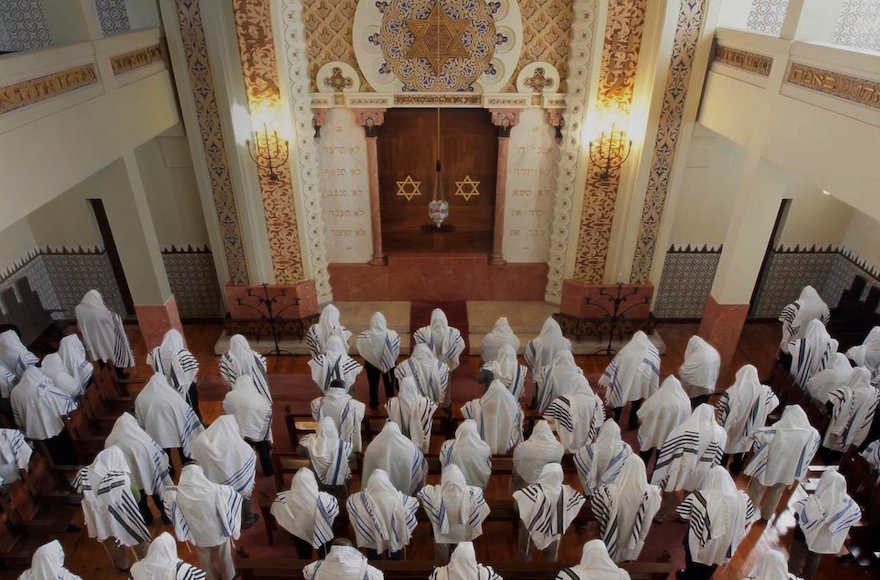
Congregants praying at the Kadoorie - Mekor Haim synagogue in Porto, Portugal, May 2014. (Courtesy of the Jewish Community of Porto)Congregants praying at the Kadoorie – Mekor Haim synagogue in Porto, Portugal, May 2014. Photo courtesy of the Jewish Community of Porto
Porto hasn’t seen a single anti-Semitic incident over the last decade, according to the mayor, Rui Moreira, who spoke last month at an event at the synagogue and obliquely referenced the rising anti-Semitic violence elsewhere in Europe.

“This synagogue was built when others across Europe were being burned,” he said. “Today it again offers shelter from the bad winds blowing around us.”

Alexandre Sznajder, a Jewish businessman from Rio de Janeiro with a Polish passport who was in town for the kosher hotel and synagogue celebration, is thinking about moving to Porto with his wife and son.

“The economic situation in Brazil is deteriorating and personal security is terrible,” said Sznajder, an importer who said he was kidnapped for ransom two years ago. “If I can keep doing business from here, where it’s safe, Porto could be the place for us.”

Some applicants for Portuguese citizenship from non-EU countries want a Portuguese passport as an insurance policy, in the event things in their home countries go south. Hila Loya, a visitor from Cape Town, applied last year for that reason.

In South Africa, she said, “the anti-Israel, anti-Jewish atmosphere is worsening, and there’s a feeling things may turn for the worse in the near future.”

Last month, approximately 250 Jews from 14 countries convened here for a weekend retreat designed to introduce them to Porto and its Jews. Among those present were the president of Lisbon’s Jewish community, Turkish Chief Rabbi Ishak Haleva and 80 other Turkish Jews. Most of the applicants to Porto’s community so far have been Turkish Jews, including many of those who came for the weekend retreat.

Haleva, one of Sephardic Jewry’s most respected religious figures, said he came not to apply for citizenship – “I’m a Turkish Jew, period” – but to visit “this place where our roots are.” Many of Turkey’s Jews are descended from Sephardic Jews who fled northern Portugal after 1536, when Portugal joined Spain in applying the Inquisition’s expulsion orders against Jews, according to Haleva. And many of those who fled from Portugal to Turkey originally came from Spain, where the Inquisition began in 1492.

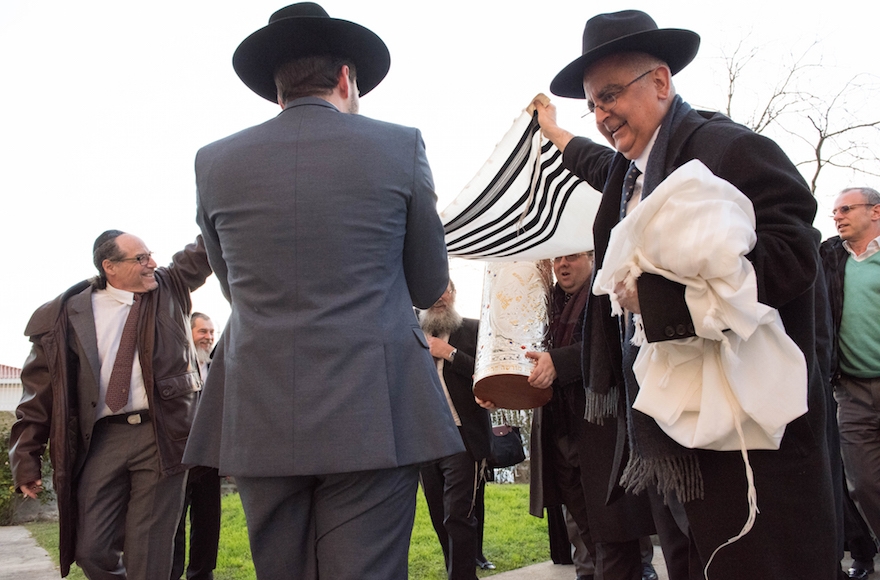
Turkish Chief Rabbi Ishak Haleva, right, talking to congregants outside Kadoorie - Mekor Haim synagogue in Porto, Portugal, Jan. 29, 2016 (Cnaan Liphshiz) Congregants carrying a Torah scroll into the Kadoorie – Mekor Haim synagogue in Porto, Portugal, Jan. 29, 2016. Photo by Cnaan Liphshiz/JTA

Tens of thousands of Jews stayed in Portugal and converted to Christianity. While many continued to practice Judaism in secret as anusim – Hebrew for “forced ones” — the Jewish presence ultimately vanished from this once heavily Jewish area. The Jewish revival was sparked in 1923, when a Portuguese army captain, Arthur Carlos Barros Basto, reached out to the descendants of the anusim, leading to the construction of Porto’s synagogue.

Built in 1939, the community’s Kadoorie – Mekor Haim synagogue is among the largest and most beautiful in the Iberian Peninsula, but it saw long periods of neglect until last year’s extensive renovations were completed. That helped put a new shine on the synagogue’s best features: Moroccan-style interior arches; heavy redwood interior and dazzling collection of more than 20,000 hand-painted azulejos, Portugal’s iconic ceramic tiles.

When Porto’s mayor dropped in at last month’s retreat, it was his second time at the city’s shul – a sign of the Jewish community’s increased significance in Porto, according to the local rabbi, Daniel Litvak.

Addressing 300 guests from the synagogue’s podium while wearing a kippah, Moreira, who himself is descended from an Ashkenazi Jew who settled in Porto in the 19th century, said Portugal’s new law of return was to “correct a historical wrong” — the 16th-century expulsion of Portugal’s Jews.

But, he added, “the law has future implications: We want you to come live here, with us, and share that future.”

New citizenship law has Jews worldwide flocking to tiny Portugal city Read More »

From Freedom of Speech to Hate- Speech

Response to a request to remove a group named “Death to Israel” is the following: “Thank you for taking the time to report something that you feel may violate our Community Standards. Reports like yours are an important part of making Facebook a safe and welcoming environment. We reviewed the page you reported for harassment and found it doesn't violate our Community Standards.” The same response is received also after reporting a page named “Against the Zionists,” which calls directly to destroy Israel. Same goes for reporting a caricature presenting fat, big-nosed “Jews” as creatures that control every aspect of the world.

Facebook’s algorithm does not recognize the listed above as harassments or dangers of any sort. To Facebook, the largest social network in the world, founded by a smart Jewish boy, calls to “kill,” “destroy” or “vanish” the Jews or Israel is legitimate, or to put it in their words, not a violation of their Community Standards.

There are hundreds, if not thousands of groups, fan pages and profiles calling to kill Jews or other religious groups, ethnic groups and other minorities. These groups and their hate speeches have no place in our world, but not only because hatred causes humanity to deteriorate. These groups have no place in our world because they spread messages that must not spread. The lies, the manipulations the propaganda, all easily convince the clueless, and in the age of instant messaging, incitement becomes a contagious epidemic.

The content of these hate-groups is being exposed to millions and enjoys the support of hundreds of thousands of people who, with the blink of an eye, can turn words into actions. When Facebook protects those groups, it does so in the name of Freedom of Speech. The people of the democratic World Wide Web have a right to say whatever is in their hearts. This claim is hard to oppose, and this is why Facebook does not hurry to delete every group, page or user being reported. However, this freedom-based algorithm does not fully take into account the risks of allowing freedom of speech at any cost.

There’s a thin line between criticism and hate, between anger and calls for dangerous action. Criticizing the state of Israel, while sometimes accompanied by a pack full of lies, is legitimate. Criticizing AIPAC can also be legitimate, as well as criticizing individuals, Jews or not. Including all of the Jewish people under one umbrella of “Jews,” accusing them of crimes is pure racism. Calling to kill a group of people is illegal. Together, these acts of hatred can cause serious, large-scale crimes in the near future.

The feeling of hatred can never vanish. People will always hate because it provides them with solutions to their problems. Blaming someone else for everything that’s wrong will always be easier than facing difficulties and issues. What CAN be dissolved is the ability to spread hate publicly under the excuse of the First Amendment, at least when it is under the control of Facebook and other social networks. Sometimes, freedom of speech must be limited, even at the cost of someone getting mad about “being silenced.” This is far better than the other, lethal, outcome.

For more daily updates about the day-to-day life in Israel, you can follow Israelife on Facebook From Freedom of Speech to Hate- Speech Read More »

#Beintrigued at the Diplomat Resort and Spa with @CurioCollection

Visiting Southern Florida and want to feel the history of Hollywood?

When the original Video

For an event at the Convention Center, go from the lobby and pass the two story fitness center or better yet stop at the Spa. The center Spa Sanctuary is lovely and peaceful. Sit down and get centered before your meeting or stay and have a marvelous massage. The area called Spa Cafe has some of the best views on property.

Video