fbpx

June 15, 2015

Korach: From rebellious to sacred

This article originally appeared on Neesh Noosh.

In this week’s Torah portion, we read about rebellious Israelites, led by Korach. While his complaints about the status of Moses and Aaron might seem like the words of an early democratic activist, his intentions were actually self-serving. He is “the arch-demagogue, lusting for power to inflate his own prominence, not to serve the people” (Etz Hayim, p. 860). He led a group of Israelites in opposition to not only Moses and Aaron but “that of Torah, and ultimately, God.” (Etz Hayim, p. 860). Rabbi Samuel Barth notes, “The sin of Korah was in thinking of himself as “outside the community”; he betook himself and his followers from being part of the People of Israel, and they became a faction, catalysts for further factionalization.”

Rabbi Moshe Bryski, on Chabad.org writes that Korach lived his life yearning for a different one, jealous of others. He comments that “A person who sees the essence of life as serving the will of His Creator does not expend useless energy craving places where the grass is greener. He finds meaning, purpose, joy and fulfillment in the place where the grass is greenest of all: his own.”

It does not end well for Korach and his followers who are subsumed into a gaping hole in the Earth. Afterwards, God commands that their fire pans be made “into flattened out plates as an overlay for the altar, for they brought them before the Lord, and have [therefore] become sanctified, and they shall be as a reminder for the children of Israel” (17:3). In writing about the transformation of the fire pans from tools that were used to rebel against Moses to sacred altar pieces, Rabbi Matthew Berkowitz writes, “the potential for the blemish to become sacred in our lives. If the blemish can be used as a teaching tool, then each of us will succeed in building a more hopeful future.”

The dish I made this week–vegan pancakes with strawberry compote–is inspired by the Korach’s fire pans and the sweetness of Torah. Pancakes are a thin and humble dish, unlike Korach’s inflated sense of self  (if I was making a dish representative of Korach, the person, I imagine it would be a souffle!). The strawberry compote on top represent the sweetness of Torah that withstood the challenges of Korach and his followers.

While pancakes are generally thought of as breakfast food, I think that these are so delicious and can easily be served as dessert! They are vegan and made with spelt flour, an ancient grain that has a delicious nutty flavor. It’s also strawberry season and they are so delicious right now-I can’t stop eating them! If you can’t find fresh organic strawberries, try other berries that are in season now. I find strawberries naturally sweet but if they’re too tart add a chopped Medjool date or two, to the compote.

Korach: Vegan spelt pancakes with no-sugar added strawberry compote

Ingredients

Pancakes: This is a modified recipe that was originally published on the Alkaline Sisters

  • 1 cup spelt flour
  • 2 tbsp baking powder
  • 1/8 teaspoon salt
  • 1 cup plant-based milk (I used a combination of plain almond and soy)
  • 2 tbsp canola or sunflower oil
  • 1 1/2 tsp vanilla
  • coconut oil or other high heat oil for pan


Strawberry compote

  • 1 1/2 cups organic strawberries
  • 1-3 tbsp water
  • 1-2 finely chopped Medjool dates (optional)


Preparation

Strawberry compote:

1. Thoroughly wash strawberries.

2. Add strawberries, water, and optional dates to a small pot.

3. Cook over low heat, about 10-15 minutes. Mash strawberries with a fork or spoon as they cook and stir periodically to prevent burning.  When finished, remove from heat.

Pancakes

1. Mix all dry ingredients together in a bowl. In a separate bowl, mix wet ingredients together. Then, pour wet ingredients into dry ingredients bowl and lightly mix. Let sit for about 5 minutes.

2. Place a skillet on low-medium heat and add a dollop of high heat oil (I used coconut oil). Place a spoonful of batter and allow to cook on first side until it bubbles and is lightly browned. Then, flip over and cook on second side.

4. Place finished pancakes on wire rack to prevent them from getting soggy.

5. Serve with a scoop of strawberry compote on top.

B’tayavon!

Korach: From rebellious to sacred Read More »

Mobli takes on Internet giants with event-based photo and video search

Israeli start-up Mobli Media Inc is taking on Internet giants Google, Facebook and Yahoo with an innovative online search tool to find the latest photos and videos across social media, the company said on Monday.

Mobli, which is backed by Mexican billionaire Carlos Slim and big-name U.S. celebrity investors Leonardo DiCaprio, Serena Williams, Lance Armstrong and Tobey Maguire, has raised more than $90 million in funding.

The company's EyeIn service allows users to search for pictures and video clips taken by people at concerts, sports events, demonstrations or natural disasters as they post images on Facebook, Twitter or Instagram, a unit of Facebook.

Its real-time, location-based search marks a new twist on a well-established category that typically returns a flood of photos or videos based on popularity or other ranking methods or requires users to wade through separate social media feeds to find relevant images.

Top photo sites include photo-sharing pioneer Flickr, a unit of Yahoo, Google Image Search and Facebook, as well as Facebook's Instagram photo-sharing site.

“Computers are very stupid, we need to give them very specific algorithms to detect what is the centre of the event,” Mobli Chief Executive Moshe Hogeg said in an interview.

“We want to be the Google of crowd-generated visual content,” he said, adding that he expects the EyeIn technology to boost audience traffic and time spent on news websites

PLATFORM OPTIONS

EyeIn is available as a search website, a downloadable mobile app or as an add-on for publishers to install within their own websites to complement text and other information. Partners for the add-on include AOL Inc's Huffington Post.

Mobli expects to share revenue with publishers from advertising as well as earn money from ads on its own site.

The company started as a photo-sharing rival to Instagram and attracted 20 million users. That was the stepping stone to building the search engine over a three-year period, with Hogeg recruiting experts in computer vision and natural language processing from the defence industry.

Hogeg said the biggest challenge was the relevancy of the results and how EyeIn determines which of the plethora of available photos are interesting.

Weighting what is important based on the location of an event is crucial to finding relevant photos, he said.

“If you want to see photos from the NBA (basketball) finals, you will probably like to see photos of players and less of the crowd,” Hogeg said.

EyeIn can scan a story on a news website to calculate what the event is about and create an album of photos that will update itself as the event unfolds.

Mobli will partner some of Slim's companies, though Hogeg would not disclose names. Slim, who owns telecoms group America Movil, is the largest shareholder of New York Times Co .

Other investors in Mobli company include Vic Lee, co-founder of Chinese Internet firm Tencent, and Kazakh businessman Kenges Rakishev, who invested $22 million. Other investor stakes were not disclosed.

Mobli takes on Internet giants with event-based photo and video search Read More »

Maccabi Tel Aviv appoint Jokanovic as manager

Israeli treble winners Maccabi Tel Aviv have appointed former Watford manager Slavisa Jokanovic as their new manager, the club announced on Sunday.

Serbian Jokanovic led Watford to promotion to the English Premier League last season after they finished runners-up to Bournemouth in the Championship.

“We are extremely pleased to secure the services of Slavisa, especially after his recent success and the obvious interest of other clubs,” Maccabi owner Mitch Goldhar said on the club's website (www.maccabi-tlv.co.il).

As a player Jokanovic, 46, won 64 caps for Yugoslavia.

He began his coaching career at Partizan Belgrade and led them to two consecutive league and cup doubles. Later he coached in Thailand, Bulgaria and Spain before going to Watford.

Jokanovic takes over from Spaniard Pako Ayesteran, who was a late recruit at the start of last term and led Maccabi to a unique domestic treble and Champions League qualifying spot.

Maccabi's league triumph secured a hat trick of titles and they also won the State Cup with a record 6-2 win over Hapoel Beersheba as well as the lesser Toto Cup.

Maccabi, founded in 1905, are the most decorated club in Israeli soccer. They were a dominant force in previous decades bud found titles hard to come by since beating Maccabi Haifa on goal difference to the league title in 2002-03.

Their recent change in fortunes was brought about through Canadian Goldhar's large investment in the club and a management team led by Jordi Cruyff, Maccabi's sports director.

Maccabi Tel Aviv appoint Jokanovic as manager Read More »

Tel Aviv Pride, the California connection

A high-profile California contingent contributed to the size and impact of the week-long LGBT Pride Celebration in Tel Aviv last week, with Los Angeles leaders joining Bay Area collegues in staging events aimed at strengthening the standing of Israel’s gay community.

“Five years ago, pride here was a ‘nice’ event,” said Joel Simkhai, Israeli-born, West Hollywood-based founder and CEO of the international mobile gay meet-up app, Grindr.

“But it has grown exponentially. Now Tel Aviv is an international gay destination, with more Europeans, Americans and people who aren’t Jewish visiting Israel for the first time to participate” in the celebration, Simkhai said.

When Simkhai discovered that Jared Fliesler and Geoff Lewis, two friends from the Bay Area venture capital world, were also heading to Tel Aviv Pride, he decided to organize a LGBT Tech meet-up to give young Israeli entrepreneurs a forum in which to network and learn from American collegues.

“I’m a big believer in people starting their own businesses; we do this for the LGBT community in L.A., and it just made sense for us to do it here, too.”

Simkhai promoted the event on his app, and in less than three hours the meet up on the terrace at Brown’s – a posh boutique hotel – was over-subscribed with gay tech entrepreneurs eager to pitch ideas to successful California counterparts. 

“It is wonderful to come back to Israel and see the visibility of the young LGBT community.  The next generation is so comfortable. It just wasn’t possible when I was coming out,” Simkhai said.

An estimated 180,000 people turned out for the June 12 LGBT Pride parade in Tel Aviv, up from 130,000 in 2014.

Todd Shotz is a Los Angeles Film & TV Producer and Jewish educator whose company, Hebrew Helpers, offers Bar and Bat Mitzvah training in Southern California, New York and Washington, D.C.

Todd Shotz with A Wider Bridge founder Arthur Slepian

“I come to Israel every year to officiate services for my students,” said Shotz, who also serves as board chair for JQ International, a resource and social service organization for the LGBT population. “But when I was at the AIPAC Conference in March, I ran into Arthur Slepian, who insisted I come again for the summit of LGBT leaders he was organizing in Tel Aviv.”

Slepian’s San Francisco-based “Wider Bridge” organization was founded to promote ties between LGBT communities in North American and Israel, but has become a global operation connecting activists, politicians, and cultural figures from Africa, Asia and Europe to the Jewish State.

“A Wider Bridge planned this global conference in Tel Aviv, because we believe the Israeli LGBTQ community deserves to have an important voice in the global struggle for LGBTQ equality.  Both the progress and the challenges here contain lessons for the rest of the world,” said Slepian who brought two busloads of international leaders to a legislative hearing on resources and protection for transgender citizens.

“A third of the total Kenesset members stopped by the meeting,” said Shotz. “There were even members of the Likud there talking in support of the trans kids and trans teachers.”

Wider Bridge made headlines in Israel by bringing Seattle Mayor Ed Murray to the country to speak at its Forty Years of Pride Conference, hosted jointly with the Aguda- Israel LGBTQ Task Force; Murray also marched in the Tel Aviv parade.

A progressive Democrat, Murray faced strong objections to his trip from Seattle’s well-organized Boycott, Divest, Sanctions coalition, which included some of his own supporters.

“I believe that the situation is very complex,” Murray told the Wider Bridge-Aguda conference Thursday. “I wish that people who are boycotting would actually come here, go to the West Bank like I went to the West Bank, talk to people here in Israel as well.

This march is just enormous. It goes on and on, and, yes, there are lots of LGBT people who came from all over Israel and Europe – but a huge proportion of this crowd is straight people who are supporters,” said Los Angeles attorney Jennifer Pizer, Law and Policy Project Director for Lambda Legal’s Western Regional office.

Pizer presented at a panel examining how the LGBT community has moved from sexual expression to making family rights its main issue.

Adoption rights and civil marriage both are challenging both for Israel’s heterosexual couples, as well as homosexuals, in a country where family status issues are still largely influenced, if not controlled by religious authorities.

“I think the vigor and exuberance of the Pride March in Tel Aviv echoes the popular vote on marriage in Ireland. I don’t think that is just a reflection of support for gay people but also a strong statement of support for the idea that everybody should have an equal place and be free to live according to their own conscience,” Pizer said.

Shervin Khorramian, who launched programing targeted for Los Angeles’ Iranian- Jewish community for JQ International sees Tel Aviv Pride as an impetus for LGBT visibility throughout the region.

“I am very proud to say that my Jewish culture has done this in the Middle East,” said Khorramian. “It’s my hope that I will live to see a parade like this in Tehran during my lifetime.”

Tel Aviv Pride, the California connection Read More »

Jeb Bush vows to ‘fix’ Washington as he starts White House run

Former Florida governor Jeb Bush vowed to fix a dysfunctional Washington as he began his U.S. presidential bid on Monday with an attempt to move out of the shadow of the White House legacies left by his father and brother.

Bush, 62, is seeking to be seen as his own man and break out of a crowded field for the Republican presidential nomination to run in the November 2016 election.

In a speech in Miami to announce his candidacy, he presented himself as an anti-Washington figure with a can-do spirit.

“We will take Washington – the static capital of this dynamic country – out of the business of causing problems,” he said. “I know we can fix this. Because I've done it.”

Bush made his announcement at Miami-Dade College, a school whose multicultural student population was chosen to emphasize Bush's commitment to trying to expand the appeal of the white-dominated Republican Party.

“We don't need another president who merely holds the top spot among the pampered elites of Washington. We need a president willing to challenge and disrupt the whole culture in our nation's capital, he said.

He was joined by his mother Barbara Bush, 90, at the event. Former presidents George H.W. Bush, his father, and George W. Bush, his brother, did not attend.

Both men left office with low approval ratings. The legacy of Jeb's brother is particularly difficult given his 2003 invasion of Iraq and the financial crisis that erupted toward the end of his time in office.

Distancing himself from the pair, without being disloyal to his family, will be tricky for the younger Bush. His campaign logo “Jeb!” avoids using the family surname.

“I think the biggest hurdle is he is going to have to sell himself as his own person, not his brother and not his father,” said Fran Hancock, 64, from Palm Beach, a supporter at the event on Monday.

Bush's speech was briefly interrupted by pro-immigration reform protesters and he responded: “The next president will pass meaningful immigration reform.”

Bush held an early lead in opinion polls of Republican voters when he first began talking about a White House run six months ago, but that has now dissipated. He is essentially tied for the lead with a host of challengers.

Failure to deal with the Bush family legacy has already caused problems for Jeb, who fumbled a response last month to a question about whether he would have invaded Iraq.

On Monday, Bush criticized former secretary of state Hillary Clinton, the front-runner for the Democratic nomination in 2016.

“With their phone-it-in foreign policy, the Obama-Clinton-Kerry team is leaving a legacy of crises uncontained, violence unopposed, enemies unnamed, friends undefended, and alliances unraveling,” he said.

Democrats made sure to remind voters of the George W. Bush's record.

“We already know what to expect from a Bush presidency, because we've seen it before. Jeb Bush supported his brother's disastrous economic and foreign policies that made us weaker at home and abroad,” said Rep. Debbie Wasserman Schultz, head of the Democratic National Committee.

Jeb Bush vows to ‘fix’ Washington as he starts White House run Read More »

Russian prosecutors investigate second Jewish educational institution

For the second time in one month, Russian prosecutors conducted a surprise inspection at a Jewish educational institution.

The latest inspection occurred earlier this month in Novgorod, a city located 335 miles northwest of Moscow, according to Russian Jewish Congress President Yuri Kanner, who spoke of the incident in an interview published last week on the Russian-language, online edition of the German broadcaster Deutsche Welle.

The Novgorod incident, according to the report, involved a Hebrew class given by the local office of Hesed, a charity with ties to the American Jewish Joint Distribution Committee.

According to asianews.it, the inspection occurred on June 1, four days after prosecutors raided a Jewish school in Yekaterinburg, 900 miles east of Moscow, and confiscated some textbooks following complaints that the faculty had incited against members of other faiths.

Students were forced to present identifying documents to representatives of the public prosecutor’s office, who arrived unannounced and without explaining the purpose of the inspection.

Kanner said documents were also seized during the Novgorod inspection, which he characterized as having “a significant psychological impact on the community.” Kanner said the Russian Jewish Congress has not been able to obtain clarifications from Russian authorities on either action.

“It’s difficult to understand or comment on prosecutors’ interest in coming into an organization where people learn the language,” Kanner said. Still, Kanner said he did not think the two inspections were part of “any kind of campaign.”

The inspections in Novgorod and Yekaterinburg coincide with a number of investigations into alleged extremism in Muslim and other faith communities.

A judge in the Ural region near Yekaterinburg ordered new analyses of two Muslim books prosecutors alleged were of an “extremist” nature, forum18.org reported last week.

In February, Russia’s Constitutional Court ruled that freedom of speech is not infringed by outlawing “extremist” material, which the court defined as proclaiming superiority of one religion or belief system over another. The ruling was on a motion concerning the 2011 banning of material from the Chinese spiritual movement Falun Gong.

In May, federal authorities banned two Muslim books, “Faith in the Light of the Qur’an and Sunnah” and “Fortress of the Muslim,” which they said were extremist but which the Sova Center, a Russian human rights watchdog, said “contain no signs of extremism.”

The Sova center listed the banning of these books and the Yekaterinburg Jewish school raid as examples of “misuse of anti-extremism” by authorities.

Russian prosecutors investigate second Jewish educational institution Read More »

Sermons slammed to celebrate Sinai

Becoming ourselves is a process. We learn what our family or friends find funny or valuable, and shape our identities accordingly, either to conform to, or in opposition to those norms and expectations. Teachers help us acquire skills, the basics of contemporary education, text analysis and interpretation. If we are lucky, our teachers don’t just teach at us, but learn with us, validating our instincts toward personal interpretation and endorsing multiple possible readings instead of just one definitive one. 
 
But for many who might never have felt free, or qualified, to interpret holy texts, Torah study remains daunting, incompatible with our hectic daily pace, or inconsistent with the personal convictions that guide our actions. Some of us have been lucky enough to find Limmud events, in Los Angeles and around the world, which position diversity of voices as a primary value. But the contemporary celebration of Shavuot is the one that most brings us the chance to see the text through our own eyes, and to share those visions with the community, as I saw last month, at Temple Beth Am’s all-night study program, or Tikkun Leil Shavuot, which featured a “Sermon Slam.”
 
The night included eight different perspectives (including one from this writer) on two short texts. Each of us wrote and delivered an original 3-5 minute “sermon” in the “story slam” style known to those who frequent “The Moth,” or other storytelling and performance nights. 
 
The night wasn’t just about the eight voices – it was about providing the entire assembly with access to the texts that were under our microscope. Outgoing Ziegeler School Dean Rabbi Aaron Alexander (only two weeks before he and his family relocated to Washington D.C. for a position at Adas Israel) taught the texts to the entire audience, giving them the background to understand the performers. 
 
So what happens when eight Jews stop being polite about text study and start being real? They interpret from their own education, influences, politics, passions and sensitivities, taking something uniform and transforming it entirely. 
 
WATCH: Esther Kustanowitz: “Brokenness” a Shavuot sermon slam
 
 
Rachel Salston, a soferet (scribe for Jewish texts) and a rabbinical student, shared her perspective on broken Torah as an opportunity to fix it. “Moshe Rabbenu was also Moshe Sofrenu. Celebrating the brokenness in revelation. I get to help just like he did.”
 
Michael Salonius, Clinical Chaplain for the Wounded Warrior project, took a different approach, calling upon his ancestors to “release me from Jacob’s sin…and the outcome of his deceit,” and invoking the rebellious spirit of Resh Lakish, the rabbi – and former bandit – who had been quoted in the text we’d been given. “Only the outliers know the cruelty of the crowd,” he said. 
Josh Warshawsky, artist-in-residence at Temple Beth Am and Pressman Academy and a rabbinical student, spoke of music’s power in piecing together broken fragments: “Song heals… Song enables us to open ourselves up to the melody of another. To infinitely feel their note by note and match it to our own.” 
 
The Sermon Slam ended with musician Nachum Peterseil teaching a song, then participants moved forward into the rest of the program, with offerings that continued the evening’s commitment to different perspectives.
 
It is this diversity of voices, the application of modern and creative formats to long-held beliefs and ancient stories that annually renews my interest in these texts. I am lucky enough to have had a solid Jewish education, but traditional programs of text study don’t stir my soul: while rabbis can inspire, it’s the insights of my peers, colleagues and strangers – now granted access to text and given a pulpit for interpretation – that invigorate my connection to tradition.
 
Such events reinforce what we’ve always been told, that all Jewish souls (including those born into non-Jewish families) were present at Sinai, and that the Torah belongs to all of us. We try to find our modern selves in ancient texts, narratives and characters, to imagine our emotional responses to things we’ll never experience, and to use our contemporary experiences to increase our understanding of our past. 
 
“We will do and we will listen,” the Jews promised at the base of Mount Sinai. Many interpretations say that this speaks of extreme faith, to promise to do something even before you’re told what it is. But my reading is a little different: na’aseh, we will actively engage in the text, making it our own, and “nishma,” as others offer their wisdom, we will also listen.

Sermons slammed to celebrate Sinai Read More »

‘Orange is the New Black’: The best Jewish moments from the new season

Mild spoilers ahead

Orange Is the New Black” protagonist Piper Chapman may no longer have a Jewish husband, but that doesn’t mean that Judaism isn’t a huge part of the new season of the Netflix hit. In fact, religious identity is one of the biggest themes of Season 3, as many of the inmates look for something to cling to, whether it be Norma’s (Annie Golden) cult or, in the case of Cindy Hayes (Adrienne C. Moore), Judaism. It’s not all that surprising: The series creator, Jenji Kohan, is Jewish, and Judaism also played a big role in her previous series, “Weeds.” We break down the best Jewish moments of the season, but if you didn’t have a chance to binge watch the entire season this weekend — congratulations, you have a life! — proceed with caution. Mild spoilers follow.

Cindy’s One-Liners

Since the quality of food at the Litchfield prison has hit rock bottom now that it is all pre-packaged, kosher is the only decent option. When Cindy asks for a kosher meal and is accused of not being Jewish, she replies, “You think you know my life? Shabbat Shalom, bitch!” That’s just the start of some great lines from Cindy in her quest for edible food, including “Shanah tova and hava nagila. It is good to be chosen,” “Jesus ain’t the messiah. He ain’t come yet,” and (in response to someone asking if a seat is taken), “Yeah. We’re saving it for Elijah.”

Caputo stands up to Danny

As the rest of the inmates catch on about the kosher meals, Danny (comedian Mike Birbiglia) from the private corporation that now owns Litchfield notices there are a lot more kosher meals on the purchasing order. He asks Joe Caputo (Nick Sandow), the assistant to the warden, how there can be so many Jews at Litchfield. Caputo responds, “I know. It’s confusing, right? We used to have them wear the Stars of David, but we had to stop doing that after World War II. I don’t remember why.

Rabbi tests the inmates

All the Jewish stereotypes come out when the “Rent-a-Rabbi” interrogates the inmates to find out who is really Jewish, but it’s impossible not to laugh at lines like Lolly (Lori Petty) saying, “I think you all are doing a wonderful job controlling the media. I mean we. We are doing a wonderful job.” But the highlight is when Cindy tells the story of her upbringing using plot points from “Annie Hall” and “Yentl.” The rabbi tells her, “Miss Hayes, while I am heartened that you appreciate the works of Woody Allen and Barbra Streisand, I think you’ve confused cultural Judaism with committed Jewish belief. Also, I hear Mandy Patinkin can be difficult to work with.”

Jewish sister

In the end, the only prisoner who is allowed to keep getting the kosher meals is the nun, Sister Jane Ingalls (Beth Fowler). She says, “The Abrahamic religions are pretty much all the same until you get to Jesus.” Touché.

Cindy converts

When Cindy decides to actually convert, she takes it seriously and gives the rabbi a beautiful speech: “Honestly, I think I found my people. I was raised in a church where I was told to believe and pray. And if I was bad, I’d go to hell. And if I was good, I’d go to heaven. And if I’d ask Jesus, he’d forgive me and that was that. And here y’all are saying there ain’t no hell. Ain’t sure about heaven. And if you do something wrong, you got to figure it out yourself. And as far as God’s concerned, it’s your job to keep asking questions and to keep learning and to keep arguing. It’s like a verb. It’s like … you do God. And that’s a lot of work, but I think I’m in, as least as far as I can see it.” When the rabbi tells her she can be a Jew and she cries, it is obvious how far this storyline, which started as comic relief, has come.

Cindy’s mikvah

Cindy can’t technically complete her conversion because there is no naturally occurring body of water in prison to use as a mikvah. But at the end of the finale, a hole is accidentally left open as the fence is being fixed and the inmates get to go into the lake. It’s one of the most touching moments of the series for all the characters, but especially for Cindy, who takes the opportunity to use it as a mikvah.

‘Orange is the New Black’: The best Jewish moments from the new season Read More »

Finding My Place in History: A Love Letter for Father’s Day

It is not enough to thank my father privately for the best gift he’s ever given me, because his own humility interferes with my every attempt to express sufficient gratitude. “Dad, I don’t know how to thank you enough for this,” I say. “I tried a new restaurant last night,” he says. His eyes tell me he’s received my gesture, but because he never allows me to lavish him with praise, I’m writing this article instead—for I am equally as stubborn, and I insist on sharing just how much I value his efforts.

Since 1998, my father has been researching our family history. Initially, he gave his parents a hand-held tape recorder, hoping they’d impart the past into an easily preserved format, but when his mother dismissed the idea out of hand, he realized he’d have to do any recordkeeping as he always had: on lined, yellow legal pads with his dark blue felt pens. In addition to interviewing his parents and as many relatives as he could reach, he consulted a wide range of sources, including the National Archives, the Ellis Island Passenger Search, newspapers, genealogists, doctors, translators, websites, court documents, state and school and military records, cemetery markers and gravestones, old photographs and old letters and old tickets still tucked into burlap envelopes, new photographs, emails, voicemails. He transformed our family tree into a Table of Contents, composed a 206-page narrative, and for Father’s Day last year, had it printed and bound, and gifted one copy to me and one to my sister.

At first, I read it looking for evidence of what made us special: the time my father let then-Senator JFK borrow his clipboard to sign autographs, the time my great uncle Max (aka Mackie) spent as an arranger for the Sev Olsen Band featuring Peggy Lee, or playing trombone at a burlesque house with chorus girls known as the Alvin Adorables. Then I became more interested in what makes our family story just like many other immigration tales: one guy in 1907 with few resources and even less money who travelled steerage across the Atlantic looking for a better life; then later his brother, my great-grandfather: first a stevedore on the docks unloading cement ships, then a fruit peddler selling oranges door-to-door from a bushel basket until he could afford a horse and cart, until he could afford a Ford one-ton truck, until he could afford a grocery store.

The family genesis and introductory paragraph is as follows:

There were originally four brothers, Mendel, Samuel (Sholom), Bencha, and Zalmon, and also sisters Reva and Hannah. There was a half brother, Samuel (Schmuel), and another sister, for whom there is no record of her name. The original family name was Metelitza according to some immigration records; however, according to Al Mattenson, a son of the half brother, the original Russian family name was Metelitzi (“blizzard”). Records of Ellis Island, however, state Metelitza.

Dad attempts to offer the facts unfiltered, and yet, just like biblical genealogies, there are gaps and ghosts in the story. Nothing is known of Bencha, Zalmon, Reva, and Hannah, who are believed to have remained in Russia. Was my great-grandmother born in Kluisi, Klency, Klinzcy, or Kleentsi? We’ll likely never know, though the town is believed to be near Kiev, Ukraine. Why did my Jewish great-grandfather, when asked to submit his Petition for Naturalization in 1918, list Christmas as the birthdate for two of his sons, and then change his own birthdate to December 25 in a World War I draft Registration Card, when he was born on January 25, as stated in his Declaration of Intention upon entering the country?

Perhaps my grandfather inherited his father’s sense of humor, because when asked to provide a birth certificate in order to get a job selling shoes, he obtained a fake one and selected Friday the 13th as his day of birth. He never knew his original birthday until my father consulted the Deputy Clerk of St. Louis County District Court, but even after we discovered that he was born on August 23, 1912 (assuming his father didn’t make up that date too), we continued to celebrate on September 13th. We like to call my dad Sherlock Holmes because he is such a thorough researcher, but there are just as many questions and discrepancies in our story as there are moments of clarity.

In school, we are taught to learn history by memorizing names and dates and fixing our understanding of events around something certain. Our family story reads more like the way history actually happens: some of it is recorded and some is not, some is understood only in context and only by the people living it, and everybody has a different view about how and why and even when and where things occur. These tensions are entry points into history. They demand our participation, and offer us a means of knowing ourselves by inquiring after our forebears.

In junior high school, I had to create a family tree in English class, and for the first time found out that my grandmother’s maiden name was Glass. I immediately recalled one of my favorite episodes of The Brady Bunch in which Jan invents a fake boyfriend named George, and when pressed to give his last name, sees a drinking glass on the nightstand. “George Glass! And he thinks I’m super cool,” she exclaims. I thought about my grandmother. I knew her as Sarah Mattenson, so Sarah Glass seemed as fictional as Jan’s George. Her history was not real to me; it was far away, in some other time and place. I was naturally inquisitive and wanted to know more about her life, but she chose to protect my innocence, so she never told me she wore dentures since early adolescence because her family, rather than spend money on dental care, extracted all her teeth instead. She never told me she was addicted to Miltown and other tranquilizers for 28 years until she voluntarily entered a chemical dependency center. She never told me she failed eighth grade three times and then dropped out of school altogether, or that she was traumatized when her family sold the piano, her one source of joy and confidence. Now that I know, I long to talk with her and let her tell her story. She had a lot of secrets.

My grandmother started writing about her life when it was almost over, and my father included those letters, knowing his mother wanted to be heard, and knowing his daughters wanted to listen. Dad included everything: the happy and sad times, detailed evidence and elusive memories, and everyone’s presence from the progenitors to Mr. C, the family dog. Dad regards everyone equally; there are no minor characters. Everyone is part of the story. This family history gives me access to human history in that sense: everyone is part of the story. It’s what my ancestors wanted—to be part of a new story—and American life. Maryascha became Minnie, Dweire became Dot, Gootel became Gertrude, and Metelitzi became Mattenson. Reading about all of them in this manuscript allows me to see them both intimately and from a distance, and thus myself the same way. Who am I and what is my place in history? Is it enough to be part of the story? My ambition drives me to stand out and make a name for myself rather than to fit in.

My grandfather’s ambitions all had a purpose. He wanted to be a dance instructor in order to meet women. He took on jobs in order to make enough money to survive. He polished Ford nameplates in a factory, sold sewing machines and flavored extracts (vanilla, lemon, and orange) and eventually shoes, and once ran away at age 16 to join the Marines. I once asked him, “Papa, why did you decide to be a salesman?” He laughed and said, “There was a job. If there was a job to be a fisherman, I would have become a fisherman.” He dropped out of school before ninth grade because his father died and he had to help support the family. It’s in part because he struggled so much that I have the luxury to choose a career and craft my own ambitions.

I took particular note of my father’s description of Samuel (born in 1873), who came to this country in 1911 and took the Grand Trunk Railway to Duluth, Minnesota to be with his brother and my great-grandfather. He was a tailor, and he executed his Declaration of Intention “by making a mark.” We can only assume he was illiterate and could not read the form, so when asked to sign his Petition for Naturalization, he must have made some sort of X or checkmark. Dad’s phrasing stuck with me and I started to wonder how all these people felt about making a mark in the world. This document itself is one way my father is making his mark. He is keeping our family alive. He even brought some people back to life; my grandfather never knew he had a fifth brother until my father’s research revealed that Louis died at age 5. Since poor families couldn’t afford gravestones, Louis was likely buried along the perimeter of the first Jewish cemetery in Duluth. He probably would have survived appendicitis if he had been born after antibiotics were discovered. His family never talked about him, and there’s only one known photo of him, now included in our collection.

For some reason, as I read, I’d keep turning back to Louis’ photo. He looks so sweet in his little black coat with his soft, golden curls, and his tiny hand resting on his brother’s shoulder. He’s holding some sort of staff and his brother sits upon a tricycle. I think about Louis. He never got to “make a mark.” The phrase reminds me of a moment, years ago, in my grandfather’s kitchen when we were making lunch. He took out a small notepad used for phone messages and drew a few lines. “Here’s the alley,” he showed me, “and here’s where our house was—522 E. 8th St. in Duluth, and here’s where I made my mark!” Apparently he had carved his initials into the cement a few feet from the garage. I’ve always wanted to travel to Duluth and see if the inscription is still there.

I, too, want to make my mark in this world, so I was honored to represent my department in a competition for a distinguished award this year. Many of my colleagues have been nominated but not selected over the years, but I assumed my dossier would be strong enough to transcend committee politics and rise above the other candidates. When I did not win the award, my ego was bruised. How will I make my mark if I’m not on the official high-achievers list?

I went home, made some strong coffee, reread all 206 pages of the family history, and emerged transformed. I’ve been so focused on being the star of my story that I’ve forgotten I’m a part of a much larger narrative, from family history to Jewish history to human history. I’ve started to think more about my life in context as opposed to being primarily distinctive. It’s a relief. I’ve got a lot of angels in these pages sending me messages: think Clarence in It’s a Wonderful Life. “You’ve been given a great gift, George,” he says, “a chance to see what the world would be like without you.” In the film, it is only when George Bailey sees his life from a distance that he can then reenter it with a renewed enthusiasm. He learns what really matters to him. That’s the gift my father has given me as well. I am merely one entry in the Table of Contents, and I can see the value of my life even as it slowly slips away. I don’t mean for that to sound melancholy. To the contrary, the subtext of impermanence throughout Dad’s offering makes me want to love and learn in as exuberant a way as possible, for as long as possible.

At dinner last week, my father made a joke about his own mortality, and my eyes filled with tears at the mere thought. I see him as too youthful to be in his seventies, and similarly, I think he has trouble believing he has two daughters in their forties. He sent us “Happy 29th Birthday!” cards for at least a dozen years. I can’t pass for that age anymore, but the older I get, I understand Dad’s humor and even the denial. I want him to live forever. He will—in the pages titled Our Family—and no doubt, I’ll return to them many times, for my father’s love is in every word of the text. It’s hard to imagine a more meaningful gift from father to daughter.

Dad’s last line is excerpted from a prayer book on the page after the Mourner’s Kaddish: As we remember our departed, we perpetuate their presence among us. By remembering them, we confer upon them the gift of immortality.

Immortality is conceptual; the reality is that my father’s father, for example, is gone, and we miss him. But his legacy is alive, and there are things he said and did that remain with us. Every time we talked on the phone, instead of “goodbye,” Papa said, “you’re a good person.” When I was younger, I’d laugh and say, “No, You’re a good person!” Sometimes, I’d say, “I love you, Papa” or “see you later.” And then he’d repeat: “you’re a good person.”

Dad, I get to be the one to bestow Papa’s enduring blessing this time: I love you dearly. Thank you for this gift. You’re a good person!


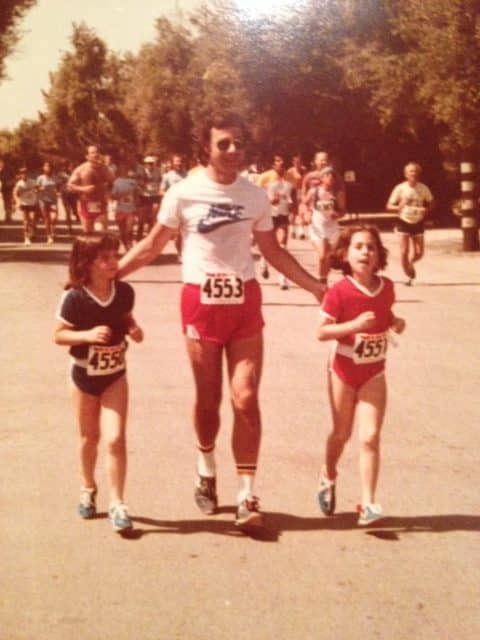
Lauri Mattenson is a Lecturer with UCLA Writing Programs. Her latest work can be found here and her new Kindle Single, “Backbone: A BodyMind Breakthrough” is now on Amazon.

Finding My Place in History: A Love Letter for Father’s Day Read More »

JNF Canada cancels Huckabee speech amid LGBTQ objections

The Jewish National Fund of Canada has canceled a scheduled speech by U.S. presidential hopeful Mike Huckabee

Huckabee, who is vying for the Republican bid in 2016, had his Oct. 15 speaking engagement in Ottawa canceled on June 10 following objections from the Canadian LGBTQ community, the Canadian Jewish News reported.

An online petition at change.org calling for Huckabee to be pulled from speaking at the JNF Negev Dinner noted that comments from the former Arkansas governor “spread degrading hatefulness towards and about transgender people.”

“This is a segment of our community that needs your support, not the appearance of yet further rejection and abuse, as clearly promoted by your announced speaker, Mr. Huckabee,” the petition said.

The petition also noted that Huckabee publicly supported Josh Duggar, a member of the family featured in the TLC reality show “19 Kids and Counting” who allegedly molested some of his underage sisters and a family friend.

Josh Cooper, JNF Canada’s CEO, told the Canadian Jewish News that the petition, which had 31 signatories as of Monday, “had absolutely no impact whatsoever” on the decision to cancel Huckabee’s speech at the dinner, which this year will support autism research in Israel.

In an email to the weekly newspaper, Cooper said that Huckabee was initially selected because “he is a staunch supporter of the State of Israel” and “has never wavered from this position,” but was disinvited because “the media spotlight has recently focused on Mr. Huckabee’s comments about issues that bear no relevance to JNF or autism.”

Huckabee gave a speech last month at the National Religious Broadcasters’ convention in which he referred to transgenderism as a “social experiment” and joked he would have pretended to be trans in high school if he’d known it would allow him to shower with girls during gym, the Canadian Jewish News reported.

JNF Canada cancels Huckabee speech amid LGBTQ objections Read More »