
fbpx

February 23, 2011

Desperately Seeking Sorkin

I had this fantasy about Aaron Sorkin. It’s probably only natural that I should want to know him, because he is, after all, the most intelligent and sharp-witted writer working in Hollywood today. His prestige began with “A Few Good Men” (1992), surged with the “The West Wing,” which he created in 1999 and for which he wrote until 2003, and was cemented with “The Social Network,” which deftly showcases his extraordinary writing talent — although he’s also had a few flops — and his uncanny gift for cultural relevance. I thought, “This brilliant, mysterious man, who has publicly struggled with dark personal demons (that is, drug addiction), is at the crest of his career and will likely win an Oscar for his darn good movie about the invention of our age (that is, Facebook) — and I want to meet him.” And not only that, he’s also Jewish.

Here’s how I imagined it: We’d meet, one afternoon at the Beverly Hills Hotel. We’d sit on the patio at the Polo Lounge but order milkshakes from The Fountain Coffee Room downstairs. We’d trade small talk for a time, then I’d dive right in, look into his eyes and ask those deep, penetrating questions I’d lost sleep coming up with — for example, about the ethics of writing about a young, living person who has become known not for who he really is, but according to Sorkin’s version of him. And, because I’m writing for The Jewish Journal — and am a Jewish woman — I’d ask him what the heck was up with some of the movie’s snide, subtle one-liners, in particular, the not-so-veiled references to the general unattractiveness of my cohort. We would talk, and laugh, and sip, and I wouldn’t have to stargaze, because there’d be one right in front of me. And afterward, I’d hand my editors a bang-up interview with Hollywood’s man-of-the-moment.

Because of the Jewish angle, I knew I’d ask him questions no one else was asking, and so, despite the fact that he has been giving a billion interviews, he’d probably enjoy mine. I mean, 4,000 years of shared history could at least give me that. And as an added benefit, said tribal bond might even make us friends.

I was so wrong.

Here’s how it actually went: On July 21, 2010, I used Sorkin’s personal e-mail, which I’d gotten from a friend, to directly request an interview. (A few years earlier, he had been kind enough to give me a “phoner” about his agent, Ari Emanuel, around the time brother Rahm was elected Barack Obama’s chief of staff — the same mutual friend helped with that one.) This was the reply: “Aaron Sorkin’s e-mail has changed. Messages to this address are being checked, and he will reply to you soon from his new e-mail. Thank you.”

A week later, his publicist’s assistant wrote and asked that I please get back in touch closer to the time of “The Social Network” press junket, which would take place in late September, “so we can set something up.” In early September, I wrote again and was told they were “very sorry,” but Sorkin was leaving on a month-long press tour, and they were “not going to be able to make it happen.” This was a problem, because we had planned a “Social Network” cover around him. I wrote back and told her this was very unfair, as I had been so conciliatory at their request to wait, believing the interview was imminent. She told me that if I could make it to the junket — in New York — I would get 20 minutes with him. But seeing as how I was heading home from Los Angeles to Florida that weekend, I told her I could not make it to the junket, but, I wondered, could he do a phoner from the junket? Yes, he could! At which point I was overcome with such overwhelming elation that if I died after this interview, it would have been OK. (Was it just a tad ironic that our interview was scheduled during the 10 days in which the Book of Life was still open?) My only request, though I was reluctantly willing to compromise on this, was that we avoid scheduling the interview on Shabbat — but, alas, no such luck.

After 20-some additional e-mails, I had finally been “approved” for a 20-minute chat on Sept. 25 at 1 p.m. That Shabbat, I was in Miami because my 19-year-old brother was in the hospital after surgery. So at my brother’s bedside, while he self-administered morphine, I voraciously consumed profiles of Aaron Sorkin. He was everywhere, talking to everyone. That week, you couldn’t pass a newsstand, a TV or any other media outlet without hearing about “The Facebook Movie.”

By 1 p.m., I was waiting back home at my mother’s house, by the phone. Then, I got a call from someone at Sony telling me Sorkin was running late, maybe 15 minutes, maybe 45, and that I should wait. An hour later, they called again and said, “Sorry Danielle, we’ll have to reschedule.” Option 1: Could I fly to New York the following day, and they’d squeeze me in? Um, no. Option 2: Could I e-mail my questions, and they’d try to have him answer them? Yes.

So I e-mailed. But even that came with caveats — how busy he was, that he was leaving the country, etc., etc., — to which I replied, “I know what I’m going to write; just give him these six questions about the film’s references to Jewish women, and I’ll be happy.”

That was the end of all contact.

A month later, out of despair and longing and genuine fascination with the film, I wrote about him anyway. In a column, I addressed my own thoughts on exactly those six questions he chose not to respond to (or, perhaps, never even saw). I suggested that “The Social Network” implies a kind of latent hostility toward Jewish women. The headline (which I did not come up with) was “Who Does Aaron Sorkin Really Hate?”

I probably don’t have to tell you that Mr. Sorkin did not like my column. To which the obvious rejoinder might be, “Hell hath no fury like a woman scorned.” But, in truth, what I wrote had nothing to do with feeling slighted by him; I honestly would have preferred to contextualize my claims with his insights. The mutual friend Sorkin and I share was also upset by my piece, and, in his defense, wrote a letter to The Journal’s editor, calling my piece “half-baked and bizarre.” Had those words come from someone anonymous to me, I probably wouldn’t have cared, but coming from one of my truly closest friends, it hurt.

If there’s anything writing about Hollywood has taught me, though, it’s that perseverance sometimes pays off. So, three months later — this would be the day after Sorkin won his Golden Globe award — I wrote him again:

Dear Mr. Sorkin, I understand you were displeased with my column. I had hoped to bring my thoughts to you directly, but our interview was canceled. But, on the off chance you’re willing to give it another go, there may be an Oscar issue cover with your name on it.

An hour later I got an e-mail from Sorkin himself.
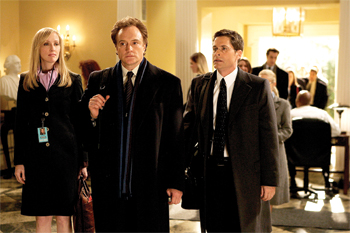
The first thing I saw in his reply — in big block lettering, copied and pasted from The Journal’s Web site — was: “Who does Aaron Sorkin really hate?” I briefly considered packing my things, absconding from Los Angeles, never to be heard from again. But to my surprise and delight, Sorkin followed up with a heartfelt, thoughtful response to my column — an itemized list, actually — of every point he took issue with.

“I don’t hate anyone,” he began, “or at least not anyone you know, and I’m dumbfounded as to how you got the impression I did.”

In response to my point that “The Social Network” suggests the creation of Facebook was, at least in part, motivated by Mark Zuckerberg’s “hot-blooded pursuit of women” — he flatly disagreed.

“While the precursor to Facebook — Facemash — was a revenge stunt against one woman … his building of the site had nothing to do with wanting to hook up and everything to do with wanting to distinguish himself. [Zuckerberg] has a eureka moment when he thinks of the ‘relationship status’ feature for the site but, again, that wasn’t about HIS hot-blooded pursuit of women, it was about heterosexual men’s.

“College guys want to meet girls — news at 11,” Sorkin wrote.

My point, of course, had been that the depiction of Zuckerberg as an awkward outsider who is undesirable to women — he is outright flouted by the woman he wants in the opening scene of the film — is yet further impetus to “distinguish himself,” even among, as Sorkin wrote, “a population of people who all got 1,600 on their SATs.”

In the movie, Alpha Epsilon Pi — the Jewish fraternity — is also depicted as an unfortunate place. The Zuckerberg character doesn’t really want to be there, and, frankly, neither do any of the other Jewish guys. Here, Sorkin allowed: “Alpha Epsilon Pi, the Jewish fraternity at Harvard, is not considered a glamorous place the way the exclusive final clubs are. I was writing about a group of guys who see women as either prizes or enemies. These guys are deeply, profoundly angry that the cheerleader still wants to date the quarterback even though it’s the computer geniuses that are running the universe now.”

I don’t know what Sorkin was like growing up Jewish, in New York. On Wikipedia, it says that from an early age he liked the theater. How it felt to be a Jewish male in the high school drama club — we can only imagine. But my guess is, like those AEPi guys, he didn’t feel hot like the quarterback. And now, well, he’s that genius who can have his way.

But actually, the most interesting thing Sorkin wrote in his e-mail was that I shouldn’t extrapolate to all Jewish women my interpretations of “The Social Network’s” Jewish women.

“Danielle, movies, plays, television shows … these things are different from Benetton ads where we get one from every column. I don’t want to be identified as a typical Jew (as if there is such a thing) … and I’d be surprised to find out that you want to be identified as a typical woman,” he wrote. “And any piece of art in any medium that begins with the mandate that all races, religions, genders and sexual orientations be represented in the best possible light is pretty much doomed unless it’s called Sesame Street.”

On that last point, I agree (and on that note, read The Jewish Journal!). But I would also argue that the images we see in Hollywood movies are representational — and, oftentimes, stereotypical — of people, of attitudes, of ideas about the world. Stereotypes are, by nature, “types,” and do not represent everybody, but Hollywood can’t control the way people perceive those representations, and Hollywood has a tremendous amount of power in influencing the way people think. Take Hollywood depictions of Muslims, or most Israelis, for that matter. Because he’s so good at what he does, Sorkin must know that.

In the last line of his e-mail, he added that he’d be happy to schedule another interview. But sure enough, 11 e-mails and one disingenuous publicist later, it didn’t happen. A week before deadline, I went back to Sorkin one last time.

He wrote: “Look, Danielle, you already wrote a story called ‘Who Does Aaron Sorkin Really Hate?’ in which you suggested that I was a misogynist, a self-loathing Jew and a bad writer — you’ve got to give me a reason why it would be a good idea to participate in another story.”

I figured that by this point, with the Oscars two weeks away, he had probably reached the point of PR ennui. Another, different mutual friend of ours saw him in a CBS interview and said, “He was completely joyless; he seemed tired and bored and mechanical — which isn’t like him at all.”

It’s possible that by that time, Sorkin was simply too exhausted for any more. Maybe he had come down with a horrific case of strep throat and lost his voice. But I don’t really buy that. Oscar nominees know those 11th-hour interviews help amass votes. So why, out of all those interviews he gave over the months, wasn’t I worthy? Was it because he thinks The Jewish Journal isn’t a significant enough publication? Too parochial? Or was I not distinguished enough to talk to?

Or was my “hate” piece so off base he didn’t think he could trust me? That I wouldn’t give him a fair shake? On the other hand, maybe what I wrote had tugged at something deep and true, and that had struck a nerve. Instead of being just another reporter who’d drunk the Aaron Sorkin Kool-Aid, maybe he was afraid I might expose his rawness, his realness. I wonder if someone so brilliant and complicated is more comfortable elucidating the complexities of his characters’ interiors than exposing what they might say about him.

Then again, perhaps all this overwrought analysis reveals more about me.

In a final, desperate attempt to inspirit him, I launched a daily campaign of “Reasons to Interview With Me.” I reminded him of something he had said to New York Magazine, months earlier, about Mark Zuckerberg: “I feel like had I met Mark, I would have felt a certain obligation to make the character sound like Mark, walk like Mark, all of those things. And frankly, I probably would have had an affection for him that I wouldn’t have wanted to betray.”

“I already wrote the piece I could write not having met you,” I wrote as my last plug.

In the end, I didn’t get to make the tribal bond I had so ardently hoped for. But, at least in some sense, Sorkin and I bonded over The Tribe.

And if he ever decides he’d like to meet, I’m still waiting.

Desperately Seeking Sorkin Read More »

Demjanjuk threatens hunger strike

Accused Nazi war criminal John Demjanjuk said he will start a hunger strike in two weeks unless new evidence is introduced in his trial in Germany.

On Tuesday, the day scheduled for final arguments in his 16-month trial in Munich, Demjanjuk was brought into the courtroom holding a sign bearing the number 1627, the number of a file that defense attorney Ulrich Busch says might hold the key to his client’s release.

According to news reports, Busch is demanding this and other materials be introduced as evidence. He also wants judges who presided over previous trials in Israel and the United States to testify.

Demjanjuk, who was already been subjected to trials by the U.S. and Israel, threatened to begin a hunger strike within two weeks if the files are not introduced.

A former Ohio autoworker, Demjanjuk, 90, is charged as an accessory to the murder of 29,700 Jews at the Sobibor death camp in Poland in 1943. Ulrich, who maintains Demjanjuk was forced by the Nazis to train as an SS guard, also on Tuesday read a statement from his client in which he once again refers to himself as the victim of a “political show trial.”

“At the end of my life, Germany—the country that murdered millions of people—is trying to extinguish my dignity, my soul and my spirit,” read the statement in part.

Busch is demanding that the court introduce 100 new items of evidence, Reuters reported. The court suggested that these requests might be part of a delaying tactic. The last scheduled court date is March 23.

A Ukrainian native, Demjanjuk, immigrated to the United States after the war and lived in suburban Cleveland. He was later stripped of his citizenship for lying about his Nazi past. A death sentence against him was overturned in Israel after the Supreme Court found reasonable doubt that he was a guard at the Treblinka death camp. In May 2009, he was deported from the United States to Germany, where he is standing trial on the Sobibor charges.

Recently, a Spanish court requested that Demjanjuk be extradited to stand trial for war crimes there as well.

Demjanjuk threatens hunger strike Read More »

Several Israelis still missing in New Zealand

Up to four Israelis who were in Christchurch, New Zealand at the time remain missing and are feared dead.

On Wednesday, Israel’s consul to New Zealand, Teddy Poplinger, said that his staff is working to contact all Israelis who were reported to be in the area of the quake when it struck on Tuesday.

“[T]here is a list of Israelis who have yet to make contact. We are more worried about three or four of them because they were last seen around town prior to the earthquake,” Poplinger told Israeli media Wednesday.

Israeli backpacker Ofer Mizrahi, 23, was among 75 confirmed killed in Tuesday’s earthquake, which measured 6.3 on the Richter scale and devastated the city of Christchurch. Some 300 people are still listed as missing and many are known to be trapped in buildings. The city’s Chabad center was destroyed in the quake.

Israel, which has hundreds of nationals trekking in New Zealand every year, offered to send food and medicine to help; Magen David Adom is assessing the possibility of sending rescue personnel. Israel’s Foreign Ministry said there were up to 150 Israelis in Christchurch at the time of the quake.

Prime Minister John Key, the son of a Jewish refugee who escaped Europe on the eve of the Holocaust, called the disaster the nation’s “darkest day.”

Several Israelis still missing in New Zealand Read More »

Montreal city council condemns boycott of Israeli shoes

Montreal’s city council has condemned the boycott campaign against a local shoe store that sells footwear made in Israel.

A council motion deploring the campaign, proposed and supported by Mayor Gerard Tremblay, passed Tuesday by a vote of 38 to 16.

Those voting against the resolution said they would not support a motion denying protesters the right of free speech and expression.

The boycott of the le Marcheur store, which sells the Israeli-made Beautifeel line of women’s shoes, was launched last fall by the group Palestinian and Jewish Unity and supported by other activists as part of a worldwide boycott, divestment and sanctions campaign against Israel.

Amir Khadir, an Iranian-born member of the provincial National Assembly, joined calls for a boycott of the store in December.

Since Khadir’s appearance, federal politicians have spoken out to defend the shop’s owner. One lawmaker even bought a pair of Beautifeel shoes.

Meanwhile, members of Montreal’s Jewish community have launched a “buycott” campaign encouraging shoppers to patronize le Marcheur.

Montreal city council condemns boycott of Israeli shoes Read More »

North American rabbis protest conversion policy

Dozens of North American Orthodox rabbis protested to Israel’s Interior Ministry following reports that converts under Orthodox auspices are being denied the right to immigrate.

“We are concerned that conversions performed under our auspices are being questioned vis-à-vis aliyah eligibility,” said a letter delivered to the ministry on Tuesday. “We find this unacceptable, and turn to you in an effort to insure that those individuals whom we convert will automatically be eligible for aliyah as they have been in the past.”

On Wednesday, a meeting was held in Jerusalem to discuss the issue. Participants included representatives of the Jewish Agency for Israel, Nefesh B’Nefesh, ITIM—The Jewish Life Information Center, the Jewish Federations of North America, Israel’s Interior Ministry and the chief rabbinate, according to Rabbi Seth Farber, ITIM’s director. Farber, a central figure in organizing the letter, told JTA that the Interior Ministry, led by the Sephardic Orthodox Shas Party Chairman Eli Yishai, did not agree during Wednesday’s meeting to retract its policy of consulting with the chief rabbinate on issues of Orthodox conversions, but did agree to consider each aliyah request by Orthodox converts on a case-by-case basis and to continue the discussion.

The Chief Rabbinate has become the defacto central body in determining the validity of Orthodox conversions, and it only recognizes about 20 religious courts in North America, mostly affiliated with the Rabbinical Council of America. Conservative and Reform converts are certified as Jewish by the central bodies of their respective movements.

In response to the letter, the plenary of the Jewish Agency’s Board of Governors adopted a resolution brought by the Unity of the Jewish People Committee calling on the Israeli government to confirm the Jewish Agency’s role in determining the eligibility of new immigrants.

The resolution passed Tuesday on the last day of the Jewish Agency Board of Governors meeting in Jerusalem and was initiated by Chairman Natan Sharansky, who told the board that Israel’s chief rabbinate should not be involved in determining who can be allowed to immigrate to Israel.

“I want to separate the argument about conversion from the recognition of Judaism for the sake of citizenship-eligibility under the Law of Return,” Sharansky told Haaretz. “It’s so important that a person who undergoes conversion according to the tradition of his community and who the community accepts as a Jew be eligible to make aliyah under the Law of Return.”

North American rabbis protest conversion policy Read More »

Letters to the Editor: Federation, Egypt, Sonenshein, Soros

Federation Funding Policy Clarified

Rob Eshman’s opinion piece “Just Say Yes” (Feb. 18) misrepresented a number of key points.


1) Our Federation’s Funding Policy on Israel Programming was the result of three months’ deliberation by a diverse group of leaders. It was built upon the foundation of policies already enacted by Bay Area institutions to help navigate potentially controversial programming choices. 


2) Jewish institutions have always drawn boundaries based on their values. For example, Jewish institutions do not permit programs that promote
extremism, violence, bigotry or converting Jews. Moreover, all funders have policies about what they will and will not fund based on alignment with their
mission. So the issue is not about drawing boundaries but rather where those boundaries should lie with respect to Israel programming and
Federation dollars raised across the community to support both Israel and local needs.


3) Eshman argues that the policy would “ban monies from supporting artists” who are tied to groups that “may have cooperated with some aspects of the BDS movement,” in whole or in part,
such as Tony Kushner and Theodore Bikel. In fact, the policy states that presentations that are not used to promote a BDS agenda are within the guidelines. That would include a Bikel concert,
a Kushner play, or an evening on their lives in the arts. Reasonable people can differ but a fair presentation of the policy is warranted. Exactly one year after its adoption, we are pleased with how it has helped to
hold up the big tent and advance lively discourse and good programming choices without stifling debate.


Jennifer Gorovitz,  CEO,
Jewish Community Federation
San Francisco              

Rabbi Doug Kahn, Executive Director
Jewish Community Relations Council
    
San Francisco


Rob Eshman responds:

If I neglected to specify the exact timeline or development process of the JCRC policy, it was only because I did not think it as pertinent as the final policy in place. I have no quarrel with the notion of boundaries, I merely called into question the ones the San Francisco group chose. Mr. Kahn’s third point seems to be that Federation money can fund artists as long as they don’t promote opinions on Israel with which the Federation disagrees. That’s just how I like my brilliant Jewish artists — muzzled.


Voice of Reason

Thank you, Rob Eshman, for being a voice of reason and balance (“Siren Song,” Feb. 8). We agree with you that we should celebrate and support people who strive for freedom from oppression.

Let’s deal with events as they develop and not zoom to the most problematic outcomes.

Judith and John Glass
via e-mail


Additional Jews in elected office

Like most other California politics professors, I deeply admire Raphael Sonenshein’s work. But once in a while, even he forgets those of us Jewish elected officials who toil in the almost invisible community college system (“Harman’s Departure: What Does It Mean for Jews?” Feb. 18).

I am among three Jewish elected members of the Los Angeles Community College District Board, and we represent over 4.5 million residents of the largest community college district in the nation. We oversee nine colleges and 10,000 employees. 

Our colleges provide important educational access for hundreds of thousands of people each year, and we are proud of the construction program that has brought modern, high-tech buildings to our campuses — buildings which have gained us international recognition for our environmental leadership.

Next time Sonenshein adds up the number of Jewish local elected officials, please add me and my colleagues on the LACCD Board of Trustees.

Mona Field
Past president, LACCD Board


Violating rights is not true nonviolence

When Rachel Roberts describes shouting down Israeli officials as “nonviolent protest” (“Muslim Criminals, Jewish Activists?” Feb. 18), she deliberately conflates two distinct activities.

What the Muslim students did in Irvine, and what A Jewish Voice for Peace did in New Orleans, was “nonviolent” in the sense that no rocks or punches were thrown. But trying to shout down and shut up a speaker because of disagreement with his message (which Roberts calls “speak[ing] up for what they believe”) is profoundly anti-democratic and anti-liberal. In that sense, it does violence —metaphorical, but real — to norms of civilized behavior.

It cannot be confused with nonviolent protest which makes its point but does not trample the rights of others. Everyone respects this sort of genuine “nonviolent protest.”

When protesters break the law, they should expect legal consequences. That’s fundamental to the theory of “civil disobedience,” and fundamental to a liberal democracy governed by the rule of law. Roberts complains that the A Jewish Voice for Peace-niks were treated more leniently than the Irvine students. Arguably, the problem is not that the Muslims were arrested, but that the Jews were not.

Paul Kujawsky
via e-mail


Not about the Jews

Kol ha-kavod to Rob Eshman for his leadership and courage. For two weeks in sequence, he has used his “This Week” editor’s column to focus on how the Jewish community has been, on the whole, reacting to the revolution in Egypt. It is natural to feel and express concern. The way ahead for this important country and its region is unclear and fraught with peril. And so, of course, possible effects on Israel are also fraught with peril. Nonetheless, as Eshman wrote on Feb. 4 (“The ‘F’ Word”), this is “not about us” — not about the Jews. We are quite appropriately at the center of our own world, but we are not at the center of the world itself, God’s world. Freedom is a human birthright, as we know and keep teaching others through the Passover story. So let’s stretch ourselves to be hopeful and idealistic along with being sober-minded and analytic. Let’s pray for Egypt and her people along with praying for Israel and the Jews.

Rabbi Susan Laemmle
Los Angeles


I’m writing to say that I’ve found myself compelled to share this article (“Israel: Stumbling Block or Shining Light?” Feb. 11) with as many people as I can possibly reach because it strikes such a powerful, rational chord that, regardless of what “side” a person is on (right / left / center), one cannot help but be on the side of Israel and freedom, all in the same breath, here in America. Also, on a selfish note,

I’d genuinely love to be ringside at such a debate and to see Soros explain to the American people as a whole his thinking, in light of the obvious facts Suissa so eloquently points out. Tell me — how can we get Soros to debate Suissa?!

Tristan Benz
CEO (Citizen Executive Officer) concerned about Israel, Freedom and America
via e-mail

Letters to the Editor: Federation, Egypt, Sonenshein, Soros Read More »

Just what is Jewish mass transit?

About six months ago, an article appeared in these pages urging Los Angeles Jews that “it’s time to get on board with transit.”  In the article, supporting public transit was seen as a “Jewish” thing to do.

The argument was made that public transit in Los Angeles is “good for Israel,” because it would decrease our reliance on foreign oil. 

Admittedly, it would be hard for any reader to resist anything that is “good for Israel,” but let’s get something straight.  Public transportation in and of itself is hardly a mitzvah. More than anything, public transportation is a necessity, considering traffic and our reliance on foreign oil. But that hardly makes it convenient; it doesn’t make it the “ideal” form of transport (the way that the common experience of seeing a movie makes it an ideal form of entertainment), and it certainly doesn’t make it “democratic” or fair.

No, ideally, we’d live in a society where there would be no dependence on foreign oil (electric or hydrogen cars, anybody?), where we had clean and inexpensive sources of renewable energy, where traffic would be reasonable, where poverty was eliminated and where everybody had the resources to get from point A to point B in the most convenient — yet also affordable and eco-friendly — manner.  For some, that might be public transport;  for others, personal vehicles or other forms of transportation.

Since this jam-free, electro-autopia is nowhere on the horizon, it is undoubtedly good policy to develop an effective public transportation system that makes sense for the region, for the individual cities and neighborhoods, and for the taxpayers.

But it also makes sense to take local concerns into account when making decisions. While the concept of public transportation may be a good one, no right-minded person, Jewish or non-Jewish, should support a public transit project that uses bait-and-switch tactics or Big Brother’s stick of eminent domain in dealing with residents to dismiss reasonable local concerns when it comes to the planning and execution of that project.  “The end justifies the means” is not exactly a Jewish principle.

Yet when it comes to the proposed location of the Westside extension’s subway station in Century City, we have a number of “transit advocates” who are trying to ram a subway alignment down an entire community’s throat, despite the existence of a perfectly viable alternative which, in fact, will save the taxpayers upward of $55 million.

Moving away from the Santa Monica Boulevard and Avenue of the Stars station, which for the better part of a decade had been part of Metro’s Century City alignment and which was the basis for gaining community support in Beverly Hills, many Metro advocates are now pushing for a station at Constellation and Avenue of the Stars. This alignment would involve tunneling under Beverly Hills High School and, in addition to being more intrusive, would be significantly more expensive than the original alignment — all for the sake of one block. Naturally, Beverly Hills residents are perturbed. Some of the transit advocates are seriously suggesting that the entire subway extension will not be viable if the Century City station is placed at Santa Monica and Avenue of the Stars. Where were they during all the years when the only option regularly discussed by Metro was the Santa Monica station?

Yes, it’s a long block — about the same length as a crosstown New York City street or a downtown L.A. street. But it’s a block.  And Century City itself is all of four square blocks.

What is behind this bait-and-switch? As there aren’t a lot of logical reasons, we’re left with speculation that wealthy Century City developers see an increase in their property values, and perhaps an excuse for further densification if the subway station is closer to their properties. There has also been speculation that the Los Angeles Country Club wants the subway alignment as far away from its golf course as possible.

So, Century City developers and the Los Angeles Country Club align their interests to change the alignment — at an estimated cost of more than $55 million in taxpayer money. And they suddenly garner the support of the politicians. Is it any wonder that people have become disillusioned with politics? 

This bait-and-switch calls into question the credibility of the entire Westside subway, as do arguments that attempt to make a Santa Monica alignment “unsafe” due to seismic concerns.  The seismic argument seems self-serving, if nothing else. Did the master planners at Metro, who for years sold the community on the Santa Monica alignment, suddenly wake up one morning to discover that we live in an earthquake zone?  And if there is such concern about seismic activity along Santa Monica — on a fault with a recurrence rate of once every 7,000 years or so — then why do Los Angeles city planners feel so comfortable about allowing the construction of massive skyscrapers right along the purported fault line?

No, trying to sell the residents a bill of goods is not a particularly Jewish thing to do.

Another tactic used by this alliance of special interests and self-styled “transit advocates” to try to deflect this criticism is to write off Beverly Hills as a group of “rich NIMBYs.” Forget the fact that more than half of Beverly Hills residents are renters, the proposed subway intrusion goes nowhere near the “rich” part of Beverly Hills, and the Westside extension will have two subway stations directly in Beverly Hills. The community has supported the extension through and in our city. As we have respected the larger needs of the region, so should our locally preferred alternative be respected; it’s an alternative that clearly is more than viable, as it was the primary Metro route for the better part of a decade.  It’s not a question of NIMBY-ism, but a question of WOBAST-ism (WOBAST, of course, standing for “We Oppose Bait-and-Switch Tactics”).

Unless you’re the biblical Laban, bait-and-switch tactics are not an especially Jewish way to get things done.

Furthermore, irony looms large when, amid all the attacks on Beverly Hills and the hullabaloo about how the entire Westside extension will be endangered if some people have to walk a block, there is a gaping silence from this same group of “transit advocates” when it comes to the planned location of the “UCLA/Westwood” station. The Santa Monica station is a block from Constellation. The “UCLA/Westwood” station is the better part of a mile from UCLA.

Double standards are not exactly known to be a highly prized Jewish value.

Jewish support (including that of new House Majority Leader Eric Cantor) for the 30/10 Initiative, by which Congress would loan Metro the money to expedite the subway construction, should indeed be predicated on the application of Jewish values in making the subway a reality. We should insist on respect for local control and fiscal responsibility, rather than swallow half-baked rationalizations with political expediency at their core. The unnecessary tyranny of the purported majority is not a particularly Jewish concept.

We should be able to expect Metro to do the right thing by respecting the locally preferred alternative — which it has presented and propagated for years — and by choosing the least intrusive, least expensive viable route. We should demand fiscal responsibility as well as consistency and fairness.

And we should be able to expect that Metro, in making a pitch to Westside Jews to support the subway expansion, would also take into account our transit needs.

It’s all well and good for the Metro advocates to try to entice you to support the subway by dangling a Langer’s pastrami sandwich in front of you, but when they’re effectively ignoring measures to make the subway a more viable option for Westside residents considering the realities of life in Los Angeles, it’s a bit disingenuous.

None of the stations between Western and the Veterans Administration have park-and-ride lots planned, meaning with the underdeveloped network of bus lines serving the residential areas on the Westside, if you don’t happen to be within walking distance of a subway station, you’re pretty much out of luck. The mavens at Metro who preach “convenience” as a guiding principle have done nothing to make it convenient for Westside residents who might like to take advantage of this multibillion-dollar public works project.

So, while we should all support the subway as a concept, as Beverly Hills has said, let’s qualify that support by insisting we do it right. Let’s not squander an opportunity to really benefit the Jews and non-Jews of the Westside, while respecting the principles of local control and the views of the people who actually live in the affected neighborhoods. Metro needs to rethink the utility of its plans to the residents in the area of the extension. Park-and-ride lots at several Westside locations could significantly increase Westside ridership by increasing access. With my colleagues on the Beverly Hills City Council, I intend to look into various ideas to present to Metro to address this very issue.

When it comes to the subway station in Century City, political insiders say that consummating the bait-and-switch tactics of Metro, ignoring the locally preferred alternative and ramming a more intrusive, more expensive subway under Beverly Hills High School is already a done deal. If that’s true, so much for due process. It is my hope, however, that we can convince the decision-makers to take a course of fiscal responsibility, while actually respecting the locally preferred alternative. In principle, at least, it should behoove local politicians to be very respectful of the principles of local control. But perhaps given the track record of a number of L.A.-area politicians and their connections with special interests, this hope is simply naïve.

Before we give Metro our unqualified support, let’s remember that tikkun olam starts at home. Now there’s a Jewish principle it would be great to get Metro, and the politicians standing behind it, to support.

John Mirisch is a member of the Beverly Hills City Council.

Just what is Jewish mass transit? Read More »

All aboard the case for an all-pervasive Metro

With all of the recent focus on Los Angeles Metro’s expansion plans and the 30/10 Initiative, it seems timely to consider what Metro’s ambitious plans mean for L.A.’s Jewish community. In case you haven’t been paying attention, Metro is moving forward with several important projects that will bring rail lines closer, if not all the way, to the synagogue door. Metro is working hard to win Congressional approval for the 30/10 Initiative, so named because it would accelerate financing for transit construction, allowing the agency to build 30 years of public transportation projects within a decade.

So here is a fifth question for the kids to ask at your Passover seder: “Is Metro’s expansion good for the Jews?”

How does one assess the merits of Metro’s plans, and where can we look for guidance? As the observant among us know, it is helpful to look and perhaps pray to the East. And in Los Angeles, east is where most of Metro’s existing transit lines have been built over the past 20 years. These critical rail projects all emanate from downtown — the Red Line to North Hollywood, the Purple Line to Wilshire/Western, the Gold Line to Pasadena and East Los Angeles, the Blue Line to South Los Angeles and Long Beach, and the Expo Line Phase I to Culver City — are, for the most part, east of today’s large L.A. Jewish communities. Until now, Metro rail lines have largely skirted or ignored Hancock Park, Fairfax, Pico Robertson, Westwood, Encino, Sherman Oaks and Beverly Hills, although arguably it could be said that it was vocal opponents in those communities who kept out Metro trains, rather than the other way around.

One public transit exception to the Jewish rule about Metro expansion is the widely lauded Orange Line, a dedicated bus rapid transit (BRT) project that opened in 2005 and runs across the San Fernando Valley from North Hollywood west to Woodland Hills. For the uninitiated, the term BRT can refer to a variety of rapid bus programs designed to speed commuters along dedicated bus lanes. The Orange Line, which passes several synagogues and other Jewish institutions along Chandler Boulevard, raised quite a ruckus when it was being planned and built. With hindsight, given the line’s current success, and the popularity of the adjacent landscaped bike path, the thought of opposing this critical project seems unimaginable.

Now, think about Metro’s building over the last 20 years, and put it on steroids. The agency’s next act includes a number of projects that would cut right through L.A.’s Jewish neighborhoods. Metro’s plans include a Wilshire BRT from MacArthur Park to the Santa Monica City Line at Centinela Avenue, Expo Line Phase II from Culver City to Fourth and Colorado in Santa Monica, the Wilshire subway extension from Wilshire and Western to the Veterans Administration in Westwood and, in the San Fernando Valley, a better north/south transit solution along Van Nuys Boulevard and an Orange Line extension north to Chatsworth. Metro is also building a light rail line on Crenshaw Boulevard, the downtown regional connector, and is expanding both the Gold and Green lines east and south respectively. All these projects are sure to happen in some form or another, and, in many cases, have already raised the ire of some members of the tribe, including card-carrying Neighbors for Smart Rail (NFSR) supporters from Cheviot Hills. For several years, NFSR has been fighting the Expo Authority’s plan to run the light rail line at grade along an existing Metro right-of-way through Cheviot Hills, which is within the Los Angeles Community Eruv.

But it is important not to confuse Jewish opponents of particular aspects of Metro’s plans with Jewish community opposition to public transportation. Indeed, the 1985 methane gas explosion at a Ross Dress for Less in the Fairfax District, which gave long-term Congressman Henry Waxman cover to ban the use of federal funds for tunneling under Wilshire Boulevard, will long be remembered as one of the more shameful uses of bad news to kill a critical public transportation project. Fortunately, today the association of Jews on the Westside with not-in-my-backyard (NIMBY) opposition to public transportation is fading like the memory of a quick ride home on the freeway. Though the resistance of some Beverly Hills residents to potential subway tunneling under a portion of Beverly Hills High School to bring the Wilshire line to Century City has led some pundits to call the residents NUMBYs — for “not under my backyard.”

Greater Los Angeles’ natural population growth and demographic shifts, which have brought thousands more jobs west of the 405 Freeway, have worsened everyone’s commute. And the resulting jam-ups have, in turn, made more of us aware of the need for public transit solutions that aren’t at the mercy of freeway traffic. How bad have things gotten? In 1965, the 405 at Olympic Boulevard carried 100,000 vehicles per workday. Today, the 405 Freeway carries 300,000 vehicles each Monday through Friday, making it, according to The Source, Metro’s year-old transportation news Web site, one of the busiest roads in the United States. 

The fact that, in November 2008, Los Angeles County voters passed Measure R, a half-cent transportation sales tax, speaks to just how much attitudes about public transportation in Los Angeles have shifted in recent years. While some voters no doubt liked the fact that the freeways will get 30 percent of the money raised by Measure R, a full 70 percent, the rest of the sorely needed largess, will go toward mass transit. Indeed, the increased volume of news coverage of Metro and 30/10 has made many of us into transit policy wonks, ready to debate the merits of a BRT line versus a light rail or subway project.

BRT lines are typically less costly to build than light rail and subways. Light rail generally has a lower capacity and lower speed than heavy rail, but higher capacity and higher speed than traditional street-running tram systems. Metro’s existing light rail lines include the Blue, Green and Gold lines.

With the subway currently going through its final environmental planning process, and some in Beverly Hills concerned about what route the tunnel will follow, the meetings have been lively, including a particularly rowdy one I attended at Roxbury Park in Beverly Hills.

Los Angeles today actually has good mass transit bones. Transit corridors date from a time when the city had an extensive streetcar system. Thanks to those still-existing rights-of-way and railroad easements, many of which were never relinquished by the agency, Metro is now building out projects like the Expo Line, due to open in phases beginning later this year.

Of course, transportation planning in this town often remains a game of politics, one that has killed many worthwhile ideas, including the earlier effort to build a subway to the Westside.  But the argument now is no longer Us versus Them in the most sectarian sort of way. Instead, Metro commuters, business owners, car commuters, bicyclists and pedestrians are now recognized as equals in the messy business of hammering out a transit solution that can serve the greatest number of Angelenos with the least disruption to homeowners and businesses. All of these parties are constituents whose concerns deserve a hearing before the Metro board and sometimes before the court of public opinion.

Twenty years into L.A.’s ever-expanding modern transit program, the fact that more of us have grown up with good transit options in the form of the subway, the Rapid buses, the Orange Line and the Gold Line has no doubt helped dispel the bubbe meise that Metro is only for L.A.’s poor and working class. Indeed many of our buses and trains already carry the rainbow of races, ethnicities and religions that live in this diverse city. But many seats still go empty on some lines, as commuters opt for the car, even when it means a long, stressful ride to and fro, and too much time idling in traffic.

Because some are skeptical that Jews ride public transit in Los Angeles, I conducted an unscientific survey.  Here is what I found:

Adi Liberman, a public affairs and communications consultant from Northridge, regularly rides the Red Line from North Hollywood to downtown. Still, Liberman said, “It’s stupid that you can’t find parking at the North Hollywood station,” because there aren’t enough free spaces, and it’s difficult to get a permit for one of the pay-to-park spaces. As for riding the bus from Northridge to the Orange Line BRT to the subway, Liberman notes that it just doesn’t make sense, as that would involve a two-hour commute by bus and rail.

Rebecca Epstein (no relation to this writer), a New York transplant and 40-something resident of Westwood who doesn’t own a car, regularly rides the Metro Wilshire 720 and 920 Rapids, as well as the Santa Monica Big Blue Bus and Culver City buses. Last year, when she was working in Glendale, she commuted on the 720 or 920, connecting to the 780, which dropped her off close to her office.  When she worked downtown, she regularly commuted on the Red and Purple subway lines.

Neal Payton, an architect with Torti Gallas and Partners Inc. in downtown Los Angeles, rides the Santa Monica Big Blue Bus 10 Express from his home in Sunset Park. Payton also likes to take the Crosstown Ride and the No. 3 Big Blue Bus to LAX.  His 17-year-old son is not interested in getting a driver’s license any time soon, as he can get everywhere he wants by bus and on foot.

Donald Spivack, a resident of downtown L.A., regularly rides the 16, 20, 26, 51, 52/352, 66, 70/71, 81 and 200, mostly for work and access to medical appointments, as well as the Red Line and 720 Rapid.

All aboard the case for an all-pervasive Metro Read More »

Understanding Shariah finance and Islamic banking in American finance

The Middle East, with its exotic tropical sirocco winds, is also now the haven and leader of a new form of finance that is enticing the world with the alluring scent of its petrodollars. Substantial profits are to be made, and gold plated Bentleys, mansions on the Palm Jumerah Island, and golf courses designed by Tiger Woods only add to the mystique behind the veils. However, more than Dubailand and dreams of riches lurk behind the Islamic ideologues who invented the concept of Islamic Finance, and they are ones who are promoting this form of “interest-free, Muslim friendly, ethical investment” worldwide.

From behind the walls of opulent palaces and banks, there are many people with militant backgrounds who are seeking to promote this new type of religious finance to spread a form of militant Islam throughout western civilization. That militancy, they believe, can be financed by co-opting American financial institutions. Many in this movement wish to replace traditional western capital systems with Islamic economic values.

Islamic Finance was conceived by the Muslim Brotherhood in Egypt in the 1920s. Decades later, it is a viable modality for spreading the Islamist movement of Jihad against the West.

To understand the concepts of Shariah one needs to understand and the doctrines that Shariah compliancy commands. Strict Shariah adherence is the sole criterion of whether a financial institution can be deemed “Islamic.” When HSBC, Citibank, or Deutsche Bank open “Islamic Windows” those are not just another place to deposit money. The banking operation must adhere to constants common to all Islamic banking institutions.

One is that the operation must adhere to the tenets of Shariah Law. However, when perusing the brochures or prospectuses sent out by the institutions, there is very little that explains the real meaning to the layperson. The advertisements usually gloss over the objectionable religious details and just refer to “ethical investment, interest-free, and an obligation to the alms giving, or zakat.” This seems innocent enough, but like the hidden face behind the veil, more information is needed for the investor, both Muslim and non-Muslim.

The lack of full disclosure and due diligence in presenting this new form of banking is no coincidence. It is being done to lure investors from all walks of life who want to share in the glow of banking and borrowing “interest free and ethically.” It is meant to draw not only from the Muslims who adhere to the laws of the Koran and Shariah, but to everyday people who think that banks are thieves, and this is a way to “beat the system.”

Western institutions that offer Islamic finance are in a conundrum, especially in America, often failing to disclose what Shariah really is. The question is, why? One reason is ignorance, or being politically correct in a post 9/11 world. The other answers are still unknown. That is why monitoring and following the growth of Shariah-compliant investments and banking is so important. For critics of Shariah Finance, it is a bit like being a “Paul Revere,” trying to ring the bell of freedom to warn investors.

The true agenda of Shariah and Islamic Finance is really just a means to bring this type of movement of Islam into the West, and especially, the “great Satan” America. As this economic system creeps into the threads of capitalism, it may eventually change the way we live. Not a few see it as part of the international campaign to legitimize Shariah Law among those who would never adopt it.

Banking compliant with Shariah law is more than just abiding by ethical rules and regulations, combined with interest-free loans. It supposedly resonates with how life is lived in Saudi Arabia and Iran. Understanding the objectives of Islamic banking by the words of the Shariah Scholars themselves suddenly brings our own financial institutions into compliance with a lifestyle anathema to the west.

Quoting from Nassar M. Suleiman, Corporate Governance in Islamic Banking, the law states: “Shariah Law must develop a distinctive corporate culture, the main purpose of which is to create a collective morality and spirituality which, when combined with the production of goods and services sustains the growth and advancement of the Islamic way of life.”

The authoritative Shariah compendium of the Shafii School of Jurisprudence, which is a cornerstone for understanding Shariah, is the “The Reliance of the Traveler: The Classic Manual of Sacred Law.” For example, this book states on family law:

1. A woman is eligible for only half of the inheritance of a man
2. A virgin may be married against her will by her father or her grandfather
3. An Arab woman may not marry a non-Arab man
4. A woman may not leave the house with her husband’s permission
5. A Muslim man may marry four women, including Christians and Jews, a Muslim woman can only marry a Muslim
6. Beating an insubordinate wife is permissible

The book states on jihad:

1. Offensive Military jihad against non-Muslims is a religious obligation
2. Apostasy from Islam is punishable by death without trial
3. Non-Muslim subjects of a Muslim state are subject to discriminatory (dhimmi) laws.
4. It is permissible to bribe (Da’wah) non-Muslims to convert them to Islam
5. Lying (Taqiyya) to infidels in time of Jihad is permissible.

The book states on human rights:

1. Homosexuals and lesbians must be killed
2. Slavery is permitted and legitimate, as in Darfur
3. A Muslim man has unlimited sexual rights over slave women, whether they are married or not
4. Female sexual mutilation (cliterectomy) is obligatory
5. Adultery is punished by death by stoning
6. A woman’s testimony in court is worth only half that of a man, and only in cases involving property.

Shariah plays a huge part in Islamic Finance and according to Islamic scholars, Shariah is simply “God-ordained sacred Islamic Law that rules each and every aspect of a Muslim’s life.” The tenets of Shariah are immutable, not subject to any change or interpretation, and valid for all times and places. This ideology is entering our financial system.

Many people think that Shariah Finance in America is a runaway train that cannot be stopped. However, with our own due diligence we can require banks to become compliant to the American way and not the Shariah way.

Allyson Rowen Taylor writes for Shariahfinancewatch.org. She speaks nationally on the influence of Shariah on the banking and financial systems.

Understanding Shariah finance and Islamic banking in American finance Read More »

Long-range Grad rockets strike Be’er Sheva

At least two long-range Grad rockets struck Beersheba, one reportedly hitting an apartment building.

No one was reported injured in the Wednesday night attack, the first time the southern Israeli city has been hit since the Gaza war in 2009. The area’s Color Red alert sounded in the seconds before the rockets hit.

The attack came several hours after Israeli soldiers shelled a group of Palestinian terrorists that the army said was planting explosives near the Gaza security fence in an attempt to attack Israeli army patrols. An explosive device detonated near an army patrol working near the security fence in the northern Gaza earlier in the day.

Palestinian news services reported that 11 Gazans were injured in the shelling, including eight members of the terrorist group Islamic Jihad and three children.

Six mortar shells fired from Gaza also landed in southern Israel on Wednesday afternoon, the Israel Defense Forces reported.

In the past two months, over 12 explosive devices were laid along the security fence and were detonated at IDF forces, according to a statement from the IDF spokesman.

Two explosive devices were uncovered by an IDF force Tuesday in the southern Gaza Strip and detonated in a controlled explosion.

Long-range Grad rockets strike Be’er Sheva Read More »