fbpx

March 9, 2010

UCI Students Continue Israel Protests

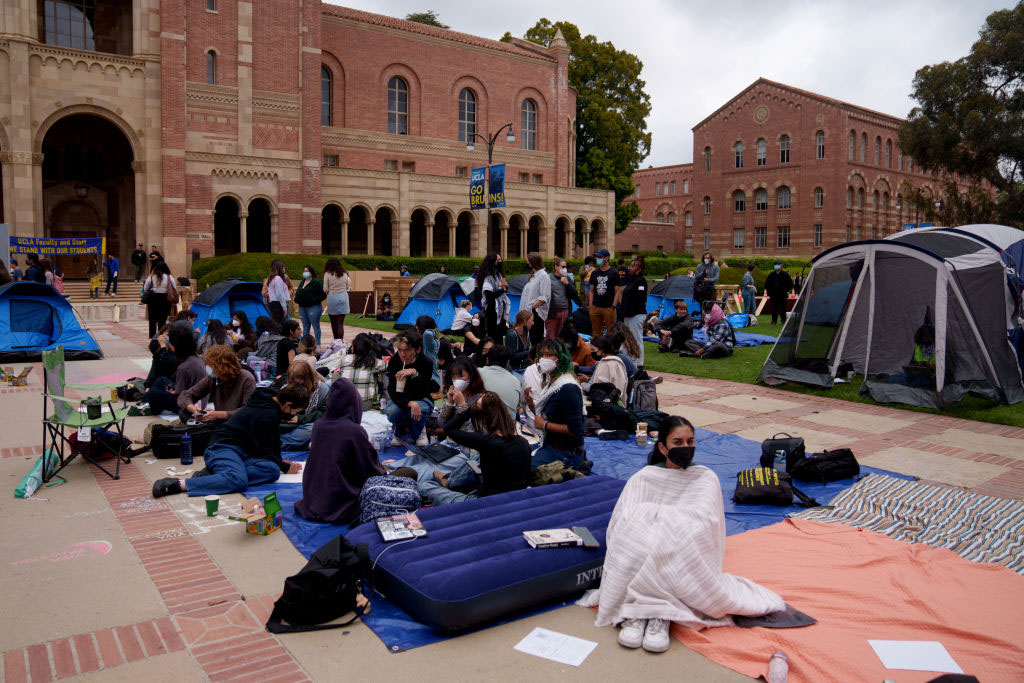
Tensions flared again on March 2 on the University of California, Irvine (UCI) campus as pro-Palestinian and pro-Israel students staged simultaneous demonstrations outside the administration building.

Shouting slogans like “Anti-genocide, anti-Israel” and waving signs equating Zionism with terrorism, several hundred anti-Israel demonstrators expressed solidarity with the “Irvine 11,” the group of UCI and University of California, Riverside students arrested last month after disturbing a speech by Israeli Ambassador Michael Oren on campus.

The group also protested disciplinary hearings currently being conducted against the eight UCI students by university officials.

The “Irvine 11 Speakout” was sponsored by the university’s Black Student Union and Students Fighting Against Tuition Hikes and Worker Layoffs, according to promotional fliers.

A YouTube video of the March 2 gathering shows an address to students by Russell Curry, a 2009 UCI graduate who says he was a member of a Viva Palestina USA convoy to Gaza last July and speaks in solidarity with the students arrested for protesting Oren’s speech. On the trip to Gaza, Curry says, “I have seen with my own two eyes the atrocities that happened there, and those are the reasons that Michael Oren was being protested.” UCI’s Muslim Student Union (MSU) is currently the subject of an
FBI investigation for allegedly collecting money on campus in May for that convoy; the money is alleged to have been delivered to Hamas.

A counter-protest by pro-Israel students took place nearby, with students waving Israeli flags and singing songs of peace. There to show support for Israel in the face of the boisterous anti-Israel rhetoric, several Jewish students nevertheless said the scene made them feel uncomfortable.

“I felt very different yesterday than at other times,” said Moran Cohen, president of Anteaters for Israel, a student group named for the school’s mascot, speaking to a group of two dozen Jewish students on March 3.

“I found myself trying to justify why Israel has a right to exist. We’re here at the university to learn and teach each other. You don’t need to justify why we have a right to live.”

Also on March 3, Israel Defense Forces reservists Lior and Inon spoke at UCI, sharing personal experiences of participation in Israel’s recent incursions into Gaza and Lebanon with two dozen Jewish students. (The soldiers requested that only first names be used for security reasons.) They spoke of Israel’s efforts to protect Palestinian civilians despite heavy fighting on the ground and encouraged students to form their own fact-based opinion about support for Israel. 

The speaking engagement was sponsored by StandWithUs.

All this followed a Feb. 26 statement issued by University of California President Mark Yudof and chancellors of the 10 UC campuses condemning “all acts of racism, intolerance and incivility.” 

“Regardless of how such offenses are rationalized, or what free speech rights they purport to express, the acts we have witnessed are unacceptable,” the group said. 

In a period that has witnessed numerous protests on UC campuses on a variety of student grievances as well as racist incidents at UC San Diego and UC Davis, the statement failed to name any individual episodes.

UCI Students Continue Israel Protests Read More »

Israel wants to produce nuclear energy

Israel announced its interest in producing electricity from nuclear energy at a conference in Paris.

Syria announced the same intention at Tuesday’s conference hosted by France to promote nuclear reactors.

“Israel is interested in being part of the circle of countries producing electricity from nuclear energy,” Infrastructure Minister Uzi Landau said at the conference, according to Haaretz.

“In a region like the Middle East, we can only depend on ourselves. Building a nuclear reactor to produce electricity will allow Israel to develop energy independence.”

Israeli officials told the French news agency AFP that it had plans to build a new plant as a joint project with Jordan and supervised by France.

Israel has a policy of ambiguity on whether or not it has nuclear weapons. It is not a signatory to the 1970 nuclear Non-Proliferation Treaty.

Israel has two nuclear facilities—a research reactor in Nahal Soreq and a reactor in Dimona.

Israel wants to produce nuclear energy Read More »

Britons honored for helping Holocaust victims

British Prime Minister Gordon Brown on Tuesday honored Britons whose extraordinary actions helped save Jews and other Holocaust victims during World War II, calling them a source of national pride.

Brown met two surviving recipients — Nicholas Winton and Denis Avey — at a reception at his Downing Street home, and praised the role of 26 others in saving the lives of those persecuted by the Nazis.

Britain has minted a new “Hero of the Holocaust” medal — a silver medallion — after a campaign by Jewish groups and lawmakers to win recognition for the bravery of those involved in the rescues.

Read the full story at GOOGLENEWS.

Britons honored for helping Holocaust victims Read More »

Biden says Israeli housing starts ‘undermining’ trust

Vice President Joe Biden denounced a decision to authorize new Jerusalem housing starts as “undermining the trust” that he needs to advance peace while in Israel.

“I condemn the decision by the government of Israel to advance planning for new housing units in East Jerusalem,” Biden said in a statement issued Tuesday, the second day of a visit that had been aimed at underscoring the closeness of the U.S.-Israel relationship. “The substance and timing of the announcement, particularly with the launching of proximity talks, is precisely the kind of step that undermines the trust we need right now and runs counter to the constructive discussions that I’ve had here in Israel.”

The “proximity talks” refer to a new round of Israeli-Palestinian talks the Obama administration had hoped to launch within the next few weeks.

Biden was referring to the announcement Tuesday by the Jerusalem District Planning Committee that it had authorized 1,600 units in Ramat Shlomo, an ultra-Orthodox neighborhood. The committee is jointly run by the Interior Ministry and the Jerusalem municipality.

A statement Tuesday evening by the Interior Ministry said that the authorization was merely “procedural,” that the plan had been in the works for more than three years and that Israeli Prime Minister Benjamin Netanyahu did not have prior knowledge of the plan.

Under U.S. urging, Netanyahu has partially frozen settlement building in he West Bank, but has refused to include disputed parts of Jerusalem in the freeze. Palestinian spokesman called the announcement Tuesday “dangerous.”

“With such an announcement, how can you build trust?” asked chief Palestinian negotiator Saeb Erekat, the Associated Press reported. “This is destroying our efforts to work with Mr. Mitchell,” a reference to George Mitchell, the U.S. special Middle East envoy who is serving as intermediary for the talks.

“It’s a really disastrous situation,” Erekat said. “I hope that this will be an eye opener for all in the international community about the need to have the Israeli government stop such futile exercises.”

Until Tuesday evening’s statement, Biden’s visit had been going as planned, and he had said that there was “no space” between Israel and the United States when it came to Israel’s security.

Biden and Netanyahu made statements to the media Monday after their two-hour meeting in Jerusalem that reportedly focused on the Iran nuclear issue. The U.S. leader reportedly warned Netanyahu not to order a unilateral strike on Iran, and worked to get him on board with allowing U.S.-backed increased sanctions to have time to work.

Netanyahu called Biden “a real friend to me, and a real friend to Israel and to the Jewish people.”

Biden says Israeli housing starts ‘undermining’ trust Read More »

The Seismic Jew

The last time I saw Christopher Hitchens speak publicly in Los Angeles, he argued against God and religion.  This time, delivering the eighth annual Daniel Pearl Memorial Lecture at UCLA on March 3, he sounded a warning against a resurgence of anti-Semitism.

A standing-room-only audience of more than 400 people turned out to hear the British-born author, who was introduced by Judea Pearl, an emeritus professor of computer science at UCLA and founder, with his wife, Ruth, of the foundation that carries the name of their son, the Wall Street Journal reporter slain by terrorists in 2002.

If the stakes of the issue weren’t already apparent, Hitchens took the stage and immediately made them so. He pointed out that he himself hadn’t discovered his own Jewishness until he was 38.  At that point in his life, he resolved, “Whatever tone of voice the question was put to me, whether it was friendly or hostile, ‘Was I Jewish,’ I would always answer ‘yes.’ “

Daniel Pearl, Hitchens pointed out, answered that question with his life.

“I pause to remember how proudly and how bravely and how nobly he refused any sort of refuge in denial,” Hitchens said.

Then, moving from the noble to the absurd, Hitchens screened TV news footage of actor Mel Gibson denying to a Jewish interviewer that he had ever made any anti-Semitic comments and asking the man if he didn’t “have a dog in this fight.”

Gibson, Hitchens said, is one of the more memorable faces of a hatred that is again ascendant.

“From the Muslim ghettos in Europe, to the proclamations in the Middle East, to the pronouncements of the Russian Orthodox church,” Hitchens said, “to Ratzinger himself, now pope,  restoring to the ranks the formerly excommunicated members of the Society of Pope Pius … it’s all coming back and needs to be confronted.”

“It’s the very bitch, I’m saying, anti-Semitism,” Hitchens continued. “This plague is very protean and very durable and very volatile.  … Just as you think it’s been eradicated, up it pops again, surges. It’s exploded with or without the existence of the state of Israel, with or without finance capitalism, for which Jews were blamed, and with or without communism, for which, amazingly, Jews were simultaneously blamed.”

Hitchens parsed anti-Semitism further. Is being anti-Israel necessarily anti-Semitic?  No — unless you deny the right of Israel to exist. Is questioning the facts of the Holocaust anti-Semitic?  No — unless you question its basic occurrence, too.  Is monotheism anti-Semitic?  Yes, said Hitchens, at least two-thirds of it is — Jews will never be forgiven for seeing Jesus as “just a crackpot rabbi and also a grave blasphemer, and Muhammad as a warlord. … You shouldn’t want to be forgiven for getting a thing like that right, but don’t go to any mushy ecumenical outreach meetings with these people.  It’s a waste of time.”

Don’t invite Christopher Hitchens and expect kumbaya.

In fact, the talk reiterated points Hitchens made in a Nov. 19, 2008 essay, but now with the added audiovisual effect of Gibson.

“I certainly don’t think it was the booze,” Hitchens said of the actor’s Malibu traffic-stop tirade. “But I can say that if whiskey made you anti-Jewish, the Pearl family would not have invited me to address them.”

Anti-Semitism endures, Hitchens said, because Jews represent cosmopolitanism, skepticism, the search for uncomfortable truths and creativity.

In this regard, Hitchens said, anti-Semitism can even be flattering.

Hitchens the atheist is a proud nonbeliever; Hitchens the Jew has adopted none of the rites, rituals or beliefs of his newfound faith, aside from a refined sense of imminent danger. He quoted Victor Klemperer, the German Jewish diarist whose writings eerily predicted the Holocaust: “You know, we Jews are seismic people.”

Wednesday’s talk was presented by the UCLA Burkle Center for International Relations, the Daniel Pearl Foundation and the Yitzhak Rabin Hillel Center for Jewish Life at UCLA. There and at a private dinner at philanthropist Ron Burkle’s home later, Hitchens didn’t entertain a load of contrary evidence that his seismograph may be off:
An Anti-Defamation League survey over the past two years shows levels of anti-Semitism have remained steady in seven European countries tested and actually declined in England.

A 2009 Pew poll found very slight increases in negative opinions toward Jews in Europe. Opinions about Muslims in almost all of these countries are considerably more negative than are views of Jews.

And, according to a Gallup poll released the same week Hitchens took the stage at UCLA, American support of Israel is at its “highest level in nearly 20 years.”

Few intellects are as potent as Hitchens’, but his central point is less nuanced than nerve-racking. Mel Gibson, after all, is not a threat — he’s a punch line. Hitchens demands proof of God but takes anti-Semitism on faith.

That leaves Hitchens’ final point — vigilance — as his strongest.

“Our task is to call this filthy thing, this plague, this pest, by its right name,” Hitchens said of anti-Semitism, “to make unceasing resistance to it, knowing all the time that it’s probably ultimately ineradicable, and bearing in mind that its hatred toward us is a compliment and resolving some of the time, at any rate, to do a bit more to deserve it.”

VIDEO TRANSCRIPT:
Hitchens on Anti-Semitism

Transcript of The Eighth Annual Daniel Pearl Memorial Lecyure

March 3, 2010

UCLA

        I can’t tell you how much of an honor it was for me to be asked by the Pearl family to do this, and I want to say to them how many people said to me when they heard or read that I was coming things that made it plain how they regarded the loss of your son as personal.

Whether they were Jewish or not, whether they were Americans or not, whether they were interested in the first amendment or whether they were journalists or not, there was something about the manner of his passing that will always remain with us.  If I lived in an uncivilized society, today could have been for me a kind of martyr’s day.  I was just taken by some very courteous and gallant young cadets to see the Veteran’s Memorial on the other side of this campus, where is commemorated second lieutenant Mark Daly, a young man who gave his life in Kurdistan a few years ago for the liberation of Iraq, and wrote very movingly to me about it and his service, and a man who I was hoping to meet and his family.  I’m very pleased now to count as I now with great pride claim the Pearls as if not family very close friends, and I thought to myself after I go to this memorial I have to go and speak for Danny, but justice at Mark’s scattering of his ashes, there will be today no ululations, no wailings, no shooting in the air, no tossing of the coffin on the shoulders of a mob, no hoarse, brutal cries for revenge and suicide and murder.  No, we won’t have that.  Instead, we’ll have honest, decent, modest, brave people trying to deal with their grief and trying to apply reason to the crises that led to their deprivation, and I think that marks if you like part of the boundary between civilization and barbarism that this lecture is designed to patrol and I would say enforce.

The Seismic Jew Read More »

Birthright Judaism

Why is it so expensive to live a Jewish life? Since Jewish continuity and vitality are such communal priorities, and since the great majority of Jewish students today
are not getting a Jewish education, why has the Jewish community not done more to help in this area? And what could it do to change that?

These are some of the questions explored in “The High Cost of Jewish Living,” a lengthy, brilliant and depressing article this month in Commentary magazine. The article’s author, Jack Wertheimer, a history professor at the Jewish Theological Seminary and one of the leading lights of the Conservative movement, dissects the problem and comes to some pretty downbeat conclusions.

First, there’s the numbers game. It’s just really expensive to lead a Jewish life. Add it all up, Wertheimer says, and “an actively engaged Jewish family that keeps kosher and sends its three school-age children to the most intensive Jewish educations can expect to spend somewhere between $50,000 and $110,000 a year at minimum just to live a Jewish life.”

This problem might be more acute today, but it’s hardly new. Wertheimer quotes from an address to the General Assembly of Jewish federations almost two decades ago, when Jacob Ukeles spoke about the idea that “living Jewishly shouldn’t force people into poverty.” But, as Wertheimer says, “The message fell on deaf ears … and there is little evidence that the problem is drawing more attention today.”

There are many reasons for this, he explains, not least the fact that the financial resources of Jewish organizations are “severely limited.” But more important than money is the question of attitude: “The prevailing attitude of too many in positions of authority is that affordability is a private matter. If families want to live an observant life, they alone should bear the costs. Why privilege day-school families? Most Jewish children attend far less costly part-time Jewish schools or receive tutoring. Let those who want
more pay for it themselves.”

What this cold calculus misses, Wertheimer says, is “any recognition that Jews well-versed in their religious culture are adding to American Jewish society. A disproportionate number of leaders and activists have been shaped by the most immersive forms of Jewish education. As for the rank and file, we would expect a community that places a great value on general education for all to ensure a comparably high level of literacy in Judaica.”

He bemoans the lack of “a principled appreciation for the responsibility Jews must assume for building Jewish social capital so that there will be a vital Jewish community in the future. A proud and self-confident community would do all in its power, or so one would think, to prepare its youth for active participation in Jewish life.”

This widespread Jewish illiteracy across America has made it easier for Jews and philanthropists to gravitate toward what they know best and what they feel most comfortable with: that is, the idea of tikkun olam, about which Wertheimer quotes Cynthia Ozick’s “dead-on” observation that “universalism is the parochialism of the Jews.”

He writes: “The measure of Tikkun Olam’s authenticity, it would seem, is that it be solely a Jewish mission to the Gentiles,” and then wonders why “this effort to repair the world cannot also extend to aiding fellow Jews.” He notes that this shift of attention away from our own community has had severe fiscal consequences, to the point that “insufficient resources are available to meet the basic needs of the American Jewish community.”

Wertheimer has the courage to take on a sacred cow — tikkun olam — but he does so in the service of something just as vital: building Jewish literacy and connecting Jews to their tradition and their people. He lays out several ideas to advance this cause, from getting funding from government agencies to creating volunteer-based programs like a Jewish Teach for America.

Above all, he makes a passionate case that the advancement of Jewish literacy ought to be a communal enterprise.

So, what can the Jewish community do to help? Well, I think one way to approach this — and attract more philanthropic interest — is to make the advancement of Jewish literacy more of a mainstream project like Birthright Israel. If a journey to Israel is a Jewish birthright, shouldn’t a journey to Judaism also be?

The idea would be to create a fun, free and adventurous “Birthright Judaism” program that would introduce thousands of unafilliated Jewish teens to the Jewish tradition.

The program would borrow from the classic camp experience, but would be more focused on advancing Jewish literacy.
Birthright Judaism wouldn’t really address the question “How can I afford to live a Jewish life?” but it might answer an even more important one: “Why should I want to?

David Suissa is the founder of OLAM magazine and OLAM.org. You can read his daily blog at suissablog.com and e-mail him at suissa@olam.org.

Birthright Judaism Read More »

Jews and God — a Troubled Relationship

We Jews need to face a sad, even tragic, fact. Things are not going very well in the relationship between God and most Jews.

All polling data agree that among Americans, Jews believe in God less than any other ethnicity or religion-based group. More Jews are agnostic, more Jews are atheist, more Jews are secular than any other group.

I would like to address two questions: Is it tragic? And why is it the case?

Yes, it is tragic. The human being needs God.

By “God,” I mean the Creator God of our Bible, a God who transcends nature, a God who knows each of us (though that does not mean He necessarily acts within our lives) and a God with a moral will who judges all humans.

Any other God is functionally equivalent to atheism. A God who made the world but who doesn’t know us is as irrelevant as no God. A God who does not transcend nature, but is within it, is pantheism. A God who created the world but does not judge His creations is an amoral, therefore evil, God.

Even science is increasingly discovering that the human brain is wired for God and religion. But one doesn’t need science to make the case for the necessity of belief in the Transcendent. If there is no God, life is pointless. Secularists who deny this are fooling themselves. I completely respect one who just finds belief in God too difficult. But such a person needs to be intellectually honest and acknowledge that if there is no God, we are all nothing more than molecular coincidences, of no more intrinsic significance than grains of sand on a beach. With no God, we are sand grains with self-consciousness, and that is all we are.

There is a second reason it is tragic that so many Jews do not believe in God. We are the people who introduced God to humanity. Whatever one’s belief level, it has to be acknowledged that it is sad that the people who brought God into the world are among the most alienated from Him.

How did this happen?

This is a considerably more complex question than the first. It is a lot easier to explain why Jews’ or anyone else’s alienation from God is tragic than it is to explain why Jews are disproportionately alienated from God.

But given the overwhelming importance of the subject — after all, if Jews believed in the God described above, we would have an enormously powerful impact on the world — it is worth giving it a try.

One reason has to be the amount of suffering Jews have endured because they were Jews. It is very hard, if not impossible, for many Jews to speak of God’s concern, let alone love, for Jews in light of the millennia of horrific suffering we have experienced.

As it happens, the hatred that the most evil individuals and regimes in every age have for the Jews confirms for this Jew that the Jews are indeed God’s Chosen People.

Willy-nilly, we are the world’s moral compass. This does not mean all Jews are good. Such a proposition would be ridiculous. It is only to say that when a group or ideology hates the Jews, you know the moral compass reads “evil.”

But I admit that there is a price paid here. While I am certain of Jewish chosenness, I do find it hard to say the many Jewish prayers describing God as shielding and saving Jews.

The fact is that Jewish suffering has hurt the God-Jews relationship.

A second factor contributing to Jewish secularism, agnosticism and atheism was the Orthodoxy of the shtetl and ghetto. As soon as Europe’s ghetto walls were broken, vast numbers of Jews left Jewish practice and either immediately or eventually left Jewish faith in God as well. The ghetto and shtetl left most Jews ill-prepared for either the wholesome or unwholesome temptations of Western Christian and Western secular life. Even today, Orthodoxy — in the Jewish state itself — does not do well in attracting secular Israeli Jews to Judaism. And, within Israel, the Conservative, Reform and Reconstructionist movements have fared worse. We Jews have now had a Jewish state for more than 60 years, yet few secular Israeli Jews have embraced any of Judaism’s organized expressions. Indeed, it seems that many secular Israeli Jews begin taking
Judaism — and even Jewish identity — more seriously after they move to America. I have often thought that if all Israeli Jews could live in America for a year, and all
American Jews could live in Israel for a year, we would have far more committed Jews.

A third reason for Jewish secularism is widespread Jewish identification of religion with backwardness and oppression. Most secular Jews associate Orthodox Judaism with the former and Christianity with the latter. Neither is fully fair. Yes, Orthodoxy does have its backward elements — how else to describe Orthodox Jews who violently demonstrate against the building of a Jerusalem parking lot that will be used on Shabbat? And Christianity’s record vis à vis the Jews has been abysmal. But Orthodoxy is far broader than violent demonstrations against parking lots, and Christianity in America has been a unique blessing to Jews. It is entirely unfair to saddle America’s
Christians with the sins of Europe’s Christians.

A fourth reason is that Jews are disproportionately highly educated, and modern higher education is essentially a secular brainwash. Anyone who goes from kindergarten to graduate school is likely to have received as thorough a secular brainwash as one who has gone from a Christian kindergarten through a Christian seminary is likely to have received a religious brainwash.

Whatever the reason, the Jews’ alienation from God is a major tragedy for us as individuals, for us as Jews and for the society at large, which would benefit enormously if Jews, with our influence in academia, media and politics, would lead people to God rather than from God.

Dennis Prager is a nationally syndicated radio talk show host, columnist, author and public speaker. He can be heard in Los Angeles on KRLA (AM 870) weekdays 9 a.m. to noon. His Web site is dennisprager.com.

Jews and God — a Troubled Relationship Read More »

The Rahm Emanuel Show

It was a very strange sight.  There in The Washington Post was an article by reporter Dana Milbank making a case that White House Chief of Staff Rahm Emanuel’s excellent advice has been ignored by a naïve President Barack Obama and that Emanuel is the great unappreciated asset of a collapsing administration with a weak staff. Several other stories followed with the same theme, including a laudatory column by right-winger Jonah Goldberg in the Los Angeles Times, another article in the Post and yet another in The New York Times going off on the rest of the staff. While Milbank swore that Emanuel was not his source, it was obvious to anyone who knows how the Emanuel media network operates in Washington that the chief of staff’s “people” inspired this clumsy public relations blitz.

This at the moment when Obama was finally getting off the sidelines to throw every single chip into the pot, trying to lead congressional Democrats to their greatest legislative victory since Medicare in 1965.  With friends like this …

Not since Donald Regan hung up on first lady Nancy Reagan has a White House chief of staff (or his friends) demonstrated such disloyal and self-destructive behavior. 

Even David Broder, The Post’s defender of Washington conventional wisdom, who largely agrees with much of Emanuel’s view of the world, was appalled and said so in his column.

What makes the story more interesting, though, is how it illuminates the continuing evolution of the Democratic Party from a timid, reactive group of individuals to an actual governing party.

Emanuel and Obama are contemporaries and friends, but, despite their common roots in Chicago, they are very different. Emanuel served Bill Clinton in the White House, and in a party dominated by high-minded, thoughtful leaders, Emanuel was a breath of fresh air with his down-to-earth, aggressive and profane style. He had absorbed the Clinton cleverness, especially at ideological cross-dressing and minimalist policy: Stick close to the Republicans on sensitive issues like national security and win on a few progressive ones. It was a highly aggressive tactical approach to a basically defensive strategic program. It was well suited for Democrats who wanted to survive in a Republican-run world.

But by 2008, Emanuel’s skill at getting big donors to fork over money (shown in the successful Democratic effort to take back the House in 2006) became secondary to the record-breaking number of small donors who powered the Obama campaign. The words “Democratic base” began to mean something. Thousands of people flooded into Obama rallies. Folks traveled from blue states to contested states to walk precincts. People read everything they could get their hands on. It was electric.  It was Obama’s world. But it was not Emanuel’s world. It was not Hillary Clinton’s world.

Nevertheless, the victorious Obama people valued Emanuel’s unique skills at the insider’s game. In his book on the campaign, David Plouffe wrote that they saw Emanuel as the best person in the United States to lead the new White House team. 

The alliance was perfect: the intellectual Obama and the hard-as-nails chief of staff, the outsider with a vision of hope and the insider enforcer. Obama joked that when Emanuel lost a middle finger in an accident when he was younger, it “rendered him mute.” The choice showed Obama’s wisdom in recruiting a tough veteran of congressional battles in light of the struggles to come.

And, indeed, Emanuel was the right man to get the stimulus package through in early 2009. He worked the deals to get a few key Republicans on board, even at the cost of some good provisions. And the stimulus package has made a real difference in the economy.

But health care, as we by now know all too well, lost momentum — first, thanks to the dithering of Montana Democrat Max Baucus’ bipartisan Gang of Six, and then to the insider horse trading common among pols but distasteful to the electorate.

The result was that by the fall of 2009, polls were showing overwhelming energy among Republicans and a deeply depressed and immobilized Democratic base. Democrats lost key elections in Virginia and New Jersey, and then, shockingly, in Massachusetts.

As Democrats fight to salvage their agenda in the face of difficult midterm elections next fall, Obama is now doing what he needed to do all along — taking a strong leadership role with nervous Democrats from both the House and Senate, as well as with the liberal and conservative wings of the party. There is no going back. He can’t stand on the sidelines. He needs Democrats to get the work done and prove their value as voters compare to them to Republicans in total opposition. And Democrats need
Obama to succeed and to hold his team together at this moment of greatest peril and greatest hope.

And so the timing of Emanuel’s fit of pique (or, to be precise, the pique displayed by his friends and allies) is both odd and revealing. Things were fine when Obama followed Emanuel’s advice on the stimulus package, which was sound and led to success. But now Obama is turning away from Emanuel’s advice on health care (which we are told in these articles was to focus not on health care, but on jobs) and pushing into infinitely difficult territory. This is a moment when Obama and the Democrats could make history. This could be the defining vote of every member of Congress’ career.

Perhaps Emanuel just wants to leave the job and get back to Congress before his successor gets too comfortable in Emanuel’s former House seat — it’s well known that he has long dreamed of being the first Jewish speaker of the House. But I hope he will stay and live up to the challenge he took on. Emanuel should understand that Democrats need more than a repeat of the Clinton years. He is right about a lot of things, but the ones he isn’t right about are awfully important.

While a party that can’t reach out to Republicans will not succeed, a party that looks for Republicans to hide behind will fail. While a party that can’t keep its moderate and conservative members in the tent will not succeed, a party that lets that wing of the party block legislative victory will fail. While a party that can’t raise money and negotiate on Capitol Hill will not succeed, a party that abandons its newly won base will also surely fail.

If Obama keeps Emanuel on, let’s hope that he will guide this missile of a man in the right direction.

And, meanwhile, maybe Emanuel should tell his friends to stop helping him out.

Raphael J. Sonenshein is chair of the Division of Politics, Administration, and Justice at California State University, Fullerton.

The Rahm Emanuel Show Read More »

Rethinking Palestine: A Paradigm Shift From the Political to the Humanitarian

It is time for the proponents of the two-state solution to admit that the Palestinians have failed the test of history in staking their claim for statehood.

A dispassionate evaluation of the events of the past two decades inexorably compels one toward an increasingly evident conclusion: The Palestinians seem far more focused on annulling Jewish political independence than attaining Palestinian political independence, far more committed to deconstruction of the Jewish state than to construction of a Palestinian one.

Accordingly, further pursuit of a Palestinian state is likely to prove both futile and detrimental. For as past precedents strongly suggest, it will advance neither peace nor prosperity, but only serve as a platform for further violence against Israel.

Thus, both political prudence and intellectual integrity inevitably militate toward the distinctly politically incorrect conclusion that establishment of a Palestinian state must be removed from the international agenda as an objective that is either desirable or feasible — and certainly as an objective that can be reconciled with long-term survival of Israel as the nation-state of the Jewish people.

However, even if the Palestinians’ spurious political demands for statehood are removed from the discourse, the grim realities of the Palestinians’ humanitarian predicament remain. This is the issue that Israel and the international community should focus on.

Cleary it is not possible in a single op-ed to provide either a comprehensive presentation of any far-reaching departure from conventional wisdom or persuasive argumentation to justify its component elements. The most that such severe constraints allow is to sketch the outlines of the proposal — and to hope that this will spark a wider, more detailed debate of the proposal’s feasibility, economic costs, international acceptability and its relative merits compared to other currently espoused alternatives.

Subject to this caveat, what would the elements of such an alternative paradigm comprise? To be comprehensive it would need to entail three constituent elements, all eminently libertarian. Two involve eliminating discriminatory practices against the Palestinians (a) as refugees and (b) as residents in Arab countries. The third involves facilitating free choice for individual Palestinian breadwinners to determine their own and their families’ future.

A brutally condensed tour de raison of the proposal begins with the refugee issue and the body responsible for dealing with it, the United Nations Relief and Works Agency (UNRWA). While a detailed account of the pernicious and obstructive role UNRWA plays is beyond the possible scope of this piece, I must stress that it is a highly anomalous organization that perpetuates a culture of Palestinian dependency and the unrealistic narrative of “return.” All the refugees on the face of the globe are under the auspices of the United Nations High Commission for Refugees (UNHCR) — except for the Palestinians. For them a unique separate institution exists — UNRWA. Unlike the UNHCR, UNRWA’s definition of refugees includes migrant and temporary workers who were resident in Mandatory Palestine for less than two years and their
multigenerational descendants. The far-reaching significance of this can be condensed into the remarkable fact that if the universally accepted UNHCR criteria for refugees were applied to the Palestinian case, the number of “refugees” would shrink from close to 5 million to around 200,000. These figures starkly illustrate that both the scale and the durability of the Palestinian refugee problem is fueled by the distorted parameters of its definition. There is growing consensus that without abolishing UNRWA and folding its operations into UNHCR, no way out of the Palestinian-Israeli impasse is possible.

Folding UNRWA into UNHCR would of course have significant ramifications for large Palestinian populations living in the Arab countries, who would no longer receive the anomalous handouts paid to them. This leads to the second element of the proposal: the grave ethnic discrimination against the Palestinians residing in the Arab world, where Palestinians have severe restrictions imposed on their freedom of movement, employment opportunities and property ownership. But most significantly, they are denied citizenship in the countries where they have lived for decades. Palestinians living in these Arab countries overwhelmingly desire this citizenship — as numerous opinion surveys indicate. Accordingly, with the abolition of UNRWA and the accompanying changes in eligibility for refugee aid, a diplomatic drive must be mounted to pressure Arab governments to end their ethnic discrimination against the Palestinians; to desist from perpetuating their stateless status and allow them to acquire citizenship in countries where they have resided for decades.

This brings us to the third and final element of the proposal: Allowing individual Palestinians under Israeli administration to exercise free will in determining their destiny.
While the first two elements of the proposed solution are directed toward easing the plight of the Palestinians in the Arab world, this measure is aimed at those inside Israeli-administered areas.

In essence, it involves enabling individual Palestinians free choice in charting their future and that of their families. These efforts should focus on two major elements:

(a) Generous monetary compensation to effect the relocation and rehabilitation of the Palestinian residents in territories across the 1967 “Green Line,” elsewhere in   the world, presumably predominantly — but not necessarily exclusively — in Arab/Muslim countries.

(b) “Atomization” of the implementation by making the offer of compensation and relocation directly to the heads of families and not through any Palestinian organization that may have a vested interest in foiling the scheme.

Although some may raise a skeptical eyebrow as to the proposal’s acceptability to the Palestinians and its economic feasibility, two points should be underscored. 

Firstly, substantial statistical data indicate that a large portion of the Palestinian population would enthusiastically embrace such a measure. According to a 2004 poll conducted by the Palestinian Center for Public Opinion, only 15 percent would refuse any financial offer that allows them to seek a better life elsewhere, while over 70 percent would accept it. Indeed, given the choices of a life either under the rigors of Israeli control or worse, under the regressive regime that the Palestinians have hitherto provided, who could blame them?

As for the overall economic cost, the proposed plan would be comparable to any alternative under discussion — establishing a new state, developing its infrastructure and presumably absorbing a large portion of the Palestinian Diaspora within its constricted frontiers.

Finally, it should be remembered that for the prospective host nations, this scheme has a distinct economic upside. Given the scale of the envisioned compensation, the Palestinian immigrants would not be arriving as destitute refugees, but as relatively wealthy families in terms of average world GNP per capita. Their absorption would entail significant capital inflow into the host economies — typically around half a billion dollars for the absorption of every 2,000 to 3,000 family units.

The time has come for imaginative new initiatives to defuse one of the world’s most volatile problems for which remedies hitherto attempted proved sadly inappropriate. Accordingly, there seems ample reason to seriously address an alternative proposal, which at least, prima facia, will: 

* Defuse the Palestinian humanitarian predicament

* Inject billions of dollars of funds into the economies of host nations

* Ensure the continued survival of Israel as the nation state of the Jewish people

Israel, the Palestinians and the international community can ill afford to dismiss it without a serious debate of its potential payoffs as well as its possible pitfalls.

Martin Sherman is currently the visiting Israeli Schusterman scholar at USC/HUC-JIR and the academic director of the Jerusalem Summit. He lectures in the security studies program at Tel Aviv University, served for seven years in operational capacities in Israel’s defense establishment and was a ministerial adviser to the Yitzhak Shamir government.

Rethinking Palestine: A Paradigm Shift From the Political to the Humanitarian Read More »

Everyday Objects, Artist’s Whimsy Form Famous Faces

Bright pink salami cold cuts and tiny bottles of liquor make up the face of Boris Yeltsin. Madonna has a red kabbalah string for a mouth; Barbra Streisand a large black microphone for a nose. And Albert Einstein sports a mane of white electrical cables.

Israeli artist Hanoch Piven’s amusing portraits of famous people are assembled from common objects imbued with references that seem both surprising and inevitable.

They include portraits of world leaders, celebrities, historical figures and pop-culture icons, and have been published in The New Yorker, Rolling Stone and Haaretz for more than 20 years. Now Piven’s work is being brought together for the first time, in an exhibition currently at the Skirball Cultural Center.

“Making Faces” includes images of Barack Obama, Golda Meir, Steven Spielberg, Charles Darwin and a never-before-seen portrait of gov. Arnold Schwarzenegger, with a slice of American apple pie for his nose. Sixteen large-scale giclee (inkjet) prints will be on display, as well as six original collages that don’t use perishable Piven favorites — such as bananas, doughnuts and chicken legs.

“We strive to make art part of everyday life here at the Skirball,” the museum’s associate curator, Tal Gozani, said. “And that is very much what Hanoch does in his own work and in his workshops, so we knew he was a perfect fit for us.”

Piven conducts art workshops around the world, including at an oncology unit in an Israeli hospital, at a conference with business executives in Greece and for schoolteachers in Barcelona, Spain. The workshops help make art accessible to nonartists of all ages and help people communicate in a nonverbal way.

“This has been useful for people who want to express something that’s difficult for them with words, like people with traumas,” said Piven, who has worked with art therapists in Israel to adapt his workshops from purely recreational to therapeutic.

A 2007 post on his blog, Drawger, titled “Art After Wartime,” describes a therapeutic art workshop he conducted with current and former Israeli soldiers suffering the emotional effects of combat.

“There was a 55-year-old veteran of the Yom Kippur War with PTSD [post traumatic stress disorder] who told me that he had not sat down to do art since kindergarten,”
Piven said in a phone interview from Rome. “The nonjudgmental, fun, relaxing space opens issues up for people without them even knowing it. One of the art therapists once described it as a ‘bungee jump of the subconscious.’ ”

One soldier’s self-portrait, made of a Spider-Man figurine, dish scrubber, pocket watch and cork stoppers, is featured on Piven’s blog. The anonymous soldier wrote: “I was afraid at first to come to the shop, and I guess that it wasn’t easy on anyone, but at the end I was very happy that I came. … One of the issue[s] that I tried to show [is] that we are not heroes! even not Spiderman! and we all need help in one way or another in our life and we should not be a shame to ask for it!!! Thank you hanoch from all my heart.”

Because of their shared interests, Piven is giving a workshop in Los Angeles on March 15 with Piece by Piece, a nonprofit that hosts art workshops using recyclable materials in underserved communities, teaching participants marketable skills while nurturing creativity and fostering self-confidence.

“Hanoch Piven shares our same philosophy: creating something whole and beautiful from broken pieces — broken hearts, broken families, broken wills,” said Sophie Alpert, the organization’s founder.

Consul General of Israel in Los Angeles Jacob Dayan and his wife, Galit, are responsible for bringing Piven to Los Angeles for the Skirball exhibition and the Piece by Piece workshop, one of several the artist will conduct during his visit, including a few at the Skirball for children and adults.

“Hanoch is absolutely huge in Israel,” Jacob Dayan said of his personal friend, noting that some of the artist’s work currently hangs in Israel’s Ben-Gurion Airport, and three portraits of Israeli dignitaries are also displayed at the consulate in Los Angeles. Piven has also written and illustrated six children’s books and will be debuting an iPhone collage art application, called Faces IMake, in Los Angeles on March 19.

“He is a unique and engaging artist whose art is interactive and accessible and brilliant,” Dayan said. “In terms of the exhibitions we [the consulate] are doing this year, this is the most outstanding by far.”

“Making Faces” runs through July 11 at the Skirball Cultural Center, 2701 N. Sepulveda Blvd., Los Angeles. For more information, call (310) 440-4500.

Everyday Objects, Artist’s Whimsy Form Famous Faces Read More »