

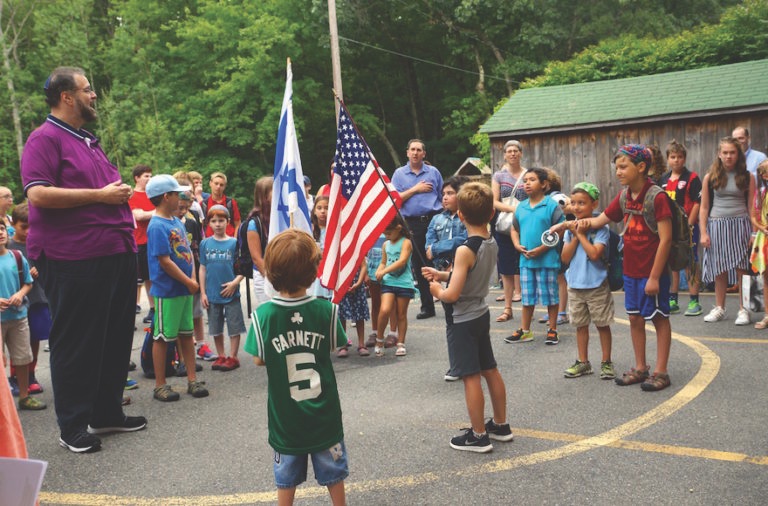
When the Jewish Community Day School in Watertown, Mass., decided several years ago to hire a former MTV producer to bring a “fresh voice of Jewish spirit” to the school, it was part of a broader goal: To bring the joys of summer camp to the school year.
The institution already was on its way. A tradition had begun on Yom Kippur eve. The whole school dresses in white and heads to a bridge over the Charles River, where they sing, listen to stories and throw birdseed into the water as part of the traditional tashlich ritual of casting away sins.
After hiring the producer, Oren Kaunfer, as a spiritual educator, he began leading the service.
“Everyone is sitting on the ground. It’s got a camp feel to it,” Kaunfer said. “It’s taking Jewish experiences and making them more memorable and exciting and deepening them.”
Increasingly, schools are emphasizing informal learning rather than lectures and drills.
Kaunfer also accompanies students on two camp-like overnight nature trips for sixth- and seventh-graders as part of the pluralistic school’s Jewish environmental education curriculum.
“When trying to describe my job, I do often say, ‘I bring camp to school,’ ” he said.
The annual transition from summer camp’s informal and highly spirited atmosphere to the more regimented, high-pressure and maybe even occasionally boring environment of school long has been one of the jarring changes of fall, right up there with cooler nights and earlier sunsets.
Yet increasingly, the differences between school and camp aren’t as stark as they used to be.
The trend of Jewish schools trying to integrate more of the positive elements of camp into the school year — without sacrificing academic rigor — mirrors what’s going on in American education overall.
Schools increasingly are emphasizing informal, experiential and project-based learning rather than lectures, worksheets and drills. This approach, the thinking goes, will better prepare students to be lifelong learners in the global economy and the internet age.
With Jewish education, there is particular interest because research has found that the Jewish identity-building benefits of summer camp are particularly strong.
“Adults who had a Jewish overnight camp experience as children are significantly more likely to exhibit Jewish behaviors as adults,” said University of Miami demographer Ira Sheskin.
The key, of course, is not just to bring elements of camp into the classroom, but to do so in a way that enhances day schools’ Judaic and academic rigor.
Schools are adopting a variety of camp-like tactics and strategies, including mentor relationships between older and younger students, character education and field trips, noted Rabbi Avi Orlow, vice president for program and innovation at the Foundation for Jewish Camp.
At MetroWest Jewish Day School in Framingham, Mass., teachers are called by their first names to make them more accessible. The school day begins with the singing of “Hatikvah,” the Israeli national anthem.
‘‘What can we do to make school feel more like camp is very prevalent,” said Bil Zarch, director of Camp Yavneh, a Jewish overnight camp in New Hampshire. Having led day schools in Baltimore and Massachusetts, he has seen both sides of the issue.
When his own child attended Lander-Grinspoon Academy, Zarch said, the school marked Sukkot by having students harvest crops on the adjacent farm, learning about the biblical commandments of pe’ah and leket, and then delivering the harvest to a food pantry that helps low-income families and individuals.
Day schools have to contend with many constraints absent from camp, including state mandates, grades and report cards. Increasingly, though, educators are realizing that the team-building, leadership and energy of a summer camp-like experience may be critical to preparing students for college — and for life.
Ira Stoll reports for the Jewish Telegraphic Agency.
































