An ancient Japanese legend holds that anyone who folds 1,000 origami cranes will be granted a wish. If three L.A.-area day schools were to get one, it might be for peace and understanding.
Pasadena's Weizmann Jewish day school hosted an interfaith origami session on Tuesday, May 6, inviting students from the Muslim New Horizon School in Pasadena and the Episcopal St. Mark's School in Altadena to participate in the annual Origami Peace Tree Project, an international celebration of coexistence through the precise and relaxing practice of paper folding.
The three schools meet several times throughout the school year to participate in collective singing and cross-cultural activities. This latest project will be sent to Jerusalem, which is hosting the Peace Tree Project for the first time this year. The art will be displayed as a canopy resting atop the point, or crease, where the Jewish, Muslim and Christian quarters meet in the Old City.
The festival, which began in 2000 as a Russian family's demonstration of peace, has since become an international declaration of tolerance and friendship. This year, the project visits Italy in addition to Jerusalem, although Israel's hosting will specifically highlight the Jewish-Christian-Muslim relationship. In recent years, the project has visited Brazil, Poland and India.
“You don't need language to fold, just a folding language as you look at each other and smile,” said Miri Golan, manager of the Israeli Origami Center, the parent organization of the Folding Together Origami Project, a program that unites Israeli and Palestinian children and serves as the official host of the Peace Tree Project in Jerusalem.
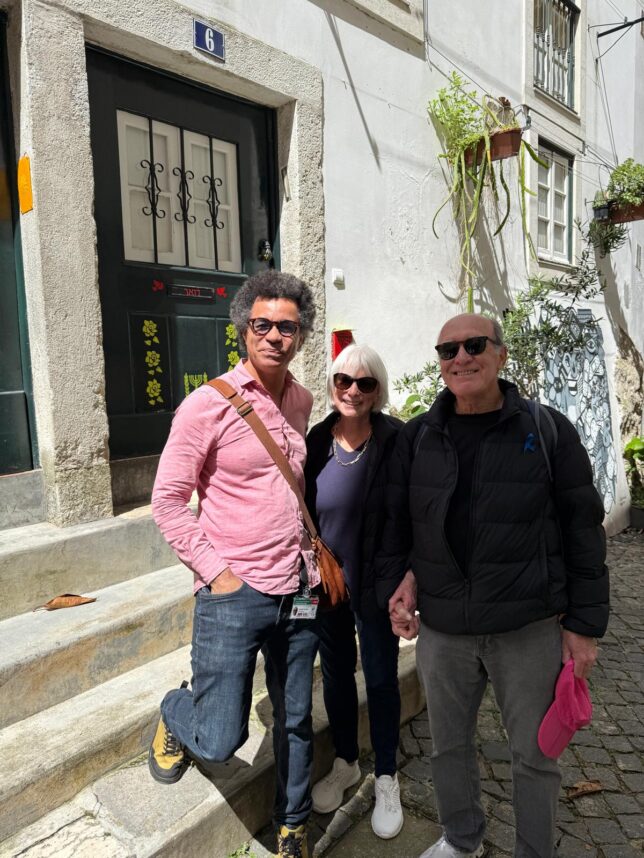
Origami expert, author and community member Joel Stern helped organize the schools' cooperation alongside Lisa Feldman, head of school for Weizmann. Stern, a friend of Golan's, was searching for appropriate schools to work with when he was informed of the already progressive relationship among the three schools.
The gathering was essentially a microcosm for the larger festival, which will bring 800 children of the three faiths to the Old City for special origami workshops at the end of July.
Although the project has a religious focus, one of the main criteria for submitting origami is that the art bears no religious ideology. Organizers want to keep the display as secular as possible — no stars, crescents, crosses or angels.
One reason the Japanese art form works so well is because of its neutrality to the three religions, Golan explained.
The three schools' contribution will have a special place at the Peace Tree Project, said Golan, who was thrilled by Stern's unique approach.
“The goals are to actively and symbolically demonstrate that people, regardless of their ethnic origins, can find common grounds for friendship, ” Stern said.
Students from the three schools seemed to agree.
“It's a good experience I'll keep for a while,” said Yusef Trad, a New Horizon eighth-grader.
Robert Cartwright, a sixth-grader at St. Mark's, enjoyed the opportunity to interact with “kids who are so similar to us,” he said.
Weizmann sixth-grader Adam Latham said the event was “good for meeting new friends and learning about one another's religion.”