
“Anyone who does not recognize the Jewish people and the State of Israel — and their right to exist — is guilty of anti-Semitism” – Pope Francis
“I think a good baseline [for when anti-Zionism becomes anti-Semitism] is: Do you think that Israel has a right to exist as a homeland for the Jewish people…If your answer is no…then that is a problem” – President Barack Obama
“Criticism of Israel that is based on anti-Zionism — that’s anti-Semitism today, this is the refuge of those who do not accept the State of Israel” – French Minister Manuel Vall
“This is the face of the new anti-Semitism. It targets the Jewish people by targeting Israel and attempts to make the old bigotry acceptable to a new generation… what else can we call criticism that selectively condemns only the Jewish state and effectively denies its right to exist, to defend itself while systematically ignoring, or excusing, the violence and oppression all around it?” – Canadian Prime Minister Stephen Harper
In 2005, the U.S. State Department adopted a definition of anti-Semitism based on the International Working Definition of the European Union’s Fundamental Rights Agency (EUMC), a joint project of international scholars, government officials, and representatives of civil rights and community organizations. Besides its adoption by the U.S. State Department, numerous national and international agencies have used, referenced and recommended the EUMC definition, including the U.S. Civil Rights Commission, the Organization for Security and Co-operation in Europe, and the Inter-Parliamentary Coalition for Combating Antisemitism.
The importance and utility of the definition derive from its understanding that contemporary anti-Semitism manifests itself through anti-Zionism. The State Department definition makes an important distinction. It recognizes that while criticism of Israel similar to that lodged against another country is not anti-Semitism, expression which demonize and delegitimize the Jewish state, or deny its right to exist, is unequivocally anti-Semitic.
The Jewish community understands this.
In 2011, the following statement affirming the State Department’s understanding of anti-Semitism was signed by the leaders of 61 Jewish communal organizations, including AIPAC, American Jewish Committee, Anti-Defamation League, Conference of Presidents of Major Jewish Organizations, Hadassah, International Hillel, Jewish Federations of North America, all three major Jewish denominations (Orthodox Union, United Synagogue of Conservative Judaism, and Union for Reform Judaism) as well as both the Republication Jewish Committee and the National Jewish Democratic Council: “We, the undersigned members of the Jewish community…recognize and accept that individuals and groups may have legitimate criticism of Israel policies. Criticism becomes anti-Semitism, however, when it demonizes Israel or its leaders, denies Israel the right to defend its citizens or seeks to denigrate Israel’s right to exist.”
Jewish college students understand it.
- “The rhetoric I heard from students opposing Israel at this meeting could easily be equated to arguments that I have only seen in quotes at museums or mentioned in textbooks for their use in the justification of historical persecution of the Jewish race.” (Margaux, University of California Santa Barbara)
- “Clearly motivated by anger about the conflict between Israelis and Palestinians, these [social media] posts expressed vitriol not toward only Zionists but also toward everybody of the Jewish faith, toward all Jews on this campus, toward me. I am not ashamed to say that this hatred moved me to tears.” (Shoshana, University of Chicago)
- “People say that being anti-Israel is not the same as being anti-semitic. The problem is the anti-Israel culture in which we are singling out only the Jewish state creates an environment where it is ok to single out Jewish students.” (Natalie, UCLA)
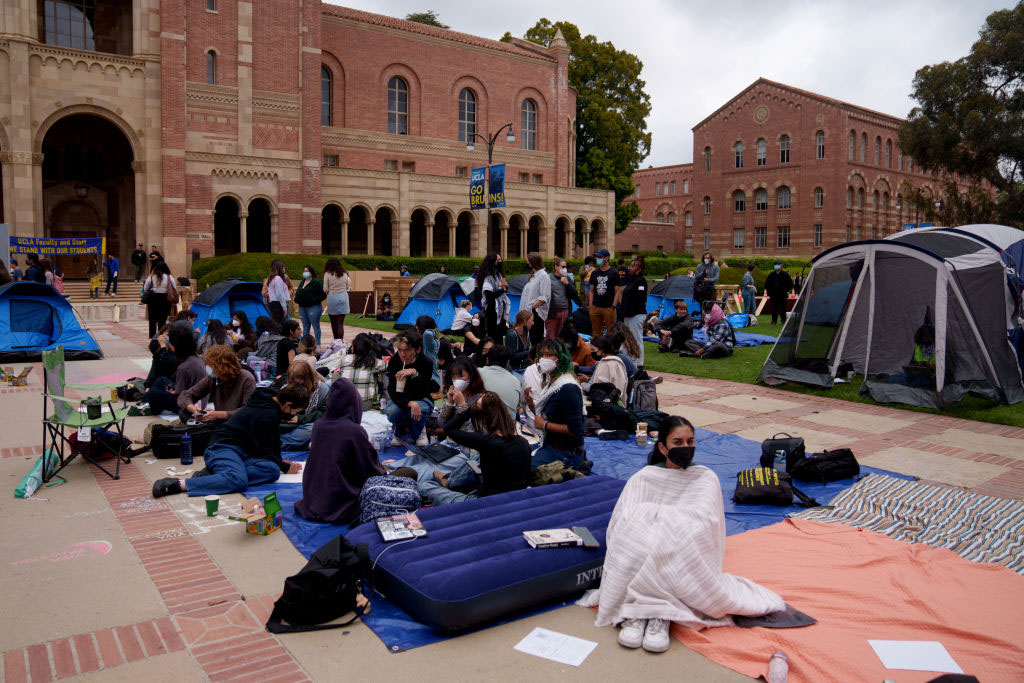
In the wake of a frightening increase in anti-Semitic incidents at the University of California last spring, student governments on 3 UC campuses — UC Berkeley, UCLA, and UC Santa Barbara —unanimously approved resolutions adopting the U.S. State Department definition of anti-Semitism. Soon after the student resolutions were approved, 17 UC student organizations and thousands of UC students, faculty, alumni and community members called on UC President Janet Napolitano and the Board of Regents to adopt the U.S. State Department definition for identifying anti-Semitic behavior and addressing it as all other racial, ethnic and gender bigotries.
Despite widespread support for the State Department definition’s accurate portrayal of contemporary anti-Semitism, there are those who are working feverishly against its adoption at the University of California. Foremost among the definition’s detractors are four avowedly anti-Zionist organizations — Palestine Legal, National Lawyers Guild, Center for Constitutional Rights and Jewish Voice for Peace — each of whom provides considerable legal and material support for anti-Israel campus groups such as Students for Justice in Palestine to engage in activities that promote the dismantling of the Jewish state. In letters and petitions to the UC Regents, these organizations have demanded that the University of California reject any definition of anti-Semitism that acknowledges a connection between anti-Zionism and anti-Semitism.
It is not surprising that those who perpetrate and enable behavior defined as anti-Semitic by the State Department definition would want to ensure that such a definition is not adopted by the University of California. What is surprising is the degree of disingenuousness and cynicism that has accompanied their efforts.
While hiding their own self-serving motivation, these organizations have falsely accused Jewish students of fabricating accounts of anti-Semitism and unfairly accused Jewish groups of promoting the State Department definition simply in order to shut down all criticism of Israel.
Furthermore, these anti-Zionist organizations have spuriously argued that just by virtue of adopting the State Department definition the Regents will be violating the First Amendment rights of “Palestinian human rights activists.” Not only is this patently false — there is nothing remotely unconstitutional about adopting a definition in order to identify and educate the campus community about anti-Semitic bigotry — the UC Regents themselves have a constitutionally protected right to adopt principled viewpoints on matters of important social concern such as this. In fact, if anyone is engaged in violating the First Amendment it is groups like Students for Justice in Palestine, who routinely act to disrupt and shut down pro-Israel student events, thereby depriving Jewish and pro-Israel students of their constitutionally protected freedom of expression.
Finally, those seeking to torpedo the adoption of the State Department definition at the University of California have cynically made anti-Zionist Jews the “poster children” of their campaign. After all, they say, how can anti-Zionism be anti-Semitic if Jews themselves are calling for an end to the Jewish state? The truth is, despite the existence of a small number of strident anti-Zionist Jews, the vast majority of world Jewry affirms the right of the Jewish people to a Jewish state.
The bottom line is this: allowing groups committed to the dismantling of the Jewish state to define anti-Semitism is tantamount to allowing the KKK to define racism, gay bashers to define homophobia, or rapists to define sexual harassment. It is an outrage.
Rossman-Benjamin is faculty at the University of California and the co-founder and director of AMCHA Initiative, a non-profit that combats campus anti-Semitism.





















 More news and opinions than at a Shabbat dinner, right in your inbox.