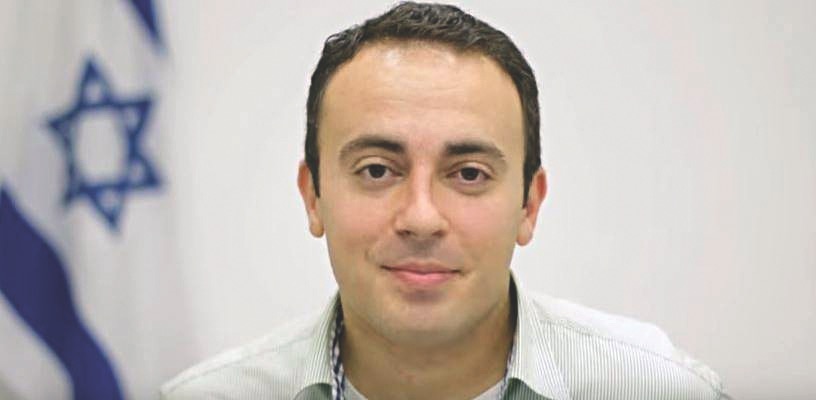
 Mark Halawa
 This is the story of a man born in Kuwait to a Palestinian-Muslim family and who today lives as an observant Jew in Jerusalem.
It is a story of slavery, of exodus and of personal redemption.
Some of the man’s tale has appeared in newspapers and video clips, and he has recounted it to audiences all over the world. But some of the story has been shrouded in secrecy and shame.
Until now.
Mark Halawa has been aware his entire life that he came from Jewish blood. When he was in the Palestinian Boy Scouts burning Israeli flags, or listening to his father rail against the “evil Zionists,” or learning math from a teacher who asked, “If one rocket could kill five Jews, how many rockets will it take to kill 35 Jews?”, he knew his maternal grandmother had been a Jew in Jerusalem. He did not know what that meant until years later when, while studying at the University of Western Ontario in Canada, he met a Jewish professor who told him that it meant he was also a Jew.
The revelation brought with it consternation, intrigue and delight in equal measure.
“I was shocked and interested and happy to belong to a multifaith family. It made me feel cool and special,” he said. “When you grow up with so much anti-Semitism, you have the utmost hate and the utmost curiosity.”
Halawa was full of questions. He began to explore. But he took care not to offend his parents, with whom he was still close. His father, a staunchly secular Palestinian nationalist who in the 1960s helped fund the establishment of the PLO, did not want to hear about it.
“I was so angry, I wanted to tell the whole world my story.” — Mark Halawa
When it came to his mother, Halawa remembered thinking that he would be able to talk with her more openly: “My mother is youthful. She’s funny. I tell her everything.”
He did not tell her, however, that he had moved from Canada to Jerusalem to study Torah at a yeshiva in Jerusalem. At the time, his mother was becoming a more religious Muslim — a move that eventually led his father to divorce her — so in a way she was glad her son had shed his partying “frat boy” lifestyle and was becoming more devout.
“We would speak in broad terms about God and godliness,” Halawa said.
But later, when Halawa was married and had made Jerusalem his permanent home, the gulf widened between his mother’s beliefs and his own.
Things came to a head with the birth of Halawa’s daughter. The happy event came in the wake of the Duma arson attack, which resulted in the deaths of three people, including a toddler. Jewish extremists were suspected of committing the crime.
Halawa sent a photo of his baby girl to his mother. Her response: “I hope she burns along with her mother. Just like those Jews burned that boy.”
That moment broke Halawa. He became deeply depressed, he said. “It burns a hole in my heart, but I don’t want to connect to my mother anymore. She sees my helpless child as an infidel Jew.”
Yet at the same time, the future was suddenly clear. All the ambivalence he had felt about speaking in public was gone. “I was no longer scared,” he said. “I was so angry, I wanted to tell the whole world my story.”
And tell it he did. Halawa made videos in Arabic for the Israel advocacy group StandWithUs that went viral, and he has established a nonprofit for pro-Israel outreach to the Arab world.
“I was enslaved by hate,” Halawa said. “I was under my mother’s thumb, even as a Jew. But that moment when I broke from my mother, I crossed the Red Sea.
“I was finally free.”











 More news and opinions than at a Shabbat dinner, right in your inbox.