Wiping the Smirk Off Smack Talk
I realize there’s a lot going on in the world right now, so it’s easy to get distracted, but would someone please check in on former President Barack Obama. I fear that he must be seriously unwell.
Israel’s pre-emptive attack against Iran nine days ago, and the knock-out punch delivered by the United States early Sunday morning, has left the ayatollahs positively reeling. Obama must be inconsolably bereft. As president, he never met a mullah he didn’t simply adore. It was a little creepy, but most Americans forgave his peculiar predilection.
His one foreign policy achievement was an unmitigated disaster. Billions of dollars of unfrozen funds were awarded to Iran. Economic sanctions lifted. The United States negotiated a bogus “deal” that allowed for Iran to enrich uranium 300 feet below mountainous terrain—for ostensibly “civilian” purposes. Not even inspectors with the International Atomic Energy Commission were given complete access to verify Iran’s compliance.
Energy for commercial use only requires 3 percent to 5 percent enrichment. Weapons grade uranium is enriched at 80 percent. Iran was enriching at 60 percent.
So much for that Nuclear Non-proliferation Treaty. Obama had many talents. Math was not one of them. The full implications of his misjudgment are impossible to calculate, but American soldiers stationed in Iraq, and Israelis before and after October 7, 2023, lost their lives due to terrorist acts undertaken by Iran and its regional proxies.
Donald Trump’s first term in office scuttled the Iran deal. Joe Biden’s foreign policy team—all graduates from the Obama Academy of Clueless Diplomats—lifted sanctions and spent four years begging the ayatollahs to return to the negotiating table. The clerics predictably stalled Biden, all the while tinkering with fissile material.
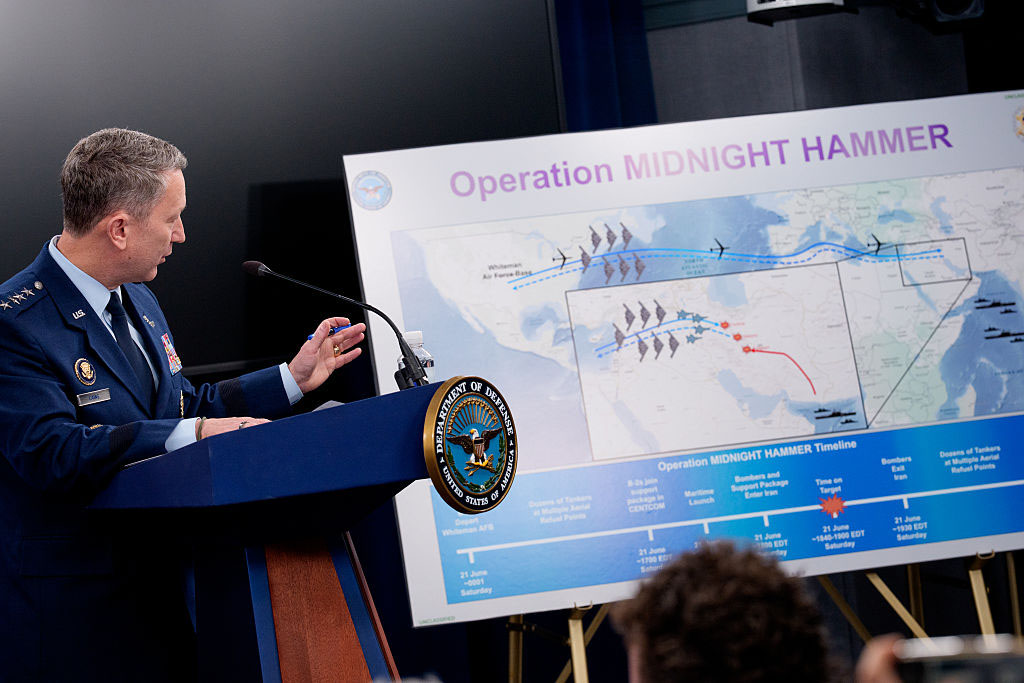
Now that seven B-2 bombers dropped bunker-busting bombs on Fordo and Natanz, and 30 Tomahawk missiles rained down on a third nuclear hideout in Isfahan, the bad faith balking of the ayatollahs may have finally come to an end.
The Israeli Air Force already obliterated Iran’s air defense missile systems, strategic command centers, launching facilities, and drone sites in Tehran, Bushehr, Ahvaz and Yazd. The top echelon of the Iranian Revolutionary Guard Corps are all dead, along with 14 of the regime’s best nuclear scientists.
I’m sure we will soon hear from Obama, Biden, and other Democrats—flaunting the same instincts for appeasement as Neville Chamberlain—roundly condemning Trump’s canny deployment of American might. We’ll hear that the mullahs should have been trusted. The moron wing of the MAGA movement will question America’s self-interest in thwarting Iran’s nuclear aspirations.
Some members of Congress will insist that before undertaking any such action tantamount to a declaration of war, Trump should have first received their approval pursuant to the War Powers Act.
All except that Obama, in 2011, launched 112 Tomahawk cruise missiles aimed at over 20 targets in Libya to end the reign of Muammar Gaddafi. In 1993, President Bill Clinton ordered 23 Tomahawk cruise missiles to strike Baghdad, Iraq in a preview assassination attempt on Saddam Hussein.
Neither of those military actions received prior congressional approval. What’s more, Libya and Iraq never came close to presenting the same threat to American, and worldwide, national security as does Iran. Unless and until Trump orders ground troops to not only change the Iranian regime, but also to rebuild its nation, Congress not need have been consulted beforehand. Talk about ruining a surprise attack.
So far, Trump has done precisely what America’s Commander in Chief and the leader of the free world should be expected to do: exercise the right judgment in the service of both the United States and humankind. Their abject failings are precisely why Obama and Biden never fit the bill.
President Trump and Israeli Prime Minister Benjamin Netanyahu both saw the ayatollahs for what they are: trash-talking theocrats who roguishly financed and fomented terrorism around the world.
The United Nations Charter requires member states to “practice tolerance and live together in peace … as good neighbours,” and “refrain in their international relations from the threat or use of force against the territorial integrity or political independence of any state.”
And, yet, Iran somehow remained a nation in good standing after repeatedly threatening to wipe Israel from the map. Now that smirk has been wiped from their faces.
Iran somehow remained a nation in good standing after repeatedly threatening to wipe Israel from the map. Now that smirk has been wiped from their faces.
A nation that worships the Stone Age finally got its wish. Iran’s military infrastructure is in rubble. The ayatollahs boastingly absorbed America’s first-strike capacity and promised “everlasting consequences.”
Apocalyptic theocrats are not known for their poker faces, or sense of irony. Their terrorist Revolutionary Guards are quaking. Missile stockpiles depleted and production facilities out of commission. Launching sites, annihilated. Fighter jets that never left the tarmac. Nuclear ambitions, now buried and impassable.
All that’s left is global terrorism—something the Western world now must take very seriously.
If Iran continues firing rockets at Israeli population centers (indisputable war crimes that seem of little interest to the global community), then the Jewish state will rightly see that as an invitation to collapse the remaining guardrails keeping the mullahs in power.
The assistance of the United States will no longer be necessary. Fear that America’s involvement in Israel’s final Middle East battlefront might set off World War III, or embroil the United States in yet another “forever war,” is more science fiction than realpolitik.
Israel was already at the 5-yard-line. America’s bunker busters merely punched this war over the goal line, allowing President Trump, like Harry Truman who once brought Japan to its heels, to relish an endzone celebration.
The Persian Gulf nations, along with honest brokers within the European Union, realize that Israel, aided by the United States, has done everyone a massive favor. Soon they will admit it, privately, at first. Eventually, Iran’s absence as a menace will be widely felt.
The Persian Gulf nations, along with honest brokers within the European Union, realize that Israel, aided by the United States, has done everyone a massive favor. Soon they will admit it, privately, at first. Eventually, Iran’s absence as a menace will be widely felt.
In the polarized United States, however, among Blue State coastal elites and anti-American academics who have co-opted its universities, if it originates from the Trump White House, it can’t be good. Not only must it be denounced, it must serve as an impeachable offense.
With the fear of ballistic missiles on their collective brains, Israelis went from the Iron Dome to Iran being effectively done. Quite a dizzying turnaround. What might be even more improbable to imagine, notwithstanding the global significance of Iran’s fall, is a Nobel Peace Prize with Trump’s name on it.
Such a Norwegian gift is not entirely undeserved. It might correct for the one prematurely given to Obama.
Wiping the Smirk Off Smack Talk Read More »