The Deplorables: The Movie
It’s officially summertime, and with COVID-19 waning across the country, the annual ritual of the summer blockbuster movie is upon us. Remember “Jaws,” “Ghost Busters,” and “Batman”? Can such summer fun be revived?
America, after all, has become an increasingly divided nation. Consensus is no longer our strong suit—if it ever was. And all those differing opinions suggests that we have fewer things in common. Red and Blue states, those with coastal views and urban streets, are cut-off, emotionally, from the rural heartland. The politics of identity segregates by color, gender and sex, leaving Caucasian whiteness with a permanent stain.
What once entertained us is now off-color, if not downright racist in this more touchy, sanctimonious and humorless America. Baseball is no longer our national pastime. And who eats hot dogs and apple pie anymore?
But surely feature films still unite us, those moving pictures that depict who we are, or wish to be, or obsessively dread, at any given moment in time.
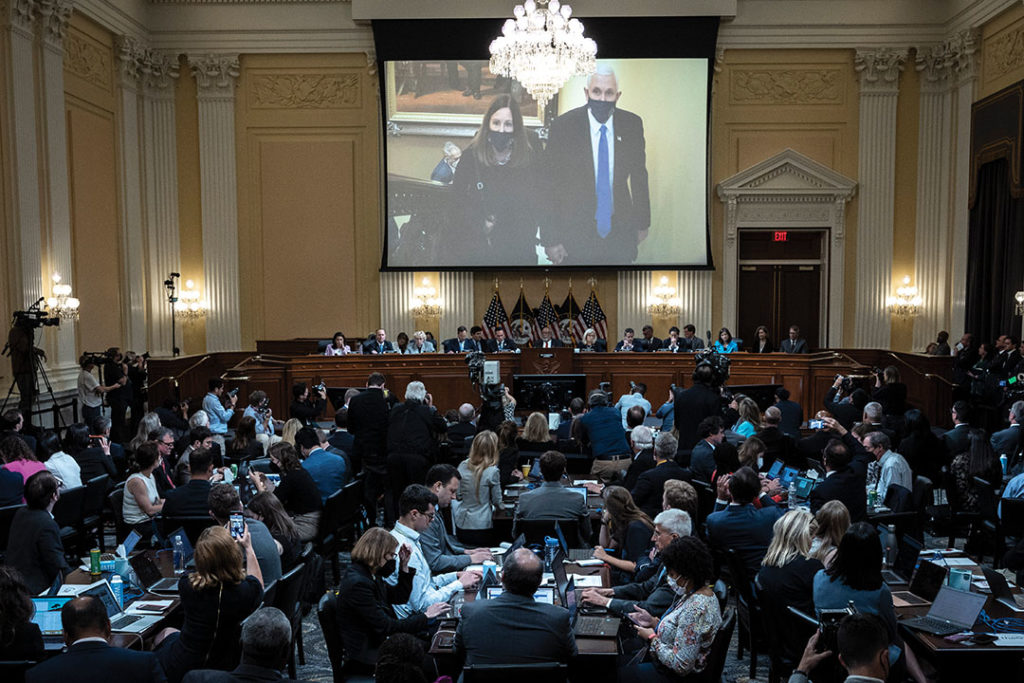
There’s a movie being screened in our nation’s capital right now. It’s premiering not in cinemas but in the Capitol building itself. We all received a sneak peek on prime-time television during the opening session of the Select Committee hearings to investigate the January 6th Insurrection.
What we saw was a trailer about American trailer trash—call it the “The Deplorables,” the movie.
Yes, what began as Hillary Clinton’s contemptuous dig at Donald Trump’s core supporters is receiving a sequel in Congress. The Democratic Party, after all, is led these days by shrieking progressives who simply can’t resist demonizing and hectoring half the county.
With few taking notice, moral superiority graduated from college and now permeates public life. It’s not a good look.
“The Deplorables” is a graphic, R-rated showcase of some of the more appalling moments of the Oath Keepers and Proud Boys laying siege to the Capitol on January 6th. And we hear a number of them betray their ignorance of basic American civics and the gullibility that compelled them to smash windows in the “People’s House” in order to “Stop the Steal.”
Slickly produced, cynically edited, think of the movie as a cross between “Deliverance” and a reimagining of “Saving Private Ryan.” Its cast of characters largely lacks, well, color, and ethnicity. It is regionally represented by the interior, and comprised of a demographic loathed by Blue State Democrats and Late-Night Talk Shows, alike—the butt of jokes about beer cans, NASCAR, country music, fornicating cousins, and white nationalism.
Needless to say, no one in the movie has any desire, or hope, of applying to Brown University. And no Ivy League school believes that “Diversity and Inclusion” should apply to them.
So, essentially, “The Deplorables” once more depicts how the self-proclaimed cultural elite feels about their political enemies. (An actual movie, “The Hunt,” a political satire in which “liberal elites” hunt down Republicans for sport, was mercifully shelved by a major studio.).
Those who compulsively find themselves needing to deplore Trump voters should realize that they are engaging in a pernicious form of “white-race baiting.” Aside from moral qualms, they should have political ones, too. There’s no better way to galvanize Red State voters to turn out to the polls than by treating them as American doormats.
Of course, like all Hollywood movies, “The Deplorables” has fantastical elements that overshadow truthful ones. Much of the January 6th story was left on the cutting room floor.
There were over 30,000 protestors at the Ellipse on that day to hear President Trump and others speak. Only 800 were arrested, indicted and imprisoned for unlawfully entering the Capitol—the vast majority of whom were unaffiliated with any group. It was the least well-planned insurrection in history. All those unarmed amateurs clearly were not involved in a conspiracy to overthrow the government. They didn’t know each other beforehand.
“The Deplorables” highlights the Oath Keepers and Proud Boys—sparsely represented though they may have been—because they were the only ones who could be prosecuted for seditious conspiracy. Well over 600 were charged with the lesser felony of criminal trespass.
But the 30,000 who lawfully assembled at the Ellipse committed no crimes at all. Most had served in the military and saw themselves as patriots who stood in line to vote on election day with their government-issued IDs, and wondered about those tens of millions of absentee votes in battleground states that apparently were subject to less rigorous verification.
Slogans such as “The Big Lie” and “Insurrectionists” simply do not fairly describe most of those who traveled to Washington, D.C. on January 6th. And it’s precisely those people who received no screen time in “The Deplorables.”
A more responsible, dignified president wouldn’t have spoken at all that day. But he, too, had a right to free speech.
The film also omits the moment when President Trump told the demonstrators, “I know that everyone here will soon be marching over to the Capitol building to peacefully and patriotically make your voices heard.” A more responsible, dignified president wouldn’t have spoken at all that day. But he, too, had a right to free speech. And those words did not meet the legal standard required of incitement.
Everything about the Trump presidency was boorish, guttural, impulsive and reckless, but that didn’t make it illegal—as the Mueller Report, instigated by the Steele Dossier, and two Senate Impeachment Trials, demonstrate. (A charge of obstruction of an official proceeding is still possible, however.)
Tens of millions of dollars were spent on those proceedings. Now American taxpayers helped finance a film with dazzling special effects, and costly days of congressional hearings, all for the ostensible purpose of finally indicting and imprisoning a former president so that he will be barred from public life.
Hollywood types know that because “The Deplorables” got made, other plotlines will never go into production: Hunter Biden’s influence peddling, the real estate holdings of Black Lives Matter moguls, the spike in crime and the refusal of prosecutors to incarcerate repeat offenders, and the erosion of public trust when police precincts burn and civilized values are so casually trampled upon.
Even true deplorables can recognize a double standard: the January 6th rampage is deserving of solitary confinement; post-BLM violence is merely just deserts.
The Presidency is Oscar time in American electoral politics. For those who don’t wish to see Donald Trump riding off into the sunset on his way back to the White House, it’s time to start watching a different movie.
Thane Rosenbaum is a novelist, essayist, law professor and Distinguished University Professor at Touro University, where he directs the Forum on Life, Culture & Society. He is the legal analyst for CBS News Radio. His most recent book is titled “Saving Free Speech … From Itself.”
The Deplorables: The Movie Read More »