
 Screenshot from Twitter.
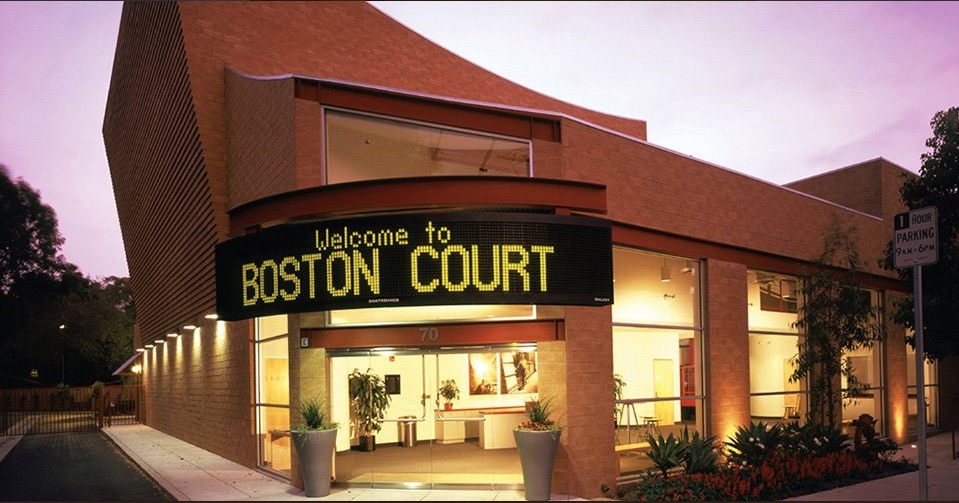
 Although it begins with a classic major score by a non-Jew, three upcoming concerts at Boston Court Performing Arts Center in Pasadena definitely make for “a Jewish weekend,” according to Mark Saltzman, artistic director for the music series at Boston Court.
The shows begin Oct. 27, when pianist Susan Svrcek leads a performance of French composer Olivier Messiaen’s “Quartet for the End of Time” for piano, clarinet, violin and cello. The 1941 score, composed in a Nazi prisoner of war camp after France fell, received its premiere outside, in the rain, with Messiaen’s fellow prisoners playing whatever instruments they could find.
“It’s an example of the universal human spirit,” said Saltzman, 60, who served as cantor for 18 years at Congregation Kol Ami in West Hollywood before becoming artistic director. “Messiaen, experiencing loss, showed a spirit that can triumph over adversity.”
“It’s an example of the universal human spirit.” – Mark Saltzman
Triumphing over adversity, then and now, is one of the themes of pianist and Jewish music scholar Neal Brostoff’s concert on Oct. 28. It features forgotten or underperformed works by Jewish-Polish composers like Alexandre Tansman, Mieczyslaw Weinberg, Szymon Laks and Jerzy Fitelberg.
“The Nazis tried to annihilate not just Jews but also our culture,” Brostoff said. “But the unexpected post-Communist renaissance of Jewish culture in Poland continues to find its most eloquent voice in music.”
Like Saltzman, Brostoff also includes works by non-Jews — Krzysztof Penderecki’s Sextet for Piano, Woodwinds and Strings, and Frederic Rzewski’s set of variations on a theme from the Yiddish folk song “Mayn Yingele.”
“Like the other composers on the program,” Brostoff said, “Rzewski’s piece connects us to a culture that refuses to be extinguished.”
Brostoff’s concert also features the visiting Cracow Duo — Jan Kalinowski on cello and Marek Szlezer on piano — along with the New Zimro Ensemble, a collective of UCLA music students and recent graduates dedicated to nurturing the resurgence of music composed during and after the Holocaust.
Noreen Green, artistic director and conductor of the L.A. Jewish Symphony, will feature a group of the ensemble’s chamber players in a program called “Klassics to Klezmer” on Oct. 29.
Green said the L.A. Jewish Symphony Chamber Players, who include members of the L.A. Philharmonic and L.A. Opera orchestras, also will feature a soprano and “some surprises.” Usually reserved for private fundraisers, the Jewish Symphony’s chamber configuration is being seen in a public concert for the first time.
“I’ve been blown away by Boston Court’s acoustics and the intimacy of the space,” Green said, referring to the art center’s 80-seat concert hall and 99-seat main stage. Saltzman chooses halls depending on the concert and availability.
Saltzman has been singing in synagogues since he was 10 years old. “I started in a very small synagogue in Barstow, in the middle of the Mojave Desert,” he said.
A trained classical singer and cellist, Saltzman studied at UC Irvine and Hebrew Union College-Jewish Institute of Religion. He said he’s especially proud of the hall’s acoustics and “the tremendous amount of new work we do.” Boston Court is presenting about 35 concerts this season.
“Acoustically, our hall has the same sound quality as La Scala in Milan,” he said, referring to the famous Italian opera house. “It’s a very clear, precise and vibrant sound.”
Saltzman has worked to transform the compact venue into an adventurous hall for showcasing new and underperformed music. Baritone David Childs, 23, who is a cantor’s son, kicked off Boston Court’s new “Emerging Artists” program earlier this month. Other rising stars, like 22-year-old violinist Blake Pouliot, also have appeared there.
Since Boston Court is a nonprofit, Saltzman joked that top-tier and rising young artists don’t perform there for the fees.
“They come because they are treated so well,” he said. “They also come because they can communicate best the most intimate parts of themselves — things they can’t do in a big space. At Boston Court, they’re comfortable enough to take risks.”
For more information on the concerts, visit bostoncourt.com.

















 More news and opinions than at a Shabbat dinner, right in your inbox.